Sudipta Fitness · Online nutrition & weight-loss coaching · Meta Ads (Facebook & Instagram) · 2026
How Sudipta Fitness cut cost per lead by 96% and still grew volume 42×
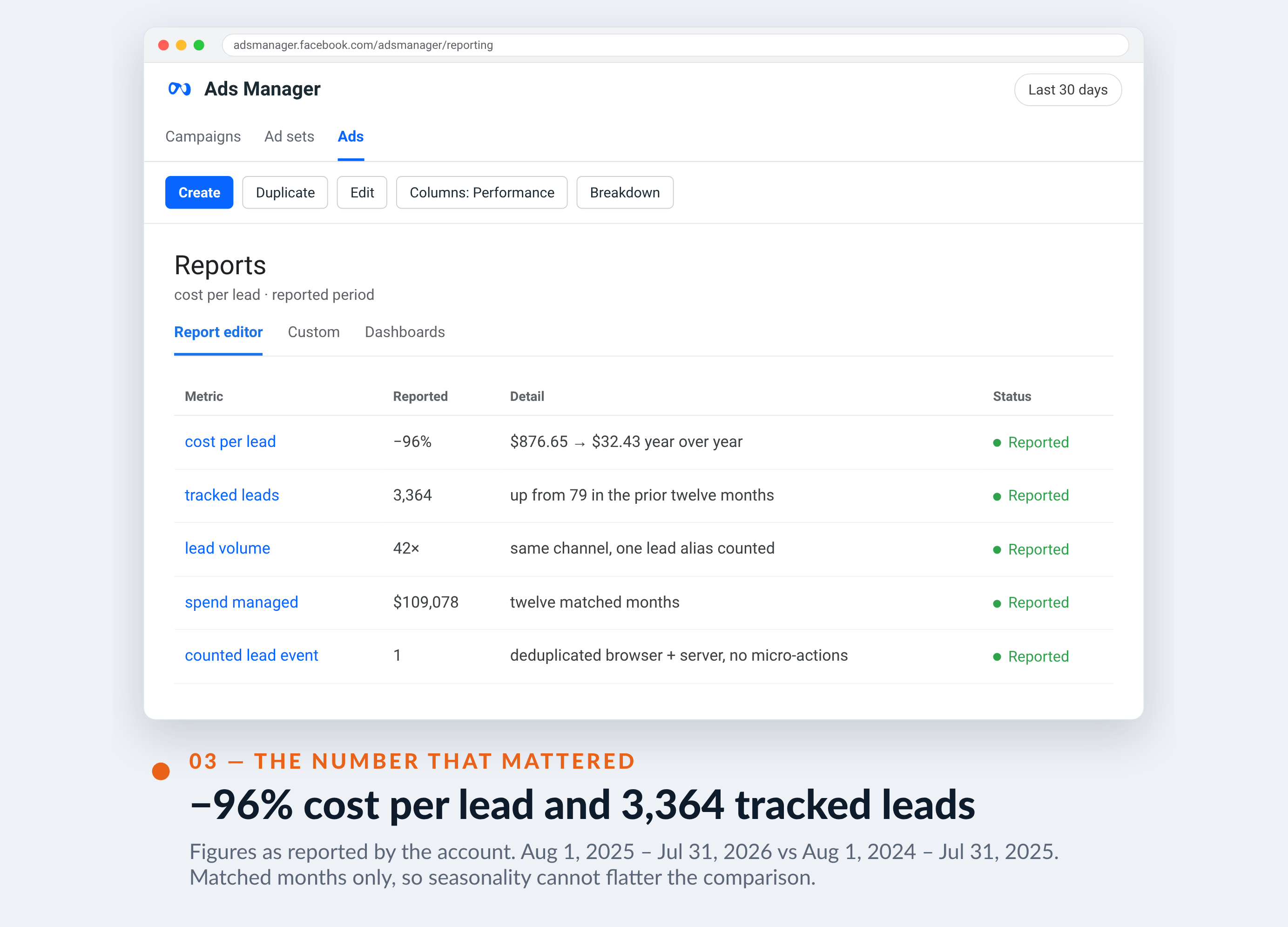
Almost every account can buy more leads or cheaper leads. This one did both at once: 79 leads a year became 3,364, and the price of a lead fell from $876.65 to $32.43.

$32.43
cost per lead
down from $876.65 year over year
The results, up top — every number is in the strip below
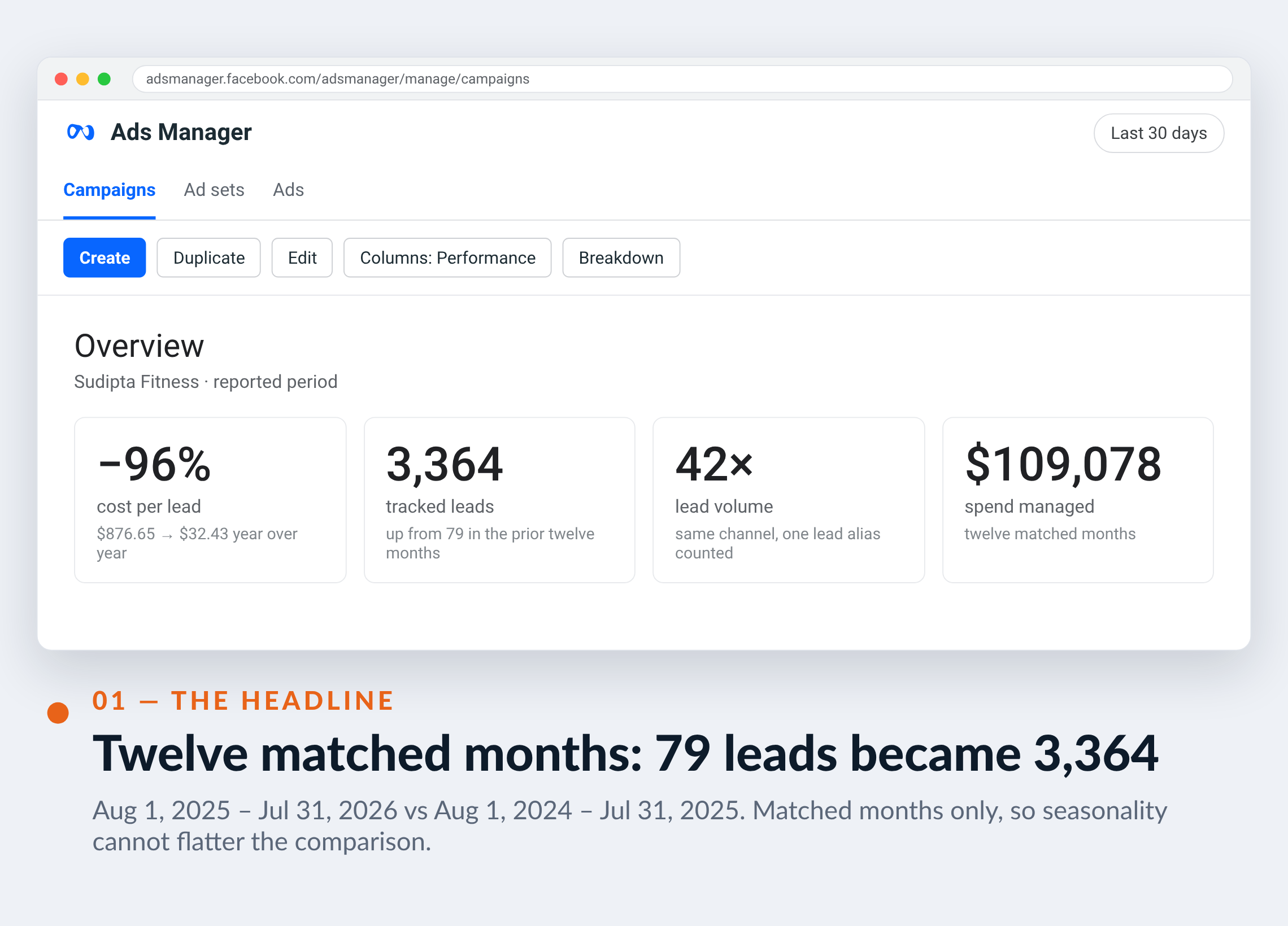
−96%
cost per lead
$876.65 → $32.43 year over year
3,364
tracked leads
up from 79 in the prior twelve months
42×
lead volume
same channel, one lead alias counted
$109,078
spend managed
twelve matched months
1
counted lead event
deduplicated browser + server, no micro-actions

01 — The challenge
A credentialed practitioner with an unaffordable acquisition cost.
Sudipta Fitness is the practice of a certified nutritionist and holistic health practitioner, selling structured programmes — weight loss, detox, prepartum and postpartum nutrition — that begin with a consultation. The product is the practitioner, and the buying decision is personal rather than comparative.
The offer worked. The Meta account did not: in the prior twelve months it recorded 79 tracked leads at an average cost of $876.65 each. At that price no coaching practice closes profitably, because the lead cost alone exceeds most programme prices. The account was not short of budget; it was short of signal. A pixel firing on the wrong event, an intake form nobody could finish and creative that argued rather than demonstrated will produce exactly this number no matter how much money you feed them.
“I was convinced Facebook simply did not work for a practice like mine. What actually happened is that we were paying for the wrong action and never knew it — and once the right one was being counted, the same budget started returning enquiries I could actually call.”
That is the most common version of “ads don’t work for us”: the channel is fine, the measurement is not. Nothing else on this page would have mattered if the account had kept optimising toward an event that was not a lead.
02 — Our approach
Fix what is being counted, then let the algorithm do its job.
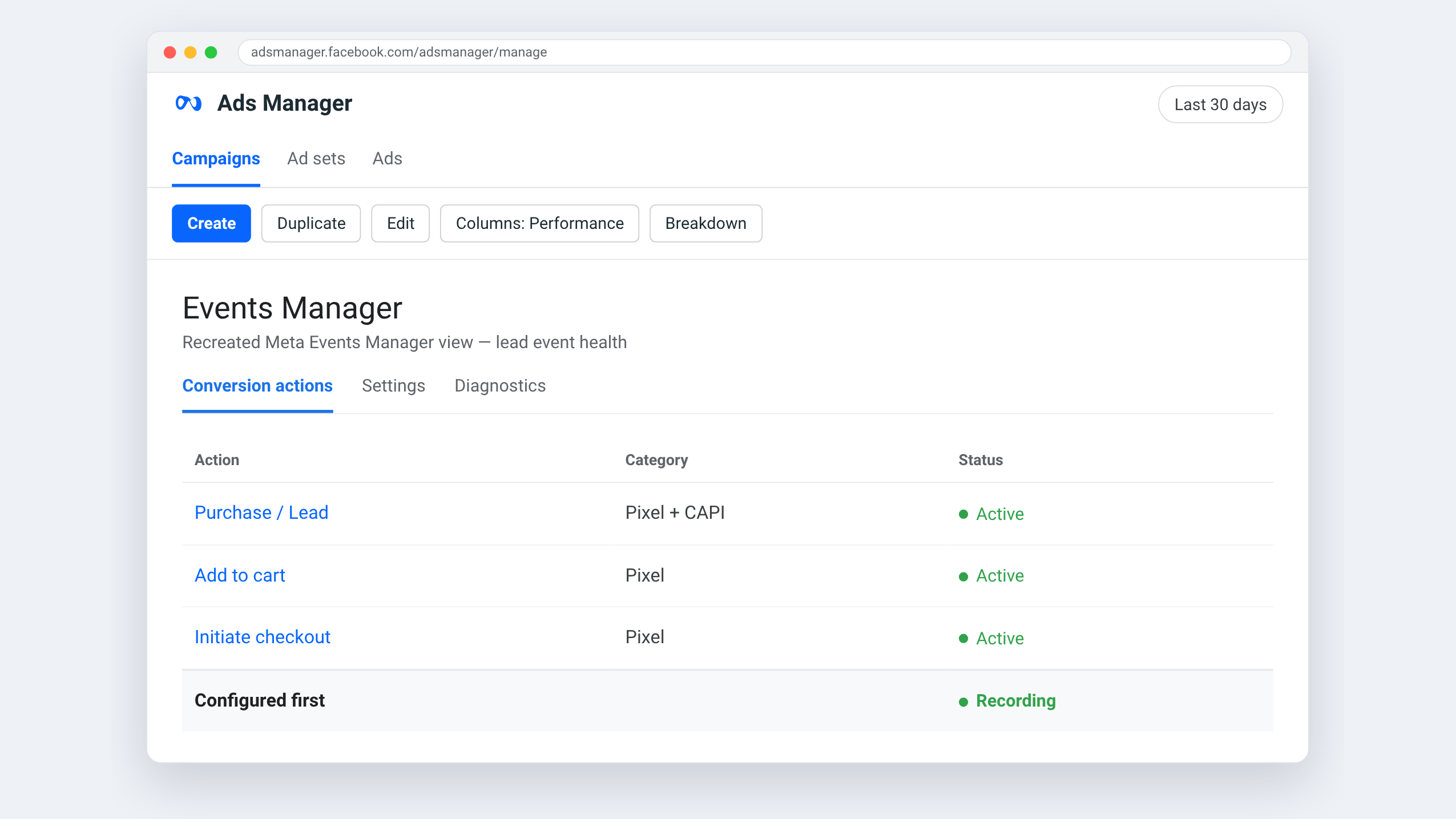
The first work was measurement, not creative. The lead event was rebuilt so one submitted enquiry equalled exactly one counted lead, deduplicated across browser and server, and stopped every adjacent action — clicks on the form, partial submissions, page views of the thank-you screen — from being counted as a conversion. Every figure on this page uses that single lead alias.
Second came consolidation. A handful of small ad sets each learning from a few conversions a month never leaves the learning phase. Fewer, broader ad sets meant one learning system fed by all the signal instead of six starved ones.
Third, what the creative had to do changed. A nutrition practice is sold by proof and by the practitioner: client outcomes, plans explained, the nutritionist speaking to camera. Concepts shipped on a rolling schedule, each entering against a named control, and retired them on evidence of fatigue rather than on a calendar.
Fourth, the intake was made to do less work — fewer fields, a clearer promise, and a follow-up that reached the enquiry while intent was still warm.

03 — What we did
Measurement, consolidation, proof-led creative, then scale.
In that order, because each step made the next one cheaper.
Measurement
Rebuilt the lead event so one enquiry equalled one lead
Server-side and browser events were deduplicated and every adjacent micro-action was removed from the conversion set. Optimising toward a clean lead is the single change that moved cost per lead most.
Account structure
Collapsed fragmented ad sets into a few high-signal ones
Consolidation gave the delivery system enough conversions per ad set to exit the learning phase and stay out of it, which is what allowed spend to rise without cost per lead following it up.
Creative
Proof and practitioner, on a rolling test schedule
Client outcomes and to-camera explanation replaced generic promotional creative. Each new concept ran against a named control and was retired on fatigue signals, not on a fixed monthly refresh.
Funnel
Shortened the intake and warmed the follow-up
Fewer fields, a clearer promise on the landing step and a faster follow-up meant more of the paid clicks turned into enquiries the practice could actually reach.

04 — The results
Twelve matched months: 79 leads became 3,364.


The stack we ran it on

Meta Ads Manager
Paid social
Meta Conversions API
Tracking
Meta Events Manager
Tracking

GA4
Analytics

Google Tag Manager
Tracking

Canva
Creative

AgencyAnalytics
Reporting
Looker Studio
Dashboards















































Farrukh Ahmed CPA — Local SEO launch
position 50 → 17 · +166% desktop map impressions





Food Allergy Institute — Paid media and booked consultations
243 → 1,012 consultations/mo · cost per landing page view −30%





























































National Consumer Panel — UGC-driven acquisition & paid media
CPI −30% · CPA −20%


National Debt Relief — UGC, performance creative & influencer strategy
CVR +25% · CAC −30%






New Balance — Casting, post-production & influencer marketing
7 athletes · 750k audience














































"Their transparency, attention to detail, and collaborative approach made them feel like an extension of our own team."


.webp)
.webp)