Systems that do the follow-up.
do the follow-up
We are the marketing automation agency for teams whose platform costs a fortune and sends four emails a month. We connect the data, design the journeys that carry the revenue, and hand back a system your own team can change — with CRM analytics, email marketing and measurement support when the reporting has to hold up in a board meeting.






Tell us a little about your brand and we'll be in touch within 24 hours to lock in a time.



THE FOUR WORKSTREAMS
Data, journeys, content, governance.
Data, journeys
Automation fails for boring reasons: the data is wrong, the journey was never designed, nobody wrote the content, or twelve half-built workflows are quietly fighting each other. Each of these four workstreams has an owner and a number we review.
Data foundation
Journey design and build
Content and personalisation
Governance and measurement
Nothing automates around bad data.
Every automation is a decision made without a human in the room, so it inherits whatever your data believes. We start by mapping what exists: which systems hold the customer record, which fields are trusted, where duplicates come from, what the lifecycle stages actually mean, and which of them anybody maintains.
Then we build the foundation: a single definition per field, deduplication and normalisation rules, the integrations between website, CRM, commerce, support and billing, consent captured and stored per channel, and event tracking so behaviour is available to a workflow rather than trapped in an analytics tool. Access is the constraint most teams underestimate — Salesforce's tenth State of Marketing report found only 58% of marketers have complete access to service data, 56% to sales data and 51% to commerce data, which is precisely the context a good journey needs.
None of this is glamorous and all of it is why one team's automation compounds while another's sends the same discount to a customer who already bought.
- Field-by-field data dictionary agreed with sales and service
- Deduplication, normalisation and ownership rules
- Integrations to CRM, commerce, support and billing
- Consent captured and stored per channel
- Behavioural events available to workflows, not just dashboards
58%
of marketers have full access to service data (Salesforce)
51%
have complete access to commerce data
Designed on paper before it touches the platform.
We map the journey as a customer experiences it: what triggers entry, what the person is trying to do, what we know at that moment, what a helpful next message would be, and how they leave. Only then does anything get built, which is why our workflows are readable six months later by somebody who was not in the room.
The set that earns its keep is fairly consistent: onboarding that gets a new customer to first value, lead nurture driven by sales stage rather than a content calendar, abandonment and browse recovery, post-purchase and replenishment, renewal and winback, reactivation, and internal alerts that put a human in front of a hot account. Every journey gets branching on behaviour and value, frequency caps, quiet hours and an exit condition.
The prize is efficiency rather than volume. Omnisend's 2026 report found automated messages making up 2% of sends while producing 30% of email revenue, at 16 times the revenue per send of scheduled campaigns — timing beats broadcasting.
- Journeys mapped and approved before anything is built
- Onboarding, nurture, recovery, renewal, winback and alerts
- Branching on behaviour, value and lifecycle stage
- Frequency caps, quiet hours and exit conditions on every flow
- Documented so your team can edit without us
30%
of email revenue from automations that are 2% of sends
16x
more revenue per send than scheduled campaigns
Relevance beats another rule.
Most automation programmes stall because nobody wrote the messages. A beautifully branched workflow carrying three generic emails performs like three generic emails, and customers can tell. Salesforce found 84% of marketers admit to running generic campaigns and 98% hit barriers to personalisation, with data quality the usual culprit.
So we treat content as part of the build, not a hand-off. Messages written in your voice for each stage and segment, modular blocks so a variant does not need a developer, dynamic content driven by fields we trust rather than every field available, and a preference centre that lets people choose topic and cadence instead of guessing on their behalf. Where AI helps — drafting variants, summarising behaviour, routing — we use it with a human approving what goes out.
Personalisation stops where it starts feeling like surveillance. We use context a customer would expect you to have, and we say no to the rest.
- Copy written per stage and segment, in your voice
- Modular blocks your team can assemble without a developer
- Dynamic content driven only by fields we trust
- Preference centre for topic and frequency
- AI-assisted drafting with human approval before send
84%
of marketers admit their campaigns are generic
98%
hit barriers to personalisation, mostly data quality
One owner, one log, one number.
Automation estates rot quietly: a workflow built for a campaign two years ago still runs, two flows send on the same trigger, a field gets renamed and three journeys silently stop. So governance is part of the service rather than an afterthought. Every workflow has an owner, a purpose written in one sentence, a review date and a change log, and we run a quarterly audit that switches off what no longer earns its place.
Measurement follows the same discipline. We report what each journey contributed — entries, completion, influenced pipeline or revenue, and where it leaks — alongside the operational numbers that predict trouble: deliverability, error rates, records failing validation, and how many contacts are sitting in a stage nobody moves. Holdouts settle the credit argument where the volume supports them.
Adoption is the last piece and the one that decides whether any of it lasts: training, documentation and a runbook, so the platform is not a black box only the agency understands.
- Every workflow owned, described and dated
- Quarterly audit that retires what no longer earns its place
- Per-journey contribution and leak points reported
- Operational alerts: errors, validation failures, stalled stages
- Training, documentation and a runbook handed over
47%
of marketers say they are leveraging automation (HubSpot 2026)
42%
more likely to respond to customers when data is unified
of B2B companies run a dedicated automation platform (Ascend2)
months median time-to-value on a new platform (Ascend2)
Journeys approved on paper before anyone builds them
The platform, workflows and documentation
We made the difference for those brands

B2B software, fintech, insurance

Consumer tech and platforms

Home essentials, appliances, kitchen & pet

B2B software, fintech, insurance

Beauty, personal care & wellness

B2B software, fintech, insurance

B2B software, fintech, insurance
Travel & mobility

Food & beverage

Beauty, personal care & wellness

Healthcare & regulated services

Home essentials, appliances, kitchen & pet

Home essentials, appliances, kitchen & pet

B2B software, fintech, insurance

Creative, content, arts & culture

Apparel and lifestyle

Food & beverage

B2B software, fintech, insurance

Travel & mobility

B2B software, fintech, insurance

Beauty, personal care & wellness

Home essentials, appliances, kitchen & pet

Home essentials, appliances, kitchen & pet

Creative, content, arts & culture

Travel & mobility

B2B software, fintech, insurance

Home essentials, appliances, kitchen & pet

Consumer tech and platforms

Food & beverage
Creative, content, arts & culture

Creative, content, arts & culture

Beauty, personal care & wellness
01 — The challenge
An expensive platform sending four emails a month.
The licence renews every year, the implementation partner left after go-live, and what remains is a newsletter, a welcome email written before the rebrand, and forty half-built workflows nobody dares switch off. Sales says the leads are cold, marketing says the CRM data is wrong, and both are partly right.
“We are paying enterprise money to send a monthly newsletter.”
It is a common place to be rather than a failure. Salesforce's survey of nearly 4,500 marketers found 83% saying customers now expect two-way conversations while 69% struggle to respond promptly, and the barrier is usually disconnected data rather than effort. Fix the foundation, design a handful of journeys properly, and the platform you already own starts paying for itself.
02 — Our approach
Fix the data, design the journeys, hand back the keys.
We start with an audit of the estate: what is running, what it was for, what it touches, and which data it trusts. That produces a short list of journeys worth building and a longer list of workflows worth retiring. Then we build the foundation — field definitions agreed with sales and service, deduplication, integrations to CRM, commerce, support and billing, consent per channel, and behavioural events available to workflows. Journeys are mapped on paper and approved before anything is built, then constructed with branching, frequency caps, quiet hours and exit conditions, and populated with copy written for each stage rather than borrowed from the newsletter. Every workflow gets an owner, a one-sentence purpose and a review date. Finally we measure honestly: contribution per journey, leak points, operational alerts, and holdouts where volume allows. Then we train your team and hand over the documentation, because a system only the agency understands is a liability.
03 — What we did
Four phases, and the platform starts paying.
Audit, foundation, journey build, then governance — the first two are unglamorous and decide whether anything after them works.
Weeks 1-2 / Audit
Map what is actually running
Every workflow, integration and field inventoried, with what to keep, what to rebuild and what to switch off.

Weeks 2-5 / Foundation
Agree the data, then connect it
Field definitions, deduplication, integrations to CRM, commerce and support, consent per channel, behavioural events.

Weeks 4-10 / Journeys
Design on paper, then build
Onboarding, nurture, recovery, renewal and winback built with branching, caps, exits and copy written per stage.

Ongoing / Governance
Own it, measure it, keep it clean
Owners and review dates per workflow, contribution reporting, operational alerts, training and a quarterly audit.

WHAT YOU GET
Deliverables that stay in your platform.
stay in your platform
Everything below is built inside the tools you already license, documented as we go and handed over in full.

Automation estate audit
Every workflow, integration and field inventoried, with a ranked plan of what to keep, rebuild or retire.

Data model and integrations
Field definitions, deduplication rules and connections to CRM, commerce, support and billing that survive a rename.

Journey maps and builds
Onboarding, nurture, recovery, renewal and winback designed on paper, built with branching, caps and exit conditions.

Content and templates
Copy written per stage and segment, in modular blocks your team can assemble without a developer.

Scoring and routing
Lead scoring built from behaviour that predicts revenue, with routing and alerts your sales team actually acts on.

Reporting and enablement
Per-journey contribution, operational alerts, plus training, documentation and a runbook for your team.
HOW WE WORK
Operating standards, not promises.
Operating standards


B2B
Nurture and scoring driven by sales stage and real buying signals, with alerts sales acts on.
ExploreeCommerce
Recovery, replenishment and winback journeys tied to product, margin and purchase cycle.
ExploreSaaS and subscription
Onboarding to first value, expansion prompts and renewal journeys driven by product usage.
Explore

















Built on trust. Proven by results.
We partner with SMBs and Fortune 500 companies to deliver more than reach — we bring clarity, execution, and measurable outcomes. Every successful partnership starts with a strong culture fit and a shared drive to grow.






CASE STUDIES
Case studies
Website Portfolio
Video Ads
Static Ads















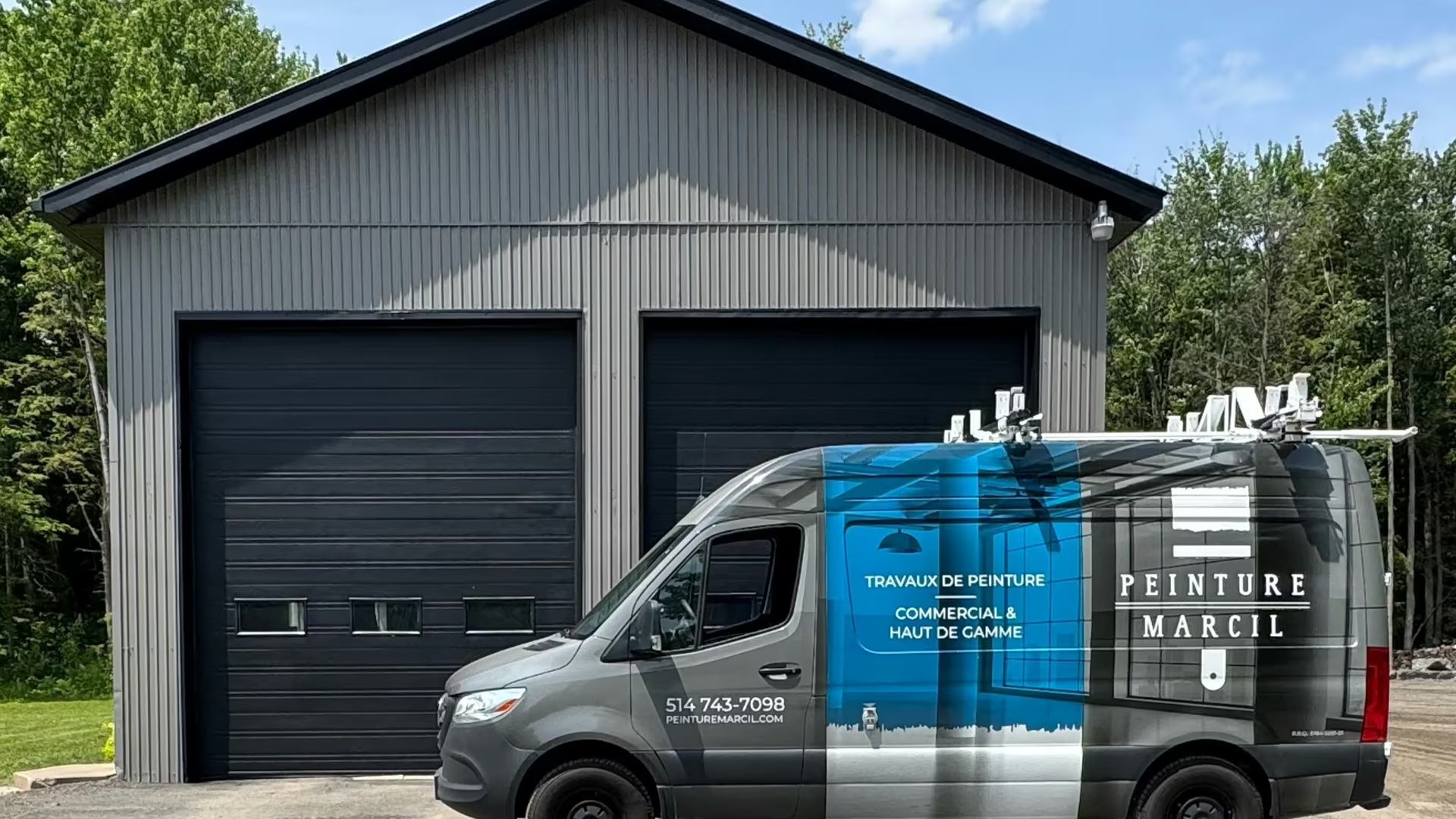
























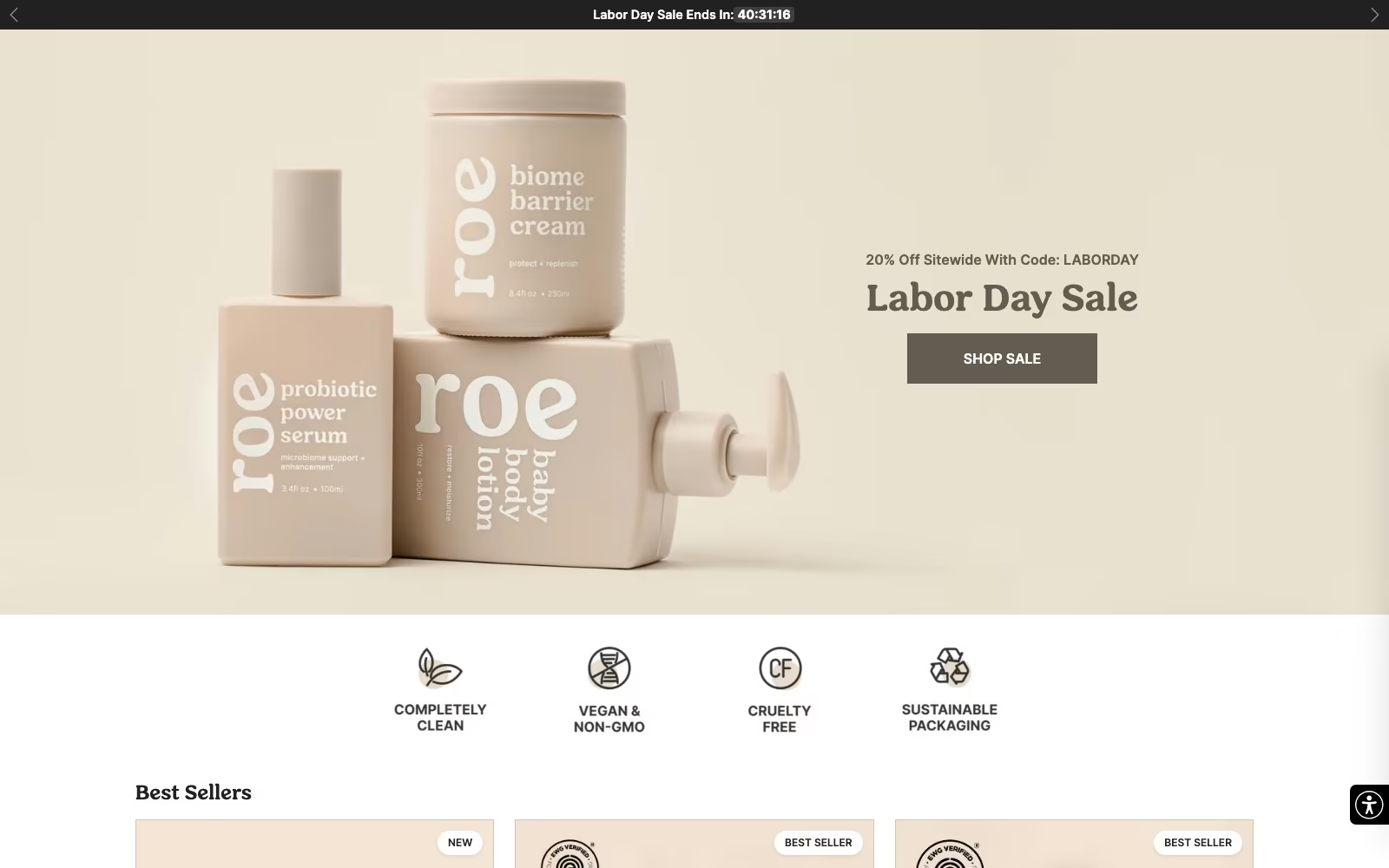

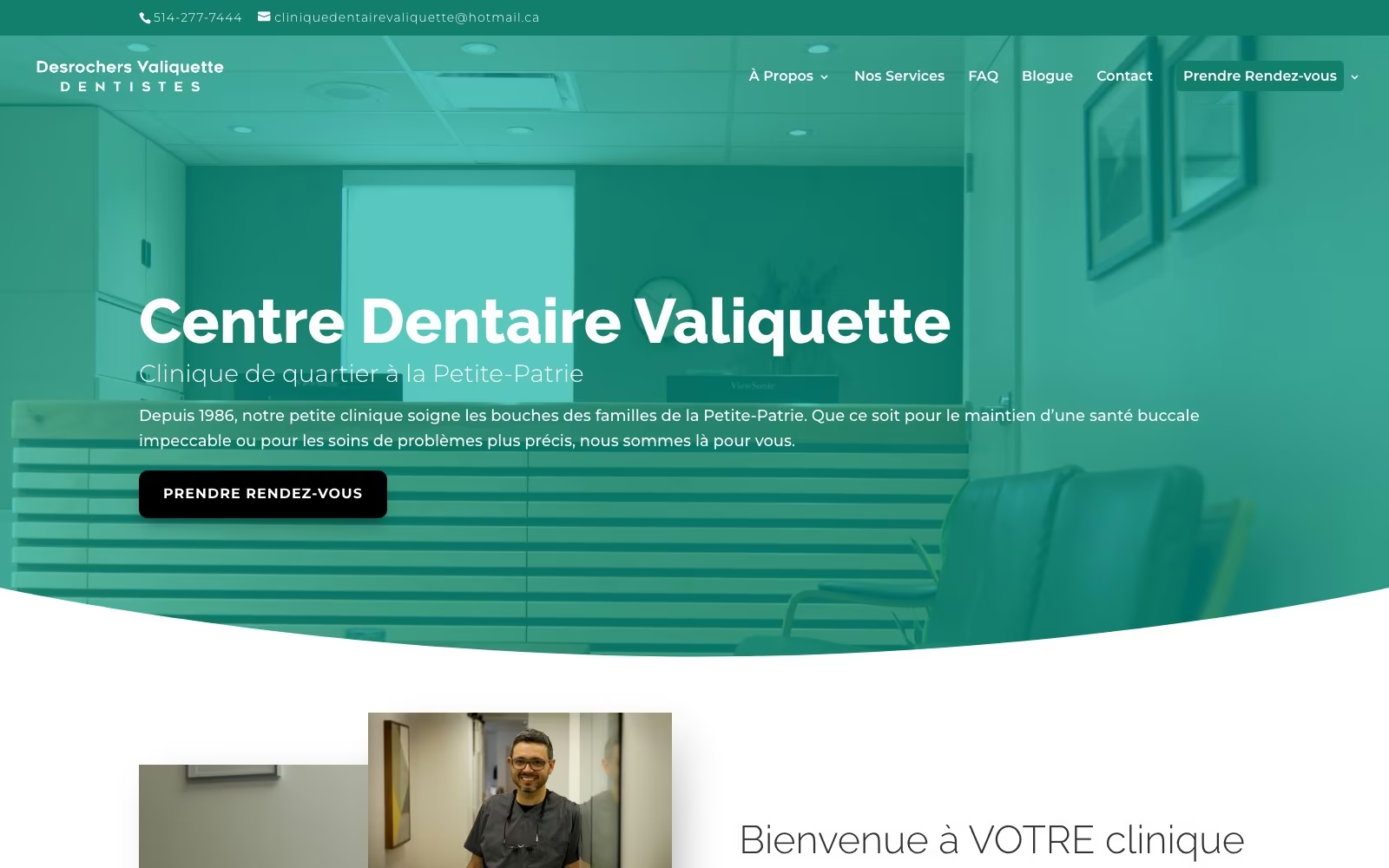



























FAQ
What teams ask us first.
What does a marketing automation agency actually do?
Four things that only work together. It fixes the data foundation, because every automated decision inherits whatever your records believe. It designs and builds the journeys — onboarding, nurture, recovery, renewal, winback — on paper first and in the platform second. It writes the content those journeys carry, which is the step most stalled programmes skipped. And it governs the estate: owners, review dates, retirement of dead workflows, and reporting on what each journey contributed. The output is a documented system your team can run, not a dependency on us.
How long does an automation programme take?
The audit takes a fortnight and usually pays for itself in what it switches off. The data foundation and integrations run two to five weeks depending on how many systems hold the customer record. The first journeys go live inside six to ten weeks, starting with the ones that recover revenue fastest rather than the ones that look most impressive. After that it compounds: new journeys, better segmentation, tested content. We plan the sequence so something useful is live in month one instead of a six-month build with nothing to show.
Do we need to change platforms?
Usually not, and we will say so plainly. Most underperforming programmes are not platform problems — they are data, design and content problems that would follow you to a new tool at considerable cost. Migration is a real project involving journeys, templates, integrations, historical data and deliverability warm-up, so we only recommend it when the current platform genuinely blocks something you need, and we write out the comparison with costs on both sides. Often the better move is to use less of an expensive platform properly, or to drop to a cheaper tier you actually consume.
How much of this can AI do?
More of the drafting and less of the deciding than the pitch decks suggest. AI is genuinely useful for producing message variants, summarising a contact's behaviour before a sales call, classifying enquiries and suggesting next steps. It is not a substitute for a data model or a designed journey: Salesforce found 75% of marketers have adopted AI while 84% still admit to generic campaigns, which is what happens when a fast content engine sits on disconnected data. We use AI where a human still approves the output, and we put the effort into the context that makes it worth reading.
How do we know whether the automation is working?
Per journey, not per platform. Each one reports entries, completion rate, where people drop out, and the revenue or pipeline it influenced, alongside operational health — error rates, records failing validation, contacts stuck in a stage nobody moves. Where volume allows we run a holdout so the credit argument is settled with evidence rather than opinion. The monthly review reports what moved, what we changed and what is next, and it includes the journeys that underperformed, since retiring a flow is as valuable as launching one.
Our CRM data is a mess. Is that a blocker?
It is the normal starting point, not a disqualification. We work through it in a fixed order: agree what each field means with the people who use it, deduplicate and normalise, decide which system owns which record, and fill the gaps that journeys genuinely need rather than boiling the ocean. Anything we cannot trust simply does not drive a decision until it is fixed, so the first journeys use fewer signals and still work. This is also where our CRM analytics team earns its place, and the clean-up pays off far beyond marketing.
How does lead scoring work, and do we need it?
Only when sales capacity is the constraint. Where it is, scoring should be built from behaviour that historically predicted revenue — specific pages, repeat visits, pricing interest, demo requests, company fit — rather than points invented in a workshop. We validate the model against closed deals, agree thresholds with sales, route and alert on the ones that matter, and review the model quarterly because buying behaviour drifts. If sales can call everybody, scoring is theatre and we will tell you to skip it and spend the time on the follow-up content instead.
Who writes the emails and content inside the journeys?
We do by default, in your voice, from a documented brief, and we build them as modular blocks so your team can assemble variants without a developer. This is the step that quietly kills most automation programmes: the workflow gets built, the content never arrives, and the whole thing sits in draft. Plenty of clients prefer to write their own and buy the strategy, data work and build from us — that split works well, provided somebody owns the deadline. Our copywriting team keeps the tone consistent with the rest of your marketing.
Will this annoy our customers?
Not if it is designed with restraint, and that is a deliberate part of the build. Every journey has frequency caps, quiet hours, suppression during active support conversations and an exit condition, and the caps are global so three flows cannot stack messages in one day. Personalisation uses context a customer would expect you to have, not everything technically available. A preference centre lets people choose topic and cadence, which consistently outperforms guessing. Done this way, automation reduces the noise most brands generate — fewer messages, better timed, easier to act on.
How do you choose between marketing automation agencies?
Ask what happens in week one: if the answer is not data and audit, expect workflows built on sand. Ask to see a journey map they produced for another client, since the map shows whether they think about customers or about tools. Ask who writes the content. Ask what your team will be able to change without them at the end, and ask for the documentation format. Good marketing automation agencies are comfortable recommending less: fewer journeys done properly, a cheaper platform tier, or a training engagement instead of a retainer when that is genuinely what you need.
Can you work alongside our in-house team?
Frequently, and it is often the best value. Many teams have a capable operations person who needs the foundation set and the design decided: data model agreed, integrations built, journeys mapped, templates made easy to assemble, reporting connected. We build that, train the team, document it, and stay available for the harder work — a platform upgrade, a migration, a new product line, a quarter where the pipeline stalls. It is a smaller engagement than a full retainer and it keeps day-to-day control with the people closest to your customers.
What does it cost?
The audit and build phase is fixed-scope and quoted up front — estate audit, data model, integrations, the first set of journeys, content and reporting — so you approve a number rather than an open retainer. Ongoing work is a monthly fee scoped to how many journeys you want built and maintained, how much content you need, and how many systems we keep in sync. Platform licences, data enrichment and message costs are listed separately rather than folded into one figure, so you can see exactly what you are buying and where it can be reduced.
What happens if we stop working with you?
You keep everything and it keeps running. The platform, the workflows, the templates, the field definitions, the journey maps and the runbook are all in your accounts and written for someone who was not in the room. We hand over with a session for your team, an inventory of every automation and its owner, and a list of what to watch in the first month. We would rather be kept because the work is worth it than because unpicking it would be painful, so nothing is built in a way that traps you.

.webp)
.webp)