Bumble · Dating app · UGC ads & creator partnerships · 2026
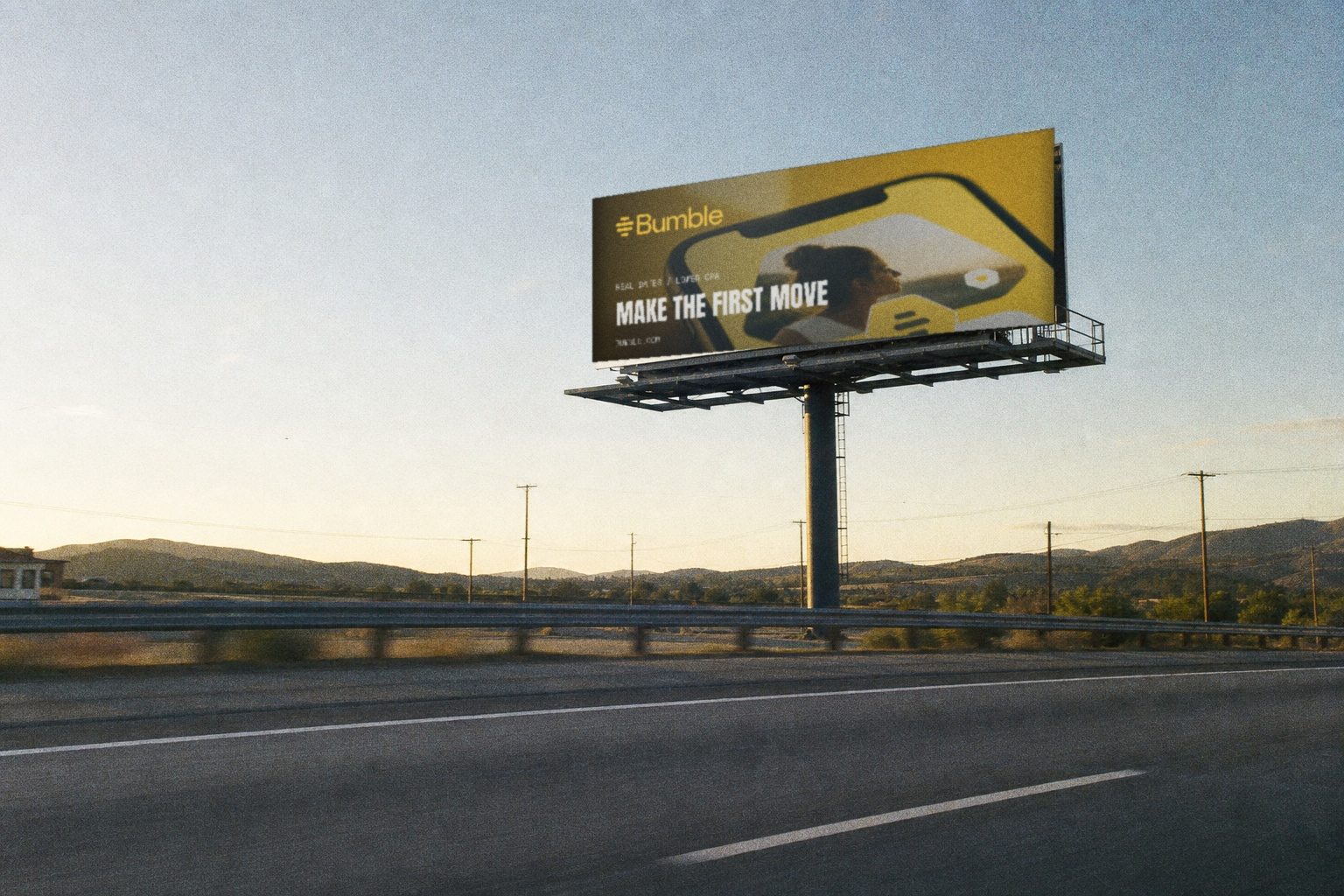
How Bumble replaced staged ads with real first dates
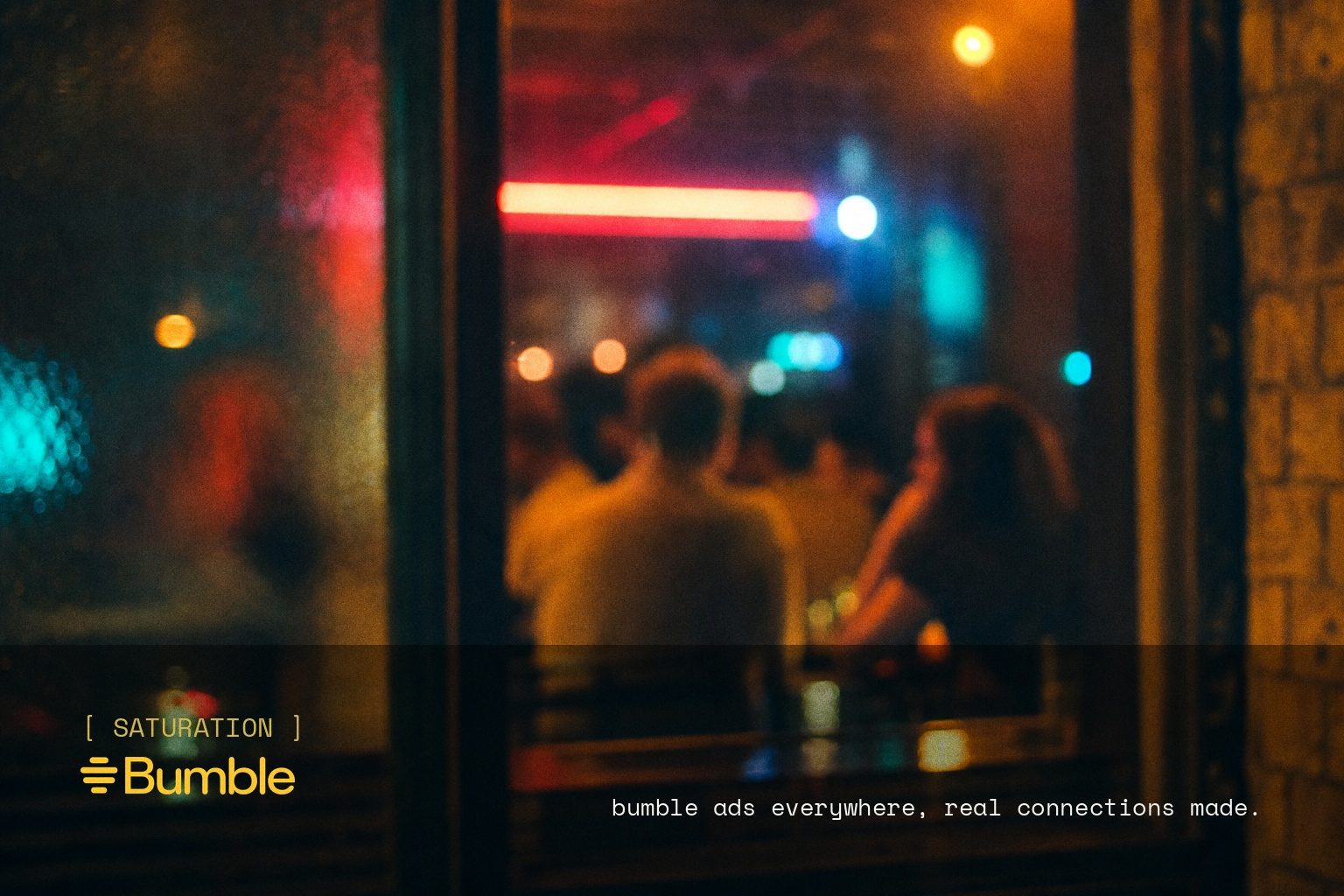
Dating creative has a specific failure mode: the more polished it looks, the less it feels like something that could happen to you.
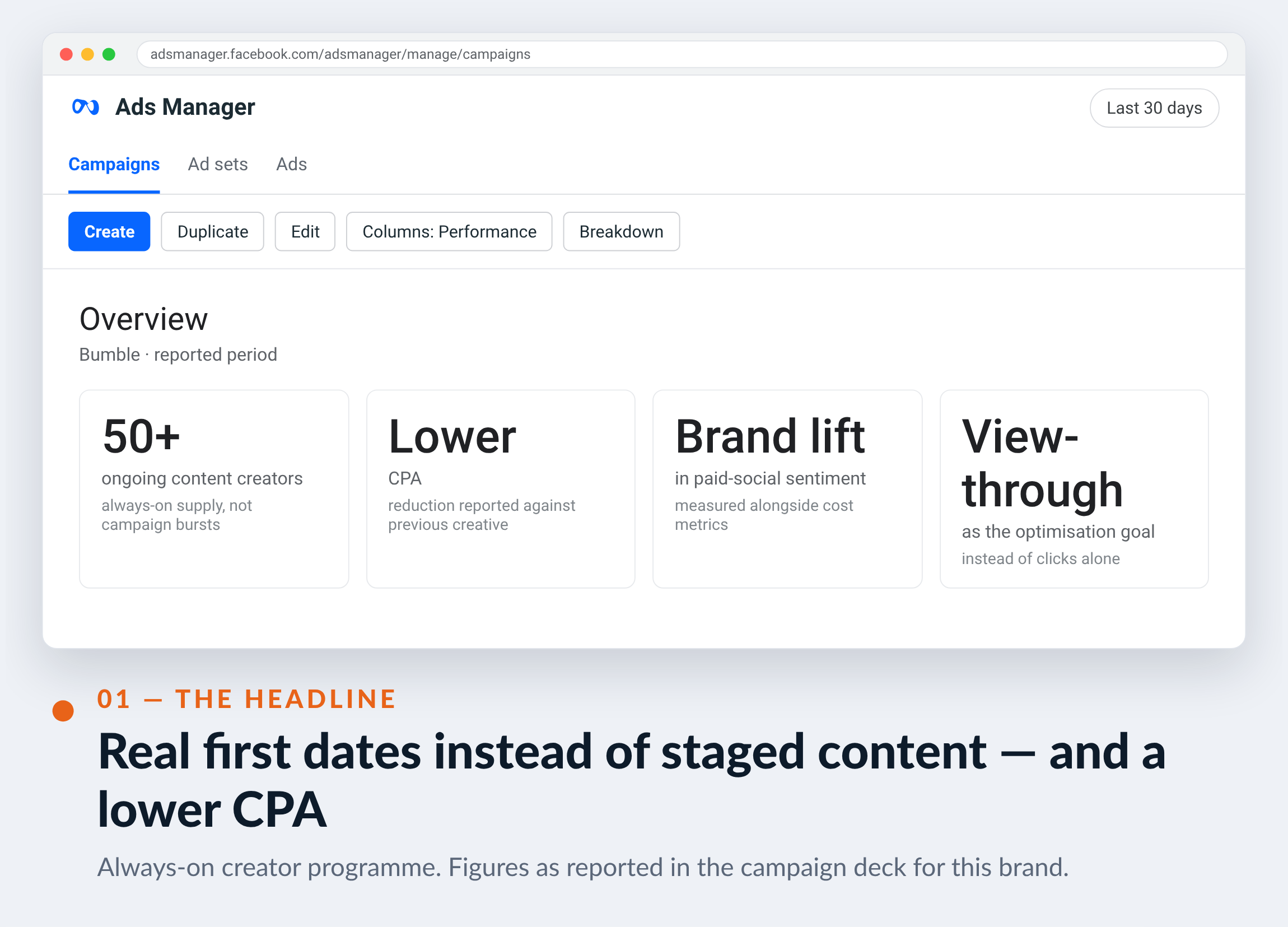
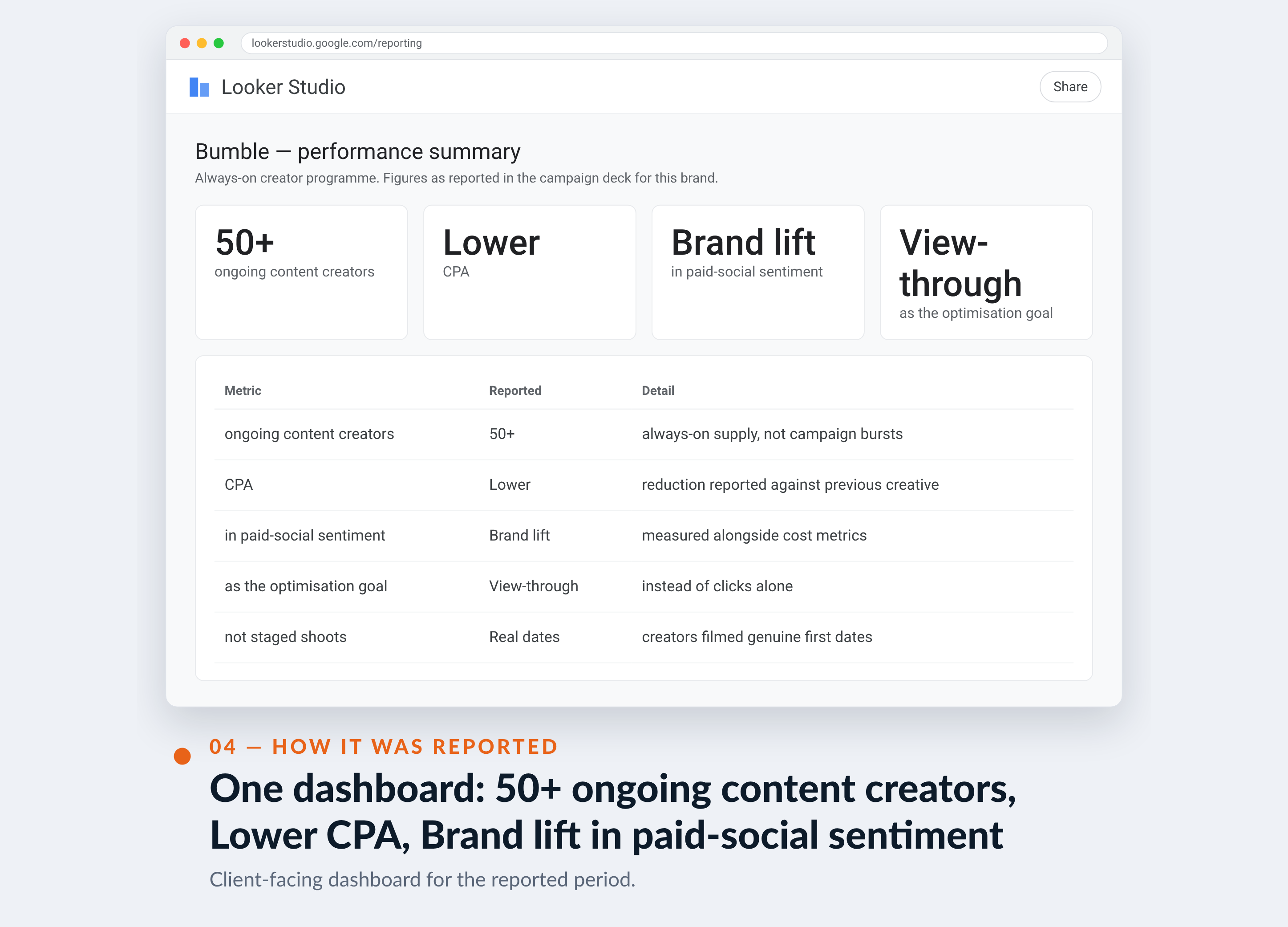
The results, up top — every number is in the strip below
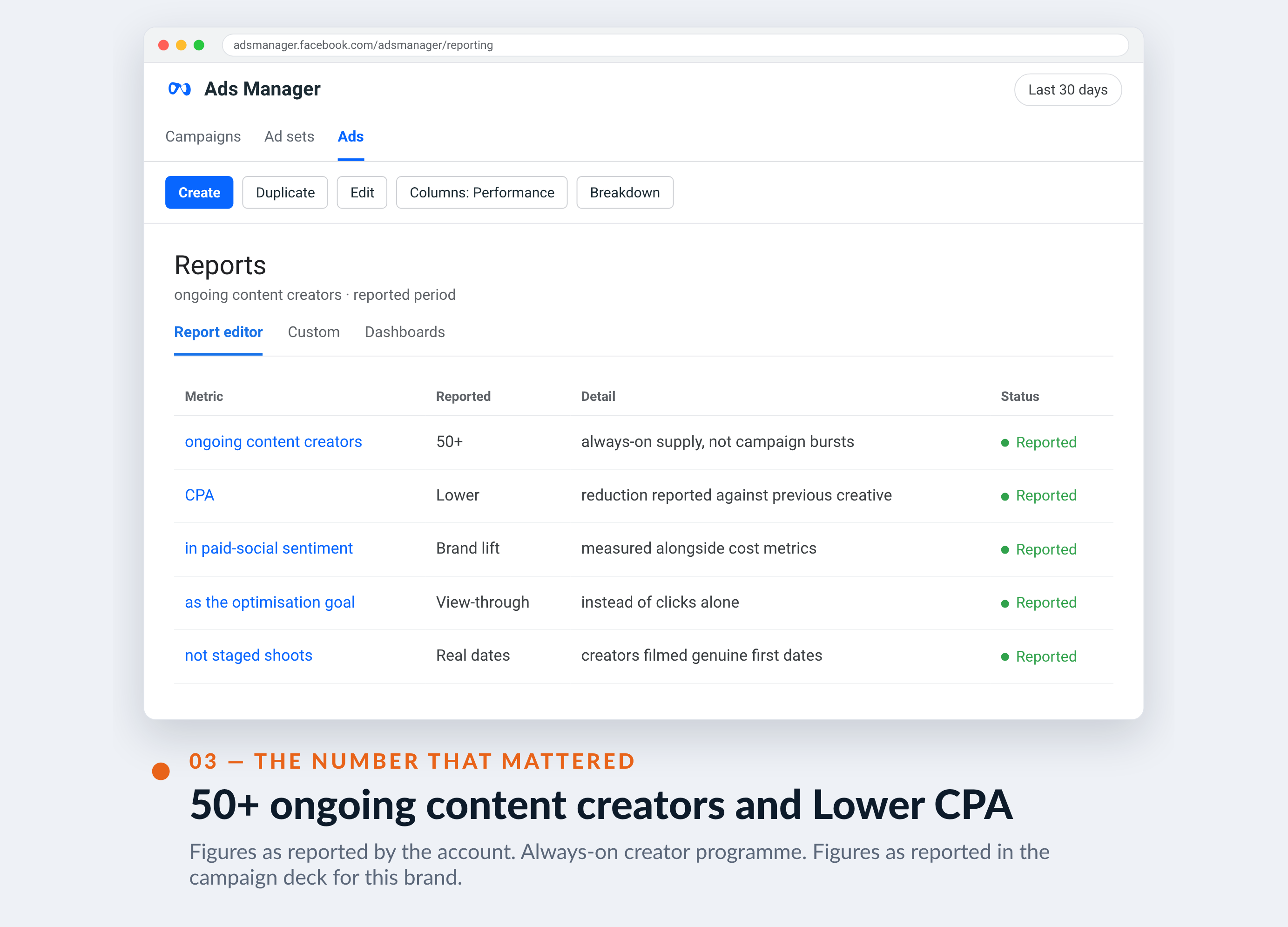
50+
ongoing content creators
always-on supply, not campaign bursts
Lower
CPA
reduction reported against previous creative
Brand lift
in paid-social sentiment
measured alongside cost metrics
View-through
as the optimisation goal
instead of clicks alone
Real dates
not staged shoots
creators filmed genuine first dates
Polished ads were working against the brand they were selling.
Bumble sells the possibility of a real connection. Its paid-social creative had drifted toward studio-styled scenes that read as advertising first and romance second, which hurt sentiment at the same time as it flattened performance.
Fixing that meant changing what got filmed, not just how it was cut.
“The ads looked expensive and felt like nothing. People do not download a dating app because an ad is beautiful — they download it because they believe the thing in the ad could actually happen to them.”
So creators were sent on real first dates, and the campaign optimised for view-through rather than clicks alone.
Creators on real dates, judged on view-through rather than clicks.
Rather than briefing creators to perform a date, the programme sent them on real ones and captured what happened. That produces awkward, specific, unrepeatable footage — exactly the material studio production cannot fake.
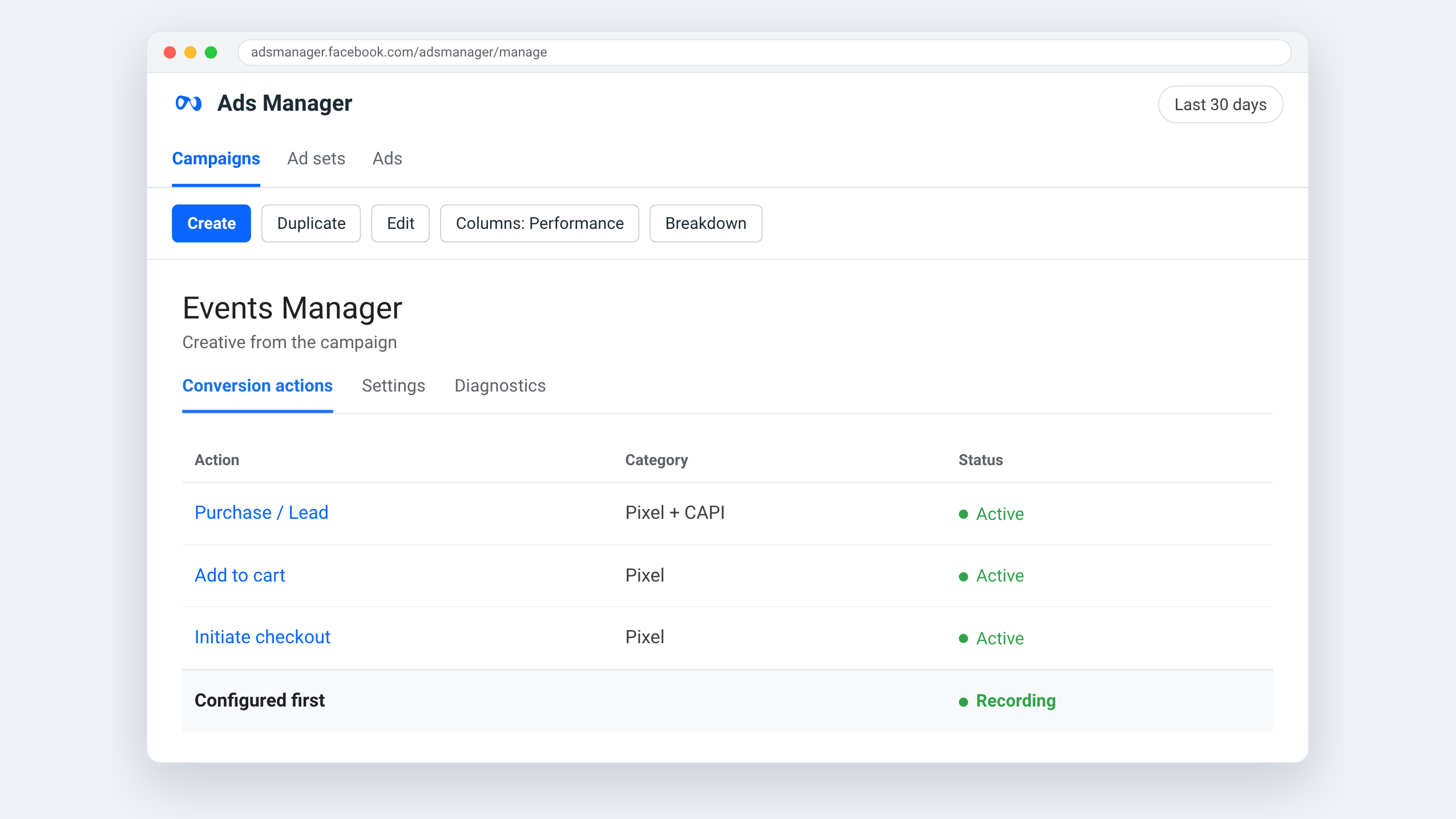
Measurement moved with it. Optimising on clicks rewards curiosity; optimising on view-through rewards the ads people actually watch, which is the closer proxy for brand sentiment in a category built on trust.
What the campaign actually consisted of.
The working parts behind the Bumble numbers above.
Real dates, not staged scenes
The footage could not be faked
Creators went on genuine first dates and filmed them. The unpolished moments became the hooks.
Always-on creator bench
50+ creators kept the pipeline full
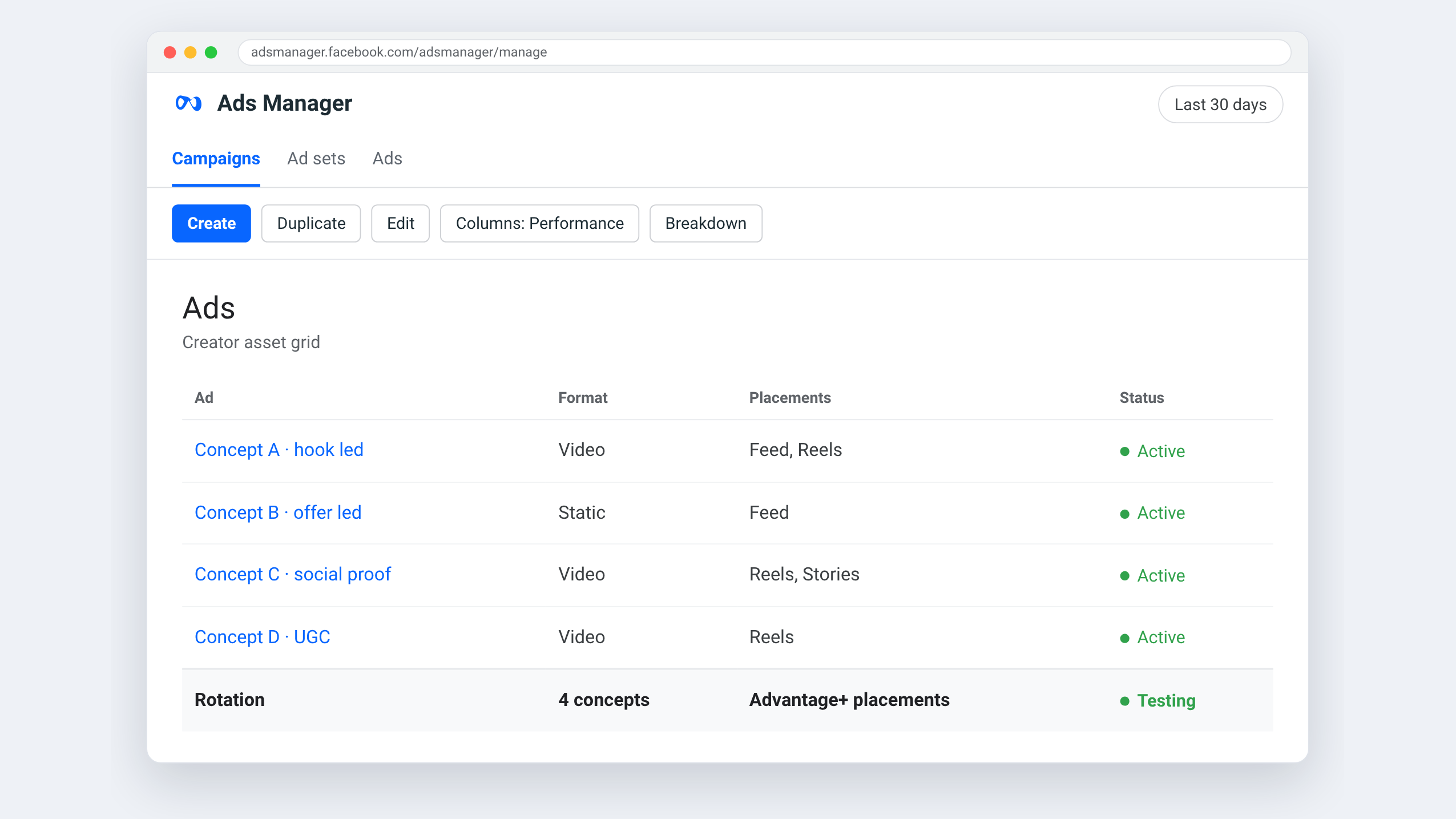
An ongoing roster meant new creative was always entering the account instead of arriving in campaign-sized bursts.
View-through optimisation
Rewarded watching, not curiosity clicks
Optimising for view-through moved spend toward the ads people finished, which aligned performance with brand tone.
Sentiment as a KPI
Brand lift measured alongside cost
Paid-social sentiment was treated as an outcome the creative was accountable for, not a side effect.
Real first dates instead of staged content — and a lower CPA
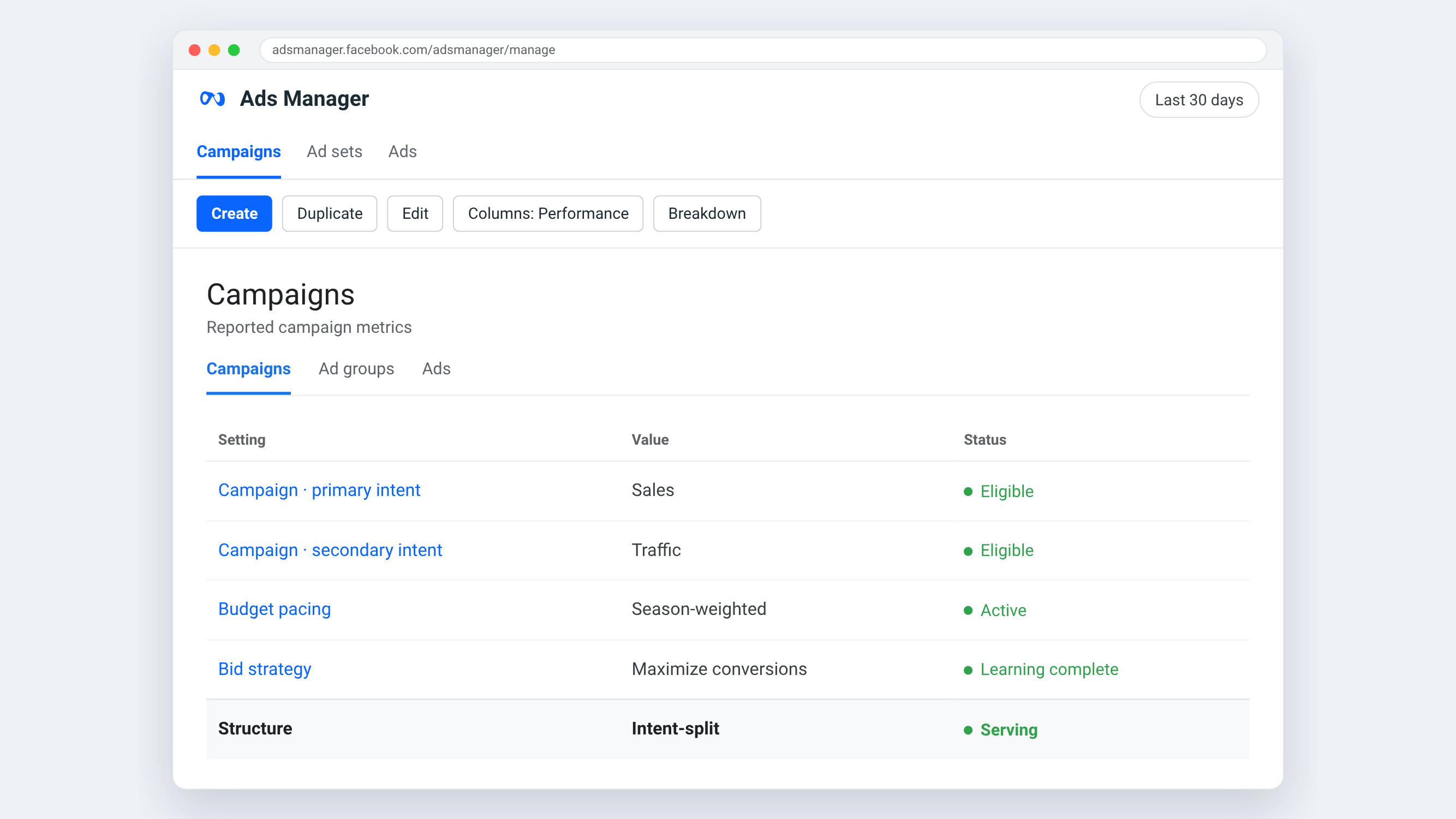
Meta Ads Manager
Paid social
TikTok Ads Manager
Paid social
Spark Ads & whitelisting
Amplification

Sebas Bumble (1) — video ad creative
https://s3.amazonaws.com/webflow-prod-assets/69dce281d3b49704d8c8cdd0/6a782bdd04d37a6778e0c659_out.mp4

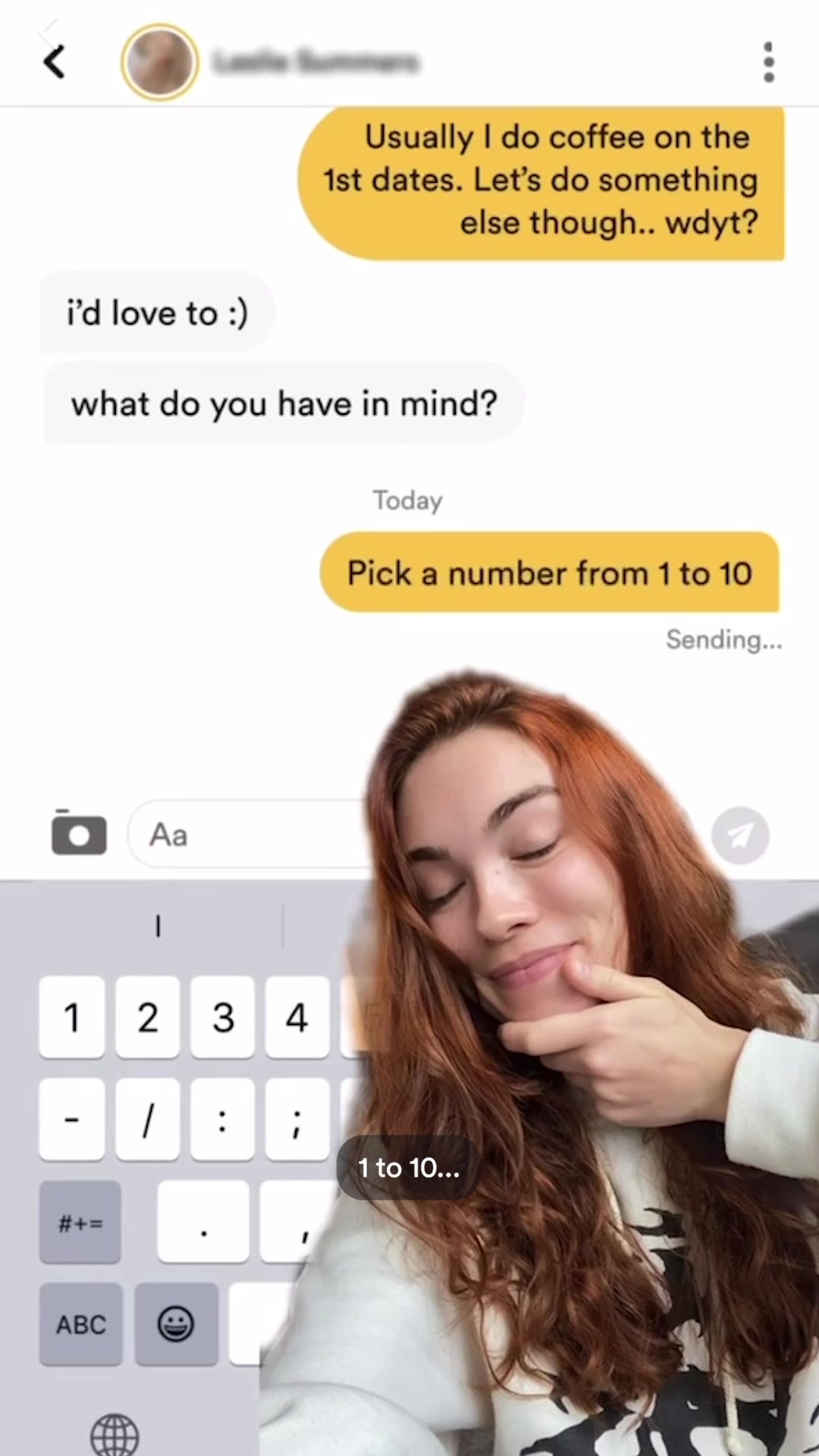
Leslie Bumble (1) — video ad creative
https://s3.amazonaws.com/webflow-prod-assets/69dce281d3b49704d8c8cdd0/6a782bcc157ed9bc2f2f55ee_out.mp4
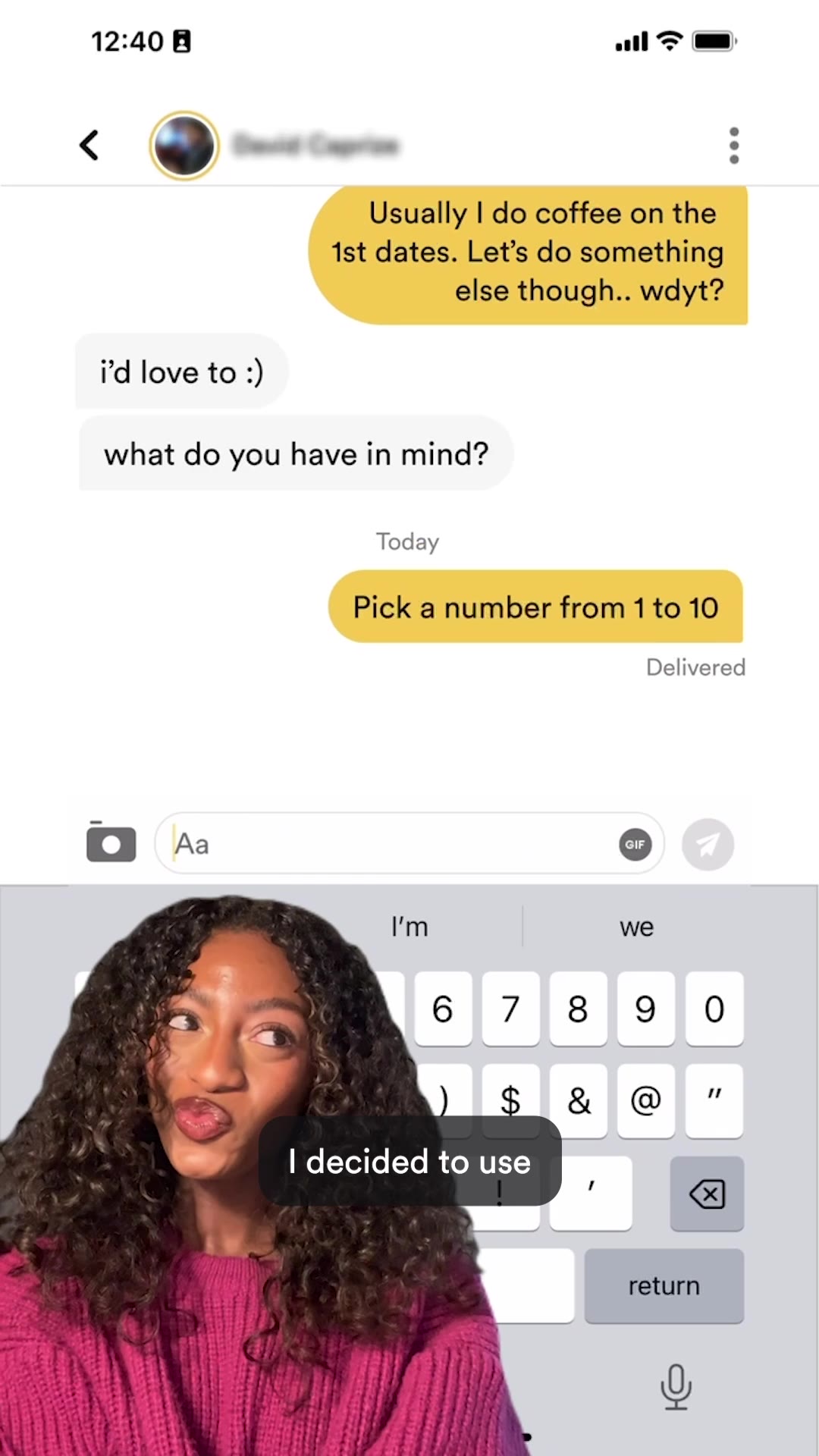
Kirsten — video ad creative
https://s3.amazonaws.com/webflow-prod-assets/69dce281d3b49704d8c8cdd0/6a782abfa1903c8860d7c34c_out.mp4
Alyssa Bumble (1) — video ad creative
https://s3.amazonaws.com/webflow-prod-assets/69dce281d3b49704d8c8cdd0/6a782abde1dedd519c747e3e_out.mp4


123Couvreur
95,129 impressions in 9 months from zero
Home services & trades

123Couvreur — Google Ads
103 quote requests
Home services & trades

3D Entrepreneur Général
124 forms + 109 calls
Home services & trades
419 Lafayette
4,239 sessions in the first 3 months
Events & venues


À l'Amiable
206 → 393 ad calls, flat spend
Professional services

Alpha Serrurier
139 → 260 ad-extension calls
Home services & trades

Arboxygène — SEO
25.5 → 18.9 avg position
Home services & trades

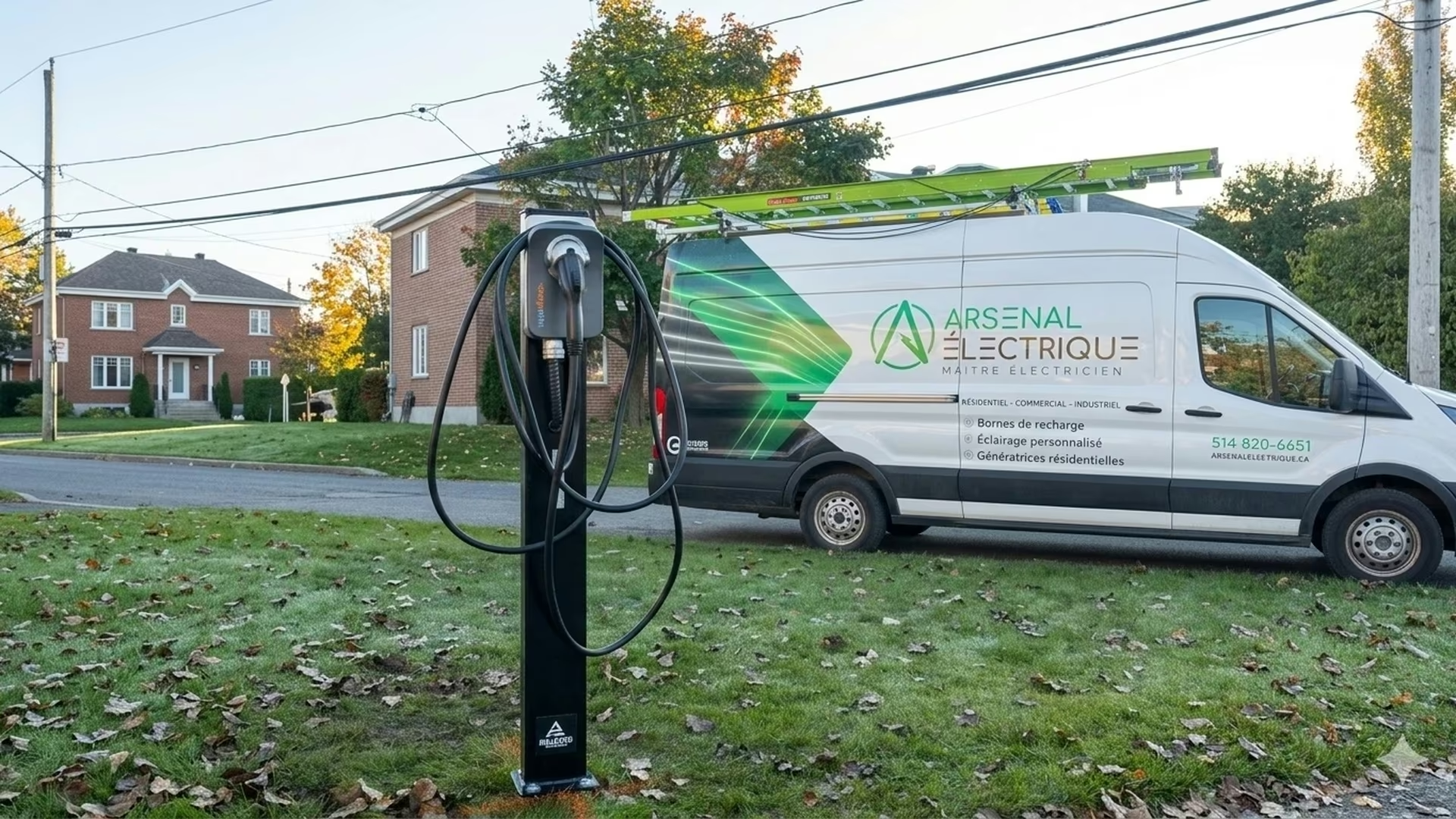
Arsenal Électrique
36 → 444 leads a year
Home services & trades

Benjel — SEO
24.8 → 18.8 avg position
Professional services

Booksy — Creator whitelisting
+1,700% signups · CPR −92%
Consumer apps & platforms

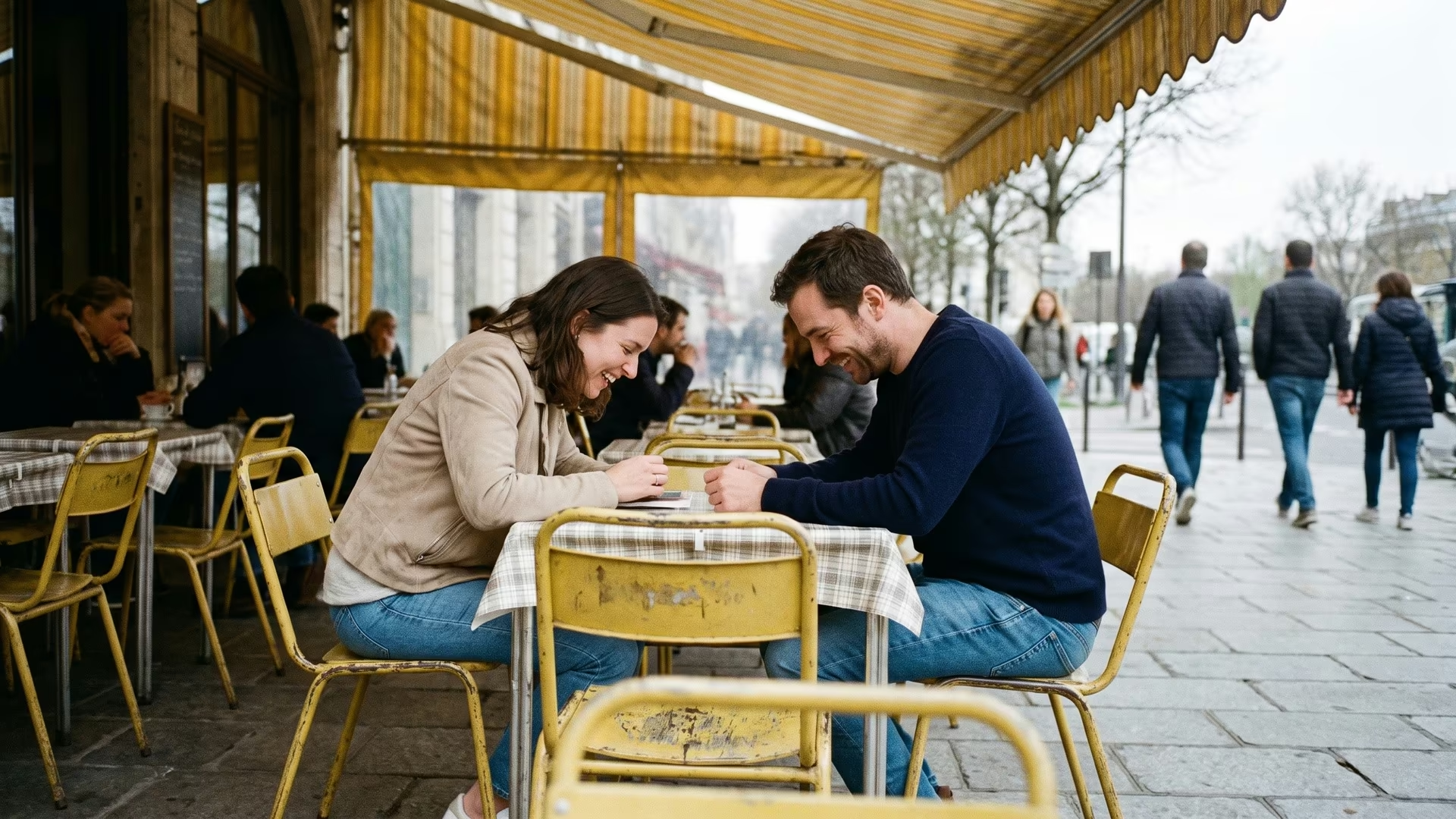
Bumble — UGC ads & creator partnerships
50+ creators · lower CPA
Consumer apps & platforms


Busuu — Performance-driven user acquisition
450+ assets · 60+ creators
Education & training


Canado-Nacan Équipements — SEO
36.2 → 25.8 avg position
B2B & SaaS


CFC & Elevate Health
16,387 leads at CA$33 CPL
Health & medical

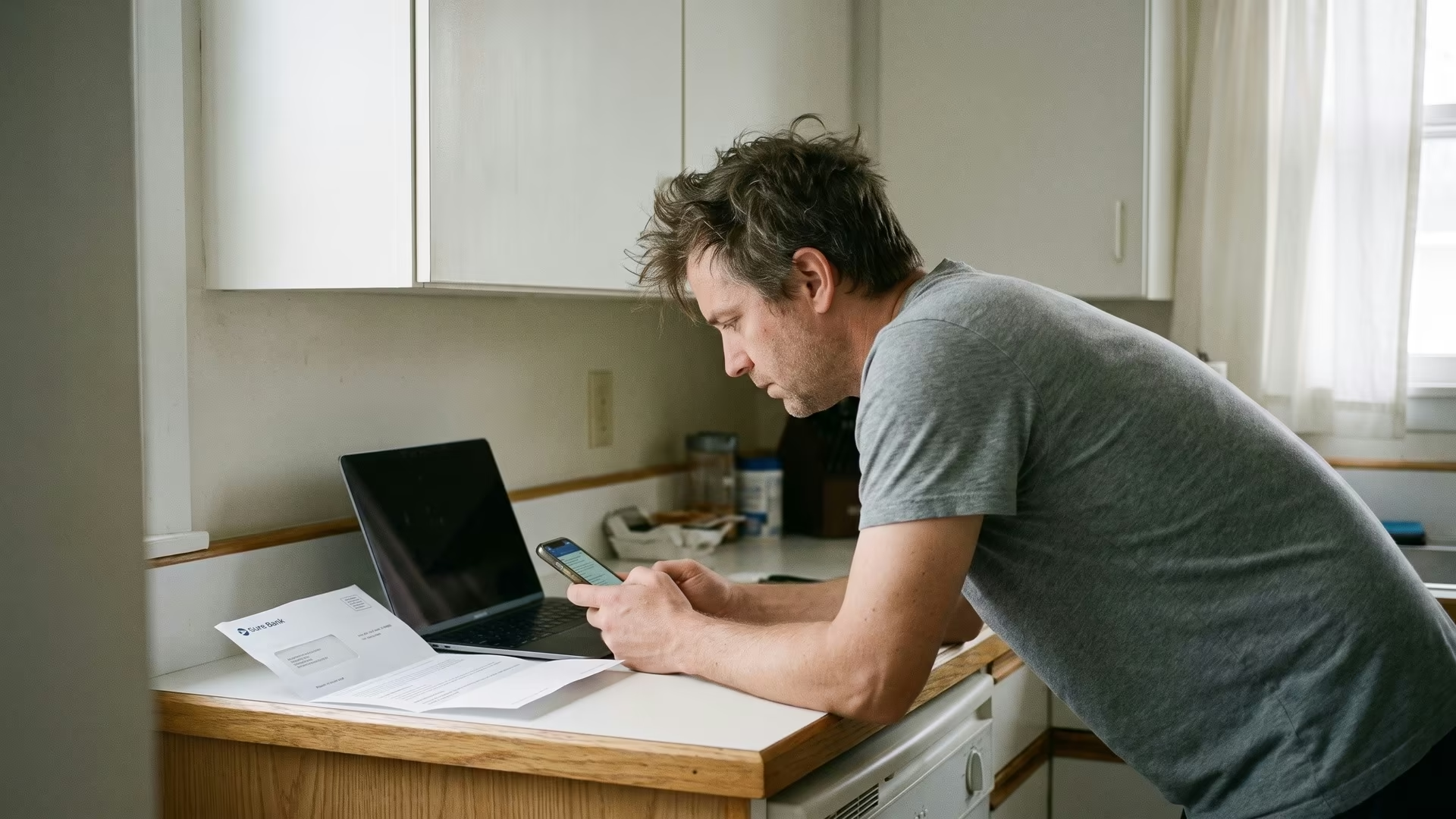
ClearScore — Global creator-led acquisition
CPS −27% MoM · 33% thumbstop
Fintech & financial services

Clinique Majora
CA$9.00 → CA$6.27 per booking
Health & medical


Confort Prestige — SEO
6,168 clicks · +111% directions
Home services & trades


Cours Jeunesse
8 → 1,481 organic clicks
Education & training

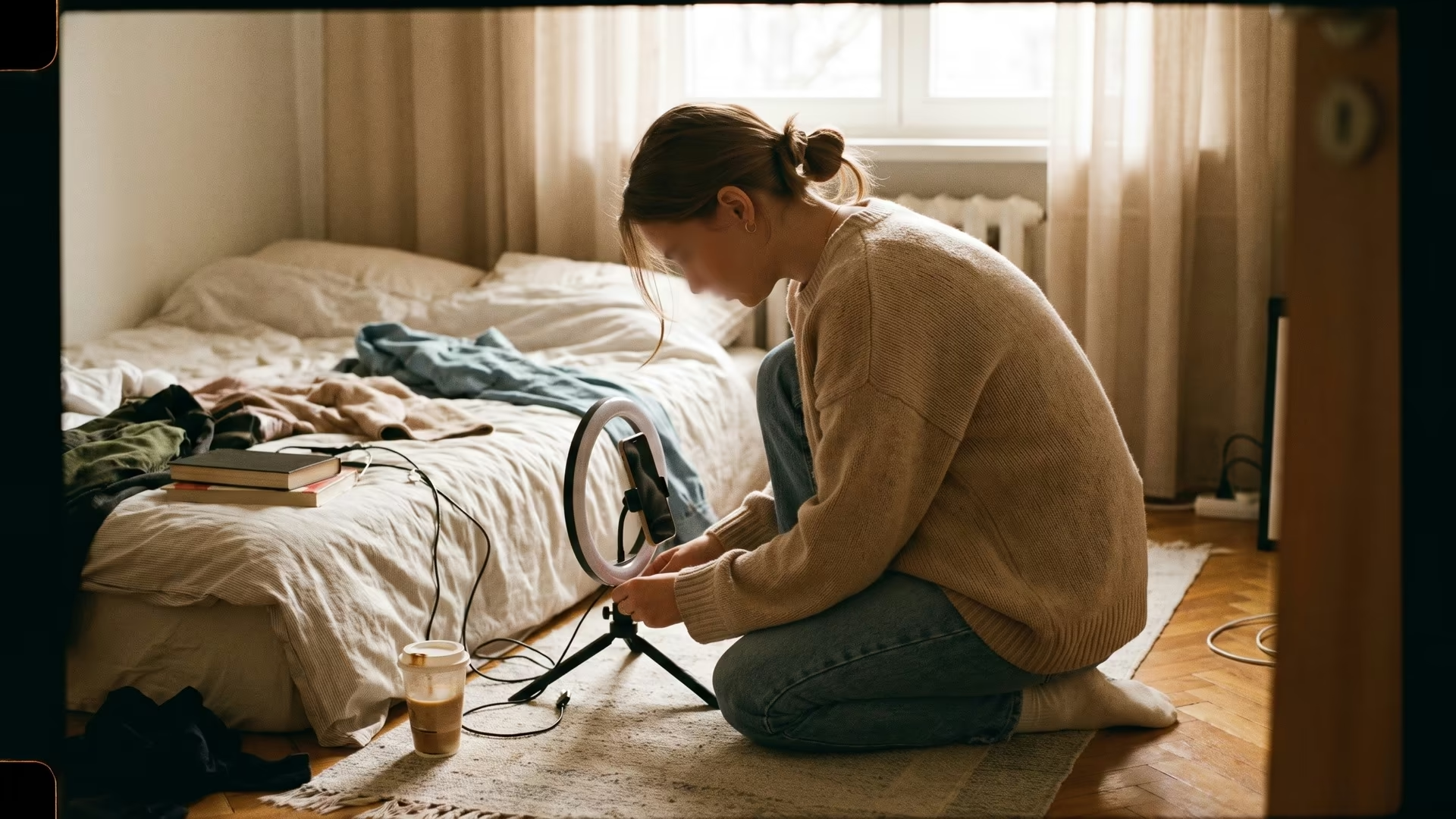
Crowdtap — Performance creative & paid media
TikTok CPA −30% · volume +15%
B2B & SaaS

Dashing Diva — Full-funnel campaign
CAC −24% · 3→7 channels
Beauty & personal care


Dockers — Influencer & whitelisting
16M+ views · 80+ influencers
Apparel & fashion


Dr du Matelas — SEO
+118% profile calls
Retail & e-commerce

Electrolibre
498 first-time calls
Retail & e-commerce

EnMouvement
107 → 293 ad calls
Home services & trades


Entretien Squidgee — SEO
+58% impressions · +12% clicks
Home services & trades

Erco Électrique
−47% spend, +72% calls
Home services & trades

EVRY Jewels — Full-funnel growth
$6M → $100M · 7×+ ROAS
Retail & e-commerce


Farrukh Ahmed CPA — Local SEO launch
position 50 → 17 · +166% desktop map impressions
Professional services


Fil Chauffant Toiture — Meta Ads
45 leads · CA$38.53
Home services & trades

Fil Chauffant Toiture — SEO
133 → 524 clicks
Home services & trades


Food Allergy Institute — Paid media and booked consultations
243 → 1,012 consultations/mo · cost per landing page view −30%
Health & medical


Future Forward — Performance-driven creator campaign
CPA −20% · 5 platforms
Education & training

Geo Stone
275 leads at CA$19.59
Home services & trades
Geo Stone — Google Ads
93 → 198 calls from ads
Home services & trades

Geo Stone — SEO
1,476 → 3,025 clicks
Home services & trades


Gouttières Grand-Montréal — SEO
53 → 327 clicks
Home services & trades

HelloFresh — Dark posting at scale
17 countries · CPA −20% MoM
Food & beverage

Her-Age
6.63× tracked ROAS
Retail & e-commerce

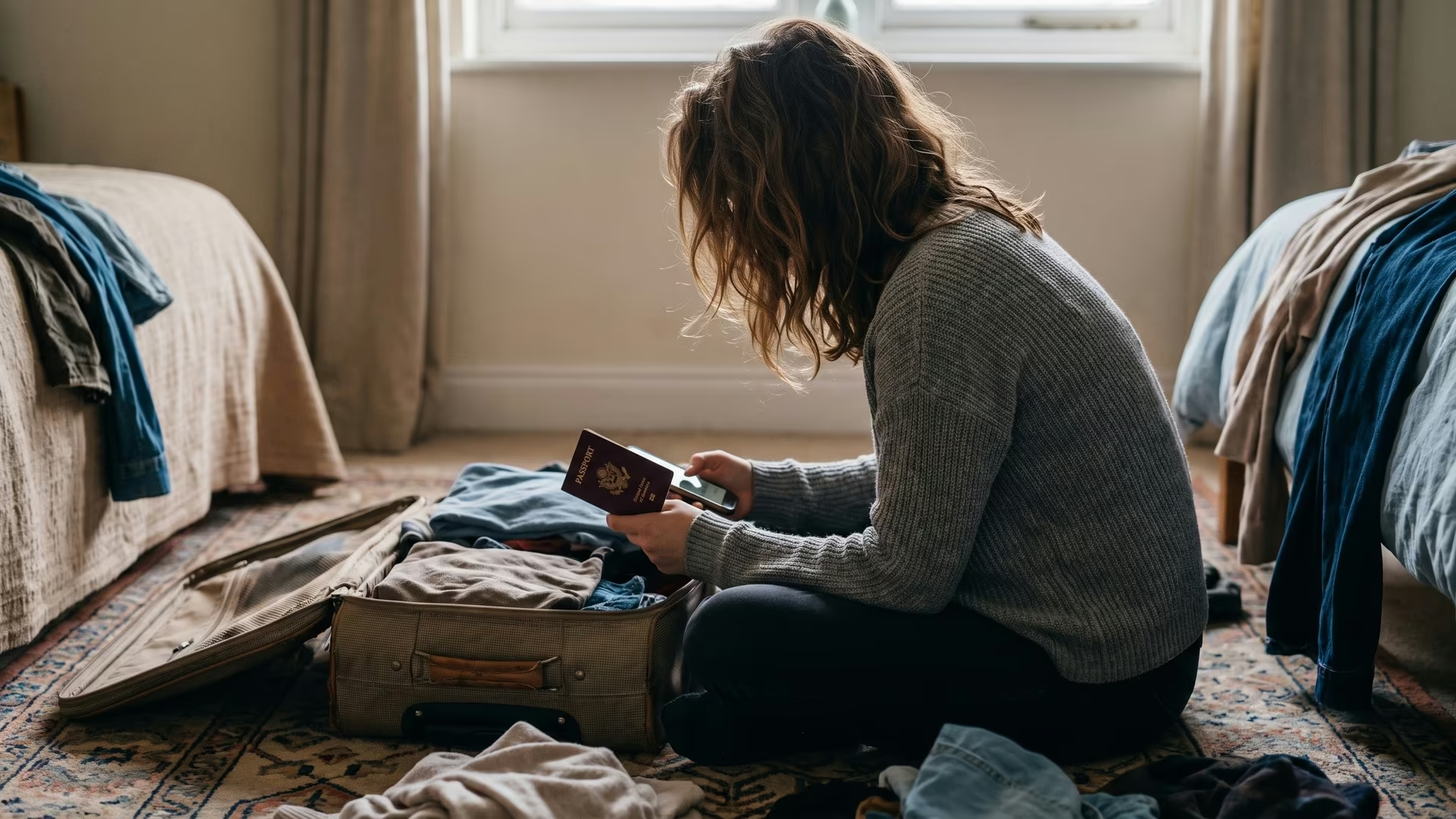
Hopper — Performance creative at scale
300+ assets/mo · CAC −20%
Travel & mobility

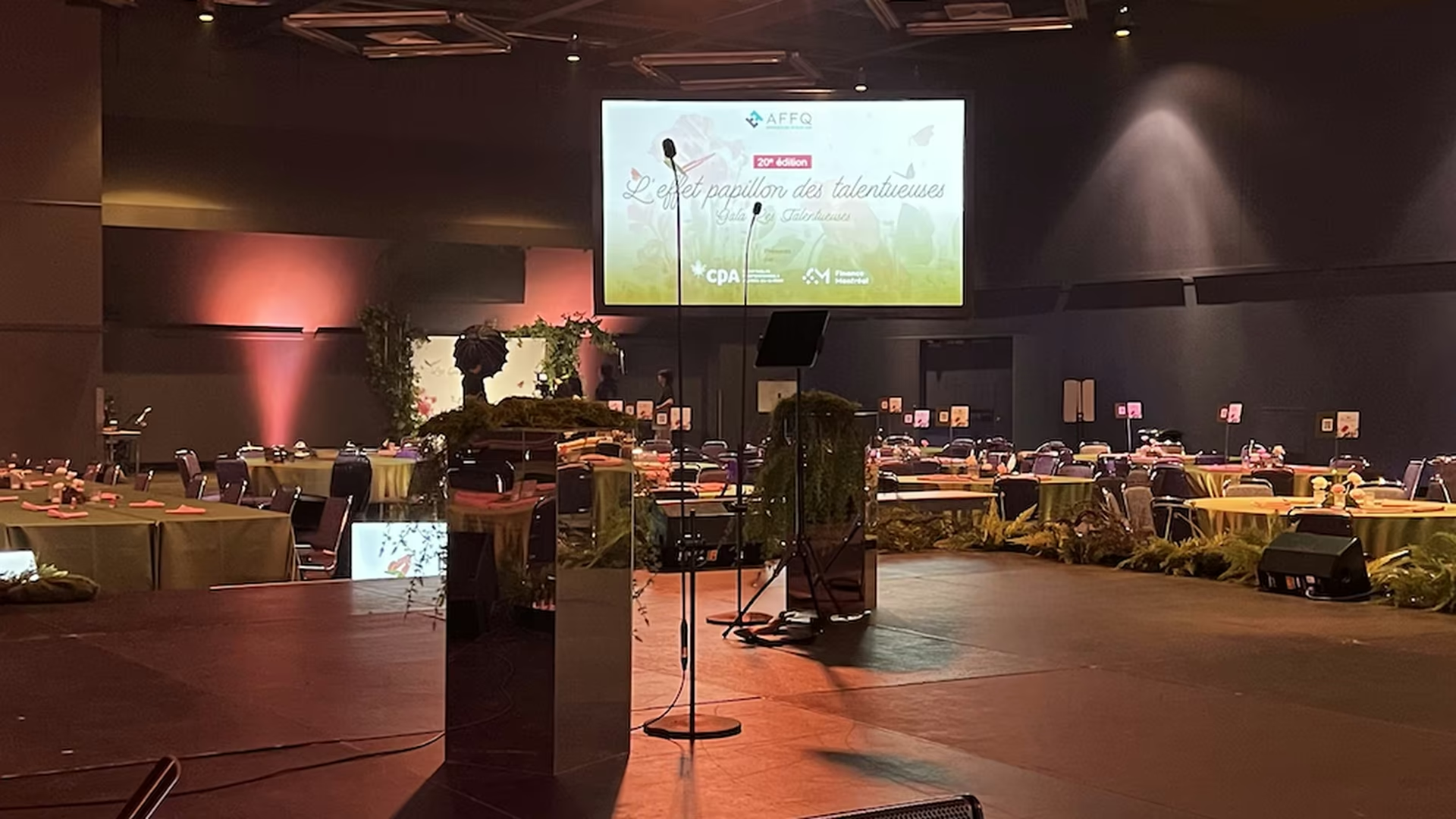
HUBZ404
90 → 86,773 impressions
Events & venues

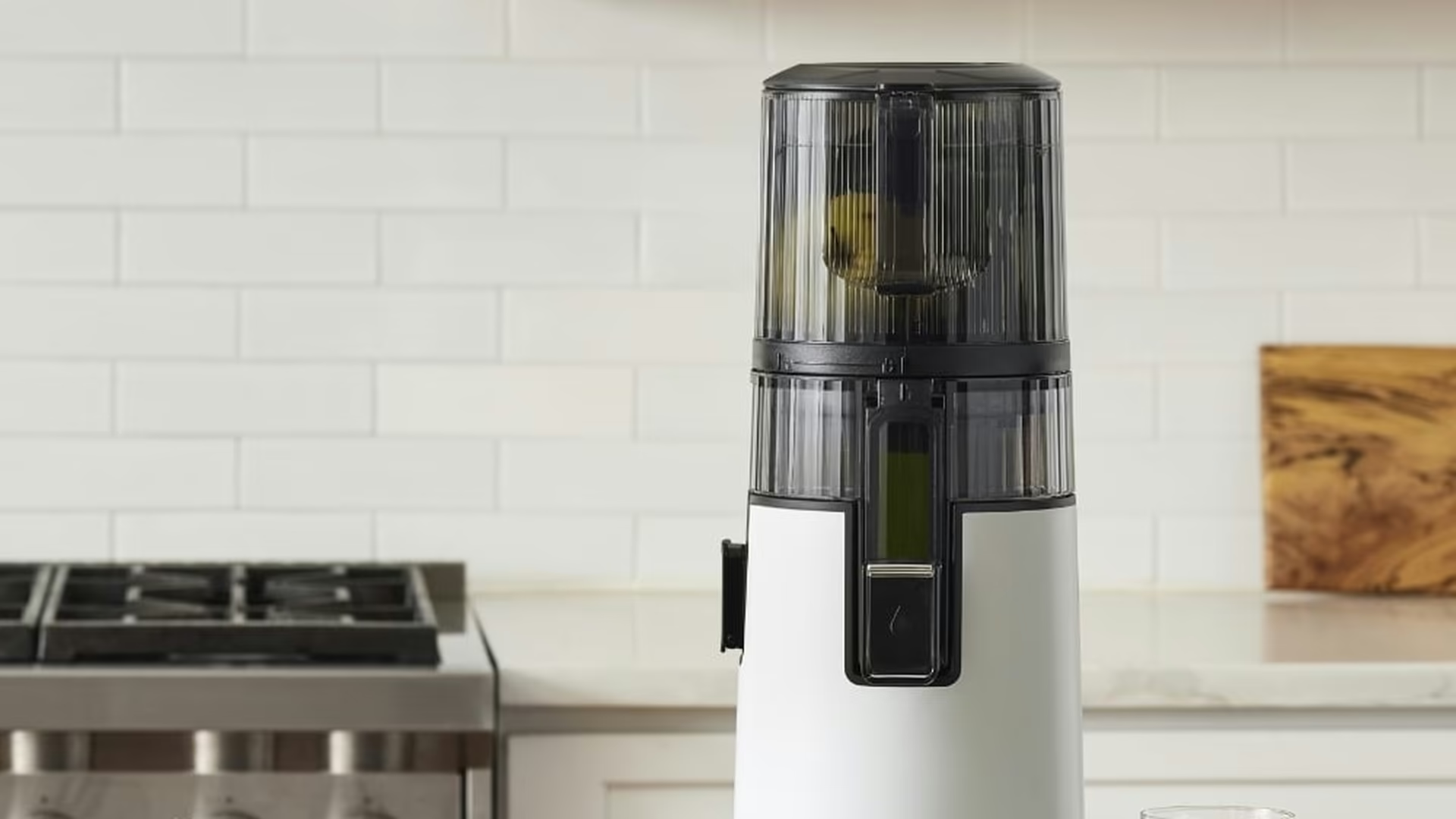
HUROM — Full-funnel paid media & influencer strategy
ROAS +300% · CPA −70%
Retail & e-commerce

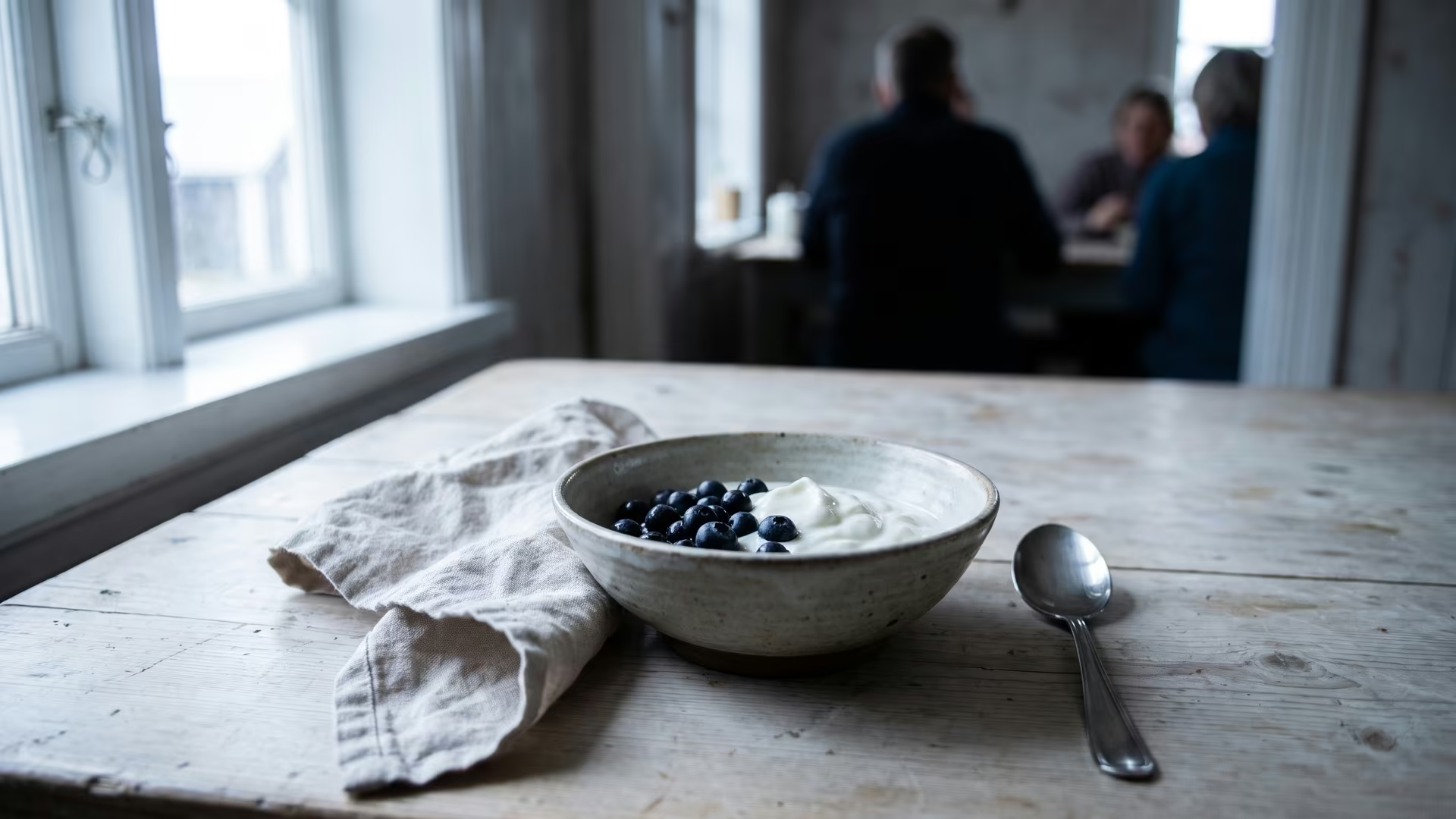
Icelandic Provisions — Influencer-led branded creative
3M+ impressions · 9%+ CTR
Food & beverage

Impact Santé
ROAS 13.62× → 14.96×
Education & training

Impact Santé+ — SEO
+36% clicks · +91% impressions
Education & training

Inspections Nicolas Landry — SEO
+117% impressions
Home services & trades


iTrustCapital — UGC & paid media
CVR +100% · CAC −65%
Fintech & financial services


JDM Drive — SEO
37,831 clicks · from zero
Automotive


JDM Engine Direct
$1.42M tracked revenue at 14.62×
Automotive

Katchoo — Meta Ads
CA$11.15 per lead
Home services & trades


K&R Strategic Partners
$24,740 in tracked value from zero
Professional services

K&R Strategic Partners — SEO
0 → 76,344 organic impressions
Fintech & financial services

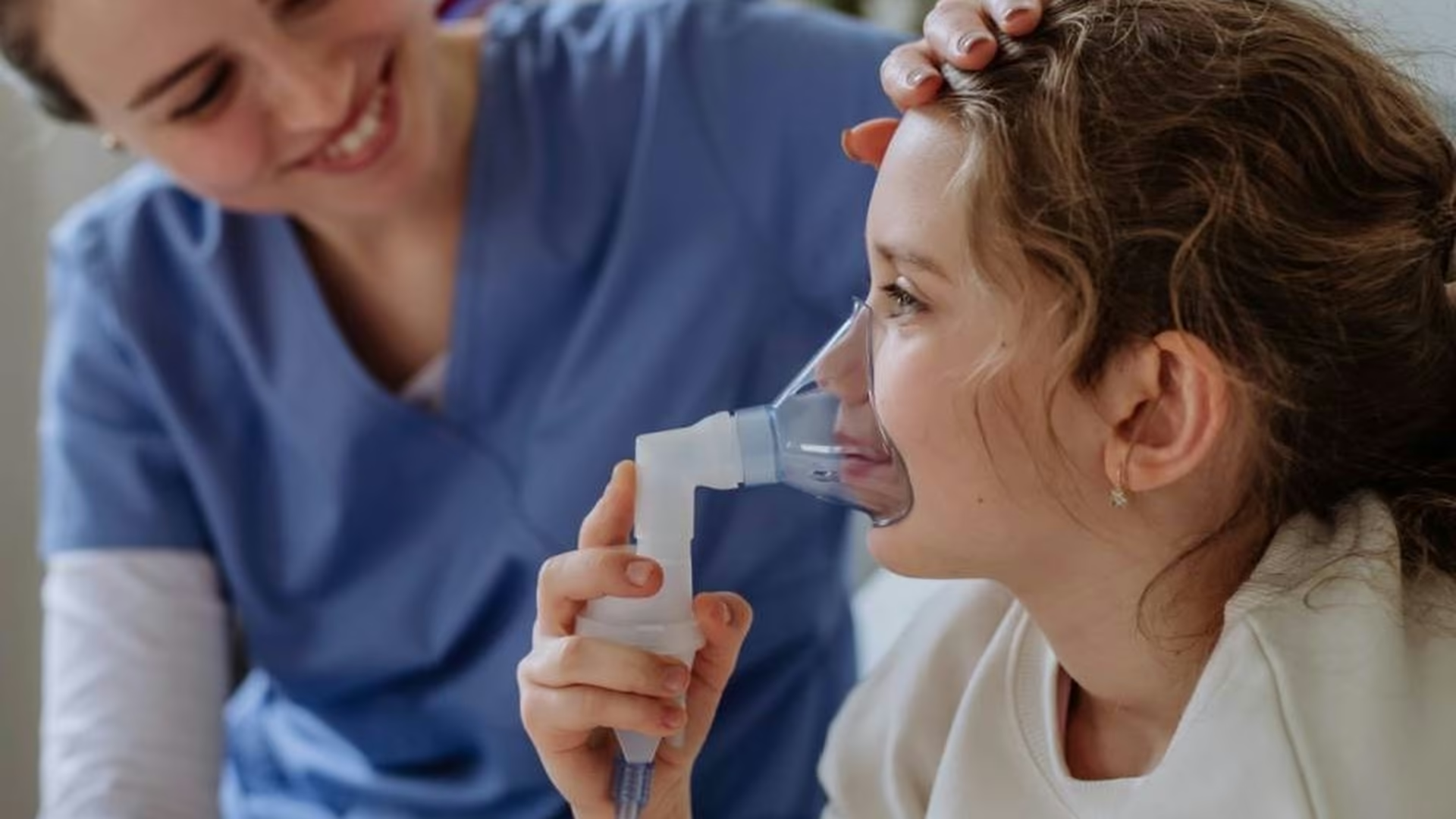
LAHA
24 → 475 tracked conversions
Health & medical


L'Entrepôt de la Réno
5.55× ROAS while tripling spend
Retail & e-commerce

L'Entrepôt de la Réno — Google Ads
CA$356k → CA$1.9M tracked revenue
Retail & e-commerce
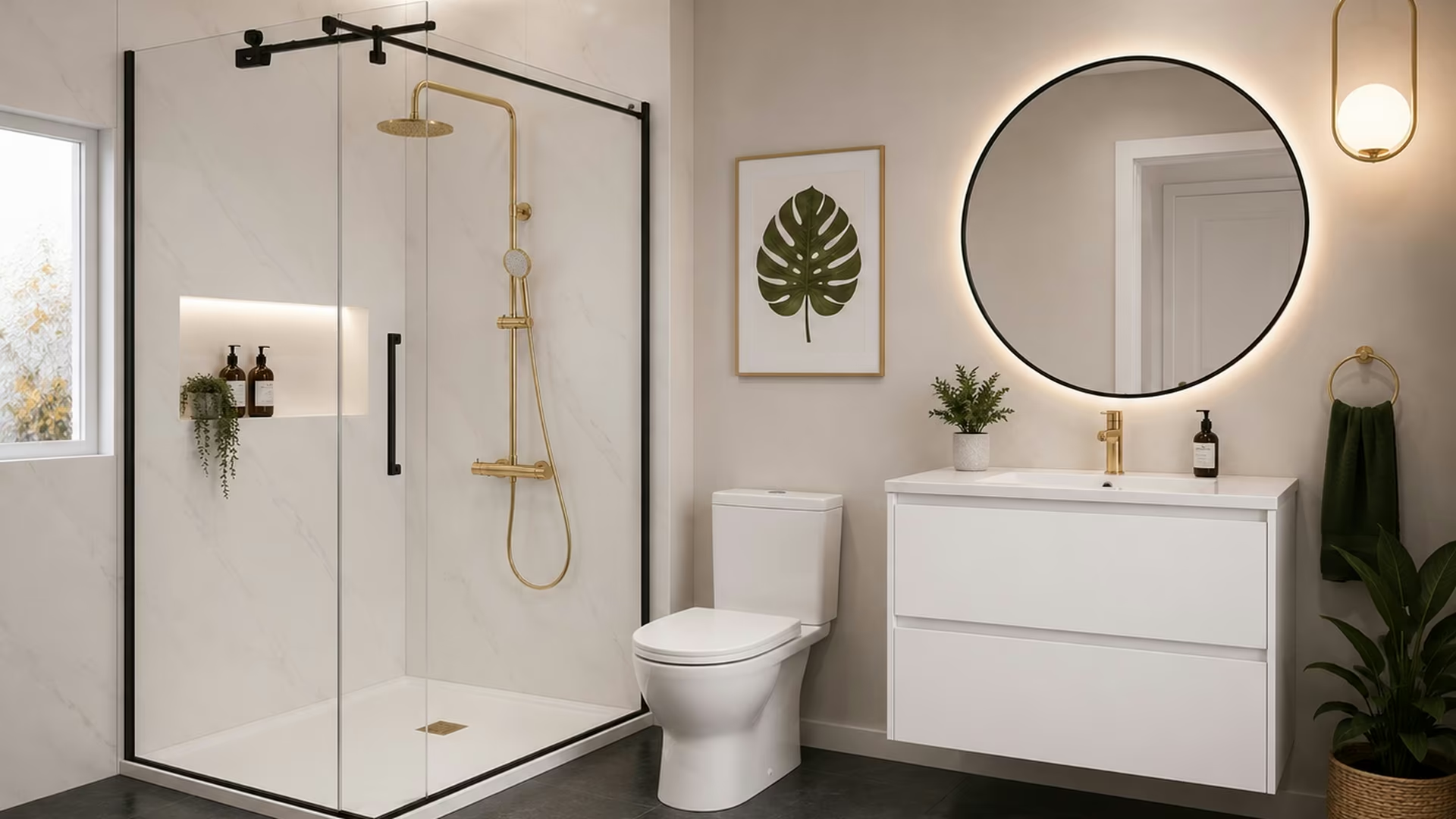
L'Entrepôt de la Réno — SEO
111,651 → 280,019 clicks
Retail & e-commerce

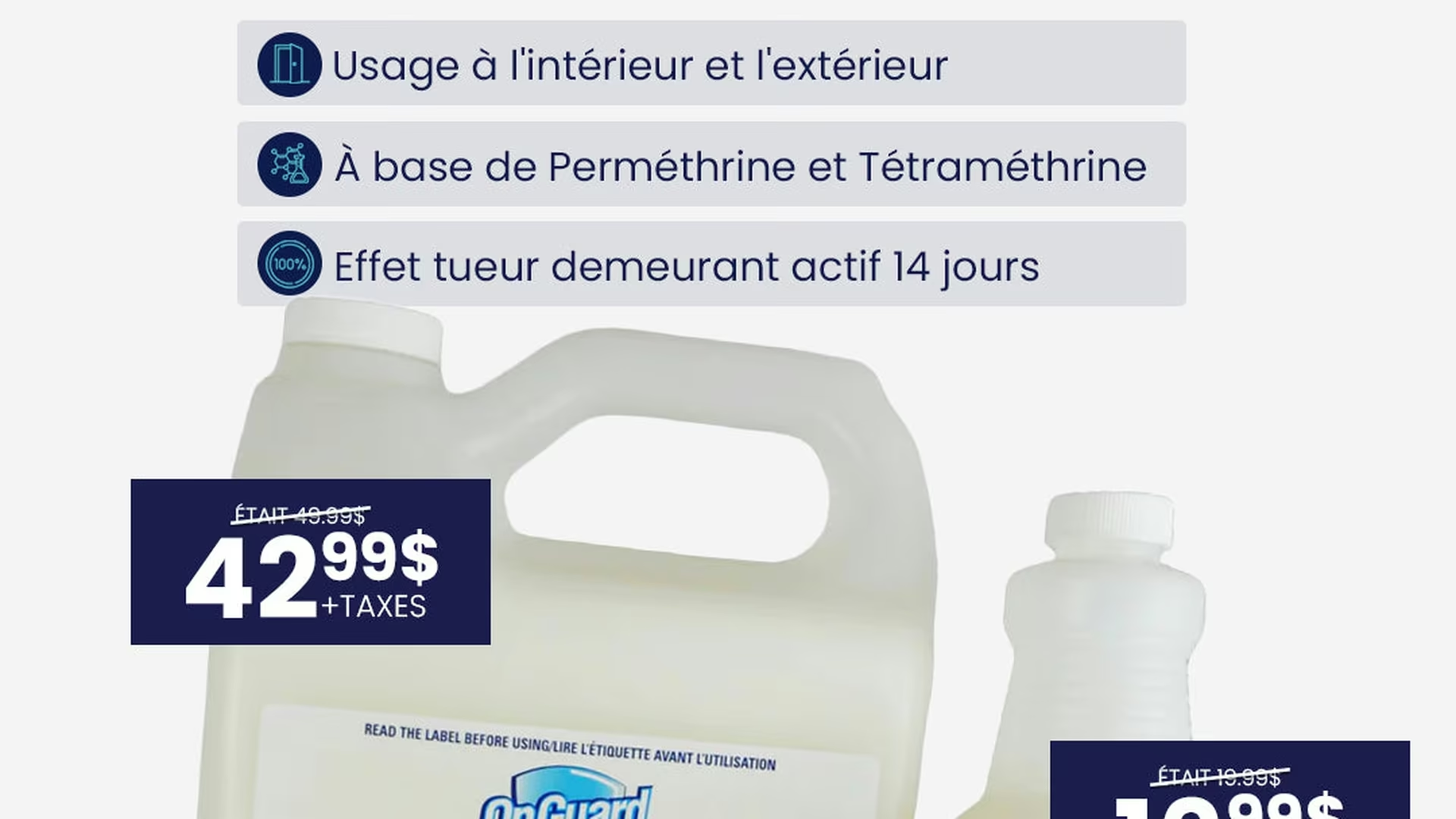
L'Exterminateur en Ligne
ROAS 3.27× → 5.51×
Home services & trades

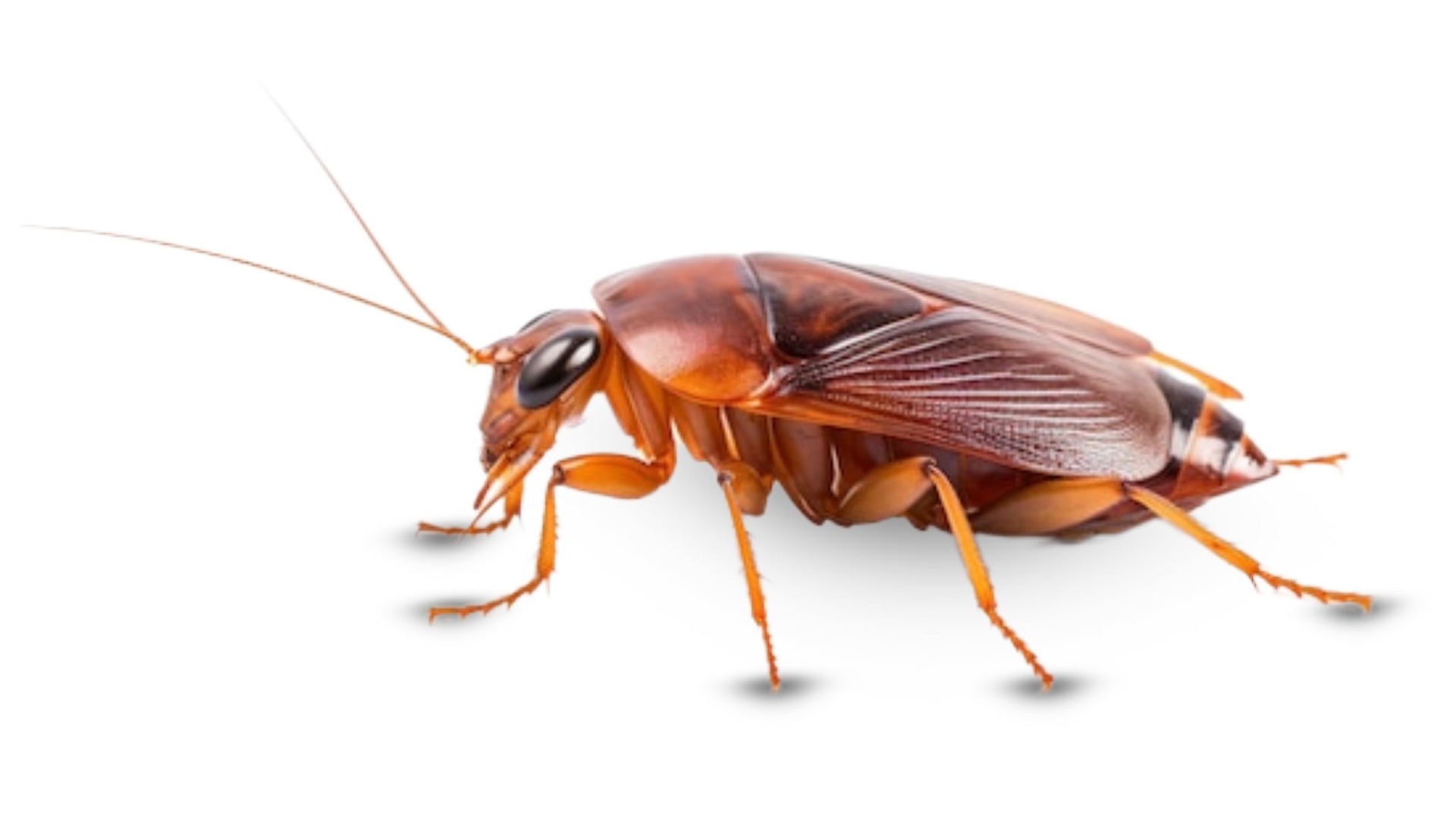
L'Exterminateur en Ligne — Meta launch
9.60× ROAS in the first 3 months
Home services & trades

L'Exterminateur en Ligne — SEO
+20% clicks · +47% impressions
Retail & e-commerce

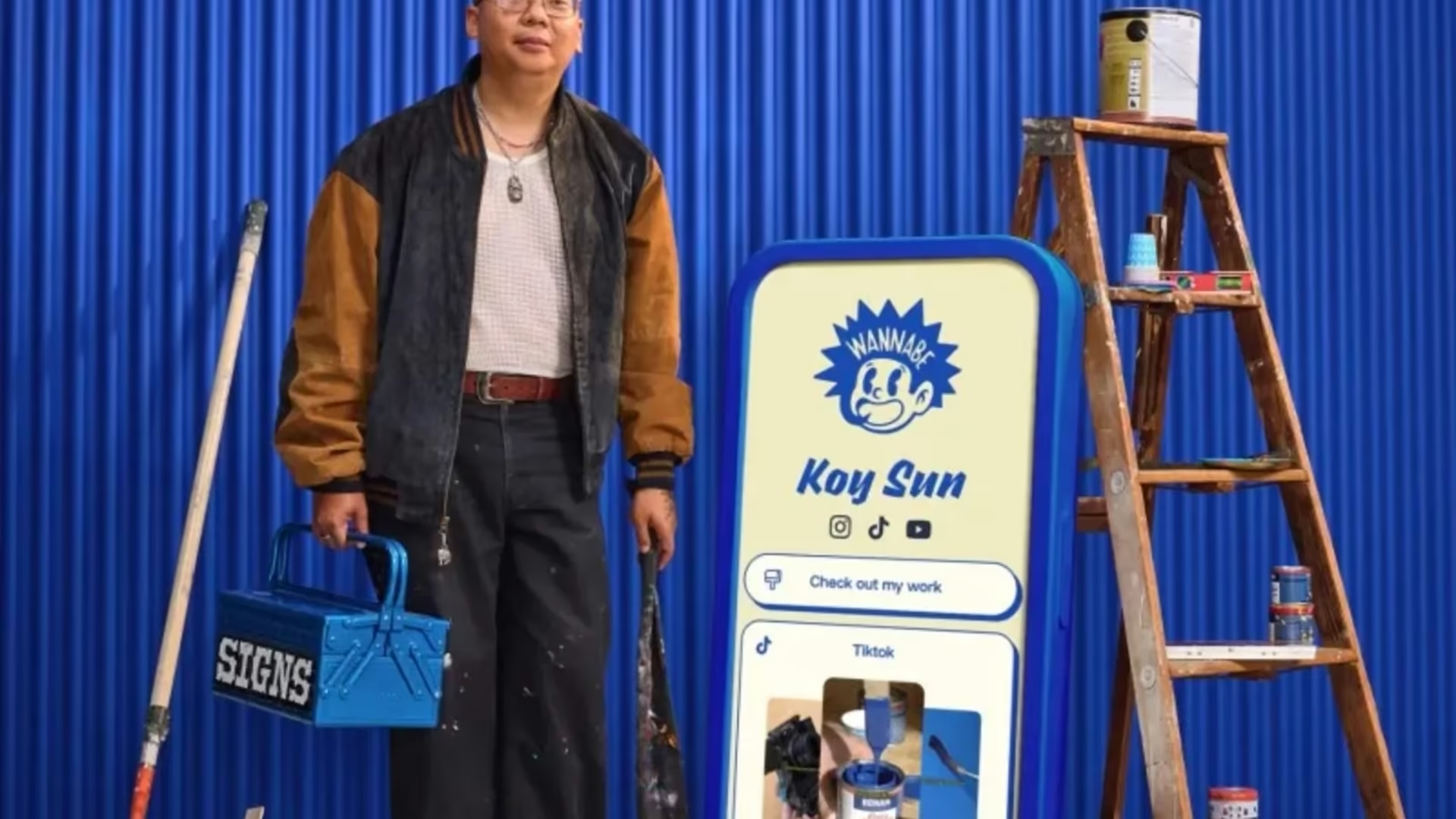
Linktree — Organic social, series & design
5× reach · 10M views
Consumer apps & platforms


Living Beauty
+225% purchases, matched months
Retail & e-commerce
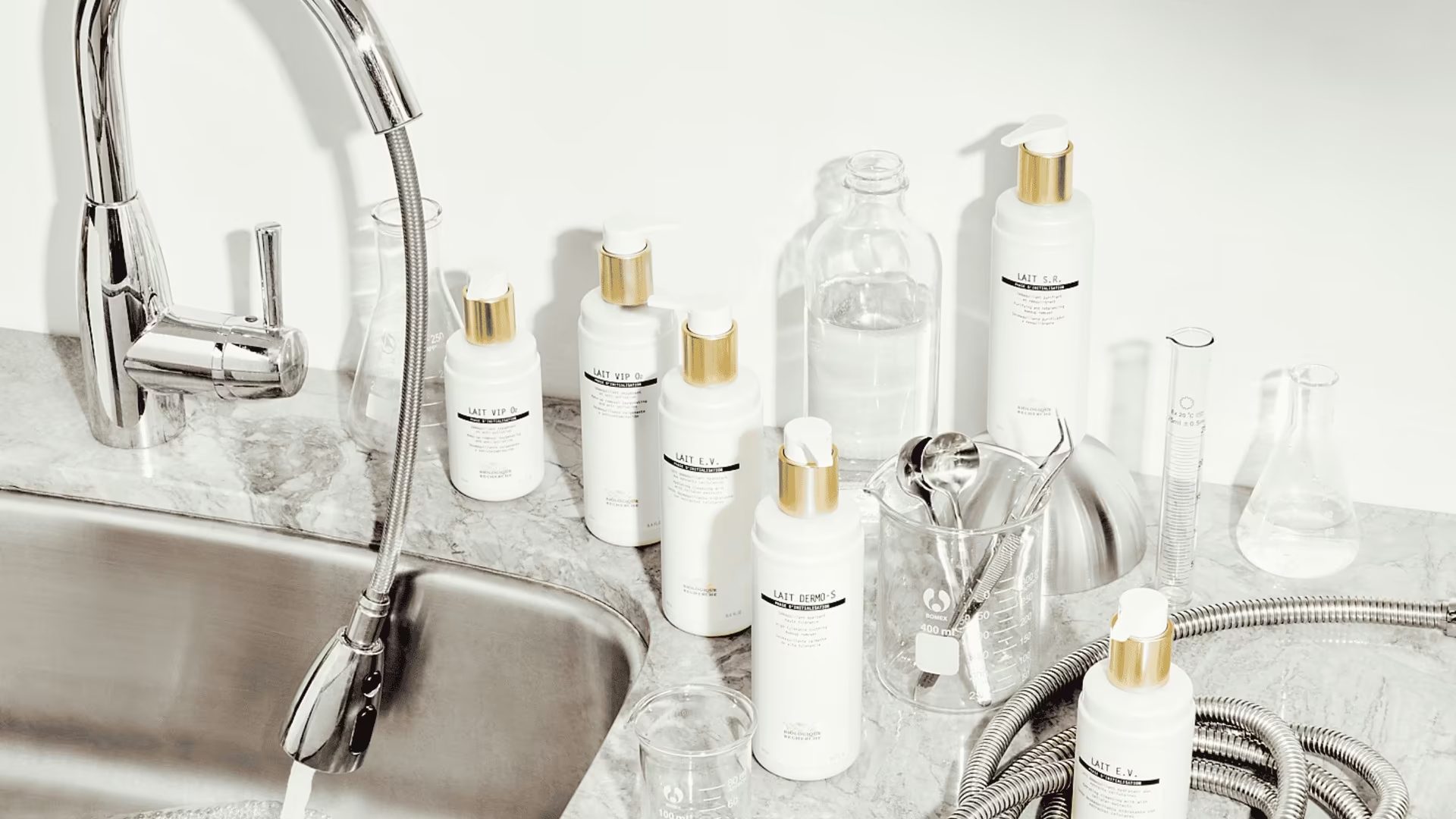
Living Beauty
402,490 → 1,007,144 impressions
Beauty & personal care


Madhippie — Performance creative
50+ assets/mo · 30%+ thumbstop
Beauty & personal care


Marvel Styles — Disney — Organic social
+40% saves · 9%+ engagement
Apparel & fashion


MDF Mécanique — Google Ads
187 ad calls · CA$37 each
Automotive
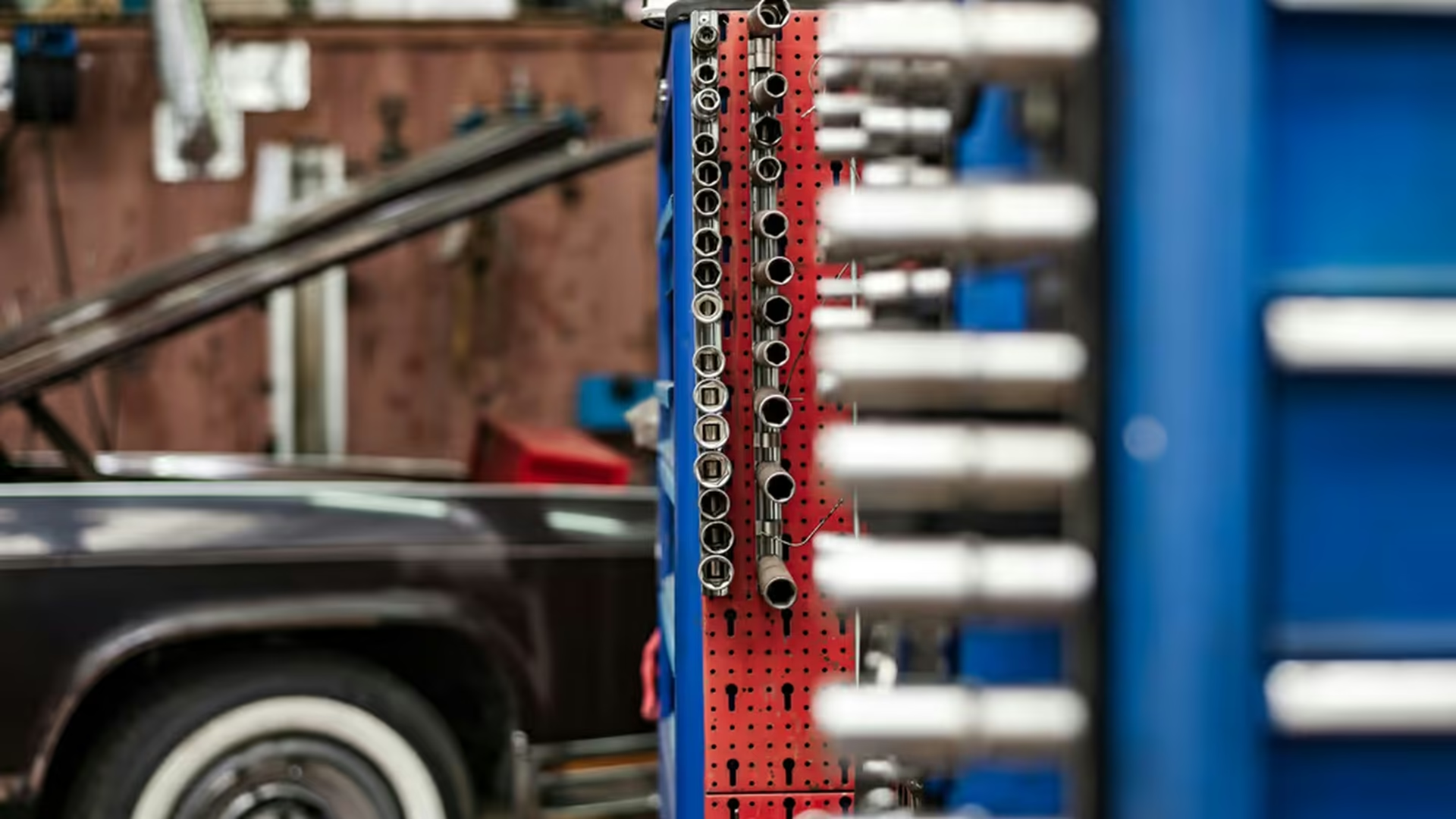
MDF Mécanique Laval
240 leads at CA$33 from CA$7,966
Automotive


Medic Québec
152 → 3,855 organic clicks
Health & medical

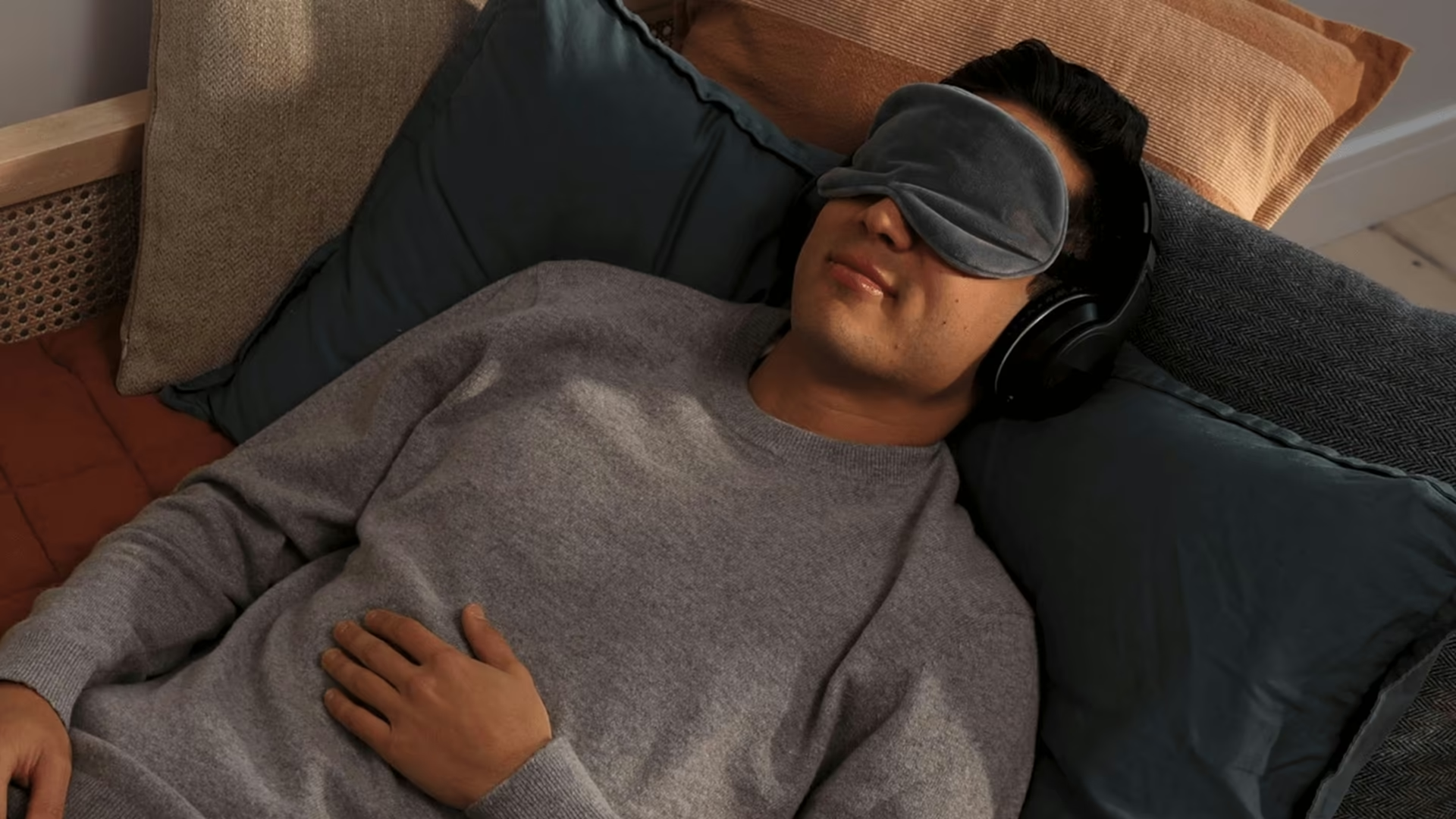
Mindbloom — Influencer marketing & paid social
CAC −25% · referrals +40%
Health & medical

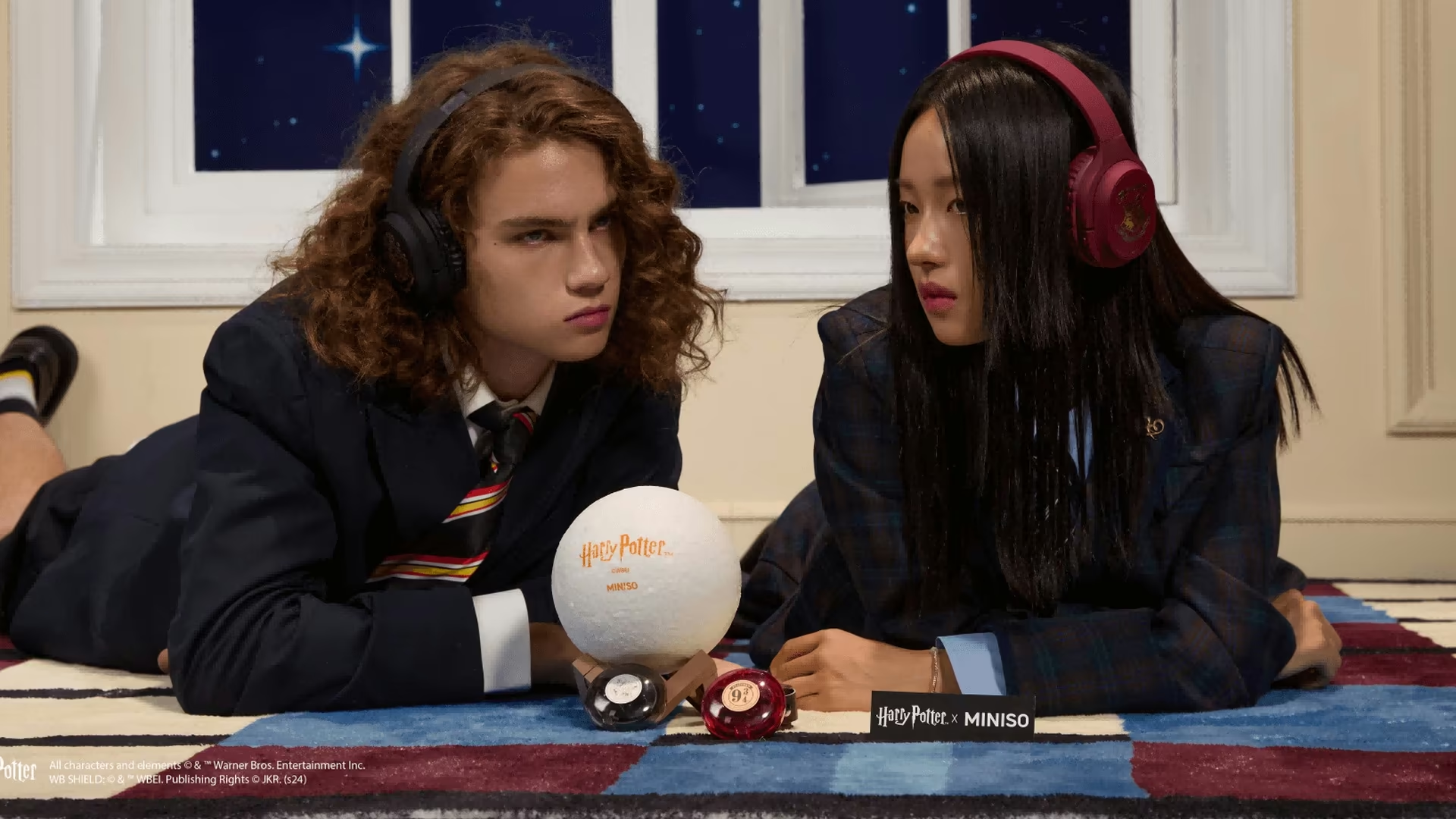
Miniso — Influencer activations
7M+ views · 200+ activations
Retail & e-commerce


Miro — B2B creator marketing
20M+ impressions · 25 KOLs
B2B & SaaS


Mogu Mogu — Influencer-led high-reach campaigns
#28 → #3 · 445M+ views
Food & beverage

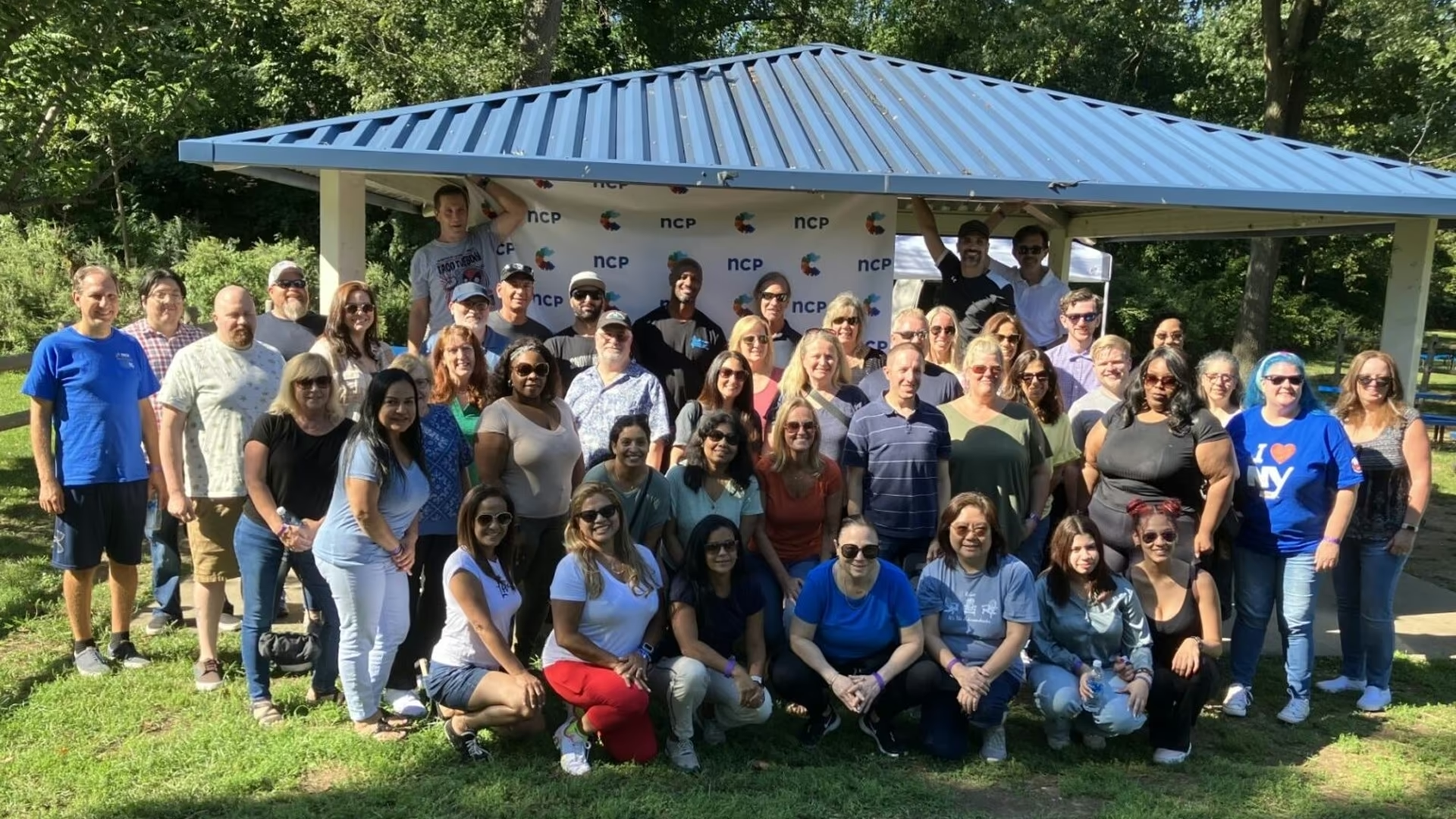
National Consumer Panel — UGC-driven acquisition & paid media
CPI −30% · CPA −20%
Professional services


National Debt Relief — UGC, performance creative & influencer strategy
CVR +25% · CAC −30%
Fintech & financial services

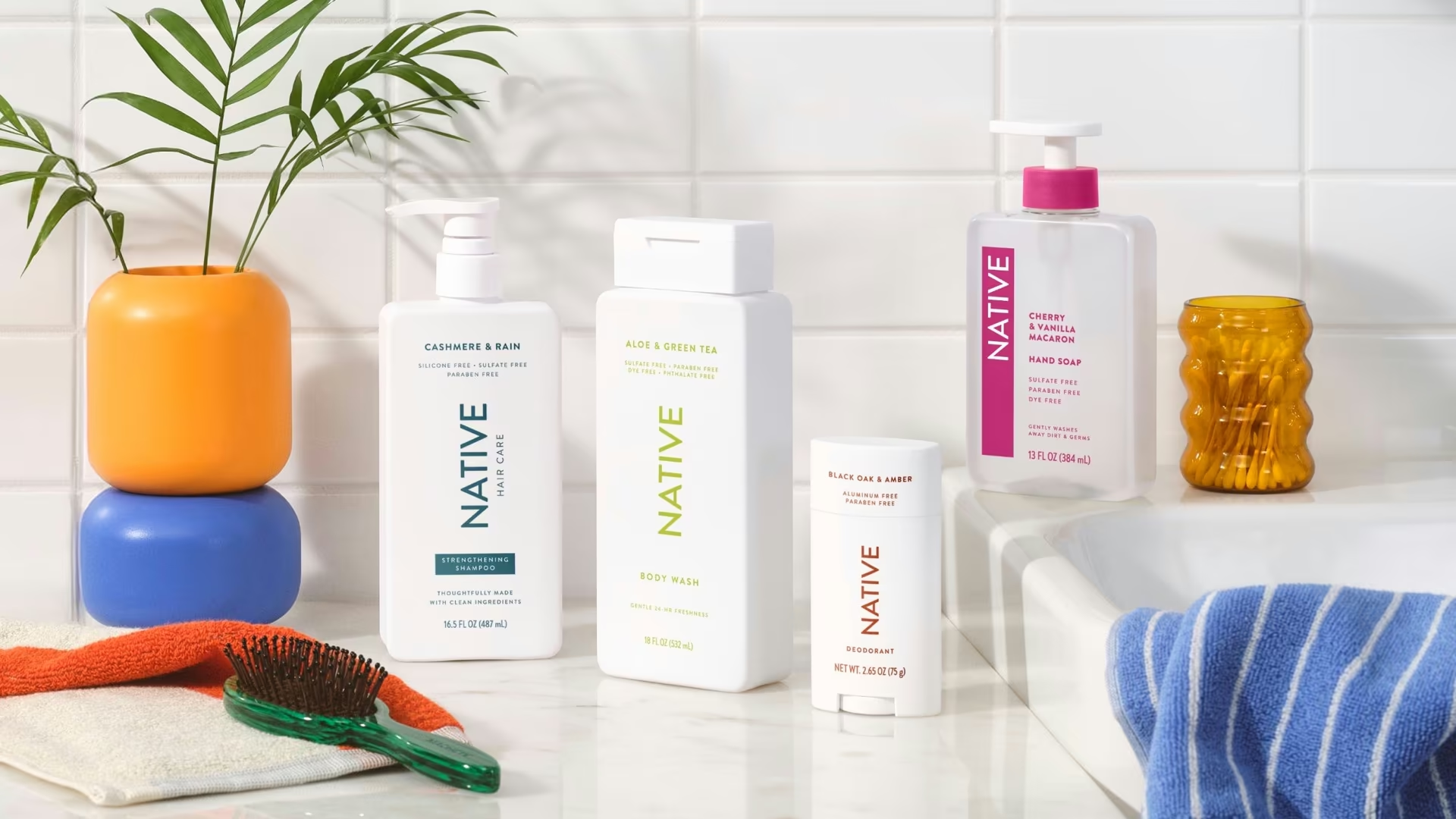
NATIVE — UGC, studio content & retouching
1,000+ assets · 50+ creators
Beauty & personal care

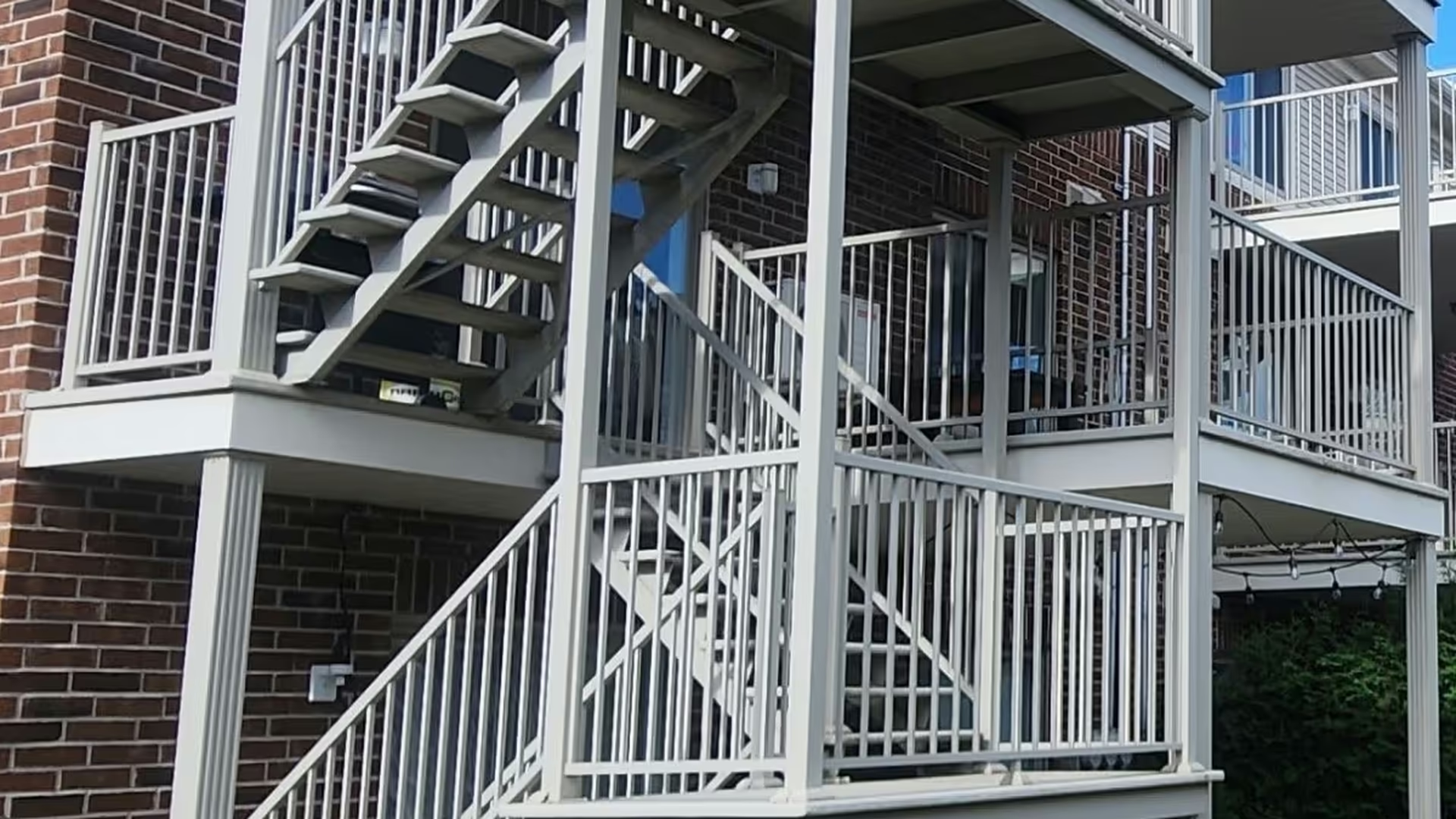
Nettoyage Danfour
+39% leads at −26% cost, flat budget
Home services & trades

Nettoyage Danfour — SEO
+228% organic impressions
Home services & trades


New Balance — Casting, post-production & influencer marketing
7 athletes · 750k audience
Apparel & fashion

NielsenIQ — Global UGC at scale
100 creators/mo · $20M+ media
Professional services


Nordstrom / Wildfang — Micro influencer & gifting
500+ assets · 10M+ views
Apparel & fashion


Nurse.com — Influencer-led creative strategy
200k+ users · <$0.20 CPC
Health & medical

Nuun — Nestlé — Influencer marketing & UGC
60%+ TOFU capture · +30% engagement
Food & beverage

Oever — Event promotion (Google Ads)
1,678,801 impressions · $3.05 CPM
Events & venues

Peintres Montréal — SEO
+441% sessions
Home services & trades

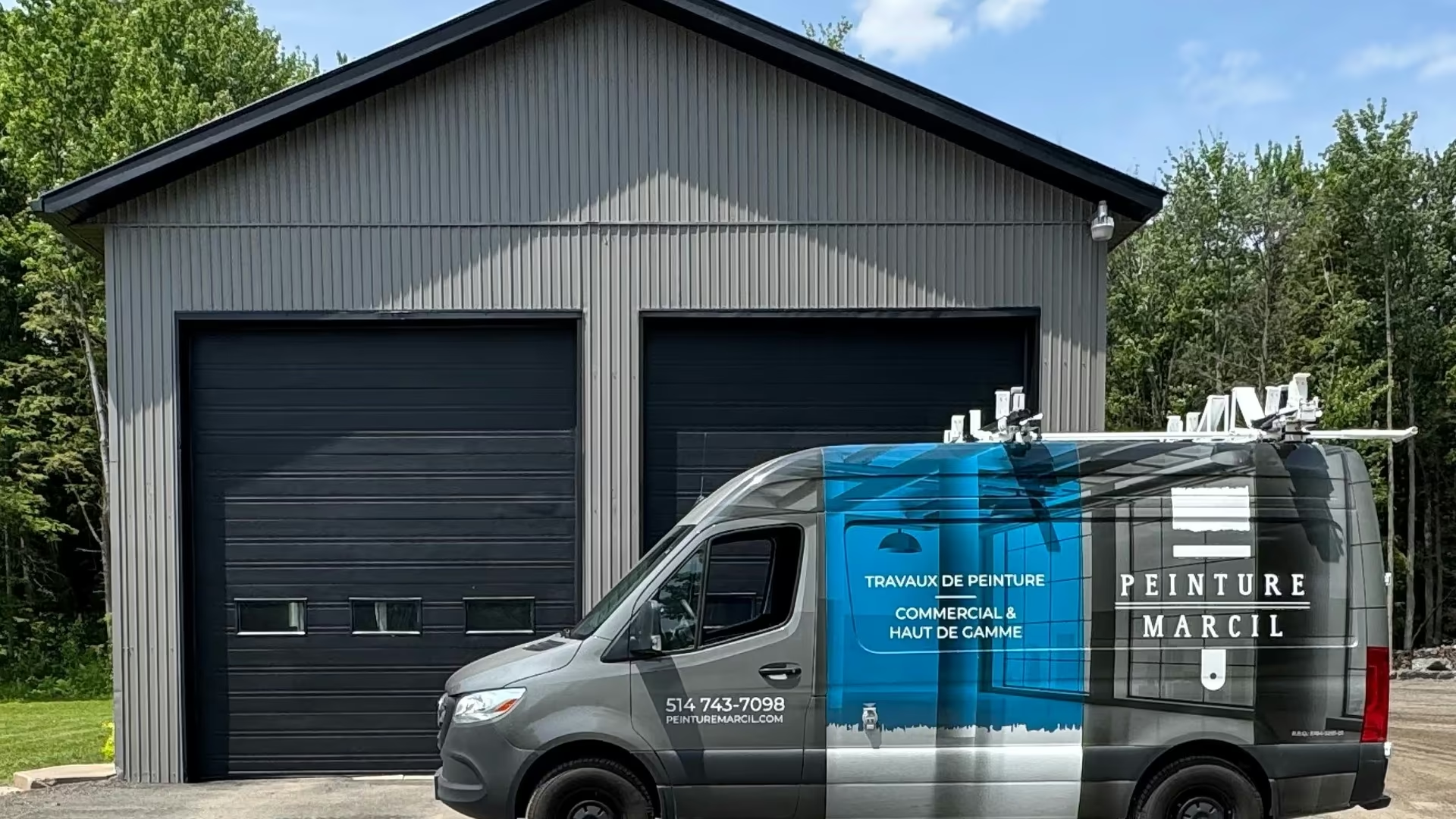
Peinture Marcil — SEO launch
0 → 2,176 sessions
Home services & trades


Pièces d'auto La Plaine
561 → 1,669 calls, flat spend
Automotive

Plomberial — Meta Ads
30 leads · CA$32.97
Home services & trades
Plomberial — SEO
+887% impressions
Home services & trades


Polarsteps — UGC strategy & content production
136+ assets · 60+ creators
Travel & mobility


Prépa PPL — audience launch
0 → 1,575 sessions/month
Education & training


Rail Europe — Creator-led UGC & content strategy
28+ outputs · 2 audience contexts
Travel & mobility


Réparation Toiture Montréal
Sessions 523 → 1,367 matched
Home services & trades

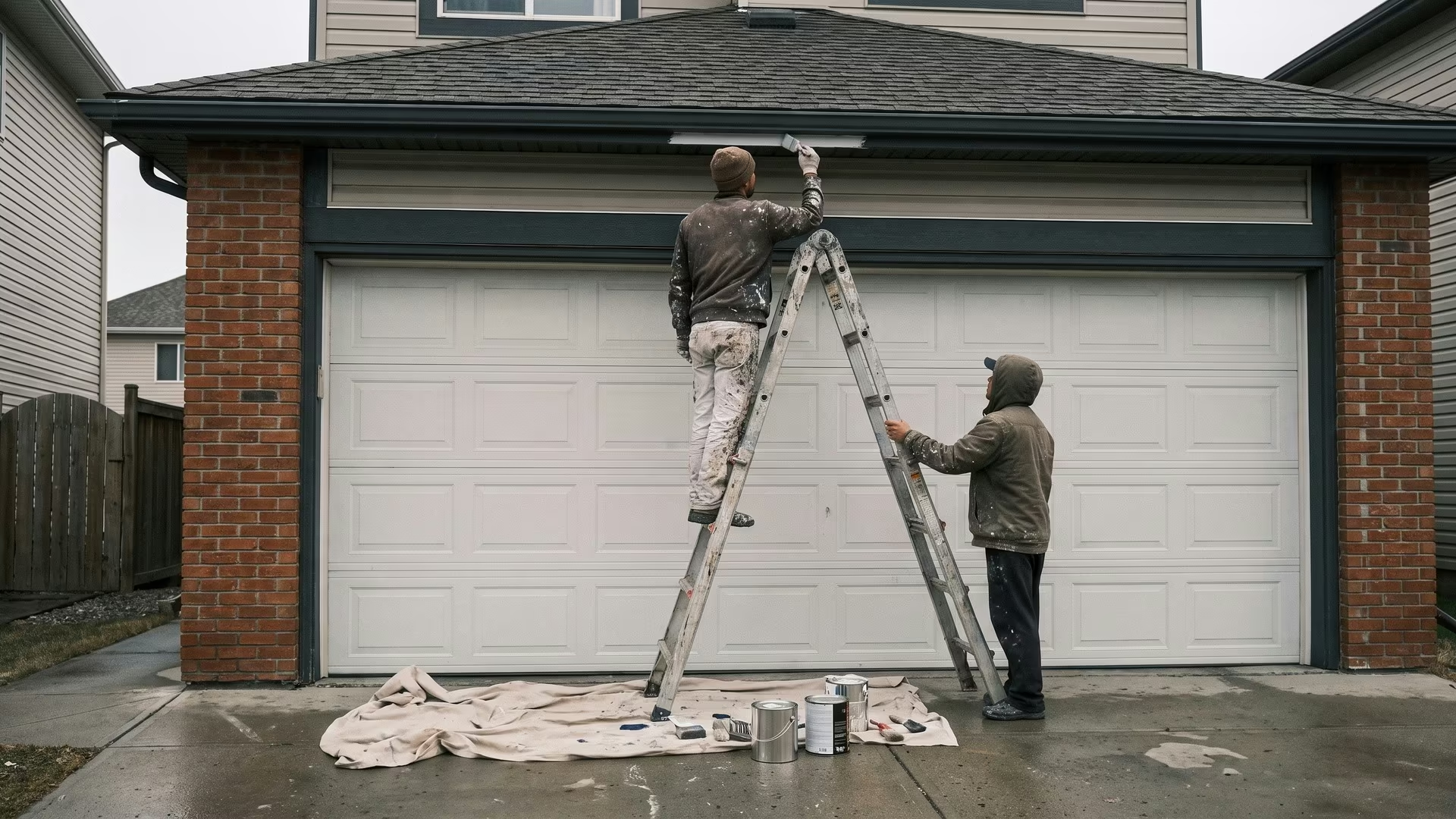
Santoy Calgary Painters — SEO
+46% sessions
Home services & trades


Secourisme RCR Plus — SEO
+100% impressions · clicks steady
Education & training


Slynumber — Creator strategy & paid media
90K+ installs · 20K+ signups
Consumer apps & platforms

Soffite Fascia Montréal
143,856 impressions from near zero
Home services & trades

Solution Cimex
48 → 387 calls from ads
Home services & trades


Solutions Prox-Secur — SEO
565 → 5,195 clicks
B2B & SaaS

SOS Électricien Montréal — SEO
+17% clicks · +24% reach
Home services & trades

SOS Plombier Montréal
+263% organic sessions
Home services & trades


Stone Decorative — Organic recovery and tracked calls
137 → 1,075 monthly clicks · +85% calls
Home services & trades


Sudipta Fitness
CPL $876.65 → $32.43
Health & medical
Over 253x 5-star

reviews
"Their transparency, attention to detail, and collaborative approach made them feel like an extension of our own team."
Book your strategy call today!
{"@context": "https://schema.org", "@type": "Article", "headline": "How Bumble replaced staged ads with real first dates", "about": {"@type": "Organization", "name": "Bumble"}, "author": {"@type": "Organization", "name": "Web Tonic", "url": "https://www.webtonic.io"}, "publisher": {"@type": "Organization", "name": "Web Tonic", "url": "https://www.webtonic.io"}, "description": "Real first dates instead of staged content — and a lower CPA", "mainEntityOfPage": "https://www.webtonic.io/case-study/bumble-creator-ads"}















.webp)
.webp)