THE LOSS ALREADY HAPPENED. WHO DID THEY CALL?
Marketing for restoration firms that want the first call
Water, fire, smoke, mould and storm work arrive at 2am and go to whoever answers. We make sure that is you — and we report on jobs signed, not on clicks.








Tell us a little about your brand and we'll be in touch within 24 hours to lock in a time.


average US homeowners water-damage and freezing claim (III, 2018–2022)
insured homes files a water-damage or freezing claim every year
US restoration firms competing for that work (IBISWorld)
of owners put licensed and insured first when choosing a restorer
We made the difference for those brands

Consumer tech and platforms

Consumer tech and platforms

Food & beverage

Creative, content, arts & culture

Consumer tech and platforms

Healthcare & regulated services

B2B software, fintech, insurance

Beauty, personal care & wellness

Healthcare & regulated services

Consumer tech and platforms

B2B software, fintech, insurance

B2B software, fintech, insurance

Consumer tech and platforms

Creative, content, arts & culture

Home essentials, appliances, kitchen & pet

Healthcare & regulated services

Food & beverage

Beauty, personal care & wellness

Food & beverage

B2B software, fintech, insurance

Beauty, personal care & wellness

Consumer tech and platforms

Creative, content, arts & culture

Retail & commerce

Home essentials, appliances, kitchen & pet

B2B software, fintech, insurance

Retail & commerce

B2B software, fintech, insurance

Retail & commerce

Home essentials, appliances, kitchen & pet
Who we are
A partner who understands mitigation runs on hours, not campaigns
Web Tonic is a digital marketing agency that runs contractor and property-services accounts every day — roofing, water damage, exteriors, trades — with the same senior team handling search visibility, paid media, creative and the website all three depend on. We are not a generalist shop applying one playbook to a dentist, a law firm and a mitigation crew. Restoration gets its own plan because the buying window is measured in minutes and half of the work is paid by an adjuster.
Sound familiar?
If you run mitigation crews, two of these will sound familiar.
The phone rings hardest in the week after a freeze or a storm, then goes quiet while trucks, dehumidifiers and payroll cost exactly the same. Referral partners send work when they remember you. And when a panicked owner searches at midnight, a national call centre or a lead reseller shows up before the company ten minutes away. None of that is a demand problem. It is a visibility, response and measurement problem, and all three move inside one quarter.
Volume swings with weather, so a strong February hides a March where the crews worked three days a week.
You buy shared emergency leads that reach three competitors at once, so your close rate says nothing about how good your mitigation actually is.
Nobody can tell you which calls last month came from search, from a plumber, from a property manager or from the truck wrap.
Results & timeline
Your first seven days with us.
Day 1–2: Audit
We map the service radius you can genuinely reach inside an hour, the companies outranking you in each town, and the state of your tracking. Most accounts we open are losing half their calls: no call tracking, after-hours calls counted nowhere, and no way to separate an emergency call from a price question.
Day 3–4: Offer and tracking
Measurement gets rebuilt end to end — calls, forms, after-hours routing and signed jobs — then the offer is rewritten the way a property owner reads it at midnight. Paul Davis’ North American homeowner research found the two things owners want first are a licensed and insured company (65%) and one that will coordinate with their insurer (60%), so those go above the fold, not on an about page.
Day 5–6: Build and launch
Campaigns, call tracking and the pages that receive the traffic go live together, highest-urgency searches first: flooded basement, burst pipe, sewage backup, fire and smoke cleanup, mould. Each town you cover gets a real page instead of one “service areas” list.
Day 7: Review and scale
You get the first written review: what launched, what the early numbers say, cost per booked job, and the 30-day roadmap. After that it is a weekly working session, not a monthly PDF.
for WHO
Built for emergency work, not borrowed from a retail playbook
Restoration demand is not created by marketing. It is created by a pipe, a storm or a fire, and the only question is who the owner reaches first. Water damage and freezing alone hit roughly one in every 62 insured homes each year at an average claim of $13,954, according to the Insurance Information Institute’s homeowners loss table — steady, insurance-funded work happening in your service radius right now.
The competition for it is fragmented rather than thin: the State of Restoration 2026 data set counts about 62,582 US restoration firms sharing a roughly $7.2 billion niche, most of them under two employees. That is why a mid-sized firm with real certifications can outrank a national brand locally, and why an unanswered 2am call is the most expensive thing in the business.
We work that gap with four things under one roof: local search visibility in every town you can reach in an hour, paid search that scales within hours of a weather event, paid social and creative to stay in front of plumbers, adjusters and property managers, and a site built to convert so the first three are not paying for a dead-end form. One senior team, one plan, and market exclusivity in writing. Outcomes live on our case studies.
Results
Real Spend. Real Revenue.



What we run for restoration companies.
Local visibility in every town your trucks can actually reach.
Emergency searches are hyper-local and unforgiving: whoever owns the map pack in that township gets the call. So the work is reviews, the profile that carries them, and a real page for each community rather than one list of cities you serve.
Each loss type is a separate search with a separate buyer: burst pipes and flooded basements, sewage backup, fire and smoke, mould remediation, storm and wind damage, contents pack-out, commercial and multi-family work. Each gets its own page and its own campaign, because someone standing in six inches of water and a property manager planning a mould assessment are not the same person and should not land on the same page.
Paid search that scales with the weather, not with a flat monthly plan.
A freeze week and a quiet week need different budgets. We run search campaigns and Local Services Ads with call tracking on every line, lift spend when urgent volume appears, and pull it back when queries turn into research. Ad copy is written per loss type, and the landing page matches the search instead of dropping everyone on a homepage.
Quality is judged on jobs mitigated, not raw enquiry count. Ten qualified emergency calls with an answered phone beat forty shared leads that reached three competitors first.
Referral and follow-up systems that keep you in the rotation.
Plumbers, adjusters, agents and property managers send the highest-margin work you get, and they send it to whoever they thought of last. Automated email and text sequences keep you present between losses, review requests go out the day a job closes, and every estimate that never got signed stays in a sequence instead of a notebook.
Response speed is the other half. Owners rank a 24-hour call centre (40%) and rapid time on site (37%) among the attributes they most want, per Paul Davis’ North American homeowner research, so we set up the routing, the missed-call text-back and the weekly report that shows exactly which calls went unanswered.
Services


Paid media across Google search, PPC, Local Services Ads, Meta and short video, structured by loss type and service area. Budget follows signed jobs, creative is refreshed before it fatigues, and every dollar traces to a booked mitigation rather than a click.
Social will not replace emergency search here, but it compounds it. It is where an owner checks that your company looks real before letting a crew into the house, and where a neighbourhood campaign after a completed job buys the cheapest customer you will ever get. A campaign that wins on cost per click and loses on signed work gets rebuilt, not defended.
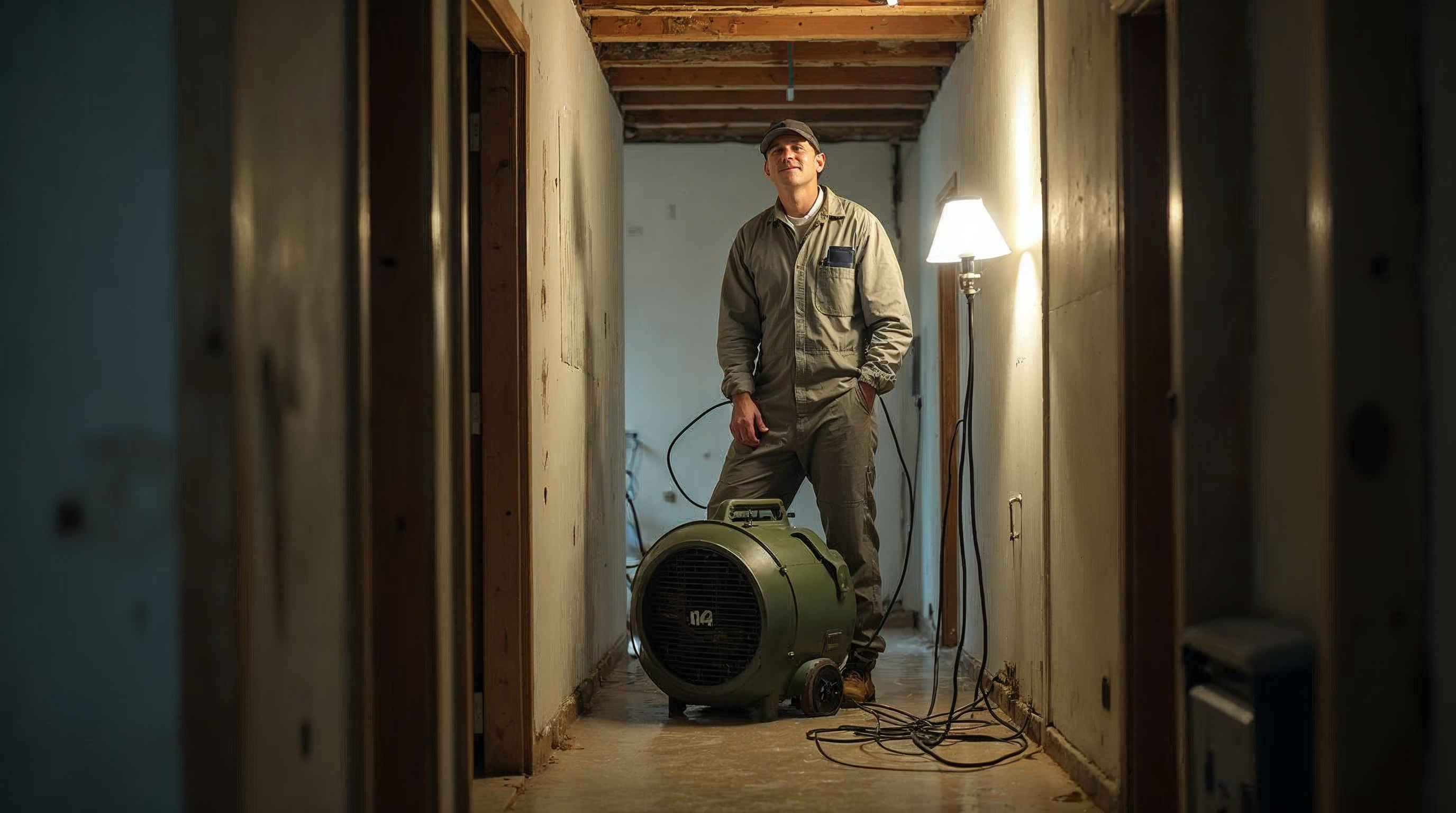
Content that answers what comes up on every loss: what insurance covers and what it does not, how a claim actually runs, what drying equipment is doing in the hallway for four days, when mould testing is warranted. Job-site photography, before-and-after sets and moisture-mapping footage build more trust than any paragraph — and they are assets an agency without site access can never produce. Done properly this is the strongest part of your online presence: the businesses that rank at the top of local results in this trade are usually the ones showing real work rather than describing it.
Data intelligence: tracked phone lines with after-hours attribution, deduplicated form events, and one dashboard tying every call and signed job back to what produced it — cost per job, close rate by source and by loss type, revenue by service area. If a number is not tied to work on the schedule it does not go on the report, and we connect the CRM you already use rather than pushing a new system. Reporting is data-driven rather than narrative: which advertising produced signed work, which location is growing, and which leads never got a callback.
A website built to convert under stress: fast on a phone in a wet basement, the emergency number visible on every screen, certifications and licences shown plainly, insurance coordination explained, and proof from the towns you serve. A panicked owner will not read three paragraphs — the site’s only job is to make calling you the obvious next action. Mobile profile pages, clear service lists and a single tracked number per location do more for visibility than a redesign, and they are the best place to start.
.avif)


















Built on trust. Proven by results.
We partner with SMBs and Fortune 500 companies to deliver more than reach — we bring clarity, execution, and measurable outcomes. Every successful partnership starts with a strong culture fit and a shared drive to grow.




faq
Answered questions.
Growth-minded firms that want tracked, accountable marketing — from single-crew water-damage outfits to multi-market companies running mitigation, contents and reconstruction divisions side by side, plus franchise operators who need local demand beyond what the brand supplies. What they share is wanting to build something durable instead of renting shared emergency leads forever, and most arrive after two or three agencies that reported on rankings while the schedule stayed thin.
We also hold market exclusivity: one restorer per market, written into the agreement. If we work for you, we are not building the same plan for the firm across town. Most of our clients are contractors and property-services businesses, so the digital strategies we bring to a restoration account have already been tested on other trades in the same local search results.
Paid search and Local Services Ads can produce emergency calls in the first week, because the demand already exists and we are simply appearing in front of it with tracking attached. Conversion fixes on the site land inside 30 days. Local organic visibility across a full service radius is a two-to-three-quarter programme: town-level pages and reviews compound, and anyone promising map-pack dominance in six weeks is bidding on your own brand name.
A fixed monthly fee, quoted separately from ad spend, scoped to the channels and the number of service areas you need. After the audit you get a plan tied to targets — cost per signed job first — and we will tell you which channels we would not run yet rather than selling the full bundle on day one. The right budget is the one you can hold through a quiet quarter, so we scope to that.
Usually we improve what you have, and that is the faster and cheaper route: page speed, mobile layout, the emergency contact path, certifications, proof and the service-area structure. A rebuild is worth it when the current site blocks growth structurally — no usable CMS, or a theme nobody can maintain. Either way you keep ownership of the site, the ad accounts and the analytics.
Either route starts with the same three things: mobile page speed, a visible contact path on every screen, and one honest page per location. Those are the highest-return fixes on almost every restoration website we open, and they help long before any campaign does.
Yes, and it is the highest-value work to get right. Search campaigns and Local Services Ads run on urgent queries with tracked phone lines and after-hours routing, so a 2am call reaches a person rather than a voicemail. Budgets scale within hours of a freeze or a storm and settle back afterwards, and reporting separates insurance-funded work from cash jobs so you can see which one is actually paying for itself.
Because referral volume is somebody else’s decision and search volume is yours, and the plateau most firms hit is structural: strong in one town and invisible in six, after-hours calls never counted, estimates never followed up, and no way to say which source produced last month’s revenue. Those are fixable, and cheaper than another 10% of ad budget. Done properly, marketing makes the referral network stronger too — partners send more work to the firm they keep seeing.
What you get is a named senior strategist rather than a coordinator relaying questions, with the paid, organic, creative and web specialists on one team. Most firms arrive from two or three vendors who each optimise their own report; one team means one set of numbers and one weekly review. If the fix turns out to be smaller than a full retainer, we scope to the fix and say so on the first call.