



Table of contents
LinkedIn advertising gives food service and catering companies direct access to corporate decision-makers who control catering budgets, event contracts, and bulk purchasing — here is what the latest benchmarks reveal about costs, conversions, and ROI in this channel.
Key Takeaways
- Food & beverage LinkedIn CPC averages $2.45, significantly below the all-industry LinkedIn average of $5.26–$8.50
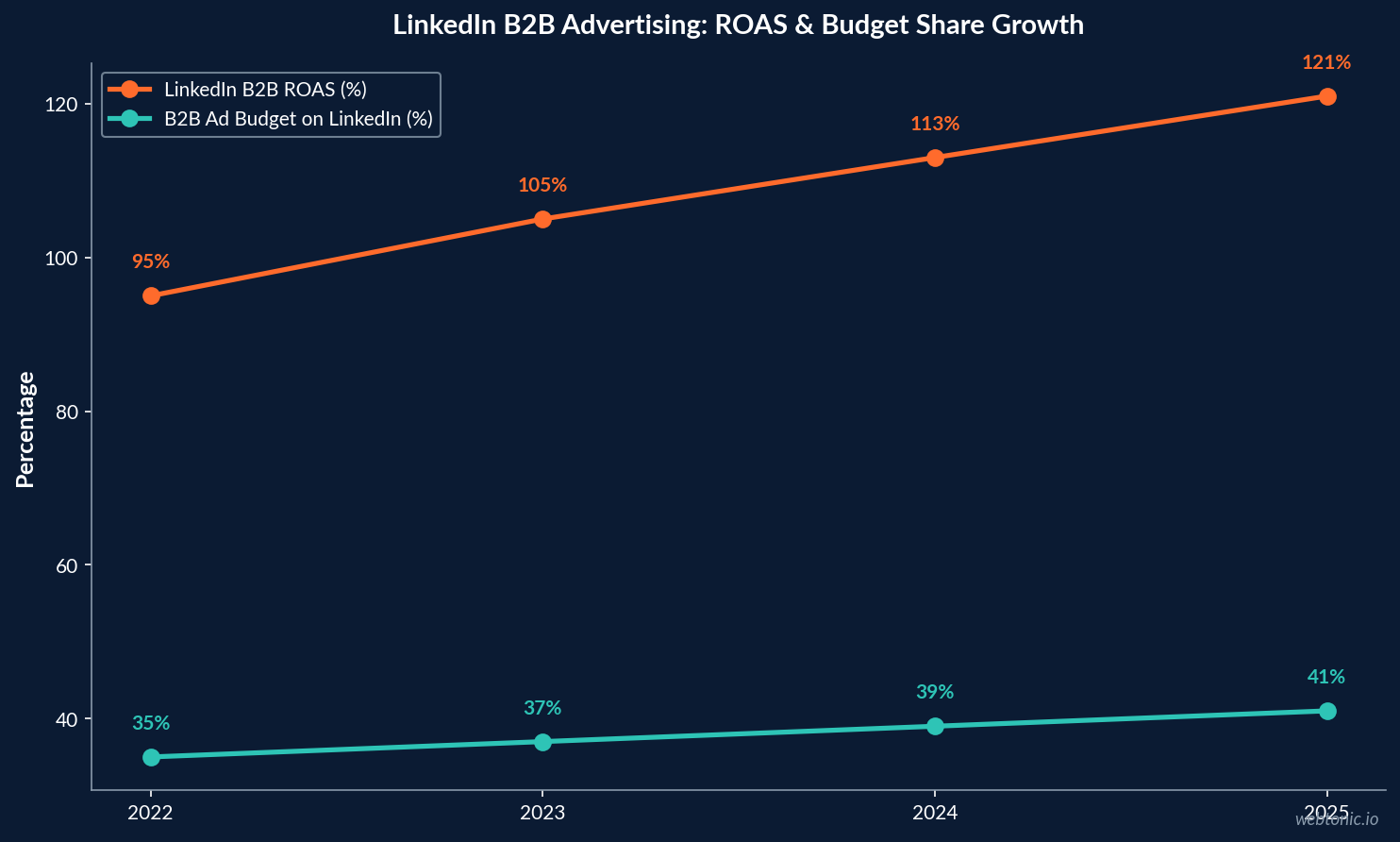
- LinkedIn now commands 41% of total B2B ad budgets, up from 39% in 2024, making it the largest single B2B advertising channel
- LinkedIn ROAS for B2B reached 121% in 2025, returning $2.21 for every $1 spent according to Dreamdata research
- Lead Gen Forms deliver 6–13% conversion rates, roughly 2× better than standard landing page campaigns
- Food & beverage LinkedIn CPM averages $19.13, well below the hospitality SaaS premium of $95 CPM
- Restaurant tech campaigns achieve sub-$50 cost per lead when prioritizing Lead Gen Forms and Document Ads
- Corporate catering LinkedIn posting frequency benchmarks at 2× per week for optimal organic engagement
Food Service LinkedIn Ads Benchmarks at a Glance
| Metric | F&B Average | 25th Percentile | 75th Percentile |
|---|---|---|---|
| CPC | $2.45 | $1.72 | $3.43 |
| CPM | $19.13 | $13.39 | $26.78 |
| CVR | 1.03% | 0.72% | 1.45% |
| Median CPL (all-industry) | $110 | $70 | $150 |
| Lead Gen Form CVR | 6–13% | — | — |
CPC Comparison: Food & Beverage LinkedIn vs Other Channels
The food and beverage vertical enjoys a CPC advantage on LinkedIn at $2.45, roughly 53% lower than the all-industry LinkedIn average of $5.26–$8.50. This discount exists because F&B advertisers compete against fewer B2B bidders in the auction than finance or SaaS verticals. However, restaurant SaaS companies targeting the same hospitality audience push CPCs to $8.50 or higher due to concentrated demand from POS, scheduling, and inventory platforms all bidding on the same thin audience pool.

LinkedIn B2B Advertising Dominance and ROAS Trends
LinkedIn has become the single largest advertising investment channel for B2B companies. According to Dreamdata's 2026 benchmarks report, LinkedIn commands 41% of total B2B ad budgets, up 2 percentage points since 2024. More importantly, LinkedIn ROAS grew to 121% in 2025 — generating $2.21 in revenue for every $1 spent — up from 113% in 2024.
For food service companies selling corporate catering contracts, bulk meal programs, or event services, this B2B channel reaches procurement managers and office administrators during work hours when they have ordering authority and budget lines for what catering companies sell. B2B food service lead generation typically allocates 30% of its channel mix to LinkedIn, second only to email at 50%, according to LeadHaste research.
LinkedIn Ad Format Performance for Food Service
| Ad Format | Best Use Case | Benchmark CVR | Key Advantage |
|---|---|---|---|
| Lead Gen Forms | Demo requests, catering quotes | 6–13% | 2× better than landing pages; pre-filled data |
| Document Ads | Menu guides, pricing sheets | 8–12% | High engagement; captures leads via gated content |
| Sponsored Content | Brand awareness, case studies | 1.03% | Broad reach; works for top-of-funnel trust building |
| Thought Leader Ads | Chef/founder authority content | 1.5–3% | Lowest CPC ($2.29); authentic personal brand |
| InMail (Message Ads) | High-value event proposals | 3–5% | Direct inbox delivery; high open rates |
Restaurant tech campaigns that prioritize Lead Gen Forms and Document Ads achieve sub-$50 cost per lead and 13% conversion rates, demonstrating that format selection matters as much as audience targeting in the food service vertical.
LinkedIn Advertising Cost Benchmarks Across Industries
Understanding where food service costs sit relative to other industries helps marketers set realistic budgets. The global LinkedIn CPC average for Sponsored Content sits at $5.26, with U.S. averages ranging from $6–$12. Meanwhile, average ROAS for B2B LinkedIn campaigns stands at $2.21 per $1 spent based on Dreamdata 2026 data.
| Industry | Avg CPC | Avg CPL | CTR Range |
|---|---|---|---|
| Food & Beverage | $2.45 | $60–$110 | 0.8–1.5% |
| Financial Services | $7.80–$15.20 | $148–$200 | 0.35–0.52% |
| Technology/SaaS | $6.20–$11.80 | $103–$160 | 0.42–0.65% |
| Hospitality SaaS | $8.50+ | $75–$150 | 0.5–0.8% |
| Education | $3.50–$6.00 | $55–$90 | 0.6–1.0% |
Audience Targeting Strategies for Catering LinkedIn Campaigns
Food service advertisers face a unique challenge on LinkedIn: the hospitality audience pool is thin relative to SaaS or finance. One audit of a hospitality SaaS company's $15K monthly ad spend found that CPMs hit $95 because every restaurant technology vendor bids on the same tight audience of restaurant owners and operations managers.
Successful catering advertisers mitigate this by targeting adjacent job functions — office managers, executive assistants, HR directors, and event coordinators — who actually place catering orders. This broadening strategy reduces CPMs while improving lead quality because these decision-makers have direct purchasing authority. According to Foundation Inc research, 29% of B2B marketing-qualified leads are influenced by paid LinkedIn campaigns, with an average buyer journey stretching 211 days from first touchpoint to closed deal.
Best Practices for Food Service LinkedIn Advertising
- Prioritize Lead Gen Forms over landing pages — the 6–13% conversion rate versus ~1% for standard campaigns makes forms the highest-ROI format for catering quote requests
- Target adjacent decision-makers (office managers, EAs, event planners) instead of only restaurant owners to avoid the $95 CPM premium on thin hospitality audiences
- Use Document Ads for menu guides and pricing sheets — gated content builds pipeline while showcasing your offering at 8–12% conversion rates
- Run Thought Leader Ads featuring chef or founder content at the lowest available CPC of ~$2.29 to build authentic brand authority
- Post organic content 2× per week on the company page to warm the audience before paid campaigns, per catering industry benchmarks
- Schedule campaigns during business hours when corporate buyers are actively planning events and have budget authority
- Budget at least $5,000/month to clear the learning-phase threshold and generate enough data for meaningful optimization
- Track MQL-to-SQL conversion — 5–15% of LinkedIn leads typically become sales opportunities, per growth marketing benchmarks
Seasonal LinkedIn Advertising Trends for Food Service
LinkedIn advertising costs for food service fluctuate predictably throughout the year, mirroring corporate event planning cycles. Q1 (January–March) offers the lowest CPCs as annual budgets reset and competition for business decision-makers dips after the holiday rush. LeadFeeder research documents LinkedIn CPC peaking at $15.72 in Q3 (July–September) and dropping to $10.48 in Q1 across all industries — a 33% swing that food service advertisers can exploit by front-loading campaigns.
For corporate catering companies, the most productive advertising windows align with fiscal year budget planning (October–December), annual company event scheduling (January–February), and summer gala and conference season (April–June). Running LinkedIn campaigns outside these windows doesn't necessarily waste budget, but the conversion intent behind clicks tends to be lower because fewer prospects are actively shopping for catering vendors.
The annual pattern also affects content strategy on the platform. Posts about holiday catering packages outperform in September–November, while recurring corporate lunch programs resonate most in January when businesses are establishing new vendor contracts. Aligning ad creative with these buying windows can improve CTR by 15–30% compared to evergreen messaging run year-round.
LinkedIn Lead Quality vs Other Channels for Food Service
While LinkedIn delivers fewer raw leads than Meta or Google Ads per dollar spent, the lead quality gap is substantial for B2B food service. Lead-to-opportunity conversion rates on LinkedIn range from 5% to 15%, according to MetadataONE's 2026 B2B benchmarks, compared to typical 2–5% rates on Facebook for B2B verticals. The higher conversion rate offsets the premium cost per click because each LinkedIn lead is more likely to hold purchasing authority.
Corporate catering contracts frequently exceed $10,000–$50,000 annually for recurring meal programs, making a $110 cost per lead acceptable when the close rate justifies the investment. This dynamic is why 39% of B2B companies allocate their largest single ad budget share to LinkedIn — the lifetime value of a converted corporate catering client outweighs the acquisition cost by 10–50×.
Food service brands that track the full funnel from LinkedIn click to signed contract consistently find that LinkedIn-sourced clients have higher average order values and longer retention periods than clients acquired through social media or paid search. The professional context of the platform filters out consumer-intent traffic that drives up lead volume without driving revenue on other channels.
Creative Strategy for Food Service LinkedIn Campaigns
Ad creative performance on LinkedIn differs fundamentally from consumer-facing platforms. Facebook and Instagram reward visual storytelling and emotional hooks, while LinkedIn rewards professional utility and clear value propositions. For food service advertisers, the most effective creative approaches include:
- Case study carousels showing real event setups, menu presentations, and client testimonials — these generate 2–3× the engagement of static image ads because they give prospects a preview of the actual service experience
- Behind-the-scenes video of kitchen operations running 30–60 seconds, which builds trust by demonstrating food safety standards, team capability, and volume capacity that corporate buyers need to verify before signing contracts
- Data-driven infographics about industry trends (e.g., "72% of employees say workplace meal programs improve satisfaction") that position the catering brand as an informed industry partner rather than just a vendor
- Chef or founder thought leadership posts promoted as Thought Leader Ads at the lowest CPC tier (~$2.29), building personal brand authority that transfers to commercial trust
Testing frequency matters on LinkedIn because creative fatigue sets in faster with smaller B2B audiences. Plan to refresh ad creative every 4–6 weeks and maintain 3–5 active ad variations per campaign to prevent frequency-driven CPM inflation.
Food Service LinkedIn Ads vs Other Marketing Channels
Catering companies often compare LinkedIn against Meta (Facebook/Instagram) and Google Ads. While Facebook Ads deliver cheaper CPCs for consumer-facing restaurants, LinkedIn excels for B2B food service segments — corporate catering, institutional meal programs, and event catering — where the average deal value justifies the higher cost per lead. A $10,000 corporate catering contract can absorb a $100 CPL far more easily than a $25 consumer dinner order.
| Channel | Best For | Avg CPC | Typical ROAS |
|---|---|---|---|
| LinkedIn Ads | Corporate catering, B2B contracts | $2.45 | 121% (B2B avg) |
| Google Ads | High-intent local searches | $2.80 | 200–400% |
| Facebook/Instagram | Consumer dining, events | $1.12 | 150–300% |
| Email Marketing | Retention, repeat orders | ~$0 | 3,600–4,400% |
Frequently Asked Questions
How much do LinkedIn Ads cost for food service companies?
Food and beverage LinkedIn Ads average $2.45 per click (CPC) and $19.13 per thousand impressions (CPM) based on Q4 2024–Q1 2025 benchmarks. The median cost per lead across all industries on LinkedIn is $110, but food service companies using Lead Gen Forms often achieve sub-$50 CPL with optimized targeting.
Are LinkedIn Ads effective for catering businesses?
Yes, particularly for B2B catering segments. LinkedIn ROAS for B2B campaigns reached 121% in 2025, and Lead Gen Forms deliver 6–13% conversion rates — roughly double the rate of standard landing page campaigns. The platform excels at reaching corporate decision-makers during business hours when they hold purchasing authority.
What LinkedIn ad format works best for food service marketing?
Lead Gen Forms consistently outperform other formats for food service, delivering 6–13% conversion rates compared to approximately 1% for Sponsored Content driving to external landing pages. Document Ads perform well for sharing menu guides and pricing at 8–12% conversion rates, while Thought Leader Ads offer the lowest CPC at approximately $2.29.
How does food service LinkedIn CPC compare to other industries?
Food and beverage enjoys one of the lowest LinkedIn CPCs at $2.45, compared to $7.80–$15.20 for financial services and $6.20–$11.80 for technology. This lower cost reflects reduced B2B advertiser competition in the F&B space relative to finance, SaaS, and professional services verticals.
What budget should a catering company allocate for LinkedIn Ads?
Industry practitioners recommend a minimum of $5,000 per month to clear the learning-phase threshold and generate statistically significant optimization data. For food service B2B campaigns, LinkedIn typically receives 30% of the total digital channel mix, second only to email marketing at 50%.
Sources
creativegrade.tech/benchmarks/food-beverage/linkedin/cpc
creativegrade.tech/benchmarks/food-beverage/linkedin/cpm
creativegrade.tech/benchmarks/food-beverage/linkedin/cvr
dreamdata.io/blog/announcing-linkedin-ads-benchmarks-report-2026
foundrycro.com/blog/linkedin-ads-benchmarks-by-industry-2026
calc4marketers.com/linkedin-ads-benchmarks
cufinder.io/blog/benchmarks/catering
saashero.net/strategy/linkedin-ads-restaurant-tech-2026
leadgenius.com — hospitality SaaS ad spend audit
leadhaste.com/blog/b2b-lead-generation-for-food-and-beverage
foundationinc.co/lab/b2b-marketing-linkedin-stats


