Table of contents
Funny ads work because humour buys attention that media money cannot: a joke earns the watch time, and the brand rides along with it. The catch is that most comedy in advertising fails for one boring reason — the laugh has nothing to do with the product.
Below are 18 funny commercials worth studying, the humour mechanics behind each, and a testing framework so your own comedy sells something.
Key Takeaways
- 5.66 billion people now use social platforms and spend an average of 2 hours 40 minutes a day there, so entertaining creative competes with entertainment, not with other ads.
- Social ad spend is tracking at $317.33 billion and growing near 10.9% a year — paying to distribute dull work gets more expensive every quarter.
- TikTok's engagement rate by views fell to 3.85% in Q2 2026 while brand posting frequency rose 40%: more output, less reward for average ideas.
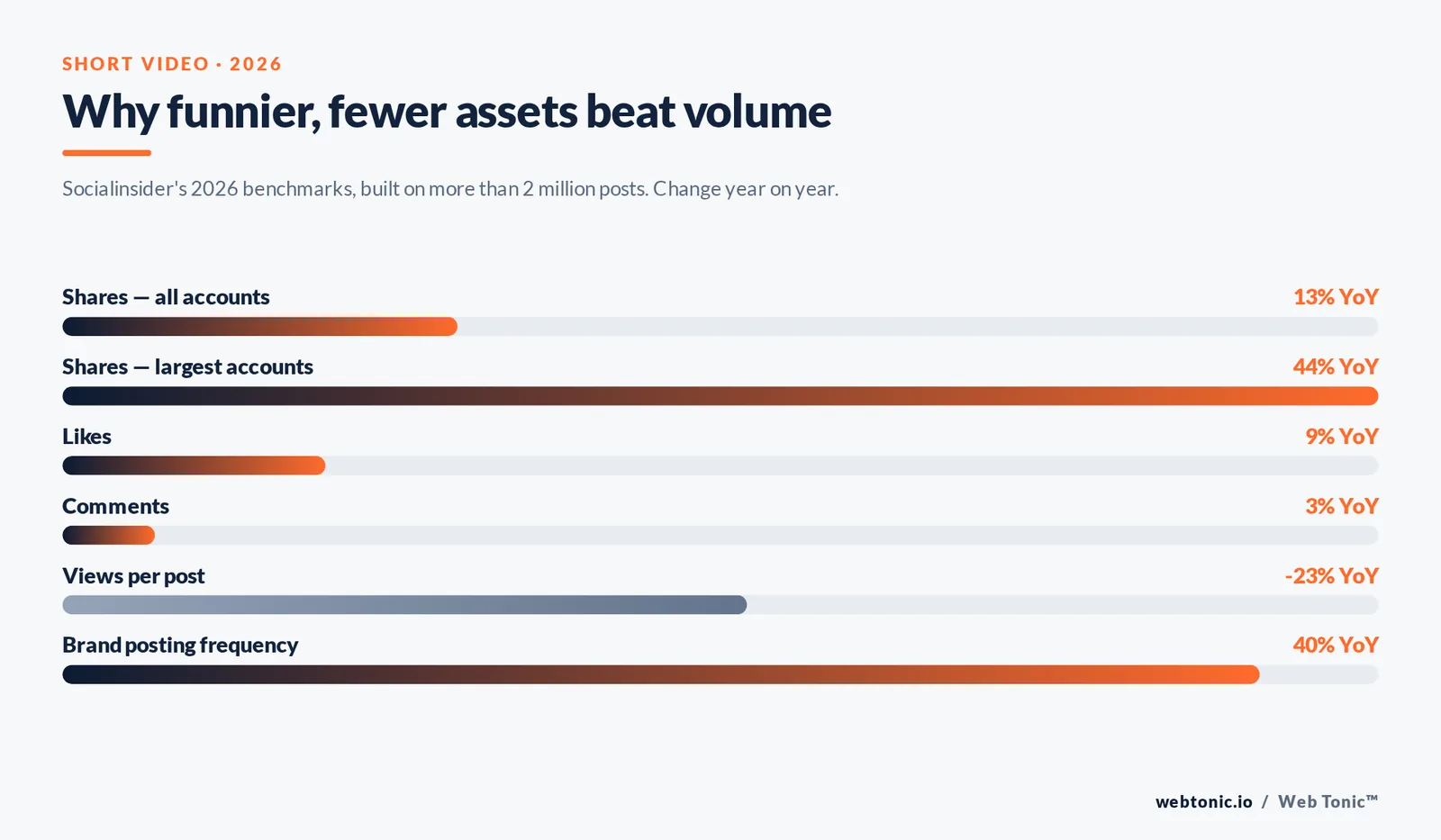
- Shares are the one metric still climbing on short video — up 13% year on year overall and 44% for the largest accounts. Comedy is the cheapest share engine there is.
- Only 7 of the 18 examples below rely on a celebrity; the rest are built on a repeatable comic device a small brand can copy.
- The best long-running comic platforms in this list have survived 14 to 40 years, because the joke sits on the product truth rather than beside it.
Why funny ads work (and when humour quietly fails)
Humour does three jobs at once. It holds attention long enough for branding to land, it creates a positive emotional trace that makes the brand easier to recall in-store, and it makes people forward the ad — free media. That is why emotional, entertaining creative keeps outperforming rational messaging in effectiveness datasets from the IPA and in the emotional-response benchmarks behind System1's Cost of Dull research, which quantifies the extra media spend needed for a neutral ad to match a distinctive one.
The failure modes are predictable. Comedy that mocks the customer creates avoidance. Comedy detached from the product tests brilliantly and sells nothing, because viewers remember the sketch and not the brand. Comedy that depends on a single punchline dies on the second viewing, which is fatal in paid social where frequency is high. And comedy that trades on stereotypes draws complaints — the UK's Advertising Standards Authority publishes rulings on exactly this territory, and the reputational cost lands faster than the media plan.
Two structural rules survive every category we have tested with clients on performance creative programmes. First, the brand must be the source of the joke, not the interruption of it. Second, the device must be repeatable, so one funny ad becomes a comic platform you can extend for years instead of a one-off you have to top.
18 funny ads, sorted by the comic device they use
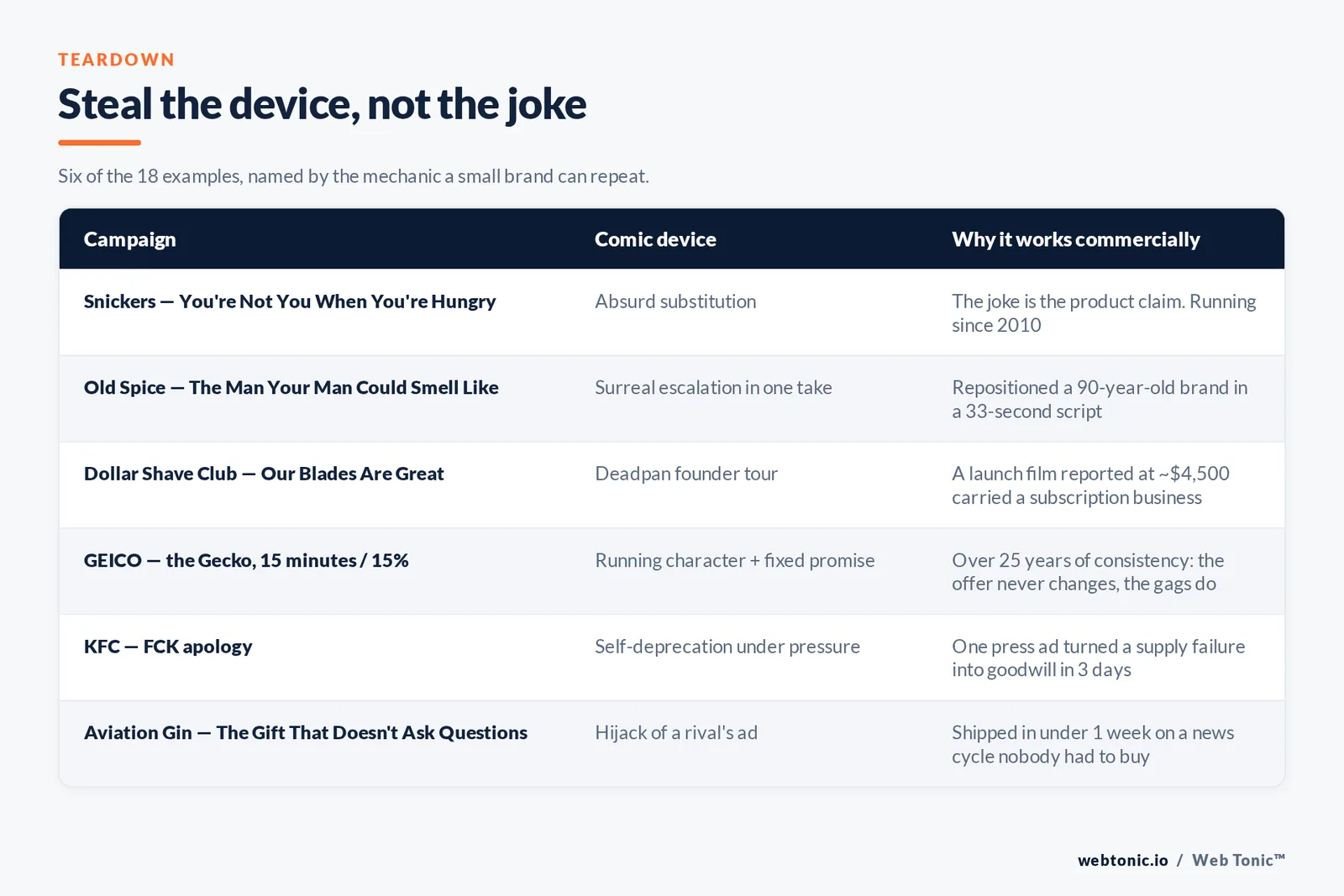
Each entry names the device so you can steal the mechanic rather than the joke. Brands and campaigns are cited as illustrative examples of publicly celebrated work; several have been honoured at Cannes Lions or in Effie effectiveness programmes.
| Funny ad / campaign | Comic device | Why it works commercially |
|---|---|---|
| Snickers — "You're Not You When You're Hungry" | Absurd substitution | The joke is the product claim: hunger changes you, the bar fixes it. Running since 2010. |
| Old Spice — "The Man Your Man Could Smell Like" | Surreal escalation in one take | Repositioned a 90-year-old brand for a younger buyer in a single 33-second script. |
| Dollar Shave Club — "Our Blades Are F***ing Great" | Deadpan founder tour | A launch film reported at roughly $4,500 to produce that carried a subscription business. |
| GEICO — the Gecko and "15 minutes could save you 15%" | Running character + fixed promise | Comic consistency for over 25 years; the offer never changes, the gags do. |
| Specsavers — "Should've gone to Specsavers" | Consequence gag | Every execution dramatises the cost of 1 missed eye test. |
| Dos Equis — "The Most Interesting Man in the World" | Mock-heroic hyperbole | Turned a low-interest import into a character-led brand for about 10 years. |
| Skittles — "Taste the Rainbow" | Committed weirdness | A 30-plus-year platform that licenses strangeness as brand property. |
| Wendy's — Twitter/X roast era | Punch-up insult comedy | Turns replies into earned reach; 73% of consumers switch to a rival if a brand ignores them, so being funny fast pays twice. |
| Aviation Gin — "The Gift That Doesn't Ask Questions" | Hijack of a rival's ad | Shipped in under 1 week, riding a news cycle nobody had to buy. |
| KFC — "FCK" apology | Self-deprecation under pressure | A single-page press ad converted a supply failure into goodwill in 3 days. |
| Compare the Market — "Compare the Meerkat" | Pun made literal | Solved a boring category by inventing 2 mascots people actually search for. |
| Volkswagen — "Lemon" and the small-car print era | Dry understatement | Print copy from the 1960s that still teaches restraint as comedy. |
| Doritos — fan-made Super Bowl spots | Slapstick with a twist ending | Crowdsourced comedy generated 10-plus years of near-free creative supply. |
| Cadbury — "Gorilla" | Absurd non-sequitur | No product demo for 90 seconds, all mood — proof joy can carry a brand alone. |
| IKEA — "Lamp" | Emotional bait-and-switch | Mocks the viewer's sentimentality in the final 5 seconds and sells replacement. |
| Halo Top / low-calorie challengers | Uncomfortable satire | Polarising humour that buys conversation on a media budget under 1% of category leaders'. |
| Squatty Potty — "This Unicorn Changed the Way I Poop" | Absurd metaphor for a taboo | Made an unmentionable product demonstrable in about 2 minutes. |
| Duolingo — the owl on TikTok | Unhinged mascot, native format | Comedy built for the feed, not adapted to it — the reason short-video shares compound. |
The six humour types that actually convert
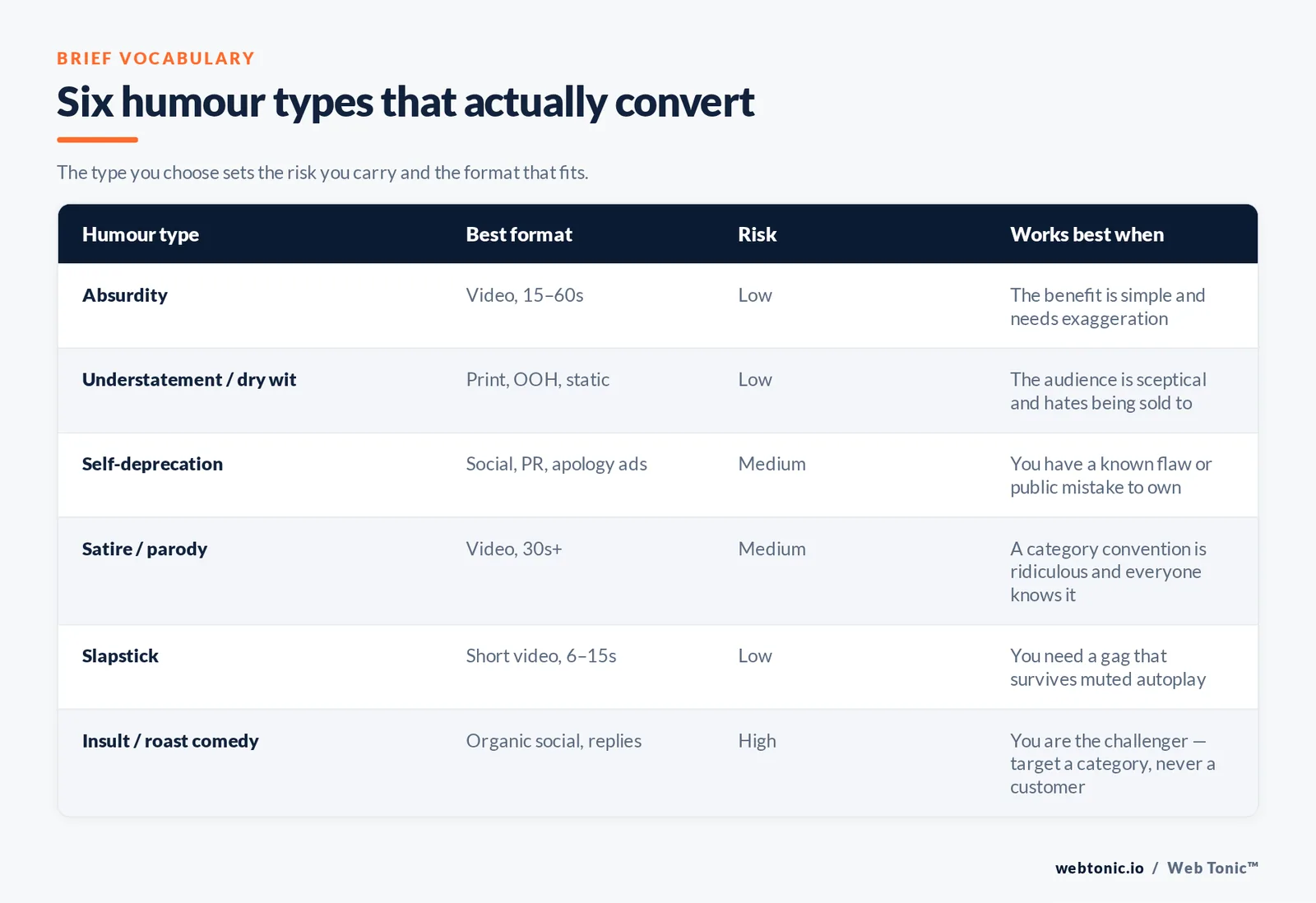
Comedy in advertising is not one technique. Categorise your options before you brief, because the type you choose determines the risk you carry and the format that fits. Sitting down with a creative team without this vocabulary is how brands end up funding a sketch with a logo taped to the end.
| Humour type | Best format | Risk level | Works best when |
|---|---|---|---|
| Absurdity | Video, 15–60s | Low | The product benefit is simple and needs exaggeration. |
| Understatement / dry wit | Print, OOH, static | Low | The audience is sceptical and hates being sold to. |
| Self-deprecation | Social, PR, apology ads | Medium | You have a known flaw or a public mistake to own. |
| Satire / parody | Video, 30s+ | Medium | A category convention is ridiculous and everyone knows it. |
| Slapstick | Short video, 6–15s | Low | You need a visual gag that survives muted autoplay. |
| Insult / roast comedy | Organic social, replies | High | You are the challenger and the target is a category, never a customer. |
Where funny ads perform best in 2026
Platform mechanics decide which jokes survive. Short vertical video rewards a gag that lands inside the first 3 seconds and repays it with shares; long-form YouTube rewards a build. Attention supply is the constraint everywhere: DataReportal puts daily social use at 2 hours 40 minutes across an average of 6.75 networks, and Sprout Social reports social ad spend of $317.33 billion chasing it.
Short video is also getting harder, not easier. Socialinsider's 2026 benchmarks, built on more than 2 million posts, show engagement rate by views down to 3.85% and views down 23% year on year while brands post 40% more. Shares, though, are up 13%. Read those together and the strategy is obvious: fewer, funnier assets aimed at the share button beat volume.
On YouTube, the annual creative rankings published by Think with Google are dominated by entertainment-first films rather than product walkthroughs — useful evidence when a stakeholder asks why the funny cut deserves the budget. Trade coverage in Ad Age and the academic-adjacent effectiveness debate collected under Harvard Business Review's advertising topic both keep landing in the same place: distinctiveness is the scarce asset.
Super Bowl commercials: the funniest ads get the biggest stage
No single day produces more funny commercials than Super Bowl Sunday. The Super Bowl is the one advertising slot where people actively watch the ads, so brands load the reel with humor: talking animals, celebrity cameos, slapstick, and the twist-ending format that has become a Super Bowl commercial convention. Snickers used the stage to launch "You're Not You When You're Hungry", and Doritos ran fan-made Super Bowl spots for more than 10 years, proving that a good comedic idea does not need a famous director.
The reason the Super Bowl matters to marketers who will never buy a Super Bowl slot is the content it generates. Every year the funniest commercials get compiled, ranked and shared for days afterwards, and those lists are a free research library. Watch 20 of the best Super Bowl commercials back to back and the shared structure becomes obvious: a clear setup in the first 5 seconds, one comedic escalation, a brand reveal that pays off the joke rather than interrupting it. That form travels to a 15-second social ad just as well as it works in a 60-second broadcast commercial.
Two cautions. First, a Super Bowl-style hilarious commercial is expensive to imitate badly; a weak celebrity cameo is worse than no cameo. Second, humor that depends on knowing the football context does not travel. If you want the Super Bowl effect on a normal budget, borrow the comedic form and skip the production scale.
How to make a funny advertisement: from idea to copy
Making a funny ad is a craft process, not a lucky day in the edit. Start with a list of 20 comedic ideas, not 1. Most will be bad, a handful will be good, and the shortlist is where the great work hides. Write each idea as a single sentence — "hunger turns you into someone else", "our blades are great and everything else is nonsense" — and cut any idea whose sentence does not contain the product.
Then write the copy long and cut it short. Print advertisement humor lives or dies on rhythm: the classic Volkswagen print ads are funny because every unnecessary word was removed, and the same discipline applies to a caption on social content. Read the copy aloud; if the laugh does not arrive in the first line of a static image or the first breath of a video, it will not arrive at all.
For the visual, keep the image simple. A funny advertisement usually contains one comic idea and one clean brand image, because two jokes competing in one frame cancel each other out. Test the ad muted and at thumbnail size — if the humor survives both, it will survive a busy feed on a distracted commute on any day of the week.
Finally, build a comedic system rather than a one-off. Old Spice, Snickers, Dollar Shave Club and Specsavers all turned one hit into a repeatable campaign, which is what makes humor a marketing asset instead of an entertainment expense. Keep a running list of every joke you tested, the format it ran in, and how the audience responded — that list becomes the most valuable creative content your marketing team owns, and it will help the next brief start from evidence rather than from a blank page.
How to brief and test comedy so it sells
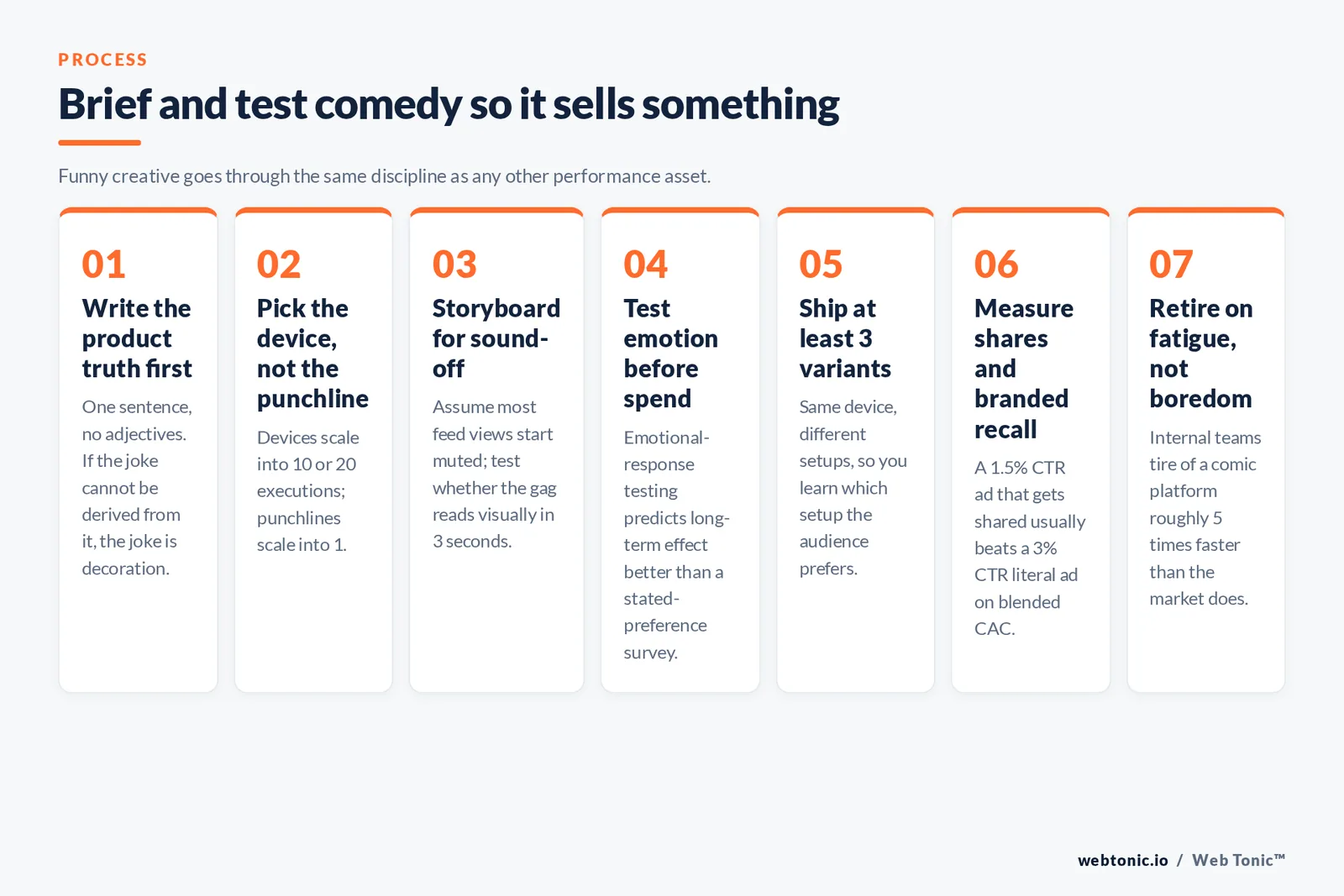
Funny creative should go through the same discipline as any other performance asset. The sequence we use inside growth marketing engagements is deliberately unromantic.
1. Write the product truth first. One sentence, no adjectives. If the joke cannot be derived from it, the joke is decoration.
2. Pick the device, not the punchline. Devices scale into 10 or 20 executions; punchlines scale into 1.
3. Storyboard for sound-off. Assume the majority of feed views start muted and test whether the gag reads visually in 3 seconds.
4. Test emotion before spend. Emotional-response testing of the kind catalogued in System1's Ipsos and System1 predicts long-term effect better than a stated-preference survey.
5. Ship at least 3 variants. Same device, different setups, so you learn which setup — not which brand — the audience prefers.
6. Measure shares and branded recall, not just CTR. A funny ad with a 1.5% click rate and heavy sharing usually beats a literal ad with a 3% click rate on blended acquisition cost.
7. Retire on fatigue, not on boredom. Internal teams tire of a comic platform roughly 5 times faster than the market does.
Common mistakes brands make with funny ads
The commonest error is treating humour as a tone-of-voice decision made after the media plan. Comedy is a structural choice: it changes the script length, the casting, the edit rhythm and the number of assets you need. The second commonest is a single hero film with no follow-up, which wastes the recognition you just bought.
Three more worth naming. Localising a joke by translating it — humour rarely survives literal translation, so re-write per market instead. Approving comedy by committee, which sands every edge off until the ad is merely pleasant. And skipping legal review on parody, where the difference between a laugh and a claim letter is one specific brand reference. If you want a second opinion on a comic platform before it goes live, talk to our team, and there are more creative teardowns across the Web Tonic blog.
FAQ
What are the funniest ads of all time?
The perennial shortlist includes Snickers' "You're Not You When You're Hungry", Old Spice's "The Man Your Man Could Smell Like", Volkswagen's 1960s print work, Dollar Shave Club's launch film, Specsavers' consequence gags and Cadbury's "Gorilla". What they share is not a comic style but a structure: the humour dramatises a real product truth, and the device can be repeated.
Do funny ads actually increase sales?
Emotional, entertaining advertising consistently outperforms purely rational messaging on long-term business effects in industry effectiveness datasets, and System1's Cost of Dull work quantifies the extra media spend a neutral ad needs to match a distinctive one. Humour is a reliable route to that emotional response — but only when the brand is central to the joke and branding is present early.
What type of humour is most effective in advertising?
Absurdity and understatement carry the least risk and travel best across markets. Self-deprecation is powerful when you have a real flaw to own. Insult comedy delivers the most earned reach and the most damage when aimed at a customer instead of a category convention.
Where can I watch collections of funny commercials?
YouTube brand channels remain the largest archive, Think with Google publishes annual creative rankings, and Cannes Lions and Effie both maintain public award showcases. Trade titles such as Ad Age cover new work weekly.
How many funny ads should we make at once?
Build one device and ship at least three executions of it before judging performance. A single funny ad is an anecdote; three variants of one device is a test you can learn from and extend for years.
Sources: System1 (Cost of Dull, insights library) · IPA · Socialinsider 2026 TikTok Benchmarks · Sprout Social social media statistics · DataReportal Digital 2026 · Think with Google YouTube Ads Leaderboard · Cannes Lions · Effie · ASA · Ad Age · Harvard Business Review.