Table of contents
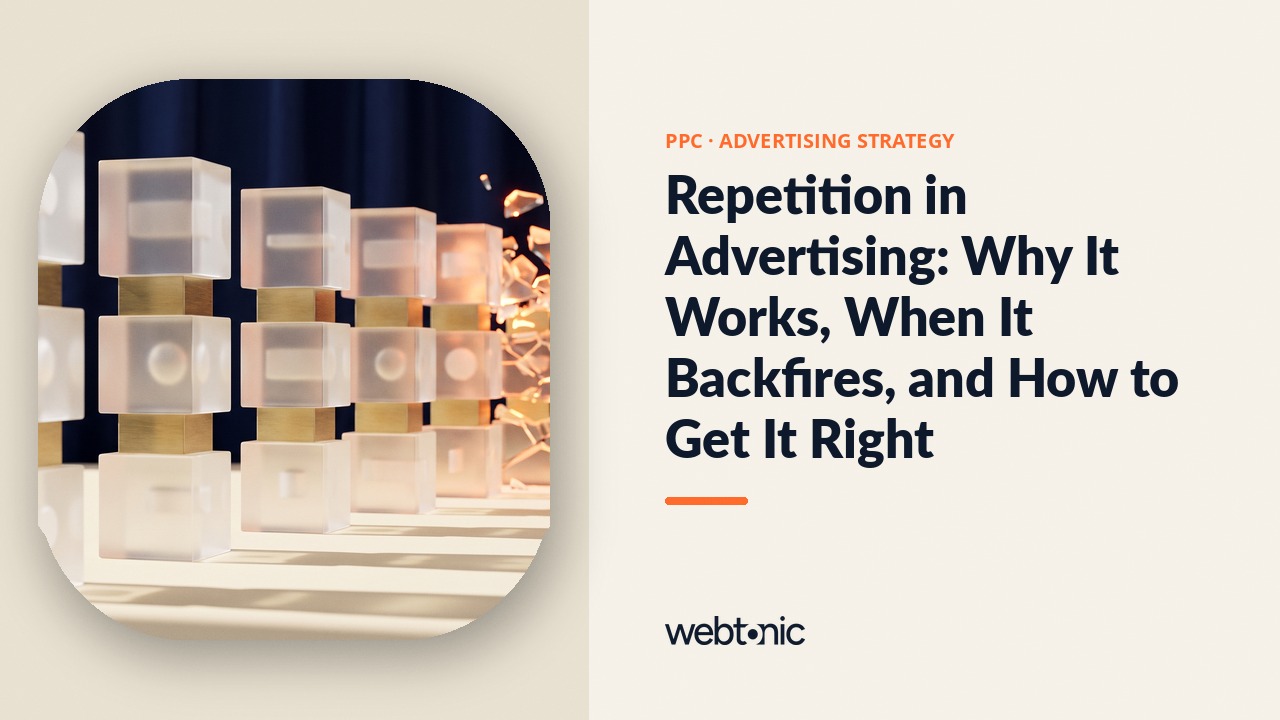
Repetition in advertising is one of the most powerful tools in marketing. The more frequently consumers encounter your brand message, the more likely they are to remember, trust, and act on it. Yet there is a critical line between effective frequency and overexposure.
Key Takeaways
- Consumers need an average of 3–7 exposures to a brand message before taking action, according to frequency studies by Magna and Roku (2023).
- The mere exposure effect — a psychological phenomenon proven in 200+ studies — shows that familiarity breeds preference, even when people cannot consciously recall seeing the ad.
- Ad fatigue sets in 15–20 % faster on social media than on traditional channels like television or out-of-home, per Meta's Creative Research Team data.
- Coca-Cola's "Share a Coke" campaign drove a 2 % increase in U.S. sales by repeating one simple, personalized concept across 80+ markets simultaneously.
- 68 % of consumers say they prefer brands that appear consistently across multiple channels, according to Salesforce's State of the Connected Customer report (2024).
The Psychology Behind Repetition in Advertising
Advertising repetition effectiveness is rooted in how human memory works. The brain processes thousands of stimuli daily and aggressively filters out noise. Your ad — no matter how brilliant — is competing against this filter. Repetition is the mechanism that moves a brand message from short-term awareness into long-term recognition.
Two psychological frameworks explain why this works:
- The mere exposure effect, first documented by psychologist Robert Zajonc in 1968, demonstrates that repeated exposure to a stimulus increases a person's preference for it — even without conscious awareness. In advertising terms, a viewer who has seen your logo or tagline multiple times will instinctively favor your brand over an unfamiliar competitor.
- The spacing effect (Ebbinghaus, 1885) shows that information presented at intervals is retained far better than information delivered all at once. This is why drip campaigns and multi-channel approaches outperform single-blast strategies.
The practical implication is clear: brand recall increases by up to 80 % when consumers see an ad 5+ times versus a single exposure (Nielsen Brand Effect data, 2023). But the delivery pattern matters as much as the frequency count.

Effective Frequency: How Many Times Is Enough?
The "Rule of 7" — the idea that a prospect needs to encounter your brand message seven times before buying — has been cited in marketing textbooks for decades. But modern research paints a more nuanced picture:
| Exposure Count | Consumer Response | Strategic Implication |
|---|---|---|
| 1st Exposure | Awareness — "What is this?" | Maximize reach to introduce the brand |
| 2nd Exposure | Recognition — "I've seen this before" | Reinforce the core message |
| 3rd Exposure | Consideration — "Maybe this is relevant to me" | Add proof points: testimonials, stats, case studies |
| 4th–6th Exposure | Preference — "I trust this brand" | Vary creative to maintain freshness while reinforcing the core message |
| 7th+ Exposure | Action or fatigue — "I'll buy" or "Make it stop" | Frequency capping and retargeting with new angles |
A 2023 study by Magna and Roku found that existing customers need only 2–3 exposures to elevate purchase intent, while new prospects require 5–7 exposures. This means frequency strategy should be segmented by audience familiarity — one size does not fit all.

The Multi-Channel Approach to Advertising Repetition
Repeating the same ad on the same channel is the fastest path to ad fatigue. Smart repetition uses a multi-channel approach to deliver the brand message across different touchpoints — social media, email, search, display, out-of-home, and video — so the audience encounters the message in varied contexts. This leverages the spacing effect while keeping the core message consistent.
Consider how Nike executes this masterfully:
- Television: Emotional storytelling ads that establish brand identity.
- Social media posts: Athlete endorsements, user-generated content, and short-form video.
- Email: Product launches and personalized recommendations.
- In-store: Point-of-sale displays echoing the same campaign visuals.
- Out-of-home: Billboard campaigns in high-traffic urban areas.
The tagline "Just Do It" has been repeated billions of times across these channels since 1988 — and it still works because the creative execution changes while the core brand message remains constant.
When Repetition Backfires: Ad Fatigue and Overexposure
There is a tipping point where repetition stops building brand recognition and starts eroding it. This phenomenon — advertising wearout — manifests as:
- Declining click-through rates: CTR drops by an average of 45 % after the 4th impression of the same creative on social media platforms (Meta internal data, 2024).
- Negative sentiment: 53 % of consumers report feeling annoyed by repetitive ads, with 37 % saying it makes them less likely to buy (HubSpot Consumer Survey, 2024).
- Brand damage: Overexposure can associate your brand with intrusion rather than value — the opposite of what repetition is supposed to achieve.
The solution is not less repetition but smarter repetition: frequency capping, creative rotation, and audience segmentation. Platforms like Google Ads and Meta Ads offer built-in frequency controls that prevent individual users from seeing the same ad more than a set number of times per week.

Iconic Campaigns That Used Repetition Brilliantly
The most memorable campaigns in advertising history all share one trait: they repeated a core idea relentlessly while evolving the creative execution.
| Campaign | Core Repeated Element | Duration | Result |
|---|---|---|---|
| Coca-Cola — "Share a Coke" | Personalized names on bottles | 2011–present (80+ countries) | +2 % U.S. sales, reversing a decade of decline |
| Nike — "Just Do It" | Tagline + athlete stories | 1988–present (37+ years) | Built the world's most recognized sportswear brand |
| Apple — "Shot on iPhone" | User-generated photos/videos | 2015–present | Reinforced camera quality as key differentiator |
| Geico — "15 Minutes" | Savings message + humor | 1999–present | #2 U.S. auto insurer (from #7) |
| McDonald's — "I'm Lovin' It" | Jingle + tagline | 2003–present (22+ years) | Globally recognized sonic branding |
Each campaign above repeated the message thousands — or millions — of times. But they stayed fresh by rotating the creative execution: new athletes for Nike, new names for Coca-Cola, new user photos for Apple. The takeaway for any brand is that repetition works when the message is consistent but the creative is dynamic.
Strategies for Effective Repetition in Your Advertising
Implementing repetition without triggering fatigue requires a deliberate framework:
- Set frequency caps: Limit impressions to 3–5 per week per user on digital channels. Monitor frequency reports in your ad platform and exclude users who have already converted.
- Rotate creative assets: Prepare 3–5 ad variations that share the same brand message but use different visuals, headlines, or formats. Rotate them on a 2–3 week cycle.
- Leverage retargeting: Use retargeting campaigns to deliver sequential messages — awareness ad first, then social proof, then a direct CTA — rather than repeating the same ad.
- Use a multi-channel approach: Distribute your message across multiple marketing channels — social media, email, search, and display — so repetition feels natural rather than intrusive.
- Monitor wear-out signals: Track CTR, frequency, and negative feedback metrics weekly. If CTR drops below 50 % of its initial rate, it is time to refresh the creative.
- Segment your audience: New prospects need more exposures than existing customers. Build separate frequency strategies for cold, warm, and hot audiences using data intelligence.
Repetition in Digital vs. Traditional Advertising
The mechanics of repetition differ significantly across channels:
- Social media: High scroll speed means ads are seen for fractions of a second. Repetitive ads on platforms like Instagram and TikTok fatigue audiences faster — creative refresh cycles of 7–14 days are now standard practice.
- Television: Longer attention spans and lean-back viewing allow for higher frequency before fatigue. TV ads can run for 4–8 weeks before declining in effectiveness.
- Search advertising: Users actively seeking information are more tolerant of repeated messaging. Performance-driven search ads can maintain effectiveness for months with minor copy variations.
- Email: Optimal email frequency is 1–3 sends per week for most B2B and B2C brands. Beyond that, unsubscribe rates spike by 25 % (Mailchimp Benchmarks, 2024).
- Out-of-home: Billboard and transit ads benefit from high-frequency exposure in daily commute routines. 65 % of consumers recall an OOH ad they saw in the past month (OAAA, 2024).
Measuring Advertising Repetition Effectiveness
Knowing that repetition works is only half the equation. You also need to measure how well it is working for your specific campaigns and target audience. Here are the key metrics and frameworks for tracking advertising repetition effectiveness:
- Frequency-to-conversion ratio: Plot your conversion rate against frequency (number of times a user sees your ad). The ideal curve rises steeply between exposures 2–5 and flattens after 7. If conversions plateau or decline before reaching 5 exposures, your creative may be too weak — not your frequency too low.
- Brand lift studies: Platforms like Google and Meta offer brand lift surveys that measure whether your repetitive ads actually increased ad recall, brand awareness, and purchase intent. Brands running lift studies see a median 12 % increase in ad recall at optimal frequency versus under-exposed segments.
- Incremental reach vs. frequency trade-off: Every additional impression to the same user has diminishing returns. Use your ad platform's reach-and-frequency planner to model whether budget is better spent reaching new people or deepening exposure to existing audiences.
- Share of voice (SOV): Track your brand's share of total category advertising. The Ehrenberg-Bass Institute's research shows that brands whose SOV exceeds their share of market (SOM) tend to grow, while those below parity tend to shrink. Repetition is how you build SOV.
For most digital marketing teams, the simplest starting point is to segment campaign reports by frequency bucket (1–2 impressions, 3–5, 6–10, 10+) and compare conversion rates across each. This reveals your campaign's effective frequency sweet spot — and whether you are over- or under-investing in repetition.

Building a Repetition Strategy for Your Brand
Every effective advertising repetition strategy starts with three decisions:
- Define the core brand message: What is the one idea you want your audience to associate with your brand? Coca-Cola chose "sharing happiness." Nike chose "personal achievement." Your message must be simple enough to survive hundreds of repetitions without becoming meaningless.
- Map your channel mix: List every channel where your target audience spends time — social media platforms, search engines, email, podcasts, physical spaces. Assign each channel a role: awareness, consideration, or conversion. A growth marketing strategy ensures each channel reinforces the others rather than operating in isolation.
- Set frequency targets by segment: Cold audiences (never interacted with your brand) need 5–7 exposures before action. Warm audiences (visited your site, engaged with content) convert with 2–4 exposures. Hot audiences (abandoned cart, free trial users) may need just 1–2 reminder impressions. Build separate ad sets for each segment with appropriate frequency caps.
The brands that win with repetition are not the ones spending the most — they are the ones who repeat the right message, to the right audience, at the right frequency, across the right mix of channels. That is the formula for turning repetitive ads into a brand-building engine.
Related reading
- Subliminal Advertising: What the Evidence Actually Shows
- Comparative Advertising: Legal Rules, Risks and Examples
- Content Advertising: What It Is, What It Costs and Which Assets Deserve Paid Distribution
- Marketing Strategy Consulting services at Web Tonic
FAQ
How many times should a consumer see an ad before buying?
Research suggests 3–7 exposures for most product categories. Existing customers convert faster (2–3 exposures), while new prospects in high-consideration categories like B2B software or real estate may need 10+ touchpoints across multiple channels before making a decision.
What is the mere exposure effect in advertising?
The mere exposure effect is a psychological principle showing that people develop a preference for things simply because they are familiar with them. In advertising, this means repeated brand visibility — even brief, passive exposure through banner ads or social media posts — builds subconscious preference over time. It works even when viewers cannot recall specific ad details.
How do you avoid ad fatigue from repetitive ads?
Use frequency capping (3–5 impressions per user per week), rotate 3–5 creative variations, leverage sequential retargeting instead of repeating identical ads, and distribute your message across multiple channels. Monitor CTR and negative feedback as early warning indicators, and refresh creative every 2–3 weeks on social media.
Does repetition work the same way on all advertising channels?
No. Social media audiences fatigue faster (7–14 day refresh cycles) than TV audiences (4–8 weeks). Search ads tolerate repetition well because users are in active buying mode. Email has a narrow optimal window (1–3 sends per week). The key is calibrating frequency to the channel's attention dynamics and your audience segment.
What is the Rule of 7 in marketing?
The Rule of 7 states that a prospect needs to encounter your brand message at least seven times before taking action. While the original number was never scientifically measured, modern studies confirm that multiple exposures are necessary — with the effective number varying by audience familiarity, product complexity, and channel. Today, the principle holds but the exact count should be data-driven, not fixed at seven.
Sources
Magna & Roku — How Many Ad Exposures Are Enough
An Artful Science — The Marketing Rule of 7
Frontiers in Psychology — Mere Exposure Effect
Krows Digital — Nike's "Just Do It" Campaign
Wyzowl — Video Marketing Statistics 2025
Salesforce — State of the Connected Customer
Roku — Frequency Study Insights