Table of contents
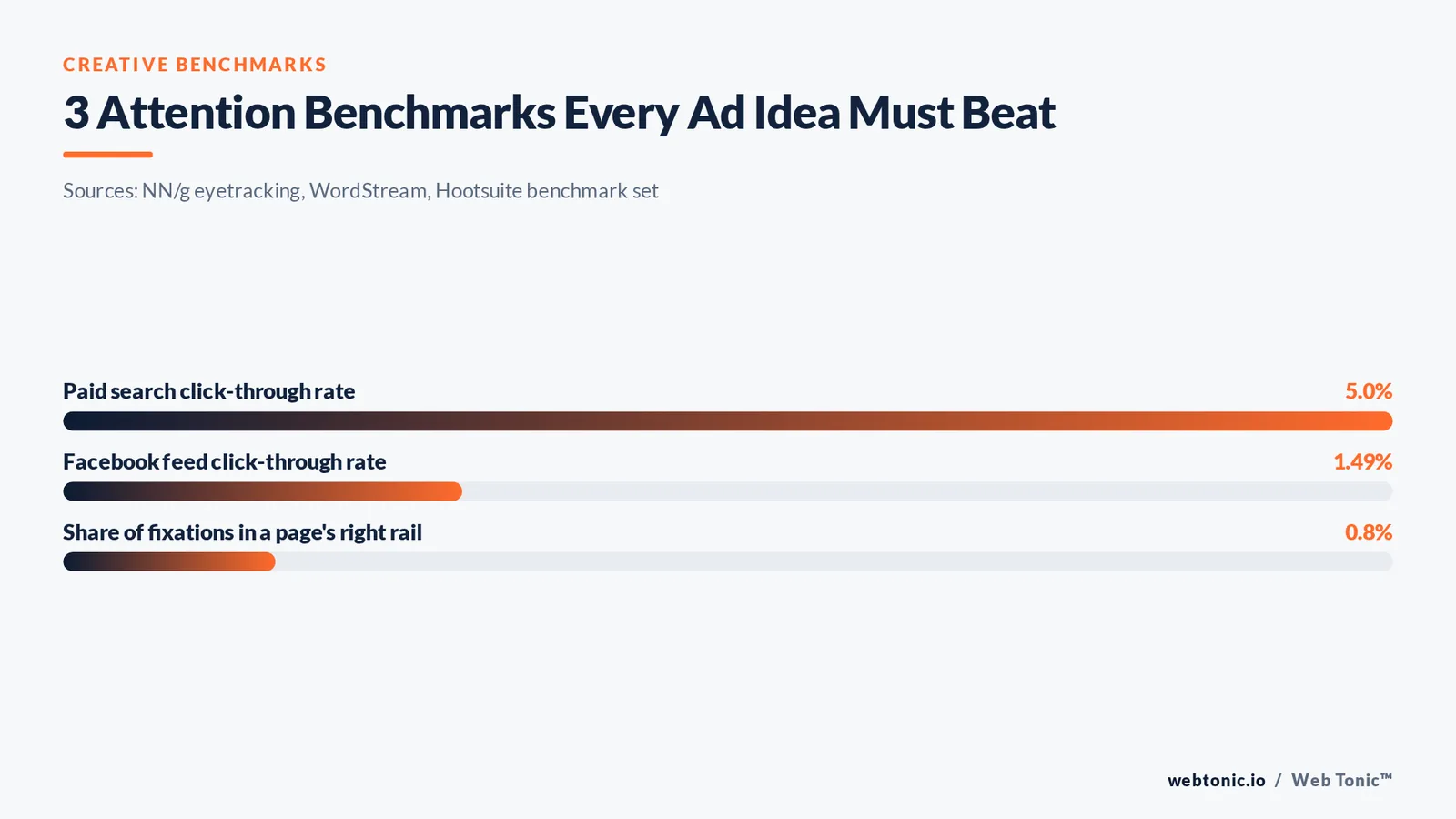
Most creative advertising ideas fail for a boring reason: nobody looked at them. In NN/g eyetracking, a page's right rail drew 0.8% of fixations while filling 25% of the content area. Below: 58 ideas by medium, plus the rules and metrics that pick winners.
Key Takeaways
- Global ad spending rose 5% to roughly $832 billion in 2025, and the US alone passed $450 billion — creative competes in an extremely crowded room (Statista).
- The average paid-search click-through rate is 4-6%, so a striking concept lifts a small base, not a large one.
- Attention is the scarcest input: 132 of 148 fixations in the NN/g study landed inside the content area, not the ad slot.
- Digital already carries 68.7% of world ad spend, yet out-of-home is the offline format attracting the most budget increases into 2026.
- Every idea in this list needs a disclosure check — the FTC endorsement guides apply to a stunt exactly as they apply to a banner.
What makes an advertising idea creative rather than merely decorative
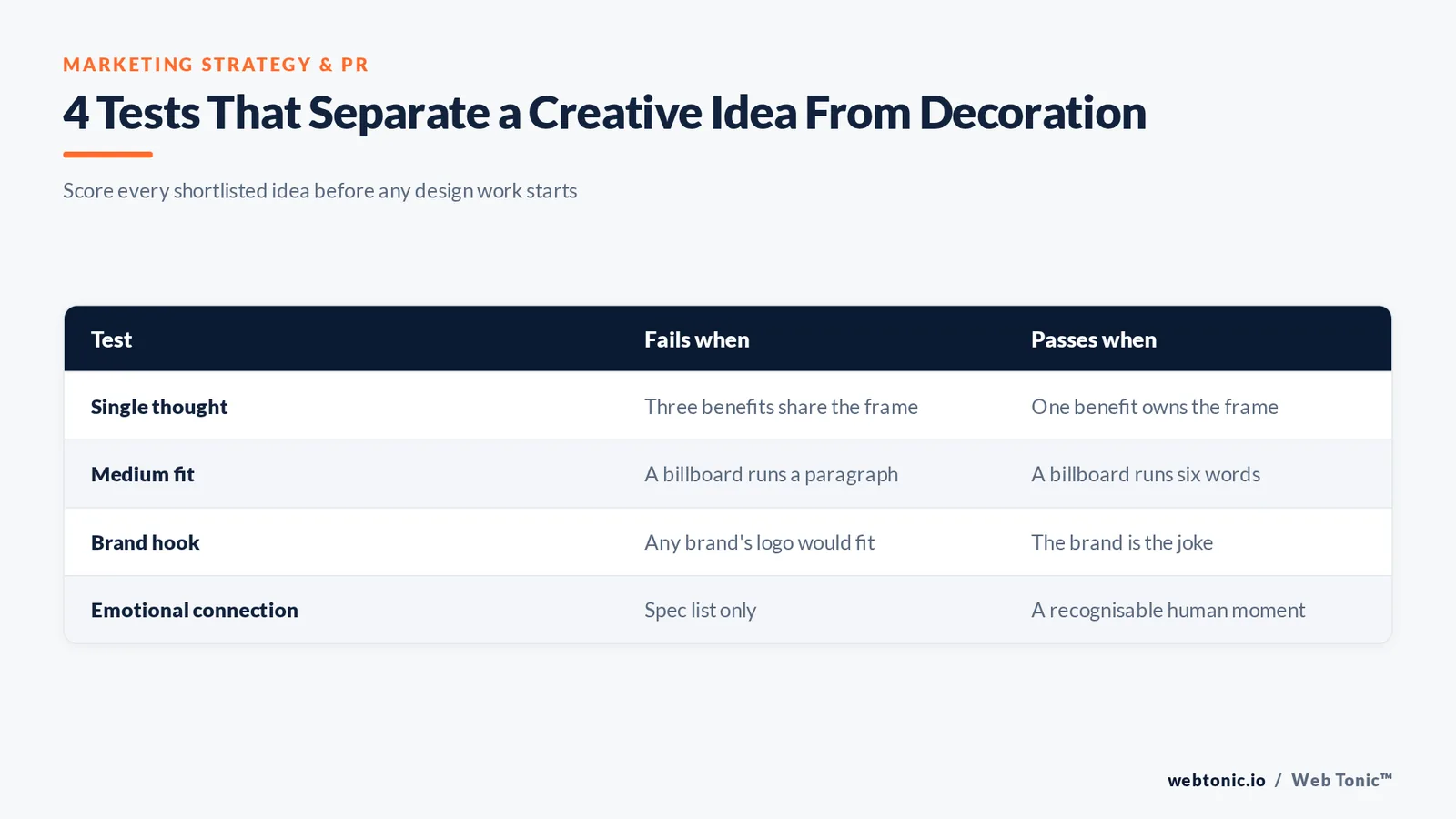
A creative advertising idea changes the meaning of a product for a specific target audience, in one medium, in under three seconds. Decoration changes only the surface. The four tests below separate the two, and the difference is measurable: award juries at Cannes Lions reward the idea, while the Effie Awards reward the business result the idea produced.
| Test | What it asks | Fails when | Passes when |
|---|---|---|---|
| Single thought | Can one sentence carry the whole ad? | Three benefits share the frame | One benefit owns the frame |
| Medium fit | Does the format do work the idea needs? | A billboard runs a paragraph | A billboard runs six words |
| Brand hook | Would the ad still work with a competitor logo? | Yes, any brand fits | No, the brand is the joke |
| Emotional connection | Is there a feeling, not just a feature? | Spec list only | A recognisable human moment |
Rule 1 — one thought per execution. The 30-character headline limit inside a responsive search ad is a useful discipline even for print advertising: if the thought does not survive 30 characters, it is two thoughts.
12 print advertising ideas that still work in 2026
Print advertising forces edit discipline, and the physical page removes the scroll. Idea 4 below is the cheapest of the twelve and needs only a photographer and a permit.
| Idea | Execution | Why it works | Best for |
|---|---|---|---|
| 1. Product-as-letterform | Build the headline word from the product itself | Reader decodes the image, so attention lasts longer | FMCG, tools |
| 2. Two-page before/after | Left page problem, right page product | The page turn is the reveal | Health, home repair |
| 3. Die-cut window | Cut through to the next page | Physical interaction beats a flat visual | Magazines, catalogues |
| 4. Scale comparison | Shoot the product beside a familiar object | Instantly communicates a spec without numbers | Hardware, travel |
| 5. Instruction-manual parody | Style the ad as an assembly diagram | Design cue signals simplicity | SaaS, furniture |
| 6. Missing element | Remove the obvious thing and caption why | Absence creates a question | Insurance, safety |
| 7. Long-copy confession | 800 words of honest detail | Trust from specificity | B2B, premium goods |
| 8. Data portrait | Turn one statistic into a picture | A number becomes visually striking | Nonprofits, finance |
| 9. Recipe layout | Show inputs as ingredients | Familiar structure lowers reading effort | Food, agencies |
| 10. Coupon-as-artwork | Make the tear-off the visual | Response is designed in | Retail, local services |
| 11. Series of three | One idea, three variations, same slot | Repetition builds brand identity | Launches |
| 12. Reader-supplied caption | Print the blank, invite entries | Turns readers into content | Community brands |
10 out-of-home and billboards ideas
Out-of-home is bought in space and time, which is why placement is half the idea. The Out of Home Advertising Association of America publishes the format and measurement standards these executions have to respect. Limit 2: six words maximum on any board seen above 30 mph.
| Idea | Execution | Creative lever | Production note |
|---|---|---|---|
| 13. Site-specific line | Copy that names the exact street or exit | Local relevance | Needs per-site copy versions |
| 14. Extended structure | Let an element break the frame | Physical surprise | Engineering sign-off required |
| 15. Two boards in dialogue | Board A asks, board B answers | Sequence creates a story | Buy adjacent inventory |
| 16. Weather-triggered copy | Digital board swaps by live feed | Timeliness, no reshoot | Digital OOH only |
| 17. Countdown board | Numbers change daily to a date | Builds anticipation | Automate the feed |
| 18. Negative space silhouette | Read the gap, not the ink | Eye catching at distance | High-contrast printing |
| 19. Shadow or light installation | Use sun position or projection | Free media in the environment | Permit dependent |
| 20. Transit wrap continuity | Design flows across doors and windows | Movement is the message | Vehicle templates |
| 21. Vertical stack | Use a tall format as a ladder | Format itself is the joke | Stairwells, buildings |
| 22. Blank board with URL | Deliberate emptiness plus one link | Curiosity gap | Pair with search coverage |
10 social and short-video advertising ideas
Social creative is judged in the first second. Practitioner benchmarks published by Sprout Social and the ads benchmark set from Socialinsider both point the same way: hook variety, not polish, drives spread. Fact 1 — the average Facebook feed ad CTR sits near 1.49%, so the hook is the only real variable you control (Hootsuite).
| Idea | Hook type | First-second visual | Metric to watch |
|---|---|---|---|
| 23. Unboxing with a twist | Curiosity | Hands, wrong object | 3-second view rate |
| 24. Customer voicemail | Social proof | Waveform plus caption | Hold rate |
| 25. Speed-run demo | Utility | Timer in corner | Watch-through |
| 26. Wrong-way tutorial | Pattern break | Mistake on screen | Comments |
| 27. Split-screen comparison | Contrast | Two products side by side | CTR |
| 28. Founder to camera | Trust | Face, no set | Cost per result |
| 29. Text-message story | Narrative | Chat thread mock | Completion |
| 30. Employee POV | Behind the scenes | Shoulder-mounted shot | Shares |
| 31. Ranked list of five | List promise | Number one card | Saves |
| 32. Ask-the-audience poll | Participation | Two-option overlay | Reply volume |
8 augmented reality and interactive ideas
Augmented reality earns its cost only when it answers a real pre-purchase question, usually fit, scale or placement. Interactive units also have to clear viewability and measurement rules — the standards maintained by the Media Rating Council and the research library at the IAB are the reference points. Trap 3: an AR unit with no measurable question behind it is a demo, not an ad.
| Idea | Question it answers | Build effort | Reuse value |
|---|---|---|---|
| 33. Place-in-room | Will it fit my space? | Medium | High, per SKU |
| 34. Virtual try-on | How does it look on me? | High | High |
| 35. Scan-the-pack story | Where did this come from? | Low | Medium |
| 36. Size-my-body sizing | Which size do I order? | High | Very high |
| 37. Colour swap configurator | Which finish? | Medium | High |
| 38. Before/after slider | How much changes? | Low | Medium |
| 39. Interactive quiz to product | Which model suits me? | Low | High |
| 40. Calculator unit | What will it cost me? | Low | Very high |
Accessibility is not optional in an interactive execution: follow the W3C image guidance so alternatives exist for every visual state.
8 guerrilla and experiential ideas
Guerrilla work buys attention with placement instead of media weight — the practice and its risks are catalogued in the guerrilla marketing literature. Limit 4: never run one without written permission from the property owner.
| Idea | Location logic | Cost band | Risk to manage |
|---|---|---|---|
| 41. Sidewalk stencil | Commute path to a store | Low | Municipal rules |
| 42. Product vending stunt | Event entrance | Medium | Stock and staffing |
| 43. Free-service pop-up | Where the pain occurs | Medium | Liability |
| 44. Reverse graffiti | Dirty walls near transit | Low | Property consent |
| 45. Interactive bus shelter | Waiting time is the media | High | Vandalism |
| 46. Sampling with a task | Sample given for an action | Low | Fulfilment |
| 47. Staged rescue demo | Trade show floor | Medium | Safety sign-off |
| 48. Charity match wall | Public square | Medium | Payout audit |
6 low-budget ideas for small businesses under $1,000
Small budgets buy specificity, not scale. Google's own guidance suggests starting a search campaign around $10-$50 per day, so an idea that needs a film crew is out of reach while an idea built from customer material is not (Semrush). Fact 2 — the average monthly Facebook ad spend across advertisers is roughly $1,691, which is the bar a scrappy execution has to beat on efficiency, not volume.
| Idea | Total budget | What you need | Expected output |
|---|---|---|---|
| 49. 20-customer quote wall | $0-150 | Email outreach | 20 social assets |
| 50. One-take phone demo | $0 | Phone, window light | 3 video ads |
| 51. Local landmark photo series | $120 | Permit, photographer hour | 6 print or social ads |
| 52. Handwritten insert card | $180 | Print run of 500 | Repeat-purchase lift |
| 53. Competitor-question FAQ ad | $0 | Sales call notes | High-intent search copy |
| 54. Staff-picks poster | $90 | In-store print | Footfall conversion |
Small advertisers also punch above their weight on search because Quality Score is judged per exact search against other advertisers over a 90-day window, not against their budgets (Google Ads Help).
4 brand-identity ideas that make every later ad cheaper
An advertising design system is the compounding asset. Rule 5 — pick one ownable device and repeat it for at least four quarters.
| Idea | Device | Compounding effect |
|---|---|---|
| 55. One colour, everywhere | Single saturated brand colour | Recognition before the logo is read |
| 56. Fixed frame | Same crop and border on all creative | Cheaper production, faster recall |
| 57. A recurring character | Mascot, founder or customer archetype | Continuity across campaigns |
| 58. A signature sound | Two-note audio mark | Works in muted-to-unmuted video |
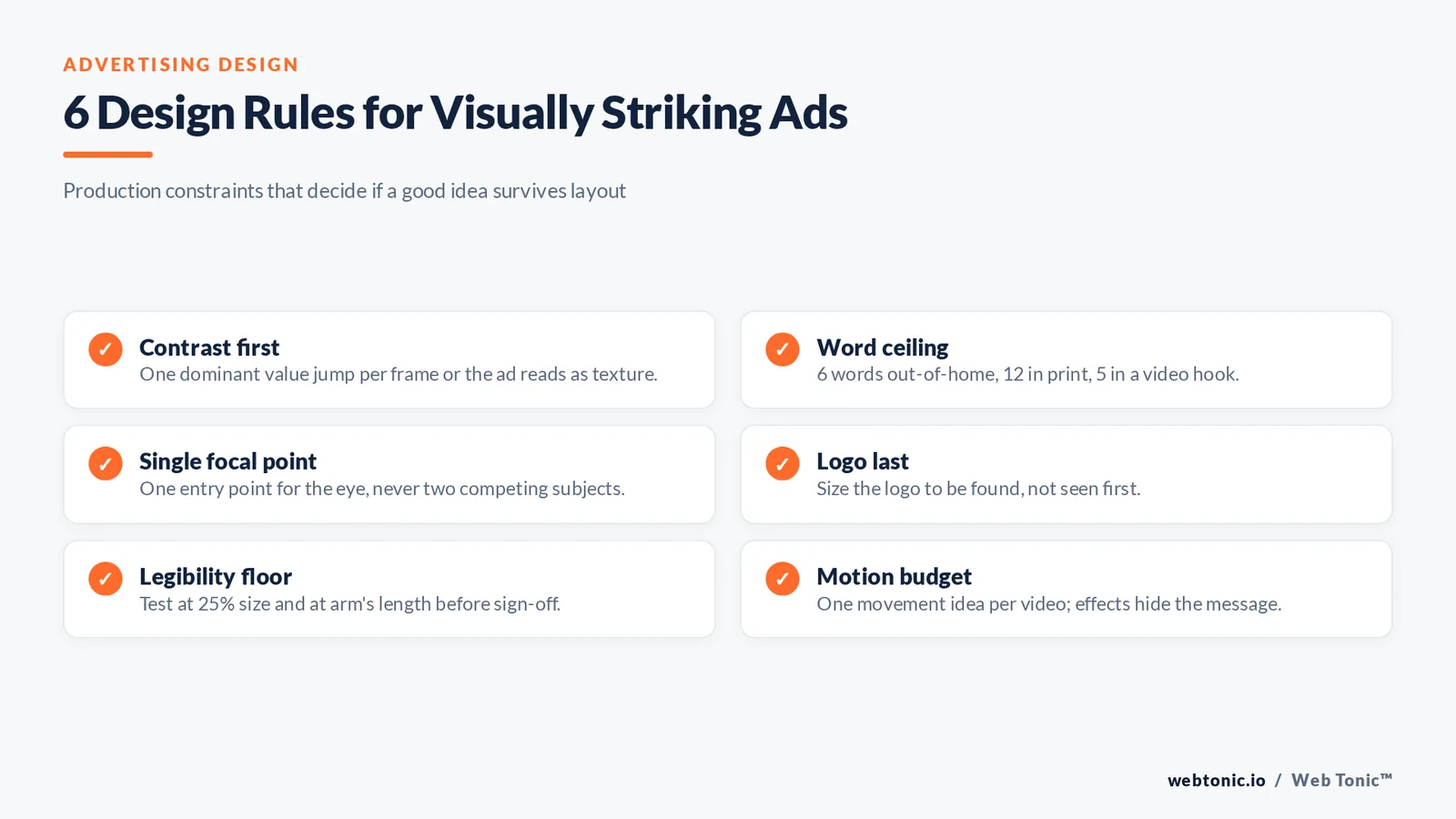
Advertising design rules for visually striking work
These are the production constraints that decide whether a good idea survives layout. Fact 3 — improving responsive search ad strength from Poor to Excellent is associated with about 15% more clicks and conversions, evidence that craft at the asset level moves numbers (Google Ads Help).
| Rule | Specification | Failure mode |
|---|---|---|
| Contrast first | One dominant value jump per frame | Ad reads as texture at a glance |
| Word ceiling | 6 words OOH, 12 words print, 5 words video hook | Reader gives up |
| Single focal point | One entry point for the eye | Competing subjects flatten attention |
| Logo last | Logo sized to be found, not seen first | Ad looks like a logo slide |
| Legibility floor | Test at 25% size and at arm's length | Type dies in the real environment |
| Motion budget | One movement idea per video | Effects hide the message |
Copy density matters as much as layout: users scan rather than read, a behaviour documented for decades by NN/g, and the plain-language patterns collected at plainlanguage.gov translate directly into shorter ad lines.
How to run a creative advertising ideas session that produces usable work
Volume first, judgement second. The session below produces 40 raw ideas in 90 minutes and three briefed executions by the end of the week.
| Stage | Time | Input | Output |
|---|---|---|---|
| Framing | 10 min | One customer problem, one metric | Written creative question |
| Solo writing | 20 min | Silence, no laptops | Ideas per person |
| Forced media round | 20 min | One medium per participant | Format-native ideas |
| Opposites round | 15 min | Invert the category cliche | Pattern-break ideas |
| Clustering | 15 min | Wall of ideas | 5-7 territories |
| Scoring | 10 min | The four tests above | 3 shortlisted ideas |
Prompts that reliably unlock a stuck room: describe the ad a competitor could never run; explain the product to a ten-year-old; show the moment before the purchase; make the ad a warning; remove the product from the frame. Trend context from Think with Google helps calibrate what is already saturated.
Which metrics prove a creative idea worked
Pick the metric before production, not after. Trap 6 — judging an awareness idea on last-click conversions kills good work.
| Objective | Primary metric | Benchmark to beat | Reading window |
|---|---|---|---|
| Attention | 3-second view rate | Category median from your own account | 3-7 days |
| Response | Click-through rate | 4-6% paid search, ~1.49% Facebook feed | 7-14 days |
| Efficiency | Cost per result | Prior best creative, not platform average | 14-28 days |
| Recall | Aided brand recall lift | Pre-campaign survey baseline | Campaign end |
| Retention | Repeat purchase rate | Trailing 90-day rate | 60-90 days |
The 4-6% paid-search CTR benchmark is a sanity check, not a target: your own previous best creative is the only fair comparison. Our performance creative and data intelligence teams set the measurement plan before a single frame is shot.
Legal and disclosure guardrails
Every idea above is subject to truth-in-advertising rules. The FTC small-business advertising FAQ is the shortest useful summary: claims need substantiation before the ad runs, and disclosures have to be clear and conspicuous in the same medium as the claim. Limit 7: a stunt that relies on a misunderstanding is not creative, it is a liability.
| Idea type | Disclosure obligation | Common mistake |
|---|---|---|
| Customer testimonial | Typical results, material connection | Cherry-picked outcome with no context |
| Creator or influencer post | Clear paid-partnership label | Hashtag buried at the end |
| Comparative claim | Substantiation on file | Comparison to an outdated competitor spec |
| Contest or giveaway | Full rules, odds, end date | Rules only in an image |
| Free trial offer | Renewal terms up front | Terms in a linked page only |
Turning ideas into a campaign plan
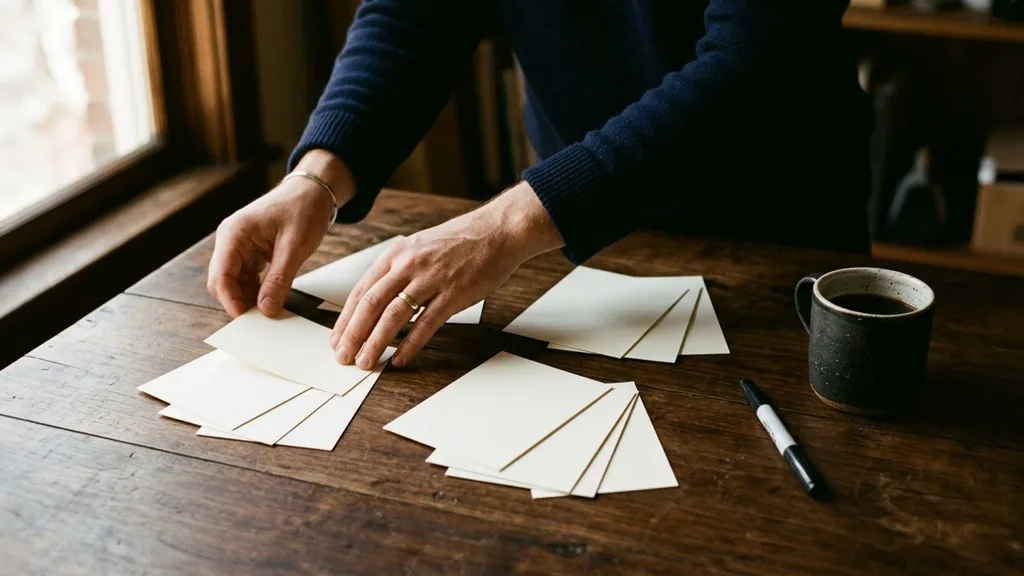
Ideas die in the gap between the wall of sticky notes and the media plan. Rule 8 — every shortlisted idea leaves the room with an owner, a medium, a budget band and a test date. That plan is the deliverable our growth marketing team builds; more worked examples live on the Web Tonic blog, and you can bring a specific brief to us via contact.
| Shortlisted idea | Medium | Budget band | Test date | Success metric |
|---|---|---|---|---|
| Site-specific OOH line | Digital OOH, 3 sites | $8-15k | Week 2 | Aided recall |
| Wrong-way tutorial | Reels and TikTok | $1-3k | Week 1 | 3-second view rate |
| Calculator unit | Landing page | $4-9k | Week 3 | Lead conversion rate |
| Handwritten insert | Print insert | under $500 | Week 1 | Repeat purchase |
12 famous example campaigns and the clever mechanic behind each
Studying a memorable advertisement is faster than theory, because the mechanic is usually visible in one frame. Fact 9 — 11 of the 12 campaigns below run on a single device, not a feature list. Lego, BMW and Ikea in particular show how far a magazine page or a billboard can be pushed when the idea is unique rather than loud.
| Example campaign | Medium | Clever mechanic | What businesses can copy |
|---|---|---|---|
| Lego Imagine | Magazine and poster designs | A few bricks stand in for a famous character | Reduce the product to its simplest recognisable shape |
| BMW and Audi billboards, Santa Monica | Billboards | Rival brands answered each other board to board | Buy adjacent inventory and let the exchange create news |
| Ikea pregnancy-test magazine ad | Magazine insert | The page itself was the test that unlocked a discount | Make the media do the demo |
| Volkswagen Think Small | Print advertisement | Deliberate empty space plus honest copy | Sell the objection instead of hiding it |
| Absolut bottle series | Print campaigns | The bottle silhouette repeated for years | One ownable outline beats a new layout each time |
| Snickers hunger campaign | TV and social | A character swap makes the benefit literal | Dramatise the moment of need |
| Coca-Cola Share a Coke | Packaging and out of home | Personalised names turn the box into media | Put the customer's own name on the product |
| KitKat break benches | Guerrilla out of home | A bench shaped as the product | Turn a public object into an eye catching prop |
| Dove Real Beauty Sketches | Online film | A courtroom sketch artist reveals self-perception | Let a third party deliver the emotional proof |
| Burger King Moldy Whopper | Print and film | Showing decay to prove no preservatives | Use the ugly truth as the creative asset |
| Spotify Wrapped | Owned data campaign | Users become the advertisement each December | Give customers a shareable version of their own data |
| Nike Dream Crazy | Film and posters | A belief statement, not a product claim | Say something a competitor cannot repeat |
Humor and fun carry a disproportionate share of this list, because a joke earns the second look that a claim never gets. The pattern to copy is not the humour itself but the compression: one clever device, one product truth, one frame.
The 9-step agency approach to create an advertisement
This is the working process an advertising agency uses between the brief and the shipped campaigns. Rule 10 — no design work starts before step 4 is signed off.
| Step | What happens | Owner | Output artefact |
|---|---|---|---|
| 1. Brief intake | Business problem, customers, budget, deadline | Account lead | One-page brief |
| 2. Evidence pull | Search demand, past creative results, customer verbatims | Strategist | Insight deck |
| 3. Creative question | The brief restated as a question worth answering | Strategist | One sentence |
| 4. Territories | 3-5 unique idea directions, no execution yet | Creative team | Territory summary |
| 5. Ideation | 40 raw ideas, then scored to three | Whole team | Shortlist |
| 6. Designs | Layouts, storyboards, key visual | Art director | Design comps |
| 7. Production | Shoot, edit, print or build | Producer | Master assets |
| 8. Trafficking | Sizes, cut-downs, tracking parameters | Media buyer | Live campaigns |
| 9. Read-out | Results against the metric chosen in step 1 | Analyst | Learning log |
Steps 8 and 9 are where most in-house teams lose the value of a good idea: the effective version of an advertisement is the one that arrives in every required size with clean tracking, so the traffic it drives can be attributed and reinvested.
Making ideas engage customers across the funnel
An idea that engages a cold audience rarely converts a warm one. Trap 11 — running one creative idea at all three stages wastes roughly two thirds of the impressions. Map each idea to a stage before you buy media.
| Funnel stage | Job of the creative | Format that fits | Example from this list | Metric |
|---|---|---|---|---|
| Cold | Stop the scroll, register the brand | Billboards, short video, print | Lego Imagine, KitKat benches | 3-second view rate |
| Warm | Prove the product does the job | Demo video, calculator, comparison | Ikea test page, Moldy Whopper | Click-through rate |
| Hot | Remove the last objection | FAQ ad, testimonial, offer card | Customer quote wall | Cost per result |
| Existing customers | Increase frequency and referral | Insert card, owned data campaign | Share a Coke, Spotify Wrapped | Repeat purchase rate |
FAQ
What are the most effective creative advertising ideas for a small budget?
Customer-sourced ideas win at low budgets: quote walls, one-take phone demos, staff-picks posters and FAQ ads built from real sales objections. Each costs under $200 to produce and can be tested against the same audience, which matters because average monthly Facebook ad spend across advertisers is around $1,691 and you are competing on relevance rather than weight.
How many ideas should a creative advertising session produce?
Aim for 40 raw ideas per 90-minute session and expect three to survive scoring. Volume protects against the first-idea trap, and the four tests in this article, single thought, medium fit, brand hook and emotional connection, do the filtering objectively.
Do print ads and billboards still deliver in a digital-first plan?
Yes, in a supporting role. Digital carries roughly 68.7% of global ad spend, yet out-of-home is the offline format attracting the most budget increases into 2026, largely because a physical board is unskippable and creates search demand your paid campaigns then capture.
How do I know whether a creative idea failed or the media plan failed?
Separate attention from response. If the 3-second view rate or impression share is healthy but clicks are not, the idea underperformed. If nobody saw it, the plan underperformed. Never judge an awareness execution on last-click conversions.
What legal checks does a creative stunt need?
Substantiate any claim before launch, disclose material connections in the same medium as the claim, publish full contest rules, and obtain written property consent for any physical installation. The FTC advertising FAQ for small businesses covers the baseline in a single page.
Sources
Nielsen Norman Group, banner blindness eyetracking findings. Statista, global advertising market topic page, 2026. WordStream, average click-through rate. Hootsuite, Facebook ads cost benchmarks. Socialinsider, Facebook ads benchmarks. Sprout Social, social media advertising. Semrush, Google Ads cost analysis. Google Ads Help, Quality Score and responsive search ad guidance. OAAA, out-of-home advertising standards. IAB Insights and the Media Rating Council, measurement standards. FTC, advertising FAQs for small business and endorsement guides. W3C WAI image tutorials. plainlanguage.gov guidelines. Cannes Lions and Effie Awards. All URLs verified live 2026-08-06.