Table of contents
Bandwagon advertising is a persuasion technique that sells a product or service by claiming everyone else is already buying it — "join the millions", "America's favourite", "the #1 choice".
It works because popularity is a mental shortcut. Here is how the bandwagon appeal is built, where it wins, and where it quietly destroys trust.
Key Takeaways
- Bandwagon advertising rests on the bandwagon effect: a cognitive bias in which people adopt behaviours, styles or opinions mainly because others already have (bandwagon effect).
- The psychology is older than advertising. Solomon Asch's conformity studies showed people will publicly agree with an obviously wrong majority rather than stand alone (Asch experiments).
- Social proof is now a default interface pattern, not just an ad line — review counts, "X people are viewing this" and follower totals all do bandwagon work (Nielsen Norman Group).
- Scale makes the claim credible: 5.66 billion people use social media, averaging 2 hours 40 minutes a day, so crowd signals are visible constantly (Sprout Social).
- Over 60% of product discovery now starts on social platforms, and 73% of consumers will switch to a competitor if a brand does not respond to them.
- Global social ad spend is on track for $317.33 billion in 2026 — most of it competing for the same attention with the same popularity cues.
- Unsupported popularity claims are a legal exposure, not just a creative choice: the FTC requires that objective claims be substantiated before they run (FTC advertising FAQs).
- Bandwagon appeal is 1 of 4 techniques that stack well together — social proof, scarcity, authority and FOMO — but it decays fastest when the crowd evidence is thin.
What is bandwagon advertising?
Bandwagon advertising is an advertising technique in which the persuasive argument is the size of the crowd. Instead of proving that a product performs better, the ad asserts that many people already chose it, and invites the audience to do the same. The implied logic — "everyone is doing it, so it must be right" — is the classic appeal to popularity.
The name comes from 19th-century American political parades, where supporters literally climbed aboard a candidate's bandwagon to show they were with the winning side. Marketing borrowed the phrase intact. In modern practice, bandwagon advertising covers everything from a bold "join 2 million happy customers" headline to a subtle "most popular plan" badge on a pricing page.
Three ingredients make a bandwagon appeal work:
- 1. A visible crowd — a number, a queue, a follower count, a wall of customer testimonials.
- 2. A relevant crowd — people the target audience recognises as similar to themselves.
- 3. A low-friction next step — joining must be easier than deliberating.
Why bandwagon advertising is effective: the psychology
Consumers do not evaluate most purchasing decisions carefully. Attention is scarce, options are many, and the cost of being wrong on a $6 shampoo is trivial. In that environment, popularity is an efficient heuristic: if a lot of people bought it, the odds of a disaster are lower. Behavioural research on consumer decision-making treats this as rational shortcutting rather than stupidity (Harvard Business Review).
Two distinct forces sit under the bandwagon effect. Informational influence means the crowd is treated as evidence — other people know something you do not. Normative influence means the crowd is treated as a rule — you want to belong and avoid being the odd one out. Asch's line-judgement studies isolated the second force: participants conformed to a majority answer they could see was wrong, purely to avoid dissenting.
Fear of missing out is the modern accelerant. When popularity is paired with a deadline or a countdown, the audience is not only told that others are buying, they are told the window to join is closing. That combination is what makes bandwagon advertising social and urgent at the same time.
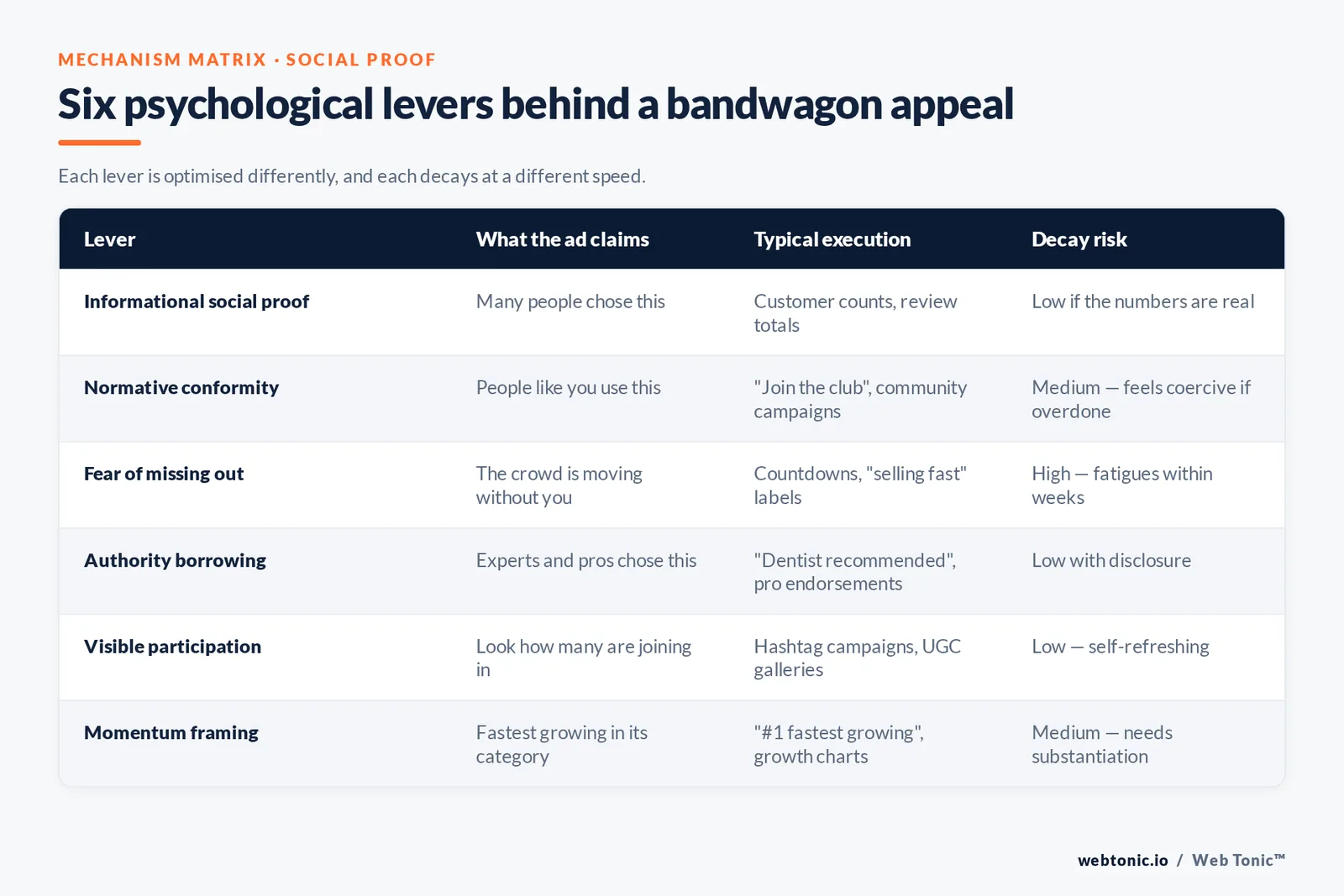
| Psychological lever | What the ad claims | Why it influences consumer behaviour | Typical execution | Decay risk |
|---|---|---|---|---|
| Informational social proof | Many people chose this | Crowd choice is read as quality evidence | Customer counts, review totals | Low if numbers are real |
| Normative conformity | People like you use this | Belonging outweighs independent judgement | "Join the club", community campaigns | Medium — feels coercive if overdone |
| Fear of missing out (FOMO) | The crowd is moving without you | Loss aversion beats gain framing | Countdowns, "selling fast" labels | High — fatigues within weeks |
| Authority borrowing | Experts and pros chose this | Credential transfer shortens evaluation | "Dentist recommended", pro endorsements | Low with disclosure |
| Visible participation | Look how many are joining in | User generated content proves real usage | Hashtag campaigns, UGC galleries | Low — self-refreshing |
| Momentum framing | Fastest growing in its category | Growth implies future dominance | "#1 fastest growing", growth charts | Medium — needs substantiation |
Bandwagon advertising techniques that actually convert
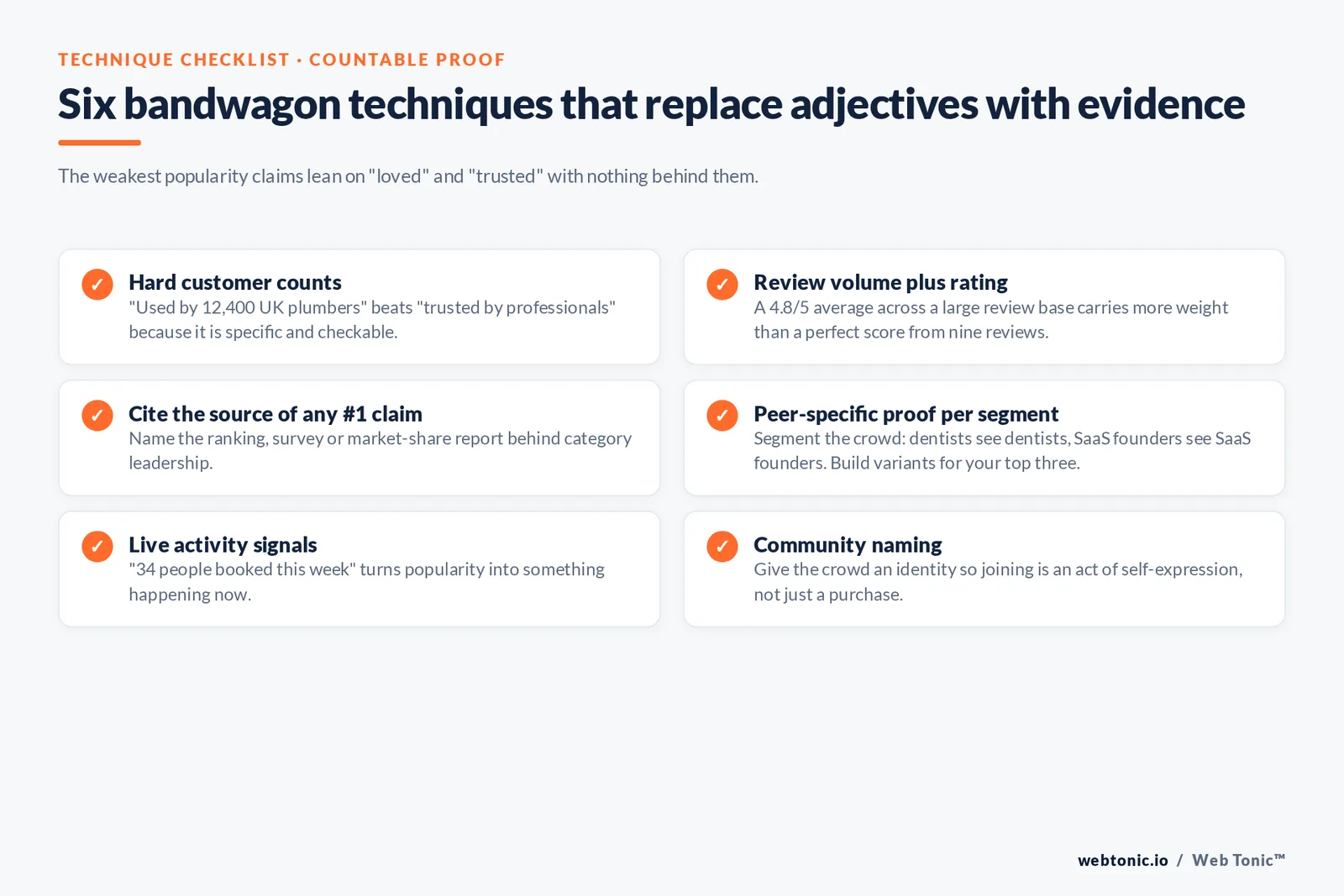
Not all popularity claims are equal. The strongest bandwagon advertising replaces adjectives with countable evidence, and the weakest leans on words like "loved" and "trusted" with nothing behind them. These are the techniques worth building a campaign around:
- Hard customer counts (technique 1 of 8). "Used by 12,400 UK plumbers" beats "trusted by professionals" because it is specific and checkable.
- Review volume plus rating. A 4.8/5 average across a large review base carries more weight than a perfect score from nine reviews.
- Category leadership backed by a #1 claim source. Cite the ranking, the survey or the market-share report behind any "#1" claim.
- Peer-specific proof for each of your top 3 segments. Segment the crowd: dentists see dentists, SaaS founders see SaaS founders.
- User generated content. Real customers who share photos, videos and unboxings supply proof that no headline can fake (Sprout Social on UGC).
- Live activity signals from the last 24 hours. "34 people booked this week" turns popularity into something happening now.
- Waitlists and sold-out badges. Constraint plus demand is the most efficient FOMO pairing.
- Community naming. Give the crowd an identity so joining is an act of self-expression, not just a purchase.
Each technique should be deployed where the decision actually happens: in the ad creative, on the landing page above the fold, and again at checkout, where doubt spikes. A social proof block placed only in the footer is decoration.
Examples of bandwagon advertising you already know
Bandwagon advertising is easiest to learn from real campaigns and formats. The examples below span mass media and digital, and each one shows a different mechanic for making popularity claims feel earned rather than shouted.
| Example format | How the bandwagon appeal is expressed | Channel where it works best | Why it works |
|---|---|---|---|
| "Millions served" signage | A running total of customers | Out of home, packaging | A single number does all the arguing |
| "America's favourite" claim | National preference asserted | TV, retail media | Implies consensus of an entire market |
| Chart and bestseller badges | Ranking within a category | Ecommerce listings | Ranks the crowd's choice for the shopper |
| "Most popular plan" highlight | Crowd choice inside a pricing table | SaaS pricing pages | Removes the hardest decision on the page |
| Follower and subscriber counts | Audience size as credential | Social media profiles | Visible before any content is read |
| Hashtag challenge | Everyone is joining in publicly | TikTok, Instagram Reels | Participation itself becomes the ad |
| Customer testimonials wall | Many named voices, one verdict | Landing pages | Volume plus specificity builds trust |
| "Join X other marketers" newsletter CTA | Peer group already subscribed | Email capture forms | Reframes signing up as normal behaviour |
| Live booking counters | Real-time demand | Travel and events | Urgency without a fake deadline |
| Creator seeding waves | Many creators post at once | Influencer campaigns | Manufactures the appearance of a trend |
| Election-style momentum ads | Polling and support figures | Political and advocacy media | Nobody wants to back a loser |
| Award badge cluster | Third-party validation stacked | B2B websites | Distributes trust across institutions |
How to build a bandwagon campaign without lying
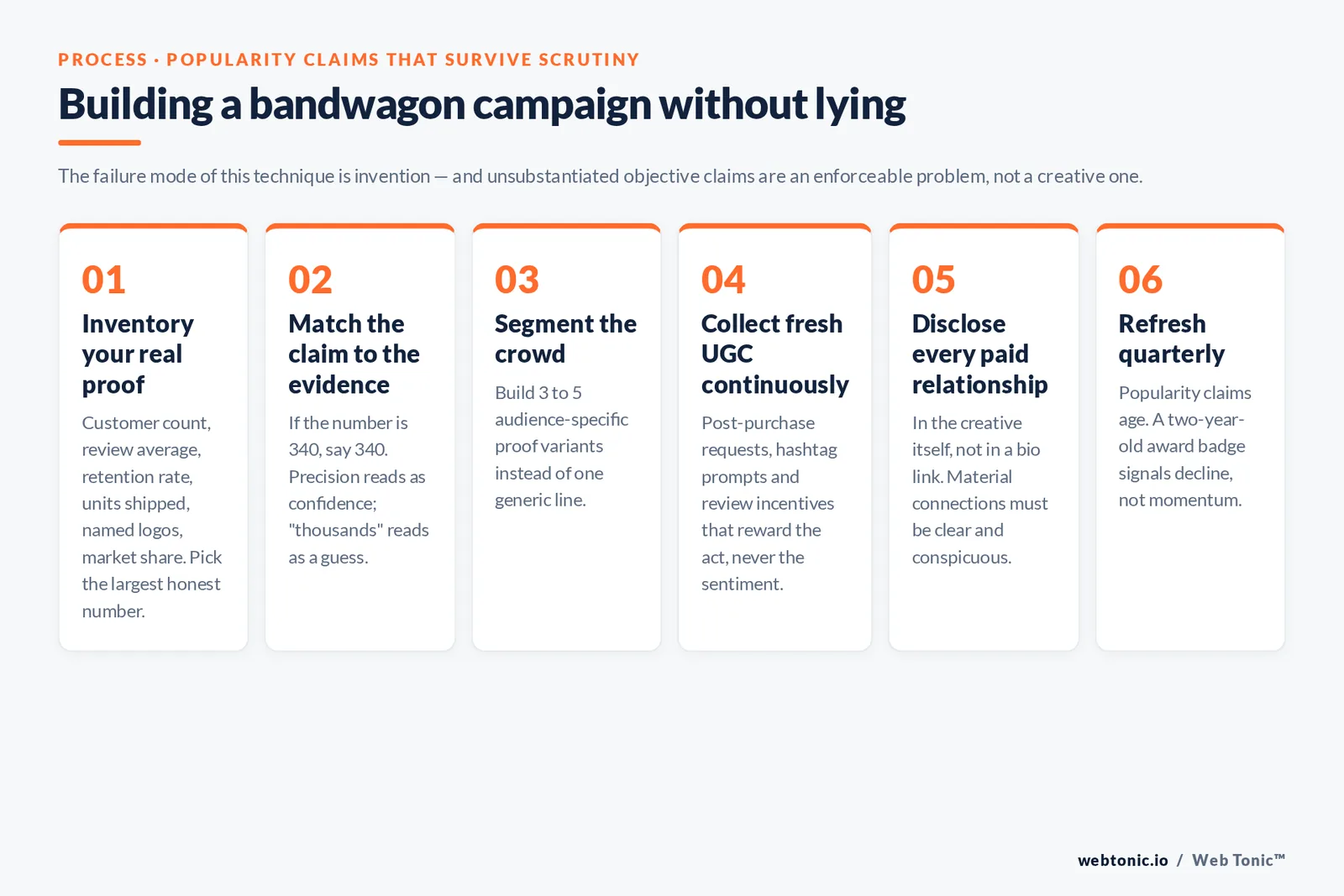
The failure mode of this technique is invention. A brand with 340 customers writes "trusted by thousands", a reviewer count includes solicited five-star reviews, or a creator posts an endorsement without disclosing payment. All three are avoidable, and all three are enforceable problems. The FTC's endorsement guidance is explicit that endorsements must reflect honest opinions and that material connections must be disclosed clearly (FTC endorsement guides). UK advertisers face the same principle under the CAP Code, policed by the Advertising Standards Authority.
A defensible workflow looks like this:
- Step 1 — inventory your real proof. Customer count, review average, retention rate, units shipped, named logos, market share. Pick the largest honest number.
- Step 2 — match the claim to the evidence. If the number is 340, say 340. Precision reads as confidence.
- Step 3 — segment the crowd. Build 3 to 5 audience-specific proof variants instead of one generic line.
- Step 4 — collect fresh UGC continuously. Post-purchase requests, hashtag prompts and review incentives that reward the act, never the sentiment.
- Step 5 — disclose every paid relationship in the creative itself, not in a bio link.
- Step 6 — refresh quarterly. Popularity claims age; a 2024 award badge signals decline, not momentum.
Creative quality still decides whether any of it lands. Work on advertising distinctiveness shows that dull, undifferentiated advertising costs brands significantly more to achieve the same effect (System1), and brand-effect measurement from Nielsen consistently ties results to creative, not just targeting. A popular-but-boring ad still fails.
Limits, risks and when to avoid the bandwagon appeal
Bandwagon advertising buys short-term attention efficiently and builds trust slowly, if at all. Three limits matter in practice.
Limit 1: it does not answer objections. Popularity tells a buyer that risk is low, not that the product solves their problem. High-consideration purchases — enterprise software, legal services, surgery, a $40,000 renovation — need mechanism, proof of outcome and pricing clarity. Lead with the crowd there and you sound like you are hiding the specification.
Limit 2: it can invert. When popularity becomes the whole brand, a visible defection wave reads as evidence the crowd is leaving. The same bias that filled the bandwagon empties it.
Limit 3: it is fragile against scrutiny. Screenshots, review-forensics tools and community threads make thin claims cheap to debunk. One exposed exaggeration devalues every other number on the page.
Use bandwagon advertising when your category is low-risk and crowded, when you genuinely have scale, or when a network effect means the product is objectively better with more users. Use evidence-first advertising when the purchase is expensive, technical or emotionally loaded. Most brands need both, sequenced: crowd signals to earn the click, substance to earn the sale. Our growth marketing team maps which proof asset belongs at which funnel stage, and the performance creative team builds the variants that carry it.
Bandwagon advertising vs other persuasion techniques
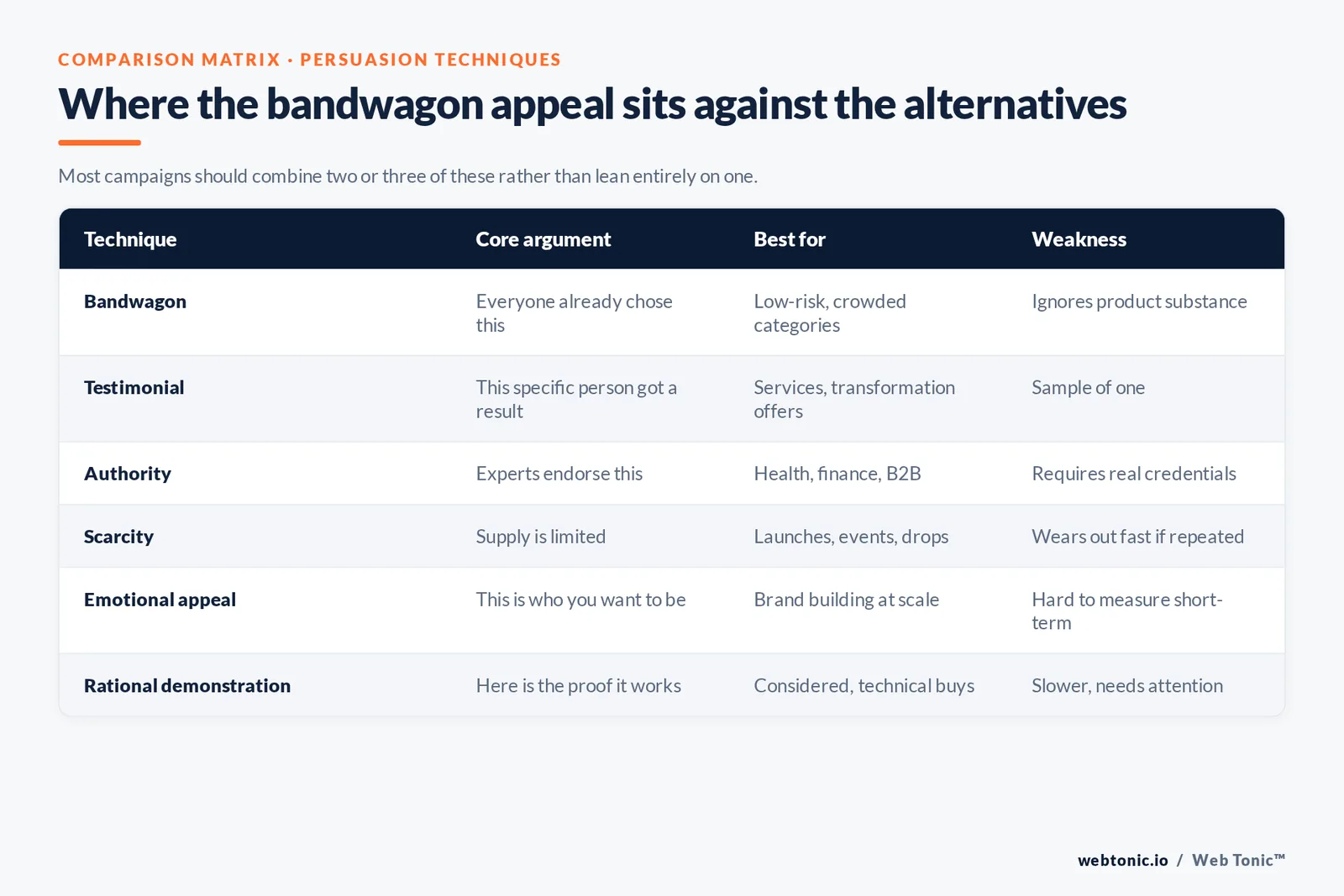
It helps to see where the bandwagon appeal sits relative to the alternatives, because most campaigns should combine two or three rather than lean entirely on one.
| Technique | Core argument | Best for | Weakness |
|---|---|---|---|
| Bandwagon | Everyone already chose this | Low-risk, crowded categories | Ignores product substance |
| Testimonial | This specific person got a result | Services, transformation offers | Sample of one |
| Authority | Experts endorse this | Health, finance, B2B | Requires real credentials |
| Scarcity | Supply is limited | Launches, events, drops | Wears out fast if repeated |
| Emotional appeal | This is who you want to be | Brand building at scale | Hard to measure short-term |
| Rational demonstration | Here is the proof it works | Considered, technical buys | Slower, needs attention |
Buffer's breakdown of social proof formats is a useful companion when you are choosing which crowd signal to build first (Buffer). If you want the measurement side handled properly, our data intelligence practice instruments which proof element moved conversion, and you can talk to us about a proof audit. More marketing breakdowns live on the Web Tonic blog.
FAQ
What is bandwagon advertising in simple terms?
It is an advertising technique that persuades by popularity: the ad tells you that many people already use the product or service, so you should join them. The argument is social rather than functional, and it relies on the bandwagon effect — a bias where people copy what others are doing.
Is bandwagon advertising effective?
Yes, for low-risk decisions in crowded categories, because popularity is a fast decision shortcut when attention is limited. It is far less effective for expensive or technical purchases, where buyers need mechanism, pricing and outcome evidence. It also fades quickly if the crowd claim is vague.
What are examples of bandwagon advertising?
"Join 2 million customers" headlines, "America's favourite" claims, bestseller and "most popular plan" badges, follower counts used as credibility, live booking counters, hashtag challenges and coordinated creator seeding waves. All of them make the crowd, rather than the product, the argument.
Is bandwagon advertising a logical fallacy?
The underlying reasoning is the appeal to popularity fallacy: something is not true or good simply because many people believe it. That does not make the technique dishonest by default — the claim just has to be accurate and substantiated, and it should sit alongside real evidence of what the product does.
How do I use social proof without misleading customers?
Use exact figures you can document, cite the source of any ranking or award, disclose every paid endorsement clearly in the creative, never buy or incentivise positive sentiment, and refresh claims at least quarterly so nothing on the page is stale.
Sources: Bandwagon effect and Asch conformity experiments (Wikipedia) · Nielsen Norman Group, Social Proof in the User Experience · Sprout Social social media statistics and UGC research · FTC advertising FAQs and Endorsement Guides · Advertising Standards Authority · Harvard Business Review consumer behaviour · System1 · Nielsen insights · Buffer. All figures accessed August 2026.