Table of contents

You can see almost every ad your competitors run, legally and for free, in the platforms' own transparency libraries. Paid tools add the part libraries hide: spend estimates, keyword overlap and how long each ad has survived.
Key Takeaways
- Start free. Transparency libraries cover Google, Meta, TikTok, LinkedIn and Microsoft and cost nothing, so paid tools should only fill named gaps.
- Paid research suites start at roughly $39 per month and run past $500 per month at agency tiers, all figures checked August 2026.
- Rule 1: copy the offer structure, never the wording. Naming a rival in your own ad text triggers trademark policy review.
- Longevity beats volume. An ad live for 90 days or more is a tested winner; a burst of 20 new ads in a week is usually a failing test cycle.
- A useful teardown takes about 3 hours per rival and produces 5 to 8 testable hypotheses, not a slide deck of screenshots.
Free sources first: what each transparency library shows
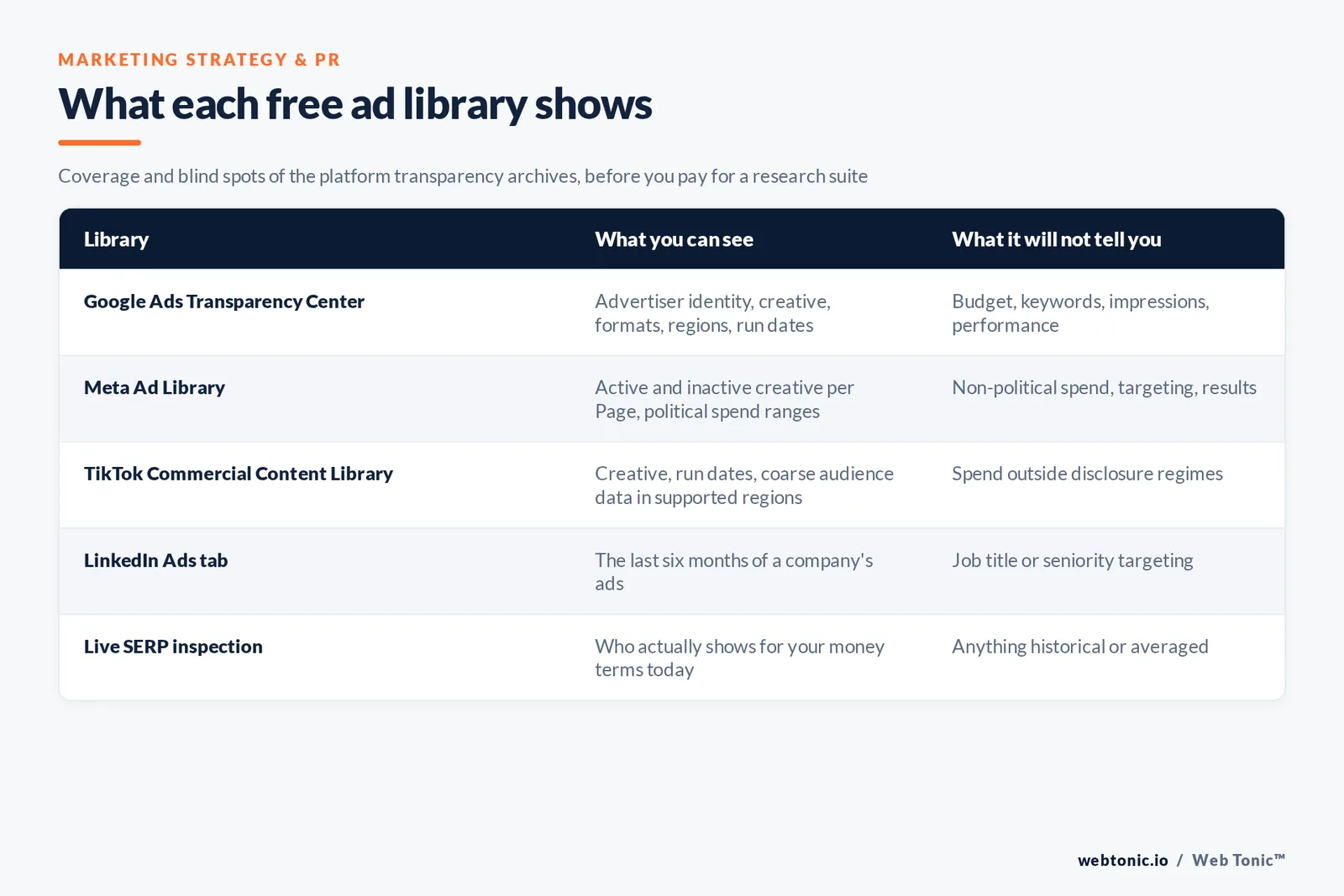
Every major platform now publishes an advertiser-level archive. The coverage differs sharply, so know what each one can and cannot answer before you pay for anything.
| Library | What you can see | What it will not tell you | Best question to bring it |
|---|---|---|---|
| Google Ads Transparency Center | Verified advertiser identity, creative, formats, regions and date ranges served | Budget, keywords, impressions or performance | Which creative has this advertiser kept live longest? |
| Meta Ad Library | Active and inactive creative per Page, plus political spend ranges | Non-political spend, targeting or results | How many concepts are in rotation right now? |
| TikTok Commercial Content Library | Creative, run dates and coarse audience details in supported regions | Spend outside disclosure regimes | Which hooks does this brand reuse across creators? |
| LinkedIn Ads tab | The last six months of a company's ads on its own page | Job title or seniority targeting | What promise are they making to my exact buyer? |
| Live SERP inspection | Who actually shows for your money terms today | Anything historical or averaged | Who is bidding on this term at 9am on a Tuesday? |
The Google Ads Transparency Center is the highest-value free source for paid search and video work, and Search Engine Journal's walkthrough covers the filters most people miss, including region and format filtering. Step 1 of any teardown is 30 minutes in the libraries before you open a single paid tool.
What the paid research suites add, and what they cost
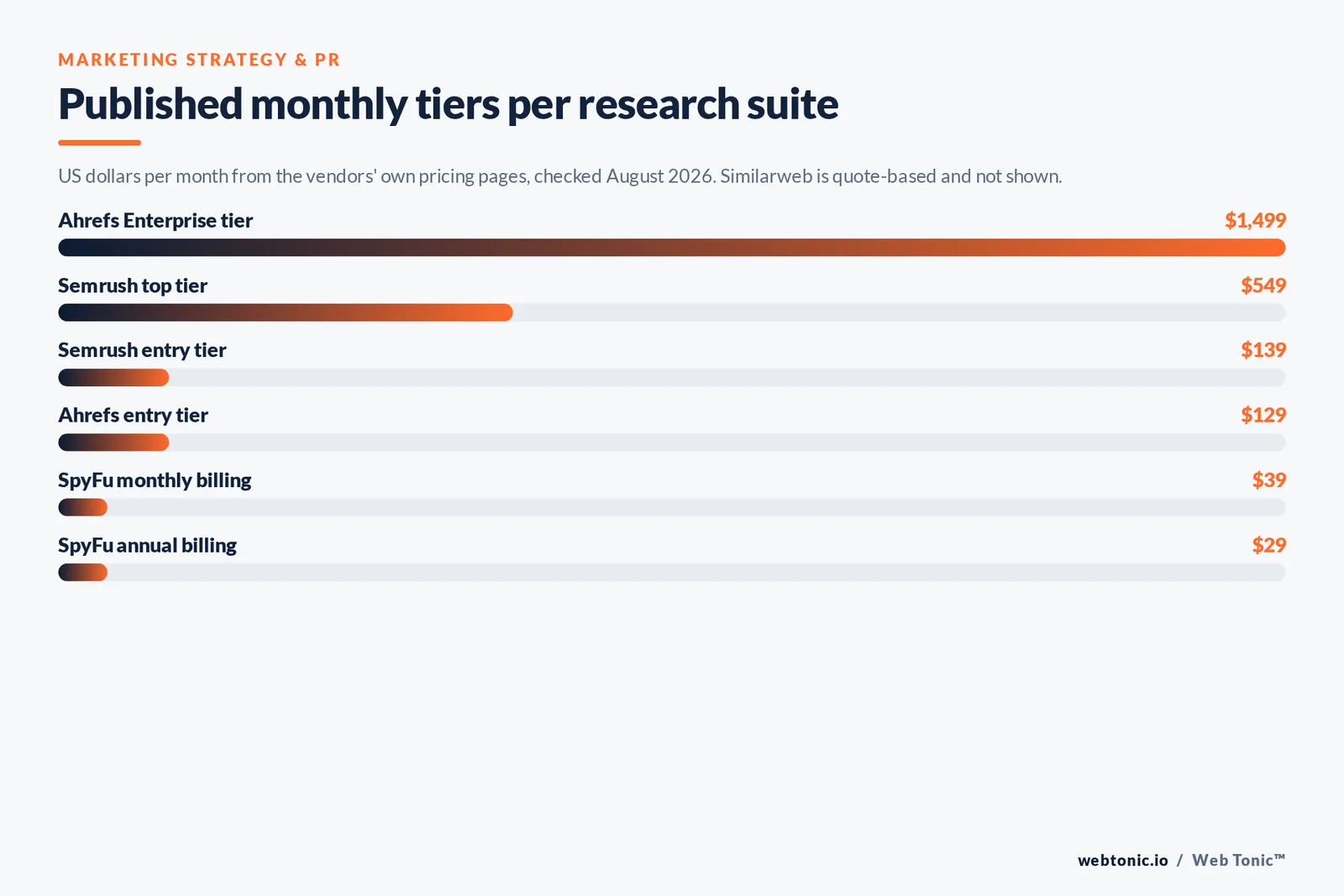
Paid platforms model what libraries omit: estimated spend, term overlap, historic ad copy and traffic share. Treat every number as directional, because all of it is modelled from panels and clickstream, not from the advertiser's account.
| Tool | Strongest for | Entry price, checked August 2026 | Where it is weak |
|---|---|---|---|
| SpyFu | Historic paid keyword and ad copy history per domain | From $39 per month, or $29 on annual billing | Coverage thins outside large English-language markets |
| Semrush | Advertising research plus organic overlap in one place | Three tiers from $139 to $549 per month billed monthly | Estimates diverge from account reality on small domains |
| Ahrefs | Organic keyword gaps and the link picture behind rankings | Four tiers from $129 to $1,499 per month | Paid ad archive is thinner than dedicated ad spies |
| Similarweb | Traffic mix, channel split and audience overlap | Quote-based, no public list price | Small sites fall below panel confidence |
| Social listening suites | Message and sentiment shifts around a launch | Enterprise, quote-based | Poor fit for keyword-level paid work |
Prices come straight from the vendors: SpyFu pricing, Semrush pricing and Ahrefs pricing. On capability, Semrush documents its advertising research toolkit and Ahrefs documents domain-level analysis in Site Explorer, while Similarweb is the usual choice for channel mix. Limit 2 — one paid suite is enough for most teams under $20,000 in monthly media.
Pick the right competitors before you research anything
Most teardowns fail here. Teams analyse the loudest brand in the category, often 10 times their own budget, instead of the one taking their deals, then copy tactics that only work at ten times the budget.
| Tier | Definition | How many to track | What to take from them |
|---|---|---|---|
| Direct rivals | Same buyer, same price band, same geography | 3 to 4 | Offer structure, objection handling, proof format |
| Auction rivals | Whoever actually shows beside you on money terms | 3 to 5 | Bid pressure patterns and message overlap |
| Adjacent players | Different product, same budget line in the buyer's mind | 2 | Framing that reroutes demand toward them |
| Aspirational brands | Category leaders operating far above your spend | 1 to 2 | Creative craft only, never structure or cadence |
| Insurgents | New entrants with no brand equity to protect | 2 | Aggressive angles worth testing before they scale |
Auction rivals are the tier teams skip and the tier that matters most. Google's guidance on showing among top ads is a reminder that the position you lose is decided by quality signals as much as by bids, so a rival with weaker creative can still be beating you on rank.
The data to extract per competitor
Screenshots are not research. Fill the same fields for every rival so the comparison holds up, and stop at the fields that change a decision.
| Field | Where it comes from | Why it changes a decision |
|---|---|---|
| Longest-running creative | Transparency library date ranges | Reveals what has already survived a real test |
| Number of live concepts | Library count, deduplicated by concept not variant | Shows testing capacity you have to match |
| Offer and price framing | Ad copy plus landing page | Sets the value bar your own offer must clear |
| Paid term overlap | Research suite keyword gap report | Finds terms you are absent from entirely |
| Organic and paid split | Traffic estimate tools | Tells you whether they can outlast you on cost |
| Landing page pattern | Manual review of 3 destinations | Exposes the conversion mechanic doing the work |
| Proof assets | Reviews, badges, case studies on page | Identifies the trust gap you can close fastest |
| Promotion calendar | Library run dates over 12 months | Predicts when they will discount next |
Keyword-level work still needs first-party volume, which is what Keyword Planner is for: use the suite for the gap list, then price and size those terms with platform data before you commit budget.
Score their creative instead of admiring it
Use one rubric across every ad you collect. Scoring forces a judgement, and the low scores are where your opportunity actually is.
| Dimension | Weight | Score 1 | Score 5 |
|---|---|---|---|
| Hook specificity | 25% | Generic category claim | Named problem in the buyer's own words |
| Offer clarity | 25% | No price, term or timeframe | Price, term and deadline all visible |
| Proof | 20% | Adjectives only | Numbers, named clients or third-party ratings |
| Message-to-page match | 20% | Ad promise absent from the page | Same headline and offer above the fold |
| Production fit | 10% | Repurposed print asset | Built natively per placement |
Trap 3 — assuming a polished ad is a winning ad. A rival can spend 6 figures on production and still lose the auction on relevance. Longevity in the library is a better signal of success than craft, which is why we log run dates before we log creative notes in any performance creative teardown.
Turn findings into work: signal to action
| Signal you observed | Most likely meaning | Your move this week |
|---|---|---|
| One creative live for 12 months | A proven angle they will not abandon | Test the same angle with a sharper offer |
| 20 new ads in 7 days | A failing test cycle, not a winning one | Hold your budget and watch what survives |
| They bid on your brand name | Deliberate conquesting | Defend your brand terms, then price the exchange |
| They abandoned a whole format | It failed for them, or their team lost the skill | Check whether it failed for you too before copying |
| Heavy discount language appears | Pipeline pressure or inventory overhang | Compete on terms and speed, not on price |
| New geography in the library | Expansion under way | Raise coverage in that market before they settle |
| Landing pages consolidated | They found their converting template | Audit your own page sprawl against it |
The keyword gap workflow, in five passes
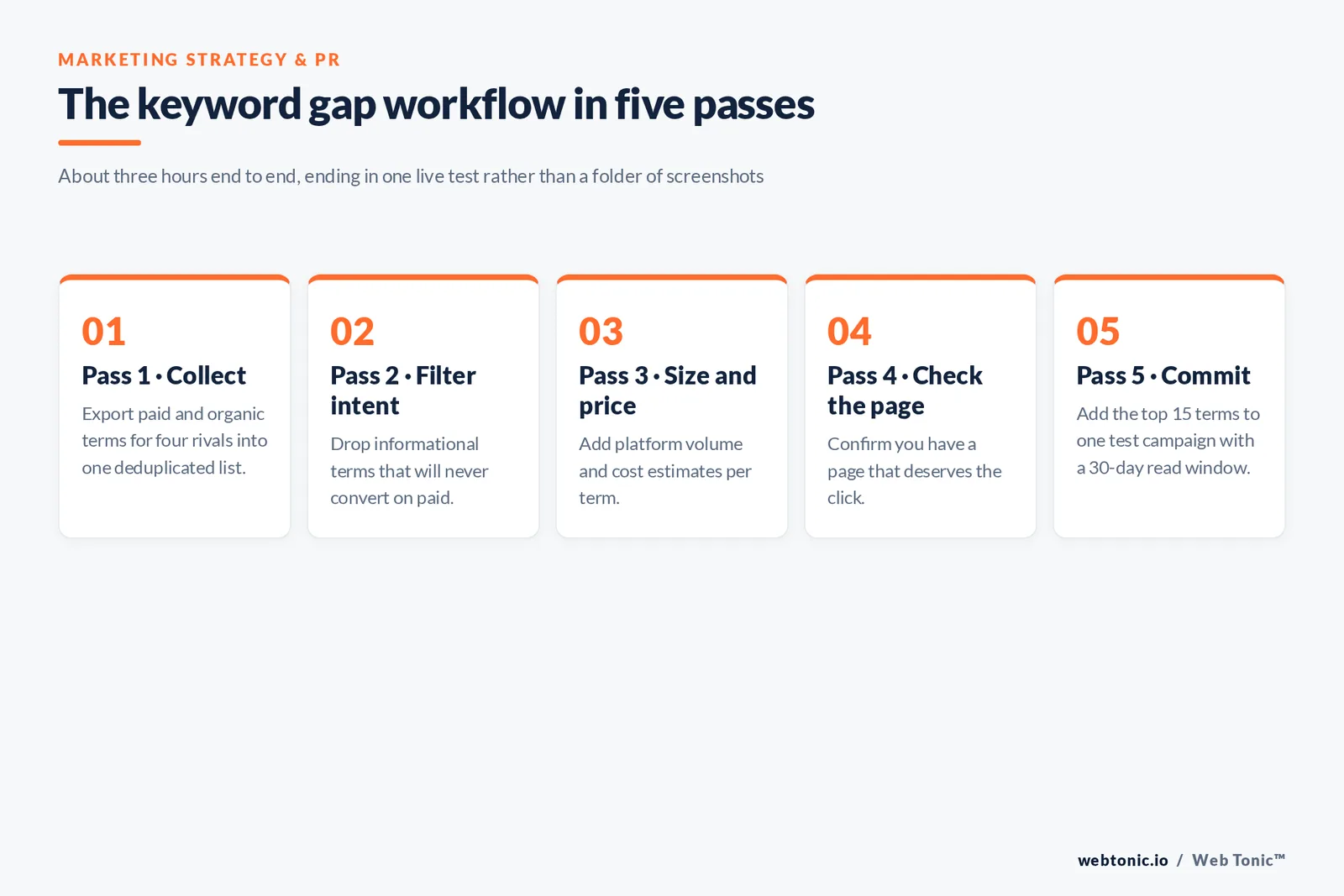
Paid and organic overlap is where competitor research pays for itself, because it shows demand you are not present for at all.
| Pass | What you do | Output | Time |
|---|---|---|---|
| Pass 1: collect | Export paid and organic terms for 4 rivals | One raw list, deduplicated | 45 minutes |
| Pass 2: filter intent | Drop informational terms that will never convert on paid | A commercial shortlist | 30 minutes |
| Pass 3: size and price | Add platform volume and cost estimates per term | A cost-ranked opportunity list | 40 minutes |
| Pass 4: check the page | Confirm you have a page that deserves the click | A short content or landing page brief | 30 minutes |
| Pass 5: commit | Add the top 15 terms to a single test campaign | A live test with a 30-day read window | 30 minutes |
Established methodology is worth reading before you invent your own process: Semrush's competitor analysis guide and Ahrefs' competitor analysis framework cover the search side, while Sprout Social covers the social side and HubSpot's competitive analysis kit supplies a serviceable template if you have none.
The organic half: competitor SEO and keyword rankings
Paid research answers what a rival is buying; SEO research answers what they no longer have to buy. If a competitor ranks organically for a term you pay for, they win the same click at a fraction of the cost, so competitive intelligence has to cover both sides of the SERP.
| What to pull | Tool view | What the data means | Decision it drives |
|---|---|---|---|
| Top organic keywords by traffic | Competitor domain search in any keyword tool | The pages carrying their non-paid demand | Which content gaps to brief first |
| Keyword rankings won and lost | Position change report over 90 days | Whether their SEO investment is rising or drifting | When to attack a category they are neglecting |
| Terms where they rank and also advertise | Overlap of paid keywords and organic rankings | Their highest-conviction commercial terms | Your own must-win keyword list |
| Search volume behind each cluster | Volume column plus platform forecast data | Whether the opportunity is worth the production cost | Content budget allocation for the quarter |
| Pages with links but weak rankings | Backlink report filtered by position | Authority they have not converted into visibility | Where a better page can outrank a stronger domain |
| Branded versus non-branded split | Keyword list segmented by brand terms | How dependent they are on existing demand | Whether to compete on category or on brand |
Rule 5 — build the paid and organic view in the same sheet. Teams that keep two separate competitor files end up bidding on terms they already rank for, which is the most common form of wasted advertising budget we find in audits.
A tracking dashboard worth maintaining
Competitive intelligence decays fast. The teams that keep it useful monitor a handful of numbers per rival on a fixed schedule instead of re-running an ad-hoc study whenever someone panics.
| Metric to monitor | Source | Refresh | What a change tells you |
|---|---|---|---|
| Live creative count per rival | Transparency library | Weekly | A jump means a new test wave or a launch |
| Share of visible ad slots on 10 money terms | Manual SERP checks | Fortnightly | Rising pressure ahead of a cost increase |
| Estimated paid keyword count | Research suite | Monthly | Expansion or retrenchment in their programme |
| Organic keyword rankings in the top 3 | Rank tracking data | Monthly | Whether their content investment is compounding |
| Website channel mix | Traffic estimate tools | Quarterly | A strategic shift between paid, search and social |
| Offer and price changes | Manual landing page review | Monthly | Margin pressure or a new positioning bet |
| New market or language pages | Sitemap and library regions | Quarterly | Expansion you can pre-empt |
Keep it to 7 rows and 8 to 10 competitors. A dashboard nobody updates is worse than no dashboard, because it turns stale data into confident decisions.
Where the legal line sits
Looking is legal. Public libraries exist precisely so anyone can look. Three things move you from research into risk.
| Activity | Status | Why |
|---|---|---|
| Browsing transparency libraries | Clearly fine | Published by the platforms for public inspection |
| Bidding on a rival's brand term | Generally allowed on Google | Keyword bidding is not restricted the way ad text is |
| Using their trademark in ad text | Restricted | Governed by platform trademark policy and complaint handling |
| Copying claims you cannot substantiate | High risk | Advertising claims must be truthful and supportable |
| Copying creative wholesale | High risk | Copyright sits with the creator, not the observer |
Read the platform rules directly in Google's trademark policy, and the substantiation expectations in the FTC's advertising and marketing guidance. Rule 4 — if a claim needs a rival's data to be true, it is not your claim to make.
A monthly cadence that does not eat the team
| Cadence | Task | Time budget | Deliverable |
|---|---|---|---|
| Weekly | Scan libraries for new creative from 4 direct rivals | 20 minutes | 3 bullet points in the Monday readout |
| Fortnightly | Check live SERPs for your top 10 money terms | 30 minutes | An auction pressure note |
| Monthly | Refresh the keyword gap export and score new creative | 2 hours | 5 to 8 testable hypotheses |
| Quarterly | Full teardown of 2 rivals including landing pages | 6 hours | A one-page strategy memo |
| Annually | Re-pick the competitor set from scratch | 3 hours | An updated tier list |
Reporting is where most of this work leaks away, so it belongs in the same dashboard as your own performance data rather than in a separate deck; that is how our data intelligence work treats it.
Seven traps in competitor ad research
| Trap | What it looks like | Fix |
|---|---|---|
| Trap 5: treating estimates as facts | A modelled spend figure quoted in a board deck | Report ranges and label the source as modelled |
| Trap 6: copying the leader | Brand-style creative on a performance budget | Copy only from rivals in your own spend band |
| Trap 7: research with no hypothesis | 40 screenshots and no test in the queue | Cap the teardown at 3 hours and 8 hypotheses |
| Trap 8: ignoring the landing page | Ad copy analysed, conversion mechanic missed | Review 3 destinations per rival, every time |
| Trap 9: one-off analysis | A great study nobody repeats for 11 months | Book the recurring 20-minute weekly scan |
| Trap 10: obsessing over 1 rival | A whole strategy built as a reaction | Track a tier list of 8 to 10, not a nemesis |
| Trap 11: no own-baseline | Rival data richer than your own reporting | Fix your measurement before buying a spy tool |
What to do differently by business type
| Business type | Highest-value source | What to look for | Cadence |
|---|---|---|---|
| Ecommerce | Transparency libraries plus feed-level tools | Promotion timing and hero SKU rotation | Weekly in peak season |
| Local services | Live SERP and map pack inspection | Review velocity and radius overlap | Fortnightly |
| B2B SaaS | LinkedIn ads tab and paid keyword exports | Category framing and gated asset offers | Monthly |
| Marketplaces | Traffic and channel mix estimates | Supply-side versus demand-side messaging split | Monthly |
| Regulated sectors | Libraries plus a claim log | Which claims survive review, and which vanish | Quarterly |
Whichever type you are, the point of the exercise is a shorter list of better tests, which is the same discipline we apply across a growth marketing programme.

FAQ
How can I see my competitors' ads for free?
Use the platform archives. The Google Ads Transparency Center shows verified advertiser creative with run dates and regions, the Meta Ad Library shows active and inactive creative per Page, TikTok publishes a commercial content library in supported regions, and LinkedIn exposes a company's recent ads on its own page. Between them you can reconstruct most of a rival's creative strategy without paying anything.
Is spying on competitor ads legal?
Reviewing publicly published advertising is legal, and the libraries exist to make it possible. The risk sits in what you do next: using a rival's trademark in your ad text is governed by platform policy, copying their creative raises copyright issues, and repeating claims you cannot substantiate creates regulatory exposure. Analyse freely, then build your own claims.
Which tool is best for competitor keyword research?
For historic paid keywords and ad copy, SpyFu is the cheapest credible entry at about $39 per month. For paid and organic in one workflow, Semrush starts at $139 per month. For organic gaps and links, Ahrefs starts at $129 per month. Buy 1 suite, learn it deeply, and validate every estimate against your own platform data before you spend against it.
How accurate are competitor spend estimates?
Directionally useful, individually unreliable. Every figure is modelled from panels, clickstream and auction sampling rather than taken from the advertiser's account, so treat it as a range and a trend. Compare a rival against themselves over time rather than against an absolute number, and never quote a single estimate as fact in a plan.
How often should we run competitor ad research?
A 20-minute weekly library scan, a fortnightly live SERP check, a monthly keyword gap refresh and one deep quarterly teardown covers almost every business. That rhythm costs roughly 3 hours a month and keeps producing tests. Anything heavier tends to generate reports nobody reads; more playbooks are on our blog.
Sources: Google Ads Transparency Center; Search Engine Journal — Google Ads Transparency Center guide; Google Ads Help — Get your ads to show among top ads; Google Ads Help — Refine keywords in Keyword Planner; Google Advertising Policies — Trademarks; FTC — Advertising and marketing business guidance; SpyFu, Semrush and Ahrefs published pricing pages; Semrush — Advertising Research and competitor analysis guide; Ahrefs — Site Explorer and competitor analysis guide; Similarweb; Sprout Social — Competitor analysis; HubSpot — Competitive analysis kit. Pricing and sources checked August 2026.