Table of contents
Persuasive ads are advertisements built to change what someone believes, feels or does — not merely to inform them a product exists. The mechanism is almost always the same: attach an emotional payoff to a specific, believable claim, then make acting on it feel easy.
Below: the working definition, the twelve techniques that do the persuading, nine campaigns dissected, the legal limits, and how to measure whether persuasion actually happened.
Key Takeaways
- Persuasion in advertising still rests on Aristotle's 3 appeals — credibility, emotion and logic — combined rather than used alone.
- Cialdini's 6 principles of influence (reciprocity, commitment, social proof, authority, liking, scarcity) map directly onto ad copy patterns you already recognise.
- IPA analysis of effectiveness case data popularised the 60:40 brand-to-activation split: emotional brand work compounds, rational activation converts now.
- System1 estimates that dull advertising forces a brand to spend roughly $189 million more in media to achieve the same result as distinctive work.
- Apple's 1984 Super Bowl film ran nationally once and is still the reference case for persuasion by story rather than specification.
- Digital viewers decide in about 5 seconds whether to skip, so the persuasive argument has to start, not build.
- Under FTC rules every objective claim needs substantiation before it runs, and material connections in endorsements must be disclosed.
- Persuasion is measurable: geo holdouts and brand-lift studies separate real attitude change from the 2-week sales bump any discount produces.
What actually makes an ad persuasive
Advertising is conventionally split into three jobs. Informative advertising explains that something exists and what it does. Reminder advertising keeps a familiar brand mentally available. Persuasive advertising argues for preference: choose this, not that, and choose it now.
The argument is rhetorical, and the vocabulary is 2,300 years old. Aristotle's Rhetoric sorted persuasion into ethos (credibility), pathos (emotion) and logos (reasoning), and modern writing guides still teach the same rhetorical strategies. What changed is the medium, not the mechanics: an ad has seconds instead of a speech, so the appeals stack instead of unfolding.
| Ad type | Goal | Typical opening line | What it moves |
|---|---|---|---|
| Informative | Explain the product or category | "Introducing a 3-in-1 cordless…" | Awareness, understanding |
| Persuasive | Shift preference and trigger action | "Still paying twice as much?" | Consideration, conversion |
| Reminder | Maintain mental availability | Brand asset only, no argument | Recall, repeat purchase |
| Comparative | Displace a named rival | "Unlike the other one…" | Switching — and legal risk |
A useful test: strip the brand name and the visual style out of your ad. If the remaining sentence would persuade nobody of anything, the ad was decorative rather than persuasive.
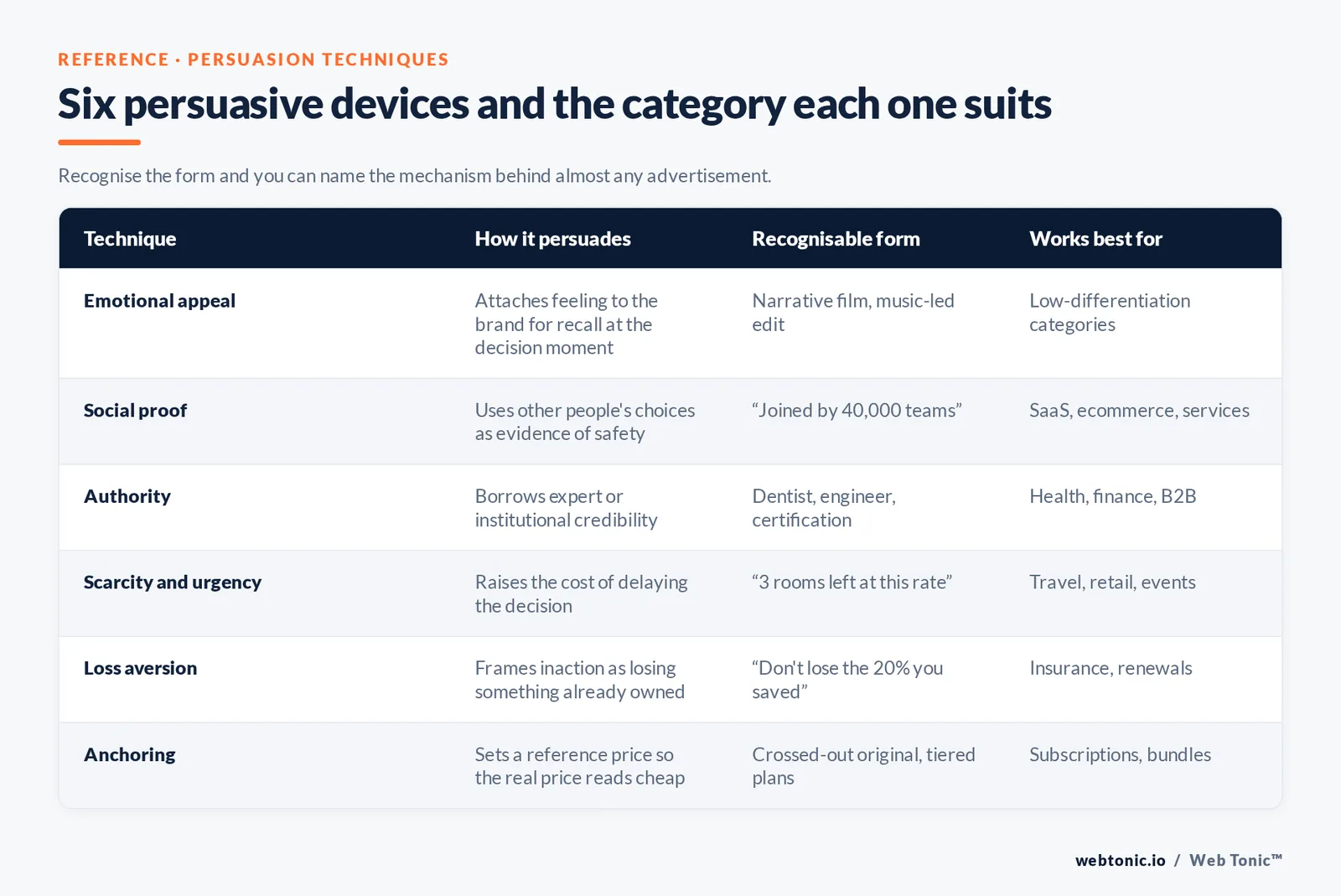
The 12 persuasive advertising techniques
Almost every persuasive ad you can name uses two or three of the following, rarely more. Overloading is the most common failure — each added technique dilutes the one before it.
| Technique | How it persuades | Recognisable form | Works best for |
|---|---|---|---|
| Emotional appeal | Attaches feeling to the brand so it is recalled at the decision moment | Narrative film, music-led edit | Low-differentiation categories |
| Social proof | Uses other people's choices as evidence of safety | "Joined by 40,000 teams" | SaaS, ecommerce, services |
| Authority | Borrows expert or institutional credibility | Dentist, engineer, certification | Health, finance, B2B |
| Scarcity and urgency | Raises the cost of delaying the decision | "3 rooms left at this rate" | Travel, retail, events |
| Loss aversion | Frames inaction as losing something already owned | "Don't lose the 20% you saved" | Insurance, renewals |
| Anchoring | Sets a reference price so the real price reads cheap | Crossed-out original, tiered plans | Subscriptions, bundles |
| Repetition of a single claim | Builds fluency, and fluency feels like truth | One benefit repeated 3 times | Mass reach campaigns |
| Humour | Buys attention and lowers defensiveness | Absurd demonstration, self-mockery | FMCG, telecoms, apps |
| Fear then relief | Names a risk, then removes it with the product | Safety, security, warranty ads | Automotive, cyber, home |
| Bandwagon | Implies a movement the viewer is missing | "Everyone's switching" | Fast-growing challengers |
| Storytelling and identity | Lets the viewer cast themselves as the hero | Mini-documentary, real customers | Sport, education, causes |
| Demonstration proof | Shows the claim happening on camera | Stress test, before-and-after | Tools, cleaning, cosmetics |
Robert Cialdini's research programme, summarised at Influence At Work, gives the same list a tighter spine. Six principles — reciprocity, commitment and consistency, social proof, authority, liking, scarcity — explain why the techniques above work at all, and a seventh, unity, covers identity-led work. Written as ad instructions they look like this:
- Reciprocity: give something usable first — a calculator, a template, a free audit — before asking for the form fill.
- Commitment: ask for a 1-question micro-yes before the 9-field quote request.
- Social proof: quantify it. "Trusted by many" persuades nobody; "1,482 installs in Phoenix last year" does.
- Authority: show the credential, not the adjective.
- Liking: cast people who look like the buyer, not like the brand's aspiration.
- Scarcity: only ever claim limits that are real — a fake countdown is the fastest way to lose a repeat customer.
Emotion or argument? What the effectiveness data says
The long-running debate is whether persuasion is best done through feeling or through reasons. The effectiveness literature leans emotional for long-term growth. Analyses of the IPA effectiveness databank popularised the 60:40 guideline — roughly six parts brand-building to four parts short-term activation — on the basis that emotionally led campaigns produced substantially larger long-term business effects than rationally led ones.
The counterweight is dullness. System1's work on the extraordinary cost of dull puts a number on failing to feel anything: brands running unremarkable advertising need to spend in the order of $189 million more in media to buy the same outcome that distinctive, emotionally resonant work achieves. Measurement houses agree on the direction of travel — Nielsen's cross-media research consistently finds creative quality to be the largest in-ad driver of sales impact, ahead of targeting and reach decisions.
None of that makes reasons useless. Rational claims do the closing: price, guarantee, delivery window, proof. The practical structure most high-performing ads land on is emotion first, reason second, action third — feeling earns the attention, the claim justifies the choice, and the call to action removes friction. Our own performance creative work uses exactly that order when scripting paid social video.
| Appeal balance | Best used when | Typical KPI | Risk if overused |
|---|---|---|---|
| Mostly emotional | Parity products, long buying cycles | Brand lift, search volume | Nobody knows what you sell |
| Balanced 60:40 | Established brand, steady growth goal | Blended CAC, market share | Slow to show in-quarter |
| Mostly rational | Price-led offers, high-intent search | Cost per acquisition | Discount dependency |
| Fear-led | Genuine, documented risk | Quote requests | Backlash, regulator interest |
Nine persuasive ads and the exact device each one used
Award archives are the honest sample here: the Effie Awards judge business results and Cannes Lions judges craft, so campaigns that appear in both tend to be persuasive rather than merely famous.
| Campaign | Core persuasive device | Why it worked |
|---|---|---|
| Apple, "1984" | Identity plus fear of conformity | Sold a worldview, not a spec sheet; a single national airing created decades of earned coverage |
| Nike, "Dream Crazy" | Unity and belief | Took a position its core audience already held, making the purchase an act of alignment |
| Dove, "Real Beauty Sketches" | Emotional reframe with demonstration | Viewers saw the insight proved live on camera rather than asserted in a voiceover |
| Volvo Trucks, "Epic Split" | Demonstration proof | Turned a dry engineering claim — steering precision — into a single unfakeable stunt |
| Old Spice, "The Man Your Man Could Smell Like" | Humour and reappraisal | Spoke to the female purchaser of a male product, and made an old brand feel current |
| Snickers, "You're Not You When You're Hungry" | Repetition of one benefit | The same claim, restaged for a decade, built the fluency that drives impulse choice |
| Always, "#LikeAGirl" | Social norm challenge | Made the audience notice their own bias, then credited the brand with the correction |
| Guinness, "Wheelchair Basketball" | Story with a delayed reveal | Withheld the point until the final seconds, so viewers finished the argument themselves |
| Heineken, "Worlds Apart" | Reciprocity and shared task | Strangers built something together before disagreeing — the product arrived as the reward |
Three patterns repeat across all nine. Each has 1 idea, not several. Each shows rather than states. And each is built so the viewer draws the conclusion — persuasion lands harder when the audience believes they reached it themselves. The annual YouTube Ads Leaderboard is a good running sample of the same devices in short-form digital work.
How to structure a persuasive ad, step by step
- Name one audience tension. Write it as a sentence the customer would actually say out loud. If you have 3 tensions, you have 3 ads.
- Choose one claim you can substantiate. The claim must be true, specific and provable — "installed in 48 hours" beats "fast service".
- Pick two techniques, maximum. Typically one emotional device and one proof device from the table above.
- Open on the payoff. On skippable placements the argument must be recognisable within about 5 seconds; on feeds, within the first frame.
- Show the proof visually. Demonstration, real customers, or on-screen numbers — anything the viewer can verify without trusting you.
- Reduce the next step to one action. One button, one promise about what happens after the click, no competing links.
- Match the landing experience. The page must repeat the ad's claim in its first heading, or the persuasion resets to zero.
- Build variants for the same idea. Test 4 to 6 executions of one concept rather than 6 unrelated concepts.
Most persuasion is lost at steps 6 and 7 rather than in the creative. An ad that changes a belief and then asks for 11 form fields has persuaded somebody to do nothing. We treat the ad and the destination as a single unit in growth marketing engagements for exactly that reason.
Writing persuasive ad copy: message before layout
Most weak advertisements fail in the copy, not the design. A persuasive message is a promise a consumer can picture, written in the words consumers already use. Before writing a line, settle four things: who the audience is, what they currently believe, the single claim that changes that belief, and the action you want. Everything else in the advertisement is packaging.
The message architecture that consistently wins is short: a headline carrying the benefit, a subhead carrying the proof, and a call to action carrying the next step. Ad copy is not an essay — students of copywriting are usually taught to cut every sentence that does not either create desire or remove doubt. The examples below show the same claim written three ways so you can see how much the wording moves.
| Weak copy | Persuasive rewrite | Technique used |
|---|---|---|
| "Quality plumbing services" | "A licensed plumber at your door in 90 minutes — or the call-out is free" | Specificity, risk reversal, authority |
| "Great value software" | "Teams save 6 hours a week on reporting. Try it free for 14 days" | Quantified benefit, free trial, low commitment |
| "Trusted by many customers" | "1,482 homeowners in Phoenix chose us last year" | Social proof with real numbers |
| "Book your consultation" | "Get your 2-page audit — no call required" | Reciprocity, friction removal |
| "Innovative skincare" | "Redness down in 4 weeks in a 120-person trial" | Demonstration proof, substantiated claim |
Two habits separate persuasive copy from filler. First, write the benefit as a consequence in the customer's life, not a product attribute: nobody buys insulation, they buy a warm room and a smaller bill. Second, name the values the audience holds and show the brand shares them — value alignment is what makes identity-led campaigns feel personal rather than commercial.
Tone matters as much as content. A message based on facts still fails if it sounds like a corporate memo, and a warm, human tone earns trust faster than a superlative ever will. Read every draft aloud: if you would not say the sentence to a customer standing in front of you, it will not persuade one on a screen either.
Persuasive video ads and how the format changes the argument
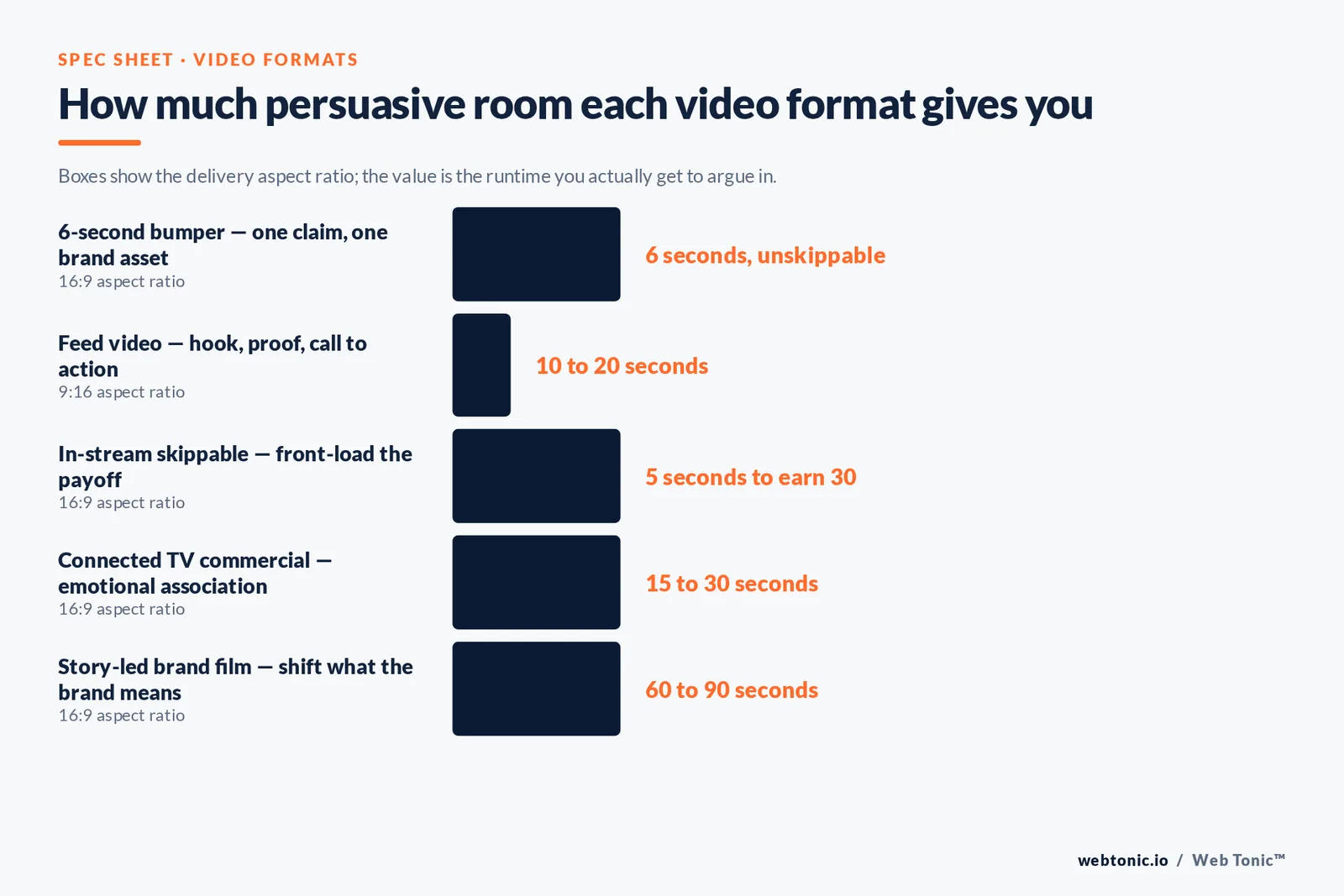
Video is now the default persuasive medium because it carries the two things static media cannot: performance and time. A commercial can show a face changing its mind, and it can control the order in which the audience receives information. That control is why the same message performs very differently across media.
The trade-off is attention. Skippable placements give a video ad seconds to earn the rest of its runtime, so the persuasive claim leads and the brand appears early rather than being saved for a reveal. Long-form storytelling still works, but it works where people have chosen to watch — connected TV, cinema, in-stream content they selected — not in a scrolling feed.
| Format | Time available | Persuasive job | How to create it |
|---|---|---|---|
| 6-second bumper | 6 seconds, unskippable | One claim, one brand asset | Cut from your hero film, never shoot separately |
| Feed video | 10 to 20 seconds | Hook, proof, call to action | Sound-off first: captions and on-screen copy |
| In-stream skippable | 5 seconds to earn 30 | Front-load the payoff | Open on the consequence, not the setup |
| Connected TV commercial | 15 to 30 seconds | Emotional association at scale | Single narrative, no URL-heavy end card |
| Story-led brand film | 60 to 90 seconds | Shift what the brand means | Earn the runtime with a genuine reveal |
One production note that saves money on every campaign: shoot once, create many. A single day of footage should yield the long film, three feed cuts, two bumpers and a set of static frames for social and display. Media plans change weekly; the content library should be deep enough to keep up without a reshoot.
The legal line: persuasion versus misleading
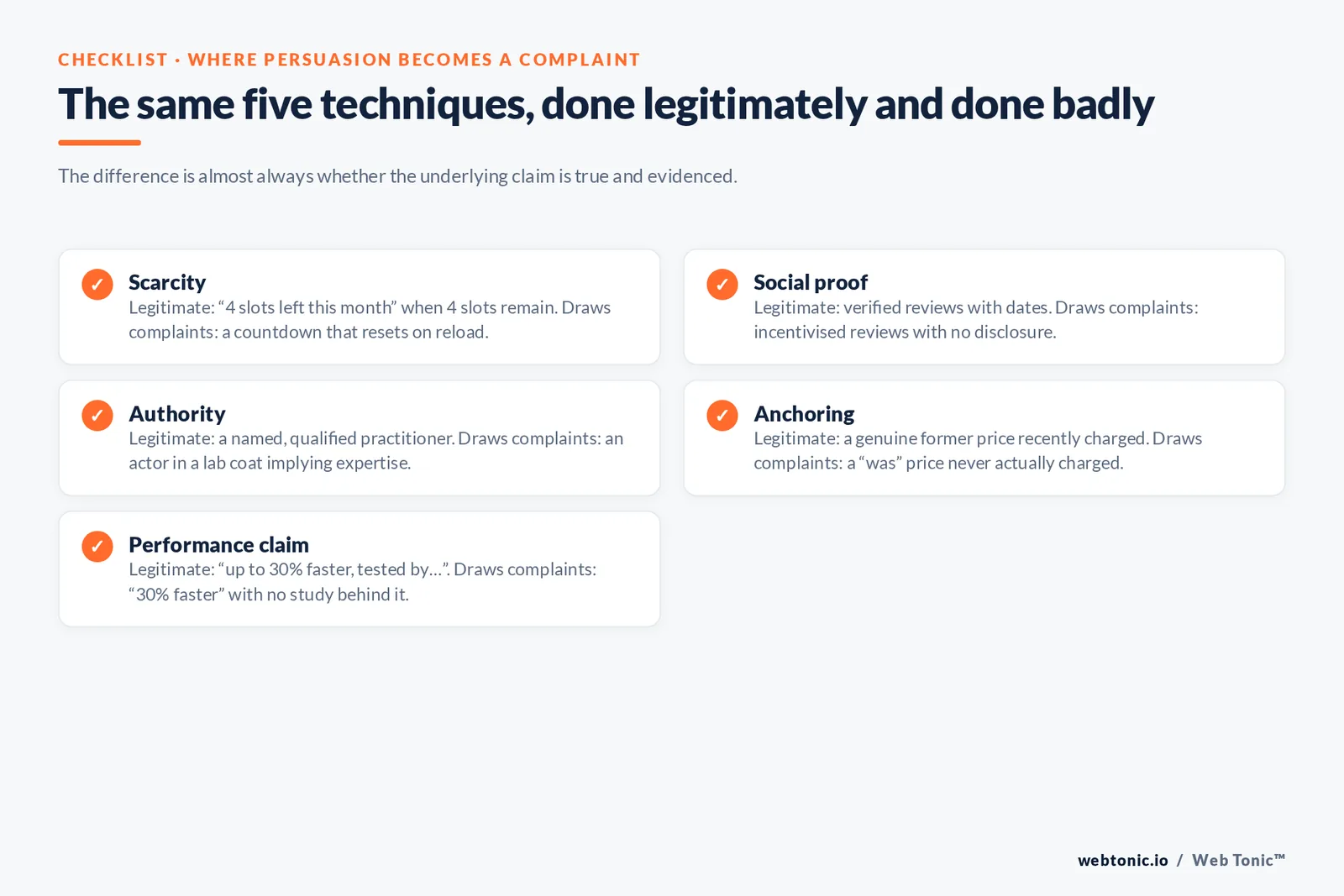
Persuasive technique is regulated at the point where it becomes deception. In the United States, the FTC's advertising and marketing guidance sets two durable requirements: ads must not be deceptive or unfair, and advertisers must hold adequate substantiation for objective claims before publication. The FTC's endorsement guides add that material connections between a brand and anyone praising it — payment, free product, employment — must be disclosed clearly and conspicuously. In the UK, the ASA enforces an equivalent standard and publishes rulings that read as a practical catalogue of techniques that went too far.
| Technique | Persuasive version | Version that draws complaints |
|---|---|---|
| Scarcity | "4 slots left this month" when 4 slots remain | A countdown that resets on reload |
| Social proof | Verified reviews with dates | Incentivised reviews with no disclosure |
| Authority | A named, qualified practitioner | An actor in a lab coat implying expertise |
| Anchoring | A genuine former price recently charged | A "was" price never actually charged |
| Performance claim | "Up to 30% faster, tested by…" | "30% faster" with no study behind it |
Ethos, pathos and logos in real advertisements
The three classical appeals are worth revisiting with examples, because they are the fastest diagnostic for a draft that is not landing. Students of rhetoric learn them as separate categories; advertisers should treat them as three dials on the same message.
Ethos is credibility. In advertisements it appears as certifications, years in business, named experts, warranties and third-party reviews. Ethos does not persuade on its own, but without it every other appeal is discounted — consumers do not act on a claim from a brand they do not trust.
Pathos is emotion. This is the appeal most commercial work leans on: relief, pride, belonging, humour, nostalgia, or the quiet fear of getting a decision wrong. Pathos creates the memory; ethos makes it safe to act on.
Logos is reasoning: prices, comparisons, timings, test results, guarantees. Logos rarely wins attention, but it closes. Note that "logos" here means logic, not brand marks — a confusion worth flagging in any creative review where both meanings are in the room.
| Appeal | Example line from a real advertisement pattern | What the consumer thinks |
|---|---|---|
| Ethos | "Recommended by 8 out of 10 dentists" | "People who would know approve of this" |
| Pathos | "You're not you when you're hungry" | "That is exactly how it feels" |
| Logos | "Half the energy use, based on independent testing" | "The maths works in my favour" |
| Ethos plus logos | "Licensed installers, 10-year written warranty" | "Low risk if something goes wrong" |
| Pathos plus logos | "Sleep through the night — 92% did within 3 weeks" | "I want that, and it is plausible" |
Balance the dials by category. In regulated or high-consideration markets, ethos leads and the messages read as evidence. In everyday consumer categories, pathos leads and logos appears once, late, as reassurance. Where a purchase signals identity — sport, fashion, causes — the persuasive weight moves to shared values, and the product becomes proof of membership rather than the subject of the argument.
A practical review habit: mark every sentence in your draft E, P or L. If a whole advertisement is L, it will be ignored. If it is all P, nobody will know what they are being asked to buy. If ethos is missing entirely, expect high engagement and a low conversion rate, which is the single most common pattern we see when auditing underperforming creative.
Measuring whether the ad actually persuaded anyone
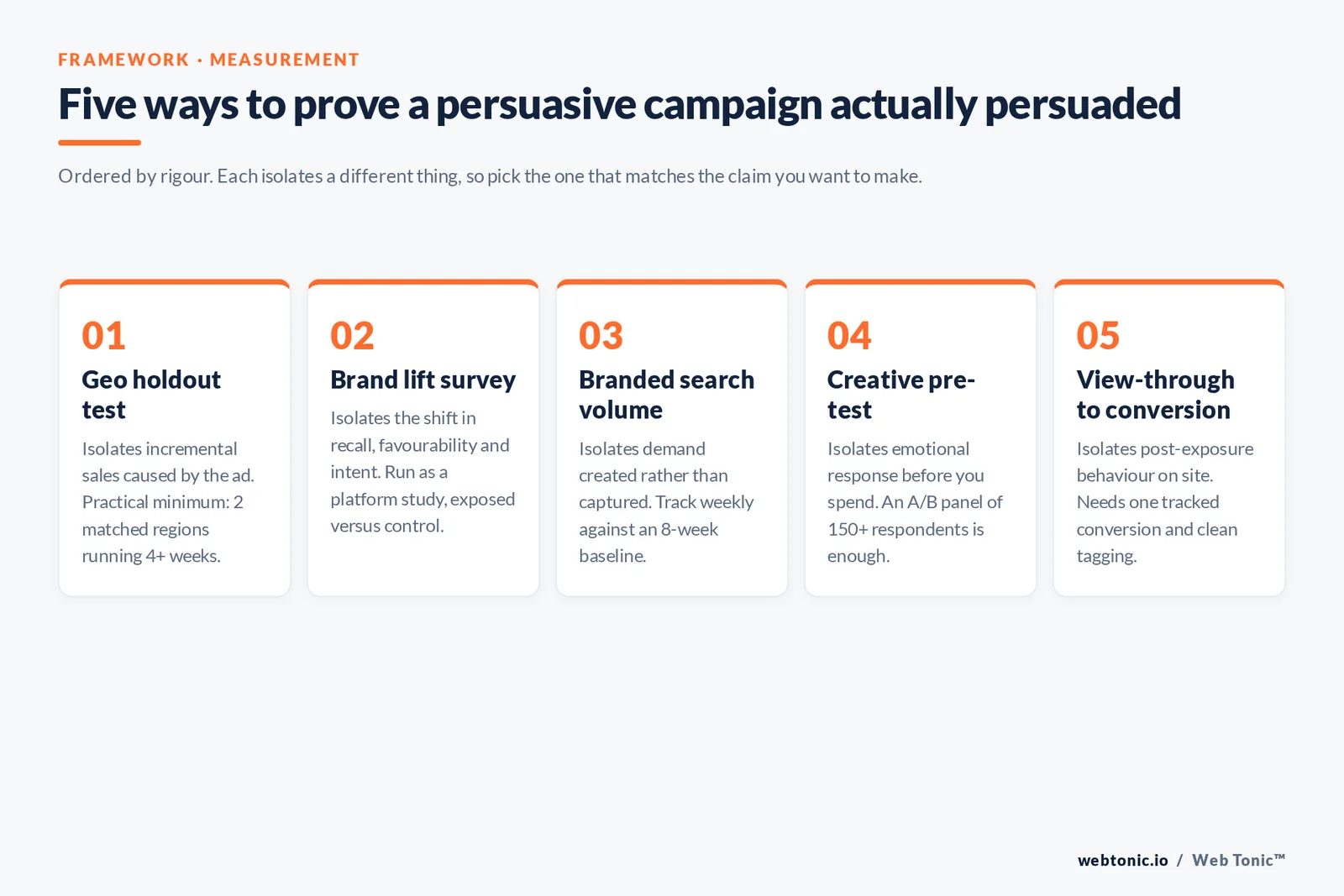
Clicks measure interest, not persuasion. Attitude change and incremental demand are what separate a persuasive ad from an ad that harvested people who were already buying.
| Method | What it isolates | Practical minimum |
|---|---|---|
| Geo holdout test | Incremental sales caused by the ad | 2 matched regions, 4+ weeks |
| Brand lift survey | Shift in recall, favourability, intent | Platform study, exposed vs control |
| Branded search volume | Demand created rather than captured | Weekly trend, 8-week baseline |
| Creative pre-test | Emotional response before spend | A/B panel, 150+ respondents |
| View-through to conversion | Post-exposure behaviour on site | 1 tracked conversion, clean tagging |
Read those together. A campaign with a 3-point brand-lift gain and flat incremental revenue changed minds but not behaviour — usually a targeting or offer problem. Flat lift with rising sales usually means the ad found existing demand, which is valuable but is not persuasion. Our data intelligence team builds these read-outs before a campaign launches, not after, and there are more worked examples across the Web Tonic blog.
FAQ
What is a persuasive ad in simple terms?
An advertisement designed to change a belief, feeling or action rather than simply announce information. It states a benefit the audience cares about, backs it with proof, and makes the next step easy enough to take immediately.
What are the most common persuasive advertising techniques?
Emotional appeal, social proof, authority, scarcity, loss aversion, anchoring, repetition, humour, fear-then-relief, bandwagon, storytelling and demonstration proof. Strong ads combine two or three; weak ads try to use most of them at once.
Why is emotional appeal so important in persuasive advertising?
Because emotion drives memory, and memory is what decides which brand comes to mind at the moment of purchase. Effectiveness analyses associated with the IPA databank found emotionally led campaigns delivered far larger long-term business effects than rational ones, which is where the 60:40 brand-to-activation guideline came from.
Is persuasive advertising the same as manipulation?
No. Persuasion presents a true, substantiated case in a compelling way; manipulation relies on a claim the advertiser cannot support, a limit that is not real, or an undisclosed paid endorsement. The FTC and ASA rules mark the boundary clearly, and crossing it costs more in refunds and reputation than the extra conversions are worth.
How do I test whether my ad is persuasive?
Pre-test the creative on emotional response before spending, then measure incrementality with a geo holdout or platform brand-lift study while it runs. If neither branded search nor incremental revenue moves, the ad was noticed but did not persuade.
How long should a persuasive ad be?
Long enough for one idea. Short-form social work generally lands between 6 and 15 seconds with the payoff in the opening frame, while story-led films need 60 to 90 seconds because the reveal is the persuasion. Length is a consequence of the device, not a target. If you want a second opinion on a specific script, talk to our team.
Sources: Aristotle, Rhetoric (MIT Classics) · Purdue OWL, rhetorical strategies · Influence At Work (Cialdini) · IPA · System1, "The Extraordinary Cost of Dull" · Nielsen Insights · Think with Google, YouTube Ads Leaderboard · Effie Awards · Cannes Lions · FTC advertising and marketing guidance · FTC endorsement guides · ASA. All sources accessed August 2026.