



Table of contents
Luxury advertising delivers measurably stronger returns than mass-market campaigns because it targets wealthier audiences who spend more per transaction and stay loyal longer.
Key Takeaways
- The global luxury market reached €1,443 billion in 2025 and personal luxury goods are projected to grow 2–4 % in 2026, according to Bain & Altagamma.
- Mature luxury Shopping campaigns achieve 4–8× blended ROAS, while first-party audience layering lifts return on ad spend by 20–40 % over cold audiences.
- The wealthiest top-tier clients — less than 1 % of buyers — drive the majority of long-term growth, while aspirational consumers make up 60 % of the market.
- Luxury session conversion rates range from 0.8–1.4 % for fashion, but average order values of $500–$5,000+ more than compensate for lower volume.
- The UK's Advertising Standards Authority amended or removed 22,383 ads in 2025, underscoring how premium brands that get advertising right avoid costly compliance issues.
Why Luxury Ads Outperform Mass-Market Campaigns
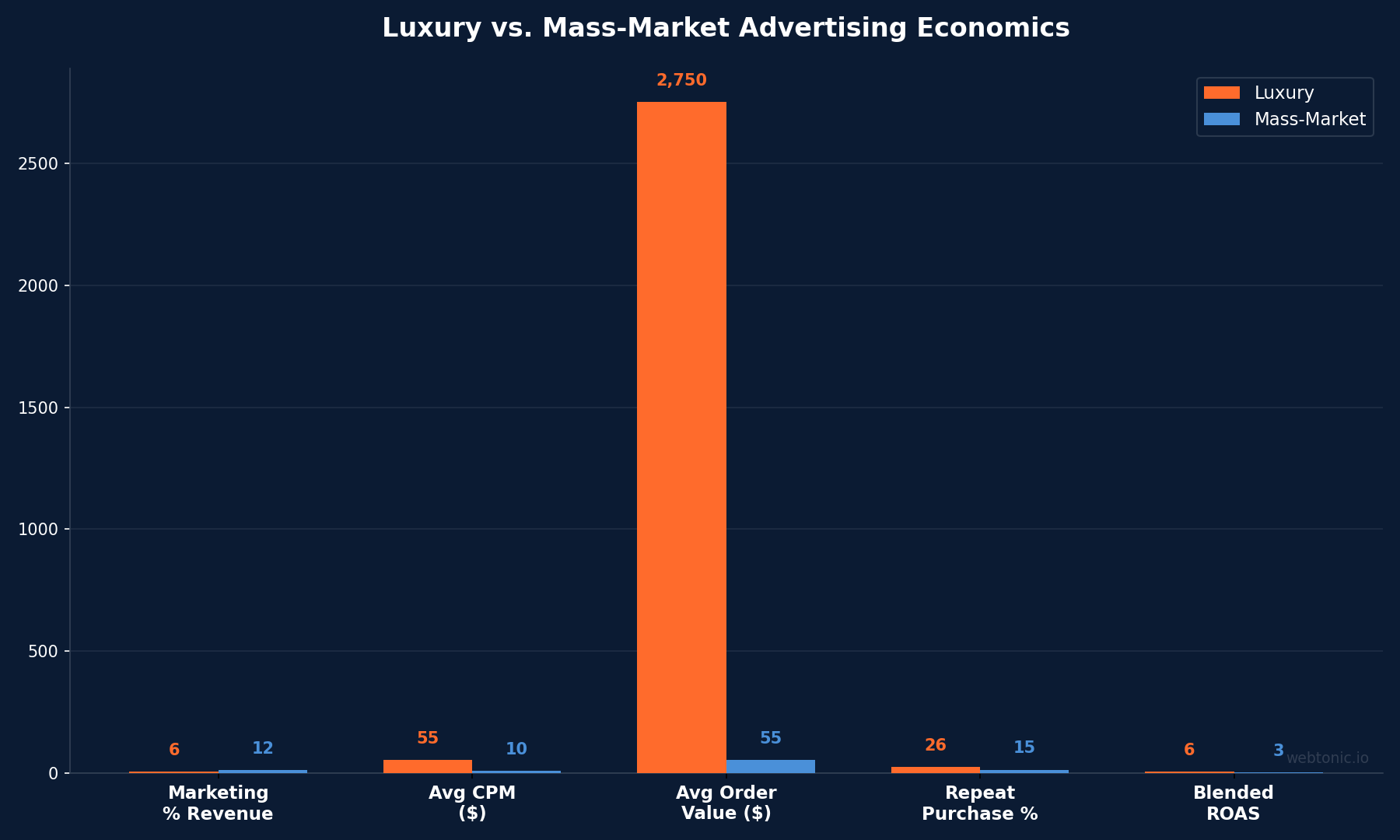
Luxury advertising operates on different economics. Where mass-market campaigns chase volume, luxury ads chase value per customer. A $50 CPM reaching affluent shoppers who convert at $800 average order value generates far more margin per impression than a $10 CPM reaching bargain hunters at $40 AOV.
This value-over-volume model means luxury brands spend 5–8 % of revenue on marketing versus the 10–15 % typical of mass-market brands, yet achieve higher returns per dollar. The key difference is audience quality — luxury advertisers target consumers with the disposable income to buy repeatedly at full price.
The Kearney 2026 Global Luxury Outlook confirms this dynamic: spending is becoming more concentrated and intentional, with ultra-high net worth and high net worth individuals remaining stable contributors to the majority of luxury spending even as aspirational consumers shift how and where they engage.
| Metric | Luxury Advertising | Mass-Market Advertising |
|---|---|---|
| Marketing as % of Revenue | 5–8 % | 10–15 % |
| Average CPM | $30–$80 | $5–$15 |
| Average Order Value | $500–$5,000+ | $30–$80 |
| Session Conversion Rate | 0.8–1.4 % | 2–4 % |
| 12-Month Repeat Purchase | 18–35 % | 10–20 % |
| Blended ROAS (Mature) | 4–8× | 2–4× |
These numbers come from luxury e-commerce benchmarks published by Oneiro Digital and Deus Marketing, aggregating data from 40+ luxury accounts across fashion, jewellery, beauty, and hospitality.
Brand Equity Compounds Over Time
The most underappreciated benefit of luxury advertising is compounding brand equity. Unlike performance campaigns that stop generating revenue the moment you pause spending, luxury brand campaigns create a residual value that appreciates like an asset.
When Louis Vuitton runs a brand campaign, it reinforces exclusivity signals that support pricing power across every product line for years. This is why Bain's 2025 luxury study found that even during a sector-wide normalization, overall luxury spending remained 12–14 % above 2019 levels — brand equity built over decades acts as a buffer against economic headwinds.
Luxury brands benefit from what economists call the Veblen effect: higher prices actually increase demand among target consumers because the price itself signals status. Advertising amplifies this effect by maintaining the perception of exclusivity and desirability that justifies premium pricing. Cart abandonment rates of 80–88 % in luxury e-commerce are not a failure — they reflect considered purchasing behavior from customers who return when the timing is right.
Precision Targeting Reaches High-Value Audiences
Luxury advertising delivers outsized returns partly because modern digital marketing tools allow precise targeting of affluent consumers. Instead of broadcasting to millions of unqualified viewers, luxury brands can layer targeting signals to reach the exact audience most likely to convert.
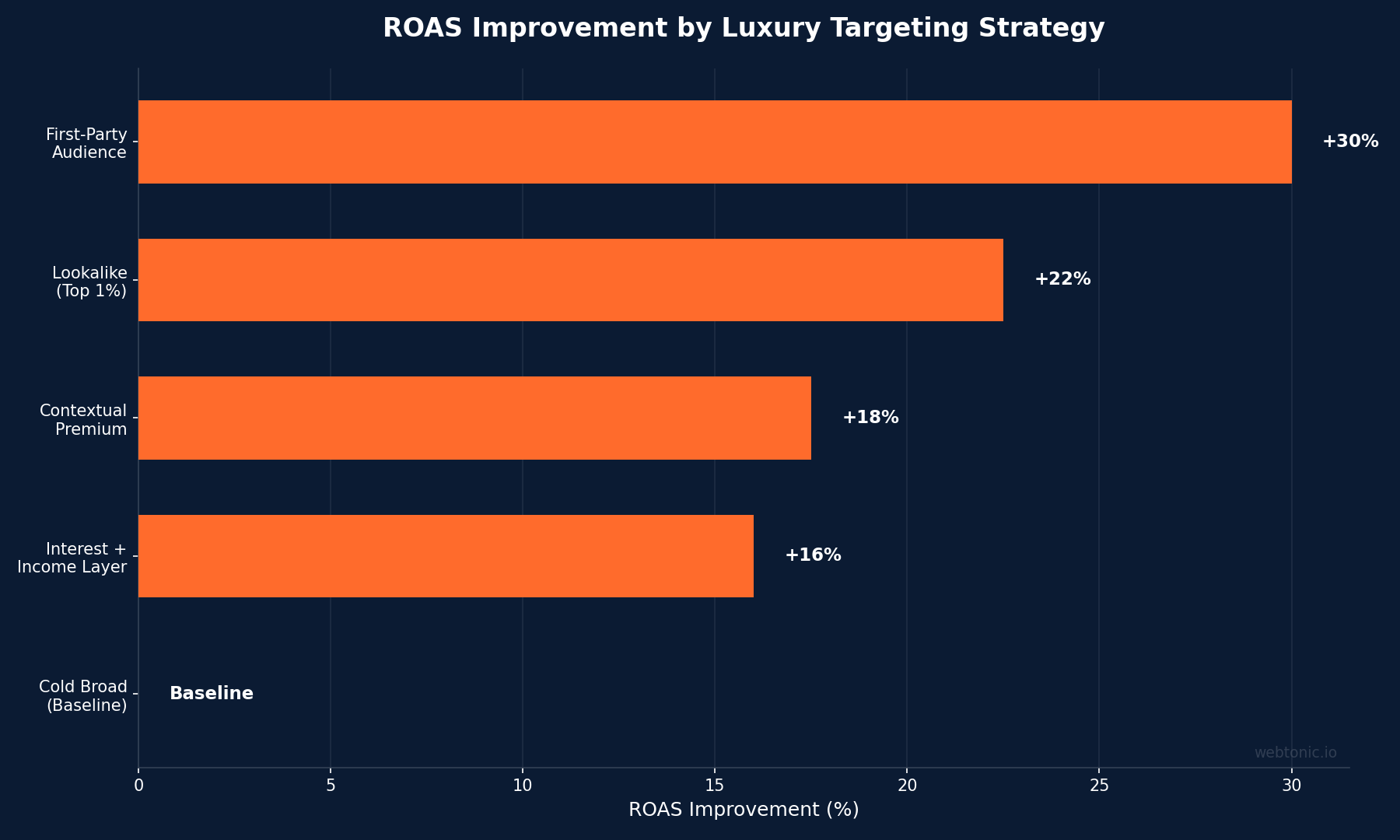
According to the 2025 True-Luxury Global Consumer Insight study (surveying over 7,000 luxury consumers), the wealthiest clients have reaffirmed their position as the key engine of long-term growth. Here is how different targeting strategies compare in ROAS lift:
| Targeting Strategy | ROAS Improvement | Best For |
|---|---|---|
| First-Party Audience Layering | +20–40 % | Retargeting existing luxury clients with personalized offers |
| Lookalike Audiences (Top 1 %) | +15–30 % | Finding new affluent prospects who mirror best customers |
| Contextual Placement on Premium Publishers | +10–25 % | Brand awareness alongside editorial luxury content |
| Interest + Income Layering | +12–20 % | Reaching aspirational consumers with verified purchase intent |
| Cold Broad Targeting | Baseline | Prospecting at scale with automated optimization |
Digital Channels That Work for Luxury Brands
Not every digital channel suits luxury positioning. The best luxury advertising strategies concentrate spend where affluent audiences engage — and where brand-safe environments protect the premium perception.
Paid social on Instagram, Pinterest, and TikTok drives luxury e-commerce discovery. Instagram remains the primary platform for luxury brand storytelling, with Meta paid social delivering 1.5–3× last-click ROAS for luxury accounts. TikTok is increasingly important for reaching younger affluent consumers — AdSpyder reports that luxury brands using short-form video see higher engagement rates than static image campaigns.
Google Shopping and Search capture high-intent demand. Mature luxury Shopping accounts achieve 4–8× blended ROAS, while early-stage or Performance Max-only accounts typically see 2–4×. The key variable separating high-ROAS luxury accounts from average ones is product feed quality — accurate titles, luxury-appropriate descriptions, and rich attributes like material, color, and designer dramatically improve Shopping performance.
Email and SMS marketing achieve the highest ROI for nurturing existing luxury clients. Data-driven lifecycle campaigns recover 5–12 % of abandoned carts and maintain relationships that turn one-time buyers into loyal clients with 18–35 % twelve-month repeat purchase rates.
The Aspirational Halo Effect
One benefit unique to luxury advertising is the halo effect — campaigns for flagship products lift sales across the entire portfolio. When a brand like Hermès advertises the Birkin, it drives traffic and sales for scarves, fragrances, and accessories that carry lower price points but higher margins.
This halo works because luxury advertising sells identity, not features. Consumers who cannot afford the hero product still buy into the brand through more accessible items. Research confirms that aspirational consumers — now 60 % of the luxury market — are the primary engine for volume growth, even as top-tier clients drive value growth.
The practical implication for advertising strategy is clear: invest in brand campaigns that elevate the most aspirational products, then let the halo drive conversions on accessible price points. This is why luxury conglomerates like LVMH and Kering allocate significant budget to brand campaigns that have no direct conversion objective — the downstream commercial lift more than justifies the investment.
Premium Pricing Power and Reduced Price Sensitivity
Effective luxury advertising builds pricing power that directly improves margins. When consumers associate a brand with quality, craftsmanship, and status, they become less sensitive to price increases. This is the opposite of mass-market advertising, where brands compete on deals and promotions that erode margins over time.
The 2026 Bain-Altagamma study mapped a market shaped by four interconnected forces: amplifying experiences, evolving consumer identities, sustainability requirements, and digital transformation. Brands that invest in advertising these value pillars — rather than discounting — maintain pricing power even during market contractions. Personal luxury goods spending stabilized at €358 billion in 2025, and projections for 2026 anticipate growth to €365–€373 billion under the base case scenario.
Server-side tagging — now standard for premium web implementations — recovers 15–30 % of conversions lost to browser restrictions, ensuring luxury advertisers measure their true campaign impact rather than underreporting returns.
Measuring Luxury Advertising Success
Luxury brands cannot rely solely on last-click attribution. The purchase journey is longer (often 30–90 days), involves more touchpoints, and includes offline interactions that digital tracking misses. Successful measurement combines several approaches:
Blended marketing efficiency ratio (MER) divides total revenue by total marketing spend, capturing the full impact of brand and performance campaigns together. Customer lifetime value (LTV) analysis reveals the true return of acquisition campaigns — a luxury customer acquired at a $200 CPA who spends $3,000 over three years represents dramatically different economics than the same CPA in mass-market retail.
Brand lift studies measure the awareness and consideration gains that precede purchase intent. Incrementality testing with holdout groups isolates the true contribution of each channel by measuring what would have happened without the advertising campaign. Both tools are essential because standard digital attribution systematically undervalues luxury brand campaigns whose payoff unfolds over months.
Building a Luxury Advertising Strategy
The most successful luxury advertising strategies start with a clear understanding of the brand's position in the market. A heritage house like Chanel with decades of accumulated brand equity requires a different approach than an emerging luxury brand building awareness from scratch.
For established brands, the priority is protecting brand equity while expanding reach. This means allocating 60–70 % of advertising budget to brand campaigns that reinforce exclusivity, with the remaining 30–40 % on performance campaigns that capture demand. For emerging luxury brands, the ratio inverts: 60–70 % on performance to drive initial sales velocity, with 30–40 % on brand to build the perception necessary for premium pricing. As the brand matures and recognition grows, the allocation shifts toward brand investment.
Related reading
- Features vs Benefits: 14 Examples and When to Lead With Each
- 18 Funny Ads That Actually Sold Something (And Why They Work)
- Persuasive Ads: 12 Techniques, 9 Examples and the Legal Limits
- Marketing Strategy Consulting services at Web Tonic
FAQ
What are the main benefits of luxury advertising?
Luxury advertising builds brand equity, commands premium pricing, targets high-net-worth audiences with precision, and typically delivers 4–8× blended ROAS in mature campaigns. It also creates an aspirational halo effect that lifts the entire product portfolio, reduces price sensitivity, and drives higher customer lifetime value compared to mass-market advertising.
How does luxury ad spend compare to mass-market advertising?
Luxury brands allocate roughly 5–8 % of revenue to marketing compared to 10–15 % for mass-market brands, yet achieve higher per-dollar efficiency because they target a narrower, wealthier audience. Cost per mille rates run 2–5× higher on premium placements, but conversion values offset the cost because average order values typically exceed $500.
What digital channels work best for luxury advertising?
Paid social (Instagram, Pinterest, TikTok) and Google Shopping perform best for luxury e-commerce, while programmatic display on premium publishers builds brand awareness. First-party audience layering improves ROAS by 20–40 % over cold audiences. Email and SMS marketing achieve the highest ROI for nurturing existing luxury clients.
Is luxury advertising worth the higher CPM?
Yes. Although luxury CPMs run 2–5× above mass-market averages, the economics work because luxury average order values are 5–20× higher. A $50 CPM reaching affluent shoppers who convert at $800 AOV produces far more margin per impression than a $10 CPM reaching bargain hunters at $40 AOV.
How do you measure luxury advertising ROI?
Use a combination of blended marketing efficiency ratio (MER), customer lifetime value analysis, brand lift studies, and incrementality testing. Last-click attribution underreports luxury campaign performance because purchase journeys span 30–90 days across multiple touchpoints.
Sources
Bain & Altagamma — Luxury Goods Worldwide Market Study 2026
Kearney — 2026 Global Luxury Industry Outlook
Oneiro Digital — Luxury Ecommerce Benchmarks 2026
Deus Marketing — Luxury Marketing Benchmarks 2026
AdSpyder — Luxury Brand Marketing Strategies 2026
Bain & Company — Finding a New Longevity for Luxury


