Table of contents
Subliminal advertising is the practice of embedding a brand message below the threshold of conscious perception — a frame, sound or shape the audience never consciously registers — in the hope it still shapes behavior. It is the most famous idea in advertising history that almost entirely failed to replicate.
Key Takeaways
- The founding experiment was a fraud. James Vicary claimed a 1/3000th-of-a-second flash lifted Coca-Cola sales 18.1% and popcorn 57.8% in a New Jersey cinema in 1957; he later admitted he falsified the data.
- 4 decades of replication attempts found nothing resembling Vicary's numbers. Modern subliminal priming effects are real but tiny and conditional.
- Subliminal priming shifts brand choice mainly when a matching goal is already active — thirsty participants, not all participants. Treat it as a 1-in-2 conditional effect, not a lever.
- The US has no statute banning subliminal ads. The FCC's 1974 public notice called the technique "contrary to the public interest," and the FTC's deception standard already covers it.
- Brain imaging confirms invisible stimuli reach the visual cortex — decodable from activity in primary visual cortex (V1) — but reaching V1 is not the same as changing a purchase.
- For practitioners the useful takeaway is inverted: the 3 supraliminal mechanisms people mistake for subliminal work — priming, mere exposure and framing — are legal, measurable and far stronger.
What subliminal advertising actually means
A stimulus is subliminal when it is presented below the limen — the threshold at which a person can consciously report seeing or hearing it. In advertising terms that means a visual frame shown too briefly to notice, a word masked by other imagery, or audio mixed far under the music bed. If the audience can find the message when told to look, it is not subliminal; it is merely subtle. That distinction matters because most viral "subliminal advertising" examples circulating online are supraliminal: hidden arrows in logos, shapes in packaging, background objects in commercials. Anyone can see them once pointed out.
Academic work separates three related ideas that popular coverage collapses into one. Subliminal stimuli are presentations below conscious perception. Subliminal priming is the measurable downstream effect of those presentations on a later judgment or choice. Unconscious cognition is the broader field studying processing that happens without awareness, only part of which involves subliminal presentation at all. The American Psychological Association's research overview of subliminal perception is the cleanest entry point to that literature.
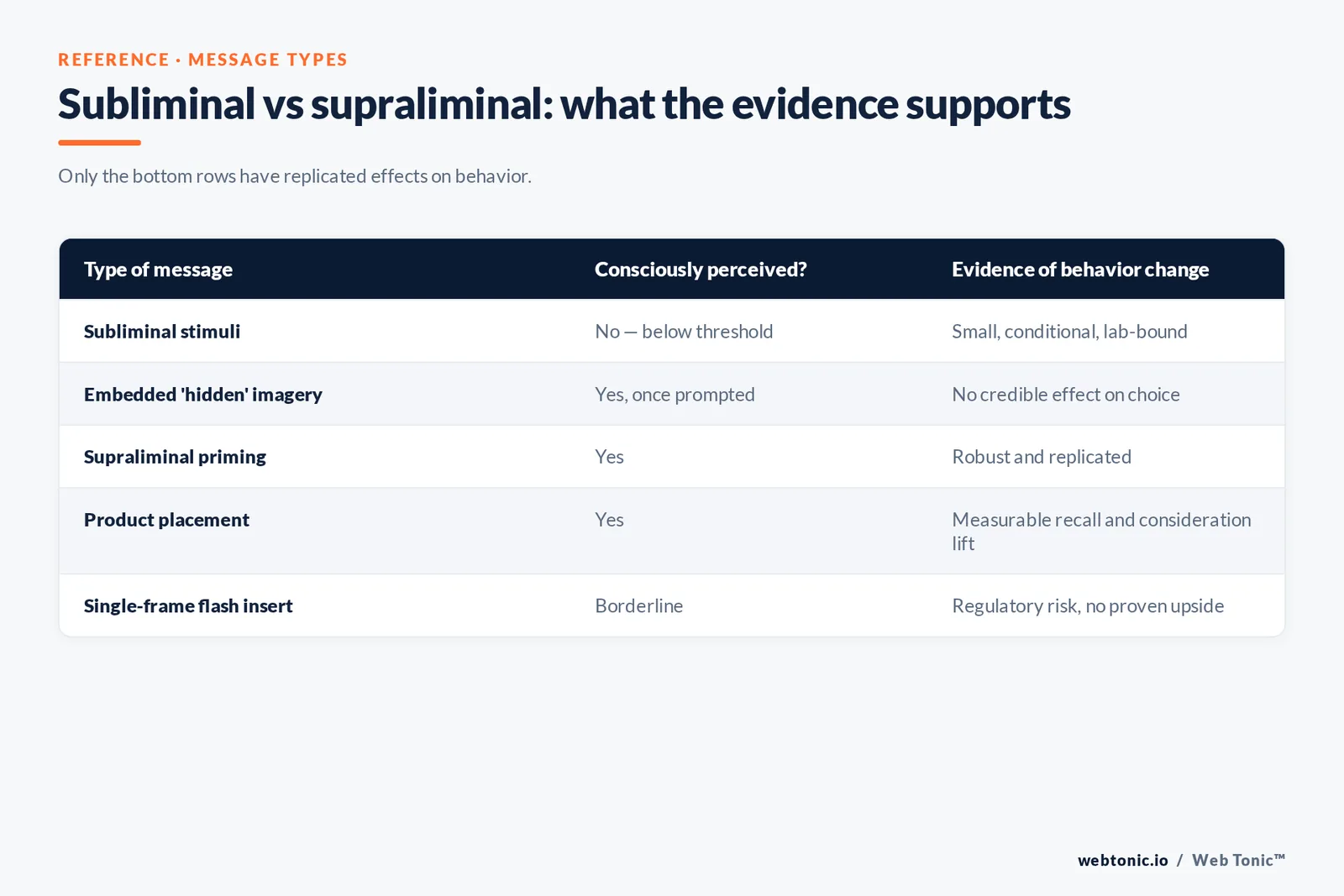
| Type of message | Consciously perceived? | Typical vehicle | Evidence of behavior change |
|---|---|---|---|
| Subliminal stimuli | No — below threshold | Masked word, sub-30ms frame, audio under mix | Small, conditional, lab-bound |
| Embedded imagery ("hidden" shapes) | Yes, once prompted | Logo negative space, packaging art | No credible effect on choice |
| Supraliminal priming | Yes | Colour, music, adjacency, category cues | Robust and replicated |
| Product placement | Yes | Film, streaming, games | Measurable recall and consideration lift |
| Single-frame "flash" insert | Borderline | Broadcast or online video | Regulatory risk, no proven upside |
The 1957 experiment that started everything — and the confession that ended it
Public anxiety about hidden persuasion predates the term. Vance Packard's 1957 book The Hidden Persuaders documented the motivational-research techniques then sweeping post-war American marketing, and primed the audience for something more sinister. That same summer, market researcher James Vicary installed a tachistoscope in the projection booth of a Fort Lee, New Jersey cinema during screenings of the film Picnic and, by his account, flashed "Drink Coca-Cola" and "Hungry? Eat Popcorn" every five seconds at 1/3000th of a second each.
The reported result — 18.1% more Coca-Cola and 57.8% more popcorn — became one of the most repeated statistics in marketing. It was also invented. As Snopes documents in its fact check of the popcorn story, Dr. Henry Link of the Psychological Corporation challenged Vicary to repeat the test; the replication produced no significant sales increase, and Vicary eventually confessed the original figures were falsified. Some historians doubt the Fort Lee study ever happened.
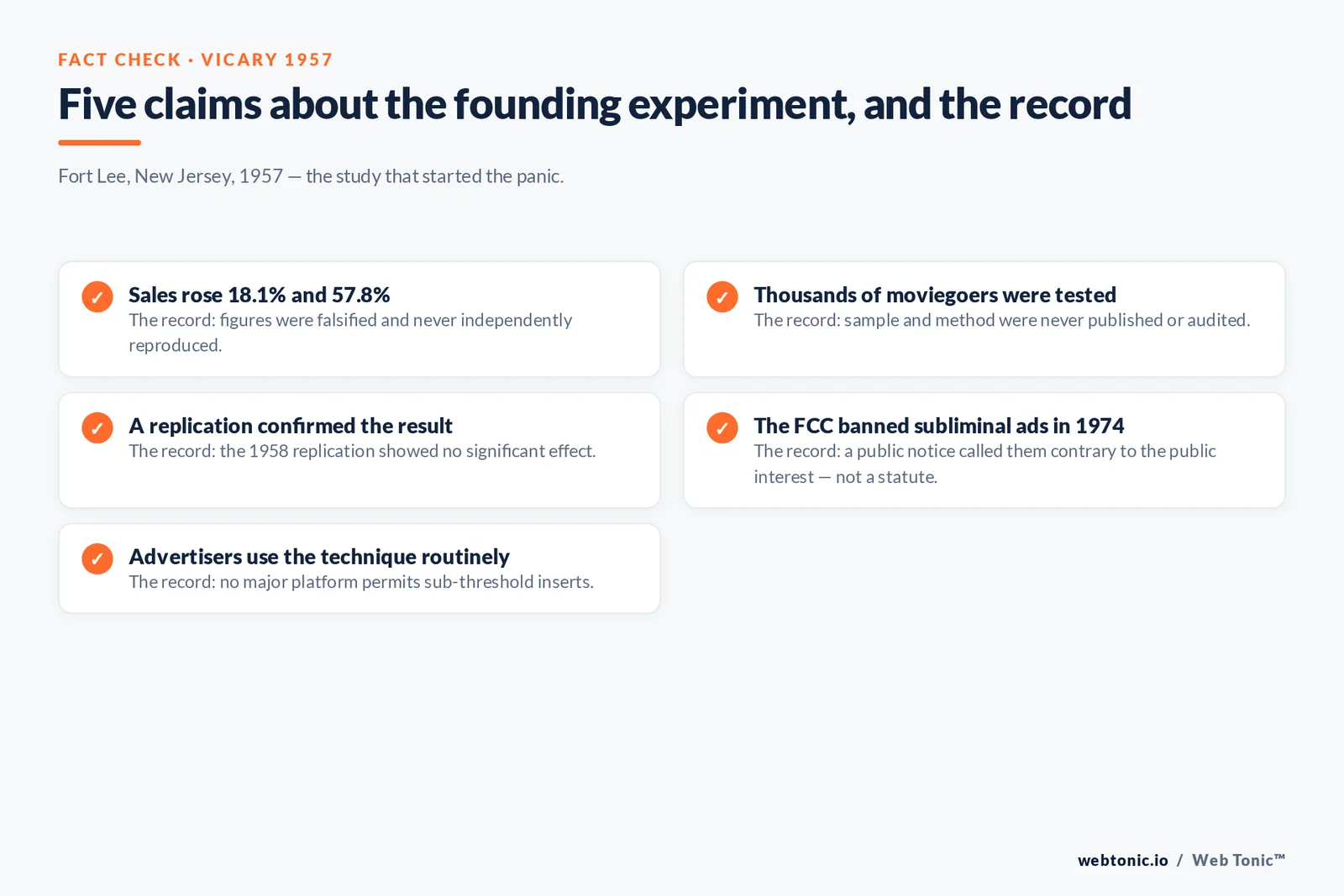
| The claim | The record |
|---|---|
| Sales rose 18.1% and 57.8% | Figures were falsified; never independently reproduced |
| Thousands of moviegoers were tested | Sample and method were never published or audited |
| A replication confirmed it | The 1958 replication showed no significant effect |
| The FCC banned subliminal ads in 1974 | A public notice called them contrary to the public interest — not a statute |
| Advertisers use the technique routinely | No major platform permits sub-threshold inserts; ad-tech pipelines cannot deliver them reliably |
The legend survived because the sensational version travelled and the retraction did not — a pattern any marketer running a claims-based campaign should recognise. Wilson Bryan Key's 1973 book Subliminal Seduction extended the panic to print, arguing that airbrushed words and sexual imagery were routinely concealed in magazine advertising. Those readings were never demonstrated experimentally, but they shaped two generations of public belief about the industry.
What the peer-reviewed evidence actually shows
Serious research on subliminal messaging did not stop when Vicary's story collapsed; it just produced far more modest results. Three findings anchor the modern picture.
First, invisible stimuli genuinely reach the brain. Haynes and Rees showed that the orientation of a stimulus rendered invisible by masking can still be decoded from activity in human primary visual cortex using functional magnetic resonance imaging. Neural processing without awareness is not controversial.
Second, subliminal affective cues can nudge consumption. In a study of masked happy versus angry faces, participants who never consciously perceived the faces still shifted how much of a drink they consumed and what they judged it to be worth. The effect was on quantity and valuation, not on brand switching.
Third, the effect is moderated by the person. A Frontiers in Psychology study of a subliminal energy-drink advertisement found that sensation seeking moderated sensitivity to the subliminal ad — the prime landed for some personality profiles and not others. The best-known brand-choice result, Karremans, Stroebe and Claus in the Journal of Experimental Social Psychology (2006), pointedly titled "Beyond Vicary's fantasies," found subliminal priming of an iced tea brand raised choice of that brand only among participants who were already thirsty.
| Study focus | What was primed | Finding | Condition required |
|---|---|---|---|
| Masked orientation (fMRI) | Invisible visual stimuli | Decodable in V1 without awareness | None — perception only, no behavior |
| Masked emotional faces | Happy vs angry expressions | Changed consumption volume and willingness to pay | Immediate consumption opportunity |
| Iced tea brand priming | Brand name below threshold | Increased brand choice | Participant already thirsty |
| Energy drink advertisement | Subliminal ad exposure | Effect varied by personality | High sensation seeking |
| Self-help audio tapes | Hidden affirmations | No effect beyond expectation | None — effects traced to placebo |
Read together, the literature supports one sentence: subliminal stimuli can tip a choice a person was already close to making, in a controlled setting, within seconds. It cannot create demand, and no published work shows it surviving the messy conditions of a real media buy. The Association for Psychological Science catalogue of replication work in social priming is a useful corrective for anyone tempted by a single dramatic study.
Why the effect collapses outside the lab
Four practical barriers stand between a lab prime and a campaign.
- Limit 1 — timing. Lab primes work within roughly 2 to 5 minutes of exposure and require the choice to be available immediately. Ad exposure and purchase are usually hours or days apart.
- Limit 2 — dose control. Reaching sub-threshold presentation needs a fixed viewing distance, a calibrated screen and a mask frame. Phones, TVs and browsers all render differently, so the same insert is invisible to one viewer and plainly visible to another.
- Limit 3 — goal dependence. Every credible brand-choice result required an active goal such as thirst. Broad audiences do not share an active goal at the moment of exposure.
- Limit 4 — measurement. Effect sizes in this literature are small enough that detecting one in-market would need sample sizes far beyond a normal campaign, which is why no advertiser has ever published a clean in-market result.
Subliminal messaging beyond advertising
Most of the cultural weight behind subliminal advertising comes from adjacent claims that were never about advertising at all. Understanding those claims makes it easier to answer the question when a client raises it, because the evidence pattern repeats: a dramatic assertion, a media cycle, and a quiet failure to replicate under controlled conditions with real participants.
| Claim | Era | Mechanism alleged | Status of the evidence |
|---|---|---|---|
| Backmasking in recorded music | 1970s-1980s | Reversed speech processed unconsciously | No evidence the brain decodes reversed speech |
| Self-help audio tapes | 1980s-1990s | Hidden affirmations under music | Controlled trials found expectation effects only |
| Single-frame film inserts | 1957-1974 | Sub-threshold visual stimuli | Founding study falsified; never reproduced |
| Retail in-store audio | 1980s-2000s | Anti-theft messages under the music bed | Vendor claims, no peer-reviewed support |
| Political frame insertions | 2000 | Brief negative words in broadcast spots | Frames were visible, so not subliminal at all |
| Video game and streaming cues | 2010s-present | Fast-cut brand exposure | Measurable as ordinary attention, not hidden influence |
The common thread is a mismatch between how strong the claim sounds and how much conscious perception it actually requires. Every case that survives scrutiny turns out to be a normal attention effect: the message was perceptible, people simply were not paying attention to it. That is a genuinely useful insight for marketing, and it is measurable — low-attention processing of consciously perceivable ads is a mainstream research area with published effect sizes, unlike subliminal influence. When a stakeholder asks about hidden messaging, the productive reframe is "how do we work with low attention?" rather than "how do we bypass awareness?"
It also explains why the topic keeps resurfacing in brand psychology discussions. People experience their own purchase decisions as rational, so any explanation that locates the cause outside conscious control feels revealing. Consumer psychology research points the other way: the influences that shift choice are almost always visible, repeated and boring — availability, price framing, familiarity and distinctiveness. 4 of those 4 mechanisms can be tested inside a live media account within a month.
How different business types encounter the question
Clients rarely ask "should we run subliminal ads?" They ask a version of it disguised as something else — a request for a hidden shape in a logo, a suggestion to flash a frame, a worry that a competitor is doing it. Here is what the question usually means by business type, and what we recommend instead.
| Business type | How the question arrives | Real underlying need | Recommended replacement |
|---|---|---|---|
| Consumer packaged goods | "Can we hide a cue in the packaging?" | Shelf standout | Colour-block distinctiveness testing |
| Beverage and snack brands | "Vicary proved this works for drinks" | Impulse conversion | Point-of-purchase priming with visible cues |
| DTC ecommerce | "Can we flash the offer in the video?" | Higher hook rate in 3 seconds | Overt first-frame value proposition |
| SaaS and B2B | "Subconscious trust signals" | Credibility at first visit | Visible proof: logos, numbers, security badges |
| Retail chains | "In-store audio suggestions" | Basket size | Tempo and lighting research, staff prompts |
| Political and advocacy | "Frame-level imagery" | Emotional salience | Transparent message testing |
| Entertainment and streaming | "Single-frame teasers" | Curiosity and buzz | Visible easter eggs the audience can find |
| Gaming | "Hidden in-world brand cues" | Native integration | Disclosed in-game placement |
| Healthcare | "Persuasion without claims" | Compliance-safe messaging | Regulated claims plus patient stories |
| Financial services | "Subtle urgency" | Lower drop-off | Clear disclosures and shorter forms |
| Local services | "Psychological tricks" | More qualified calls | Offer clarity and review volume |
| Agencies and consultancies | "Client asked for it" | A defensible answer | This page, plus a test plan |
Is subliminal advertising illegal?
In the United States, no federal statute names subliminal advertising. Two regimes cover it anyway. The Federal Communications Commission issued a public notice in 1974 stating that broadcast use of subliminal perception techniques is inconsistent with a licensee's public-interest obligations — widely mis-remembered as an outright ban. Separately, the Federal Trade Commission's deception framework applies to any practice likely to mislead a reasonable consumer; a message deliberately placed below awareness is difficult to defend under the FTC's advertising and marketing guidance, and the agency's small-business advertising FAQ spells out the substantiation burden that follows any persuasive claim.
The United Kingdom is more explicit: the misleading-advertising section of the CAP Code requires that marketing communications not mislead by omission or by any form of concealed material information. Broadcast codes there have long prohibited techniques that exploit the possibility of influencing viewers without their awareness. Industry self-regulation adds a third layer: the IAB's standards and guidelines library defines what a viewable, disclosed digital ad impression is, and a sub-threshold frame satisfies none of those definitions.
Political advertising supplies the cautionary tale. During the 2000 US presidential race, a George W. Bush campaign spot criticising Al Gore's prescription-drug plan contained frames in which the letters "RATS" appeared, drawn from the word "bureaucrats." Gore's campaign objected, the ad was withdrawn, and the story ran for a week. The frames were technically visible, not subliminal — which is exactly why the episode was so damaging. 1 ambiguous frame cost more attention than the message it carried.
What to do instead: 7 legal mechanisms that actually move behavior
Everything advertisers hoped subliminal messaging would do has a visible, testable equivalent. These are the levers our performance creative team works with, and they can be measured in a live account rather than a lab.
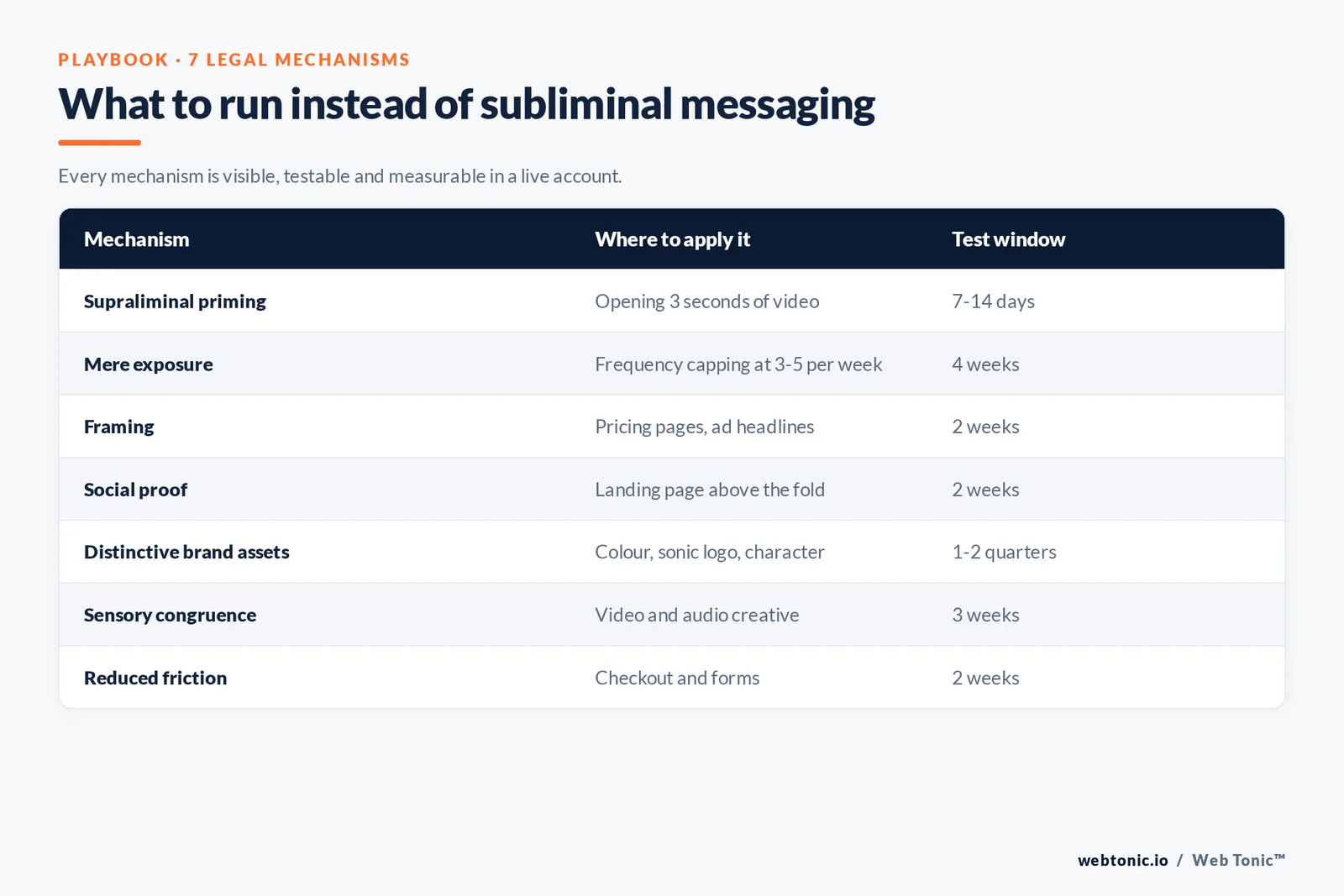
| Mechanism | What it does | Where to apply it | Typical test window |
|---|---|---|---|
| Supraliminal priming | Category cues raise the salience of a need | Opening 3 seconds of video | 7-14 days |
| Mere exposure | Familiarity increases preference | Frequency capping at 3-5 per week | 4 weeks |
| Framing | Same offer, different reference point | Pricing pages, ad headlines | 2 weeks |
| Social proof | Others' behavior lowers perceived risk | Landing page above the fold | 2 weeks |
| Distinctive brand assets | Speeds recognition in cluttered feeds | Colour, sonic logo, character | 1-2 quarters |
| Sensory congruence | Music and imagery match the promise | Video and audio creative | 3 weeks |
| Reduced friction | Removes steps between intent and action | Checkout and forms | 2 weeks |
The strategic point is that these mechanisms compound with measurement. Google's own Think with Google research library is full of visible-attention findings that outperform anything the subliminal literature offers, and our data intelligence practice exists to make those effects observable in your own numbers rather than inferred from a study. If you want the strategy layer around it, start with growth marketing or read more case work on the Web Tonic blog.
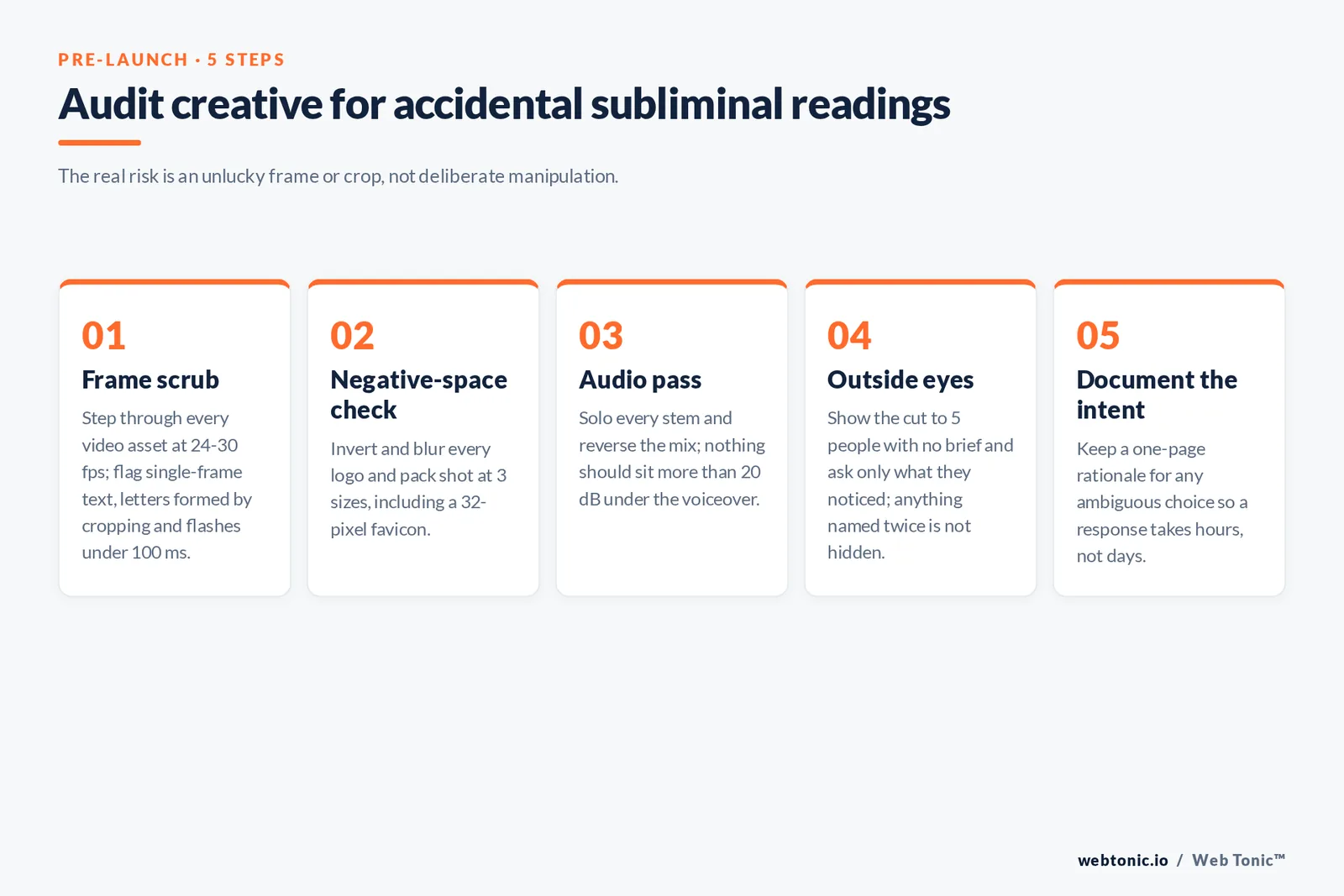
A 5-step audit for accidental subliminal readings
The realistic risk for a modern brand is not deliberate manipulation. It is an unlucky frame, a crop, or a shape in a logo that the internet decides is a hidden message. Run this before launch.
- Step 1 — Frame scrub. Step through every video asset frame by frame at 24 to 30 frames per second and look for single-frame text, letters formed by cropping, and flashes shorter than 100 milliseconds.
- Step 2 — Negative-space check. Invert and blur every logo and pack shot; look at what the empty space forms. Do this at 3 sizes, including a 32-pixel favicon.
- Step 3 — Audio pass. Solo every stem and reverse the mix. Confirm nothing in the bed sits more than 20 dB under the voiceover where it becomes an unintended whisper.
- Step 4 — Outside eyes. Show the cut to 5 people with no brief and ask only "what did you notice?" Anything reported by two or more is not hidden and needs a decision.
- Step 5 — Document the intent. Keep a one-page rationale for any ambiguous creative choice so a response takes hours, not days, if the question ever comes up publicly.
FAQ
Does subliminal advertising actually work?
Not in the way the 1957 legend implies. Controlled studies show subliminal primes can shift a choice by a small margin when the person already has an active, matching goal and the choice is available within minutes. No published study shows subliminal advertising creating demand or working through normal media at scale.
Is subliminal advertising illegal in the United States?
There is no statute that names it. The FCC's 1974 public notice treats broadcast use as inconsistent with the public interest, and the FTC's deception standard applies to any message intended to influence a consumer without their awareness. In practice, the legal exposure and reputational cost far exceed any measured benefit.
What is the difference between subliminal and supraliminal messaging?
Subliminal stimuli are below the threshold of conscious perception; supraliminal cues are consciously perceivable even if you do not pay attention to them. Almost every famous "subliminal ad" example — hidden arrows, shapes in packaging, background objects — is supraliminal, because you can see it once someone points it out.
What are the most cited examples of subliminal advertising?
The Vicary popcorn and Coca-Cola claim from 1957, the airbrushed imagery Wilson Bryan Key described in 1973, and the 2000 "RATS" frames in a US political spot. The first was fabricated, the second was never experimentally demonstrated, and the third was visible rather than subliminal.
Can subliminal messages change consumer behavior long term?
There is no evidence for durable change. The effects measured in social psychology decay within minutes and depend on immediate opportunity. Long-run preference shifts in the literature come from repeated, conscious exposure and distinctive brand assets, not from hidden stimuli.
Should a brand ever test a subliminal element?
No. Delivery cannot be controlled across devices, the upside is statistically undetectable at normal campaign sizes, and the downside is a public accusation of manipulation. Test visible priming, framing and social proof instead, where the effect is measurable and defensible. Talk to our team if you want that test plan built.
Sources: Snopes fact check of the Vicary popcorn claim; American Psychological Association research overview of subliminal perception; Haynes & Rees, Nature Neuroscience (decoding invisible stimuli in V1); Winkielman et al., Personality and Social Psychology Bulletin 2005 (masked faces and consumption); Frontiers in Psychology 2015 (sensation seeking and subliminal advertisement); Karremans, Stroebe & Claus, Journal of Experimental Social Psychology 2006; US Federal Trade Commission advertising and marketing guidance; UK Advertising Standards Authority CAP Code section 3; IAB standards and guidelines; Think with Google. Last reviewed August 2026.