



Table of contents

Key Takeaways
WordPress remains the dominant CMS for fitness websites, powering 42.5% of all websites globally (ZeroToWP). For gyms and fitness studios, website performance is business-critical: 76% of local mobile searchers visit a business within 24 hours (Verlua), and 50% of new gym members quit within six months, making website-driven retention features equally important as acquisition. Below are the WordPress and fitness website statistics shaping digital strategy in 2026.
WordPress Market Position in 2026
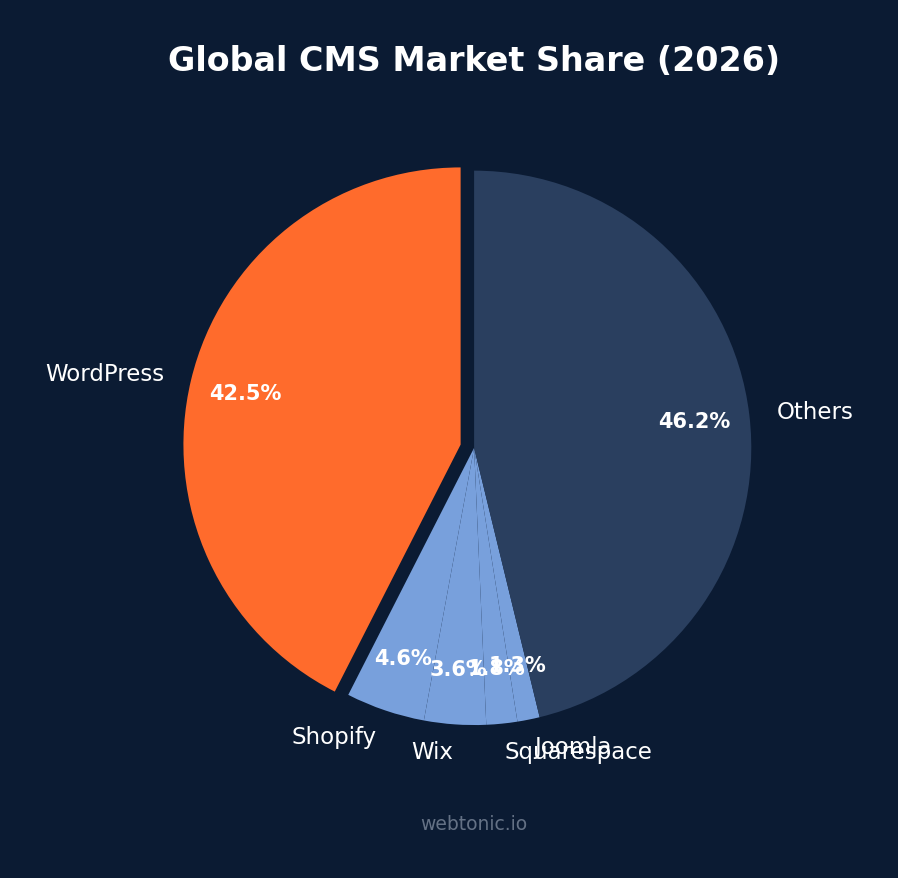
WordPress holds a 42.5% share of all websites and 59.8% of sites using a known CMS (ZeroToWP). That is more than all other CMS platforms combined. However, the platform's market share dipped from a 43.2% peak in 2022 to 42.5% — the first meaningful decline in WordPress's 23-year history.
| CMS Platform | All Websites Share | Known CMS Share | YoY Trend |
|---|---|---|---|
| WordPress | 42.5% | 59.9% | −1.0pp (declining) |
| Shopify | 4.6% | 6.5% | Growing |
| Wix | 3.6% | 5.1% | Growing |
| Squarespace | 1.8% | 2.5% | Stable |
| Joomla | 1.3% | 1.8% | Declining |
Despite the slight decline, WordPress's ecosystem of 59,000+ plugins and 12,000+ themes gives fitness businesses unmatched customization. Major fitness brands including F45 Training, Central Rock Gym, and Chuze Fitness run WordPress-powered websites.
Why Fitness Businesses Choose WordPress
WordPress dominates fitness websites for several structural reasons:
- Fitness-specific integrations — plugins for class scheduling (MindBody, Amelia), membership management (MemberPress, Paid Memberships Pro), and online training platforms connect directly to WordPress
- SEO control — WordPress offers granular SEO capabilities that help gyms rank for local searches. A case study showed 120% increase in organic search traffic within three months for a fitness coach site on WordPress (KurbatovDev)
- Cost efficiency — WordPress development starts at $5,000–$15,000 for a custom fitness site, compared to $25,000+ for fully custom platforms (SDLC Corp)
- Content marketing — built-in blogging + SEO plugins make WordPress ideal for fitness SEO strategies centered on educational content
- WooCommerce integration — fitness businesses selling supplements, merchandise, or online programs can add ecommerce through WooCommerce, which powers $235 billion in GMV globally
Fitness Website Performance Benchmarks
A fitness website's performance directly impacts lead generation and member acquisition. Here are the benchmarks that matter:
| Metric | Benchmark | Top Performer | Source |
|---|---|---|---|
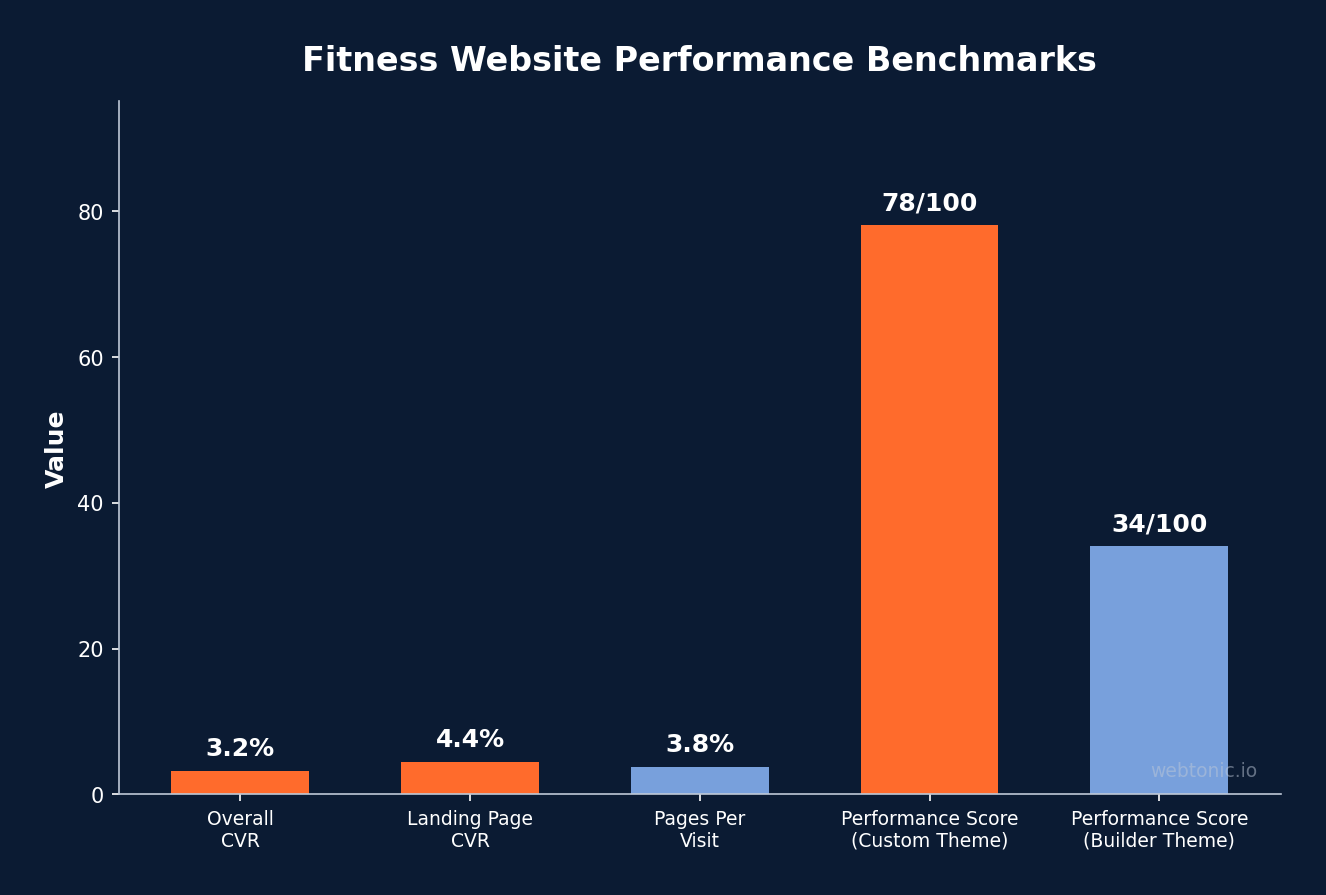
| Average conversion rate (overall) | 3.2% | 5.8% | CuFinder |
| Landing page conversion rate | 4.4% | 8%+ | CuFinder |
| Pages per visit | 3.8 | 5+ | CuFinder |
| Bounce rate | 42–55% | <40% | Industry avg |
| Mobile traffic share | 65–75% | N/A | Verlua |
The average fitness website conversion rate is 3.2%, with top performers reaching 5.8% (CuFinder). Landing pages convert at 4.4% — significantly above the 3.2% site-wide average — reinforcing why dedicated landing pages outperform generic homepage funnels.
WordPress Performance and Speed
Website speed is a make-or-break factor for fitness businesses, where most traffic comes from mobile devices and users expect instant load times. WordPress performance data shows significant variation based on setup quality:
- Custom lightweight themes score 78/100 on performance tests vs. 34/100 for page-builder themes — a 129% difference (BackToFrontShow, citing Appycodes)
- Plugin threshold sits at ~20 plugins — beyond this, performance degrades measurably on standard hosting
- WordPress Core Web Vitals pass rate is 36.6% on mobile (99Coupons, citing HTTP Archive)
- Caching plugins improve load times by 40–60% on average, making them essential for fitness sites with high-resolution imagery
For fitness websites specifically, performance optimization is non-negotiable because 76% of local mobile searchers visit a business within 24 hours (Verlua). A slow-loading gym website loses that prospect to a faster competitor.
Gym Website Design That Converts
The fitness industry is projected to reach $110.4 billion in 2026 (Verlua), and websites are now the primary conversion tool. The design elements that drive gym website conversions include:
- Online class booking integration — the single most requested feature; sites with embedded scheduling see higher conversion rates than those using external links
- Transparent pricing — fitness websites that display pricing openly reduce friction and attract higher-intent leads
- Virtual tours — video or 360° gym tours reduce the "unknown" barrier that prevents first-visit bookings
- Mobile-first design — with 65–75% of fitness website traffic coming from mobile, responsive design is baseline, not a feature
- Social proof placement — reviews, transformation photos, and member count badges positioned above the fold increase trust signals
A UK gym case study demonstrated the impact of proper growth marketing implementation: 43% year-over-year increase in form submissions, 1,700 members in year one (target was 1,000), and 227% traffic increase (BoxChilli).
WordPress SEO for Fitness Websites
WordPress's SEO capabilities are a primary reason fitness businesses choose the platform. The data supports this:
| SEO Metric | Result | Context | Source |
|---|---|---|---|
| NYC gym — organic traffic growth | 0 → 3,300/mo | 12-month SEO campaign | Aamir Digital |
| Top 3 keyword rankings achieved | 42 keywords | From zero baseline | Aamir Digital |
| Fitness coach organic traffic lift | +120% | 3-month WordPress SEO | KurbatovDev |
| Authority score improvement | <10 → 28 | +180% via link building | Aamir Digital |
| Backlink growth | <10 → 1,800 | +18,000% in 12 months | Aamir Digital |
A NYC gym WordPress site went from zero organic traffic to 3,300 monthly visitors, ranking for 42 keywords in the top 3 and growing backlinks from under 10 to 1,800 in 12 months (Aamir Digital). WordPress's plugin ecosystem (Yoast SEO, Rank Math, AIOSEO) and clean content architecture make these results achievable for local fitness SEO campaigns.
WordPress Fitness Theme and Plugin Ecosystem
The WordPress theme marketplace offers hundreds of fitness-specific themes, with popular options like GymBase, flavflavor themes for yoga studios, and multipurpose themes with gym demo imports. Key ecosystem data includes:
- 59,000+ WordPress plugins available, with fitness-relevant categories including booking, scheduling, membership, and WooCommerce extensions
- 12,000+ themes available, with dedicated fitness themes supporting class schedules, trainer profiles, and membership areas
- Drag-and-drop builders (Elementor, WPBakery, Gutenberg) enable gym owners to build pages without developer support
- Full Site Editing (FSE) — WordPress's block-based theme system is evolving to give fitness businesses even more design flexibility without code
- MindBody and Amelia integrations connect class scheduling directly into WordPress, replacing standalone booking systems
The ecosystem's depth means fitness businesses can build everything from a simple data-driven brochure site to a full membership portal with ecommerce, online training, and community features — all on WordPress.
WordPress vs. Other CMS Platforms for Fitness
Choosing the right CMS is a strategic decision for fitness businesses. Each platform serves a different use case in the fitness vertical:
| Feature | WordPress | Squarespace | Wix | Shopify |
|---|---|---|---|---|
| Fitness plugin ecosystem | 59,000+ plugins | Limited extensions | Built-in Wix Bookings | 8,000+ apps |
| SEO control | Full (Yoast, Rank Math) | Basic built-in | Moderate (Wix SEO) | Limited (blog-only) |
| Class scheduling | MindBody, Amelia plugins | Acuity (native) | Wix Bookings (native) | Third-party apps |
| Ecommerce | WooCommerce ($235B GMV) | Built-in (limited) | Wix Stores | Best-in-class checkout |
| Typical fitness cost | $5K–$15K custom | $16–$49/mo + design | $17–$35/mo + design | $39–$399/mo + apps |
WordPress's advantage is depth: the ability to combine class scheduling, membership management, ecommerce, blogging, and SEO into a single platform that the business fully owns. However, WordPress requires more technical management than hosted platforms like Squarespace or Wix. For solo trainers or small boutique studios without developer support, a hosted platform may be more practical despite the trade-offs in SEO control and flexibility.
Content Marketing on WordPress Fitness Sites
WordPress was built for content, and fitness businesses that leverage this strength see disproportionate results. The average gym website visitor views 3.8 pages per visit (CuFinder), and well-structured content keeps visitors exploring longer.
High-performing fitness WordPress sites share common content patterns:
- Workout libraries organized by muscle group, difficulty, and equipment — these pages rank for long-tail fitness search queries and keep members engaged between visits
- Local SEO content targeting "[gym type] near [city]" and neighborhood-level keywords, leveraging WordPress's URL structure and schema markup capabilities. Local SEO data shows that 46% of Google searches have local intent
- Trainer bio pages with credentials, specializations, and booking integration — these serve both SEO and conversion by building trust through individual expertise
- Blog content covering nutrition, training tips, and member success stories — fitness blogs that publish consistently see compounding organic traffic growth over 6–12 months
The NYC gym case study is instructive: a WordPress site went from zero to 3,300 monthly organic visitors in 12 months through systematic content creation and link building, ranking for 42 keywords in the top 3 (Aamir Digital). WordPress's native blogging engine, combined with SEO plugins, makes this type of growth achievable without custom development.
Mobile Performance and User Behavior
Mobile performance is particularly critical for fitness WordPress sites because the user journey often starts on a phone — someone searching "gyms near me" or "yoga class downtown" while on the go. Key mobile performance data includes:
- 65–75% of fitness website traffic comes from mobile devices, with some urban markets exceeding 80% mobile share (AdvertAI Marketing)
- WordPress Core Web Vitals pass rate is 36.6% on mobile vs. significantly higher on desktop (99Coupons), highlighting the optimization gap most fitness sites face
- A 1-second delay in mobile load time reduces conversions by up to 20% — for a gym averaging 500 website visitors per day, that means losing potential leads every hour
- 77 million Americans held gym memberships in 2024 (Verlua), and virtually all of them first interact with their gym digitally before stepping through the door
For WordPress fitness sites, mobile optimization means choosing lightweight themes over feature-heavy page builders, implementing lazy loading for high-resolution gym photos, and ensuring booking forms work seamlessly on small screens. Gyms that optimize for mobile-first design see measurably higher landing page conversion rates than those treating mobile as an afterthought.
Related reading
- Fitness Webflow Trends: Data-Driven Insights for 2026
- 2026 WordPress Stats for Countertops: Benchmarks That Matter
- Dental WordPress Statistics: 2026 Website Performance & CMS Data
- Custom Web Development services at Web Tonic
FAQ
What percentage of fitness websites use WordPress?
While exact fitness-vertical data is limited, WordPress powers 42.5% of all websites globally (ZeroToWP). Major fitness brands like F45 Training, Central Rock Gym, and Chuze Fitness use WordPress, and the platform's scheduling/membership plugins make it the most popular CMS choice for gyms and studios.
Is WordPress fast enough for a gym website?
Yes, with proper optimization. Custom lightweight themes score 78/100 on performance tests, while bloated page-builder themes score only 34/100 (BackToFrontShow). Keeping plugins under 20, using caching, and choosing a performance-optimized theme ensures fast load times. This matters because 76% of local mobile searchers visit within 24 hours — a slow site loses them.
How much does a WordPress fitness website cost?
Custom WordPress fitness websites typically cost $5,000–$15,000 for a professional build with scheduling, membership, and SEO integration (SDLC Corp). Premium themes with gym demo imports start at $50–$100, with ongoing hosting at $15–$50/month. Fully custom platforms run $25,000+.
Should a gym use WordPress or Shopify?
It depends on the primary business model. WordPress is better for service-based fitness businesses (gyms, studios, coaching) that need class scheduling, membership management, content marketing, and local SEO. Google Ads excels for product-based fitness brands selling supplements, equipment, or apparel. Many fitness companies use both — WordPress for their main site and Shopify for their ecommerce store.
What conversion rate should a gym website target?
The average fitness website conversion rate is 3.2%, with top performers reaching 5.8% (CuFinder). Landing pages convert higher at 4.4%. Gym websites should aim for at least 3% overall, optimizing for mobile-first design, transparent pricing, and frictionless booking flows.
Sources
zerotowp.com — WordPress Statistics 2026
backtofrontshow.com — WordPress Statistics
colorlib.com — CMS Market Share 2026
blog.99coupons.ai — WordPress Statistics
cufinder.io — Fitness Benchmarks 2026
verlua.com — Gym Website Design Guide
sdlccorp.com — WordPress for Fitness Websites
boxchilli.com — Bicester Gym Case Study
kurbatov.dev — Fitness Coach SEO Case Study
advertaimarketing.com — Fitness Website Conversion


