Table of contents

Webflow powers over 500,000 active websites globally with a 2.8% share of the CMS market, and fitness businesses are adopting it for its design flexibility — even as the average gym website scores just 47/100 on PageSpeed. These statistics reveal the intersection of Webflow adoption and fitness industry web performance in 2026.
Key Takeaways
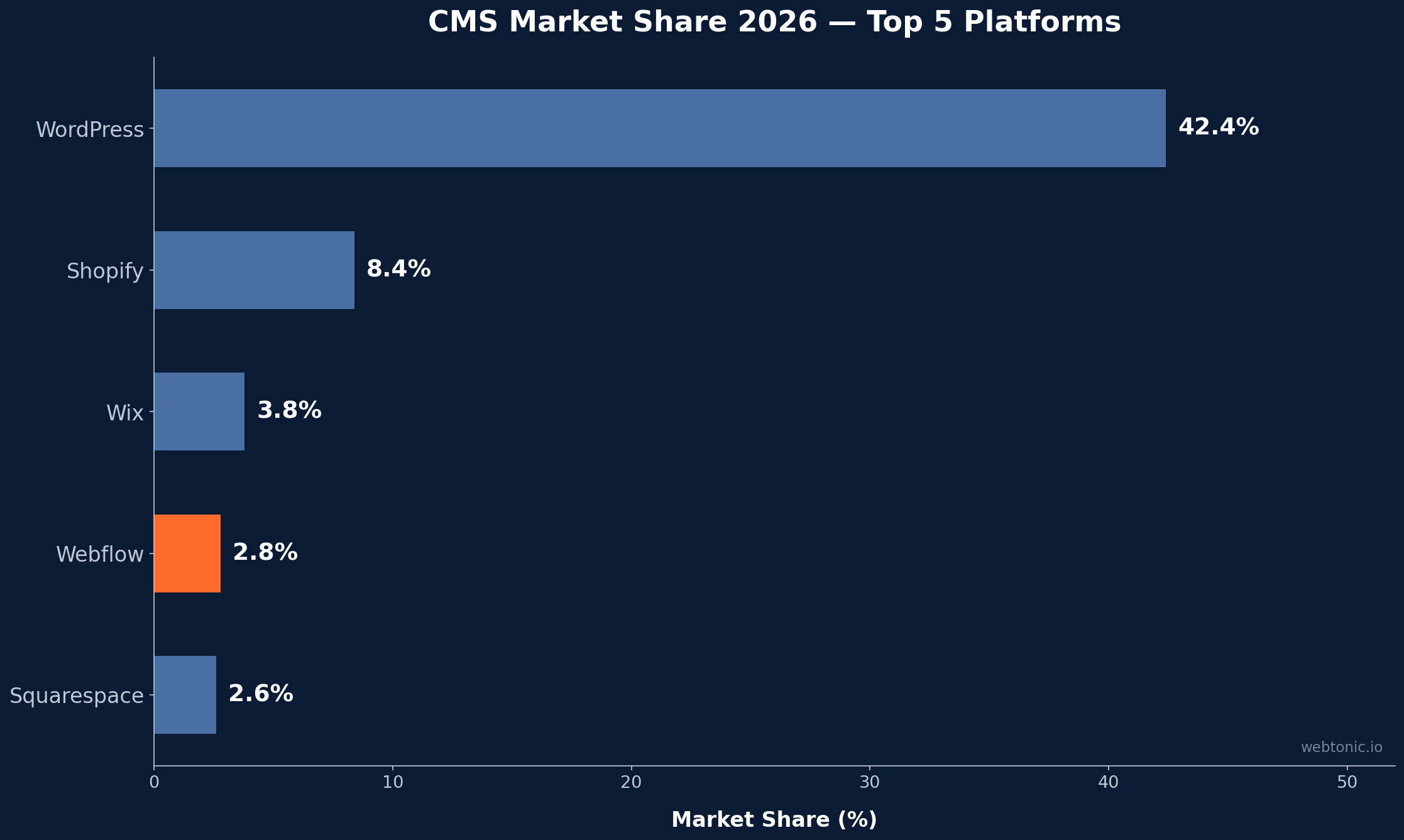
- Webflow holds 2.8% of the global CMS market across 1 million domains crawled, behind WordPress (42.4%) and Shopify (8.4%) (Visionary Marketing).
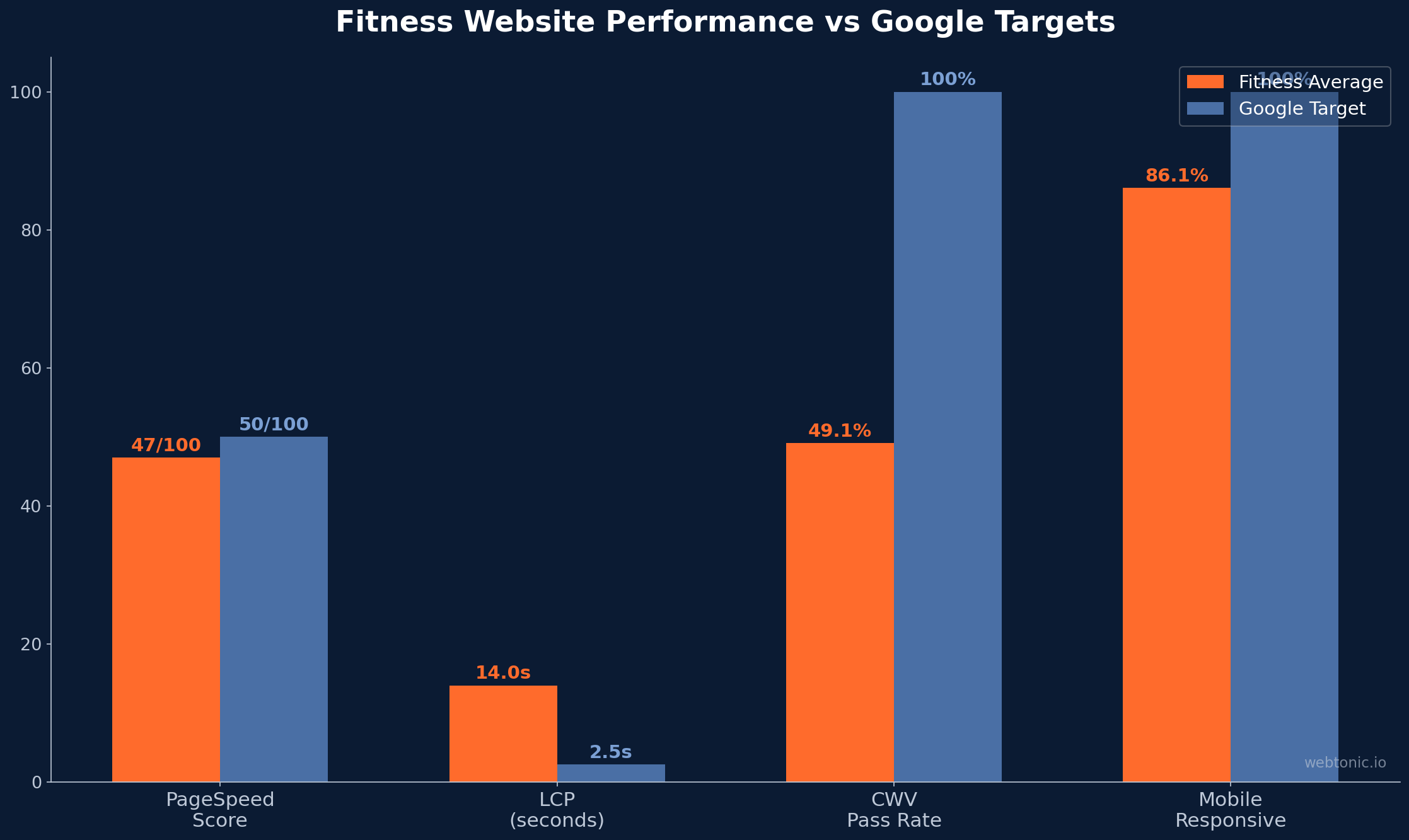
- The average fitness website scores 47/100 on Google PageSpeed, with a 14.0-second Largest Contentful Paint — 11.5s over Google's threshold (Borah Labs).
- 70–85% of fitness website traffic comes from mobile devices, making responsive design a non-negotiable for gym sites (Sprout Sage Solutions).
- Webflow generated $213M in revenue in 2024, growing 66% year-over-year from $128M in 2023 (Popupsmart / Tap Twice Digital).
- The fitness industry average bounce rate is 44.5%, with mobile-specific bounce sitting higher at 48.2% (CuFinder).
Webflow Platform Statistics at a Glance
Webflow has carved a niche between fully custom development and template-based builders, attracting businesses that prioritize design control without server management. Before examining how fitness businesses specifically use the platform, here is its overall market position in 2026.
| Metric | Value | Source |
|---|---|---|
| Active Websites | 500,000+ | Outside The Box |
| CMS Market Share | 2.8% | Visionary Marketing |
| Global Website Share | ~0.8% | Sales-Hacking |
| 2024 Revenue | $213M | Popupsmart / Tap Twice |
| YoY Revenue Growth | 66% | Popupsmart |
| Live Fitness Stores | 268 | StoreLeads |
| E-commerce Store Growth | +4% YoY (Q2 2026) | StoreLeads |
Webflow's 66% revenue growth from $128M to $213M in a single year signals strong market momentum. The platform now powers 268 live fitness e-commerce stores specifically (StoreLeads), with 59% selling fewer than 10 products — suggesting most fitness Webflow stores are boutique supplement shops, single-product brands, or merchandise extensions of gym businesses rather than large-scale retailers.
Fitness Website Performance Benchmarks
Web performance is where fitness businesses consistently underperform regardless of CMS choice. Whether a site runs on Webflow, WordPress, or a custom stack, the data shows that most gym and studio websites fail basic speed standards — directly costing them leads. A well-optimized landing page is the foundation of any effective digital marketing strategy.
| Performance Metric | Fitness Average | Google Target | Gap |
|---|---|---|---|
| PageSpeed Score | 47/100 | 50+ | -3 points |
| Largest Contentful Paint | 14.0s | 2.5s | +11.5s over |
| Core Web Vitals Pass | 49.1% | 100% | Half fail |
| Median Score (Codivox) | 65/100 | 90+ | 83.3% C or lower |
| Mobile Responsive | 86.1% | 100% | 13.9% not responsive |
| Performance Hygiene | 88.9% | 100% | 11.1% lack defer/lazy |
These figures underscore a critical opportunity for fitness businesses choosing Webflow: the platform's built-in responsive design, automatic image optimization, and clean code output can help close the performance gap that plagues 83.3% of gym websites scoring C or lower (Codivox). Each additional second of load time causes a 27% drop in conversions (SearchLab), making the difference between a 2.5-second target and the actual 14-second average an enormous revenue leak for fitness businesses.
Mobile Traffic and User Behavior in Fitness
Mobile dominance in fitness is not a trend — it is the baseline. 70–85% of fitness studio traffic comes from mobile devices, with urban markets often exceeding 80% mobile share (Sprout Sage Solutions, AdvertAI Marketing). This makes Webflow's mobile-first visual editor a strong architectural fit for gym websites that need to capture leads on the go.
Key mobile behavior stats for fitness websites include an average visit duration of 2 minutes 14 seconds, 3.8 pages per session, and a 44.5% overall bounce rate — rising to 48.2% on mobile compared to 39.1% on desktop (CuFinder). Mobile-specific bounce is 3.1 percentage points higher than average, which underscores the importance of fast-loading, thumb-friendly navigation that platforms like Webflow facilitate through their responsive breakpoint system.
Online membership sign-up capability is present on 88.9% of gym websites (Codivox), and mobile fitness app users are 3.5× more likely to convert to paid services than desktop users (WorldMetrics). Sites that load within 3 seconds capture mobile visitors effectively, while the average gym site's 14-second LCP pushes prospects to faster competitors (Borah Labs, Sprout Sage Solutions). For fitness studios, the 3-second window is not arbitrary — it matches the attention span of someone who just saw an Instagram ad or received a friend's recommendation.
CMS Market Share Comparison for Fitness Websites
Webflow competes in a crowded CMS market where WordPress still dominates. Each platform brings different strengths to the fitness use case, from booking integrations to design flexibility.
| Platform | Market Share | Fitness Fit | Key Strength |
|---|---|---|---|
| WordPress | 42.4% | High | Plugin ecosystem, SEO flexibility |
| Shopify | 8.4% | Medium | E-commerce for supplements and merchandise |
| Wix | 3.8% | Medium | Beginner-friendly drag-and-drop builder |
| Webflow | 2.8% | High | Design control, clean code output |
| Squarespace | 2.6% | Medium | Template aesthetics, easy initial setup |
For fitness businesses that prioritize brand differentiation through design, Webflow is the recommended choice over template-based builders like Wix or Squarespace (Website Builder Site). However, WordPress remains the stronger option for fitness businesses needing infinite scalability, advanced SEO through Yoast, and booking integrations through its plugin ecosystem (Qrolic). The decision often comes down to whether a fitness business values design precision (Webflow) or functional breadth (WordPress).
Best Practices for Fitness Webflow Sites
- Optimize images aggressively. With 14.0s average LCP in the fitness vertical, lazy-loading hero images and compressing gym photo galleries should be priority one. Webflow's responsive image system helps, but manual WebP conversion and sizing is still required for optimal performance (Borah Labs).
- Implement Core Web Vitals monitoring. Only 49.1% of fitness sites pass CWV — deploying performance monitoring and optimizing layout shifts gives an immediate competitive edge over the majority of gym websites (PageSpeedMatters).
- Design mobile-first, not desktop-first. With 70-85% mobile traffic, every interaction — class booking, membership signup, contact form — must be thumb-friendly and load within 3 seconds to avoid losing paid traffic that cost money to acquire (Sprout Sage Solutions).
- Use Webflow CMS for class schedules and blog content. Fitness sites with active blogs generate 48.2% of traffic from organic search, and Webflow's collection-based CMS makes content management significantly easier than custom-coded alternatives (CuFinder).
- Add schema markup for local SEO. Fitness businesses ranking in the top 3 of the local pack see 2.5–3× higher CTR. Webflow supports custom code injection for LocalBusiness and GymOrHealthClub schema (AuthoritySpecialist).
- Integrate booking and membership tools via third-party APIs. Webflow pairs with tools like Memberstack and Outseta for gated membership content — 88.9% of gym sites already offer online sign-up, and those without it lose mobile conversions to competitors (Codivox).
Fitness Website SEO and Organic Performance
Organic search remains the single largest traffic source for fitness websites. 48.2% of fitness website traffic comes from organic search, followed by direct visits at 22.1% and social referrals at 15.3% (CuFinder). The average Beauty and Fitness website receives 9,672 organic visits per month from search engines (Ahrefs), making SEO-focused site architecture critical for any platform choice.
Webflow sites benefit from clean HTML output, automatic sitemap generation, and fast server response times, which contribute to better Core Web Vitals scores. Case studies show fitness businesses that migrate to optimized platforms can achieve a 60% increase in organic traffic and a 40% reduction in bounce rate, as demonstrated by Rise Fitness after implementing technical SEO improvements including a 63% reduction in page load time (Higglo Digital).
For AI-driven search visibility (GEO), structured data implementation is becoming essential for fitness websites. Webflow's custom code capabilities allow fitness businesses to embed schema markup for AI search engines — positioning their services for featured snippets and AI-generated answers about gym locations, class schedules, and membership pricing (FrostBite Marketing). With 76% of local mobile searchers visiting a business within 24 hours (Verlua), the combination of strong technical SEO and local schema gives Webflow-built fitness sites a meaningful acquisition advantage.
Webflow for Fitness E-Commerce and Membership Sites
While Webflow is primarily known as a design-first website builder, its e-commerce capabilities are increasingly relevant for fitness businesses selling supplements, branded merchandise, workout programs, and digital memberships. There are currently 268 live Webflow stores in the Fitness category (StoreLeads), with 59% selling fewer than 10 products — indicating that most fitness Webflow stores operate as boutique operations rather than large-scale retailers.
Webflow's e-commerce store count grew 4% year-over-year in Q2 2026 despite a slight -1.2% quarter-over-quarter dip (StoreLeads). This pattern suggests steady annual adoption with normal seasonal fluctuations. For fitness businesses considering Webflow for e-commerce, the platform handles simple product catalogs well but lacks the deep inventory management, subscription billing, and marketplace integrations that Shopify provides out of the box.
The sweet spot for fitness Webflow e-commerce is personal trainers selling digital programs, coaches offering membership content, and boutique studios selling branded merchandise alongside their core service offerings. These businesses benefit from Webflow's ability to create a visually cohesive brand experience across service pages and shop pages — something that embedding a separate Shopify store cannot match.
For fitness businesses that need robust subscription and membership management, third-party integrations like Memberstack and Outseta add gated content, tiered pricing, and recurring billing to Webflow sites. This approach requires more setup than WordPress membership plugins but delivers a more polished front-end experience that aligns with premium fitness brand positioning.
Fitness Website Conversion and Revenue Impact
Web performance directly translates to revenue for fitness businesses. The data connecting site speed, design quality, and conversion rates makes a compelling case for investing in platform choice and optimization — regardless of whether that platform is Webflow, WordPress, or a custom build.
Fitness websites in the top 10% for conversion rate achieve a 5.8% CVR (CuFinder), compared to the industry average which sits significantly lower. Mobile fitness app users are 3.5× more likely to convert to paid services than desktop users (WorldMetrics), reinforcing that mobile optimization is not just a design preference but a revenue multiplier.
Annual gym member retention sits at 74%, while app retention at Day 30 drops to just 12% (CuFinder). This means the website's role extends beyond initial conversion — it must also support re-engagement through class schedules, community content, and member portals. Webflow's CMS collections can power dynamic class listings and blog content that keep members returning, contributing to the 40 average customer lifetime value in the fitness industry (CuFinder).
The cost-per-lead for fitness businesses averages 4.50 (CuFinder), making every percentage point of conversion rate improvement worth significant revenue. A gym generating 3,000 monthly website visitors at a 3% conversion rate and 4.50 CPL acquires 90 leads monthly. Improving that to 4% through better site speed and mobile UX adds 30 additional leads — worth roughly ,335 in reduced acquisition costs per month. Over a year, that single improvement justifies substantial investment in platform optimization.
Local SEO integration amplifies this impact further. Fitness businesses ranking in the top 3 positions of Google's local pack see 2.5–3× higher click-through rates (AuthoritySpecialist), and 76% of local mobile searchers visit a business within 24 hours. Webflow's ability to inject custom LocalBusiness schema and manage location-specific landing pages makes it a strong contender for multi-location fitness brands prioritizing local search visibility.
Speed Optimization Strategies for Fitness Webflow Sites
Given that the average fitness website takes 14.0 seconds to render its main content (Borah Labs), speed optimization represents the single highest-impact improvement most gym sites can make. Webflow provides several built-in advantages over WordPress and custom-coded alternatives, but manual optimization remains necessary to achieve competitive load times.
Webflow automatically generates responsive image variants, serves assets through a global CDN (via Fastly and AWS CloudFront), and produces minified HTML and CSS. These defaults put Webflow-hosted fitness sites ahead of self-hosted WordPress installations that rely on third-party caching plugins. However, fitness websites are image-heavy by nature — gym interiors, trainer photos, class action shots, and transformation galleries create large page payloads that overwhelm default optimization.
The most effective speed improvements for fitness Webflow sites include converting all images to WebP format (reducing file sizes by 25-35% versus JPEG), implementing native lazy loading on below-fold images, deferring non-critical JavaScript for booking widgets and chat tools, and limiting homepage hero sections to a single optimized image rather than auto-playing video backgrounds. These changes typically improve PageSpeed scores by 15-25 points, moving a gym site from the failing 47/100 average toward the passing 70-80 range.
For fitness businesses running paid advertising campaigns, site speed has a direct impact on ad performance. Google Ads Quality Score factors in landing page experience, and slow-loading pages receive lower scores — increasing cost per click and reducing ad position. A fitness website that improves from 14 seconds to under 3 seconds LCP can see Quality Score improvements of 1-2 points, which translates to 10-20% lower CPCs on branded and local search campaigns.
Frequently Asked Questions
Is Webflow good for fitness websites?
Yes. Webflow excels for fitness businesses that prioritize design differentiation and brand presentation. It offers pixel-level design control, responsive breakpoints, and clean code output. However, it requires third-party integrations (Memberstack, Outseta) for booking and membership features that WordPress handles through native plugins (Website Builder Site, Qrolic).
How fast should a fitness website load?
Google recommends a Largest Contentful Paint under 2.5 seconds. The average fitness website takes 14.0 seconds — 11.5 seconds over the threshold. Every extra second costs a 27% drop in conversions. Fitness sites should target sub-3-second load times to capture mobile visitors effectively (Borah Labs, SearchLab).
What percentage of gym website traffic is mobile?
70–85% of fitness studio traffic comes from mobile devices, with some urban markets exceeding 80%. Mobile bounce rates sit at 48.2%, compared to 39.1% on desktop — making mobile-first design essential for any gym website built on Webflow or any other platform (Sprout Sage Solutions, CuFinder).
How does Webflow compare to WordPress for gym sites?
WordPress holds 42.4% CMS market share versus Webflow's 2.8%. WordPress offers superior plugin ecosystems for booking, SEO (Yoast), and membership management. Webflow wins on design control, hosting speed, and visual editing ease. For fitness businesses prioritizing aesthetics and brand, Webflow is ideal; for scalability and integrations, WordPress is stronger (Visionary Marketing, Elsner).
Sources
Borah Labs — Gyms and Fitness Website Benchmarks
CuFinder — Fitness and Wellness Benchmarks 2026
Visionary Marketing — CMS Market Share Report 2026
Popupsmart — Webflow Statistics
Codivox — State of Gym Websites 2026
Sprout Sage Solutions — Web Design for Fitness Studios 2026
Outside The Box — Webflow in 2026
Sales-Hacking — Webflow Key Figures 2026
WorldMetrics — Marketing in the Fitness Industry 2026