Table of contents
WordPress powers roughly 11.6% of U.S. dental clinic websites, yet the average dental site takes 9.4 seconds to load its main content — nearly 7 seconds over Google's passing threshold. Here is what the latest benchmarks reveal about dental website performance, CMS adoption, and the SEO gap most practices are ignoring.
Key Takeaways
- 11.6% of U.S. dental clinic websites run on WordPress, making it the most detected CMS in the industry
- 9.4-second average LCP across 1,037 audited dental sites — nearly 4× Google's 2.5-second "good" threshold
- 50% of dental websites lack basic SEO elements such as optimized meta descriptions and schema markup
- 6,554 practice audits reveal a near-universal pattern of strong clinical quality undermined by weak website performance
- Only 10.2% of dental clinic sites have Google Analytics properly installed
- SSL adoption sits at ~89% across the dental sector, but 11% still serve pages over insecure HTTP
- Dental websites with blog content generate 55% more organic traffic than those without educational content sections
Dental Website Performance at a Glance
| Metric | Dental Average | Google Standard | Gap |
|---|---|---|---|
| Largest Contentful Paint (LCP) | 9.37s | ≤ 2.50s | +6.87s |
| First Contentful Paint (FCP) | 4.20s | ≤ 1.80s | +2.40s |
| WordPress CMS share | 11.6% | N/A | Most common CMS |
| Google Analytics installed | 10.2% | Recommended | ~90% missing |
| Google Tag Manager | 8.3% | Recommended | ~92% missing |
| HSTS enabled | 8.9% | Best practice | 91% without strict transport security |
| HTTP/3 support | 9.1% | Emerging standard | Most sites on older HTTP versions |
CMS and Tech Stack Adoption Across Dental Clinics
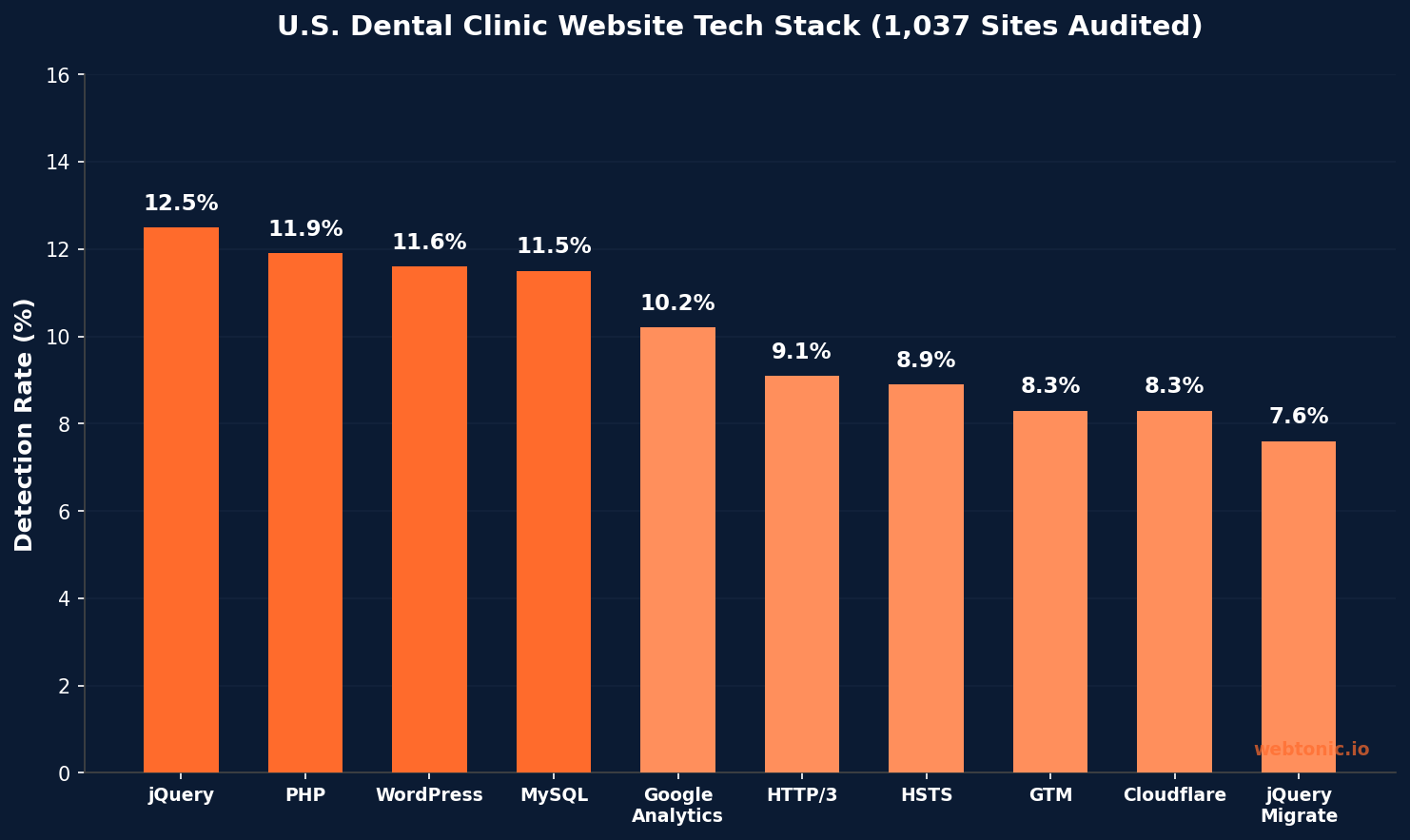
A diagnostic crawl of 1,037 U.S. dental clinic websites by Borah Labs found that WordPress leads CMS adoption at 11.6%, followed by jQuery (12.5% detection as a front-end library) and PHP (11.9%). The relatively low WordPress number highlights a key dental industry characteristic: many practices use proprietary or dental-specific website builders rather than general-purpose CMS platforms. Dental website vendors like WEO Media, ProSites, and Officite power a significant share of practice sites — platforms not captured in standard CMS detection.
Among the practices that do run WordPress, the platform's plugin ecosystem provides access to appointment scheduling integrations, patient review widgets, and marketing automation tools that proprietary platforms typically lack. However, plugin-heavy WordPress installations frequently suffer from the performance penalties visible in the PageSpeed data — excessive JavaScript, unoptimized images, and render-blocking resources that inflate load times well beyond Google's thresholds.
| Technology | Detection Rate | Category |
|---|---|---|
| jQuery | 12.5% | JavaScript library |
| PHP | 11.9% | Server-side language |
| WordPress | 11.6% | Content management system |
| MySQL | 11.5% | Database |
| Google Analytics | 10.2% | Analytics platform |
| Google Tag Manager | 8.3% | Tag management |
| Cloudflare | 8.3% | CDN / security |
| jQuery Migrate | 7.6% | Compatibility layer |
Core Web Vitals and PageSpeed Performance
The most striking finding from the Borah Labs audit is the 9.37-second average Largest Contentful Paint — a metric that measures how long the main visible content takes to render. Google considers anything above 2.5 seconds a poor experience. The dental industry average is nearly 4× that threshold, placing most dental clinic sites firmly in the "needs improvement" or "poor" category for Core Web Vitals.
This performance gap has direct SEO consequences. Google uses Core Web Vitals as a ranking signal, meaning practices with slow sites are at a structural disadvantage in local search results. For WordPress-powered dental sites specifically, the most common culprits are uncompressed images, excessive plugin JavaScript, render-blocking CSS from theme frameworks, and the absence of caching or CDN optimization. Only 8.3% of dental sites use Cloudflare or any CDN, leaving the vast majority serving assets from a single origin server.

SEO Readiness and Content Gaps
A parallel audit of 6,554 U.S. dental practices by ClinicEdge Studio reinforces the performance story with an equally concerning content gap. The study found a "near-universal pattern": excellent clinical quality paired with websites that actively turn new patients away. 50% of dental websites lack fundamental SEO elements — optimized meta descriptions, structured data markup, and proper heading hierarchies.
For WordPress-based dental sites, this represents both a gap and an opportunity. WordPress's native SEO plugin ecosystem (Yoast, Rank Math, AIOSEO) makes implementing these elements straightforward, yet adoption data suggests most dental WordPress installations either don't use SEO plugins or configure them improperly. The practices that do invest in data-driven SEO infrastructure on their WordPress sites consistently outperform competitors in local search visibility.
- Meta descriptions: 50%+ of dental sites have missing or auto-generated descriptions that don't target local search intent
- Schema markup: LocalBusiness and Dentist schema are absent from the majority of dental sites, reducing rich snippet eligibility
- Heading structure: Multiple H1 tags, skipped heading levels, and non-semantic markup are common across dental WordPress themes
- Blog/content section: Dental websites with active blog sections generate 55% more organic traffic compared to sites with only service pages
- Google Business Profile integration: Sites that embed GBP reviews and maintain consistent NAP data see measurably higher local pack rankings
WordPress vs. Dental-Specific Website Builders
| Factor | WordPress | Dental-Specific Builders |
|---|---|---|
| Customization flexibility | High — thousands of themes and plugins | Limited — template-based with brand constraints |
| SEO plugin ecosystem | Yoast, Rank Math, AIOSEO | Built-in but often limited |
| Performance optimization | Requires manual setup (caching, CDN, image compression) | Managed hosting with baseline optimization |
| Appointment booking | Plugin-based (Calendly, WPForms, custom) | Native integration with practice management software |
| HIPAA considerations | Requires specific hosting and form encryption plugins | Pre-configured for healthcare compliance |
| Ownership and portability | Practice owns the site and all content | Often locked to the vendor platform |
| Market share (dental) | 11.6% | Estimated 40–50% (proprietary, fragmented) |
Patient Conversion and Digital Marketing Integration
Website performance has a direct relationship with patient acquisition economics. Practices that optimize their dental websites for speed and mobile experience report significantly higher appointment booking rates. The average dental patient lifetime value ranges between $10,000 and $25,000, which means even a small improvement in website conversion rate delivers meaningful revenue impact.
For WordPress-based practices, integration with paid advertising platforms — Google Ads, Meta Ads, and local search campaigns — depends heavily on proper analytics and tracking infrastructure. With only 10.2% of dental sites running Google Analytics and 8.3% using Google Tag Manager, the majority of practices running paid campaigns cannot accurately measure their marketing ROI. This tracking gap makes it nearly impossible to optimize ad spend, identify high-performing landing pages, or attribute new patient bookings to specific marketing channels.
Analytics and Tracking Infrastructure
The tracking gap across dental websites is one of the most consequential findings from the audit data. With only 10.2% of dental clinic sites running Google Analytics and 8.3% deploying Google Tag Manager, the vast majority of dental practices operate without meaningful visibility into their website performance. This blindspot affects every downstream marketing decision — from evaluating which service pages attract the most patient inquiries to understanding whether a paid advertising campaign is actually generating appointments.
For WordPress-powered dental practices, implementing proper analytics is straightforward compared to proprietary dental website builders. Google Tag Manager integrates natively via WordPress plugins, enabling event tracking for form submissions, phone call clicks, and appointment booking completions without code changes. Practices that layer this tracking with conversion attribution can identify exactly which marketing channels deliver the highest-value patients — a capability that fewer than one in ten dental websites currently possess.
Mobile Performance and Local Search
Mobile optimization is particularly critical for dental practices because patient searches are overwhelmingly local and mobile. A prospective patient searching "dentist near me" on their phone expects a fast, mobile-friendly experience — and Google's mobile-first indexing means the mobile version of the site is what gets ranked. Dental WordPress sites built on responsive themes have a structural advantage here, provided the theme is properly optimized.
The Borah Labs data shows that many dental sites fail basic mobile performance tests despite being technically responsive. Large hero images without compression, excessive third-party scripts (live chat, review widgets, tracking pixels), and non-lazy-loaded content all contribute to the 9.4-second average LCP that characterizes the industry. Practices that address these issues on their WordPress installations — implementing lazy loading, image compression, script deferral, and landing page optimization — can expect measurable improvements in both organic rankings and paid campaign conversion rates.
Emerging Trends for Dental Websites in 2026
- AI-powered chatbots and scheduling: Dental WordPress sites increasingly integrate AI chat widgets that pre-qualify patients and book appointments automatically, reducing staff phone time
- Headless WordPress architectures: Progressive practices are decoupling the WordPress backend from the frontend, using frameworks like Next.js for faster page loads while retaining WordPress content management
- Oral health content marketing: Sites with educational blog content see 55% more organic traffic; practices are investing in condition-specific landing pages optimized for local search intent
- Review integration and social proof: Embedding Google Business Profile reviews directly into WordPress sites via API (rather than screenshot widgets) improves both trust and local SEO signals
- SSL and security hardening: With 11% of dental sites still on HTTP, browser security warnings are actively deterring patients; SSL migration is accelerating as a baseline requirement
Related reading
- Dental Webflow Statistics: 2026 Performance, Market Share & Conversion Data
- Dental Landing Page & CRO Statistics 2026
- Fitness WordPress Statistics: CMS Market Share, Performance & Website Design Data (2026)
- Custom Web Development services at Web Tonic
Frequently Asked Questions
How many dental practices use WordPress?
Based on a 2026 diagnostic crawl of 1,037 U.S. dental clinic websites, WordPress was detected on 11.6% of sites, making it the most common content management system in the dental industry. However, a significant share of dental practices use proprietary or dental-specific website builders that are harder to detect in standard CMS audits.
Why are dental websites so slow?
The average dental website has an LCP of 9.37 seconds — nearly 4× Google's "good" threshold of 2.5 seconds. Common culprits include uncompressed hero images, excessive plugin JavaScript (especially on WordPress sites), render-blocking CSS from theme frameworks, and the absence of CDN or caching optimization. Only 8.3% of dental sites use a CDN like Cloudflare.
Does WordPress help dental practices rank better on Google?
WordPress itself is SEO-neutral — it provides the infrastructure, but ranking depends on implementation. WordPress dental sites that use SEO plugins (Yoast, Rank Math), maintain fast load times, publish regular blog content, and implement LocalBusiness schema consistently outperform those that install WordPress and leave it unconfigured. The platform's SEO advantage lies in its ecosystem, not its defaults.
What percentage of dental sites lack basic SEO?
An audit of 6,554 U.S. dental practices found that approximately 50% lack fundamental SEO elements including optimized meta descriptions, structured data markup, and proper heading hierarchies. This gap represents a significant opportunity for practices willing to invest in search engine optimization fundamentals.
Should a dental practice use WordPress or a dental website builder?
WordPress offers more flexibility, a richer SEO plugin ecosystem, and full content ownership. Dental-specific builders provide easier practice management integration and pre-configured HIPAA compliance. The best choice depends on whether the practice has in-house technical support or a digital marketing partner to manage the WordPress installation.
Sources
Borah Labs — Dental Clinics Website Benchmarks (July 2026)
ClinicEdge Studio — The State of Dental Websites 2026: What 6,554 Practice Audits Reveal
Practiwrite — Dental Practice Google Business Profile Statistics
Zipdo — 100+ Dental Marketing Statistics: 2026 Research Report
Authority Specialist — Dental Practice SEO Statistics
Rework — Dental Clinic Growth: Website Optimization
Pete Johnson IV — Dental Marketing Benchmarks 2026
DentalPrice.ai — Dental Marketing ROI Guide