Table of contents
Google Ads is the fastest path to high-intent fitness leads in 2026. With an average click-through rate of 5.81%–7.2% and conversion rates between 4.10% and 6.94%, search advertising delivers prospects who are actively looking for a gym, personal trainer, or fitness class near them. This article compiles the most current Google Ads benchmarks for the fitness industry, drawing from TheAdSpend, WordStream, CuFinder, PPCChief, and campaign-level analyses.
Key Takeaways
- Fitness Google Ads CPC ranges from $2.77 to $6.17 depending on keyword competition, location, and match type.
- Average conversion rate sits at 4.10%–6.94%, with top campaigns exceeding 8% on branded and high-intent terms.
- Cost per lead averages $25–$67, with well-optimized single-location campaigns achieving $25–$55 CPL.
- Google Ads delivers 4.5× ROAS for fitness, the highest among all paid channels for the vertical.
- Search ads convert at 5%–15% trial-to-member rates because searchers carry active purchase intent.
- A $1,000–$1,500 monthly budget generates 25–45 leads, resulting in 4–8 new paying members at 90 days.
| Metric | Fitness Benchmark | All-Industry Avg. | Source |
|---|---|---|---|
| CPC (Cost per Click) | $2.77–$6.17 | $4.66 | WordStream, TheAdSpend |
| CTR (Click-Through Rate) | 5.81%–7.2% | 3.17%–5.0% | TheAdSpend, ScaleGrowth |
| CVR (Conversion Rate) | 4.10%–6.94% | 4.40%–8.18% | CuFinder, TheAdSpend |
| CPL (Cost per Lead) | $25–$67 | $53–$67 | OptimizedGrowth, TheAdSpend |
| ROAS | 2.5×–4.5× | 2.0×–3.5× | ScaleGrowth, Marketing LTB |
CPC Benchmarks: What Fitness Advertisers Actually Pay
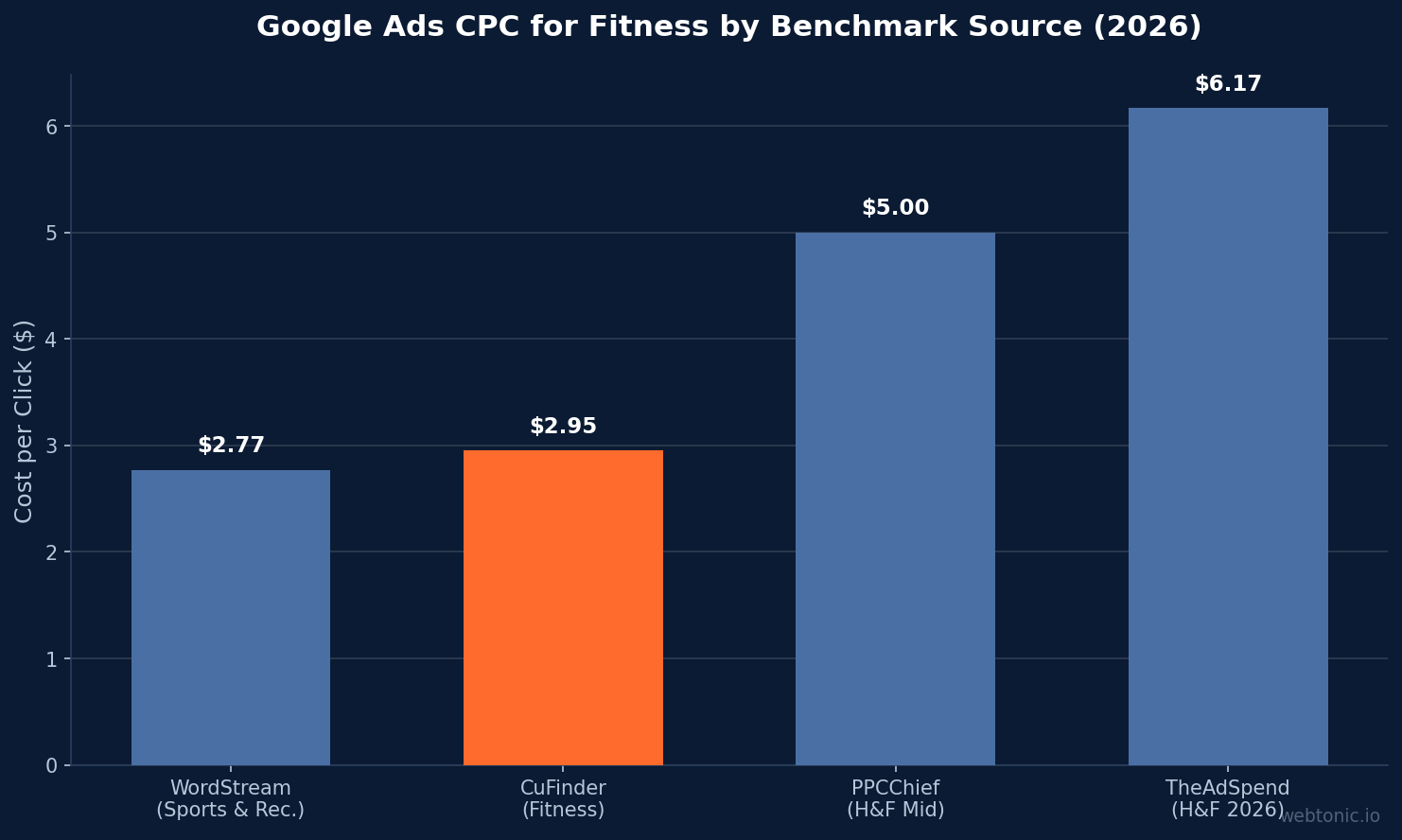
The cost per click for fitness-related Google Ads varies substantially across benchmark providers, reflecting different keyword mixes and geographic scopes. TheAdSpend’s 2026 benchmarks for Health & Fitness show a CPC of $6.17, representing a 23% year-over-year increase. PPCChief places the industry midpoint at $5.00, with a typical range of $3.75–$6.75.
More favorable figures come from CuFinder’s fitness-and-wellness benchmarks at $2.95 and WordStream’s Sports & Recreation category at $2.77. The discrepancy reflects category definition: narrower “gym near me” keywords command higher CPCs than broader wellness terms. Advertisers targeting high-intent local keywords (“gym near me,” “personal trainer [city]”) should budget for the $4–$7 CPC range, while broader awareness terms sit closer to $2–$4.
Click-Through and Conversion Rate Performance
Fitness search ads achieve above-average click-through rates, signaling strong ad relevance and searcher intent. TheAdSpend reports a 5.81% CTR for health and fitness, while Scale Growth Digital’s analysis shows 7.2%. Both exceed the cross-industry average of 3.17%–5.0%, confirming that fitness searchers engage actively with relevant ads.
Conversion rates range from 4.10% (CuFinder) to 6.94% (TheAdSpend), with Scale Growth Digital reporting 6.8%. The overall Google Ads average conversion rate in 2026 is 8.18% (WordStream), placing fitness slightly below the mean — likely because many fitness advertisers still send traffic to suboptimal landing pages rather than dedicated conversion funnels.
| Benchmark Source | CTR | CPC | CVR | CPL |
|---|---|---|---|---|
| TheAdSpend (H&F) | 5.81% | $6.17 | 6.94% | $67.36 |
| Scale Growth Digital | 7.2% | — | 6.8% | $63 |
| CuFinder (Fitness & Wellness) | 6.45% | $2.95 | 4.10% | — |
| PPCChief (H&F) | — | $5.00 | — | $47–$85 |
| WordStream (Sports & Rec.) | — | $2.77 | — | — |
| Optimized Growth (Gyms) | — | — | — | $25–$55 |
Cost per Lead and Budget Planning
The cost to acquire a lead through Google Ads varies by market size, competition, and campaign maturity. real-world campaign benchmarks for mid-size markets show a $25–$55 CPL range at 90 days with $1,000–$1,500 monthly ad spend, yielding 25–45 leads per month.
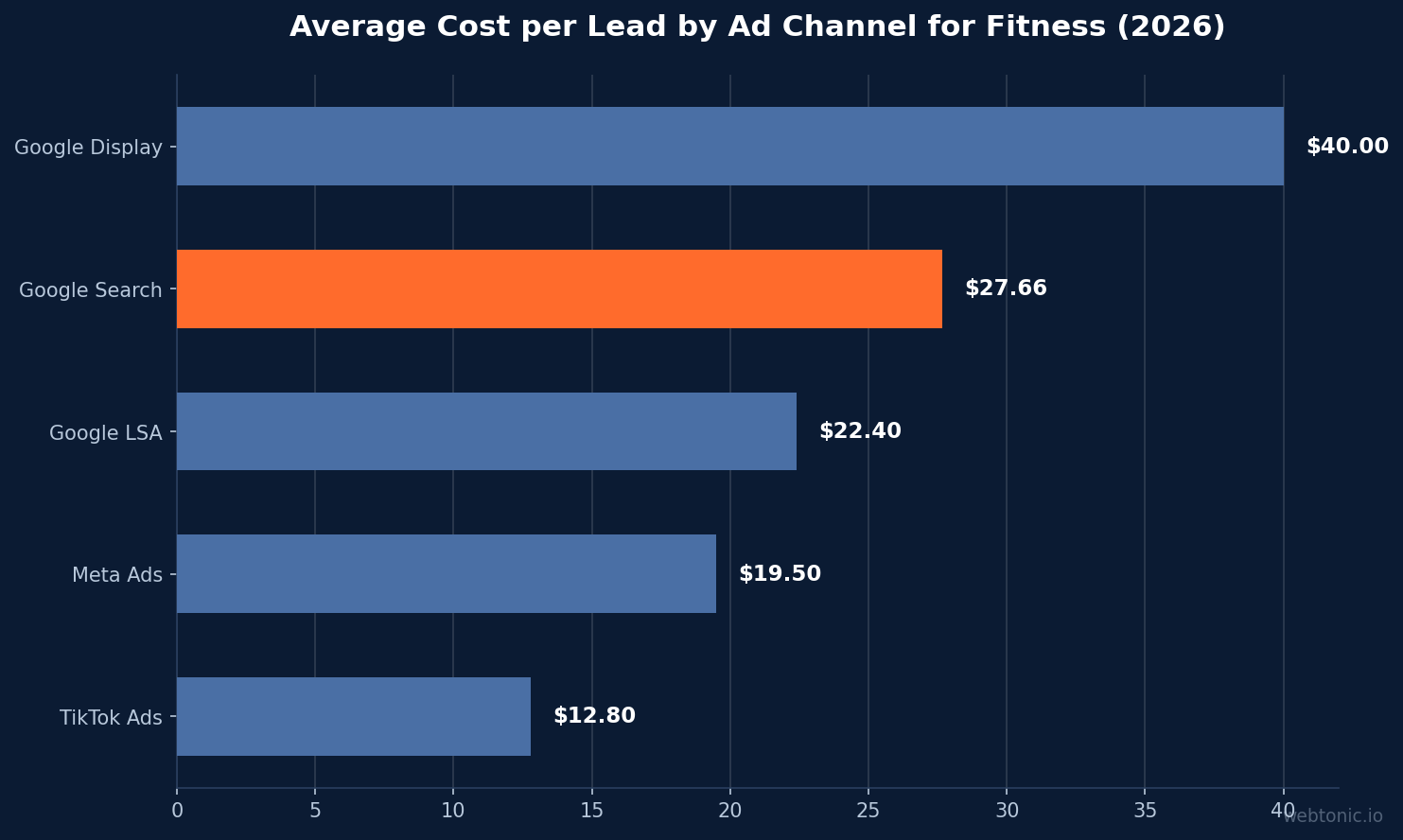
At the higher end, TheAdSpend’s aggregate benchmark shows $67.36 CPL, reflecting a mix of competitive metro markets and less-optimized accounts. PPCChief’s range of $47–$85 confirms that most fitness advertisers land between these extremes. Pilotium breaks it down by channel: Google Search Ads average $27.66 CPL, while Google Local Service Ads (LSAs) come in at $22.40 — making LSAs particularly attractive for single-location gyms.
ROI and Revenue Impact
Scale Growth Digital reports a 4.5× ROAS for fitness Google Ads, making paid search the highest-return paid channel for the vertical. Marketing LTB’s data shows Google Ads generate 2.5× ROI for gyms on average, with data-driven marketing improving overall gym ROI by up to 40%.
The full acquisition funnel from campaign-level 90-day benchmarks illustrates realistic expectations: 25–45 leads → 10–18 booked trials → 4–8 new paying members. Search ads convert at 5%–15% trial-to-member rates because searchers carry active purchase intent (Adwave). With an average gym membership worth $50–$80/month and a customer lifetime value of $640, even conservative CPL figures deliver strong long-term returns.
Campaign Type Comparison for Fitness
| Campaign Type | Avg. CPL | Best For | Key Advantage |
|---|---|---|---|
| Search Ads (Standard) | $27–$67 | High-intent local leads | Captures active searchers |
| Local Service Ads (LSA) | $22.40 | Single-location gyms | Pay per lead, Google Guaranteed badge |
| Performance Max | $30–$55 | Multi-location chains | Cross-channel reach, AI optimization |
| Display / YouTube | $40–$80 | Brand awareness | Visual storytelling, broad reach |
| Google Shopping | $15–$35 | Equipment / supplements | Product-level targeting |
Keyword Strategy and Cost Tiers
Fitness-related keywords fall into distinct cost tiers based on intent and competition. High-intent local terms like “gym near me” or “personal trainer [city]” command the highest CPCs ($5–$10+) but also deliver the best conversion rates. Mid-funnel terms such as “best gym for beginners” or “CrossFit classes” sit in the $3–$6 range. Informational queries like “how much does a gym membership cost” offer lower CPCs ($1–$3) but require nurturing to convert.
The most effective keyword strategies for fitness advertisers combine exact and phrase match on core terms (gym, personal trainer, fitness classes + location) with broad match on long-tail queries supported by robust negative keyword lists. Structured Google Ads strategies that segment campaigns by intent tier consistently outperform single-campaign setups by 30%–50% in CPL efficiency.
Geographic Targeting and Local Performance
Location targeting is the single most impactful lever for fitness Google Ads efficiency. Most gym members live within a 10–15 minute drive of their fitness facility, making tight radius targeting essential. Campaigns using 5–10 mile radius targeting in suburban markets and 2–5 mile radius in dense urban areas consistently outperform broader geographic setups by 25%–40% in CPL. Layering geo-bid adjustments — increasing bids by 15%–30% for high-converting zip codes and decreasing bids in low-density areas — further improves cost efficiency without sacrificing reach.
BrightCore's analysis of gym paid advertising confirms that fitness is one of the most location-dependent verticals in paid search. The CTR for Health and Fitness on Google Ads reaches 5.81%, well above the all-industry average, largely because local searchers have immediate conversion intent. Google Business Profile integration with search campaigns adds another 8%–12% lift in click-through rates by surfacing address, hours, and reviews directly in the ad unit. For multi-location fitness brands, data intelligence tools that attribute leads to specific locations are critical for accurately measuring per-location ROI.
Quality Score and Ad Rank Factors
Quality Score plays a critical role in fitness PPC profitability. Advertisers with Quality Scores of 8–10 pay 20%–50% less per click than competitors with scores of 5–6 for the same keywords. The three main Quality Score components — expected CTR, ad relevance, and landing page experience — each require attention. Fitness businesses can improve expected CTR by including location, specific services, and promotional offers in ad headlines. Ad relevance improves when ad copy closely mirrors the search query and landing page content. Landing page experience scores rise with fast load times (under 3 seconds), mobile optimization, and clear calls-to-action.
For fitness advertisers, the most impactful Quality Score improvement is typically landing page optimization. Many gyms still send paid traffic to their homepage or a generic “join now” page. Building service-specific landing pages (“personal training in [city],” “group fitness classes near [neighborhood]”) with conversion-focused design can lift Quality Score by 2–3 points and reduce CPC by 15%–30% within weeks.
Best Practices for Fitness Google Ads
- Start with Local Service Ads (LSAs): At $22.40 average CPL, LSAs offer the lowest cost per lead and include the Google Guaranteed badge, which builds instant trust with local searchers.
- Use location extensions and call ads: Adding location extensions increases CTR by 10%–15% and connects searchers directly to the nearest gym. Call-only ads perform well for personal trainers seeking phone consultations.
- Build conversion-optimized landing pages: Dedicated landing pages with a single CTA (book trial, claim pass) convert at 3–5× the rate of general website pages. Include social proof, pricing transparency, and a visible phone number.
- Implement offline conversion tracking: Connect CRM data to Google Ads so the algorithm optimizes for actual memberships sold, not just form fills. This improves lead quality by 25%–40% over time.
- Leverage expert campaign management: Fitness accounts benefit from aggressive negative keyword management, dayparting (reduce bids during low-conversion hours), and geo-bid adjustments for high-converting zip codes.
- Monitor competitive CPC trends: CPC increased 23% year-over-year in 2026. Review keyword bids quarterly and shift budget toward lower-competition, high-intent terms to maintain efficiency.
Competitive Landscape and CPC Trends
The fitness Google Ads landscape is becoming more competitive. CPC increased 23% year-over-year in 2026 according to TheAdSpend, driven by new market entrants and larger franchise groups expanding their digital budgets. The rise of boutique fitness chains, virtual training platforms, and hybrid membership models has intensified auction competition for core keywords. However, the competitive pressure varies dramatically by market size — smaller cities (population under 100,000) typically see CPCs 30%–50% below major metro averages, offering single-location operators a significant cost advantage. Monitoring competitor activity through auction insights and adjusting bids monthly helps fitness advertisers stay competitive without overspending on increasingly expensive click inventory.
FAQ
What is the average Google Ads CPC for fitness in 2026?
The average CPC for fitness Google Ads ranges from $2.77 to $6.17 depending on the keyword mix and benchmark source. High-intent local terms (“gym near me”) command $5–$10+, while broader wellness keywords sit at $2–$4. The overall health and fitness benchmark from TheAdSpend is $6.17, up 23% year-over-year.
How many leads can a gym expect from Google Ads?
With a $1,000–$1,500 monthly budget in a mid-size market, a gym can expect 25–45 leads per month at 90 days of campaign maturity. This typically translates to 10–18 booked trials and 4–8 new paying members.
What is a good Google Ads conversion rate for gyms?
Fitness Google Ads conversion rates range from 4.10% to 6.94% across major benchmarks, slightly below the all-industry average of 8.18%. Top campaigns with dedicated landing pages and strong offers can exceed 8%–10%.
Should gyms use Local Service Ads or standard Search Ads?
Both are valuable. Local Service Ads offer lower CPL ($22.40 vs. $27.66) and the Google Guaranteed badge, making them ideal for single-location gyms. Standard Search Ads provide more control over keyword targeting, ad copy, and landing page selection, making them better for multi-location businesses or those targeting specific services.
How does Google Ads ROI compare to other channels for fitness?
Google Ads delivers 2.5×–4.5× ROAS for fitness, with search ads capturing the highest-intent leads. The cost structure favors fitness because local intent keywords have high conversion rates and the customer lifetime value ($640 average) far exceeds acquisition costs.
Sources
https://theadspend.com/benchmarks/google-ads-search-fitness
https://ppcchief.com/google-ads-cost/health-fitness
https://cufinder.io/blog/benchmarks/fitness-and-wellness/
https://www.wordstream.com/blog/2026-google-ads-benchmarks
https://scalegrowth.digital/resources/ppc/google-ads-for-fitness/
https://pilotium.cc/en/blog/state-of-gym-marketing-2026/
https://pilotium.cc/en/blog/state-of-gym-marketing-2026/
https://marketingltb.com/blog/statistics/gym-marketing-statistics/
https://adwave.com/resources/best-advertising-gyms-fitness-centers
https://brightcore.ie/blog/paid-ads-gym-fitness