Table of contents
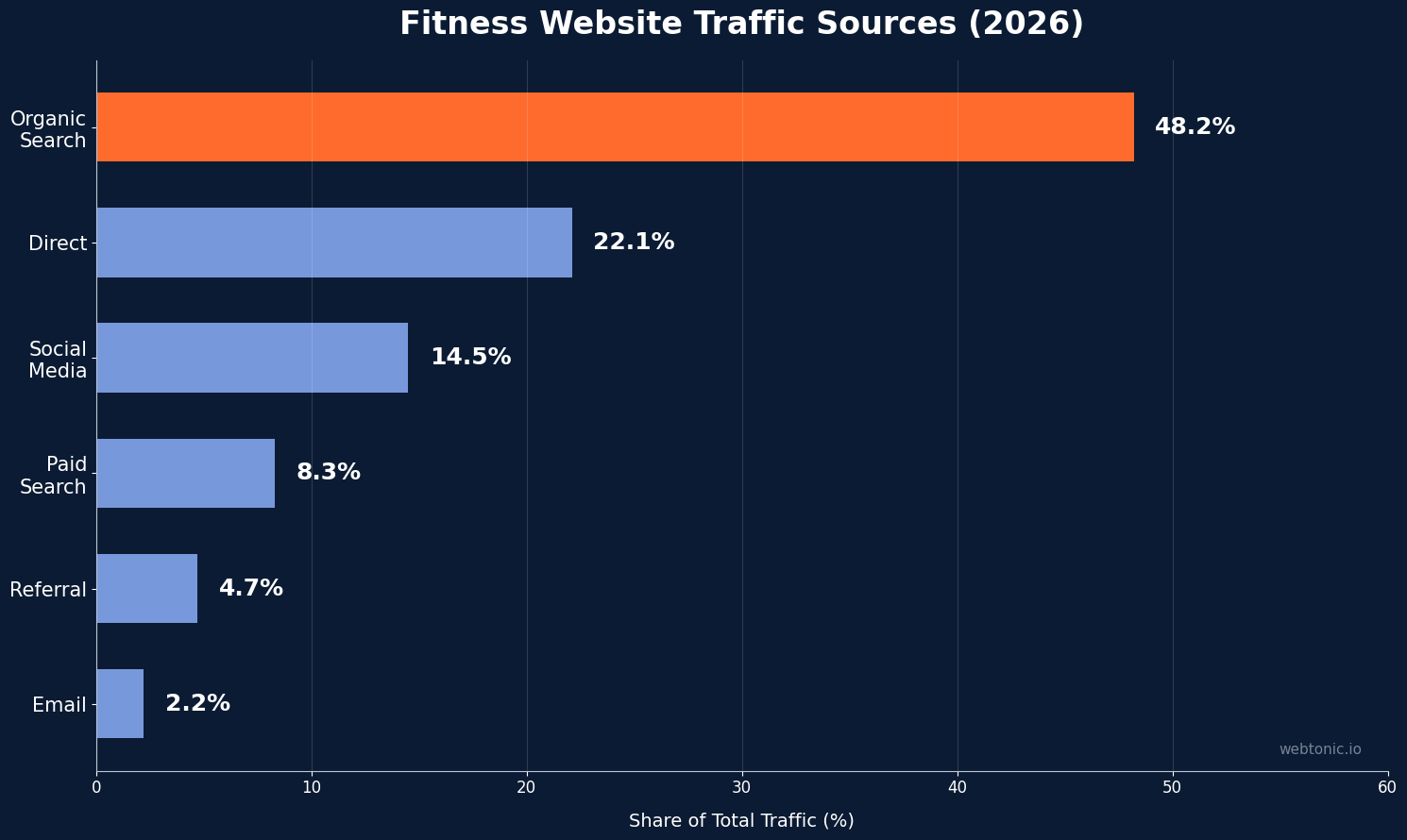
Organic search is the highest-ROI acquisition channel for gyms, studios, and fitness brands in 2026. Facilities that rank in the Local 3-Pack receive 126% more traffic and 93% more actions than those in positions 4–10, and 48.2% of all fitness website traffic comes from organic search. This article compiles the most current SEO benchmarks for the fitness industry, drawing from AuthoritySpecialist, CuFinder, ContentStream, RankPill, and multi-location audit data.
Key Takeaways
- 48.2% of fitness website traffic originates from organic search, making SEO the single largest traffic driver for the industry.
- Gyms in the Local 3-Pack generate 2.5–3× higher click-through rates than those ranking in positions 4–7 for the same market.
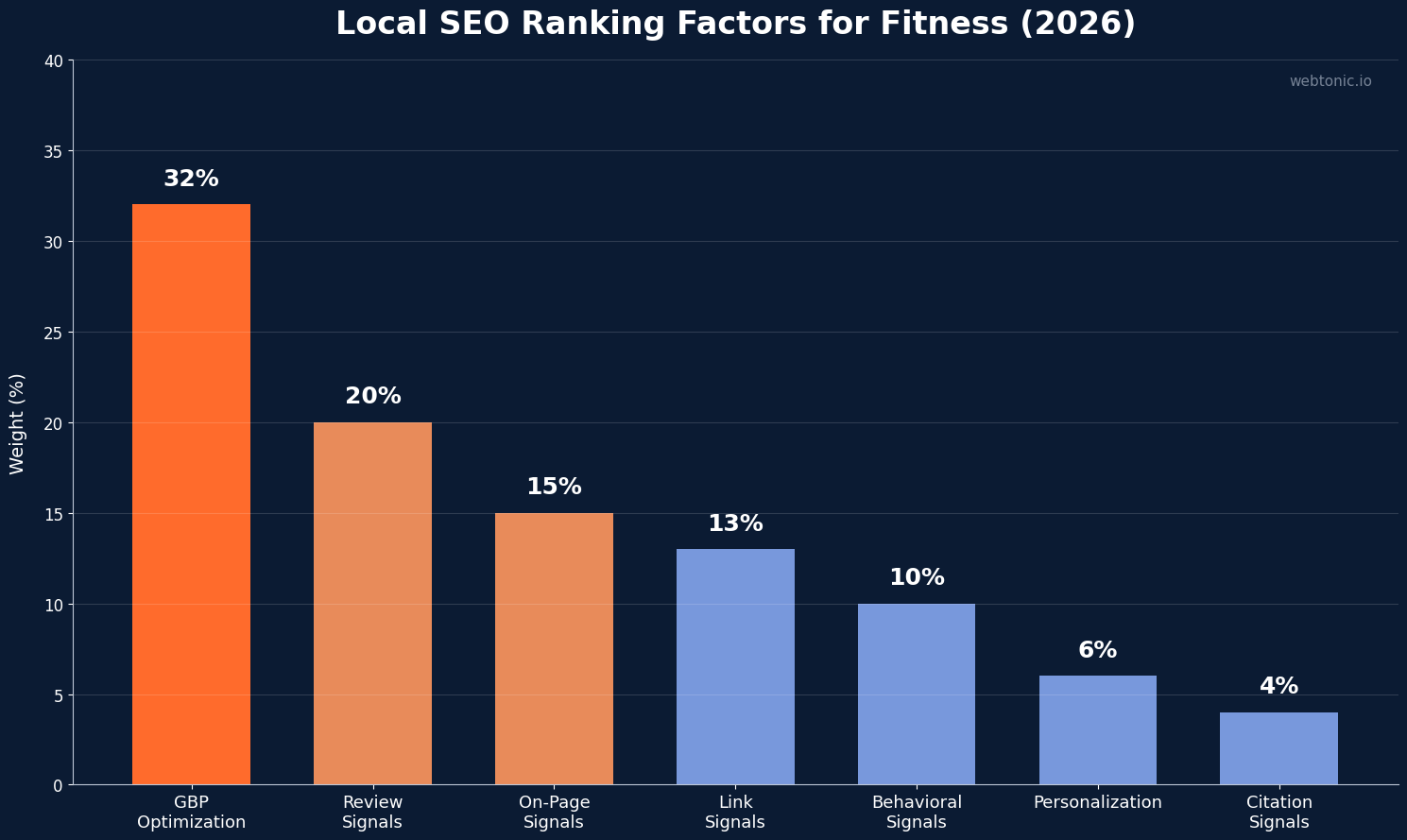
- Google Business Profile optimization accounts for 32% of local ranking factors, followed by review signals at 20% and on-page signals at 15%.
- Average website conversion rate for fitness is 3.2%, with top 10% performers reaching 5.8%.
- SEO delivers $0 cost-per-click versus $5–$20 for paid search on personal trainer and gym keywords, compounding over time.
- 92% of organic search traffic comes from long-tail keywords, which convert at higher rates than head terms for fitness businesses.
| SEO Metric | Fitness Benchmark | All-Industry Avg. | Source |
|---|---|---|---|
| Organic Traffic Share | 48.2% | 53.3% | CuFinder |
| Website Conversion Rate | 3.2% | 2.9% | CuFinder |
| Top 10% Conversion Rate | 5.8% | 5.0% | CuFinder |
| Local 3-Pack Traffic Lift | +126% | +100–120% | FitBudd, BrightLocal |
| GBP Actions Lift (3-Pack) | +93% | +70% | FitBudd |
| Organic Cost per Click | $0 | $0 | RankPill |
Organic Traffic and Search Visibility
Organic search remains the dominant traffic channel for fitness websites. CuFinder's 2026 fitness benchmarks show that 48.2% of global traffic to fitness and wellness sites comes from organic search, outpacing paid media, social, and direct combined. For gyms and studios, this share is even higher in local markets, where search engine queries like "gym near me" and "fitness classes [city]" drive the majority of new-member discovery.
AuthoritySpecialist's 2026 audit of multi-location gym brands reveals that facilities ranking in the top three local pack positions generate organic click-through rates roughly 2.5 to 3 times higher than those ranking in positions four through seven for the same market. This gap is widening as Google increasingly surfaces Local Pack and AI Overview results above traditional organic listings. Fitness brands investing in growth marketing strategies that prioritize local visibility consistently outperform competitors relying solely on paid channels.
Local SEO and Google Business Profile Performance
Local SEO is the most impactful search engine optimization discipline for fitness businesses. FitBudd's 2026 gym SEO guide confirms that gyms in Google's Local 3-Pack receive 126% more traffic and 93% more actions — calls, clicks, and direction requests — than positions 4–10. Achieving a 3-Pack position is the primary goal of local fitness SEO.
BizIQ's 2026 local SEO data compilation breaks down the ranking factors: Google Business Profile optimization drives 32% of local ranking signals, followed by review signals at 20% and on-page signals at 15%. For multi-location fitness brands, GBP management is rated as the most valuable local SEO service by 76% of franchise and multi-location marketing teams (BizIQ). Customer actions on GBP listings — calls, direction requests, and website clicks — increased 41% year-over-year from 2025 to 2026.
| Local Ranking Factor | Weight | Key Action | Impact |
|---|---|---|---|
| GBP Optimization | 32% | Complete profile, categories, attributes | Primary ranking signal |
| Review Signals | 20% | Volume, velocity, response rate | Trust + CTR boost |
| On-Page Signals | 15% | NAP consistency, local content | Relevance confirmation |
| Link Signals | 13% | Local citations, directory listings | Authority + trust |
| Behavioral Signals | 10% | Click-through rate, dwell time | Engagement quality |
| Personalization | 6% | Searcher location, history | Proximity relevance |
| Citation Signals | 4% | NAP on directories, aggregators | Consistency verification |
Website Conversion Rates and Lead Generation
A strong search engine presence only delivers results when website visitors convert. CuFinder's fitness benchmarks report an average website conversion rate of 3.2%, with top 10% performers achieving 5.8%. Landing page conversion rates average 4.4%, while product pages convert at 2.6%. The gap between average and top performers highlights the opportunity: gyms optimizing landing pages for local search intent — with clear calls to action, class schedules, and trial offers — consistently outperform those using generic homepages.
WorldMetrics reports that fitness blogs generate 126% more leads than static websites, making content marketing a powerful complement to technical SEO. Fitness websites with video content see even higher engagement, as search engines increasingly prioritize multimedia-rich pages. For fitness brands seeking professional optimization, partnering with a search marketing agency can accelerate the path from traffic to conversions through conversion rate optimization and structured A/B testing programs.
Keyword Strategy and Search Volume Trends
Industry data shows that 92% of organic search traffic comes from long-tail keywords, which are more specific and tend to convert better than broad head terms. For the fitness market, this means targeting phrases like "best yoga studio for beginners in [city]" rather than competing for "yoga studio" alone. RankPill's 2026 fitness SEO guide emphasizes mapping keyword clusters to user intent — informational queries ("how often should I work out") feed top-of-funnel content, while transactional terms ("gym membership near me") drive direct conversions.
Paid search CPCs for fitness keywords range from $5 to $20 per click for terms like "personal trainer near me," making organic rankings increasingly valuable. An SEO-optimized fitness website that ranks for 50–100 local keywords effectively generates thousands of dollars in equivalent paid traffic value monthly, compounding over time as domain authority grows. Search engine optimization for fitness websites should prioritize content clusters around services — classes, personal training, membership types — tied to specific locations with proper address, phone number, and hours structured data.
| Keyword Category | Avg. Monthly Volume | Paid CPC | Conversion Intent | SEO Priority |
|---|---|---|---|---|
| Brand + Location | 500–2,000 | $1–$3 | Very High | Defend |
| "Gym near me" | 100K+ | $5–$10 | High | Critical |
| "Personal trainer [city]" | 1K–10K | $8–$20 | High | High |
| "Best [class type] classes" | 5K–30K | $3–$7 | Medium | High |
| "How to lose weight" | 200K+ | $1–$4 | Low | Content/Blog |
Content Marketing and Blog Performance
Content is the foundation that supports search engine rankings for fitness brands. Fitness blogs generate 126% more leads than static websites, and gyms that publish consistent content see measurable improvements in organic visibility within 60–90 days. The most effective content strategies for fitness SEO combine evergreen guides (workout routines, nutrition basics, equipment comparisons) with locally-optimized pages (neighborhood guides, class schedules, trainer bios).
E-commerce conversion rates for health and supplements typically sit between 2.8% and 4.2%, with high-trust brands pushing the upper end. Fitness apparel brands see slightly lower average conversion rates, emphasizing the importance of product page optimization and social proof. For gyms and studios, integrating social media marketing with SEO-driven content creates a compounding visibility loop where social shares boost search engine rankings and organic traffic fuels social proof.
Technical SEO and Site Performance
Technical search engine optimization determines whether content actually ranks. Page load speed is critical: 53% of mobile visitors abandon sites that take longer than 3 seconds to load, and Google's Core Web Vitals directly impact search engine rankings. For fitness websites running on platforms like WordPress or Webflow, optimizing images (compression + lazy loading), implementing server-side caching, and minimizing third-party scripts are the highest-impact technical improvements.
Mobile optimization is non-negotiable for fitness SEO. Over 70% of "gym near me" and "fitness classes" searches happen on mobile devices, and Google uses mobile-first indexing for all websites. Fitness sites with responsive design, tap-friendly CTAs, and fast mobile load times (under 2.5 seconds for Largest Contentful Paint) consistently outperform desktop-optimized competitors in local search results. Structured data markup — including LocalBusiness schema with address, phone number, hours, and class offerings — helps search engines understand gym content and display rich snippets in results. Embedding consistent name, address, phone number details across every page reinforces trust signals for both users and crawlers.
Fitness Apps and Digital Visibility
The fitness apps market adds another dimension to SEO strategy. CuFinder reports app retention at Day 30 of just 12%, while monthly subscription churn averages 6.5%. These numbers highlight the importance of long-term health and engagement strategies beyond initial acquisition. Top fitness brands like Peloton, Nike Training Club, and MyFitnessPal dominate app store search results, but local gyms can compete by optimizing their web presence for terms that fitness apps cannot capture — "gym with pool near me," "CrossFit box [neighborhood]," "24-hour gym [city]."
The global online fitness market is valued at $67.4 billion and growing, creating both competition and opportunity for local fitness businesses. Gyms that build content around hybrid fitness experiences — combining in-person training with on-demand classes — capture search traffic from members researching both options. The key is ensuring that every piece of content supports search engine visibility through proper heading structures, internal linking, and keyword optimization without sacrificing the user experience that converts visitors into members. By treating SEO for fitness websites as a long term health investment rather than a quick fix, operators build sustainable acquisition engines that compound over time.
SEO Services and Agency Selection for Fitness
Fitness businesses will increasingly rely on specialized SEO services to create competitive advantages as the digital landscape grows more complex. Dedicated agencies and tools help clubs, gyms, and studios focus on what moves the needle — from site audits and keyword research to link building and content production. Marketers managing multi-location fitness brands should look for agencies with proven fitness-industry experience, robust reporting dashboards, and a track record of increasing memberships through organic search.
Key selection criteria include transparency in pricing, expertise in local SEO for fitness websites, and the ability to track users from first click to paid membership. The best SEO services for gyms integrate Google Business Profile management (including accurate address, phone number, and hours), on-page optimization, and content creation into a unified workflow. Fitness clubs that invest in professional SEO services typically see a 3–5× increase in organic leads within the first year, compounding long-term health of their digital acquisition pipeline.
SEO ROI Compared to Other Channels
| Channel | Avg. Cost per Lead | Time to Results | Compounding Value |
|---|---|---|---|
| Organic SEO | $0–$31 (content cost) | 3–6 months | High (builds over time) |
| Google Ads | $25–$67 | Immediate | None (stops with spend) |
| Social Media Ads | $12–$40 | 1–2 weeks | Low |
| Email Marketing | $2–$8 | Ongoing | Medium (list growth) |
| Directory Listings | $15–$50 | 1–3 months | Low |
Related reading
- Fitness Technical SEO Statistics: 2026 Website Speed, Mobile & Ranking Data
- SEO for Fitness Studios: A Practical Growth Playbook
- Dominant Fitness Brands Claim Half of Search Visibility: Fitness Enterprise SEO Statistics
- GEO & AEO services at Web Tonic
Frequently Asked Questions
What percentage of fitness website traffic comes from organic search?
Organic search drives 48.2% of all fitness and wellness website traffic according to CuFinder's 2026 benchmarks. This makes SEO the largest single traffic source for the fitness industry, ahead of paid advertising, social media, and direct visits. For local gyms, the share can be even higher when Google Business Profile actions are included.
How much does SEO cost for a gym compared to Google Ads?
SEO produces organic traffic at $0 cost per click, while Google Ads for fitness keywords cost $5–$20 per click. However, SEO requires upfront investment in content creation, technical optimization, and local listings management, typically $500–$2,000 per month for a single-location gym. The key difference is compounding: SEO traffic grows over time while paid search traffic stops immediately when the budget runs out.
How important is Google Business Profile for gym SEO?
Google Business Profile is the most important single factor in local fitness SEO, accounting for 32% of local ranking signals. Gyms with fully optimized GBP listings — including accurate address, phone number, hours, photos, and regular post updates — rank significantly higher in the Local 3-Pack. GBP actions (calls, direction requests, website clicks) increased 41% year-over-year in 2025–2026.
What is a good conversion rate for a fitness website?
The average fitness website conversion rate is 3.2%, while top 10% performers achieve 5.8%. Landing pages optimized for specific services (personal training, class sign-ups, free trial offers) convert at 4.4% on average. To reach top-tier conversion rates, fitness websites need clear calls to action, social proof (reviews, member testimonials), and fast load times under 3 seconds.
How long does it take for gym SEO to show results?
Most fitness businesses see measurable SEO improvements within 60–90 days for local keywords, with significant traffic and lead growth occurring between 3–6 months. Competitive markets like major metro areas may take 6–12 months to achieve top 3 rankings. Content marketing efforts typically begin generating organic traffic within 30–60 days of publication.
Sources
cufinder.io/blog/benchmarks/fitness/
authorityspecialist.com — Gym SEO Benchmarks 2026
biziq.com — Local SEO Statistics 2026
fitbudd.com — SEO for Gyms: 2026 Guide
rankpill.com — SEO for Fitness 2026
worldmetrics.org — Marketing in the Fitness Industry
biziq.com — Multi-Location SEO Statistics 2026
backlinko.com — Google CTR Stats