



Table of contents

WordPress powers 59.1% of all websites with a known CMS in July 2026, and its dominance extends into the countertop industry where fabricators, distributors, and stone retailers rely on the platform for everything from portfolio sites to full ecommerce operations. With WooCommerce running over 2.3 million verified active stores globally, WordPress remains the most accessible path for countertop businesses building their digital presence.
Key Takeaways
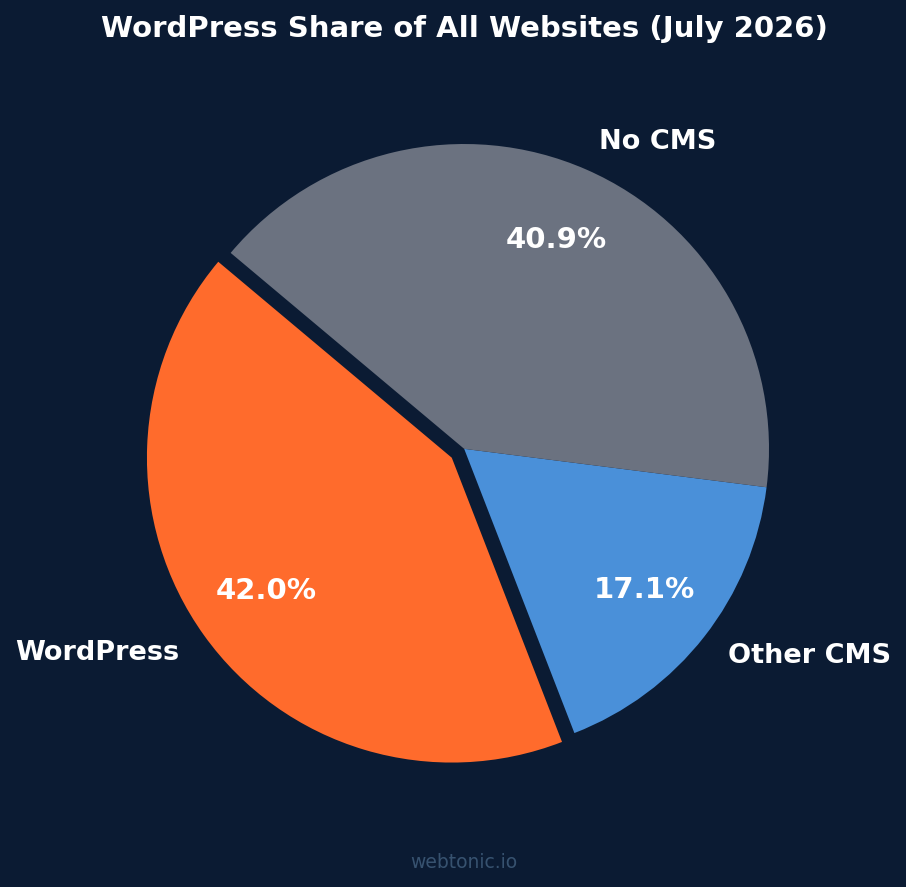
- WordPress holds 59.1% CMS market share as of July 2026, used by 42% of all websites on the internet.
- Remodeling contractor websites average a 65.67/100 performance score, with 46% earning a D or worse in comprehensive site audits.
- Mean mobile LCP for remodeling sites is 10.16 seconds, four times slower than Google's 2.5-second "good" threshold.
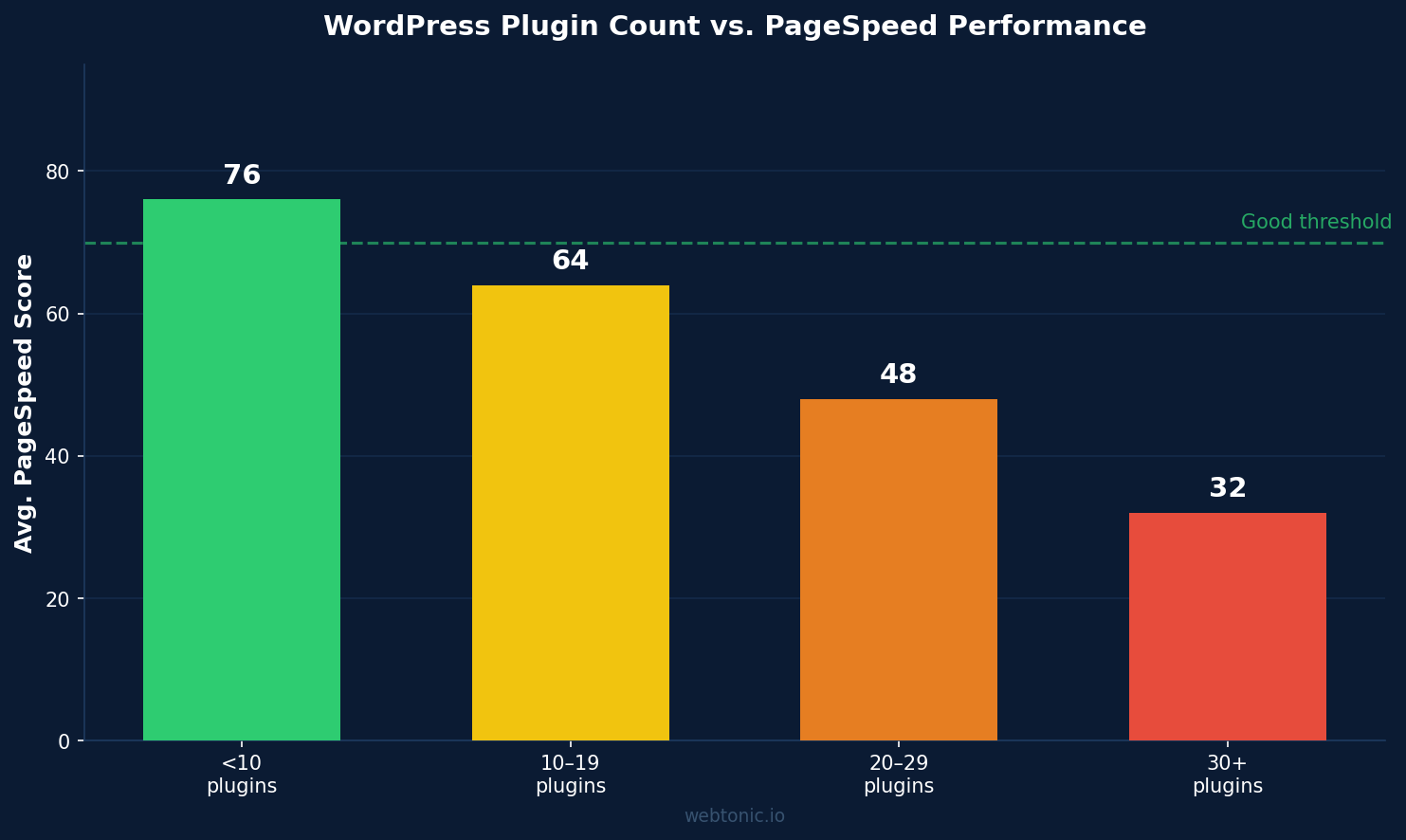
- WordPress sites with fewer than 10 plugins average a PageSpeed score of 76, compared to just 32 for sites with 30+ plugins.
- Page builders cost roughly 4x the JavaScript execution time of custom WordPress themes.
- WooCommerce powers 97.6% of WordPress ecommerce stores, with 565,402 new stores launched in the past 12 months.
- Mobile traffic to countertop manufacturer sites reached 58% in 2026, up from 52% in 2024.
WordPress Market Share and Adoption Statistics
WordPress continues to dominate the CMS landscape, and its market position directly affects the tools, themes, and plugins available to countertop businesses building their online presence.
| Metric | Value | Source |
|---|---|---|
| CMS Market Share | 59.1% | W3Techs (July 2026) |
| All Websites Share | 42.0% | W3Techs (July 2026) |
| WordPress Sites Without CMS Label | 50.6% | W3Techs |
| WooCommerce Active Stores | 2.3 million verified | ShopRank (June 2026) |
| WooCommerce Global Market Share | 33.4% | Cloudways |
| New WP Stores (12 months) | 565,402 | ShopRank |
| WooCommerce Share of WP Ecommerce | 97.6% | ShopRank |
| WordPress Version 7 Adoption | Leading version | W3Techs |
For countertop businesses, WordPress's 59.1% CMS market share means access to the largest ecosystem of themes, plugins, and developer talent. The platform's dominance ensures that industry-specific tools — from 3D countertop visualizers to quote calculators — are more likely to be built for WordPress first. With WooCommerce powering 97.6% of WordPress ecommerce, countertop retailers and fabricators have a proven path to selling samples, remnants, and finished products online.
The Gutenberg block editor has matured significantly, with WordPress version 7 now the leading version in adoption. For countertop businesses, the block editor enables visual content creation — embedding product galleries, comparison tables, and customer testimonials — without relying on heavy page builders that degrade site performance. The shift toward blocks also aligns with modern content strategies where modular, reusable content components reduce maintenance overhead and improve consistency across product pages.
Countertop Website Performance Benchmarks
Website performance directly impacts lead generation for countertop businesses. A comprehensive audit of 146 remodeling contractor websites reveals significant performance gaps that affect search rankings and conversion rates.
| Performance Metric | Industry Average | Google Target |
|---|---|---|
| Overall Site Score | 65.67 / 100 | 80+ |
| Median Site Score | 71 / 100 | 80+ |
| Sites Earning A Grade | 0 of 146 | N/A |
| Sites Earning D or Worse | 67 (46%) | N/A |
| Sites Earning F Grade | 37 (25%) | N/A |
| Mean Mobile LCP | 10.16 seconds | ≤2.5 seconds |
| Lowest Score Observed | 3 / 100 | N/A |
| Highest Score Observed | 86 / 100 | N/A |
The remodeling industry's website performance data is stark: not a single site out of 146 earned an A grade, and nearly half scored D or worse. The primary culprit is speed — mean mobile Largest Contentful Paint of 10.16 seconds is four times Google's "good" threshold. For countertop businesses, heavy hero images and unoptimized portfolio galleries are the usual performance killers. Brands that invest in image optimization, lazy loading, and proper caching gain an immediate competitive advantage in organic search visibility.
WordPress Plugin Impact on Site Performance
The number of active plugins is one of the strongest predictors of WordPress site performance. A data-backed study of 100 WordPress sites quantifies the relationship between plugin count and performance scores.
| Plugin Count | Sites in Study | Avg. PageSpeed Score | Plugin Bloat Index |
|---|---|---|---|
| Fewer than 10 | 22 | 76 | 0.07 |
| 10–19 | 38 | 64 | 0.22 |
| 20–29 | 27 | 48 | 0.50 |
| 30+ | 13 | 32 | 1.09 |
Each additional 10 plugins drops the average PageSpeed score by roughly 12–16 points. Countertop businesses running 30+ plugins — common when stacking a page builder, SEO tool, forms plugin, gallery plugin, visualizer tool, and multiple analytics scripts — can expect scores in the low 30s, effectively making their site invisible in mobile search results. The solution is ruthless plugin auditing: keep essential functionality and eliminate redundant or low-impact plugins.
Page builders represent an even larger performance liability. Sites using Elementor, Divi, or WPBakery averaged PageSpeed scores in the mid-30s to low-40s, while custom-themed WordPress sites averaged 78. The Builder Overhead Ratio is approximately 4x, meaning builder sites ship four times the JavaScript execution time of custom themes. For countertop businesses investing in a WordPress site, choosing a lightweight custom theme over a drag-and-drop builder delivers measurably better search performance and conversion rates.
The practical implication is clear: countertop websites loading galleries of high-resolution stone slab images already face bandwidth challenges. Adding page builder overhead on top of image-heavy portfolios creates a compounding performance problem. A custom WordPress theme with properly sized images and lazy loading can achieve the sub-2.5-second LCP that Google rewards, while a builder-based site with the same imagery will likely exceed 8–10 seconds on mobile — enough to push it off the first page of search results entirely.
WooCommerce and Countertop Ecommerce Statistics
WooCommerce is the dominant ecommerce platform within the WordPress ecosystem, powering everything from sample ordering to full countertop retail operations.
- WooCommerce powers 2.3 million verified active stores globally, with 565,402 new stores launched in the past 12 months.
- WooCommerce holds 33.4% of the global ecommerce platform market, making it the most widely used solution worldwide.
- 97.6% of WordPress ecommerce stores use WooCommerce, with Custom (1.9%) and Welcart (0.2%) as distant alternatives.
- PayPal leads payment integration at 29.6% of active stores, followed by MasterCard (14.7%) and Stripe Connect (13.7%).
- The United States hosts 24.1% of all WordPress ecommerce stores (342,736 verified), followed by India (7.9%) and the United Kingdom (6.6%).
- Over 60% of WooCommerce users are small business owners, many running lean, focused operations — a profile that matches most countertop fabricators and stone retailers.
For countertop businesses, WooCommerce provides a cost-effective path to selling samples, offcuts, and pre-fabricated pieces online. The platform's extensive plugin ecosystem supports custom pricing — important for an industry where pricing varies by material, edge profile, and project dimensions. Stone marketplace platforms like SlabFinder have demonstrated that complex product configuration (varying size, thickness, texture, and color) can be built on WooCommerce with custom development.
The geographic distribution of WooCommerce stores reflects the countertop industry's international nature. With the United States hosting 24.1% of all WordPress ecommerce stores and significant presence in India (7.9%) and the UK (6.6%), countertop businesses operating across multiple markets can leverage WordPress's built-in multilingual and multi-currency support through plugins like WPML and WooCommerce Payments. The peak store launch month of May 2026 with 53,262 new stores suggests continued strong adoption that will drive further plugin development and platform improvements beneficial to countertop retailers.
Mobile Performance and Traffic Patterns
Mobile traffic dominance makes WordPress site speed even more critical for countertop businesses competing for homeowner attention.
| Metric | Value | Context |
|---|---|---|
| Mobile Traffic Share (2026) | 58% | Up from 52% in 2024 |
| Desktop Traffic Share | 38% | Primary for B2B quoting |
| Mobile Conversion Rate | 1.8% | Desktop converts 2.3x higher |
| Desktop Conversion Rate | 4.2% | Best for final quoting |
| Avg. Session Duration | 2 min 45 sec | AR visualizers boost this |
| Pages Per Session | 3.8 | Higher than home improvement avg. |
| Bounce Rate (Average) | 48% | Top 20% hit 35% |
Mobile traffic to countertop sites has grown from 52% to 58% in two years, driven primarily by Instagram and Pinterest referral traffic. Yet mobile converts at just 1.8% versus 4.2% on desktop — a 2.3x gap that represents significant lost revenue. WordPress sites with optimized mobile experiences, fast load times, and streamlined quote request forms can capture a disproportionate share of this growing mobile audience.
The average bounce rate of 48% suggests that roughly half of visitors leave without deeper engagement, while top performers achieve 35%. For WordPress-powered countertop sites, reducing bounce rate starts with page speed: every second of delay increases bounce probability. Sites running custom themes with fewer than 10 plugins are best positioned to deliver the sub-2.5-second LCP that Google rewards with higher rankings.
WordPress vs. Other CMS Options for Countertop Businesses
While WordPress dominates, countertop businesses should understand how alternative platforms compare for their specific needs, including portfolio management, ecommerce capabilities, and SEO performance.
| Platform | Market Share | Best For | Countertop Fit |
|---|---|---|---|
| WordPress + WooCommerce | 59.1% CMS / 33.4% ecommerce | Custom portfolios, flexible ecommerce | Excellent |
| Shopify | ~25% ecommerce | Pure ecommerce, hosted simplicity | Good for retail |
| Webflow | ~1.5% CMS | Design-forward portfolios | Good for showcasing |
| Squarespace | ~3% CMS | Template-based simplicity | Adequate for basics |
| Custom Build | N/A | Unique configurators, AR tools | Best for large brands |
WordPress remains the strongest all-around option for countertop businesses because it combines portfolio flexibility with ecommerce capability and extensive SEO control. The Gutenberg block editor provides modern content creation tools while maintaining backward compatibility with established themes. For countertop fabricators who need both a visual portfolio and the ability to take orders online, the WordPress and WooCommerce combination delivers on both requirements without the cost of custom development.
The countertop market's growth trajectory toward $209.5 billion by 2034 means that online presence becomes more critical each year. Businesses that invest in a properly optimized WordPress site now — using a custom theme, minimal plugins, and strong Core Web Vitals — build a competitive moat through better search rankings, faster load times, and higher conversion rates that compound over time.
Related reading
- Countertops Webflow Stats & Trends
- 51+ Franchise WordPress Statistics Every Marketer Should Know
- HVAC WordPress Statistics — 2026 Benchmarks & Industry Data
- Custom Web Development services at Web Tonic
FAQ
Is WordPress good for countertop businesses?
WordPress powers 59.1% of all CMS-based websites and offers the largest ecosystem of themes, plugins, and developer talent. For countertop businesses, it provides flexible portfolio display, WooCommerce for product sales, and extensive SEO plugin support. The key is choosing a custom or lightweight theme over page builders to maintain performance.
How many plugins should a countertop WordPress site use?
Data shows that sites with fewer than 10 plugins average a PageSpeed score of 76, while sites with 30+ plugins drop to 32. Aim for 10–15 essential plugins maximum: SEO, forms, caching, security, analytics, and any industry-specific tools like visualizers or quote calculators.
Why are remodeling contractor websites so slow?
The mean mobile LCP for remodeling sites is 10.16 seconds — four times Google's target. Heavy hero images, unoptimized portfolio galleries, and page builder overhead are the primary causes. Sites using Elementor, Divi, or WPBakery ship 4x more JavaScript than custom themes.
Should countertop businesses use WooCommerce?
WooCommerce powers 97.6% of WordPress ecommerce and holds 33.4% global market share. For countertop businesses selling samples, remnants, or pre-fabricated pieces, WooCommerce offers a cost-effective solution with support for custom pricing, variable products, and multiple payment processors including PayPal, Stripe, and MasterCard integrations.
What is a good PageSpeed score for a countertop website?
Aim for 70+ on mobile and 85+ on desktop. The remodeling industry averages just 65.67/100, meaning most competitors score poorly. A site scoring 75+ immediately outperforms the majority of competing countertop businesses in search rankings and user experience.
Sources
https://w3techs.com/technologies/details/cm-wordpress
https://fervorstudio.ca/contractor/cro-index/state-of-the-industry/remodeling/
https://appycodes.dev/blog/wordpress-performance-data-study-2026/
https://shoprank.com/technologies/wordpress
https://www.cloudways.com/blog/woocommerce-statistics/
https://cufinder.io/blog/benchmarks/countertop-manufacturing/
https://groverwebdesign.com/full-benchmark-study/
https://elevatewebdesign.ca/blog/small-business-cms-statistics-2026


