



Table of contents
Key Takeaways
- 76% of gym members discovered their current facility through local search, making it a more effective discovery channel than social media or traditional advertising.
- Gyms in Google's Local 3-Pack receive 126% more traffic and 93% more actions (calls, clicks, direction requests) than positions 4–10, making Map Pack placement the primary goal of gym SEO.
- "Gyms near me" generates 1,220,000 monthly searches in the U.S., representing the single highest-volume local fitness keyword with strong commercial intent.
- 76% of "near me" mobile searches lead to a physical visit within 24 hours, and 28% of local searches end in a same-day purchase, confirming local search as the highest-intent traffic source.
- Google Business Profile optimization drives 32% of Local 3-Pack rankings, followed by review signals (20%) and on-page signals (15%), according to industry ranking factor studies.
- Complete GBP profiles are 70% more likely to attract local visits than incomplete ones, with profiles containing 100+ photos seeing roughly 2× the direction requests of those with fewer than 20.
- Businesses with consistent NAP across directories rank 73% higher in local results, while citation signals hold 7% of direct local pack ranking weight.
- 45% of consumers now use AI tools for local business recommendations, up from just 6% in 2025 — the single largest shift in local search behavior this year.
Fitness Local SEO Benchmarks at a Glance
Local SEO drives measurable revenue for fitness businesses. These benchmarks compile data from gym-specific studies, local search industry reports, and Google Business Profile analytics across thousands of fitness locations.
| Metric | 2026 Value | Why It Matters |
|---|---|---|
| Google searches with local intent | 46% | Nearly 1 in 2 searches wants something nearby |
| "Gyms near me" monthly volume (US) | 1,220,000 | Highest-volume local fitness keyword |
| Local 3-Pack traffic advantage | 126% more traffic | Top 3 dominate clicks vs. positions 4–10 |
| "Near me" → physical visit (24h) | 76% | Highest-intent query type available |
| GBP share of ranking factors | 32% | Single most influential local ranking signal |
| Consumers using AI for local recs | 45% (was 6%) | Largest YoY behavioral shift in local search |
| Review rating → revenue impact | +44% per star | Direct conversion and revenue correlation |
| NAP consistency ranking boost | 73% higher | Citations still feed trust scores |
How Gym Members Actually Find Their Gym
The discovery funnel for fitness businesses has a clear winner. According to AFFiNCO's 2026 Local SEO Statistics report, 98% of consumers used the internet to find information about a local business in the past year, with 80% searching for local businesses at least weekly and 32% searching daily.
For gyms specifically, the data is even more definitive. Industry research shows that 76% of gym members discovered their current facility through local search, proving it to be a more effective discovery tool than social media or traditional advertising. This makes local search optimization the highest-return marketing investment most fitness businesses can make.
The volume of fitness-specific local queries is staggering. SoftScotch's 2026 keyword analysis reveals that "gyms near me" generates 1,220,000 monthly searches in the U.S. alone. Combined with variants like "fitness gyms near me" (1,220,000), "gym membership" (368,000), and city-specific queries, fitness businesses face enormous local search demand — but only those visible in the top positions capture it.
For fitness businesses investing in growth marketing, local search represents the most capital-efficient acquisition channel because users arrive with high purchase intent and geographic proximity.
Google Local 3-Pack: The Numbers That Matter
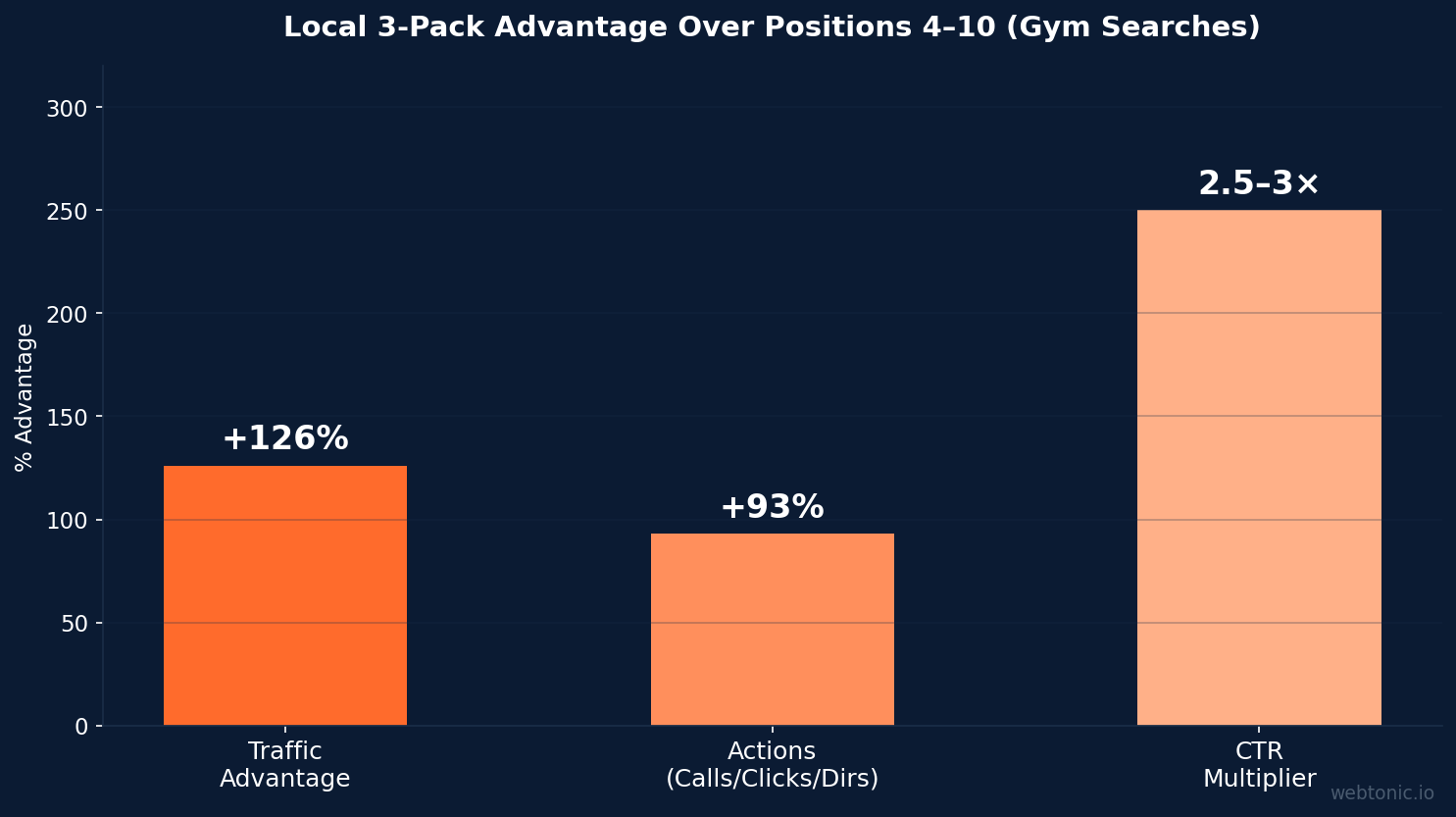
The Local 3-Pack — the three business listings Google displays above organic results for local queries — determines visibility for the vast majority of fitness searches. FitBudd's 2026 gym SEO guide reports that gyms in the Local 3-Pack get 126% more traffic and 93% more actions (calls, clicks, and direction requests) than those ranked in positions 4–10.
This gap is not subtle. Authority Specialist's multi-location gym data confirms that brands in the top three local positions generate organic CTRs 2.5–3× higher than those in positions four through seven for the same market. If your area generates 1,000 "gym near me" searches monthly, the fourth-place position means you miss out on 850–900 potential member interactions before prospects even know your business exists.
The Map Pack functions increasingly as a destination, not a doorway. Koira's analysis of near-me search behavior found that for health and wellness businesses, the click-vs-preview split looks like this:
| Map Pack Action | % of Interactions | Implication |
|---|---|---|
| Website click | 35–40% | Booking flow often requires website |
| Direction request | 25–30% | Ready-to-visit prospects |
| Phone call | 15–20% | Highest-intent immediate action |
| Photo/menu view only | 10–15% | Evaluating before engagement |
| No action (impression only) | 10–15% | Growing "zero-click" share (+8 pts since 2023) |
The key insight: website clicks represent a minority of Map Pack conversions. Direction requests and phone calls together drive more local-intent conversions than website visits for most fitness businesses. This means GBP optimization — complete hours, photos, Q&A, and recent posts — matters more than website traffic for local conversion.
Google Business Profile Ranking Factors for Fitness
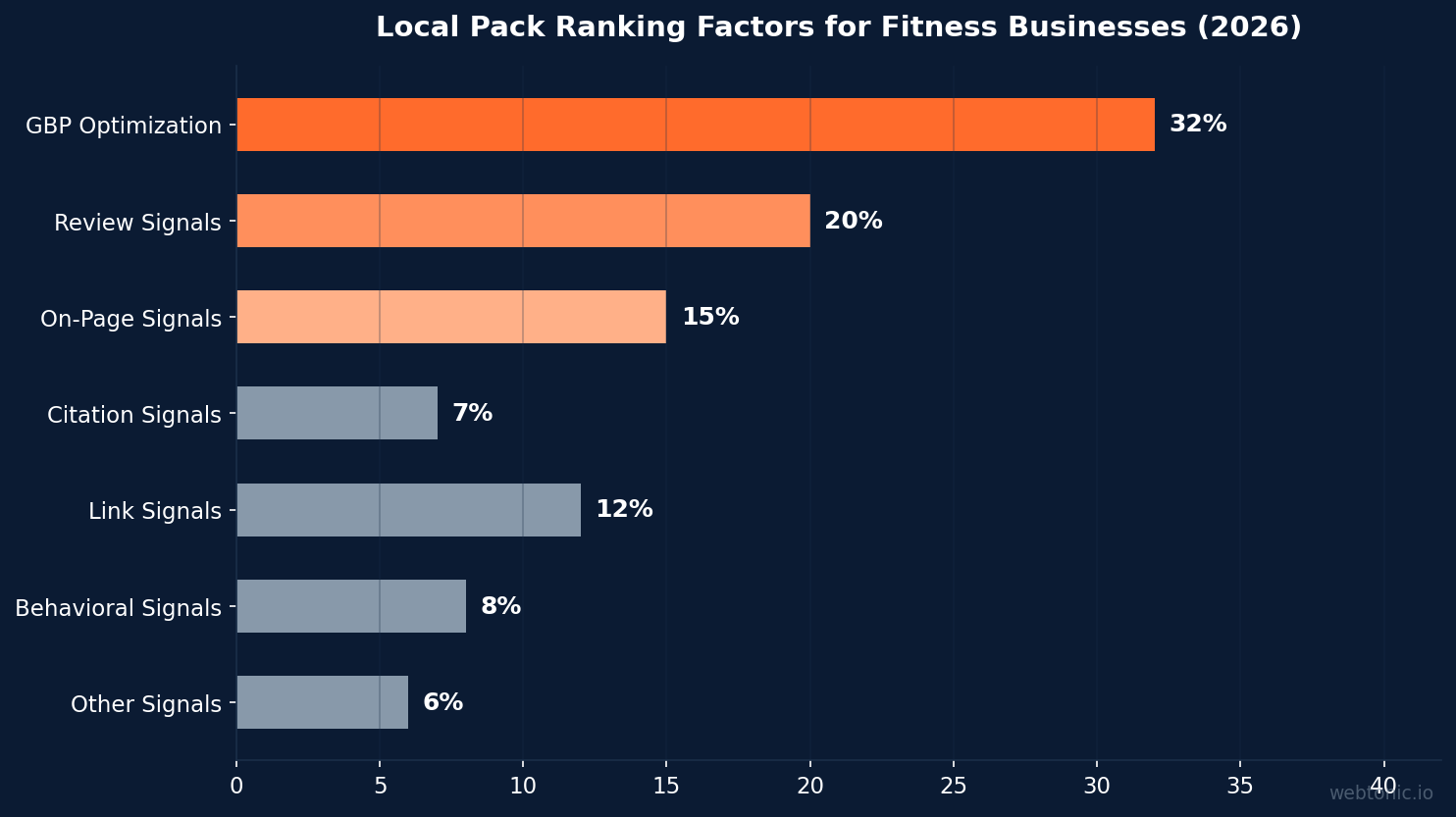
Understanding what drives Local 3-Pack placement allows fitness businesses to prioritize their optimization efforts. According to industry ranking factor studies cited by multiple sources, GBP optimization accounts for 32% of local pack rankings, followed by review signals at 20% and on-page signals at 15%.
Specific GBP elements that move the needle for gyms:
- Profile completeness: Complete GBP profiles are 70% more likely to attract local visits than incomplete ones. This includes business hours, categories, attributes, services, and descriptions.
- Photo quantity: Profiles with 100+ photos see roughly 2× the direction requests of those with fewer than 20. For gyms, this means facility photos, equipment shots, class action photos, and member transformation images all contribute directly to conversion.
- Review volume and velocity: The most consistent differentiator among top-performing gym brands is structured review acquisition, with leading gyms averaging more than 12 new verified reviews per location per month.
- Review rating impact: Increasing your Google Reviews rating by one star improves conversion and revenue by 44%. Additionally, 85% of potential members are more likely to choose a gym that actively responds to reviews, whether positive or negative.
- Google Posts and Q&A: Active posting (weekly Google Posts, answered Q&As) signals freshness to the algorithm and gives users more decision-making information before clicking through.
For multi-location fitness brands, maintaining consistent GBP management across all locations is the single highest-ROI local SEO activity. Each location functions as an independent ranking entity and needs its own review strategy, photo cadence, and post schedule.
"Near Me" Search Behavior and Conversion Patterns
"Near me" queries represent the highest-intent traffic available to fitness businesses. AFFiNCO reports that early 2026 saw more than 200 million monthly "near me" searches globally, with keyword variations holding 7.1 million monthly search volume in Semrush's data.
The conversion metrics are remarkable:
- 76% of "near me" mobile searches lead to a physical store visit within 24 hours.
- 28% of local searches end in a purchase within a day.
- 72% of local searchers visit a store within five miles of their location.
- 84% of local searches look for new businesses, not brand names — meaning prospects are open to being won over.
For fitness businesses, this creates a clear competitive dynamic: the gym that shows up first for "gym near me" in a given neighborhood captures a disproportionate share of high-intent prospects. Combined with Meta Ads targeting the same geography, a dual organic-and-paid local strategy maximizes coverage across the prospect's decision journey.
The AI Disruption in Local Fitness Search
The most dramatic shift in local search behavior this year is the rise of AI-assisted recommendations. AFFiNCO's data shows that 45% of consumers now use AI tools for local business recommendations, up from just 6% in 2025 — a 650% year-over-year increase.
This shift has direct implications for fitness businesses:
- Citation signals still hold 7% of direct local pack ranking weight, and NAP consistency across platforms feeds the trust score AI systems assign to a business entity.
- Businesses with consistent NAP across directories rank 73% higher in local results. As AI systems aggregate data from multiple sources, inconsistent business information creates trust penalties.
- AI Overviews and conversational search are changing how prospects discover gyms. Rather than scrolling through ten results, many users now receive a synthesized recommendation. Being the gym that AI consistently surfaces requires strong structured data, review signals, and comprehensive digital presence.
The implication for fitness marketing is clear: local SEO now extends beyond Google. Fitness businesses need visibility across Google Maps, Apple Maps, Yelp, Facebook, and emerging AI recommendation engines to capture the growing share of discovery happening outside traditional search.
Seasonal Patterns in Local Fitness Search
Local fitness search volume follows predictable seasonal patterns that smart gym owners leverage. January sees a 20–25% jump in gym sign-ups compared to December, with approximately 12% of all new gym sign-ups occurring in January alone as New Year's resolution traffic peaks.
Summer months present the opposite challenge: gym attendance drops up to 50% as workouts shift outdoors and travel increases. However, search data shows that interest in specific fitness categories — yoga classes increase up to 70% in summer — creates opportunities for studios and specialized facilities to capture seasonal demand through local SEO targeting.
For local SEO strategy, this means GBP posts, photo updates, and review acquisition campaigns should intensify in November and December to maximize January visibility, while summer campaigns should shift messaging toward classes and programs that align with warm-weather fitness interests.
Frequently Asked Questions
How important is local SEO for gyms compared to paid advertising?
Local SEO is the most cost-effective acquisition channel for gyms. 76% of gym members discovered their current facility through local search, and the Local 3-Pack delivers 126% more traffic than positions 4–10. While paid advertising delivers immediate visibility, local SEO builds compounding organic traffic that reduces cost per acquisition over time.
What are the most important Google Business Profile ranking factors?
GBP optimization drives 32% of Local 3-Pack rankings, review signals contribute 20%, and on-page signals add 15%. The highest-impact actions are completing your full profile (70% more visits), maintaining 100+ photos (2× direction requests), and acquiring 12+ new reviews per month. Responding to reviews matters too — 85% of prospects prefer businesses that respond to all reviews.
How much monthly search volume do fitness local keywords have?
"Gyms near me" generates 1,220,000 monthly searches in the U.S. When combined with city-specific queries, gym membership terms, and fitness class searches, total local fitness search volume exceeds several million queries monthly. These are predominantly high-intent searches — 76% lead to physical visits within 24 hours.
How does AI affect local SEO for fitness businesses?
AI adoption for local business recommendations jumped from 6% to 45% in one year. AI systems aggregate data from multiple sources, making NAP consistency and structured data critical. Businesses with consistent NAP rank 73% higher, and citation signals hold 7% of direct local pack ranking weight that AI systems specifically reference for trust scoring.
What seasonal adjustments should gyms make to their local SEO strategy?
Intensify GBP posting, photo updates, and review acquisition in November–December to maximize January visibility (when sign-ups spike 20–25%). During summer months, when attendance drops 50%, shift focus to class-specific and program-specific local keywords. Yoga-related searches increase 70% in summer, creating opportunities for studios targeting seasonal demand.
Sources
affinco.com/local-seo-statistics
authorityspecialist.com/gym-seo-statistics
fitbudd.com/insights/seo-for-gyms
koira.ai/blog/near-me-search-click-vs-map-pack-preview-data
softscotch.com/seo-keywords-for-gyms
rudys.ai/local-seo-statistics
pilotium.cc/en/blog/state-of-gym-marketing-2026


