



Table of contents
Key Takeaways
- Sports and fitness websites need a median of 564 referring domains to hold first-page positions, placing the vertical in the medium-competition tier across all industries.
- The average cost per quality backlink reached $508.95 in 2025, with 76% of SEO professionals willing to pay $300 or more per link as quality premiums continue rising.
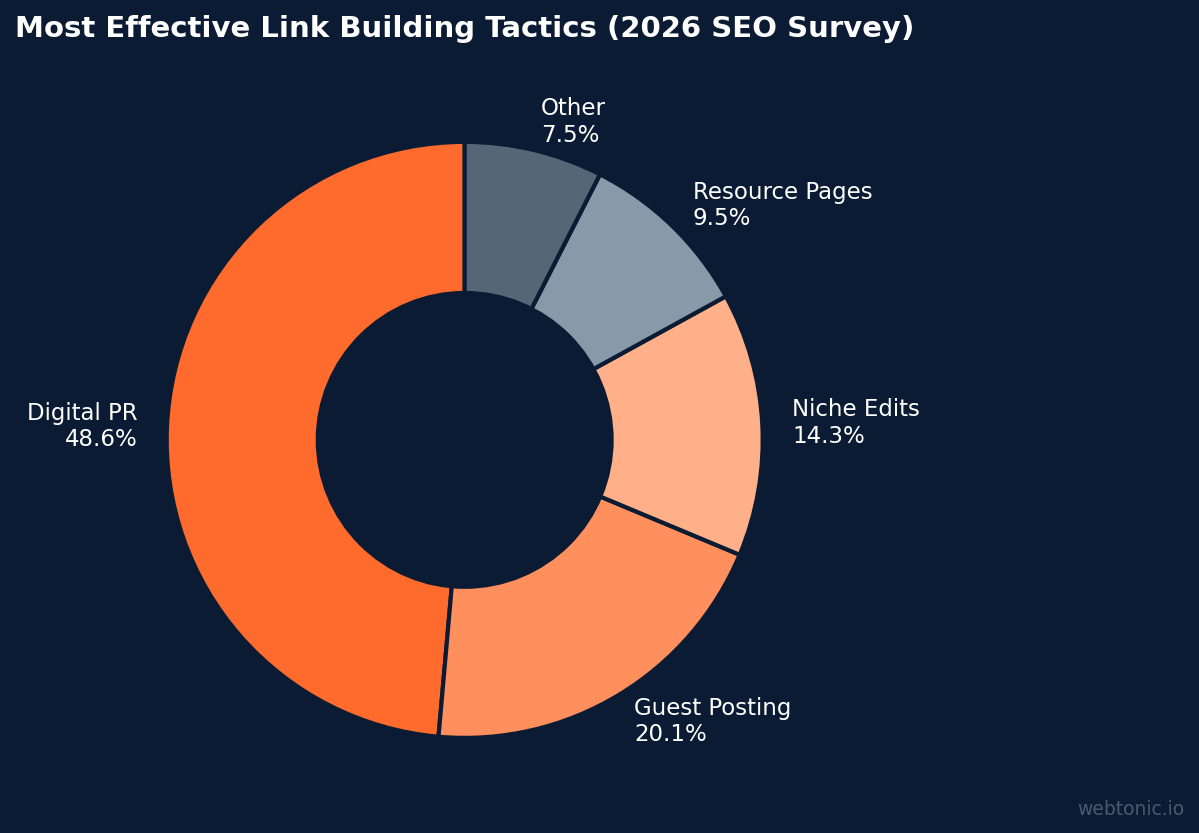
- Digital PR is rated the most effective link building tactic by 48.6% of SEOs, surpassing guest posting, broken link building, and resource page outreach.
- Only 8.5% of outreach emails receive any reply, but a single follow-up email boosts response rates by 65.8%, making persistence a measurable advantage.
- 78% of SEO professionals report positive ROI from link building, with link building costs rising 20–35% since 2022 as demand for quality placements outpaces supply.
- Long-form fitness content earns 77.2% more backlinks than short-form pieces, making comprehensive guides and data-driven articles the most link-worthy format.
- 64.9% of link builders use guest posting as their primary tactic, making it the single most popular method, with fitness guest posts generating 67% more organic impressions within 90 days.
- The number-one Google result has 3.8× more backlinks than positions two through ten, reinforcing that link quantity and quality remain decisive ranking factors.
Fitness Link Building Benchmarks at a Glance
Link building in the fitness vertical requires a specific calibration of effort, budget, and tactic selection. These benchmarks synthesize data from multiple large-scale studies to give fitness marketers clear targets.
| Metric | Fitness / Health Benchmark | Cross-Industry Average |
|---|---|---|
| Referring domains (median, page 1) | 564 | 907 |
| Domain Authority range (good) | 40–60 | 40–60 |
| Avg. cost per quality backlink | $508.95 | $508.95 |
| Outreach response rate | 8.5% | 8.5% |
| Top tactic (% of SEOs) | Digital PR (48.6%) | Digital PR (48.6%) |
| Monthly link velocity (top performers) | 48 new RDs/mo | 48 new RDs/mo |
| Positive ROI reported | 78% | 78% |
How Many Backlinks Do Fitness Websites Need to Rank?
Backlink requirements vary enormously by industry, and fitness sits in a specific competitive tier. VastCope's 2026 backlink benchmark study, analyzing over 1,400 top-ranking pages across 15 industries, found that sports and fitness websites need a median of 564 referring domains to hold first-page positions.
This places fitness in the medium-competition tier, well below finance and insurance (3,027 referring domains), health (1,915), and real estate (2,032), but above beauty and personal care (361), arts and entertainment (173), and apparel (76). The overall cross-industry median for first-page rankings is 907 referring domains.
For context, Stacker's 2026 backlink study confirms these ranges and adds that the number-one Google result has 3.8× more backlinks than results in positions two through ten. This multiplier effect means the difference between ranking third and first is not incremental — it requires a step-change in link acquisition velocity and quality.
Fitness brands can take advantage of their medium-competition positioning. Unlike finance or health verticals where YMYL requirements demand extensive credibility signals, fitness businesses can compete effectively with focused, consistent link building over 6–12 months rather than multi-year enterprise-scale campaigns.
Link Building Costs and Budget Benchmarks
Link building has become measurably more expensive. LinkPanda's 2026 analysis of 3,000+ placed backlinks reports that the average cost per quality backlink is $508.95. Costs have risen 20–35% since 2022, driven by increased demand for high-quality placements and declining availability of editorial link opportunities.
The price distribution shows clear tiers:
| Price Range | % of SEOs Paying | Typical Quality |
|---|---|---|
| Under $100 | ~12% | Low DR, often PBN or directory |
| $100–$300 | 18% | Mid-tier guest posts, niche edits |
| $300–$500 | 28% | Quality editorial placements |
| $500+ | 42% | Premium publications, Digital PR |
Reporter Outreach's 2026 State of Link Building survey of 500 SEO professionals confirms the quality premium: 62% now prioritize quality over volume, and 76% will pay $300+ per link. The bottom of the market is shrinking — strategies dependent on high volume at low prices face diminishing returns as search algorithms increasingly penalize low-quality link patterns.
For fitness businesses working with an SEO agency, a realistic monthly link building budget ranges from $1,500–$5,000 for 3–10 quality placements, depending on domain authority targets and competitive positioning. This investment typically delivers measurable ranking improvements within 3–6 months, with compounding returns over 12+ months.
Most Effective Link Building Tactics for Fitness Brands
The tactics that work best for fitness brands differ from generic link building advice. LinkPanda's data identifies the top-performing tactics industry-wide:
- Digital PR (48.6% of SEOs rate it #1): Creating data-driven fitness studies, survey results, or original benchmark reports that journalists and bloggers naturally reference. Fitness brands with proprietary member data have a unique advantage here.
- Guest posting (64.9% of link builders use it): Adbassador's 2026 State of Guest Posting confirms it remains the single most popular link building method. Fitness-specific guest posts generate 67% more organic impressions within 90 days and 3× longer dwell time on host sites.
- Niche edits and link insertions: Adding links to existing, already-indexed content on relevant fitness sites. LinkPanda's data shows these cost 34% less than the industry average while delivering comparable ranking impact when placed on topically relevant pages.
- Resource page outreach: Identifying fitness-related resource pages (university wellness programs, health organization directories, fitness association member lists) and requesting inclusion.
For fitness brands specifically, Link Building Journal's fitness guide emphasizes a critical constraint: the YMYL (Your Money or Your Life) classification of health and fitness content means credibility architecture matters before link acquisition. Fixing author bios, medical review structures, and E-E-A-T signals on your top pages should precede any outreach campaign.

Outreach Response Rates and Campaign Efficiency
Outreach remains the bottleneck of link building execution. The numbers are sobering but consistent. Backlinko's analysis of 12 million outreach emails (reported via LinkPanda) finds that only 8.5% of outreach emails receive any reply at all. However, tactical adjustments produce significant improvements:
- One follow-up email boosts reply rates by 65.8%. This single persistence step is the highest-ROI improvement in any outreach campaign.
- Personalized subject lines increase open rates by 30.5% compared to generic templates.
- Emails referencing specific content on the recipient's site receive 2.3× higher response rates than generic pitches.
- Tuesday and Thursday mornings produce the highest response rates for outreach emails targeting fitness publishers and bloggers.
For fitness link building, topic relevance amplifies response rates further. Outreach Desk emphasizes tracking referring domain growth alongside raw link counts, since one trusted connection from a fitness authority carries far more weight than dozens of low-relevance placements. The fitness niche benefits from a natural content ecosystem — wellness bloggers, personal trainers with websites, and creative agencies producing fitness content create multiple outreach angle opportunities.
Content Types That Earn the Most Fitness Backlinks
Not all fitness content attracts links equally. The data shows clear winners:
| Content Type | Link Attraction Rate | Best Use Case |
|---|---|---|
| Original research / surveys | Highest | Digital PR, journalist pitches |
| Long-form guides (2,000+ words) | 77.2% more links | Organic link attraction, resource pages |
| Data visualizations / infographics | High | Social shares, embed links |
| Expert roundups | Medium-high | Participant sharing, ego bait |
| Case studies with metrics | Medium | B2B fitness, franchise audiences |
| Short blog posts (under 1,000 words) | Lowest | Internal linking, topical support |
Long-form content earns 77.2% more backlinks than short-form pieces. For fitness brands, this means comprehensive workout guides, nutrition research compilations, and industry benchmark reports consistently outperform quick tips or listicle-style posts for link acquisition. The investment in depth pays off through both organic visibility and passive link attraction over time.
VastCope's data adds another dimension: editorial links make up 92.2% of links to first-page pages, while directory links account for only 6.8% and resource links 1.1%. This confirms that search engines strongly reward contextual mentions within helpful content over simple listing-based placements, making quality content creation the foundation of sustainable fitness link building.
Link Building ROI and Performance Timelines
78% of SEO professionals report positive ROI from link building, but the timeline matters. For fitness websites, typical performance milestones follow this pattern:
- Days 1–30: Links indexed, minimal ranking movement. Domain authority may show early gains if starting from a low baseline.
- Days 30–90: Initial ranking improvements on lower-competition long-tail fitness keywords. Organic traffic begins increasing for supported pages.
- Days 90–180: Meaningful movement on competitive head terms ("gyms near me," "personal trainer [city]"). Compound effects from multiple link placements become visible.
- 6–12 months: Full ROI realization. Brands with sustained growth marketing campaigns see the strongest returns as domain authority compounds month over month.
Top-performing link builders maintain a link velocity of 48 new referring domains per month. For most fitness businesses, a more realistic target of 5–15 new quality referring domains monthly delivers substantial competitive advantage, particularly in local and regional markets where competitors often have weak or stagnant link profiles.
Topozicev's fitness link building analysis reinforces a key point: reaching the top of search results for competitive fitness keywords is not the finish line — it is the beginning of an ongoing effort. Competitors are actively building links too, so sustained monthly link acquisition is necessary to maintain rankings, not just achieve them. A brand that stops building after reaching page one typically sees ranking erosion within 3–6 months as competitors close the gap.
Frequently Asked Questions
How many backlinks does a fitness website need to rank on page one?
Sports and fitness websites need a median of 564 referring domains for first-page positions, placing the vertical in the medium-competition tier. However, local fitness businesses targeting city-specific keywords can rank with significantly fewer — often 50–150 quality referring domains — because local pack competition is typically less intense than national organic results.
What is the average cost of a quality backlink for fitness businesses?
The industry-wide average cost per quality backlink is $508.95, with costs rising 20–35% since 2022. For fitness-specific placements, expect to pay $200–$600 per link depending on the host site's domain authority and topical relevance. Budget $1,500–$5,000 monthly for 3–10 quality placements that deliver measurable ranking improvements.
What link building tactics work best for gyms and fitness brands?
Digital PR is rated most effective by 48.6% of SEOs, followed by guest posting (used by 64.9% of link builders). For fitness brands specifically, creating original benchmark data, member surveys, or transformation case studies provides the highest link attraction rate. YMYL compliance — proper author bios and expert review structures — should be established before beginning outreach.
How long does it take for link building to show results?
Initial ranking improvements on long-tail keywords typically appear within 30–90 days. Meaningful movement on competitive head terms takes 90–180 days. Full ROI realization requires 6–12 months of sustained effort. Paid advertising can bridge the gap while organic authority builds.
Is guest posting still effective for fitness SEO in 2026?
Yes — 64.9% of link builders use guest posting as their primary tactic. Fitness-specific guest posts generate 67% more organic impressions within 90 days and achieve 3× longer dwell time on host sites. The key is targeting topically relevant fitness publications rather than generic blog networks, as search engines increasingly evaluate contextual relevance over raw domain metrics.
Sources
vastcope.com/blog/backlink-benchmarks-2026
linkpanda.com/link-building-statistics
reporteroutreach.com/blog/state-of-link-building
adbassador.com/state-of-guest-posting-2026
linkbuildingjournal.co.uk/fitness-link-building
outreachdesk.com/health-fitness-link-building
stacker.com/stories/ai/2026-backlink-study
topozicev.com/health-fitness-link-building
authorityspecialist.com/gym-seo-statistics


