



Table of contents
Key Takeaways
Organic search drives 54–68% of new patient website sessions for health and wellness practices, making SEO the dominant acquisition channel. SEO delivers a $40–$90 cost per lead with a 14.6% close rate — 2–3× cheaper than paid search at $120–$200+. Healthcare websites without E-E-A-T signals saw up to 40% lower visibility after Google's Helpful Content updates. Meanwhile, content marketing generates 3× more leads at 62% less cost than traditional methods, and top-performing wellness stores capture 42–68% of category traffic through organic search alone.
Health & Wellness SEO Benchmarks at a Glance
| Metric | Value | Source |
|---|---|---|
| Organic search traffic share | 54–68% of new patient sessions | AuthoritySpecialist (medical practices) |
| SEO cost per lead | $40–$90 (14.6% close rate) | FoundryCRO |
| Paid search CPL | $120–$200+ (8–12% close rate) | FoundryCRO |
| E-E-A-T visibility impact | Up to 40% lower without signals | Reactll |
| Content marketing lead multiplier | 3× more leads at 62% less cost | Zipdo |
| Website CVR (medical practices) | 3.6% average | CuFinder |
| Top-performing organic traffic share | 42–68% of category traffic | AuthoritySpecialist (34 retailers) |
| Programmatic ad growth (healthcare) | 35% YoY, 42% of display spend | Zipdo |
Organic Search Traffic & Rankings for Healthcare
AuthoritySpecialist's 2026 benchmark data across multi-specialty medical practices shows that organic search drives 54–68% of new patient website sessions, with top-3 Google rankings capturing the majority of appointment-intent clicks. Map Pack visibility adds another layer of organic traffic, particularly for location-modified queries.
For health and wellness retailers specifically, AuthoritySpecialist's audit of 34 multi-location stores found that top performers capture 42–68% of category traffic through organic search, with supplement and fitness equipment verticals leading the pack. Brand search volume tends to grow alongside organic investment — as content earns citations and backlinks, branded queries increase in parallel, compounding total visibility.
The data reveals a clear hierarchy: practices with structured content strategies and condition-specific landing pages dramatically outperform those relying on a single homepage or generic services page. For wellness businesses operating across multiple locations, the local SEO dimension adds another multiplier to organic traffic potential.
The organic traffic opportunity extends beyond traditional search. SearchLab's GBP statistics show that Google Business Profile views and engagement drive significant auxiliary traffic to websites, creating a feedback loop where strong local visibility fuels organic growth. Practices that optimize for both traditional SEO and local search signals capture a disproportionate share of total healthcare search volume. Understanding these dual traffic streams requires robust data intelligence infrastructure to attribute conversions accurately.
SEO Cost Efficiency vs. Paid Channels
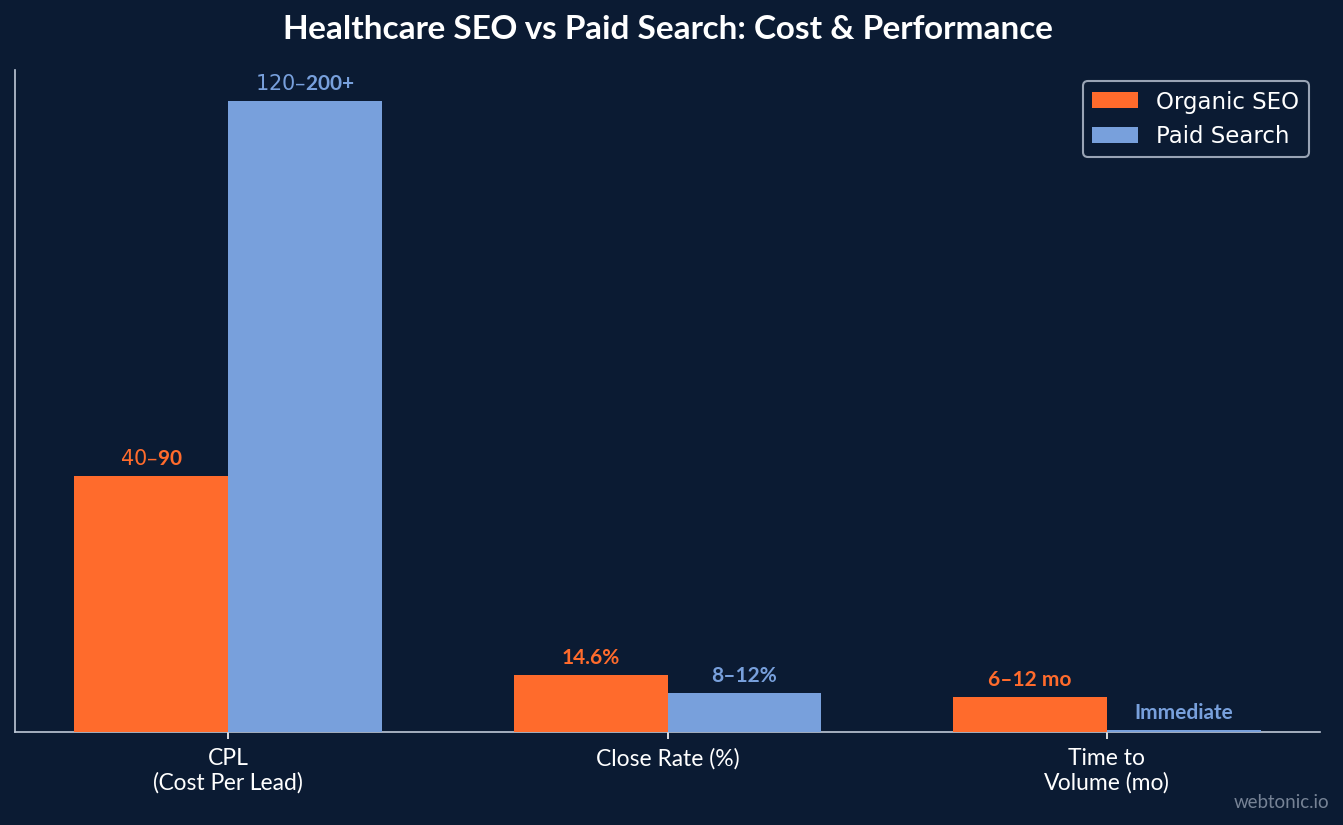
FoundryCRO's 2026 healthcare benchmarks by specialty provide the clearest cost comparison between acquisition channels. Organic SEO delivers a $40–$90 cost per lead with a 14.6% close rate, versus $120–$200+ for paid search with an 8–12% close rate. The math strongly favors SEO on both cost and quality — organic leads close at nearly twice the rate of paid leads.
The caveat is time. SEO requires 6–12 months of consistent investment before producing meaningful volume, while Google Ads can generate leads immediately. Most successful wellness businesses run paid campaigns during the SEO ramp-up period, then gradually shift budget toward organic as rankings mature. This blended approach — documented in our growth marketing methodology — maximizes both short-term pipeline and long-term cost efficiency.
Zipdo's healthcare marketing data reinforces SEO's ROI position: SEO provides 14.6% of total ROI attribution in healthcare funnels, trailing only direct response but outpacing social media, referral, and display channels. For practices with substantial annual marketing budgets, that attribution translates to significant revenue that compounds over time.
E-E-A-T & YMYL: Why Healthcare SEO Plays by Different Rules
Health and wellness content falls squarely within Google's Your Money or Your Life (YMYL) category, where Experience, Expertise, Authoritativeness, and Trustworthiness (E-E-A-T) signals carry outsized weight in search rankings. Reactll's 2026 analysis found that healthcare websites without structured E-E-A-T content saw up to 40% lower visibility following Google's 2024–2025 Helpful Content updates.
AuthoritySpecialist's doctor benchmarks confirm that the gap between practices with structured E-E-A-T content — author bios with medical credentials, cited peer-reviewed sources, clinical disclaimers — and those without has "widened measurably" since the 2024–2025 algorithm updates. For wellness brands, this means every blog post, service page, and landing page needs visible expertise signals to maintain organic rankings.
The four E-E-A-T pillars play out differently for healthcare: Experience (practitioner case studies, patient outcomes), Expertise (credentialed authors, clinical accuracy), Authoritativeness (citations from medical journals, associations), and Trustworthiness (HIPAA compliance statements, secure sites, transparent pricing). Sites that systematically address all four consistently outrank those optimizing only for keywords and backlinks.
Content Marketing & SEO Performance in Healthcare
Zipdo's comprehensive healthcare marketing statistics reveal that content marketing generates 3× more leads than traditional methods at 62% less cost in healthcare. This multiplier effect is amplified in YMYL categories where educational content builds the trust signals Google rewards with higher rankings.
Programmatic advertising in healthcare grew 35% year-over-year, capturing 42% of digital display spend, according to Zipdo. While programmatic drives awareness, the conversion path typically routes through organic search — patients see a display ad, then search the provider name, validating the importance of strong branded SEO alongside paid awareness campaigns.
AuthoritySpecialist's therapist benchmarks show that condition-specific landing pages generate significantly higher organic inquiry rates than consolidated services pages. For wellness businesses, this means creating dedicated pages for each service modality — "anxiety therapy," "sports massage," "nutritional counseling" — rather than a single "our services" page. Each page becomes a separate organic ranking opportunity with distinct creative messaging and conversion paths.
Healthcare content investment is part of a broader digital advertising expansion. The U.S. healthcare digital marketing sector has seen programmatic growth capture 42% of digital display spend, while overall healthcare digital ad spending reached $24.77 billion, growing 13.3% year-over-year. For wellness marketers, this spending surge creates both opportunity (larger audiences to reach) and competition (higher costs to stand out) — making organic SEO content an increasingly valuable counterweight to escalating paid media costs.
Conversion Rate Benchmarks by Healthcare Touchpoint
| Touchpoint | Avg CVR | Top Performers | Source |
|---|---|---|---|
| Call-only ad | 12.5% | 18–22% | CuFinder |
| PPC landing page | 6.1% | 10–15% | CuFinder |
| Website (organic) | 3.6% | 5–7% | CuFinder |
| GBP local search | 3.2% | 5%+ | SEO Design Chicago |
| Local searches → purchase | 28% | — |
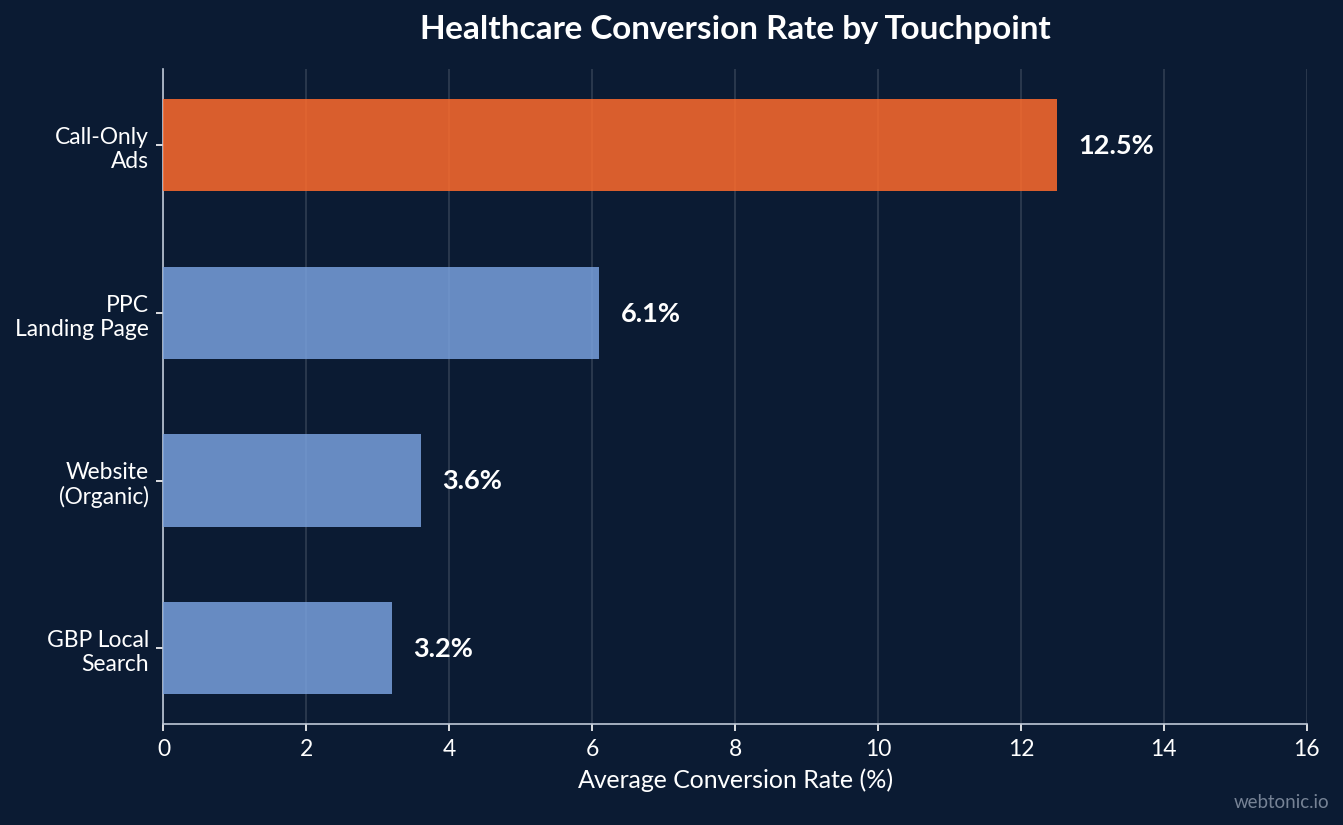
CuFinder's 2026 medical practice benchmarks show a clear conversion hierarchy by touchpoint. Websites convert at 3.6% average, PPC landing pages at 6.1%, and call-only ads at 12.5%. The implication for SEO: organic pages need to match the conversion-oriented design of paid landing pages to compete — clear CTAs, appointment scheduling widgets, and trust signals above the fold.
Voice Search & AI Search Impact on Healthcare SEO
The rise of AI-powered search is reshaping healthcare SEO strategy. Direction.com's lead source study shows AI assistant referrals to healthcare providers grew 55.10% year-over-year, from 1.2% to 1.9% of total leads. While the absolute share remains small, the growth trajectory signals a channel that wellness businesses should optimize for now.
eMarketer reports that smart speaker owners are using devices for more health-related tasks, with health queries growing as users become comfortable asking sensitive questions through voice interfaces. For SEO practitioners, this means structured FAQ content, conversational keyword targeting, and featured snippet optimization are increasingly important for capturing zero-click health queries.
The intersection of AI search and YMYL creates a unique challenge: AI tools are more cautious about health claims, preferring sources with clear E-E-A-T signals. Practices with strong credentialed content and structured data are disproportionately cited by AI assistants, while generic wellness content gets filtered out. Integrating analytics tracking for AI referral traffic helps quantify this emerging channel.
Telehealth & Digital Health SEO Opportunities
AuthoritySpecialist's therapist benchmarks note that "online therapist" queries have risen substantially since 2020, creating a new keyword category that does not follow traditional local SEO patterns. Telehealth SEO requires a different approach: broader geographic targeting, service-specific landing pages, and competitive content strategies that address patient concerns about virtual care quality and effectiveness.
For wellness businesses offering both in-person and virtual services, the SEO strategy should bifurcate. Local pages target geographic intent ("therapist near me"), while telehealth pages target modality intent ("online CBT therapy") with state-level or national targeting. This dual approach prevents cannibalization while maximizing the addressable search volume across both email marketing nurture sequences and organic discovery channels.
SEO Design Chicago's cross-industry data confirms that healthcare's 3.2% local search conversion rate outperforms several other service industries, validating the channel's effectiveness for patient acquisition. Practices that combine strong local SEO fundamentals with telehealth-specific content strategies effectively double their addressable market — capturing both geography-bound patients and the growing cohort of consumers comfortable with virtual wellness consultations.
AuthoritySpecialist's spa benchmarks from 34 multi-location spas confirm that local search via Google Maps and the 3-pack remains the primary discovery channel for most wellness services. Organic website rankings matter significantly, but local visibility often drives initial awareness that feeds into broader organic traffic patterns.
Healthcare SEO vs. Other Industries
Healthcare SEO operates under stricter guidelines than most industries due to YMYL classification, but the payoff justifies the additional compliance burden. FoundryCRO's cross-industry benchmarks show that healthcare's 14.6% organic close rate exceeds the B2B average of 8–12% and the ecommerce average of 2–4%. The high-intent nature of health searches — patients actively seeking care — drives superior conversion quality that compounds over time.
The competitive landscape is also evolving rapidly. AuthoritySpecialist's multi-location audits show that fewer than 30% of health and wellness stores rank in the top 3 for their primary category terms, suggesting significant organic search opportunity remains for practices willing to invest in structured SEO programs. The subdirectory strategy — placing location pages under a single domain rather than separate microsites — delivers 2–3× the organic performance of fragmented multi-domain approaches.
Related reading
- Health & Wellness Local SEO Statistics: 2026 Benchmarks & Performance Data
- Inside Health & Wellness Technical SEO: Key Statistics & Insights for 2026
- Are Counseling SEO Statistics Worth It in 2026?
- GEO & AEO services at Web Tonic
FAQ
What percentage of healthcare website traffic comes from organic search?
AuthoritySpecialist's 2026 benchmark data across multi-specialty medical practices shows organic search drives 54–68% of new patient website sessions, with top-3 Google rankings capturing the majority of appointment-intent clicks.
How much does healthcare SEO cost per lead compared to paid search?
FoundryCRO's 2026 benchmarks show organic SEO delivers a $40–$90 CPL with a 14.6% close rate, versus $120–$200+ for paid search with an 8–12% close rate. SEO requires 6–12 months to build volume while paid delivers leads immediately.
Does E-E-A-T really affect healthcare website rankings?
Yes. Reactll's 2026 analysis found healthcare websites without structured E-E-A-T content saw up to 40% lower visibility after Google's 2024–2025 Helpful Content updates. AuthoritySpecialist confirms the gap has widened measurably.
What is the average conversion rate for healthcare websites?
CuFinder's 2026 medical practice benchmarks report an average website conversion rate of 3.6%, PPC landing pages convert at 6.1%, and call-only ads reach 12.5%. Top performers with condition-specific landing pages consistently exceed these averages.
How does content marketing ROI compare in healthcare?
Zipdo's healthcare marketing statistics show content marketing generates 3× more leads than traditional methods at 62% less cost. SEO provides 14.6% of ROI attribution in healthcare funnels.
Sources
authorityspecialist.com — medical practice SEO benchmarks 2026
authorityspecialist.com — H&W store SEO statistics
authorityspecialist.com — doctor SEO benchmarks 2026
authorityspecialist.com — therapist SEO benchmarks
foundrycro.com — healthcare CAC by specialty 2026
reactll.com — E-E-A-T for medical websites
zipdo.co — healthcare marketing statistics 2026
cufinder.io — medical practice benchmarks 2026
seodesignchicago.com — local SEO across 10 industries
direction.com — healthcare lead sources 2026
authorityspecialist.com — spa SEO benchmarks


