Table of contents
77% of adults with a diagnosable mental illness in 2023 received no treatment at all, and 46% of psychologists still report no openings for new patients in 2025. Counseling SEO cannot manufacture clinician capacity - but the data below shows it is aimed at a real, documented access-and-information gap, not a demand problem search traffic alone can close. This page separates what SEO realistically fixes from what it does not, using primary 2023-2026 sources.
Key Takeaways
- 22.8% of U.S. adults (58.7 million people) had any mental illness in the past year (2023 NSDUH).
- Only 23.0% of all adults received mental health treatment in the past year (2023).
- 5.7% of adults (14.6 million) had a serious mental illness in the past year.
- 6,807 federally designated Mental Health HPSAs cover 137,133,953 people.
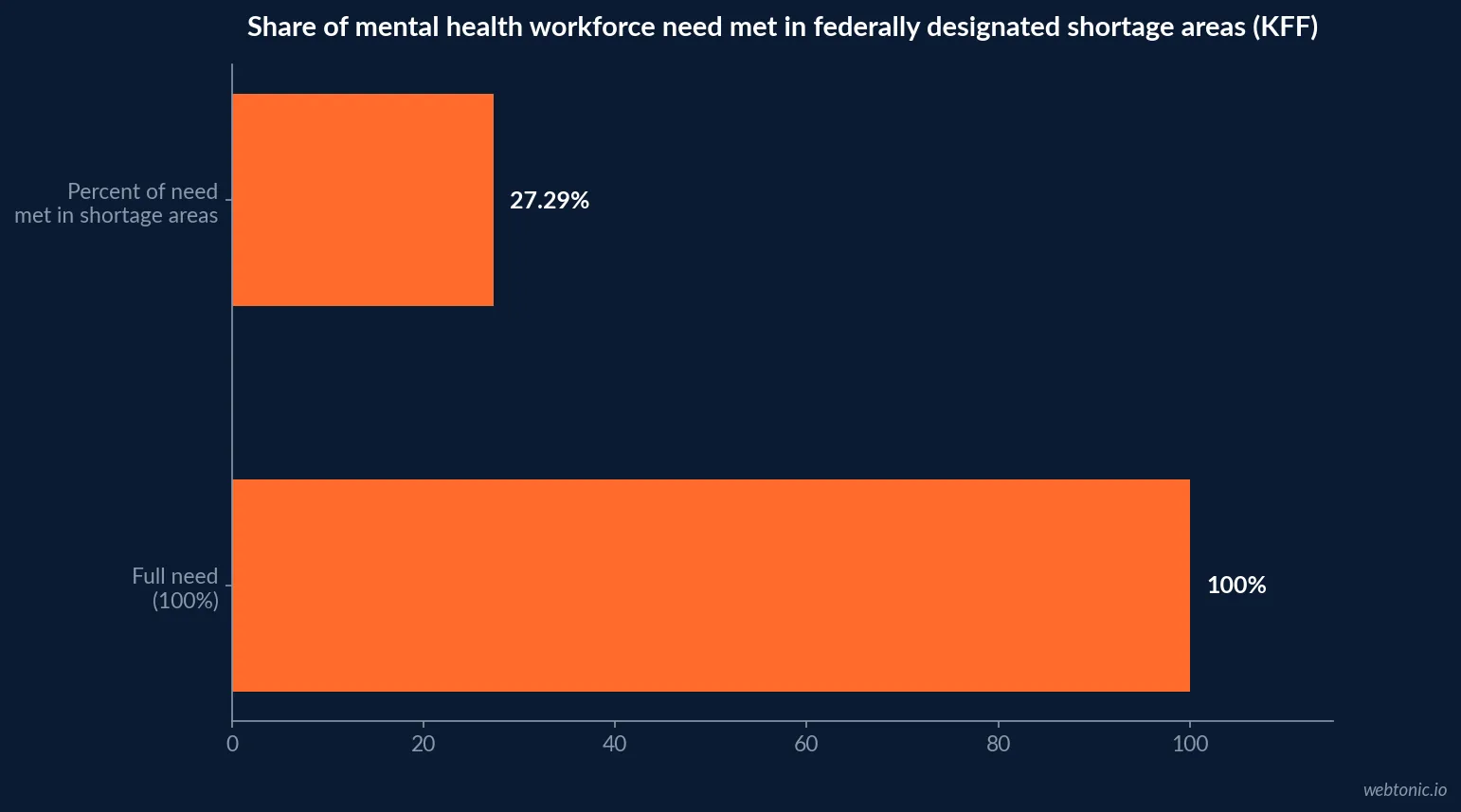
- Only 27.29% of mental health workforce need is met nationally.
- 46% of psychologists report no openings for new patients (2025).
- 40% of psychologists maintain a waitlist for new clients.
- 87% of providers can now see new patients within 3 months, an improving trend since 2021.
- Knowing first steps (23%) and finding availability (19%) are consumers' top mental healthcare frustrations.
- 245,000+ clinicians are captured in SimplePractice's aggregated 2025 practice data.
- 88% of clinicians intend to stay in the field through 2026.
- 33.7% of adults with any mental illness used telehealth treatment in 2023.
- ~1 in 3 teens get mental health information from social media, and 63% of those call it important.
- 48% of teens say social media has a mostly negative effect on peers, up from 32% in 2022.
The demand-and-access gap SEO content is actually competing against
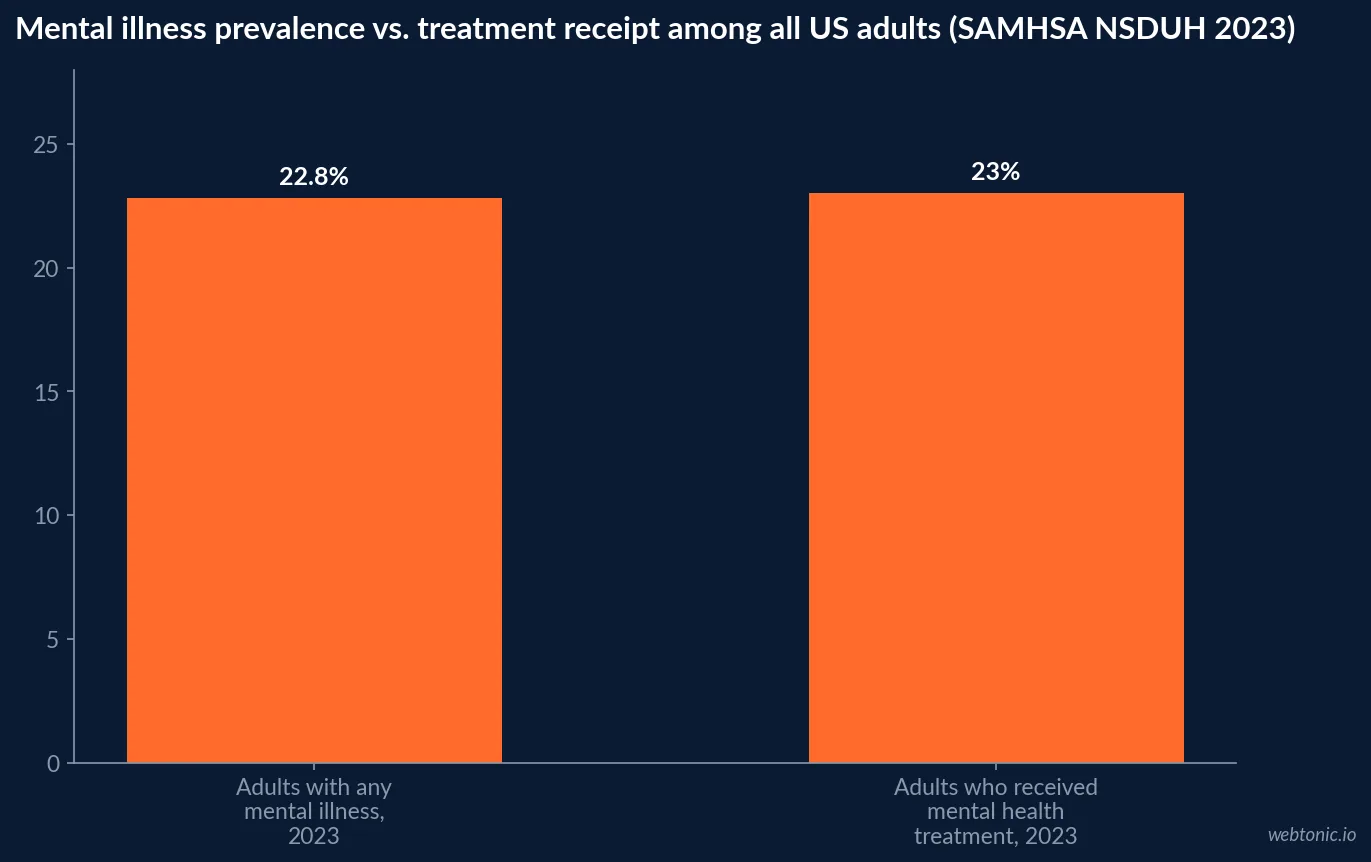
Per the 2023 National Survey on Drug Use and Health, 22.8% of adults (58.7 million people) had any mental illness (AMI) in the past year, and 5.7% (14.6 million) had a serious mental illness (SMI). Yet only 23.0% of all adults - not just those with a diagnosis - received any mental health treatment in the same period. That gap is the honest reason a "counseling SEO statistics" search exists at all: a large share of the population that needs care is not finding or reaching a provider, and organic search is frequently the first channel a person in that gap turns to.
| NSDUH 2023 metric | Adults 18+ | What it measures | Source |
|---|---|---|---|
| Any mental illness (AMI), past year | 22.8% (58.7M) | Diagnosable condition prevalence | SAMHSA NSDUH 2023 |
| Serious mental illness (SMI), past year | 5.7% (14.6M) | Most severe prevalence tier | SAMHSA NSDUH 2023 |
| Received any mental health treatment | 23.0% | Treatment receipt, all adults | SAMHSA NSDUH 2023 |
| Adults with AMI who used telehealth | 33.7% (19.7M) | Treatment channel among diagnosed adults | SAMHSA NSDUH 2023 |
| Took prescription medication (AMI subgroup) | 40.4% (23.7M) | Medication vs. talk therapy split | SAMHSA NSDUH 2023 |
Why the shortage makes accurate, local SEO content matter more, not less
KFF's tracker of federally designated shortage areas counts 6,807 Mental Health Care Health Professional Shortage Area (HPSA) designations, covering 137,133,953 people, where only 27.29% of the mental health workforce need is currently met - meaning 6,800 more practitioners would be needed to remove every designation nationally. In a market this supply-constrained, an SEO page that correctly tells a searcher whether a given practice is taking new clients, offers telehealth across state lines, or maintains a notification waitlist is doing real routing work - the opposite of a directory page that ranks well but sends every click to a practice with no capacity.
| Access-gap metric | Value | What it implies for SEO content | Source |
|---|---|---|---|
| Mental Health HPSA designations (US) | 6,807 | Most of the country has a documented gap somewhere | KFF State Health Facts |
| Population in designated shortage areas | 137,133,953 | A large share of any local audience is underserved | KFF State Health Facts |
| Percent of workforce need met | 27.29% | Ranking #1 does not create capacity that doesn't exist | KFF State Health Facts |
| Practitioners needed to remove all HPSAs | 6,800 | The gap is not closing through content alone | KFF State Health Facts |
What consumers say actually frustrates them, per SimplePractice's own data
A Dynata consumer survey conducted on behalf of SimplePractice's 2025 State of Private Practice report (1,000 consumers, alongside aggregated data from 245,000+ clinicians and a 2,200-clinician survey) found the top-ranked frustrations in navigating mental healthcare were knowing first steps (23%) and finding availability (19%) - not, notably, cost or stigma topping the list. Both are information problems a well-structured site addresses directly: a clear "what to expect in your first session" page and an accurate, regularly-updated availability status. The same report found more than 60% of clinicians have appointment availability within the next seven days and 80% are taking new clients - meaning the perception of scarcity outpaces the reality for a majority of practices, which is itself an argument for clear, current SEO content over assuming every search ends at a waitlist.
| Consumer frustration (SimplePractice/Dynata, 2025) | Share citing it | SEO content fix |
|---|---|---|
| Knowing first steps | 23% | Clear intake/what-to-expect page |
| Finding availability | 19% | Accurate, regularly-updated availability status |
| (Context) Clinicians with availability in 7 days | 60%+ | Content should not assume universal scarcity |
| (Context) Clinicians taking new clients | 80% | Most practices have room; content should say so clearly |
What a counseling SEO content plan should prioritize first
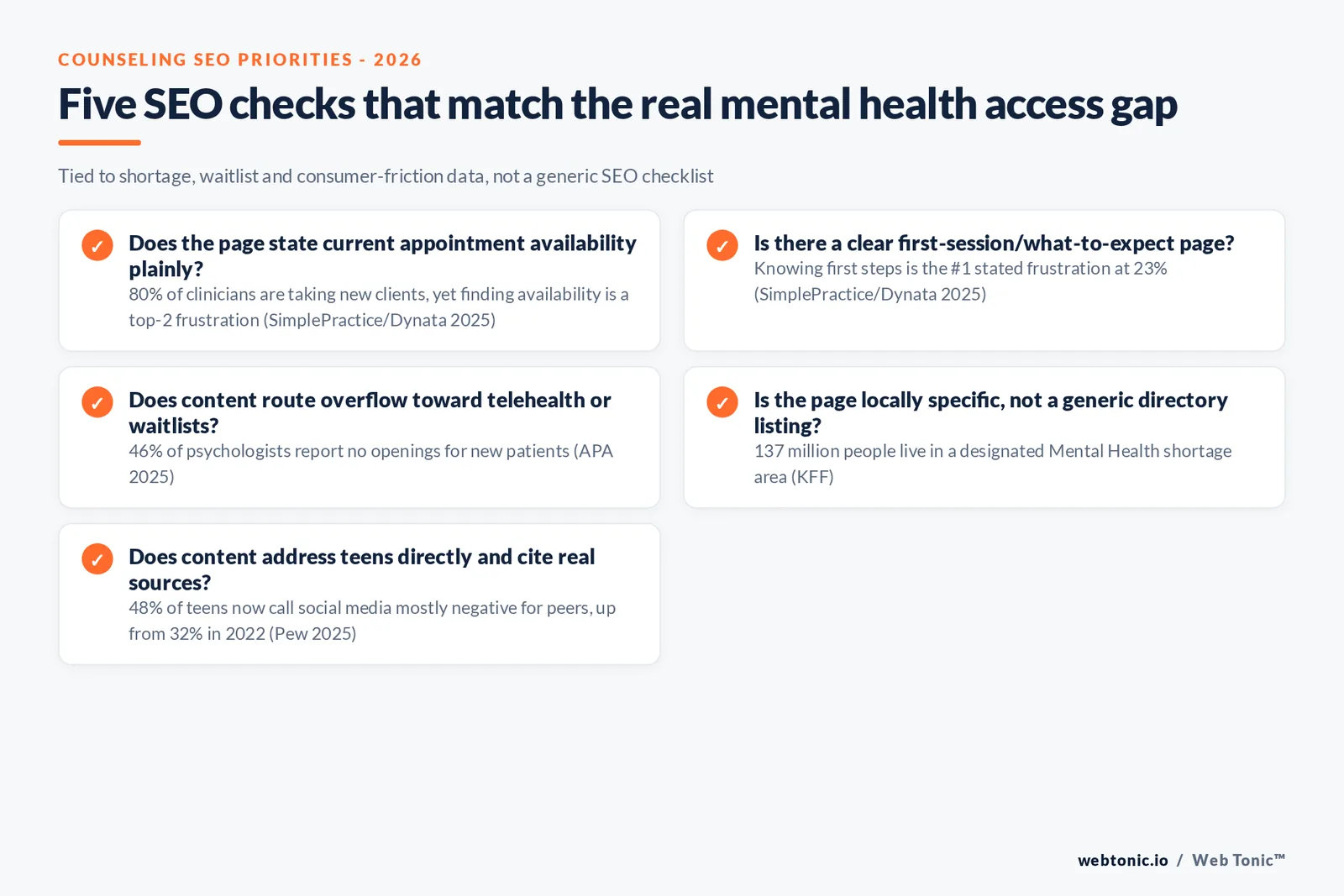
Given the access-and-information gap above, the highest-leverage content is not a generic "signs of depression" blog post competing against national publishers - it is the practice-level information a searcher cannot get anywhere else: current availability, telehealth licensure by state, insurance panels accepted, and what a first session actually involves. Our growth marketing team treats this as a content-priority exercise, not a keyword-volume exercise, precisely because the SimplePractice/Dynata data shows the friction is informational, not purely about search demand.
| Content priority | Why (supporting data) | SEO format |
|---|---|---|
| Current availability status | Finding availability is a top-2 consumer frustration (19%) | Structured data + a visibly updated status block |
| "What to expect" first-session page | Knowing first steps is the #1 frustration (23%) | Long-form, FAQ-schema page |
| Telehealth/state-licensure page | 33.7% of adults with AMI already use telehealth | Location/state-specific landing pages |
| Insurance-panel and self-pay rate transparency | $40 gap between self-pay ($139.75) and insurance ($99.75) rates, SimplePractice 2025 | Clear pricing/insurance page |
The waitlist reality SEO cannot solve alone
Even a well-optimized page runs into real capacity limits. APA's 2025 Practitioner Pulse Survey found 46% of psychologists report no openings for new patients and 40% maintain a waitlist; among psychologists without one, 22% say they lack the capacity to manage a waitlist at all. The more encouraging counterpoint: 87% of providers now say they can see new patients within three months, an improving trend since 2021, and SimplePractice's own aggregated data shows the supply side stabilizing further - 88% of clinicians on its platform report strong intent to stay in the field through 2026, and the share of insurance-based sessions rose from 56% to 59% between 2024 and 2025. The honest SEO strategy is not to promise instant access, but to route overflow demand toward telehealth, group-practice capacity, or a transparent notification waitlist - and to measure success partly by how well a page sets that expectation, not only by rank.
Practically, that means building an SEO content calendar around three tiers: pages that answer "can you see me now" honestly, pages that route a searcher to the right level of care (self-help resources, group practice, or crisis lines) when the answer is no, and evergreen educational content that builds topical authority for when capacity does open up. Compare that funnel thinking against our cost-per-lead data by industry if you are weighing SEO against paid channels for this vertical, and talk to us about a content plan built around actual capacity, not just volume.
Frequently Asked Questions
Is counseling SEO actually worth the investment given how few clinicians have capacity?
The data argues yes, but for a specific reason: SEO is not primarily a demand-generation problem in this vertical, it is an information problem. SAMHSA's 2023 NSDUH found 22.8% of adults (58.7 million people) had any mental illness in the past year, and only 23.0% of all adults received any mental health treatment - a gap SimplePractice's 2025 consumer survey traces partly to friction, not capacity: the top-ranked frustrations were knowing first steps (23% of respondents) and finding availability (19%). A well-structured, accurate practice site addresses exactly those two frictions, independent of whether a given practice has an opening today.
How big is the mental health provider shortage that SEO content has to work around?
Large and geographically concentrated. KFF's HPSA tracker shows 6,807 federally designated Mental Health Care Health Professional Shortage Areas, covering 137,133,953 people, where only 27.29% of the mental health workforce need is currently met. HRSA's own 2025 workforce brief separately estimates that roughly 40% of the US population lives in a Mental Health HPSA. SEO content cannot manufacture clinicians, but accurate, locally-specific pages can correctly route a searcher toward the nearest actual capacity, telehealth options, or a waitlist - rather than a generic national directory listing.
What does the data say about waitlists and whether SEO traffic even converts to appointments?
APA's 2025 Practitioner Pulse Survey found 46% of psychologists report no openings for new patients and 40% maintain a waitlist - among those without a waitlist, 22% say they lack the capacity to manage one at all. That means a meaningful share of SEO-driven traffic to an individual practice site will hit a wall regardless of ranking. The honest framing for a counseling SEO program is to route overflow demand toward telehealth, group practice capacity, or a waitlist-with-notification flow, rather than promise the ranking alone solves access.
Do teenagers actually search for mental health information, or do they rely on social media instead?
Both, and unevenly. Pew Research's 2025 survey found roughly a third of teens say they at least sometimes get mental health information on social media, and of those, 63% call it an important or the most important source. At the same time, 48% of teens now say social media has a mostly negative effect on people their age, up from 32% in 2022 - a rising skepticism that argues for authoritative, cited SEO content as a credible alternative source, not a replacement for social platforms teens already use.
What is the strongest evidence that mental health practices are growing despite the shortage?
SimplePractice's 2025 State of Private Practice report, drawn from data on over 245,000 clinicians and a survey of 2,200, found 88% of clinicians report strong intent to stay in the field through 2026, and the share of insurance-based sessions rose from 56% to 59% between 2024 and 2025 - both signs of a stabilizing, not shrinking, supply side. That is a more optimistic read than the raw shortage numbers alone suggest, and it argues SEO content built now compounds against a workforce that is holding steady rather than one in continued decline.
Sources
SAMHSA - 2023 National Survey on Drug Use and Health, key indicators
KFF State Health Facts - Mental Health Care HPSA designations
American Psychological Association - 2025 Practitioner Pulse Survey
SimplePractice - 2025 State of Private Practice Report (press release)
Pew Research Center - 10 facts about teens and social media, 2025