



Table of contents
Key Takeaways
Local search drives 29.4% of all healthcare leads in 2026, making Google Business Profile the single largest patient acquisition channel for health and wellness practices. Healthcare practices with consistent NAP data are 40% more likely to appear in the local pack. Meanwhile, AI assistant referrals grew 55.10% year-over-year, signaling a new discovery channel that rewards structured local data. With 28% of local searches resulting in a purchase and healthcare converting at 3.2% from local search traffic, local SEO delivers measurable ROI that outpaces most paid channels for wellness businesses.
Health & Wellness Local SEO at a Glance
| Metric | Value | Source |
|---|---|---|
| GBP share of healthcare leads | 29.4% (▲ 6.95% YoY) | Direction.com (102K leads) |
| Local search conversion rate | 3.2% avg across healthcare | SEO Design Chicago |
| NAP consistency lift | 40% more likely to reach local pack | Repugen |
| AI assistant lead growth | 55.10% YoY increase | Direction.com |
| Local searches → purchase | 28% | Google / SEO Design Chicago |
| Organic search traffic share | 42–68% of category traffic | AuthoritySpecialist (34 retailers) |
| Map Pack CTR (position 1) | 25–35% avg CTR | AuthoritySpecialist |
| Organic SEO CPL vs paid | $40–$90 vs $120–$200+ | FoundryCRO |
Google Business Profile Performance for Healthcare
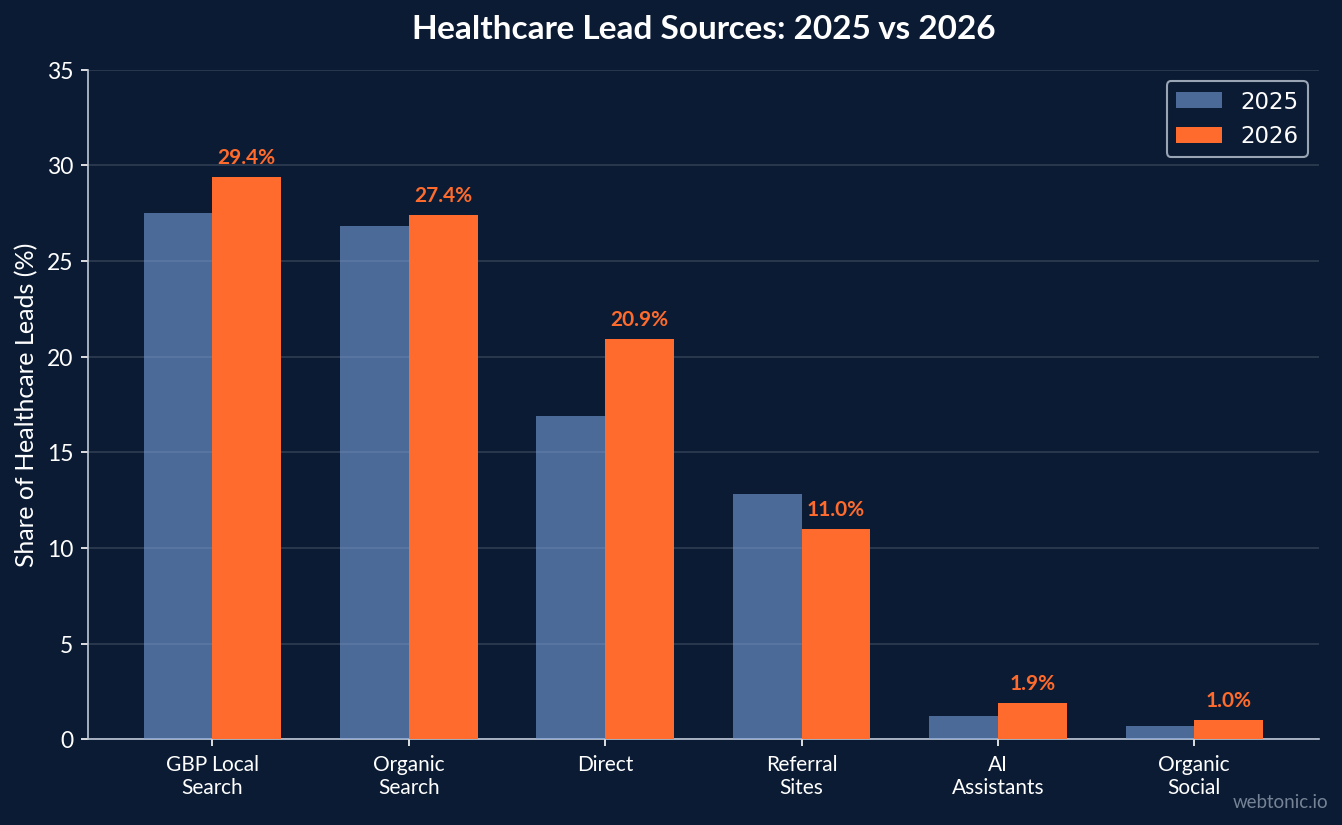
Google Business Profile (GBP) has cemented itself as the primary local discovery channel for health and wellness businesses. Direction.com's 2026 study of 102,392 healthcare leads found that GBP local search accounts for 29.4% of all leads, up from 27.5% in 2025 — a 6.95% year-over-year increase. Direct traffic contributed 20.9%, organic search 27.4%, and referral sites 11.0%.
The study also revealed that AI assistants now generate 1.9% of healthcare leads, up from 1.2% — a 55.10% year-over-year surge. While the absolute share remains modest, AI-powered search tools like Google AI Overviews and ChatGPT increasingly pull from structured GBP data when recommending local providers.
SearchLab's 2026 GBP statistics show wide variation in profile engagement by industry, with healthcare and wellness practices receiving substantial monthly views and review volumes that directly influence digital marketing performance. Practices that maintain complete GBP profiles with updated hours, photos, and service descriptions outperform those with sparse listings on virtually every engagement metric.
Local Search Conversion Rates & Patient Acquisition
SEO Design Chicago's 6-month analysis across 10 industries reports that healthcare achieves a 3.2% average conversion rate from local search traffic. The top ranking factors driving these conversions include primary GBP category accuracy, review quantity and recency, and proximity to the searcher's location.
Google reports that roughly 28% of local searches result in a purchase, and healthcare is consistently cited as one of the highest local-intent categories. AuthoritySpecialist's 2026 physician benchmarks confirm that Google triggers a local 3-Pack for the majority of healthcare queries that include location modifiers, with position 1 capturing an estimated 25–35% CTR and positions 2–3 receiving approximately 10–20%.
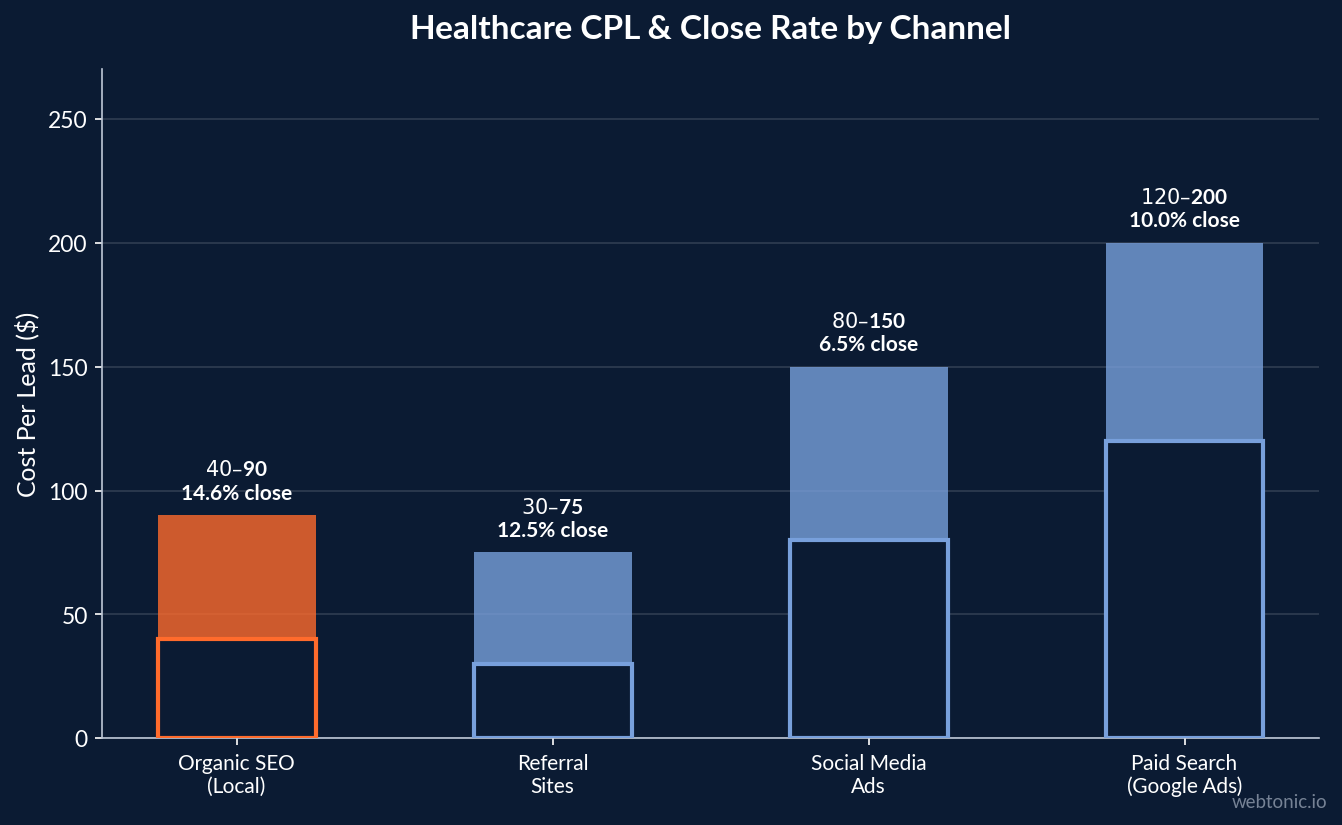
FoundryCRO's specialty-level benchmarks show that organic SEO delivers a $40–$90 cost per lead with a 14.6% close rate, compared to $120–$200+ for paid search. The trade-off: organic SEO requires 6–12 months to build volume, while Google Ads can drive leads immediately. For practices planning long-term, the local SEO investment pays compounding returns that paid channels cannot match.
NAP Consistency & Citation Management
Name, address, and phone number (NAP) consistency across directories remains a foundational local SEO signal for healthcare marketers. Repugen's healthcare analysis found that practices with consistent NAP data across primary citation sources are 40% more likely to appear in the local pack. The study also highlights that AI-powered search experiences rely on consistent structured data to recommend providers confidently.
In a consumer survey by Repugen, 67.58% of respondents said NAP inconsistency reduces their trust in a healthcare provider. For multi-location wellness businesses, maintaining citation accuracy across platforms like Healthgrades, Zocdoc, WebMD provider listings, and Google is operationally complex but directly impacts both search visibility and landing page conversion rates.
AuthoritySpecialist's medical practice benchmarks confirm that local citation consistency across directories and health-specific platforms directly contributes to website authority signals, alongside location-specific backlinks and community mentions. Practices investing in systematic citation management see measurable gains within 3–6 months of cleanup.
Reviews & Reputation Impact on Local Rankings
Reviews function as both a ranking signal and a conversion driver for health and wellness practices. AuthoritySpecialist's 2026 data shows that practices ranking in the Google Map Pack have significantly more reviews than those outside it, though the threshold varies by market competitiveness. Critically, review velocity — earning consistent new reviews — matters more than total count alone for sustained rankings.
Therapist-specific benchmarks reveal that condition-specific landing pages generate significantly higher organic inquiry rates than consolidated services pages, with the gap widening in markets where competition is moderate. For mental health practices, coupling condition-focused pages with steady review generation creates a compounding local visibility advantage.
SearchLab's cross-industry GBP data shows that healthcare providers' review volumes and average ratings directly correlate with profile views, click-through rates, and growth marketing effectiveness. Practices averaging above 4.5 stars with 50+ reviews consistently outperform those below these thresholds in local pack appearances.
Map Pack & Local Pack Performance Benchmarks
| Position | Estimated CTR | Key Factor |
|---|---|---|
| Map Pack #1 | 25–35% | Proximity + reviews + GBP completeness |
| Map Pack #2–3 | 10–20% | Category relevance + review velocity |
| Below Map Pack | < 5% | Largely invisible to searchers |
| Organic #1 (below pack) | 15–22% | Content depth + E-E-A-T signals |
AuthoritySpecialist's physician benchmarks emphasize that positions below the Map Pack are "largely invisible" to patients. The steep drop-off means that local SEO for wellness practices is not a gradual ranking game — it is a binary outcome. You are either in the pack or functionally absent from the patient's decision flow.
For link building efforts, local backlinks from community organizations, health directories, and local news outlets carry disproportionate weight for map pack rankings compared to generic domain authority signals. Practices that partner with local events, sponsor community health initiatives, and contribute to local publications build the location-specific authority signals Google prioritizes. The data from AuthoritySpecialist's spa benchmarks across 34 multi-location wellness businesses confirms this pattern — local search via Google Maps and the 3-pack is the primary discovery channel for most wellness services, and location-specific authority determines which practices appear.
Mental Health & Telehealth Local Search Trends
The intersection of telehealth and local search creates a unique optimization challenge for wellness marketers. AuthoritySpecialist's therapist benchmarks note that "online therapist" queries have risen substantially since 2020, but for practices offering in-person sessions, local intent searches remain the dominant acquisition channel.
Mental health practices face a dual optimization need: ranking locally for in-person therapy queries while capturing the growing "online therapy" segment. Practices that create dedicated pages for each modality — with distinct local schema and service-area targeting — outperform those using a single combined page.
CuFinder's medical practice benchmarks report an average website conversion rate of 3.6% and a PPC landing page conversion rate of 6.1%, with call-only ads reaching 12.5%. For mental health practices, click-to-call conversions from local search tend to be higher than form fills, reflecting the urgency and sensitivity of mental healthcare decisions. Integrating analytics tracking across all conversion paths is essential for accurate ROI measurement.
Cost Per Lead: Local SEO vs. Paid Channels
| Channel | CPL Range | Close Rate | Time to Volume |
|---|---|---|---|
| Organic SEO (local) | $40–$90 | 14.6% | 6–12 months |
| Paid Search (Google Ads) | $120–$200+ | 8–12% | Immediate |
| Social Media Ads | $80–$150 | 5–8% | 1–3 months |
| Referral Sites | $30–$75 | 10–15% | Ongoing |
FoundryCRO's data makes the case for local SEO as the most cost-efficient channel for healthcare practitioners. While organic SEO's $40–$90 CPL is 2–3× cheaper than paid search, the 14.6% close rate also outpaces paid channels. The trade-off is time: local SEO requires consistent investment over 6–12 months before reaching volume, while Facebook Ads and Google Ads can fill the pipeline immediately during the ramp-up period.
For wellness businesses combining local SEO with paid channels, Direction.com's data suggests that organic search (27.4%) and local search (29.4%) together account for nearly 57% of healthcare leads — validating a strategy that prioritizes GBP optimization alongside data intelligence to track channel attribution accurately.
E-E-A-T & YMYL Compliance for Local Wellness Sites
Health and wellness sits firmly in Google's Your Money or Your Life (YMYL) category, where E-E-A-T (Experience, Expertise, Authoritativeness, Trustworthiness) signals carry outsized weight in local search rankings. Reactll's 2026 analysis found that healthcare websites without structured E-E-A-T content saw up to 40% lower visibility following Google's 2024–2025 Helpful Content updates.
AuthoritySpecialist confirms that the gap between practices with structured E-E-A-T content — author bios with credentials, cited sources, clinical disclaimers — and those without has "widened measurably" since 2024. For local wellness businesses, this means that even a perfectly optimized GBP profile underperforms if the linked website lacks E-E-A-T signals that reassure both Google and patients. The practical implication: every location page needs a credentialed practitioner's name, a detailed bio, and verifiable credentials visible above the fold. Generic "our team" pages without individual practitioner profiles fail to satisfy Google's YMYL quality requirements.
Zipdo's healthcare marketing statistics report that content marketing generates 3× more leads than traditional methods at 62% less cost in healthcare, and SEO provides 14.6% of ROI attribution in healthcare funnels. Combining E-E-A-T-compliant content with local optimization creates the strongest foundation for sustainable performance creative and organic growth in the competitive health and wellness landscape.
FAQ
What percentage of healthcare leads come from local search?
According to Direction.com's study of 102,392 healthcare leads, Google Business Profile local search accounts for 29.4% of all healthcare leads in 2026, up 6.95% year-over-year, making it the single largest patient acquisition channel.
How does NAP consistency affect local search rankings for healthcare?
Healthcare practices with consistent NAP (name, address, phone) data across primary citation sources are 40% more likely to appear in the local pack, according to Repugen. Inconsistencies confuse both search engines and AI-powered search tools.
What is the average local search conversion rate for healthcare?
Healthcare practices see a 3.2% average conversion rate from local search traffic, according to SEO Design Chicago's 6-month analysis across 10 industries. Top-performing practices with optimized Google Business Profiles can exceed 5%.
How many reviews do healthcare practices need to rank in the map pack?
AuthoritySpecialist's 2026 benchmark data shows that practices ranking in the Google Map Pack tend to have significantly more reviews than those just outside it. Review velocity (consistent new reviews) matters more than total count alone.
How does AI search affect healthcare local SEO?
AI assistant referrals to healthcare providers grew 55.10% year-over-year in 2026, rising from 1.2% to 1.9% of total leads. AI-powered search tools increasingly rely on structured local data like Google Business Profiles and consistent NAP citations.
Sources
direction.com/healthcare-lead-sources-study
seodesignchicago.com — local SEO performance across 10 industries
authorityspecialist.com — doctor SEO benchmarks 2026
authorityspecialist.com — therapist SEO benchmarks 2026
authorityspecialist.com — medical practice SEO benchmarks
foundrycro.com — healthcare CAC by specialty
repugen.com — NAP inconsistency in healthcare
searchlab.nl — GBP statistics 2026
reactll.com — E-E-A-T for medical websites
cufinder.io — medical practice benchmarks 2026
zipdo.co — healthcare marketing statistics
authorityspecialist.com — H&W store SEO statistics


