



Table of contents
Key Takeaways
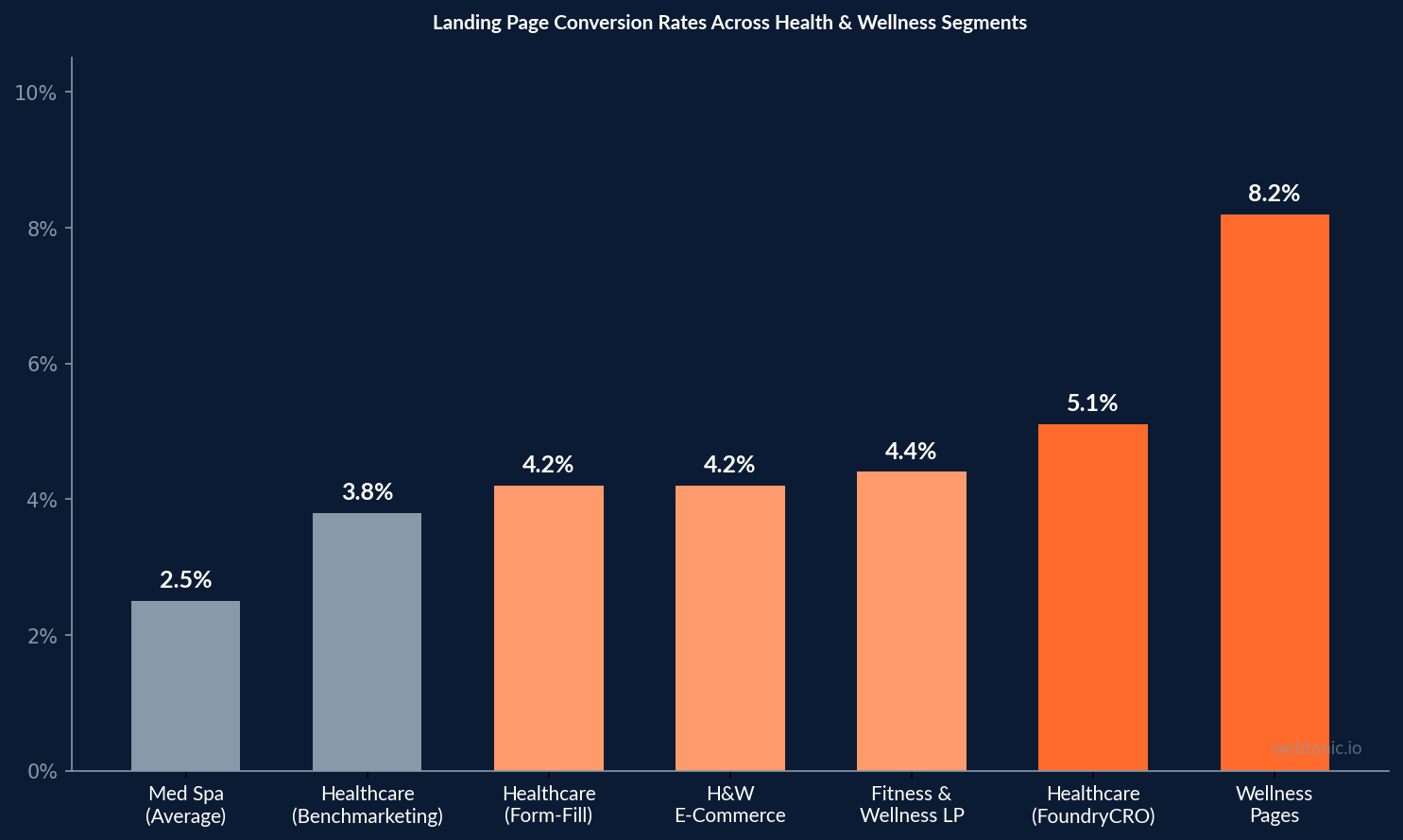
Landing pages are the conversion engine for every health-and-wellness marketing campaign, yet most practices and brands leave dramatic revenue on the table with unoptimized pages. The median healthcare landing page converts at 5.1%, but top performers reach 21.1%—a four-times gap that represents the single biggest optimization opportunity in the sector. Meanwhile, wellness-specific pages achieve an 8.2% median conversion rate, outperforming nearly every other industry. Here are the benchmarks, speed data, and testing insights that separate high-converting health pages from average ones.
Landing Page Conversion Rate Benchmarks at a Glance
| Segment | Median CVR | Top Performers | Source |
|---|---|---|---|
| Healthcare (All) | 5.1% | 21.1% | FoundryCRO |
| Wellness Pages | 8.2% | — | Unbounce |
| Healthcare (Benchmarketing) | 3.80% | — | Benchmarketing |
| Healthcare (Form-Fill) | 4.2% | — | CorePPC |
| Fitness & Wellness (LP) | 4.4% | 5.8% | CuFinder |
| Med Spa (Average) | 2–3% | 8–12% | AesthetixMedia |
| H&W E-Commerce | 4.2% | — | WebMedic |
The Conversion Gap in Healthcare
The difference between average and top-performing healthcare landing pages is not marginal—it is transformational for patient acquisition costs and growth marketing ROI.
- Healthcare landing pages convert at 5.1% median, but top performers hit 21.1%—a 4× gap that represents the single biggest optimization opportunity for any practice spending on ads (FoundryCRO).
- Wellness-category pages boast an 8.2% median conversion rate, outperforming nearly every other industry tracked by Unbounce's benchmark report (Unbounce).
- The average med spa website converts 2–3% of visitors into booked appointments, while top-performing sites convert at 8–12%. On 5,000 monthly visitors, that gap is worth an estimated $150,000 or more in monthly revenue (AesthetixMedia).
- Health-and-wellness e-commerce sites average a 4.2% conversion rate, compared to 2.5–3.0% globally across all industries and just 0.8% for furniture (WebMedic).
Conversion Rates by Traffic Source
Not all traffic converts equally on health and wellness landing pages. Channel selection and landing page–ad alignment drive significant variance.
- Google traffic converts at a 4.7% median for healthcare landing pages, significantly outperforming Bing at 2.8% (Unbounce).
- Email traffic converts 2× more than paid channels for healthcare and wellness pages, making it the highest-converting source in the vertical (Unbounce).
- Mobile drives 7× more traffic than desktop to health landing pages, but desktop converts 22% better—a friction gap that underscores the need for mobile-specific optimization (Unbounce).
- Fitness-and-wellness landing pages from paid search convert at 4.4% on average, while the top 10% of performers reach 5.8% (CuFinder).
Page Speed and Core Web Vitals
Speed is both a ranking signal and a direct conversion lever. Healthcare websites consistently underperform on Core Web Vitals, creating an opportunity for brands that invest in performance-focused assets.
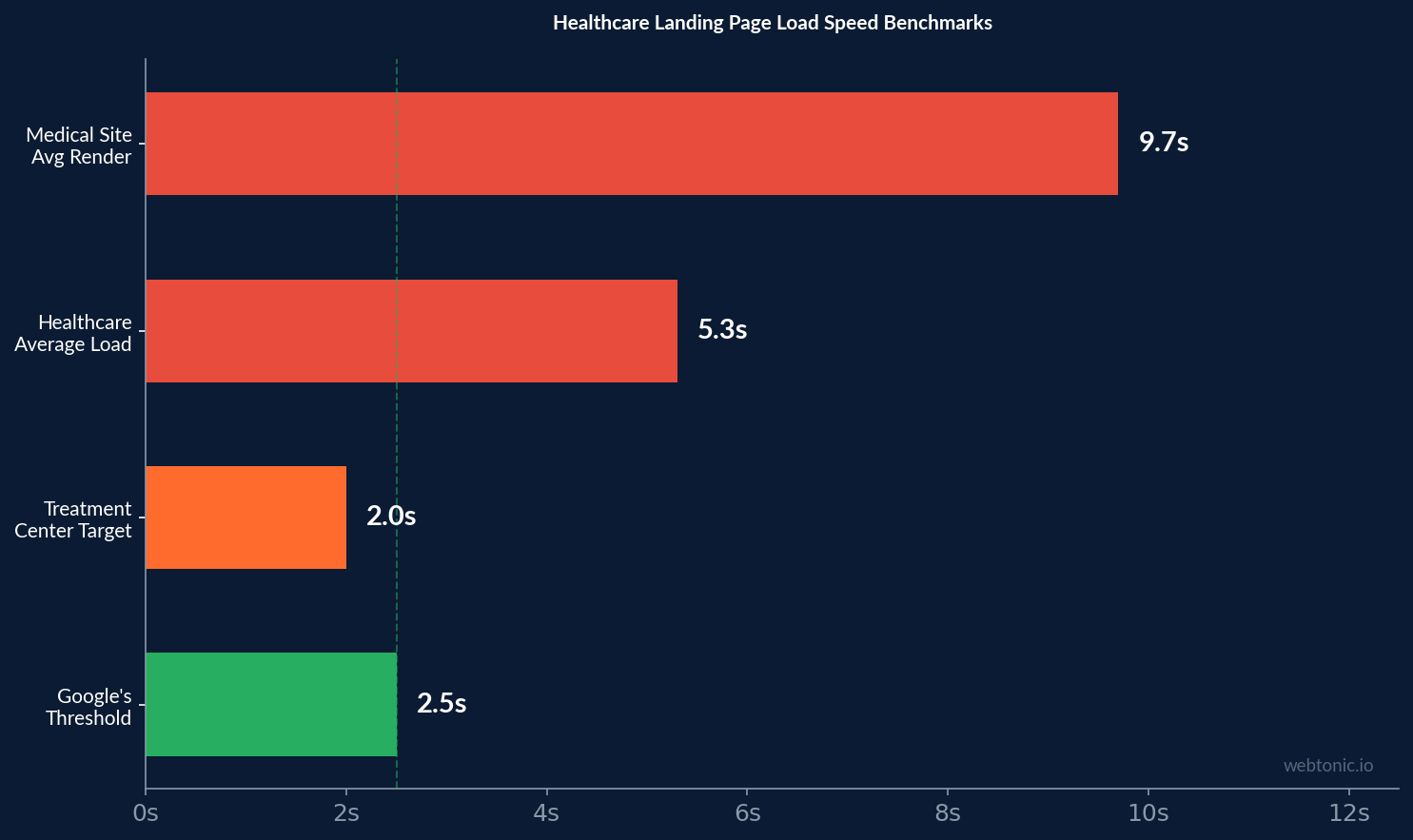
- Healthcare websites have an average load time of 5.3 seconds, more than double Google's recommended threshold (Zipdo).
- The average general medical website takes 9.7 seconds to render its main content—7.2 seconds over Google's passing threshold (Borah Labs).
- 66.5% of local medical practices pass Core Web Vitals on mobile, well ahead of large hospital systems and insurers, which tend to run heavier, more complex sites (PageSpeedMatters).
- The realistic LCP target for treatment-center sites is 1.8 to 2.2 seconds at the 75th percentile on mobile. Hitting the 2.5-second threshold is the minimum; hitting 1.8 seconds produces materially better user experience and ranking signals (Webserv).
A/B Testing and Optimization Case Studies
Testing is where the largest conversion gains occur. Even small changes to hero sections, trust signals, and CTAs produce outsized lifts in health and wellness.
- A wellness brand turned a 0.59% conversion rate into +935% revenue growth by running four A/B test variations over 21 days—testing trust badges, video testimonials, stats-led heroes, and benefit-led heroes (Inks Studio).
- A D2C wellness brand reduced CPL by 63% and grew revenue 2.4× by redesigning its landing pages, improving conversion rate from 1.9% to 4.6% (Technorhythms).
- Med spa sites with 4–12 patient before-and-after photos on treatment landing pages report the highest conversion rates in the aesthetic category—this is the single highest-converting element for most treatment pages (AestheticPatientAcquisition).
- Healthcare practice websites scoring above 52 on roast.page's audit are ahead of most competitors—the healthcare average is 44 and the top quartile starts at 59 (Roast.page).
- Reducing landing page load time from 5.3 to 2.0 seconds recovers an estimated 15–25% of lost conversions in health verticals, where patients abandon slow pages at higher rates than in retail or SaaS due to urgency-driven intent.
- Formstack's healthcare form usability analysis gives the industry an average score of 44 out of 100, with the top quartile starting at 59—indicating massive room for improvement in form design and user experience (Roast.page).
- Service-specific landing pages convert 2–4× better than generic "all services" pages because they match the patient's search intent exactly and reduce cognitive load during the decision-making process.
- High-performing health landing pages use personalized CTAs that convert 202% better than generic ones, and reducing form fields from 11 to 4 can increase conversions by 120% (Leadpages).
Form Design and Lead Capture Benchmarks
Form friction is the silent conversion killer in healthcare, where patients weigh privacy concerns against convenience.
| Form Factor | Benchmark | Impact |
|---|---|---|
| Optimal Field Count | 3–5 fields | Reducing fields from 11 to 4 lifts CVR by up to 120% |
| Healthcare Form-Fill CVR | 4.2% | Lower-friction than purchases, higher than B2B SaaS |
| Home Services (Comparison) | 8.5% median | Highest form-fill CVR across all industries |
| Pages per Session (Top) | 5.2 | Top med spa sites double the average of 2.1 |
| Online Booking vs Phone | Online preferred | Frictionless online booking lifts CVR significantly |
Mobile vs. Desktop Performance
The device split for health-and-wellness landing pages creates both the largest traffic opportunity and the most critical optimization challenge.
- Mobile generates 7× more traffic than desktop to healthcare landing pages, making mobile-first design a necessity rather than an option (Unbounce).
- Desktop converts 22% better than mobile for health and wellness pages, driven by easier form completion and higher trust during sensitive health decisions (Unbounce).
- Health-and-wellness Shopify stores average 3.4% conversion rate with a top-performer threshold of 5.5%, though visitors arriving from trusted health influencers convert at even higher rates because they arrive with pre-built purchase intent (EasyAppsEcom).
- The global average e-commerce conversion rate is 2.5–3.0%, but health-and-wellness at 4.2% dramatically outperforms, with desktop at 3.6% and mobile at 2.0% globally (WebMedic).
- Wellness app trial-to-paid conversion rates sit at 2–5% baseline but can reach 15%+ with optimized onboarding, and a single well-placed testimonial from a relatable user can meaningfully move paywall conversion (LifecycleArchitect).
Healthcare CAC and Revenue Impact
Landing page optimization directly impacts customer acquisition cost, which varies enormously by specialty and geography.
- Healthcare customer acquisition cost ranges from $155 to $2,500 depending on specialty, with landing page conversion rate being the single largest driver of CAC variance across practices (FoundryCRO).
- Benchmarketing's 2026 healthcare dataset reports a 3.80% landing page conversion rate, based on verified benchmark data traced to specific statistical sources (Benchmarketing).
- Health-and-wellness landing pages from Meta Ads and Google Ads perform best when the landing page mirrors the ad's primary claim—specificity in headline, image, and CTA alignment is the strongest predictor of conversion in health verticals.
- LeadsuiteNow reports healthcare form-fill conversion at approximately 4.2%, positioning it between home services (6.84%) and education (3.39%) for lead generation efficiency (LeadsuiteNow).
Best Practices for Health & Wellness Landing Pages
Data from hundreds of healthcare and wellness landing pages reveals a clear playbook for conversion optimization. These practices apply whether you run a Google Ads campaign, an organic funnel, or a paid social strategy.
- Lead with social proof. Patient before-and-after galleries, video testimonials, and review counts are the highest-converting elements on treatment pages.
- Minimize form fields. Ask only for name, email, phone, and preferred time. Every extra field measurably depresses conversion rates in health verticals.
- Target sub-2-second LCP. Most healthcare sites load in 5–10 seconds. Hitting 1.8 seconds puts you ahead of 80%+ of competitors.
- Run mobile-first A/B tests. Mobile drives 7× the traffic but converts 22% worse—test mobile layouts, thumb-friendly CTAs, and simplified forms independently.
- Segment landing pages by treatment or service. Specific pages convert 2–4× better than generic "all services" pages because they match search intent exactly.
- Add trust badges above the fold. HIPAA compliance, board certifications, and patient count indicators reduce anxiety and improve conversion in health verticals.
Health & Wellness Landing Pages vs. Other Industries
Health and wellness landing pages outperform most industries on conversion rate, though they trail sectors with lower consideration thresholds like home services.
| Industry | Median LP CVR | Top Quartile |
|---|---|---|
| Home Services | 8.5% | 14%+ |
| Wellness / Health | 5.1–8.2% | 21.1% |
| Financial Services | 5.10% | 11%+ |
| Legal | 5.6% | — |
| B2B SaaS | 2.92% | 6%+ |
| E-Commerce / D2C | 1.91% | 4%+ |
High-Converting Landing Page Elements
The best health-and-wellness landing pages share common elements that drive high-converting outcomes. Whether promoting health fitness business memberships, health wellness products, or clinical services, these data-driven patterns separate top performers from the average.
- Strong CTAs above the fold are the single most impactful element—fitness landing page examples with a clean, single-action CTA convert 2–3× better than pages with multiple competing calls to action.
- Social proof placement directly influences conversion rates—patient reviews, star ratings, and "X patients treated" counters positioned near CTAs increase trust and reduce decision friction.
- Data-driven personalization lifts conversion by 10–25%—landing pages that adapt headlines, images, or offers based on the visitor's search query or referral source outperform static pages consistently.
- Brand consistency between ad and landing page improves Quality Score and conversion—matching the ad's headline, imagery, and offer on the landing page signals relevance to both Google and the visitor.
- Clean page layouts with minimal navigation outperform complex designs—the best landing page examples in health and wellness remove site-wide navigation to eliminate exit paths and focus the visitor on one desired outcome.
- Trust indicators specific to healthcare drive outsized impact—HIPAA badges, board certifications, insurance logos, and patient outcome data reduce the anxiety inherent in health-related purchase decisions.
Related reading
- Mental health landing page CRO statistics, 2026
- Inside Beauty & Skincare Landing Pages & CRO: Key Statistics & Insights for 2026
- 2026 Construction Materials Landing Pages & CRO Report: Trends, Stats & Performance Data
- Landing Page Design services at Web Tonic
Frequently Asked Questions
What is the average landing page conversion rate for health and wellness?
The median landing page conversion rate for healthcare is 5.1% according to FoundryCRO, while Unbounce reports wellness-specific pages at an 8.2% median. Top performers in healthcare reach as high as 21.1%, creating a massive optimization opportunity for practices still running generic pages.
How fast should a healthcare landing page load?
Healthcare landing pages should target a Largest Contentful Paint (LCP) of 1.8–2.2 seconds on mobile. The industry average is 5.3–9.7 seconds, meaning most healthcare sites are significantly slower than both Google's threshold and their competitors in other verticals.
Does A/B testing really work for wellness landing pages?
Yes. Case studies show A/B testing on wellness landing pages producing gains from +142% to +935% in revenue. High-impact test variables include hero section layout, trust signals (reviews, certifications), video testimonials, and form field count.
What is the best traffic source for healthcare landing page conversions?
Email traffic converts 2× more than paid channels for healthcare and wellness landing pages. Among paid sources, Google outperforms Bing (4.7% vs 2.8% median CVR). However, mobile drives 7× the traffic volume, so mobile optimization is critical for overall conversion volume.
How many form fields should a health landing page have?
Best-practice research shows 3–5 form fields for optimal healthcare landing page conversions. Reducing fields from 11 to 4 can increase conversions by up to 120%. Ask only for name, email, phone, and preferred appointment time.
Sources
foundrycro.com — Healthcare Marketing Benchmarks
unbounce.com — Healthcare Wellness Conversion Rate
cufinder.io — Fitness and Wellness Benchmarks
coreppc.com — LP Conversion Rate Benchmarks 2026
aesthetixmedia.com — Med Spa Website Design
pagespeedmatters.com — Healthcare Website Speed
borahlabs.us — General Medical Benchmarks
inks.studio — Wellness Brand Case Study
technorhythms.com — D2C Wellness CPL Case Study
webmedic.com — Ecommerce Conversion Rates


