



Table of contents
Key Takeaways
The most important health and wellness analytics statistics defining data-driven strategy in 2026:
- The global digital health market is projected at $420–$492 billion in 2026, with every institutional source projecting double-digit annual growth through at least 2030.
- The global wellness economy reached $6.8 trillion in 2024 — doubling in size since 2013, according to the Global Wellness Institute.
- Wellness technology market is valued at $57.1 billion in 2025, projected to reach $208.36 billion by 2035 at a 13.82% CAGR.
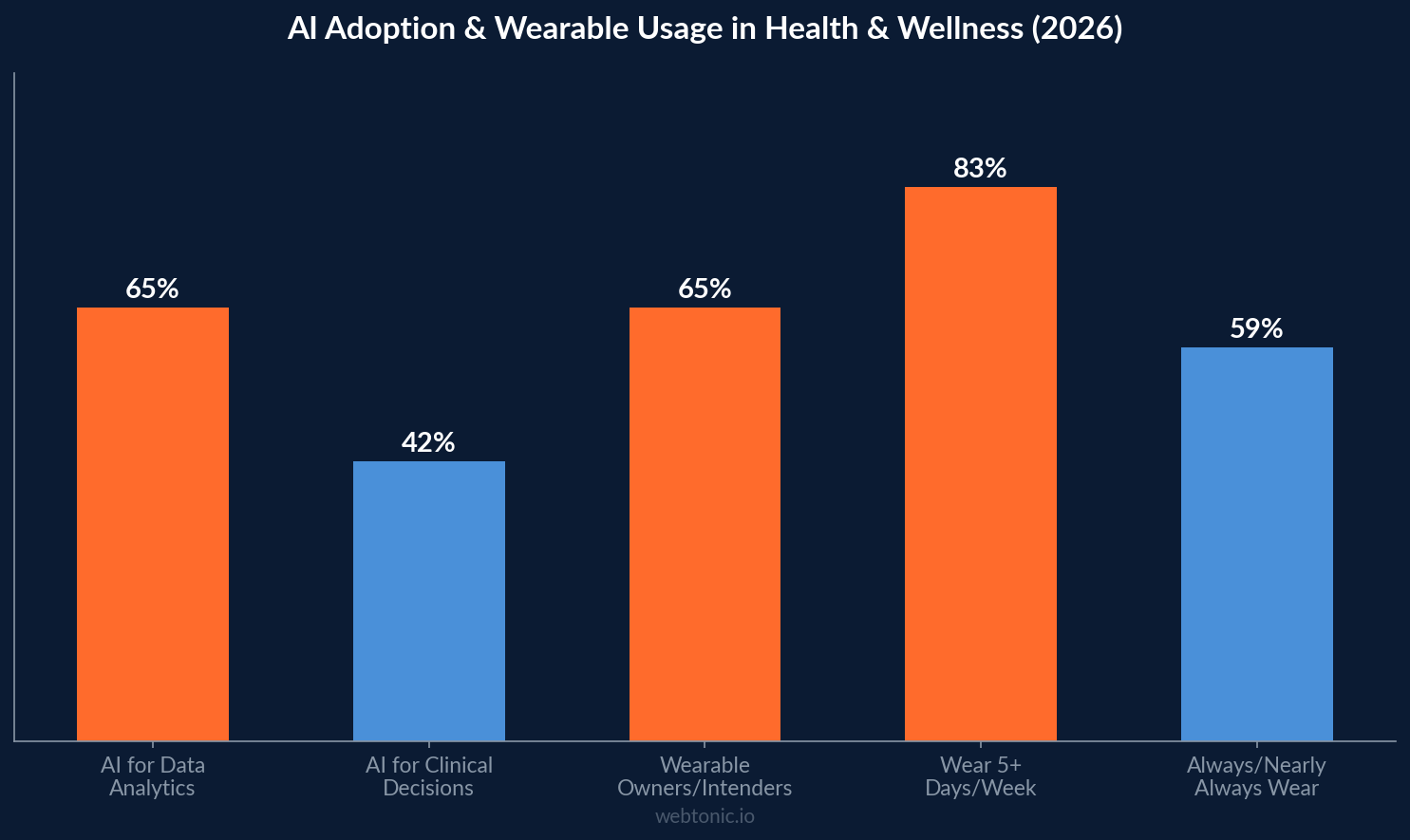
- 65% of healthcare organizations use AI for data analytics and data science, according to NVIDIA's 2026 State of AI in Healthcare report.
- 83% of wearable users wear their devices five or more days per week, with 59% wearing them always or nearly always.
- The healthcare predictive analytics market is expected to grow from $20.31 billion in 2025 to $86.62 billion by 2031 at a 27.35% CAGR.
- Beacon CAPI deployment typically reduces cost per qualified lead by 30–45% within 4–8 weeks — without changing ad creative or targeting.
- The digital health tracking apps market grew to $33.33 billion in 2026 at a 17.1% compound annual growth rate.
Digital Health Market Size and Growth Trajectory
The digital health industry continues its explosive expansion in 2026. According to Axis Intelligence's comprehensive digital health data compilation, the global digital health market is projected between $420 billion and $492 billion for 2026, with every institutional source projecting double-digit annual growth through at least 2030.
The broader wellness economy provides additional context: the Global Wellness Institute's 2025 monitor reports that the global wellness economy grew 7.9% from 2023–2024 and reached $6.8 trillion — having doubled since 2013. By 2029, the GWI projects wellness will represent 7.08% of global GDP, up from 6.12% currently.
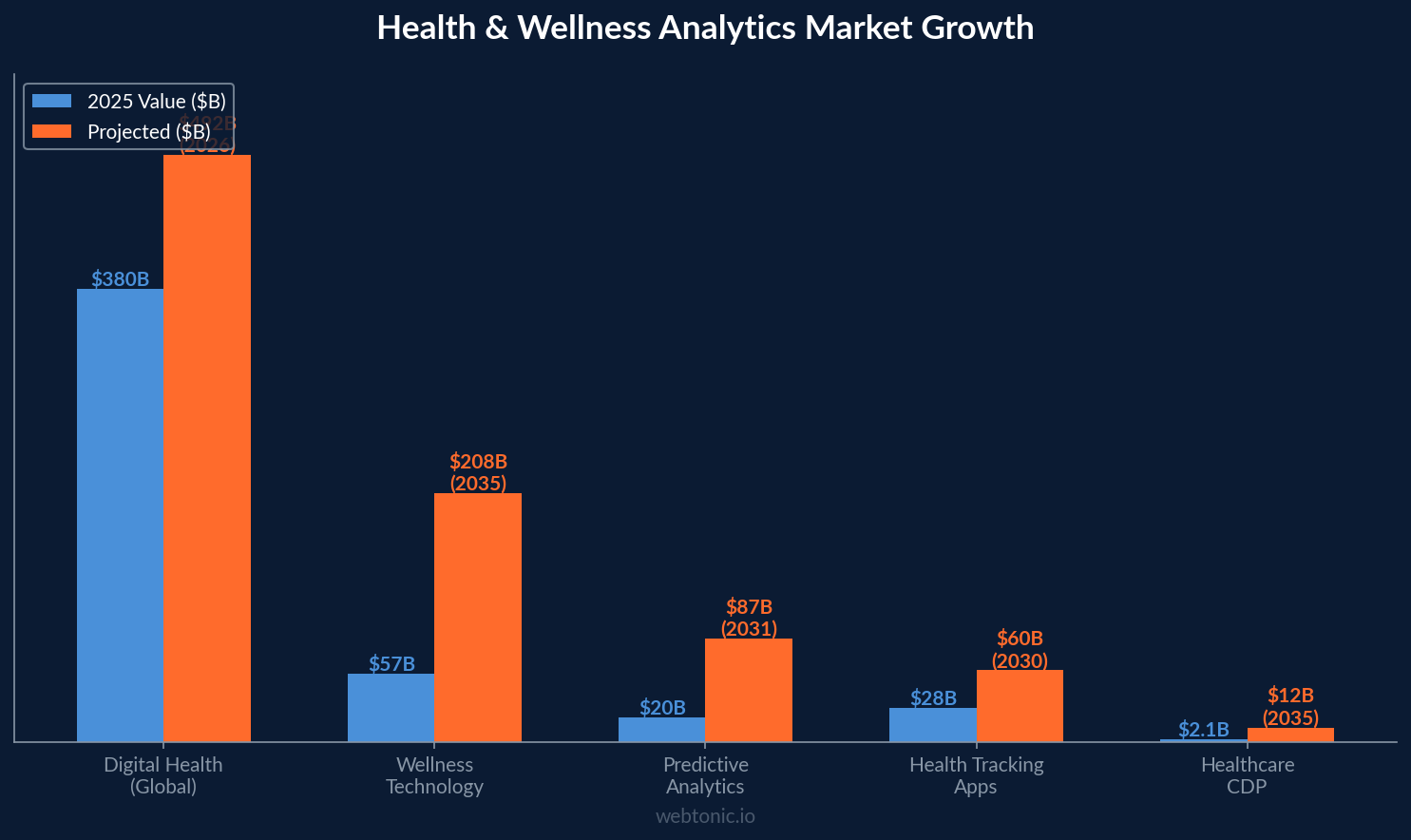
Precedence Research narrows the focus to wellness technology specifically: valued at $57.1 billion in 2025, the market is projected to reach $208.36 billion by 2035 at a 13.82% CAGR. This growth is driven by wearable adoption, telehealth expansion, and the integration of AI-powered analytics into every layer of wellness delivery.
| Market Segment | 2025 Value | 2026 Projection | 2030+ Forecast | CAGR |
|---|---|---|---|---|
| Global Digital Health | $340–$427B | $420–$492B | $800B+ | 15–20% |
| Global Wellness Economy | $6.8T (2024) | $7.2T+ | $8.5T+ | 7.9% |
| Wellness Technology | $57.1B | $65B+ | $208.36B (2035) | 13.82% |
| Digital Health Tracking Apps | $28.5B | $33.33B | $60B+ | 17.1% |
| Healthcare Predictive Analytics | $20.31B | $25.87B | $86.62B (2031) | 27.35% |
| Healthcare CDP | $2.1B | $2.6B | $12B+ (2035) | 24.8% |
Wearable Analytics and Consumer Health Tracking Adoption
Wearable technology has moved from niche fitness accessory to mainstream health infrastructure. NIQ's wearable technology report finds that 65% of adults are wearable owners or intenders — signaling that the majority of consumers either already track their health data or plan to start.
Rock Health's 2025 Consumer Adoption Survey reveals the depth of this adoption: 83% of wearable users wear their devices five or more days per week, including 59% who wear theirs always or nearly always. This consistency means wearable-generated health data is no longer sporadic — it's continuous, creating unprecedented datasets for wellness analytics.
NIQ's consumer trends analysis highlights that the self-directed health consumer is rising — one in four consumers now use at-home monitoring and wearable technology like continuous glucose monitors (CGMs), smart scales, and fitness trackers for real-time health monitoring. For wellness brands, this shift means first-party health data is becoming the most valuable marketing signal — brands that integrate wearable data into their analytics stack gain a targeting advantage competitors cannot replicate.
AI and Predictive Analytics in Health & Wellness
Artificial intelligence is becoming the analytical backbone of the health and wellness industry. NVIDIA's 2026 State of AI in Healthcare report found that 65% of healthcare organizations use AI for data analytics and data science, while 42% use AI to support clinical decision-making. The adoption curve is steep — organizations that were experimenting in 2024 are now operationalizing AI analytics at scale.
Industry surveys confirm that 95% of digital health companies report facing health data interoperability challenges — meaning that while AI analytics tools are powerful, data fragmentation remains the primary bottleneck for wellness brands trying to build unified customer views.
The predictive analytics opportunity is enormous: TBRC's market analysis shows the digital health tracking apps market grew to $33.33 billion in 2026 at a 17.1% CAGR. Meanwhile, the healthcare predictive analytics segment is growing even faster — from $20.31 billion in 2025 to a projected $86.62 billion by 2031 at 27.35% CAGR. For wellness brands, predictive analytics enables churn prediction, personalized product recommendations, and proactive health interventions — each representing a direct revenue lever.
Marketing Analytics and Attribution in Health & Wellness
Healthcare and wellness marketers face unique analytics challenges driven by privacy regulations, long consideration cycles, and multi-touchpoint journeys. According to IChelon Consulting's attribution study, Beacon CAPI (Conversions API) deployment typically reduces cost per qualified lead (CPQL) by 30–45% within 4–8 weeks — without any changes to ad creative, audience targeting, or budget. This makes server-side tracking the single highest-ROI analytics investment for wellness brands.
The healthcare customer data platform (CDP) market is growing at 24.8% CAGR through 2035, with mid-sized clinics driving adoption due to faster deployments and better interoperability. For wellness brands managing customer data across apps, websites, wearables, and in-person touchpoints, CDPs solve the data fragmentation problem that 95% of digital health companies report.
Wellness businesses that leverage data intelligence infrastructure to unify their analytics — connecting Google Ads performance data, Meta attribution signals, and first-party health engagement metrics — consistently outperform competitors relying on siloed platform dashboards.
Wellness Business KPIs and Performance Measurement
Zenoti's 2025 Beauty and Wellness Benchmark Report identifies the KPIs that matter most for wellness businesses: client retention rate, revenue per visit, booking conversion rate, and marketing ROI. The report emphasizes that wellness businesses tracking these metrics systematically outperform those relying on intuition.
Commerce Catalyst's supplements and wellness benchmarks provide financial context: wellness brands generating $1M–$10M in revenue average 4% EBITDA, while $10M–$50M brands reach 7–8% and $50M+ brands achieve 10–15%. The target for healthy wellness businesses is 10–15%+ EBITDA at any scale, and reaching it requires analytics-driven decision-making on customer acquisition costs, retention investments, and product mix optimization.
For wellness brands running paid campaigns, the core analytics framework should track customer acquisition cost (CAC), lifetime value (LTV), LTV:CAC ratio, and marketing efficiency ratio (MER). Meta Ads campaigns and Google Ads investments should be measured against these unit economics — not just platform-reported ROAS, which often overstates true marketing impact.
Privacy, Compliance, and Data Governance in Health Analytics
Health and wellness analytics operates under stricter regulatory scrutiny than most industries. HIPAA compliance in the United States, GDPR in Europe, and evolving state-level privacy laws create a complex data governance landscape that directly impacts tracking capabilities.
According to IChelon's healthcare attribution research, the shift from pixel-based tracking to server-side CAPI implementations is driven equally by privacy compliance requirements and performance improvement. Wellness brands collecting health-sensitive data — wearable metrics, supplement purchase history, fitness assessments — must implement consent management platforms, data minimization policies, and secure data processing agreements to remain compliant while maintaining analytics accuracy.
The growth marketing ecosystem for health and wellness brands now requires privacy-first analytics architectures: first-party data collection strategies, cookieless measurement frameworks, and HIPAA-compliant conversion tracking. Brands that invest in this infrastructure gain both compliance protection and better data quality — a rare case where regulatory requirements actually improve marketing performance.
| Analytics Investment | Expected Impact | Timeline to ROI | Priority Level |
|---|---|---|---|
| Server-Side Tracking (CAPI) | 30–45% CPQL reduction | 4–8 weeks | Highest |
| Customer Data Platform (CDP) | Unified customer view | 3–6 months | High |
| Predictive Analytics / AI | Churn prevention, personalization | 6–12 months | Medium |
| Wearable Data Integration | First-party health signals | 6–12 months | Emerging |
| Cross-Channel Attribution | Accurate marketing ROI | 2–4 months | High |
The Future of Health & Wellness Analytics
Several converging trends will shape health and wellness analytics through 2026 and beyond. The Fitt Insider 2026 Halftime Report identifies a critical pattern: wellness brands are evolving from single-category specialists into ecosystem platforms — leveraging earned capital in one specialty to cross categories, encouraging consumers to spend more of their lives inside singular wellness ecosystems.
This ecosystem approach demands analytics infrastructure that can track customers across multiple product lines, engagement channels, and touchpoints. The wellness brands winning in 2026 are those building unified analytics dashboards that connect wearable data, purchase behavior, content engagement, and marketing attribution into a single customer view.
With AI adoption at 65% and growing, predictive analytics transitioning from experimental to operational, and wearable penetration reaching majority adoption, the health and wellness industry is entering a data-abundance era. The competitive advantage is no longer collecting data — it's building the analytical frameworks to act on it faster than competitors can.
Health & Wellness Data Infrastructure and Integration Trends
The wellness industry's analytics maturity varies dramatically by segment. Enterprise wellness brands and healthcare systems operate sophisticated multi-channel attribution models, customer data platforms, and predictive analytics engines — while small and mid-sized wellness businesses often rely on basic Google Analytics and platform-native dashboards that capture a fraction of available insights.
The infrastructure gap creates measurable performance differences. Wellness brands with unified analytics stacks — connecting website behavior, paid media attribution, CRM data, and product engagement metrics — make marketing allocation decisions 3–5× faster than those managing siloed data sources. The healthcare CDP market's 24.8% CAGR through 2035 reflects this demand for unification.
For wellness businesses evaluating their analytics infrastructure, the priority investment order is clear: first implement server-side conversion tracking (30–45% CPQL reduction), then build a unified customer view through CDP integration, and finally layer predictive analytics for churn prevention and personalized recommendations. Each layer compounds the value of the previous one, making sequential investment more effective than trying to deploy everything simultaneously.
The convergence of wearable data streams, telehealth engagement records, and traditional marketing analytics is creating a new category of wellness intelligence — one where the health outcomes data that consumers generate daily becomes the most predictive signal for marketing and product decisions. Brands that build the infrastructure to capture and act on these signals today will hold an insurmountable data advantage within 2–3 years.
FAQ
How big is the digital health analytics market in 2026?
The global digital health market is projected at $420–$492 billion in 2026, with healthcare predictive analytics specifically valued at $25.87 billion and growing at 27.35% CAGR. The digital health tracking apps segment alone reached $33.33 billion. These figures reflect the broader $6.8 trillion wellness economy's rapid digitization.
What percentage of people use health wearables regularly?
65% of adults are wearable owners or intenders, and among active users, 83% wear their devices five or more days per week. Notably, 59% wear their wearables always or nearly always (except when charging), creating continuous health data streams that power both personal insights and population-level analytics.
How does AI impact health and wellness analytics?
65% of healthcare organizations now use AI for data analytics and data science. AI enables predictive churn models, personalized wellness recommendations, and automated anomaly detection in health data. However, 95% of digital health companies face data interoperability challenges, meaning AI effectiveness depends heavily on solving data fragmentation first.
What is the ROI of server-side tracking for wellness brands?
Implementing server-side tracking (Beacon CAPI) reduces cost per qualified lead by 30–45% within 4–8 weeks without changing ad creative or targeting. This makes it the single highest-ROI analytics investment for wellness brands running paid campaigns across Meta, Google, and other platforms.
What KPIs should wellness businesses track?
The essential KPIs are client retention rate, revenue per visit, booking conversion rate, marketing ROI, CAC, and LTV:CAC ratio. Wellness brands generating $1M–$10M average 4% EBITDA, while mature brands at $50M+ achieve 10–15%. The target at any scale is 10%+ EBITDA, driven by analytics-informed decisions on acquisition, retention, and product mix.
Sources
Axis Intelligence — Digital Health Statistics 2026
Global Wellness Institute — 2025 Global Wellness Economy Monitor
Precedence Research — Wellness Technology Market
NIQ — Unlocking Growth in Wearable Tech
Rock Health — 2025 Wearable Consumer Adoption Survey
NVIDIA — State of AI in Healthcare 2026
IChelon Consulting — Beacon CAPI vs Pixel Attribution
Zenoti — Beauty and Wellness Benchmark Report 2025
Commerce Catalyst — Supplements & Wellness Benchmarks 2026
Fitt Insider — Health & Wellness 2026 Halftime Report


