Table of contents
Key Takeaways
The most important health and wellness ad creative statistics shaping campaign performance in 2026:
- Micro-commitment messaging like "seven minutes a day" generates 73% above-average ROAS impact compared to monthly challenge framing, according to Meta × Alison.ai research.
- Videos of 60 seconds or longer outperform shorter assets on ROAS in health and wellness — contradicting the short-form-first assumption most advertisers follow.
- UGC health and wellness ads achieve a 28.34% hook rate and 1.90% CTR, with a ROAS of 2.12 — strong attention but a conversion gap that signals trust issues.
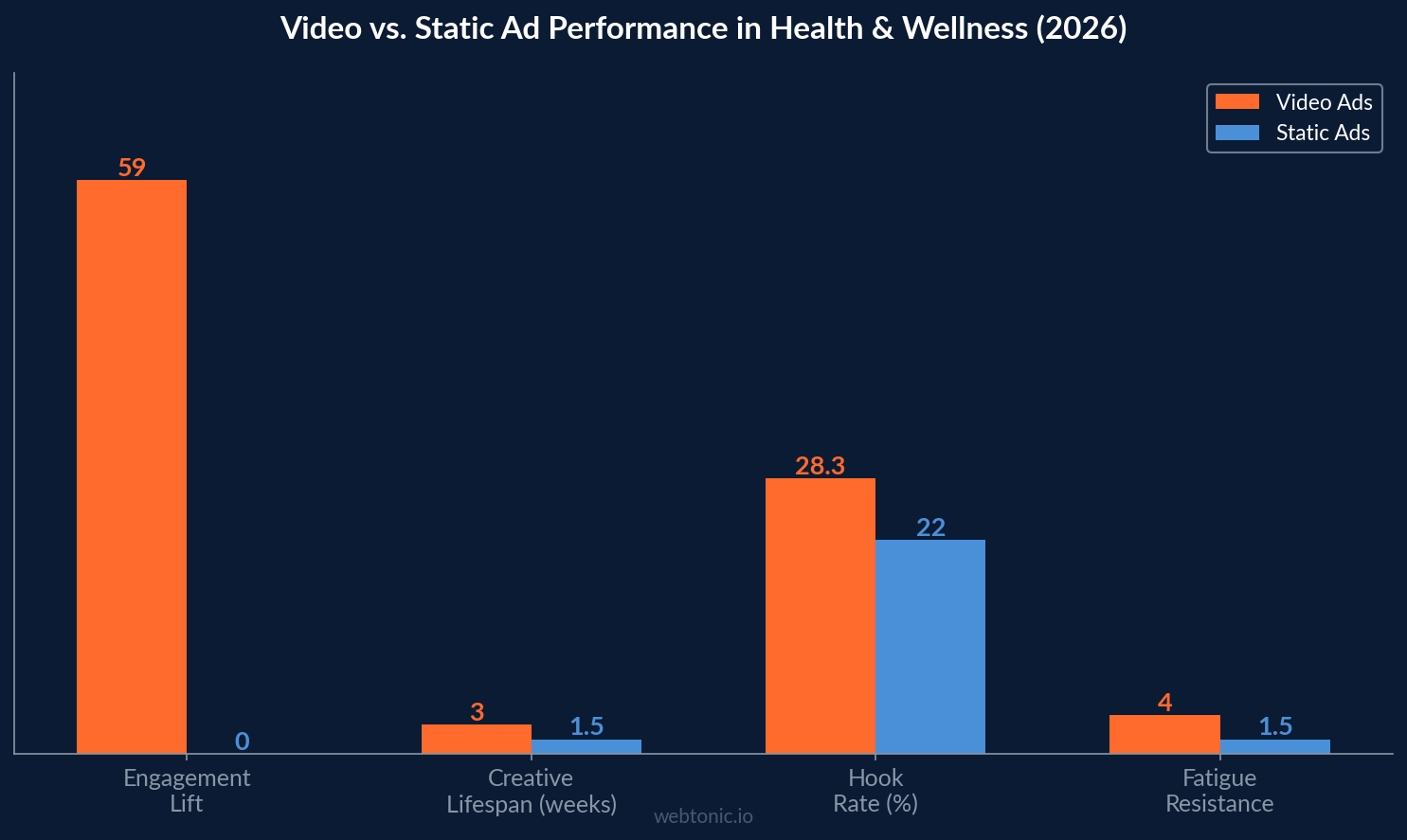
- Video ads maintain peak performance for 2–4 weeks before fatigue sets in, compared to just 1–2 weeks for static images.
- Health and wellness Google Ads average $1.73 CPC and 6.50% conversion rate, delivering 312.75% ROAS across benchmark accounts.
- Wellness brands see an average CPA of £36 with median ROAS of 3.4× across paid channels.
- Facebook Ads campaigns performing 20%+ above industry benchmarks get 43% lower CPMs and 2.3× more delivery volume.
- A well-executed UGC strategy can increase ROAS by up to 25% and improve conversion rates by over 40% for health brands.
Health & Wellness Ad Creative Performance Benchmarks
Performance data for health and wellness ad creative reveals an industry where creative quality is the primary lever for efficiency gains. According to MDMPPC's Google Ads benchmark data, health and wellness accounts average $1.73 CPC, a 6.50% conversion rate, and $26.77 cost per conversion — with ROAS hitting 312.75% across 27 million+ impressions.
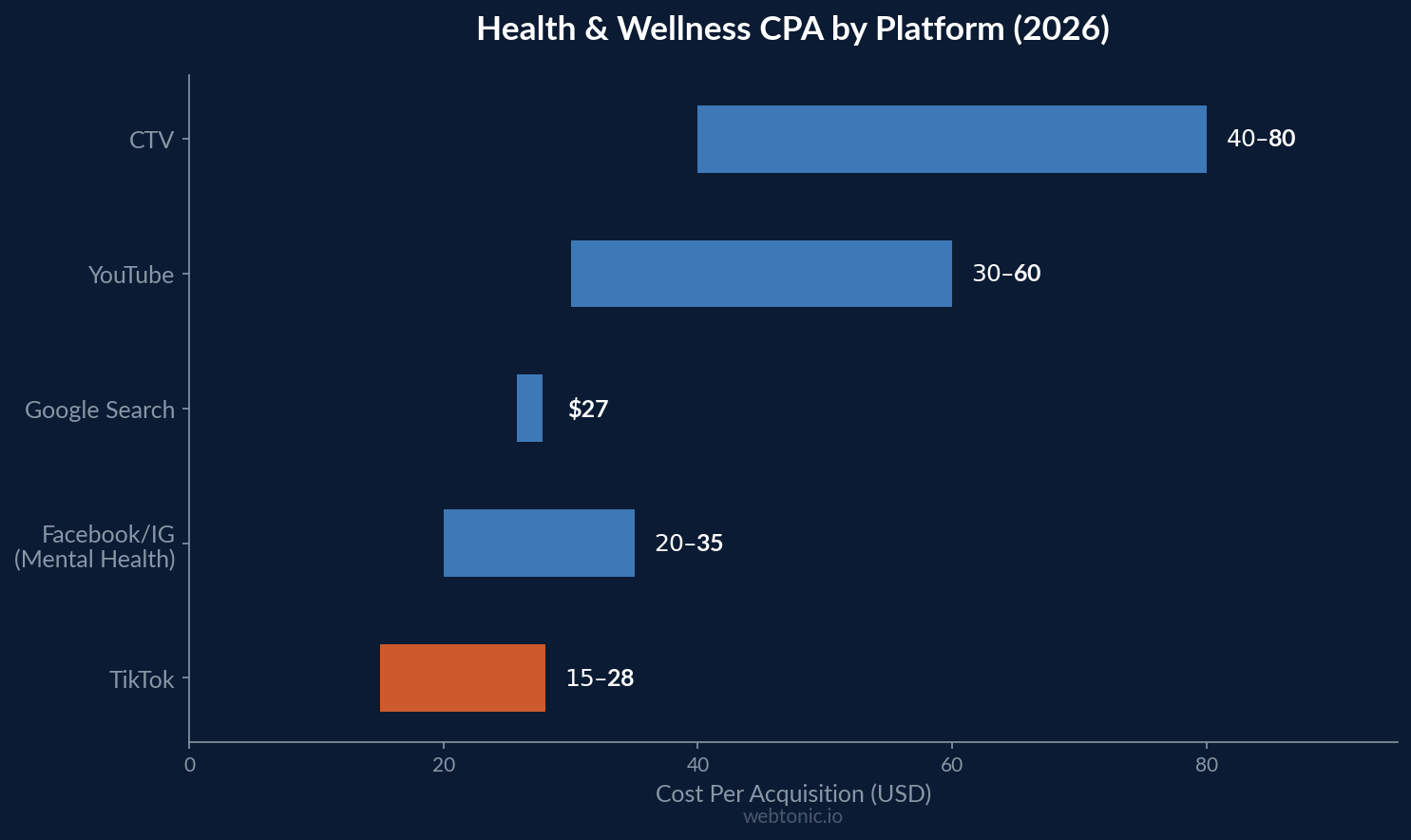
On Meta platforms, AdFuse AI's wellness CPA benchmark report shows the average wellness brand pays £36 CPA with a median ROAS of 3.4×. AdLibrary's Facebook Ads healthcare benchmarks break this down by sub-vertical: mental health and therapy ads achieve 1.0–1.4% CTR with $20–$35 CPA, while pharmaceutical ads face much steeper costs at $80–$250+ CPA with just 0.5–0.8% CTR.
CuFinder's 2026 fitness and wellness marketing benchmarks show that the average wellness industry conversion rate is 3.2%, with top 10% performers reaching 5.8% CVR. Landing page conversion rates average 4.4% — underscoring that creative alone cannot compensate for poor post-click experiences.
| Metric | Health & Wellness Avg. | Top Performers | All-Industry Avg. |
|---|---|---|---|
| Google Ads CPC | $1.73 | $0.90–$1.20 | $2.69 |
| Google Ads CVR | 6.50% | 10%+ | 3.75% |
| Facebook Ads CTR | 1.0–1.4% | 2.0%+ | 0.90% |
| Meta CPA (Wellness) | £36 | £18–£24 | £42 |
| ROAS (Google) | 312.75% | 500%+ | 200% |
| Landing Page CVR | 4.4% | 5.8% | 2.35% |
Video vs. Static Ad Creative: What the Data Shows
The format debate in health and wellness advertising has a clear data-backed answer: video wins on longevity and engagement, while static dominates rapid-test velocity. According to the Meta × Alison.ai Health & Wellness Creative Insights Report, videos of 60 seconds or longer are delivering stronger ROAS impact than shorter assets in this vertical — a finding that directly contradicts the short-form-first assumption most advertisers default to.
Pilotium's gym and fitness video ad study quantifies the format gap: video ads get 59% more engagement than static images. More importantly, video ads maintain peak performance for 2–4 weeks before fatigue, compared to just 1–2 weeks for static images — giving video a significant creative lifecycle advantage that reduces refresh frequency.
On Meta specifically, video ads survived 30+ days before performance decay compared to static equivalents — reinforcing the lifecycle advantage of video investment. For health and wellness brands managing limited creative budgets, this means video investment pays compounding returns through reduced production cycles and longer in-market performance windows.
UGC Performance in Health & Wellness Advertising
User-generated content has become a core creative strategy for health and wellness brands, but the data reveals a nuanced performance picture. Billo's health and wellness UGC analysis reports that UGC ads achieve a 28.34% hook rate and 1.90% CTR, with an overall ROAS of 2.12 — below the 2.41 platform average. The interpretation: UGC captures attention effectively but faces a trust-driven conversion gap in the health vertical.
PlusROI Media's UGC compliance guide offers a more optimistic view: a well-executed UGC strategy can increase ROAS by up to 25% and improve conversion rates by over 40% for health brands — when testimonials are properly structured and compliance requirements are met. Evolut Agency's analysis of 50,000+ UGC videos spanning beauty, fitness, and health brands confirms that the best-performing UGC consistently combines strong watch time with high CTR — both metrics need to align for ROAS to follow.
The compliance dimension is critical: health and wellness UGC faces stricter platform scrutiny than other verticals. Creative that makes specific health claims without proper disclaimers risks disapproval, and Meta's advertising policies require careful creative review before scaling UGC in health categories.
Creative Messaging: What Actually Drives ROAS in Wellness
The Alison.ai "Intuition Trap" study — based on Meta advertising data — reveals several counterintuitive findings about health and wellness creative messaging:
- Micro-commitment messaging ("seven minutes a day") generates 73% above-average ROAS impact compared to monthly challenge framing. Smaller asks convert dramatically better.
- Negative emotional framing (fear, health consequences) outperforms positive affirmation in healthcare advertising — contradicting the "always be uplifting" creative instinct.
- Creative diversity is the fuel for AI optimization: to scale campaigns in 2026, advertisers need to feed the algorithm with data-proven creative variations, not just more of what "feels right."
Swayable's creative theme analysis confirms that depicting negative emotions can actually improve performance for health brands — a finding that challenges the default approach of most performance creative teams.
For supplement and wellness product advertisers, Evolut Agency's analysis of 500+ top supplement ads identifies the winning creative formula: lead with the problem, demonstrate the mechanism, then present the product as the solution — all within the first 3 seconds for video and the top 20% of visual space for static ads.
Creative Testing and Optimization Strategies
Testing methodology matters as much as the creative itself. Airbridge's fitness app creative testing study reveals a critical pitfall: the creative that wins on CPI (cost per install) often loses on revenue by a factor of 4.5×. If a brand kills underperformers at the 48-hour CPI checkpoint, it never sees the subscription revenue data that actually matters.
Health and wellness advertisers should adopt longer evaluation windows — 7–14 days minimum for subscription or high-consideration products — to capture downstream revenue signals. Structured hook testing in fitness app campaigns identified 3 winning creative variants from a larger pool, increasing CTR by 62% and achieving 4.8× ROAS (7-day window).
The testing cadence for health and wellness brands should align with creative fatigue timelines: refresh static ads every 1–2 weeks and video ads every 2–4 weeks. Brands spending over $50,000/month on Meta should test 15–20 new creatives weekly to maintain performance, according to Meta advertising best practices.
Platform-Specific Ad Creative Benchmarks
Creative performance varies significantly across platforms in the health and wellness vertical:
| Platform | Primary Format | Avg. CTR | Avg. CPA | Creative Lifespan |
|---|---|---|---|---|
| Facebook / Instagram | Video + UGC | 1.0–1.4% | $20–$35 | 2–4 weeks (video) |
| Google Ads (Search) | RSA text | 1.20% | $26.77 | 4–8 weeks |
| TikTok | Native UGC video | 1.5–2.5% | $15–$28 | 1–2 weeks |
| YouTube | Pre-roll / Shorts | 0.4–0.8% | $30–$60 | 4–6 weeks |
| Connected TV (CTV) | 15–30s spots | N/A (view-based) | $40–$80 | 6–8 weeks |
Industry data confirms that Facebook and Instagram remain the primary paid channel globally for wellness brands, with TikTok accelerating in the U.S. and India. YouTube is severely underinvested across all three markets — representing an opportunity for brands willing to produce longer-form wellness content. The shift toward efficient Meta Ads spending continues to drive creative innovation in the health space.
Digital Advertising Spend and Creative Format Trends
The health and wellness advertising landscape is undergoing a structural shift. MM+M's 2026 Healthcare Marketers Trend Report confirms that digital ad spend has overtaken linear TV for the first time in healthcare marketing — driven by the demand for rapid creative iteration, real-time optimization, and personalization at scale.
The format mix is shifting decisively: Connected TV (CTV) is absorbing linear TV budgets, AI-powered creative tools are enabling 50%+ growth in creative volume, and influencer channel investment is growing at 44% year-over-year. For health and wellness brands, this means creative production velocity is now a competitive advantage — teams producing 10× more creative variations consistently outperform those relying on fewer, "perfect" assets.
Building a growth marketing strategy around these trends requires wellness brands to invest in creative systems — templated production workflows, rapid testing infrastructure, and performance feedback loops — rather than treating ad creative as a one-off project.
Creative Production and AI-Assisted Ad Development
The rise of AI-powered creative tools is reshaping how health and wellness brands produce ad assets at scale. According to the MM+M trend report, healthcare marketers are using AI to generate more creative variation per campaign cycle than ever before — enabling brands to test dozens of hook angles, CTA formulations, and visual treatments in the time it previously took to produce a single ad set.
For wellness brands running campaigns across Google, Meta, and TikTok simultaneously, AI-assisted creative development reduces the per-asset production cost by 40–60% while maintaining quality standards. The key advantage: brands feeding AI systems more diverse creative inputs consistently achieve lower CPA because the algorithm has more signals to optimize against. This data-driven creative approach is essential for wellness advertisers competing in a vertical where creative fatigue hits faster than in most industries.
FAQ
What is a good CTR for health and wellness ads?
A good CTR for health and wellness ads ranges from 1.0–1.4% on Facebook and Instagram, with top performers exceeding 2.0%. On Google Search, the health and wellness average CTR is 1.20%. TikTok wellness ads typically achieve 1.5–2.5% CTR due to the platform's native content format. Any CTR above your platform's industry benchmark indicates strong creative resonance.
Do video ads outperform static images for wellness brands?
Yes, for most wellness brands. Video ads achieve 59% more engagement than static images and maintain peak performance for 2–4 weeks vs. 1–2 weeks for static. However, static images are faster to produce and test — making them essential for rapid creative iteration. The optimal mix is 70% video, 30% static for mature wellness ad accounts.
How effective is UGC for health and wellness advertising?
UGC in health and wellness achieves a 28.34% hook rate and 1.90% CTR — strong attention metrics. However, ROAS averages 2.12, below the 2.41 platform average, due to a trust-driven conversion gap. When properly structured with compliance-safe testimonials, UGC can increase ROAS by up to 25% and conversion rates by over 40%.
How often should wellness brands refresh ad creative?
Static ads should be refreshed every 1–2 weeks and video ads every 2–4 weeks. Brands spending over $50,000/month on Meta should test 15–20 new creatives weekly. The key fatigue signal is a 20%+ drop in CTR or hook rate compared to the creative's first-week performance — at that point, refresh immediately rather than waiting for the scheduled cycle.
What creative messaging works best for wellness products?
Data shows that micro-commitment messaging ("seven minutes a day") generates 73% above-average ROAS impact compared to broad claims. Counter-intuitively, negative emotional framing outperforms positive affirmation in health advertising. The winning formula: lead with the problem, demonstrate the mechanism, then present the product — all within the first 3 seconds for video or the top 20% of visual space for static ads.
Sources
Meta × Alison.ai — Health & Wellness Creative Insights Report 2026
Alison.ai — The Intuition Trap in Health & Wellness Advertising
MDMPPC — Health & Wellness Google Ads Benchmarks
AdFuse AI — Wellness CPA Benchmarks 2026
CuFinder — Fitness and Wellness Marketing Benchmarks 2026
Pilotium — Video Ads for Gyms: 59% More Engagement
Billo — UGC for Health & Wellness Brands
Evolut Agency — 50,000+ UGC Videos Analyzed
AdLibrary — Facebook Ads Healthcare Benchmarks 2026
Airbridge — Creative Testing for Fitness Apps