Table of contents
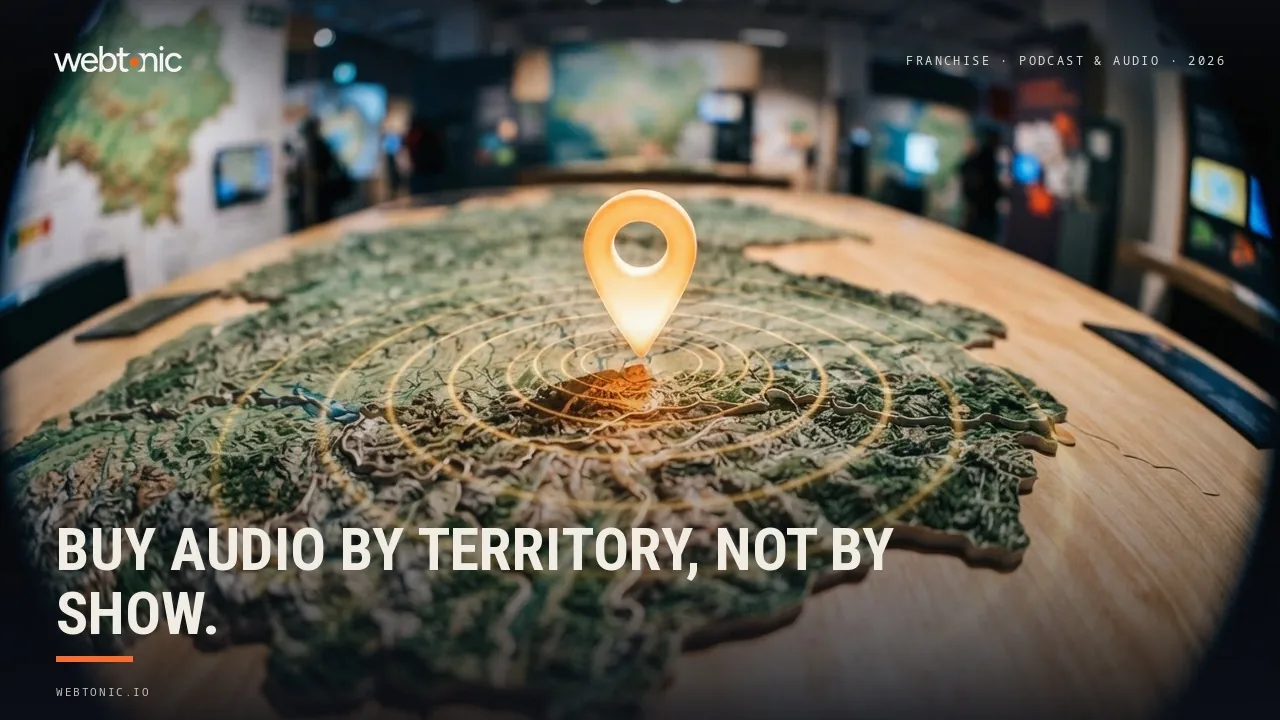
Franchise audio is a territory problem before it is a creative problem: in the 2025 AFMR, broadcast TV and radio held 7% of franchise marketing budgets, while US podcast ad revenue reached USD 2.9 billion in 2025. This page maps those national numbers onto the way franchise systems actually buy media - by market, through local and co-op funds.
Key Takeaways
- Broadcast TV and radio took 7% of franchise marketing budgets in the 2025 AFMR.
- Streaming TV and streaming radio took another 7%.
- Digital ads led franchise budgets at 42%, social at 22%.
- 85% of franchise brands recommend or require local marketing spend.
- 48% leave tracking of that local spend to franchisees.
- The IFA projects 845,000 franchise establishments in 2026.
- US podcast ad revenue hit USD 2.9 billion in 2025, up 17.6%.
- 58% of Americans 12+ listen to podcasts monthly, about 167 million people.
- 76% of weekly podcast consumers acted on a podcast ad.
- 18% of weekly podcast consumers are business owners.
- DMA is the top targeting lever in Podscribe's 105K+ campaign benchmark.
- Podcast incrementality reaches its halfway point around days 16 to 20.
Where audio sits in a franchise budget
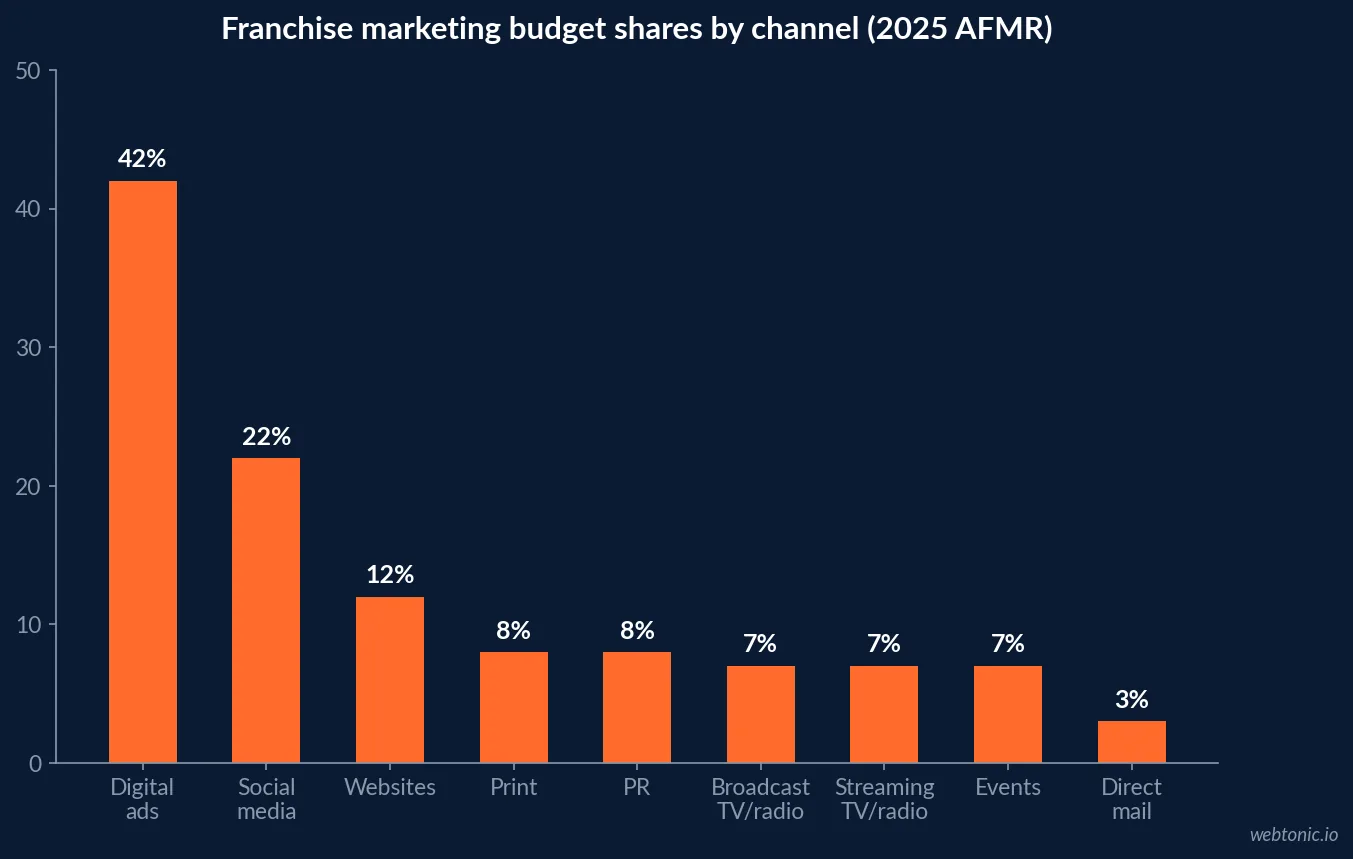
The 2025 Annual Franchise Marketing Report findings published by Franchise Update Media break franchise marketing spend into channels. Digital ads take 42%, social media 22%, websites 12%, print and PR 8% each, and broadcast TV and radio 7% - the same share as streaming TV and streaming radio. Community events also take 7% and direct mail 3%.
Two things follow. Audio is a real line in franchise plans, not a fringe test, and the report does not split podcasts out, so any claim of a precise "franchise podcast share" is invented. Inside digital, the same report says 36% of budgets go to search pay-per-click and 29% to social ads, which is the competition audio has to win budget from.
| Channel (2025 AFMR) | Share of franchise marketing budget | Where podcasts could sit |
|---|---|---|
| Digital ads | 42% | Programmatic podcast and streaming audio buys |
| Social media | 22% | Not audio - competing line |
| Websites | 12% | Not audio - landing destination for promo codes |
| 8% | Not audio | |
| Public relations | 8% | Guest spots on local business shows |
| Broadcast TV / radio | 7% | AM/FM spots, local station podcasts |
| Streaming TV / radio | 7% | Streaming audio and podcast networks |
| Community events | 7% | Live reads at sponsored local events |
| Direct mail | 3% | Not audio |
The size of the franchise system audio has to cover
The International Franchise Association's 2026 Franchising Economic Outlook projects establishments rising from 832,521 to 845,000 units (+1.5%), output from USD 907.3 billion to USD 921.4 billion (+1.6%), and franchise employment gaining more than 150,000 jobs to nearly 8.9 million.
For audio planning, the relevant number is units per market. A brand with a handful of units in a metro can justify a DMA-targeted buy funded from a regional co-op; a brand with one unit in a sprawling market is paying for listeners who cannot reach the store. The AFMR sample itself reflects this split: 61% of respondents were service brands, and 34% of those service franchisors were territory-based with no storefront at all.
| IFA 2026 outlook metric | 2025 | 2026 projection | Change |
|---|---|---|---|
| Franchise establishments | 832,521 | 845,000 | +1.5% |
| Franchise output | USD 907.3B | USD 921.4B | +1.6% |
| Franchise GDP | USD 549.9B | USD 558.4B | +1.8% |
| Franchise employment | not stated | nearly 8.9M | +150,000 jobs (+1.8%) |
Podcast reach inside a territory
Edison Research's Infinite Dial 2026 puts monthly podcast listening at 58% of Americans 12 and older, about 167 million people, with weekly listening at 45% and 68% monthly reach among 35 to 54 year olds - the core age band for many home-service and fitness franchise buyers.
Edison's Podcast Consumer 2025 adds the owner angle: 18% of weekly podcast consumers are business owners and 56% are homeowners. That is relevant twice for franchising - homeowners are the customer base of most service franchises, and business owners are the prospect pool for franchise development.
| Audience metric (Edison, 2025-2026) | Value | Why a franchise system cares |
|---|---|---|
| Monthly podcast listeners 12+ | 58% / 167M | Ceiling for any territory buy |
| Weekly podcast listeners 12+ | 45% / 130M | Frequency pool for repeat exposure |
| Monthly listening, ages 35-54 | 68% | Core homeowner age band |
| Weekly consumers who are homeowners | 56% | Service-franchise customer base |
| Weekly consumers who are business owners | 18% | Franchise development prospects |
Buying audio by DMA, not by show
Podscribe's Q3 2026 Performance Benchmark Report (vendor data, August 2025 to July 2026, 105K+ campaigns and 36B+ impressions) lists DMA as the most used targeting lever. The Libsyn Ads marketplace offers geo-targeting by city, state, ZIP, DMA and point of interest across 1,300+ shows. Both matter for franchise systems because they let a co-op buy only the markets where units exist.
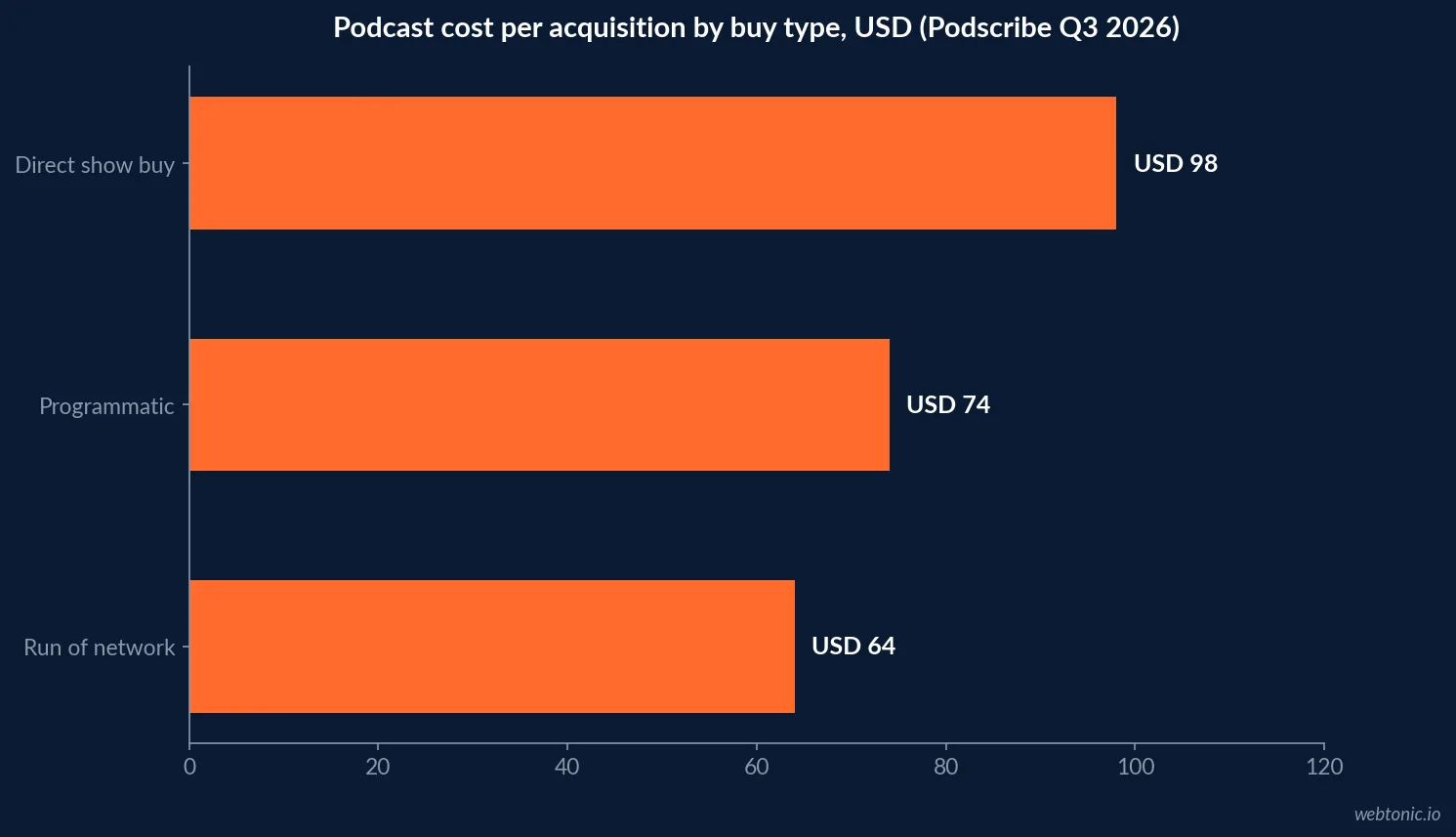
Buy type also changes cost. Podscribe's medians put cost per acquisition at USD 98 for direct show buys, USD 64 for run-of-network and USD 74 for programmatic. Run-of-network and programmatic are the formats that geo-fence most easily, which is why they fit local funds better than a national host-read.
| Podscribe Q3 2026 metric (all advertisers) | Podcast | Streaming audio |
|---|---|---|
| Site visitor rate | 0.20% | 0.07% |
| Cost per visitor | USD 10.00 | USD 8.00 |
| Cost per acquisition | USD 168 | USD 204 |
| Incrementality | 26% | 19% |
| Incrementality, brands with 0-1M visitors | 49% | 45% |
| Days to half of incrementality | 16-20 | 11-15 |
Rate cards a co-op can plan against
Public podcast pricing is thin, but a few issuers publish it. The Libsyn Ads marketplace quotes typical 30-second spots at USD 10 to 50 CPM. Libsyn's September 2024 rate report, the last in its monthly series, put the average 60-second CPM at USD 21.37, against USD 22.84 a year earlier, with Health and Fitness - the category of many gym franchises - at USD 24. Self-serve entry points are low: the Spotify Ad Studio help centre (Netherlands page) lists a minimum lifetime budget of roughly USD 250 equivalent.
As simple arithmetic, 100,000 impressions at the USD 21.37 average cost about USD 2,137 before any production. That is a rate-card illustration, not a franchise benchmark, and a co-op should expect premium shows to price well above it.
| Published audio price point | Value | Issuer and date |
|---|---|---|
| Typical 30-second podcast spot | USD 10-50 CPM | Libsyn Ads marketplace |
| Average 60-second CPM | USD 21.37 | Libsyn, September 2024 |
| Average 60-second CPM a year earlier | USD 22.84 | Libsyn, September 2023 |
| Health and Fitness category CPM | USD 24 | Libsyn, September 2024 |
| Self-serve minimum lifetime budget | about USD 250 | Spotify Ad Studio, Netherlands page |
What the national market is doing
The IAB and PwC Internet Advertising Revenue Report for full-year 2025 puts US podcast ad revenue at USD 2.9 billion, up 17.6%, inside a digital audio market of USD 8.4 billion. The earlier IAB podcast revenue study for FY2023 showed brick-and-mortar and e-commerce retail at 8.7% of podcast revenue and home improvement at 2.0% - the categories closest to most franchise concepts.
National money pouring in raises prices on the popular shows. It also means local franchise creative competes in ad breaks with national brands that may be selling the same category.
Response rates a territory test can expect
Edison's Podcast Consumer 2026 report found 76% of weekly podcast consumers took some action after hearing a podcast ad, with website visits at 66% for 13 to 34, 67% for 35 to 54 and 45% for 55 and older. Those are self-reported actions across all ads, not franchise conversion rates.
Magellan AI's Q2 2026 measurement benchmark (vendor medians) shows host-read ads with a 3.22% response rate versus 2.09% for produced spots, and notes seven-day reads capture less than half of eventual response. A franchise brand that judges a test on week-one calls will cut the channel before it has been measured.
| Response signal | Value | Source and scope |
|---|---|---|
| Weekly consumers who acted on an ad | 76% | Edison, all ads, self-reported |
| Visited a website after an ad, 35-54 | 67% | Edison, self-reported |
| Host-read response rate | 3.22% | Magellan AI Q2 2026 medians |
| Produced-spot response rate | 2.09% | Magellan AI Q2 2026 medians |
| Promo codes' share of conversions captured | 24% | Podscribe Q3 2026 |
Why tracking is the franchise weak spot
The AFMR found 85% of franchise brands recommend or require local marketing spend, yet 48% leave tracking of it to franchisees. Audio is the channel that suffers most from that gap: Podscribe estimates promo codes capture only 24% of conversions, so a franchisee counting code redemptions will see roughly a quarter of the effect.
The fix is structural rather than creative - one vanity URL or call-tracking number per territory, pixel-based attribution run at the brand level, and results reported back by DMA. If you want that measurement layer designed, our data intelligence team builds territory-level reporting.
Disclosure rules for franchisee-voiced ads
Franchisees love to voice their own local spots. When an owner, a host or a customer presents an endorsement, the FTC Endorsement Guides, 16 CFR Part 255 require material connections to be disclosed and claims to reflect typical results. On broadcast radio, paid material also needs sponsorship identification under 47 CFR 73.1212. Franchise brand standards typically add an approval step so that a local read does not promise pricing or results the system cannot honour.
A territory audio plan in six steps
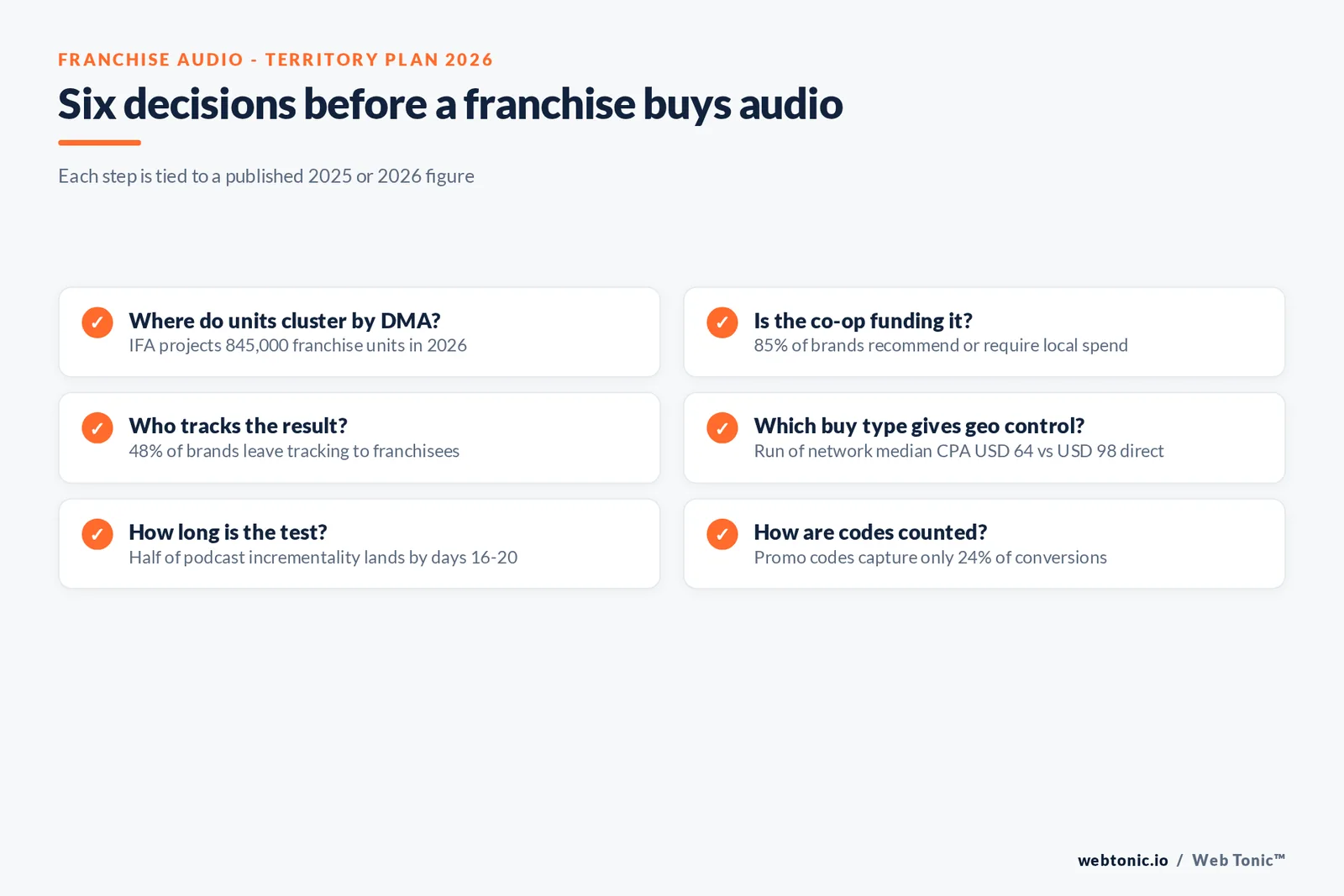
- Count units per DMA and fund audio only where units cluster.
- Fund from the co-op, not from a single franchisee, when a market has several units.
- Buy run-of-network or programmatic for geo control; save host-reads for brand campaigns.
- Give each territory its own URL and number so the 48% tracking gap closes.
- Run tests for at least 20 days, matching the incrementality curve.
- Pre-approve every local script against FTC and brand-standard rules.
How audio fits beside the rest of the franchise mix
Audio rarely replaces search in a franchise plan; it feeds it. Compare the channel with the franchise data in our franchise CTV statistics, the local-creator angle in franchise influencer and UGC data, and the cross-industry baseline in our podcast and audio advertising hub. For the search side of the same budget, see franchise Google Ads statistics.
Frequently Asked Questions
How much of a franchise marketing budget goes to audio?
No survey isolates podcasts for franchises. The closest public figure is the 2025 Annual Franchise Marketing Report (AFMR), where broadcast TV and radio took 7% of franchise marketing budgets and streaming TV and streaming radio another 7%. Digital ads led at 42% and social at 22%. Podcasts sit inside those audio and digital lines rather than as their own reported share.
Can a single franchisee buy podcast ads for one territory?
Yes, at the market level. The Libsyn Ads marketplace lists geo-targeting by city, state, ZIP code, DMA and point of interest, and Podscribe's Q3 2026 benchmark names DMA as the most used targeting lever. What a single franchisee usually cannot buy cheaply is a host-read sponsorship on a national show, because that audience spills across many territories.
What does podcast advertising cost for a franchise brand?
Libsyn's marketplace quotes typical 30-second spots at USD 10 to 50 CPM, and its September 2024 reading put the average 60-second CPM at USD 21.37. Spotify's Ad Studio help page for the Netherlands lists a minimum lifetime budget of about USD 250. Podscribe's cross-advertiser medians were USD 10 per site visitor and USD 168 per purchase, which are all-category figures, not franchise figures.
How long should a franchise audio test run?
Longer than most local tests. Podscribe found podcast campaigns reach half of their measured incrementality only around days 16 to 20, and Magellan AI reports that seven-day reads capture less than half of the eventual response. A two-week test in one territory will under-read the channel.
Do franchisee-voiced ads need a disclosure?
If a franchisee or host presents an endorsement, the FTC Endorsement Guides in 16 CFR Part 255 apply, including disclosure of material connections. Paid content on broadcast radio stations also falls under the FCC sponsorship identification rule in 47 CFR 73.1212. Brand standards in the franchise agreement usually add their own approval step on top.
Sources
Franchise Update Media - 2025 AFMR findings
International Franchise Association - 2026 Franchising Economic Outlook
IAB / PwC - Internet Advertising Revenue Report, FY2025
IAB - US Podcast Advertising Revenue Study, FY2023
Edison Research - The Infinite Dial 2026
Edison Research - The Podcast Consumer 2026
Edison Research - The Podcast Consumer 2025
Podscribe - Performance Benchmark Report Q3 2026
Magellan AI - Podcast Measurement Benchmark Q2 2026
Libsyn Ads - Podcast advertising marketplace
Libsyn - September 2024 podcast ad rates
Spotify Advertising - Ad Studio help centre
eCFR - 16 CFR Part 255
eCFR - 47 CFR 73.1212