Table of contents
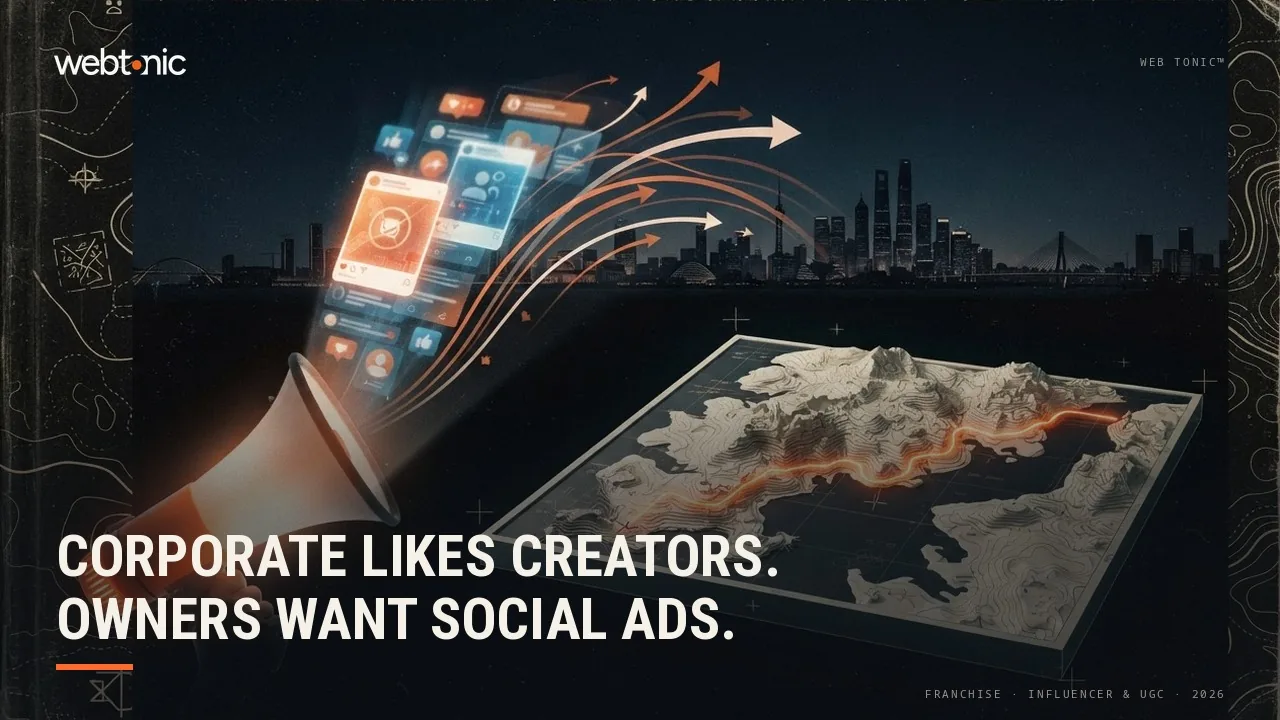
Franchise brands have no published influencer benchmark of their own, but the survey data is clear on one thing: franchisors value influencer marketing more than the franchisees who pay for local reach. This page sets out that gap, what a local creator costs, and the disclosure rules that bind both levels of the system in 2026.
Key Takeaways
- 33% of franchisors support influencer marketing for franchisees; 28% of franchisees rate it most effective.
- Social media ads show the reverse gap: 61% of franchisors support them, 70% of franchisees find them effective.
- 95% of franchisees say localized marketing support from corporate is or would be extremely helpful.
- Social media takes 22% of franchise marketing budgets in the 2025 AFMR.
- 85% of franchise brands recommend or require local marketing spend.
- 48% leave local marketing tracking to franchisees.
- 90% of franchise brands now monitor online reviews, up from 75% a year earlier.
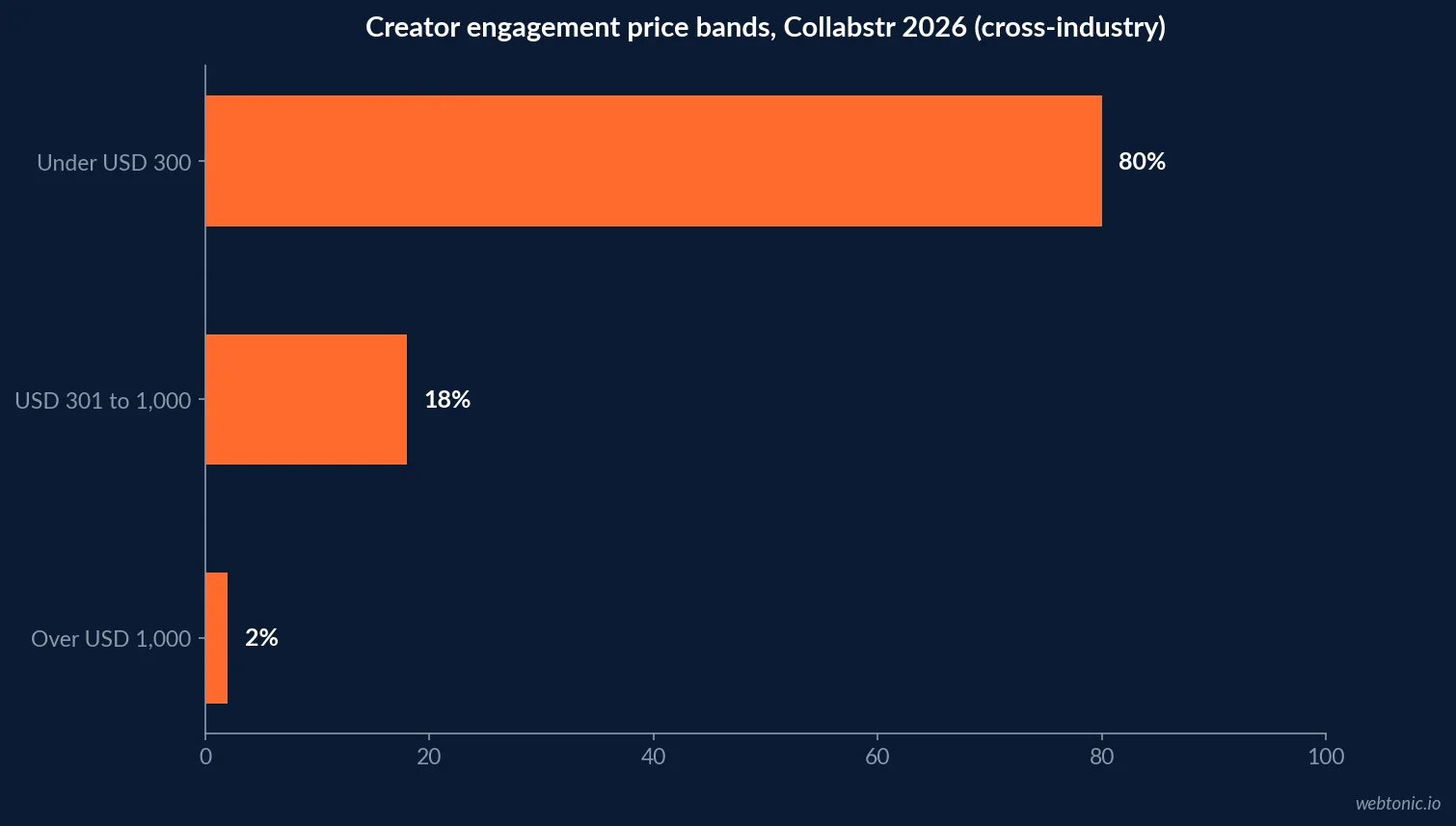
- Cross-industry, 80% of creator engagements cost under USD 300 (Collabstr 2026).
- The IFA projects 845,000 franchise establishments in 2026.
The number that frames every franchise creator program
The International Franchise Association's 2026 Franchising Economic Outlook projects franchise establishments growing from 832,521 to 845,000 units, a 1.5% rise, with employment up more than 150,000 jobs to nearly 8.9 million and output rising 1.6% to USD 921.4 billion. Every one of those units sells inside a local radius, which is why influencer marketing in franchising is really a question of local creators at scale, not a single national face.
That scale is also the problem. A creator program that works in one territory has to be repeatable across hundreds, legally consistent across all of them, and affordable for the operator who funds the local slice.
| Franchise sector indicator (IFA, 2026 outlook) | 2025 | 2026 projection | Change |
|---|---|---|---|
| Franchise establishments | 832,521 | 845,000 | +1.5% |
| Franchise employment | Not restated | Nearly 8.9 million | +1.8%, 150,000+ jobs |
| Franchise economic output | USD 907.3 billion | USD 921.4 billion | +1.6% |
| Franchise GDP | USD 549.9 billion | USD 558.4 billion | +1.8% |
Franchisors and franchisees disagree about influencers
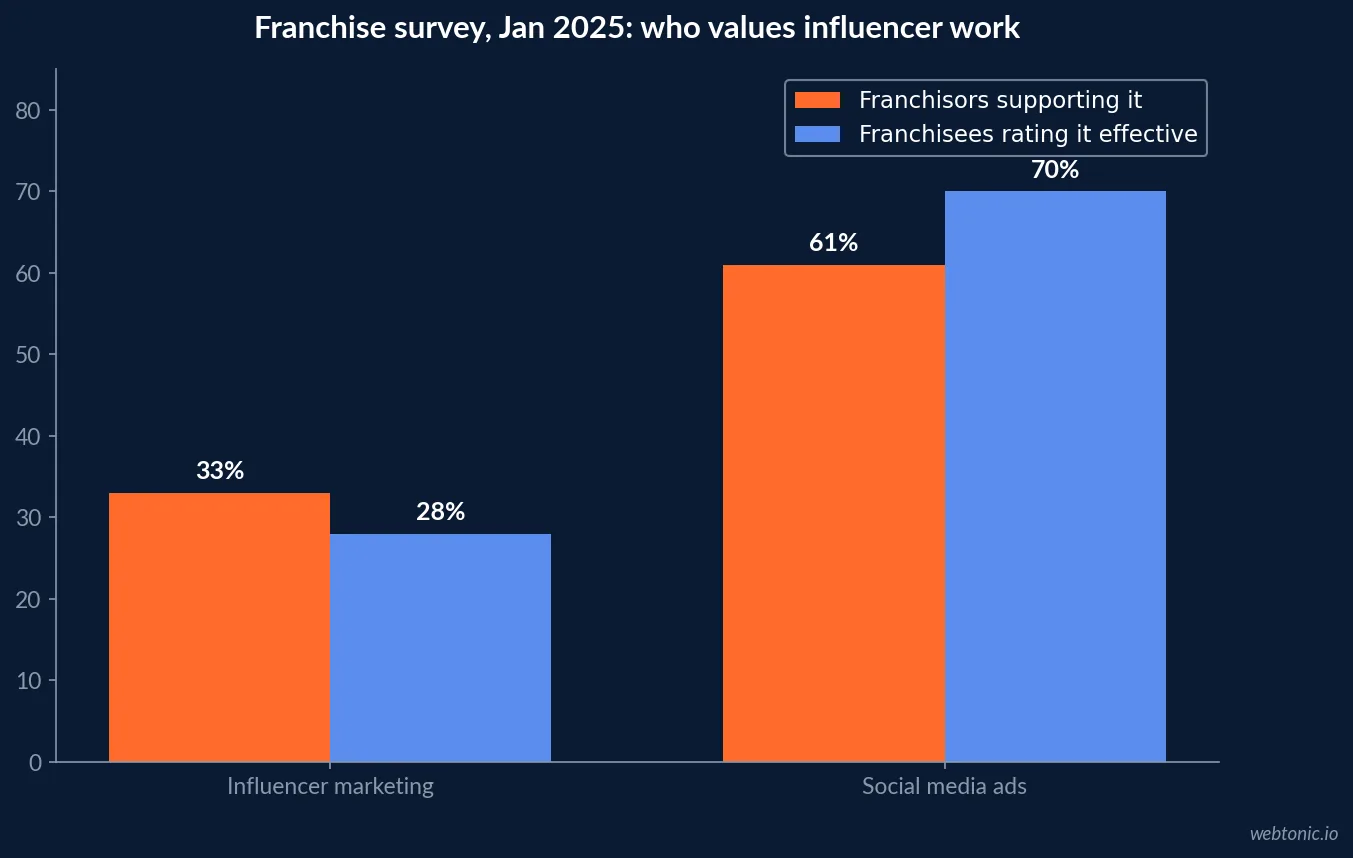
The most useful franchise-specific evidence comes from the Constant Contact and Ascend2 State of Franchise Marketing report, fielded in January 2025 with 239 franchisor and 264 franchisee marketing decision-makers in the US and Canada. It found 33% of franchisors supporting influencer marketing for their locations, while only 28% of franchisees named it among their most effective tactics. The report itself notes that franchisors put more priority on influencer marketing, text/SMS and local SEO than franchisees do.
Social media ads run the other way: 61% of franchisors support them, but 70% of franchisees rate them effective. Read together, the numbers say local operators trust paid social they can switch on and measure, and are less convinced by creator work they did not commission.
Where the franchise marketing dollar sits
Franchise Update Media's 2025 Annual Franchise Marketing Report (AFMR), a survey of franchise marketers published on the company's own Franchising.com site, puts digital ads at 42% of total franchise marketing budgets and social media at 22%, the second-largest line. Websites take 12%, print and PR 8% each, and broadcast TV/radio, streaming TV/radio and community events 7% each. Influencer fees are not broken out as a separate line, so any creator budget is competing inside that social share.
The same report found 85% of brands recommend or require franchisees to invest in local marketing, yet 48% leave it to franchisees to track and manage that spend on their own.
| Budget line (2025 AFMR) | Share of franchise marketing budget | Creator-program relevance |
|---|---|---|
| Digital ads | 42% | Where boosted creator posts are usually paid from |
| Social media | 22% | Organic creator content and social management |
| Websites | 12% | Where UGC and reviews get republished |
| Print ads / PR | 8% each | PR budgets sometimes fund creator seeding |
| Streaming TV/radio | 7% | Matches legacy broadcast at 7% |
| Community events | 7% | Natural setting for local creator visits |
What a local creator actually costs
No franchise rate card exists, so the reference point is marketplace data. Collabstr's 2026 Influencer Marketing Report, drawn from more than 21,000 collaborations and 472,000+ packages, shows 80% of engagements cost under USD 300, 18% fall between USD 301 and 1,000 and only 2% exceed USD 1,000. This is cross-industry data, not franchise data.
For a system budgeting per territory, the useful figures are average payouts: YouTube at USD 255, Instagram at USD 193, TikTok at USD 186 and UGC at USD 154 per engagement, while the average UGC campaign fell from USD 209 to USD 197 year on year.
| Platform (Collabstr 2026, cross-industry) | Average asking price | Average payout | Gap brands negotiate |
|---|---|---|---|
| YouTube | USD 311 | USD 255 | USD 56 |
| USD 214 | USD 193 | USD 21 | |
| TikTok | USD 182 | USD 186 | Payout slightly above ask |
| UGC (no posting) | USD 180 | USD 154 | USD 26 |
| Twitch | USD 398 | USD 127 | USD 271 |
Control is the real design decision
Creator programs fail in franchising less on price than on governance. In the Constant Contact survey, 95% of franchisors said keeping control of franchisee marketing tools, branding and messaging is important, and 62% called it extremely important. Franchisors granting limited control cite brand consistency (71%) and performance (65%) as their reasons.
Franchisees see it differently. 61% of those with full control over messaging are very satisfied, against 38% with moderate control and 20% with limited or no control, while 53% believe they are fully autonomous even though only 39% of franchisors say they grant that. A creator program run from headquarters without a local say walks straight into that mismatch.
| Control question (Constant Contact, Jan 2025) | Franchisors | Franchisees |
|---|---|---|
| Full marketing control granted / felt | 39% | 53% |
| Moderate control | 48% | 34% |
| Limited control | 12% | 10% |
| Very satisfied at full control | n/a | 61% |
| Very satisfied at limited or no control | n/a | 20% |
UGC and reviews are already the franchise system's content
Franchise brands already treat customer content as core infrastructure. The 2025 AFMR found 90% of brands actively monitor online reviews, up from 75% in 2024, 68% use review-monitoring platforms and 59% use social media monitoring tools. That monitoring is the raw material for a UGC program: the posts and reviews are being collected anyway.
The enterprise data backs reuse. Linqia's 2026 State of Influencer Marketing survey found 100% of marketers repurpose influencer content beyond the creator's own page and 81% say it outperforms brand-created assets, a cross-industry result that applies neatly to a system that needs the same content in hundreds of local ad accounts.
Local creators versus a celebrity franchisee
The headline cases in franchising are celebrity deals. Franchise Times reported in May 2026 on Dog Haus, whose CEO described YouTuber and boxer Jake Paul signing a 25-unit development agreement for Texas, Florida and Puerto Rico. That is equity and development, not a sponsored post, and it is not a model most systems can copy.
The budget signal points the other way. Influencer Marketing Hub's 2026 benchmark survey of 600+ marketers found 51.43% planning to expand nano-creator use and 52.83% micro-creator use, while macro creators split almost evenly at 20.59% expansion and 20.58% contraction. For franchises, nano and micro creators are the ones who actually live inside a territory.
| Creator tier (IMH 2026, cross-industry) | Planning expansion | Planning contraction | Franchise fit |
|---|---|---|---|
| Nano | 51.43% | 10.00% | One creator per territory |
| Micro | 52.83% | 7.55% | Metro or DMA-level launches |
| UGC creators | 50.00% | 0% | Ad creative for local accounts |
| Macro | 20.59% | 20.58% | Brand-level only |
| Celebrity | 33.33% | 0% | Development deals, not posts |
Disclosure rules apply at both levels of the system
The FTC's Endorsement Guides, codified at 16 CFR Part 255, say advertisers are subject to liability for misleading or unsubstantiated statements made through endorsements, or for failing to disclose unexpected material connections (255.1(d)). Section 255.5 requires a connection that might materially affect credibility, and is not reasonably expected by the audience, to be disclosed clearly and conspicuously, and it names business, family and personal relationships.
The FTC's Disclosures 101 guide tells creators to disclose any financial, employment, personal or family relationship with a brand. In a franchise, a free meal from a local operator is a material connection, so disclosure language belongs in the brand standards manual rather than in each franchisee's judgement.
Platform mechanics that suit a multi-location brand
Paid amplification is where local creator posts turn into ads a franchisee can target by radius. TikTok's Spark Ads help page (updated June 2026) describes a native format that runs organic posts as ads while keeping their engagement, with a 10-minute maximum video length and up to 10,000 Spark Ads per Ads Manager account, a ceiling that comfortably covers a creator post per location.
Tracking has to be per location. Influencer Marketing Hub's 2026 survey found promo or discount codes lead tracking tools at 45.9%, ahead of affiliate links (26.0%) and native shop features (25.0%). A code per territory keeps each franchisee's creator results separable.
The wider creator economy franchises are buying into
Goldman Sachs Research expects the creator economy's addressable market to roughly double to USD 480 billion by 2027 from USD 250 billion, with brand deals at about 70% of creator revenue and around 50 million creators worldwide. Budget intent matches: Influencer Marketing Hub found 87.49% of respondents expecting influencer budgets to rise in 2026 and 5.55% expecting a cut, and Linqia found 62% increasing influencer budgets.
Measurement lags that spend. Linqia reports 79% of marketers struggle to measure ROI, which in franchising compounds with the visibility gap: only 38% of franchisors report complete visibility into franchisee marketing programs.
How to build a franchise creator program in 2026
- Centralise the roster, localise the activation. 55% of franchisees want corporate support with some local control, which is exactly this split.
- Write disclosure into the brand standards. 16 CFR 255.5 does not care which level paid.
- Issue a code per territory. Promo codes are already the most used tracking tool.
- Budget per piece, not per campaign. Most creator engagements price under USD 300.
- Feed UGC into local paid social. Franchisees already rate social ads highest at 70%.
For the paid side, our performance creative team builds creator-led ad variants per market, and our growth marketing practice sets up location-level measurement. For the channel-wide picture, see our influencer marketing statistics and the franchise SMS marketing data.
Frequently Asked Questions
Is there a published influencer benchmark for franchise brands?
No. No association or vendor publishes a franchise-specific influencer engagement rate, CPM or return figure. The closest franchise data is survey evidence: Constant Contact and Ascend2 found in January 2025 that 33% of franchisors support influencer marketing while 28% of franchisees rate it among their most effective tactics. Creator pricing and budget data on this page are cross-industry and labelled as such.
What does a local creator cost a franchise location?
Collabstr's 2026 marketplace data, which is cross-industry, shows 80% of brand-creator engagements cost under USD 300, 18% cost USD 301 to 1,000 and only 2% cost more than USD 1,000. Average UGC campaigns cost USD 197. Those are marketplace averages, not franchise quotes, but they show that a per-territory creator program is priced in hundreds, not thousands, per piece.
Who is liable if a franchisee's influencer fails to disclose?
The FTC's Endorsement Guides say advertisers are subject to liability for misleading endorsements or for failing to disclose unexpected material connections (16 CFR 255.1(d)). A connection that is not reasonably expected by the audience must be disclosed clearly and conspicuously (255.5). Both the brand that runs the program and the local operator paying the creator should treat disclosure as their own obligation.
Should the franchisor or the franchisee run the creator program?
The survey data points to a hybrid. 55% of franchisees prefer to control some aspects of marketing with corporate support, 95% say localized support from headquarters is or would be extremely helpful, and 95% of franchisors say keeping control of tools, branding and messaging is important. A central creator roster with local activation fits both answers.
How should a franchise measure influencer and UGC results?
Start with what the system can already see. Only 38% of franchisors report complete visibility into franchisee marketing, and 48% leave local marketing tracking to franchisees. Promo codes, which lead influencer tracking tools at 45.9% in Influencer Marketing Hub's 2026 survey, can be issued per location so that each territory's creator results stay separable.
Sources
International Franchise Association - 2026 Franchising Economic Outlook
Constant Contact and Ascend2 - The State of Franchise Marketing (January 2025 survey)
Franchising.com - 2025 Annual Franchise Marketing Report findings
Franchise Times - How franchises leverage social media influencers (May 2026)
Collabstr - 2026 Influencer Marketing Report
Influencer Marketing Hub - Influencer Marketing Benchmark Report 2026
Linqia - 2026 State of Influencer Marketing
Goldman Sachs Research - The creator economy could approach half a trillion dollars by 2027
eCFR - 16 CFR Part 255, Guides Concerning Endorsements and Testimonials
FTC - Disclosures 101 for Social Media Influencers
TikTok Business Help Center - About Spark Ads