Table of contents

A franchise CTV budget starts at the platform floor, not at a national media plan: Roku's self-serve minimum is USD 500 per campaign, and franchise brands put 7% of marketing budgets into streaming TV and radio in 2025. This page builds territory budgets from those third-party figures; none of them is a Web Tonic price.
Key Takeaways
- Streaming TV and radio took 7% of franchise marketing budgets in the 2025 AFMR.
- Digital ads took 42% of franchise budgets and social media 22%.
- Roku requires a lifetime budget of USD 500 or more per campaign.
- Amazon recommends USD 10,000 for self-service streaming TV, USD 50,000 for managed.
- 52% of franchisees call limited budget their biggest marketing barrier.
- 85% of franchise brands recommend or require local marketing spend.
- Streaming reached 49.0% of US TV time in July 2026 (Nielsen).
- 25% of US open programmatic CTV traffic was invalid in Q2 2026 (Pixalate).
- The IFA projects 845,000 franchise establishments in 2026.
The franchise CTV budget at a glance
There is no published franchise-specific connected TV benchmark: no survey reports a franchise CTV CPM, completion rate or cost per lead. What does exist is franchise budget-share data, platform minimum spends and cross-industry CTV benchmarks. The table puts the numbers a franchise marketing director is most likely to need side by side, with the issuer and period of each.
| Budget input | Figure | Issuer | Period |
|---|---|---|---|
| Streaming TV/radio share of franchise budgets | 7% | 2025 AFMR (Franchise Update Media) | 2025 |
| Broadcast TV/radio share of franchise budgets | 7% | 2025 AFMR | 2025 |
| Roku self-serve lifetime minimum | USD 500 | Roku Ads Manager help centre | Current page |
| Amazon streaming TV, self-service | USD 10,000 recommended | Amazon Ads | Current page |
| Amazon streaming TV, managed service | USD 50,000 minimum | Amazon Ads | Current page |
| Invalid traffic, US open programmatic CTV | 25% | Pixalate (cross-industry) | Q2 2026 |
How franchise brands split the marketing budget
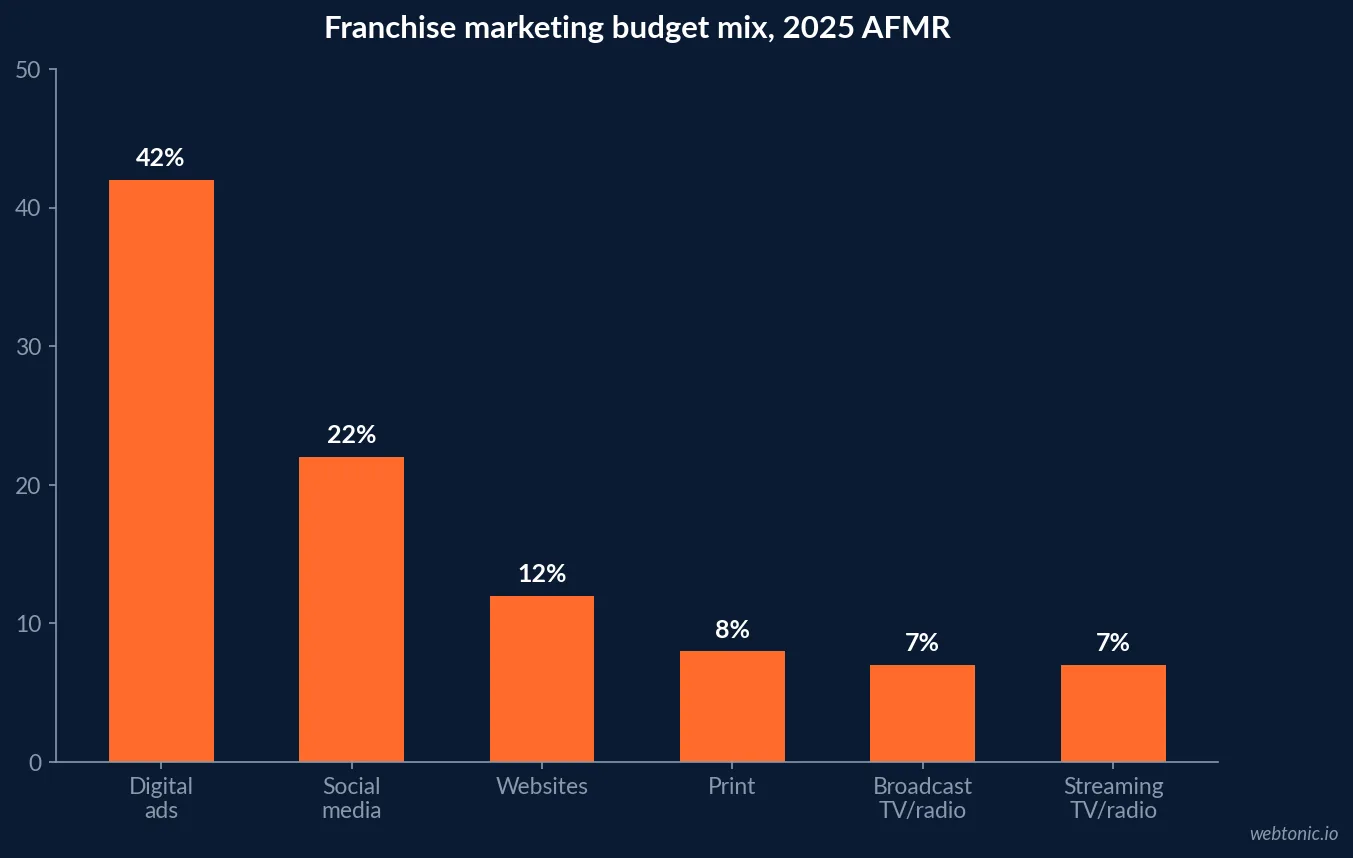
The 2025 Annual Franchise Marketing Report findings reported by Franchising.com show where franchise money goes. Digital ads accounted for 42% of total marketing budgets, social media for 22%, websites for 12%, and print and PR for 8% each. Broadcast TV and radio held 7%, and streaming TV and radio now match it at 7%. Community events took 7% and direct mail 3%.
Two cautions apply. The AFMR groups streaming TV with streaming radio, so the CTV share alone is lower than 7%. And respondents are franchisors, 61% of them service brands, so the mix reflects brand-level budgets rather than what an individual operator spends in one territory.
| Franchise budget line (2025 AFMR) | Share of total budget | What it means for CTV |
|---|---|---|
| Digital ads | 42% | The pool CTV competes with for performance money |
| Social media | 22% | Already funds video creative CTV can reuse |
| Websites | 12% | Landing pages that CTV traffic lands on |
| Broadcast TV/radio | 7% | Linear budget that can move to streaming |
| Streaming TV/radio | 7% | Current CTV plus streaming audio share |
| Community events | 7% | Local presence, often co-funded |
| Direct mail | 3% | Another ZIP-level channel to coordinate with |
Platform floors: the real starting budget
Roku's Ads Manager help centre states that lifetime budgets are required on all campaigns and must be USD 500 or more. Roku's own cost guide adds that USD 500 to 1,000 is enough for most first-time advertisers to get a campaign live and begin generating data. Amazon Ads lists no minimum spend requirement for streaming TV ads bought through its self-serve display and video tools, but its streaming TV packages carry a USD 10,000 recommended campaign minimum for self-service and a USD 50,000 minimum for managed service.
For a franchise system, those floors translate directly into structure. A single-territory test fits the Roku entry point. A 20-territory regional push at the Roku floor already equals USD 10,000, the level where Amazon's self-service package becomes an option. National managed buys belong to the brand fund, not to operators.
| Territory scenario (illustrative arithmetic on vendor floors) | Platform floor used | Minimum outlay |
|---|---|---|
| 1 territory, first test | Roku USD 500 | USD 500 |
| 1 territory, fuller test | Roku USD 1,000 guidance | USD 1,000 |
| 20 territories at the Roku floor | Roku USD 500 x 20 | USD 10,000 |
| Pooled regional package | Amazon self-service recommendation | USD 10,000 |
| Brand-fund national buy | Amazon managed service | USD 50,000 |
Why the franchisee cannot fund it alone
The Constant Contact and Ascend2 State of Franchise Marketing report, fielded in January 2025 with 239 franchisor and 264 franchisee marketing decision-makers in the US and Canada, lists franchisees' biggest barriers. Limited budget came first at 52%, followed by time constraints at 34%, lack of marketing expertise at 31% and lack of localized support at 30%. Difficulty measuring ROI was named by 24%.
The same survey found 95% of franchisees say localized marketing support from corporate is or would be extremely helpful, and 95% of franchisors say control of marketing tools, branding and messaging is important. CTV sits exactly between those positions: the creative and the platform account suit corporate control, while the ZIP list and the flight dates are local decisions.
| Franchisee barrier (Constant Contact/Ascend2, Jan 2025) | Share naming it | CTV implication |
|---|---|---|
| Limited budget | 52% | Pool budgets or co-op fund the Roku floor |
| Time constraints | 34% | Corporate builds and launches campaigns |
| Lack of marketing expertise | 31% | Central creative and targeting templates |
| Lack of localized support | 30% | Territory ZIP lists maintained by HQ |
| Difficulty measuring ROI | 24% | Shared reporting on site visits and leads |
Geo-targeting: drawing a territory on a TV screen
Roku's location targeting documentation offers three geographic types: states, postal/ZIP codes and designated market areas. A campaign can include or exclude locations using only one type at a time, so a territory defined by ZIP codes cannot be mixed with a DMA in the same campaign; Roku suggests separate inclusion and exclusion audiences instead. ZIP lists should contain residential ZIP codes only.
One rule matters for franchise categories in particular. If a campaign declares a special ad category, credit, housing or employment, ZIP-code targeting is not selectable. Real-estate, lending and staffing franchises therefore need DMA or state-level plans, which spill across territory lines and complicate cost sharing between operators.
| Roku location type | Territory fit | Restriction on the page |
|---|---|---|
| States | Multi-territory regional brand pushes | One geo type per campaign |
| Postal/ZIP codes | Closest match to a franchise territory | Residential ZIPs only; off for special ad categories |
| Designated market areas (DMA) | Metro-wide co-op buys | Spills across neighbouring territories |
| Congressional districts | Not relevant to franchises | Political ad accounts only |
The audience a territory budget is buying
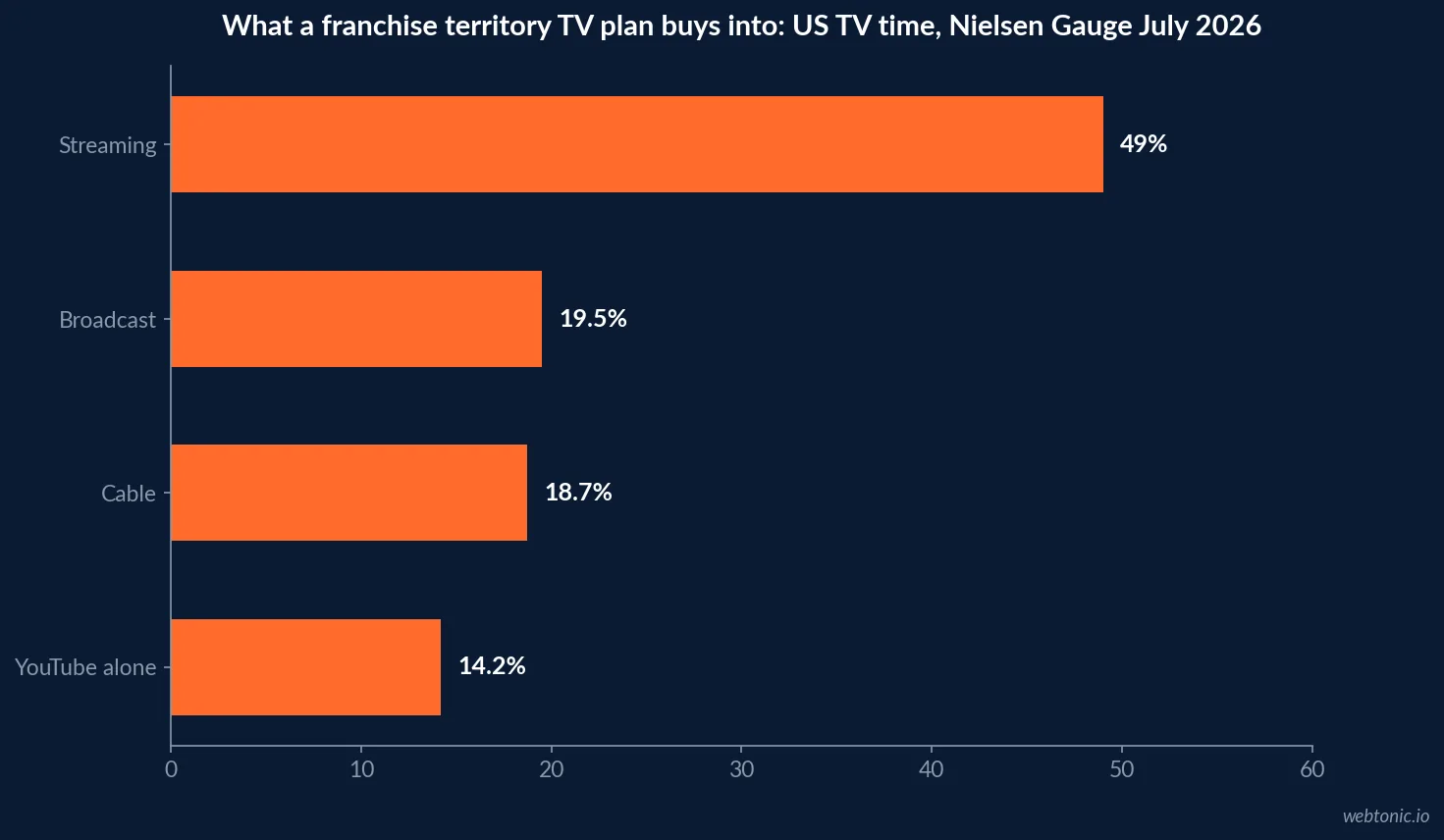
Nielsen's July 2026 report of The Gauge put streaming at 49.0% of total US TV usage, with YouTube alone at a record 14.2%, broadcast at 19.5% and cable at 18.7%. For a franchise brand whose operators have bought local cable or broadcast spots, that means roughly half of the TV time in any territory now sits in streaming, where it can be bought by ZIP code rather than by cable zone.
The shift is funded from linear. In the 2026 IAB Digital Video Ad Spend and Strategy report, 54% of advertisers increasing CTV spend said the money comes from linear TV, and the share of small spenders investing in CTV rose from 60% in 2024 to 85% in 2026, with self-serve platforms lowering the entry barrier.
CPM context for a franchise media plan
There is no franchise CPM benchmark. The best-documented cross-industry comparison is Tatari's analysis of its client data from 2019 to 2023, which found streaming CPMs typically three to four times linear: about USD 9.50 against USD 2.50. Tatari notes its streaming CPMs are already below market because of direct publisher deals, often 66% lower than programmatic buying, so the USD 9.50 is a direct-buy floor rather than what a small self-serve territory campaign will pay.
Treat any CPM as an output of targeting depth. A tight residential ZIP list narrows supply, and narrow supply usually costs more per thousand than a whole-DMA buy.
Fraud: why small territory flights are exposed
Pixalate's Q2 2026 North America benchmarks put invalid traffic at 25% of US open programmatic CTV traffic, the same rate as desktop and mobile web, against 39% for mobile apps. Globally CTV ran at 26%. These are cross-industry, open-programmatic figures; they are not franchise data.
For a USD 500 test, a quarter of impressions going to invalid traffic is not a rounding error; it is a large share of the data a territory needs to judge the test. Direct publisher inventory and verification settings matter more at small budgets than at large ones.
Unit growth and the size of the territory map
The IFA 2026 Franchising Economic Outlook projects franchise establishments growing from 832,521 to 845,000 units, up 1.5%, with output rising 1.6% to USD 921.4 billion and employment approaching 8.9 million. Every new unit is a new territory that either joins an existing CTV geography or needs its own.
The budgeting consequence is simple arithmetic: a system that funds CTV per territory at a fixed floor sees its CTV line grow with unit count, while a pooled DMA plan grows only when new units open in new markets.
Who tracks the result
The AFMR found 85% of franchise brands recommend or require local marketing spend, but 48% leave franchisees to track and manage it on their own. Nearly 80% of respondents reported stable or growing lead generation and traffic, with 39% seeing an increase. For CTV, which rarely produces a click, handing measurement to individual operators usually means no measurement: the brand needs one reporting view across territories that ties exposure to site visits, calls and bookings.
Franchise CTV budgeting checklist
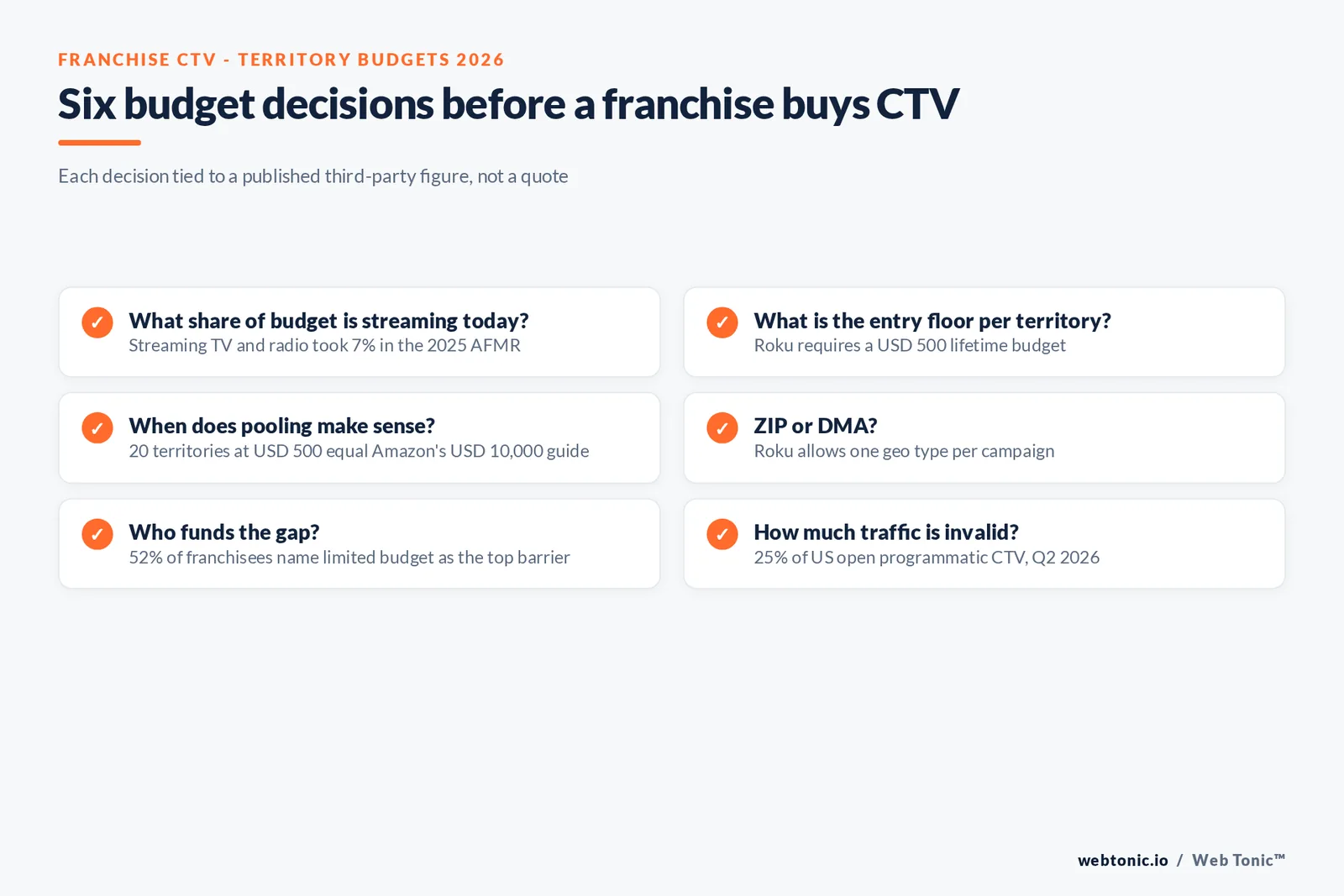
- Start at the floor. USD 500 per territory is the Roku minimum; plan tests at USD 500 to 1,000.
- Pool above 20 territories. 20 x USD 500 equals Amazon's USD 10,000 self-service recommendation.
- Draw territories in one geo type. ZIP or DMA, not both in one campaign.
- Check special ad categories. Declaring one removes ZIP targeting.
- Fund the gap. 52% of franchisees cite budget; co-op money closes it.
- Centralise measurement. 48% of brands leave tracking to franchisees today.
Our data intelligence team sets up cross-territory CTV measurement, and our performance creative team cuts TV-ready spots from existing social video. For broader context, see our streaming media statistics, the franchise influencer and UGC data and our franchise SMS marketing statistics.
Frequently Asked Questions
How much should a franchise system budget for CTV per territory?
No franchise-specific CTV benchmark exists, so the budget is built from platform floors. Roku Ads Manager requires a lifetime campaign budget of at least USD 500 and says USD 500 to 1,000 is enough for most first-time advertisers. Amazon recommends USD 10,000 for self-service streaming TV packages and USD 50,000 for managed service. A single territory test therefore starts at the Roku floor; a pooled regional buy is where the Amazon thresholds become realistic.
What share of franchise marketing budgets goes to streaming TV?
The 2025 Annual Franchise Marketing Report put streaming TV and radio at 7% of total franchise marketing budgets, the same share as broadcast TV and radio. Digital ads took 42% and social media 22%. The survey reports franchisor budgets; it does not isolate connected TV from streaming audio.
Can franchise CTV campaigns target a single territory?
Yes, within the platform's rules. Roku's help centre lists three location types: states, postal/ZIP codes and designated market areas, and one campaign can only use one type at a time. ZIP targeting is removed if a special ad category such as credit, housing or employment is declared, which matters for real-estate or lending franchises.
Should the franchisor or the franchisee pay for CTV?
The data points to shared funding. In the 2025 Constant Contact and Ascend2 survey, 52% of franchisees named limited budget as their biggest marketing barrier and 95% said localized support from corporate is or would be extremely helpful. The AFMR found 85% of brands recommend or require local marketing spend, yet 48% leave tracking to franchisees.
How much CTV traffic in a franchise buy could be invalid?
Pixalate's Q2 2026 benchmarks put invalid traffic at 25% of US open programmatic CTV traffic and 26% globally. That is a cross-industry figure for open programmatic supply. Small territory budgets feel it most, because a quarter of a USD 500 flight is a large share of the learning data.
Sources
Franchising.com - 2025 AFMR findings (Franchise Update Media)
Constant Contact and Ascend2 - State of Franchise Marketing 2025
International Franchise Association - 2026 Franchising Economic Outlook
Roku Self Serve Help Center - Campaign budget and schedule
Roku Advertising - How much does it cost to advertise on Roku?
Roku Self Serve Help Center - Location targeting
Amazon Ads - Streaming TV ads
Nielsen - July 2026 The Gauge
IAB - 2026 Digital Video Ad Spend and Strategy Full Report
Tatari - What's driving down linear CPMs
Pixalate - Q2 2026 Ad Fraud Benchmarks, North America