



Table of contents
Google Ads remains the backbone of franchise paid acquisition, with 96% of franchise brands using it as their primary PPC network — yet adoption among franchise development teams dropped from 87% to 75.6% in 2025 as rising costs pushed franchisors toward diversified lead sources. Meanwhile, Local Services Ads grew from 11% to 31% of tracked queries by November 2025, reshaping how franchise locations capture high-intent local demand. Here is every Google Ads benchmark franchise marketers need for 2026.
Key Takeaways
- 96% of franchise brands use Google Ads as their primary PPC network (BizIQ / Statista).
- 3.5× average ROI for franchise PPC campaigns — making paid search one of the most predictable lead channels (BizIQ).
- 75.6% of franchisors used Google paid advertising in 2025, down from 87% in 2024 (Franchise Insights).
- Local Services Ads appeared on 31% of tracked queries by November 2025, up from 11% at the start of the year (BizIQ).
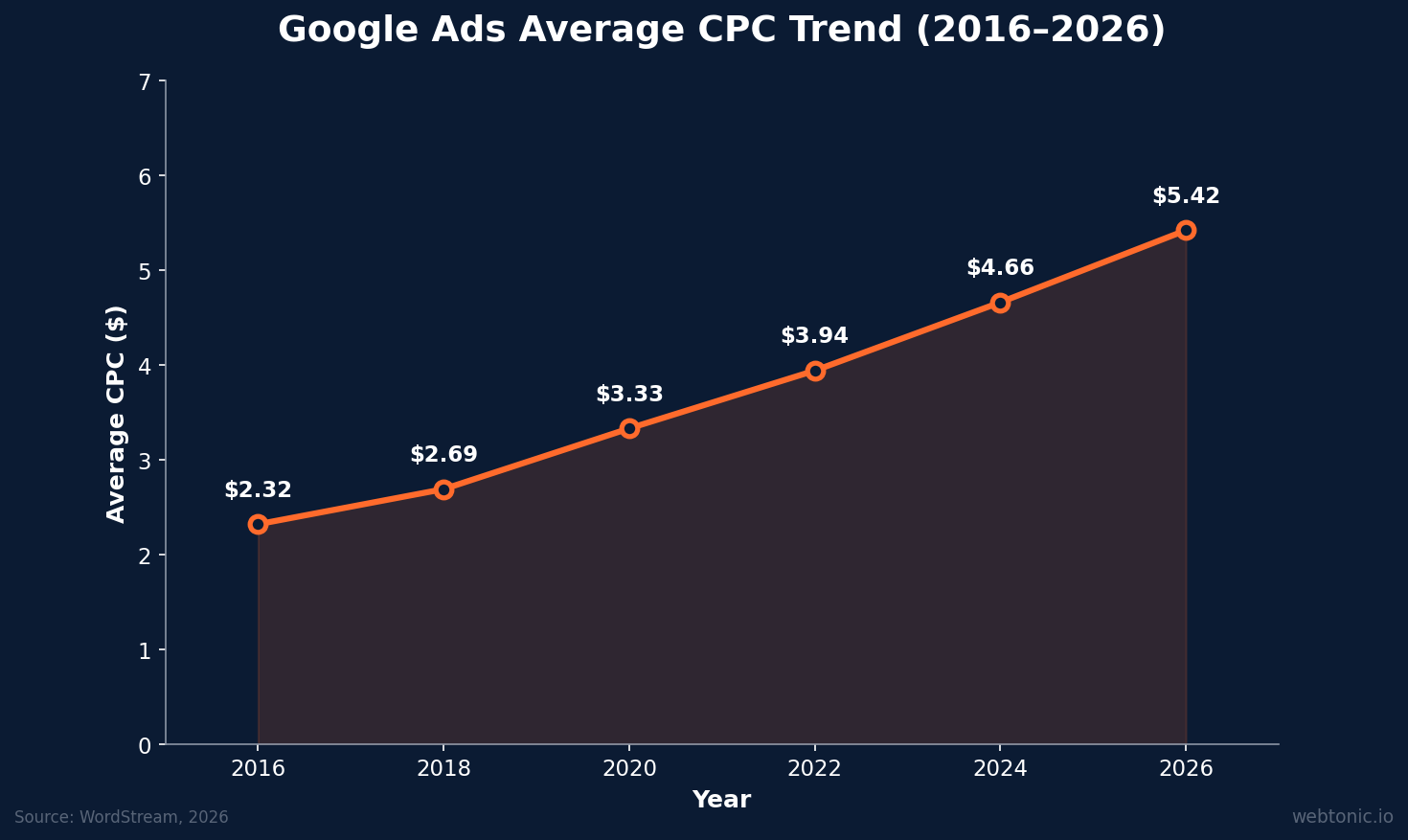
- $5.42 average CPC across all industries in 2026 — more than double the $2.32 average from 2016 (WordStream).
- $66.69 average cost per lead in 2026, down for the first time in five years (WordStream).
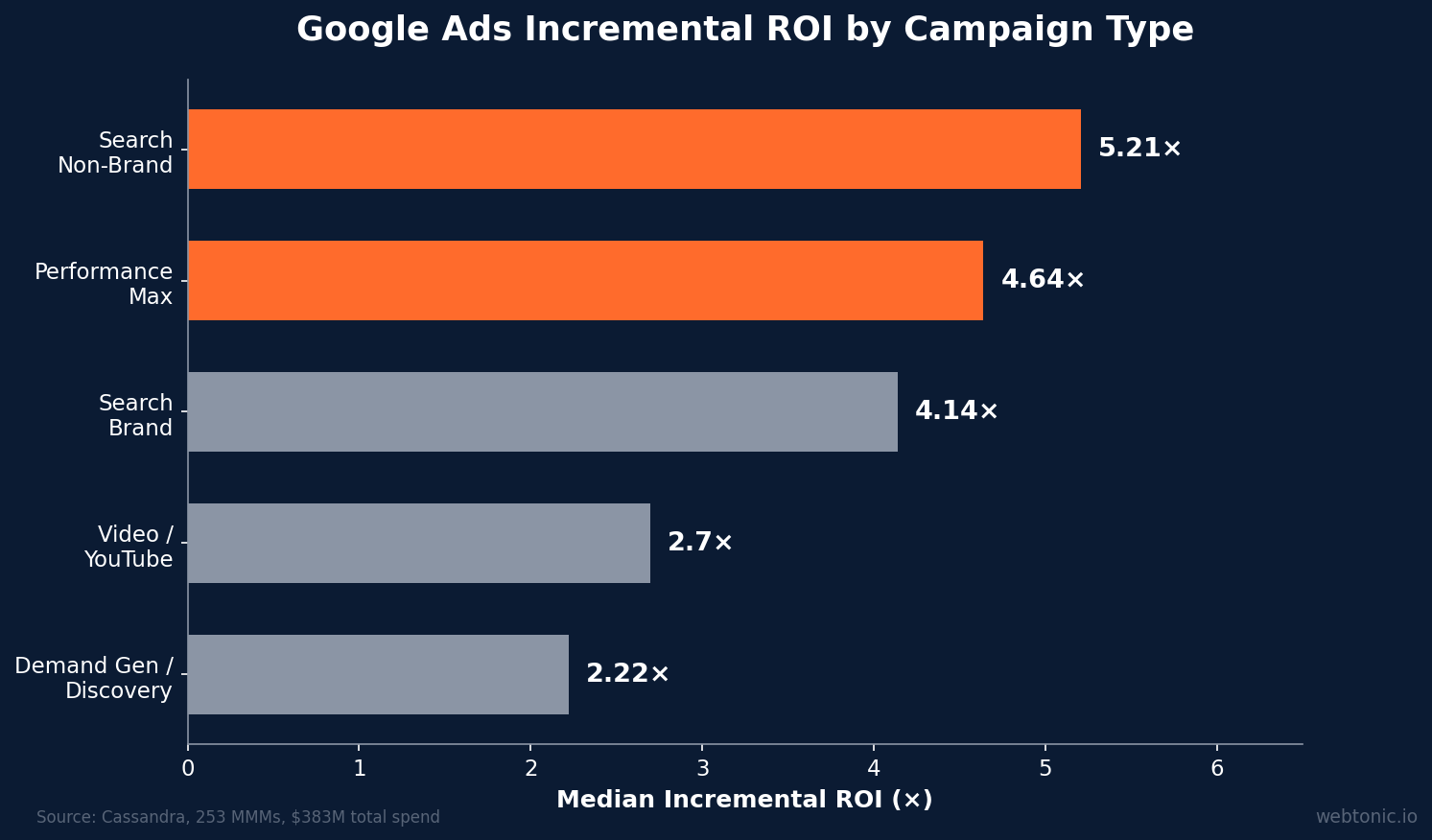
- Search Non-Brand campaigns deliver 5.21× incremental ROI — the highest among all Google Ads campaign types (Cassandra / MMM Analysis).
Franchise Google Ads Benchmarks at a Glance
| Metric | Value | Source |
|---|---|---|
| Brands using Google Ads as primary PPC | 96% | BizIQ / Statista, 2026 |
| Franchise PPC average ROI | 3.5× | BizIQ, 2026 |
| Avg. CPC (all industries) | $5.42 | WordStream, 2026 |
| Avg. cost per lead (all industries) | $66.69 | WordStream, 2026 |
| Avg. CTR (all industries) | 6.66% | WordStream, 2026 |
| LSA query share (Nov 2025) | 31% | BizIQ, 2026 |
| Google Ads brand awareness lift | 80% | BizIQ / Google, 2026 |
| Brands planning PPC budget increase | 64% | BizIQ, 2026 |
CPC, CPL, and Cost Trends
WordStream's 2026 Google Ads benchmark report analyzed over 13,000 search advertising campaigns across 23 industries and found that, for the first time in five years, average cost per lead has decreased. The 2026 CPL stands at $66.69, down from the 2025 peak — though still 13% higher than the $59.18 average measured in 2016 (WordStream).
Cost per click has more than doubled over the past decade, from $2.32 in 2016 to $5.42 in 2026. The industries seeing the largest CPL increases in 2026 align with tariff-impacted sectors (automotive, retail), while most other verticals held steady or improved.
For franchise-specific paid search, 39% of franchisors reported rising Google Ads lead costs in 2025 — with 32.5% seeing moderate increases and 6.5% reporting significant jumps. Google adoption for franchise development dropped from 87% to 75.6%, the largest year-over-year decline among major paid lead sources (Franchise Insights).
Local Services Ads and Franchise Growth
The most significant structural shift in franchise Google Ads is the rapid expansion of Local Services Ads (LSAs). At the start of 2025, LSAs appeared on roughly 11% of tracked queries. By November 2025, that figure reached 31% — nearly tripling in under a year (BizIQ).
LSAs are uniquely suited to franchise operations because they charge on a cost-per-lead basis rather than cost-per-click, reducing wasted spend on non-converting clicks. For home services franchises (HVAC, plumbing, electrical, pest control, cleaning), LSAs often appear above both organic results and traditional search ads, capturing the highest-intent traffic (RankWorks).
Key LSA advantages for franchise systems:
- Google Guaranteed / Google Screened badges build trust with consumers and create a competitive moat versus independent operators.
- Pay-per-lead model eliminates click waste — franchises pay only when a customer calls or messages through the ad.
- Location-level management allows each franchise territory to maintain its own LSA profile, reviews, and budget.
- Dispute mechanism lets franchisees flag irrelevant leads for credit, improving effective cost per qualified lead.
Campaign Type ROI Comparison
Cassandra's 2026 analysis of 253 Marketing Mix Models across 59 advertisers covering $383 million in total media spend provides the most rigorous view of incremental Google Ads ROI available. Unlike platform-reported ROAS, these figures measure what ad spend actually caused — isolated from cross-channel halo effects and attribution overlap (Cassandra).
| Campaign Type | Median Incremental ROI | Key Insight |
|---|---|---|
| Search Non-Brand | 5.21× | Highest true ROI — captures net-new demand |
| Performance Max | 4.64× | Most consistent — low variance across verticals |
| Search Brand | 4.14× | Highest in media and entertainment (10.92×) |
| Video / YouTube | 2.70× | Underpriced — competitive with Meta and TikTok |
| Demand Gen / Discovery | 2.22× | Requires careful measurement validation |
These incremental ROI figures are 2–5× lower than platform-reported ROAS because they strip out attribution inflation. For franchise systems making budget allocation decisions, incremental ROI is the more reliable signal.
Multi-Location Campaign Structure
Running Google Ads for multiple franchise locations is a fundamentally different problem than managing a single-location account. The structural decisions made at 5 locations compound into serious performance gaps at 20 and become nearly unmanageable at 100 if the foundation is wrong (GROAS).
Best practices for multi-location franchise Google Ads structure:
- Dedicated location campaigns — One campaign per location or market cluster provides independent budgets, tailored ad copy, location-specific landing pages, and clean performance data per geography. The tradeoff is management complexity.
- Location assets (formerly extensions) attach the nearest franchise address to ads but do not solve the structural problem — ad copy, landing pages, and budgets remain shared.
- Shared budgets should be avoided for multi-location franchise accounts. Google distributes shared budgets across campaigns algorithmically, often over-allocating to high-impression locations while starving smaller markets.
- Naming conventions are critical: include the location name or territory code in campaign, ad group, and ad names to enable scalable reporting and cross-location comparison.
Learn more about building a Google Ads strategy for multi-location brands, or explore Google Ads pricing to benchmark your franchise spend.
Conversion Rate and Quality Trends
WordStream's 2026 data shows that conversion rates increased for 87% of industries year over year — a strong signal that search ad traffic quality is improving even as costs rise. The average Google Ads CTR across all industries sits at 6.66%, with franchise campaigns in high-intent service categories frequently exceeding this benchmark (WordStream).
For franchise systems, conversion rate optimization hinges on several factors:
- Landing page localization — Sending clicks to location-specific pages (with local phone numbers, addresses, reviews, and team photos) dramatically improves conversion rates versus generic corporate pages.
- Call tracking and attribution — Franchise PPC campaigns should use call tracking numbers per location to measure the full conversion path from click to phone call to booked appointment or sale.
- Offline conversion imports — Uploading CRM or POS data back to Google Ads allows Smart Bidding to optimize for downstream revenue rather than surface-level conversions like form fills.
Budget Allocation and Strategic Recommendations
Paid ads receive 39% of the average franchise marketing budget — the single largest line item — but deliver only 81% ROI, trailing both email/SMS (595%) and local SEO (274%) (NP Digital). Despite this, 64% of franchise brands plan to increase PPC budgets in 2026, driven by consumer interest in franchising hitting record levels (BizIQ).
Strategic budget recommendations for franchise Google Ads:
- Invest in LSAs aggressively for service-based franchises. The pay-per-lead model and growing query share make LSAs the highest-efficiency Google Ads format for local franchise lead generation.
- Prioritize Search Non-Brand campaigns — they deliver the highest incremental ROI (5.21×) and capture genuinely new demand, unlike brand campaigns that often cannibalize organic traffic.
- Test Performance Max for franchise consumer acquisition. Its 4.64× incremental ROI and low variance make it a reliable scaling vehicle, though search term transparency remains limited.
- Rebalance toward higher-ROI channels. Industry practitioners recommend shifting from a 70/30 digital-to-local split to 60/40, increasing local execution budgets while optimizing remaining PPC spend.
- Use AI-powered bidding (Target CPA, Target ROAS) with sufficient conversion data per location — Google recommends 30+ conversions per month per campaign for optimal Smart Bidding performance.
Ready to optimize your franchise PPC program? Contact Web Tonic for a growth marketing consultation or explore our Google Ads agency services.
AI and Smart Bidding for Franchise Accounts
AI-powered bidding strategies have become the default for franchise Google Ads management. Google's Smart Bidding algorithms (Target CPA, Target ROAS, Maximize Conversions) use machine learning to adjust bids in real time based on hundreds of signals including device, location, time of day, audience list membership, and search query context.
Key considerations for franchise Smart Bidding deployment:
- Conversion volume threshold — Google recommends a minimum of 30 conversions per month per campaign for Smart Bidding to perform optimally. Franchise locations with low search volume may need to consolidate campaigns or use portfolio bidding strategies across multiple territories to meet this threshold.
- Offline conversion integration is essential for franchise businesses where the final transaction happens in-store or over the phone. Without offline conversion data, Smart Bidding optimizes for online form fills — which may not correlate with actual revenue. Franchises using offline conversion imports report 15–25% lower cost per acquisition versus online-only optimization.
- 48% of franchise brands have integrated AI into at least one marketing workflow (Vendasta), with bid management and campaign optimization being top use cases.
- Performance Max adoption is accelerating across franchise systems because it automates campaign management across Search, Display, YouTube, Gmail, Discover, and Maps — reducing the operational burden of managing separate campaign types per location. Its 4.64× incremental ROI and low variance make it particularly suitable for franchise scaling.
Industry-Specific Google Ads Benchmarks for Franchise Verticals
Franchise Google Ads performance varies dramatically by industry vertical. Understanding where your franchise category sits relative to all-industry averages is critical for setting realistic targets and identifying optimization opportunities.
| Franchise Vertical | Typical CPC Range | Conversion Rate | Primary Ad Format |
|---|---|---|---|
| Home Services (HVAC, plumbing) | $8–$18 | 4–7% | LSAs + Search Non-Brand |
| Quick-Service Restaurants | $1.50–$4 | 5–9% | Performance Max + Local campaigns |
| Fitness & Wellness | $3–$8 | 4–6% | Search + Video / YouTube |
| Automotive Services | $4–$12 | 5–8% | LSAs + Search |
| Education & Tutoring | $3–$9 | 3–5% | Search + Demand Gen |
| Senior Care | $10–$25+ | 3–5% | Search Non-Brand + LSAs |
Ranges based on aggregated data from WordStream (2026), BizIQ, and industry reports. Actual franchise results depend on local competition, landing page quality, and bidding strategy.
Franchise systems in high-CPC verticals (legal, senior care, home services) benefit most from Local Services Ads because the pay-per-lead model eliminates click waste on non-converting search traffic. Lower-CPC verticals like QSR and retail franchise brands often find more value in Performance Max campaigns that leverage Google's display, video, and discovery inventory alongside search. For franchise marketers evaluating which digital advertising channels deserve more budget, cross-referencing these vertical benchmarks with actual account data reveals the clearest optimization path. Explore data intelligence services to benchmark your franchise advertising against industry standards.
FAQ
What is the average CPC for franchise Google Ads campaigns?
The average Google Ads CPC across all industries in 2026 is $5.42, according to WordStream's benchmark report analyzing 13,000+ campaigns. Franchise-specific CPCs vary by vertical — home services and legal franchises typically see higher CPCs ($8–$15+), while food service and retail franchises often pay below the all-industry average.
Are Local Services Ads worth it for franchise businesses?
Yes. LSAs now appear on 31% of tracked queries for service-based searches, up from 11% in early 2025. They charge per lead rather than per click, carry Google Guaranteed trust badges, and allow location-level management — making them one of the most efficient Google Ads formats for franchise lead generation.
What ROI should franchise businesses expect from Google Ads?
Franchise PPC campaigns average a 3.5× ROI (BizIQ). Cassandra's Marketing Mix Model analysis found that Search Non-Brand delivers 5.21× incremental ROI and Performance Max delivers 4.64×. Platform-reported ROAS is typically 2–5× higher than true incremental ROI due to attribution inflation.
How should franchises structure Google Ads for multiple locations?
Use dedicated campaigns per location or market cluster with independent budgets, location-specific landing pages, and tailored ad copy. Avoid shared budgets, which prevent location-level optimization. Include territory codes in naming conventions for scalable reporting.
Why did franchise Google Ads usage decline in 2025?
Franchise Insights reports that Google Ads usage for franchise development dropped from 87% to 75.6% in 2025, the largest decline among major paid sources. Rising cost per lead (39% of franchisors reported increases) drove franchisors to diversify toward Meta, directories, and broker networks.
Sources
wordstream.com/blog/2026-google-ads-benchmarks
biziq.com/blog/franchise-marketing-statistics-2026/
franchiseinsights.com — Changes in Cost Per Lead for Franchise Lead Sources
rankworks.com — Google LSAs for Home Services Franchises
cassandra.app/blog/google-ads-benchmarks-2026
groas.com — Multi-Location Google Ads Strategy Guide
staging.neilpatel.com/marketing-stats/franchise-marketing-channel-roi/
franchisefasttrack.io — How to Reduce Franchise Development Cost Per Lead
vendasta.com/blog/ai-for-franchise-marketing/


