Table of contents

Quick answer: Scope an investor-ready growth plan around a named audience and deadline, an evidence standard tied to source systems, a labelled assumptions register, the board advisor's exact role, and a written diligence test the plan must pass.
Last verified: 2026-09-30
What "investor-ready" actually means
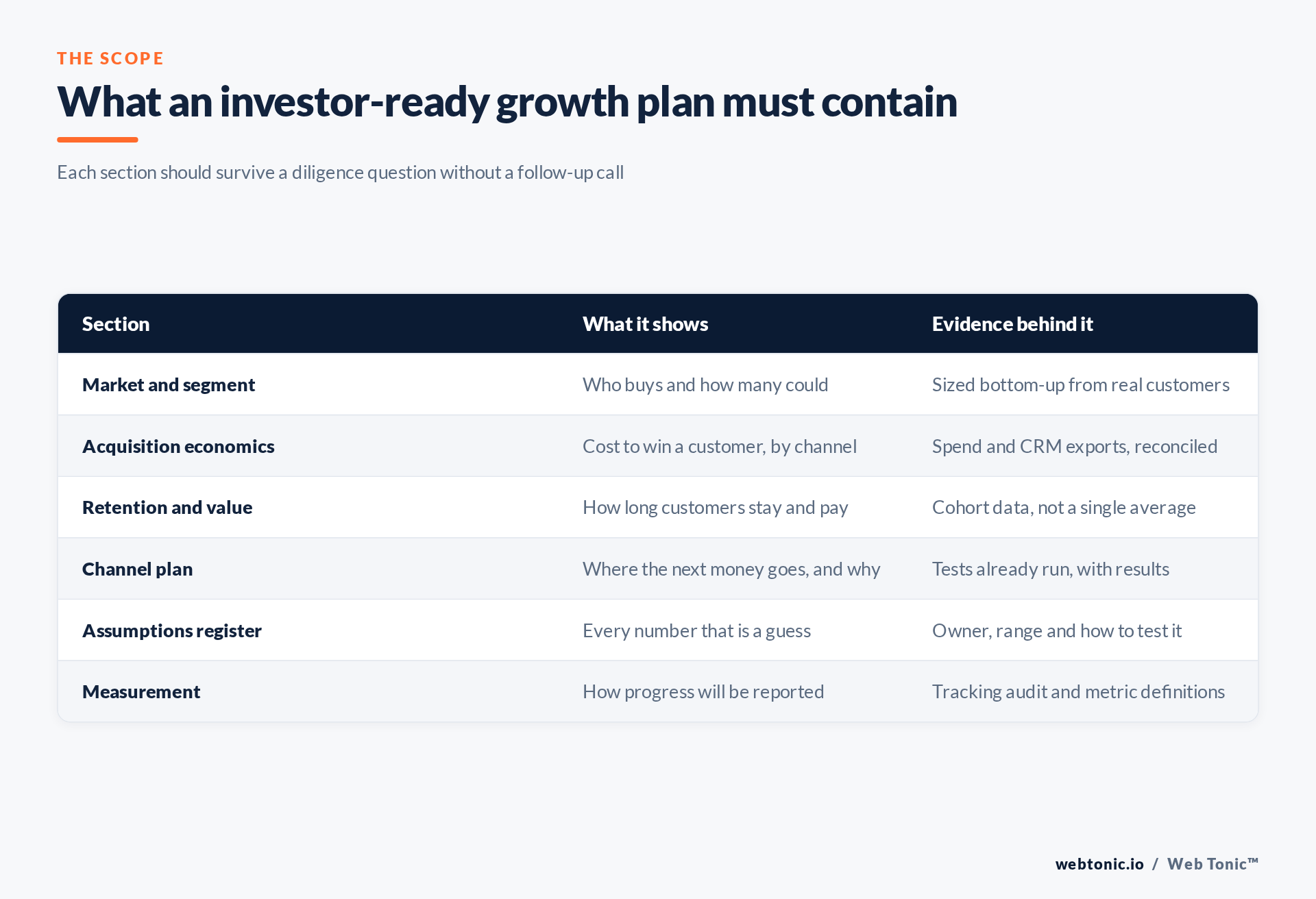
A growth plan for investors is not a longer marketing plan. It is a document that has to survive due diligence: a reader who is actively looking for the weak number, the unsupported claim and the channel that only works at today's spend. The engagement that produces it is usually led by a board marketing advisor or fractional executive working with the founder.
That changes the scope. An ordinary strategy engagement is judged on whether the plan works. An investor-ready plan is also judged on whether each claim can be traced to evidence. Scoping has to settle, in advance, how much evidence is enough and who produces it.
Step 1 — Name the audience and the moment
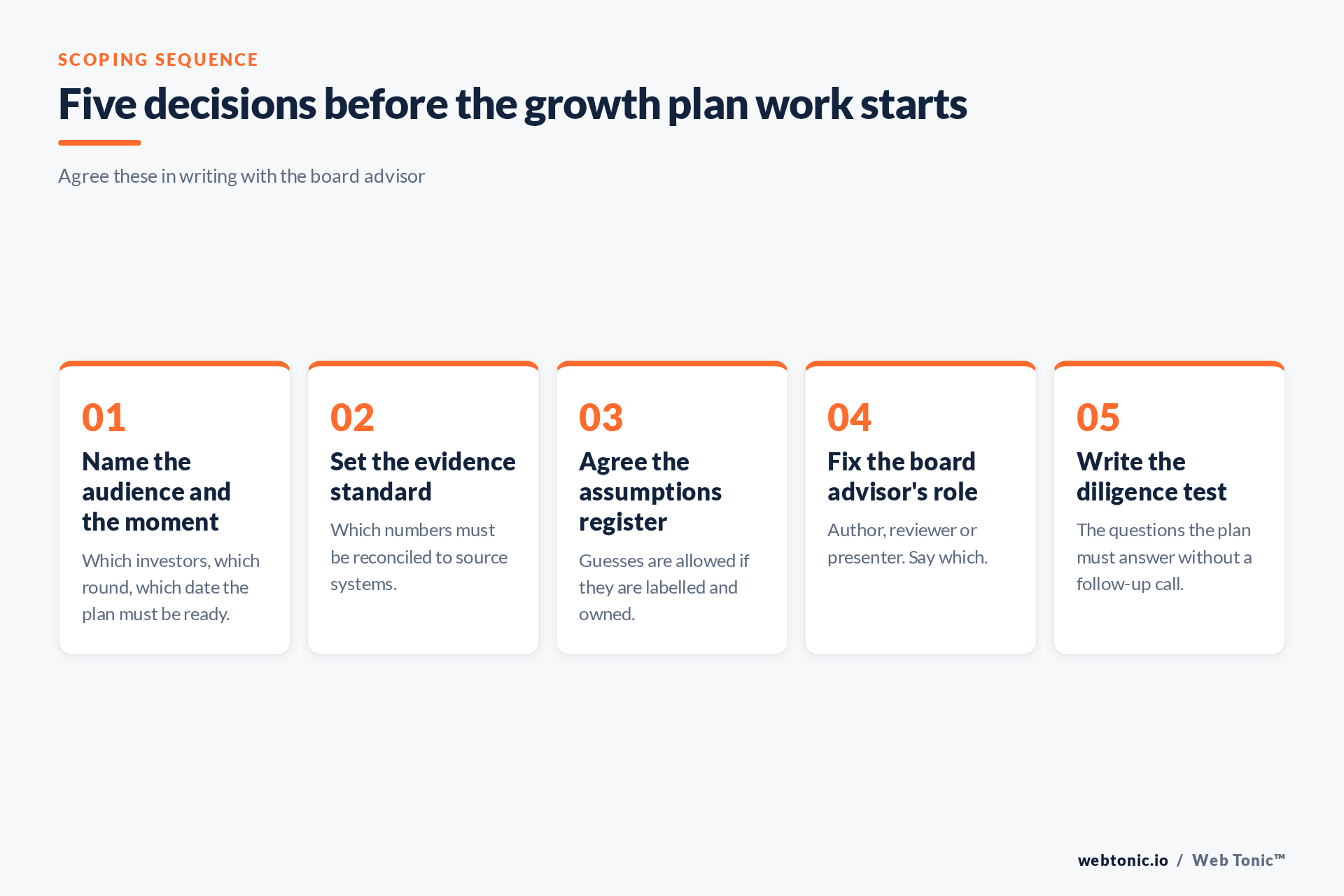
Write down who the plan is for and when it must be ready: an existing board ahead of a budget cycle, new venture investors ahead of a round, or a strategic acquirer. Each audience weighs different sections. A growth-stage investor will probe acquisition economics and retention; an existing board will care more about what changes from the last plan. The deadline matters because the evidence work, not the writing, is what takes time.
Step 2 — Set the evidence standard
Decide which numbers must reconcile to source systems. At minimum that usually means spend, customers won, revenue and retention. Customer acquisition cost and lifetime value are the two figures most often challenged in diligence, because they are easy to flatter by choosing what to include. State the calculation method in the scope, so the advisor and the finance lead compute them the same way.
If the tracking is unreliable, the scope must include fixing it or clearly marking the affected numbers. Channel-level figures depend on consistent event definitions, such as Google's recommended GA4 events. Our analytics audits usually start the evidence work.
| Scope item | Weak scope says | Diligence-ready scope says |
|---|---|---|
| Audience | "Investors" | Named round, named date, existing board copied |
| Market size | Top-down industry figure | Bottom-up from current customer profile and price |
| Acquisition cost | Blended, method unstated | By channel, method written, reconciled to spend |
| Retention | One average churn figure | Cohort view, logo and revenue separately |
| Assumptions | Embedded in the model | Listed, ranged, owned, with a test for each |
| Advisor role | "Supports the plan" | Authors growth sections; founder presents |
Step 3 — Agree an assumptions register
Every growth plan contains guesses: future conversion rates, the cost of a channel not yet tested, the size of a new segment. Investors expect that. What damages credibility is a guess presented as a fact. Scope a separate assumptions register listing each assumption, its range, its owner and how it will be tested. It turns the weakest part of the plan into evidence of discipline.
Market sizing belongs here too. A total addressable market built bottom-up from your real customer profile holds up far better than a top-down industry figure.
Step 4 — Fix the board advisor's role
State whether the advisor authors the growth sections, reviews the founder's draft, or presents to investors. Most founders want the advisor to author and the founder to present, because investors are backing the founder. If the advisor will join investor calls, say so and agree how questions are handed over. Clarity here also matters for governance: the board should know who stands behind which numbers.
Step 5 — Write the diligence test
List the ten or so questions the plan must answer without a follow-up call. Typical ones: which channel would you cut first and why, what happens to acquisition cost at double the spend, and which customer cohort retains best. The engagement is done when the plan answers them from its own pages. That list is also the most honest acceptance test you can put in a business plan engagement contract.
If customer data will be shared in a data room, the scope should name who checks it for personal data and GDPR obligations before upload.
What goes wrong
The failure mode: the engagement is scoped as a writing job, and the evidence work is discovered late. Two weeks before the round, the team learns that acquisition cost by channel cannot be reconciled to spend, and the plan ships with numbers nobody can defend. Scope the evidence first and the writing second.
A second failure is scoping diligence-ready marketing claims for channels that have never been tested. If the plan relies on a channel you have not run, the honest answer is a small, measured test before the round, which is the kind of work our growth marketing team runs. More help pages are on the Web Tonic blog.
Frequently Asked Questions
How far ahead of a round should this start?
Early enough to fix measurement gaps before writing, which usually means a few months rather than a few weeks. The evidence work sets the timeline.
Should the plan include a full financial model?
The growth plan should feed the financial model, not replace it. Finance owns the model; the plan supplies channel, conversion and retention inputs with their assumptions labelled.
Can we include projections for untested channels?
Yes, if they sit in the assumptions register with a range and a planned test. Presenting them as expected results is what diligence punishes.
Who should own the assumptions register?
Each assumption needs a named owner, usually the person whose team will test it. The advisor maintains the register as a whole.
Sources: Due diligence, Customer acquisition cost, Customer lifetime value, Total addressable market, Board of directors (Wikipedia); GA4 recommended events; GDPR.eu. Verified 2026-09-30.