Table of contents
Quick answer: Run the first SaaS fractional CMO session as a diagnosis, not a planning day. Send a subscription data pack 48 hours ahead, work through revenue, funnel leaks, customer voice and exclusions, and leave with three written outputs.
Last verified: 2026-09-30
What the first session is for
The first strategy session with a part-time CMO sets the tone for the whole engagement. In a SaaS company the temptation is to jump straight to channels and campaigns. That is usually premature. The first session's job is to agree on where revenue actually comes from, where the funnel leaks, and what the company will deliberately not do this quarter. The plan comes afterwards, informed by what the session surfaces.
Subscription businesses make this easier than most, because the key numbers already exist: recurring revenue, churn and acquisition cost. The work is getting them into one room, defined the same way, before anyone argues about tactics.
Step 1 — Send the data pack 48 hours ahead
A fractional CMO has limited days, so the session should not be spent discovering what data exists. Send the pack two working days before. Rough is fine; missing is not. If a number cannot be produced, write "not tracked" next to it, because that gap is itself a finding.
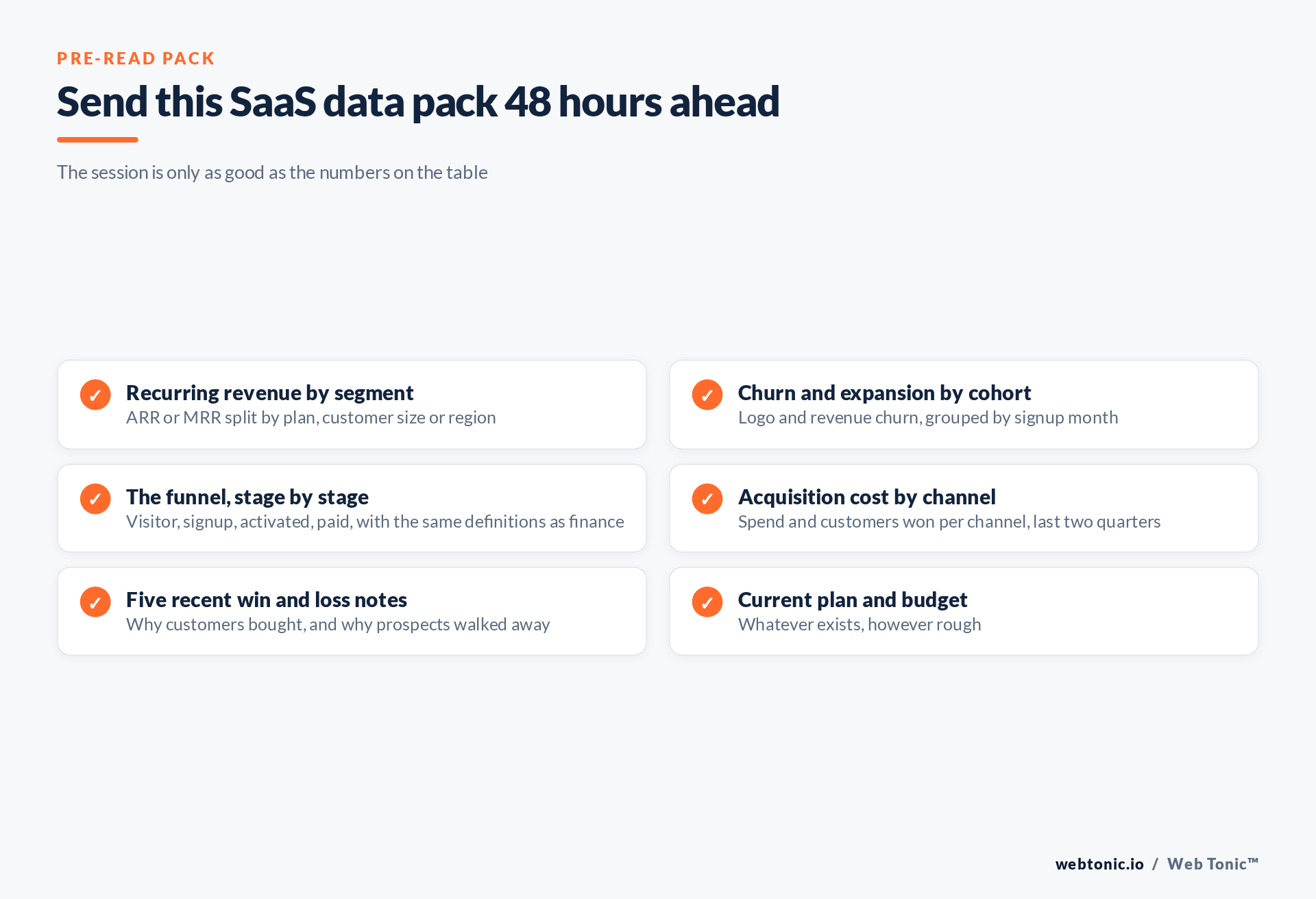
The funnel section is where definitions matter most. If "activated" means one thing in the product analytics tool and another in the board deck, flag it in the pack. Google's guidance on recommended GA4 events and on conversion windows is useful context when paid acquisition numbers do not match what the CRM shows. Our analytics team sees this mismatch more than any other.
Step 2 — Agree who is in the room
Keep it small: the CEO or founder, the heads of sales and product (or whoever owns the product-led funnel), and the fractional CMO. Customer success should join for the retention block. More people turn a diagnosis into a status meeting.
| Agenda block | Question to answer | Who leads |
|---|---|---|
| Revenue sources | Which segments and cohorts retain and expand? | Founder or finance |
| Funnel leaks | Which stage converts worst against its definition? | Fractional CMO |
| Customer voice | Do the reasons customers buy match our messaging? | Sales and customer success |
| Exclusions | What are we explicitly not doing this quarter? | CEO |
| Measurement gaps | Which numbers could we not produce, and who fixes them? | Fractional CMO |
Step 3 — Work the four agenda blocks
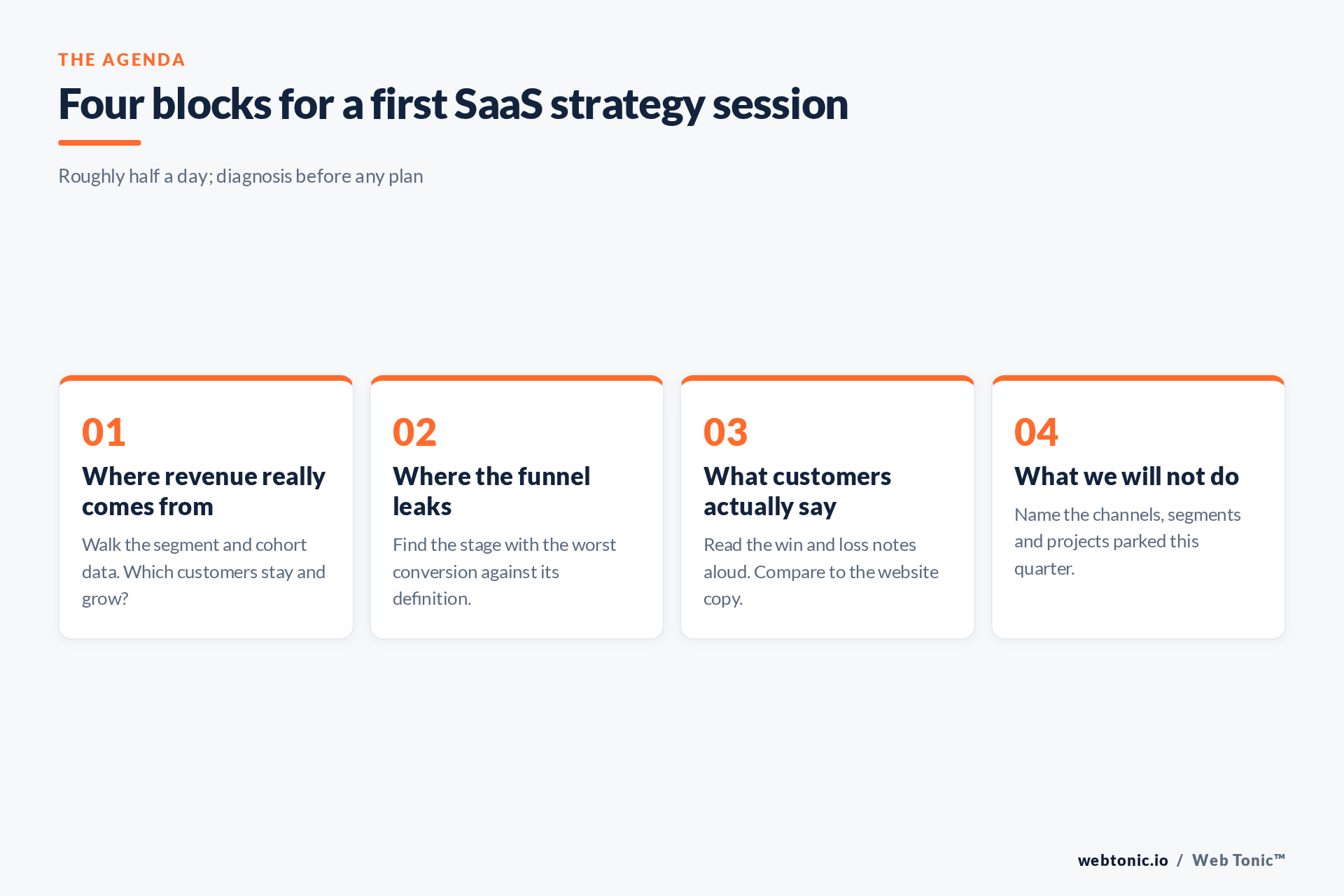
Revenue sources. Start with the segment and cohort data, not the funnel. The most useful early insight in SaaS is often that one segment retains and expands far better than the rest, which reshapes positioning and targeting before any campaign changes.
Funnel leaks. Walk each stage and find the worst conversion relative to its own definition. A leak at activation is a product and onboarding problem as much as a marketing one, which is why the head of product needs to be present.
Customer voice. Read the win and loss notes aloud and compare them to the homepage. This is a lightweight form of voice-of-the-customer work, and it regularly shows that customers buy for a reason the website barely mentions.
Exclusions. End by naming what is parked: channels, segments, a rebrand, a new market. Senior marketing leadership is as much about what gets refused as what gets funded.
Step 4 — Leave with three outputs
Close the session only when three things are written down: a one-paragraph diagnosis, a short list of ranked priorities for the quarter with one owner each, and a measurement fix list for the numbers nobody could produce. These become the first draft of the quarter's objectives; many SaaS teams format them as OKRs. The fractional CMO turns them into a dated plan within a week.
If you sell into the EU and the measurement fixes involve new tracking or lifecycle email, note the consent implications under the GDPR on the fix list rather than discovering them at launch.
What goes wrong
The failure mode: the session becomes a channel brainstorm. Someone asks "should we be on this platform?", the room debates tactics for an hour, and nobody looks at the cohort data. Channel choices made before the revenue diagnosis tend to optimise signups from segments that churn. Hold the agenda order.
The second failure is treating the session as a pitch. A fractional CMO who arrives with a finished plan before seeing your data is selling a template. Diagnosis first is the signal of a serious operator. If the diagnosis points to tracking or data problems, our data intelligence guides cover the fixes, and more help pages sit on the Web Tonic blog.
Frequently Asked Questions
How long should the first session be?
Roughly half a day for the core agenda. Longer sessions tend to drift into tactics; shorter ones rarely get through the cohort data properly.
Should the session happen in person?
In person helps for the first one, but remote works if the data pack is sent ahead and one person keeps the written outputs in a shared document.
What if we cannot produce churn by cohort?
Say so in the pack. Missing cohort data becomes the first item on the measurement fix list, and the session works from overall churn in the meantime.
When should the full plan arrive?
Within about a week of the session, built from the diagnosis and ranked priorities agreed in the room.
Sources: Annual recurring revenue, Churn rate, Customer acquisition cost, Voice of the customer, OKR (Wikipedia); GA4 recommended events, Google Ads conversion windows; GDPR.eu. Verified 2026-09-30.