Table of contents
US podcast advertising revenue reached USD 2.9 billion in 2025, up 17.6%, and 58% of Americans aged 12+ now consume a podcast every month. This page collects the reach, cost and engagement benchmarks behind that market, each tied to the named study and year it comes from.
Key Takeaways
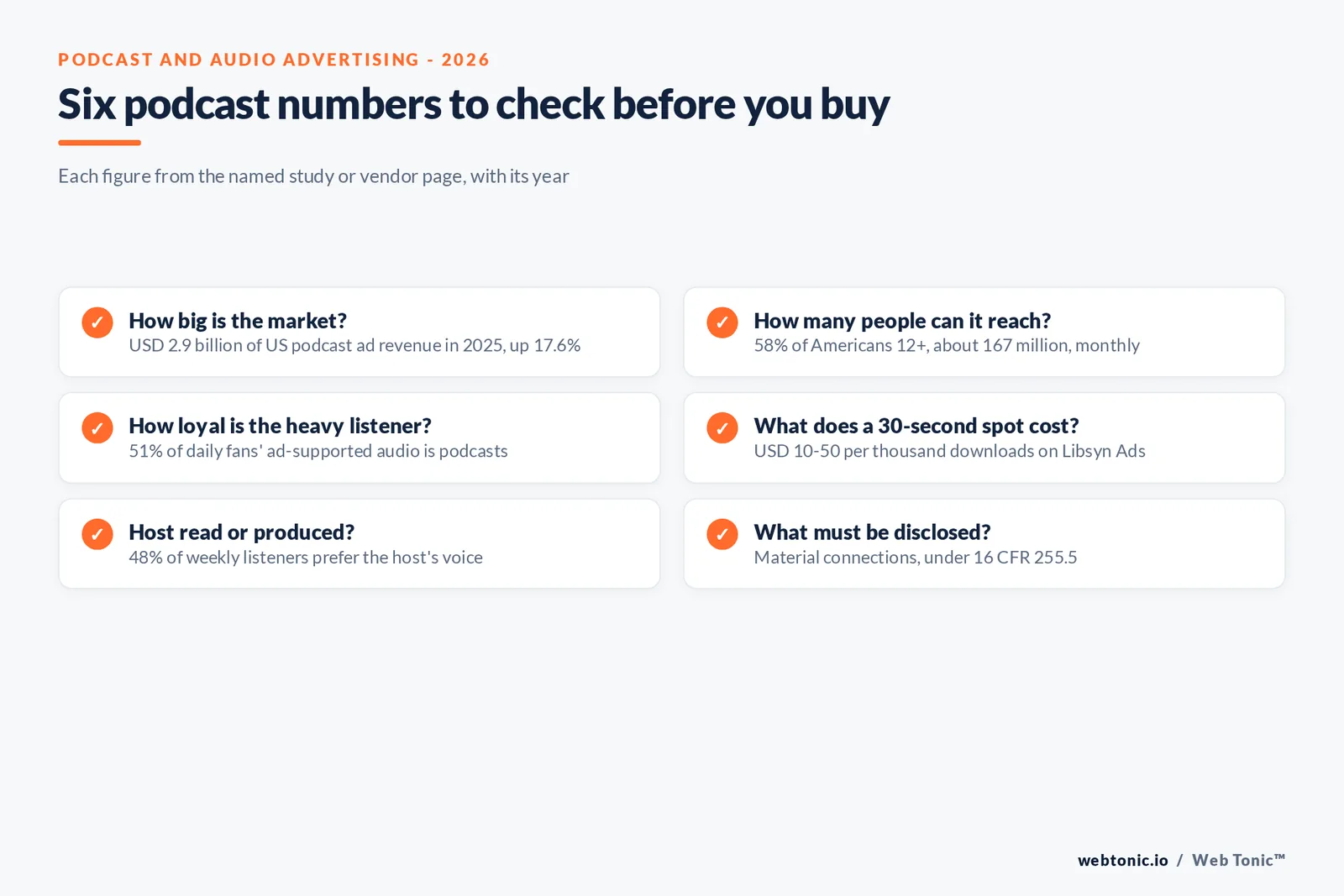
- US podcast ad revenue hit USD 2.9 billion in 2025, up 17.6% (IAB/PwC).
- 2024 growth was 26.4%, after just 5% in 2023.
- Total US digital audio ad revenue reached USD 8.4 billion in 2025.
- 58% of Americans 12+, about 167 million, consume podcasts monthly (Edison 2026).
- 68% of 35-54-year-olds are monthly podcast consumers.
- Daily podcast consumers spend 51% of ad-supported audio time with podcasts.
- 76% of weekly podcast consumers have acted on a podcast ad.
- A 30-second spot runs about USD 10-50 per thousand downloads on Libsyn Ads.
- 48% of weekly listeners prefer host-read ads (Cumulus/Signal Hill, 2022).
Podcast advertising benchmarks at a glance
The table collects the headline figure for each metric a buyer or publisher usually quotes. Periods differ because the studies run on different cycles; vendor figures are labelled as such.
| Metric | Benchmark | Issuer | Period |
|---|---|---|---|
| US podcast ad revenue | USD 2.9 billion (+17.6%) | IAB/PwC | Full-year 2025 |
| Monthly podcast consumers, 12+ | 58% (167 million) | Edison Infinite Dial | January 2026 |
| Weekly podcast consumers, 12+ | 45% (130 million) | Edison Infinite Dial | January 2026 |
| Podcast share of ad-supported audio, all 13+ | 16% | Edison Share of Ear | Q1 2026 |
| 30-second spot CPM range | USD 10-50 | Libsyn Ads (vendor) | Current page |
| Self-serve audio entry budget | USD 250 | SiriusXM Media AudioGo (vendor) | Current page |
Ad revenue: a decade of growth
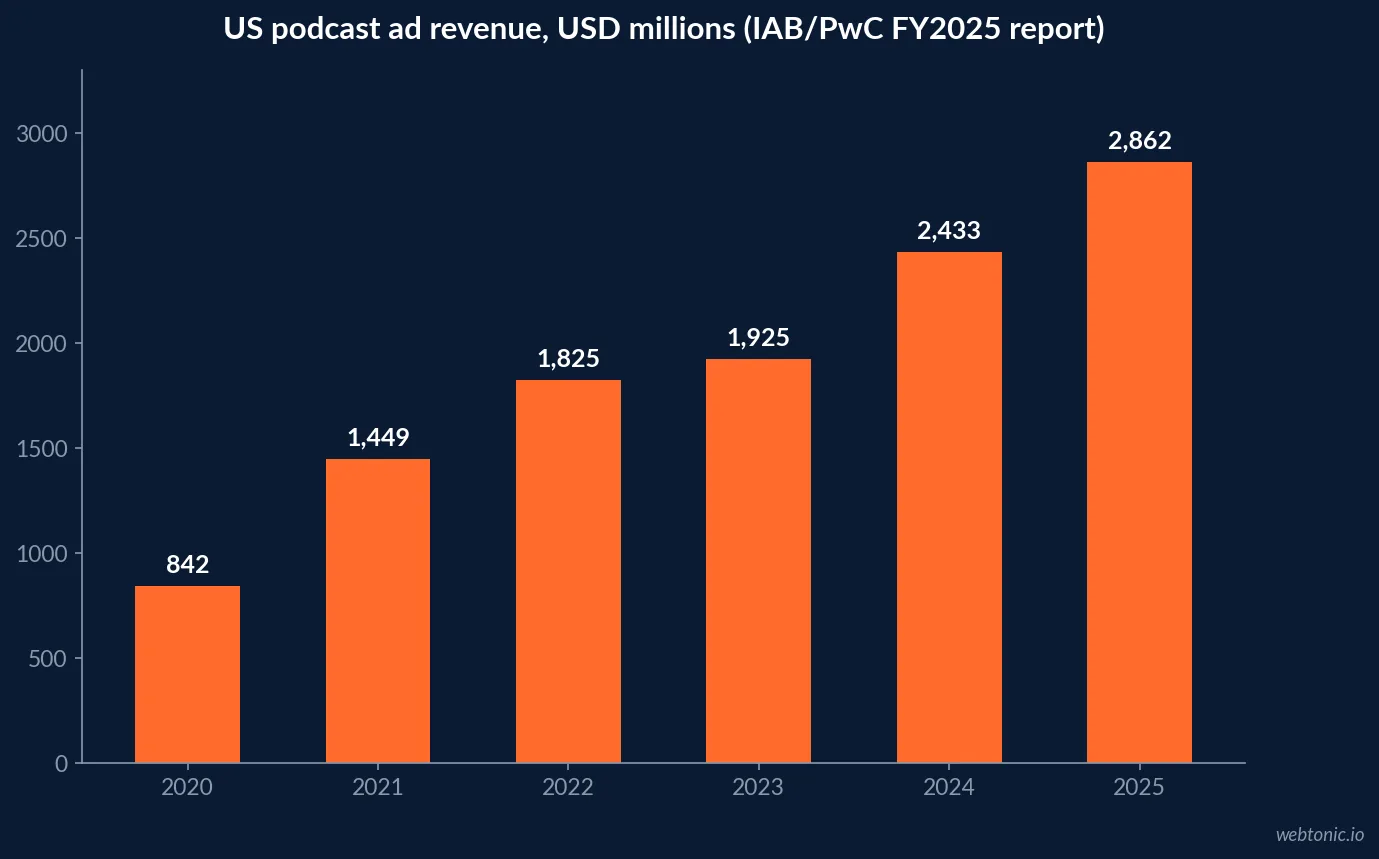
The IAB/PwC Internet Advertising Revenue Report for full-year 2025, published in April 2026, puts US podcast advertising at USD 2,862.2 million in 2025, up 17.6% from USD 2,433.1 million in 2024. Growth in 2024 had been 26.4%, helped by political advertising, after a slow 2023. Ten years earlier, in 2015, the market was USD 105.7 million.
The same report puts all US digital audio, podcasts plus streaming music and radio, at USD 8.4 billion in 2025, so podcasts are roughly a third of digital audio revenue. IAB notes it still uses the traditional audio definition of a podcast even as video becomes the leading way podcasts are consumed.
| Year (IAB/PwC) | US podcast ad revenue | Year-on-year change |
|---|---|---|
| 2019 | USD 708.1 million | Not restated |
| 2020 | USD 842.3 million | +19% |
| 2021 | USD 1,448.7 million | +72% |
| 2022 | USD 1,825.3 million | +26% |
| 2023 | USD 1,925.2 million | +5% |
| 2024 | USD 2,433.1 million | +26.4% |
| 2025 | USD 2,862.2 million | +17.6% |
Forecasts versus what happened
Forecasts in this channel have swung. IAB's dedicated podcast revenue study published in May 2024 projected 12% growth to just over USD 2 billion in 2024 and nearly USD 2.6 billion by 2026. Actual 2024 revenue came in at USD 2.43 billion and 2025 at USD 2.86 billion, already above the 2026 projection. A 2023 Nielsen article cited an earlier IAB forecast of roughly USD 4 billion by 2025, which the market did not reach.
The lesson for planners is to budget on reported revenue and audience data, and to treat multi-year channel forecasts as directional. The 2023 slowdown shows why: IAB attributed the 5% growth that year to a difficult ad market that hit mid-tier publishers hardest, and the rebound that followed was partly driven by a one-off election cycle. A budget built on the 2024 growth rate alone would overstate what a normal year looks like.
Reach: the audience in 2026
Edison Research's Infinite Dial 2026, a January 2026 national survey of 2,050 Americans aged 12+, found 80% (230 million) have ever consumed a podcast, 58% (167 million) in the last month and 45% (130 million) in the last week, all record highs. Among 35 to 54-year-olds, monthly consumption reached 68%, and 57% of Americans 12+ have both listened to and watched a podcast.
Edison's Podcast Consumer 2026 report adds that video consumption overtook audio-only in Q3 2025 Edison Podcast Metrics, with 82% of weekly consumers actively watching video podcasts against 78% listening to audio only.
| Monthly podcast consumption by age (Edison, 2026) | Share consuming in last month |
|---|---|
| Age 12-34 | 64% |
| Age 35-54 | 68% |
| Age 55+ | 44% |
| Total 12+ | 58% |
Online audio beyond podcasts
Podcasts sit inside a larger online audio audience. The Infinite Dial 2026 found 81% of Americans aged 12+ (233 million) listened to online audio in the last month and 76% (219 million) in the last week. The recent growth comes from older listeners: monthly online audio listening among Americans 55+ rose from 52% in 2024 to 70% in 2026, a gain of nearly 20 points in two years.
For media planning, that means streaming-audio inventory sold by Spotify, SiriusXM/Pandora or iHeartRadio now reaches an older, higher-income audience than it did two years ago, while podcast reach remains strongest among 35 to 54-year-olds.
| Online audio reach (Edison Infinite Dial 2026) | Share of Americans 12+ | Estimated people |
|---|---|---|
| Online audio, last month | 81% | 233 million |
| Online audio, last week | 76% | 219 million |
| Podcast, ever | 80% | 230 million |
| Podcast, last month | 58% | 167 million |
| Podcast, last week | 45% | 130 million |
Share of ear: time spent with audio
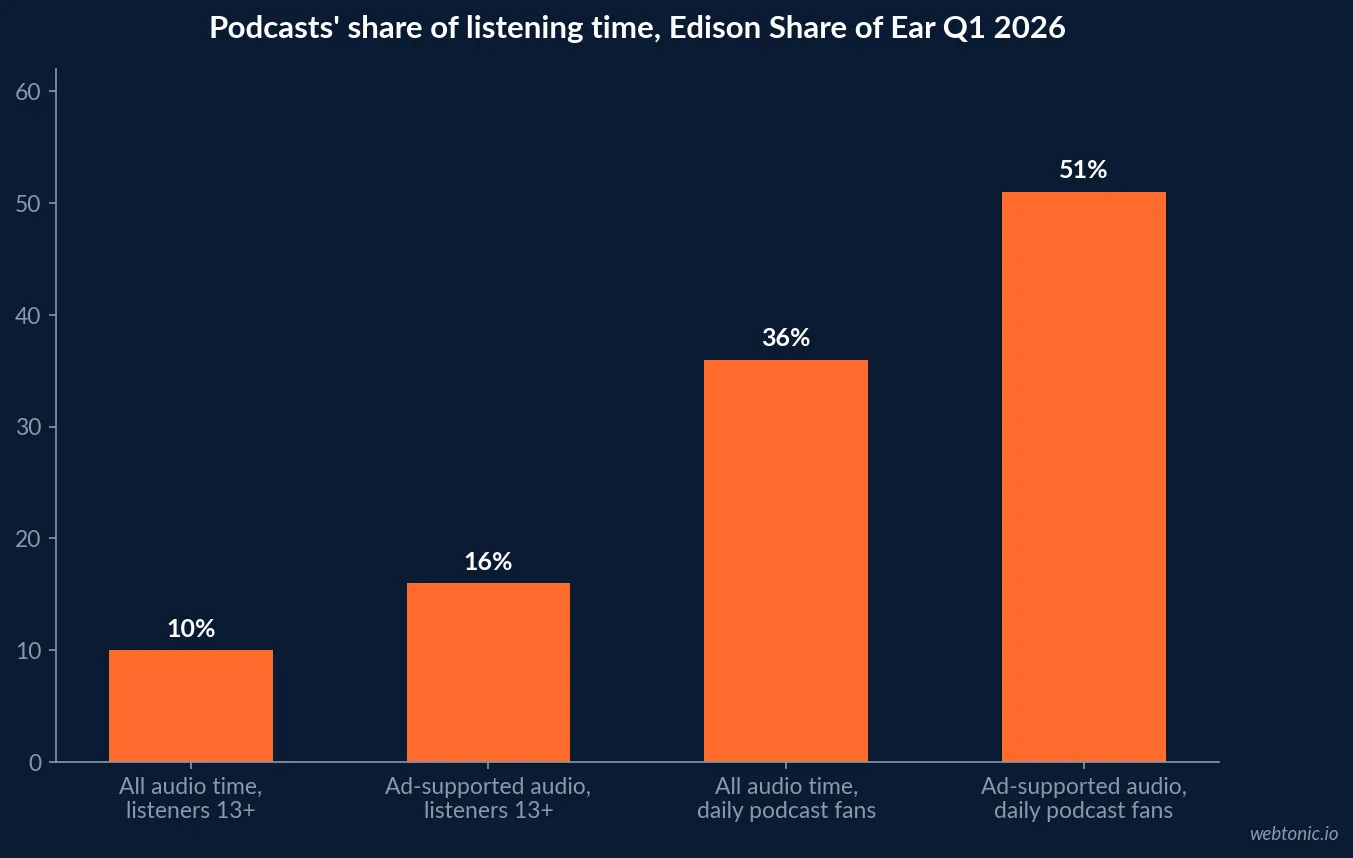
The Podcast Consumer 2026 report, citing Edison's Share of Ear for Q1 2026, puts daily audio time at 3 hours 57 minutes for Americans 13+ and 5 hours 11 minutes for daily podcast consumers. Podcasts take 10% of all audio time and 16% of ad-supported audio time across listeners 13+.
Among daily podcast consumers the shares jump to 36% of all audio time and 51% of ad-supported audio time. For an advertiser, that is the core argument: the heaviest podcast listeners spend most of their ad-supported listening inside podcasts.
Cost: published rate cards and entry floors
No neutral body publishes a market-wide podcast CPM. The most-cited public rate card is the marketplace run by Libsyn Ads (formerly AdvertiseCast), which says a typical 30-second spot costs USD 10 to 50 per thousand downloads, with 10 or 15-second spots cheaper and 60-second spots more expensive, and higher CPMs for business and entrepreneur audiences. Rates are usually based on average downloads per episode within 30 days.
Self-serve tools lower the entry point. SiriusXM Media says its AudioGo platform lets brands set budgets as low as USD 250, with voice actors from USD 10 and up to 221 interest and persona targets. Amazon Ads sells audio ads on a CPM basis through managed service or self-service Amazon DSP, with programmatic access to Wondery podcast inventory.
| Buying route (vendor pages) | Price basis | Entry point |
|---|---|---|
| Marketplace host-read or produced spot (Libsyn Ads) | CPM on 30-day downloads | USD 10-50 CPM for 30 seconds |
| Self-serve audio (SiriusXM Media AudioGo) | Bid-based CPM | USD 250 budget |
| Programmatic podcast (Amazon DSP, Wondery) | CPM | Self-service DSP or managed |
| Custom host-read sponsorship (networks) | Negotiated | Contact sales |
Engagement: action, recall and host reads
The Podcast Consumer 2026 reports that 76% of weekly podcast consumers aged 13+ have taken an action after hearing a podcast ad, such as visiting a website, recommending a product, using a promo code or buying. A Nielsen media-mix case in the same report found shifting 5% of a USD 42 million pharmaceutical plan into podcasts lifted 18-54 reach by 41% with no budget increase.
Nielsen wrote in 2023 that podcast ads can lift brand awareness by 13 percentage points, but only 49% of marketers were extremely or very confident in measuring podcast ROI, the lowest of any digital channel. In the Cumulus Media and Signal Hill Podcast Download survey from October 2022, 48% of weekly listeners preferred host-read ads and 76% said they had acted on a podcast ad.
Creative: what makes listeners pay attention
The Podcast Consumer 2026 asked weekly podcast consumers what makes them more likely to pay attention to an ad. 56% said they would be much more likely to pay attention if the ad makes them laugh, 51% if it is unique and different and 52% if it is honest and transparent. Only 13% to 18% said those qualities have no effect.
The same report shows how loyal the audience is: 21% of weekly podcast consumers gave money to support a podcast in the last 12 months. Loyalty to a host is what an advertiser rents in a host read, which is why honest, personal delivery ranks alongside humour. It is also why the disclosure rule below matters.
The rules: endorsements and sponsorship ID
A host read is an endorsement when the host speaks from personal experience. The FTC's Endorsement Guides, 16 CFR Part 255, require in section 255.5 that a material connection between endorser and advertiser be disclosed when the audience would not expect it, for example free product or payment beyond the ad fee.
The FCC's sponsorship identification rule, 47 CFR 73.1212, requires a broadcast station to announce at the time of broadcast that paid matter is sponsored and by whom. It applies to broadcast licensees, so it covers radio spots and simulcast shows rather than on-demand podcast downloads, where the FTC guides are the operative rule.
How to read a podcast media plan in 2026
- Anchor on reported revenue. USD 2.9 billion in 2025, not older multi-year forecasts.
- Check the download window. CPMs usually price 30-day downloads per episode.
- Price by spot length. 30 seconds sits at USD 10-50 CPM on Libsyn Ads; 60 seconds costs more.
- Test self-serve first. AudioGo starts at USD 250.
- Plan for video. 82% of weekly consumers watch video podcasts.
- Disclose material connections. 16 CFR 255.5 covers host endorsements.
Our data intelligence team sets up promo-code and survey-based podcast attribution, and our performance creative team writes host-read briefs and produced spots. For wider context see our streaming media statistics and the advertising statistics hub.
Frequently Asked Questions
How big is the US podcast advertising market?
The IAB/PwC Internet Advertising Revenue Report for full-year 2025 puts US podcast advertising revenue at USD 2.9 billion (USD 2,862.2 million), up 17.6% on 2024's USD 2,433.1 million. The report uses the traditional audio-based definition of a podcast, so video-podcast sponsorship sold as video may sit elsewhere.
How many Americans listen to podcasts?
Edison Research's Infinite Dial 2026, a January 2026 survey of 2,050 Americans aged 12+, found 58% (an estimated 167 million) consumed a podcast in the last month and 45% (130 million) in the last week. 68% of 35 to 54-year-olds are monthly consumers, and 57% of Americans 12+ have both listened to and watched a podcast.
What does a podcast ad cost?
Libsyn Ads, the marketplace formerly known as AdvertiseCast, says a typical 30-second spot costs roughly USD 10 to 50 per thousand downloads, with 10 or 15-second spots cheaper and 60-second spots more expensive. That is one vendor's published range, not a market-wide benchmark. Self-serve audio platforms such as SiriusXM Media's AudioGo start at USD 250.
Are host-read ads better than produced spots?
Listeners prefer them. In the Cumulus Media and Signal Hill Insights Podcast Download survey of October 2022, 48% of weekly podcast listeners said they would prefer an ad voiced by the show's host over pre-produced alternatives.
Do host-read podcast ads need a disclosure?
If the host has a material connection to the brand, yes. The FTC's Endorsement Guides, 16 CFR 255.5, require disclosure of material connections that the audience would not expect. The FCC sponsorship identification rule, 47 CFR 73.1212, applies to broadcast stations, so it governs radio simulcasts rather than on-demand podcast files.
Sources
IAB/PwC - Internet Advertising Revenue Report, Full Year 2025 (April 2026)
IAB - US Podcast Advertising Revenue Study (May 2024)
Edison Research - The Infinite Dial 2026
Edison Research - The Podcast Consumer 2026
Edison Research - The Podcast Consumer 2026 report (PDF)
Libsyn Ads - Podcast advertising marketplace (vendor rate guidance)
SiriusXM Media - How much does it cost to advertise on a podcast
Amazon Ads - Audio ads
Nielsen - Podcast brand lift and ROI (2023)
Cumulus Media and Signal Hill Insights - Podcast Download, Fall 2022
eCFR - 16 CFR Part 255, FTC Endorsement Guides
eCFR - 47 CFR 73.1212, Sponsorship identification