Table of contents

Quick answer: Scope a fractional CMO for SaaS around your revenue motion (sales-led or product-led), one funnel metric defined like finance defines it, a clear line on churn ownership, fixed days per week and a written exit test.
Last verified: 2026-09-30
Why SaaS needs its own scope
A fractional CMO is a senior marketing leader engaged for part of the week. In most businesses the scoping questions are generic: outcome, decision rights, days, reporting line. In a software-as-a-service company there is an extra layer, because revenue arrives as a subscription and marketing's contribution is spread across acquisition, activation, retention and expansion. A scope that only says "grow the pipeline" ignores most of where the money is made or lost.
The recurring model also means the board already watches a small set of numbers closely: annual recurring revenue, churn rate, and the ratio between customer acquisition cost and customer lifetime value. A fractional CMO scoped without reference to those numbers will be judged on them anyway, just without having agreed to it.
Step 1 — Name the revenue motion
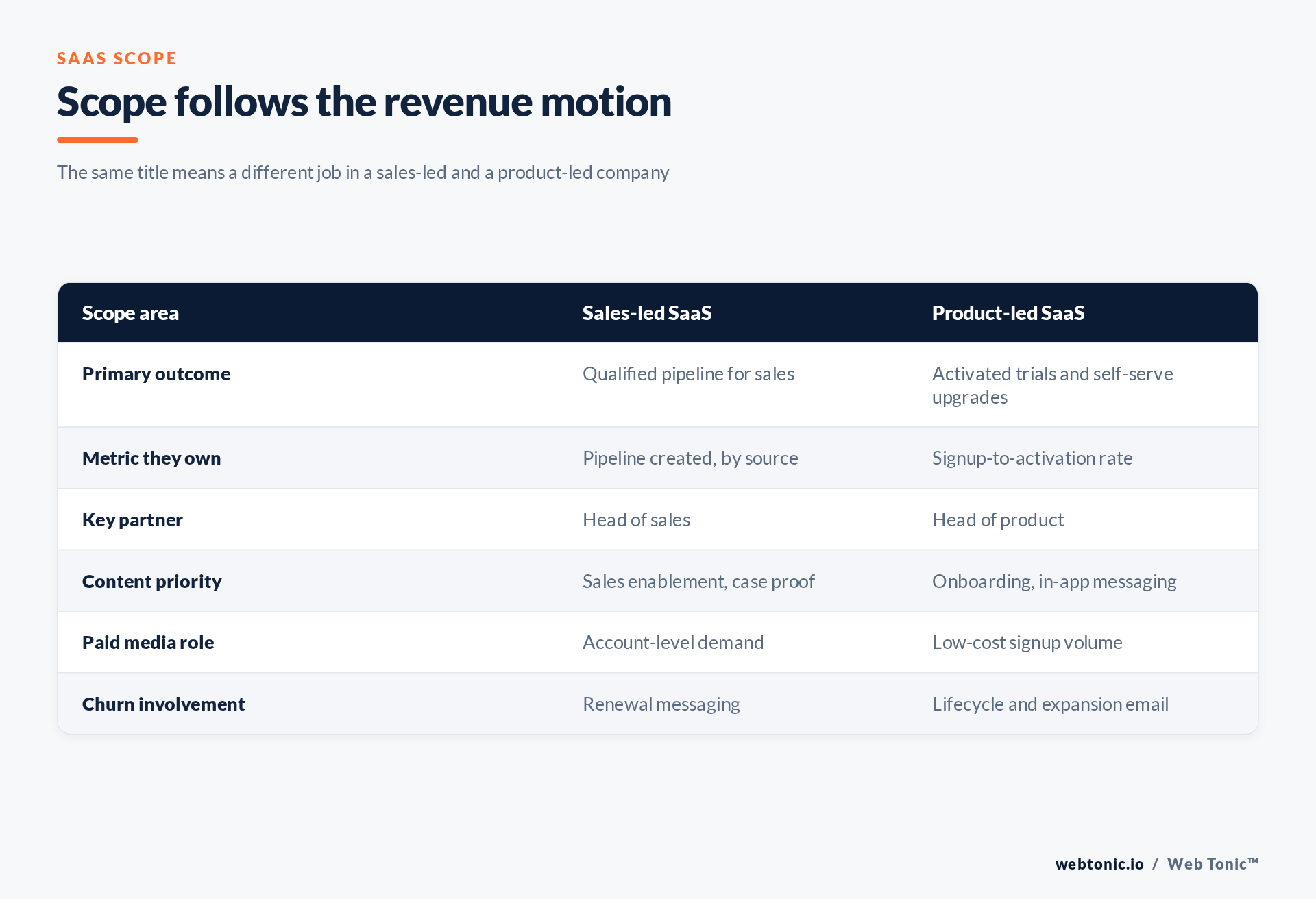
Before anything else, state whether the company sells through a sales team, through the product itself, or both. In a sales-led company the fractional CMO's job is mostly pipeline: qualified demand that sales can close. In a product-led company it is mostly signups that activate and upgrade without a salesperson. Hybrid companies need the split stated explicitly, because the two motions compete for the same budget and the same content calendar.
Getting this wrong is expensive in a specific way: you hire someone whose instincts are built for one motion and ask them to run the other. Ask candidates which motion their past wins came from, and scope to match.
Step 2 — Pick one funnel metric and define it with finance
Choose the single number the engagement is accountable for, then write its definition in the statement of work. "Pipeline" and "activation" mean different things in different companies. If marketing's dashboard and the finance model disagree on what counts, the first quarterly review becomes an argument about definitions instead of results.
The metric also has to be measurable on day one. If signups, trials and upgrades are not tracked as distinct events, the first weeks of the engagement are a measurement project. Google's documentation on recommended GA4 events is a reasonable baseline for naming them, and our conversion tracking work usually starts exactly there.
| Scope question | Weak answer | Workable answer |
|---|---|---|
| Which motion? | "All of marketing" | Sales-led pipeline first; product-led signups reviewed quarterly |
| Which metric? | "Growth" | Sales-accepted pipeline, as defined in the finance model |
| Who owns churn? | Unstated | Customer success owns it; marketing owns lifecycle messaging |
| Budget authority? | "Advises on spend" | Reallocates within the approved envelope, escalates above it |
| Product input? | None | Attends the monthly roadmap review, owns launch messaging |
| Board exposure? | Ad hoc | Prepares the marketing slide each quarter; CEO presents |
Step 3 — Draw the churn line
Retention is where SaaS scopes most often go vague. Decide whether churn and expansion are in scope, shared, or owned by customer success. A reasonable default is that customer success owns the churn number while the fractional CMO owns lifecycle messaging, onboarding content and expansion campaigns. Whatever you choose, write it down, because a rising churn rate will otherwise be blamed on whoever is newest.
Lifecycle email and in-app messaging to existing users also carry privacy obligations. If you sell into the EU, the scope should name who is accountable for consent and data handling under the GDPR, rather than assuming marketing inherits it.
Step 4 — Buy days, not hours
Hourly part-time CMO arrangements fragment into scattered calls. A fixed day count lets the person hold a cadence: a weekly marketing standup, a monthly funnel review with sales or product, and a quarterly plan. One day a week suits pure advisory; managing a team and an agency needs more. The day count should appear next to the outcome in the contract, so both sides can see whether the ambition matches the time bought.
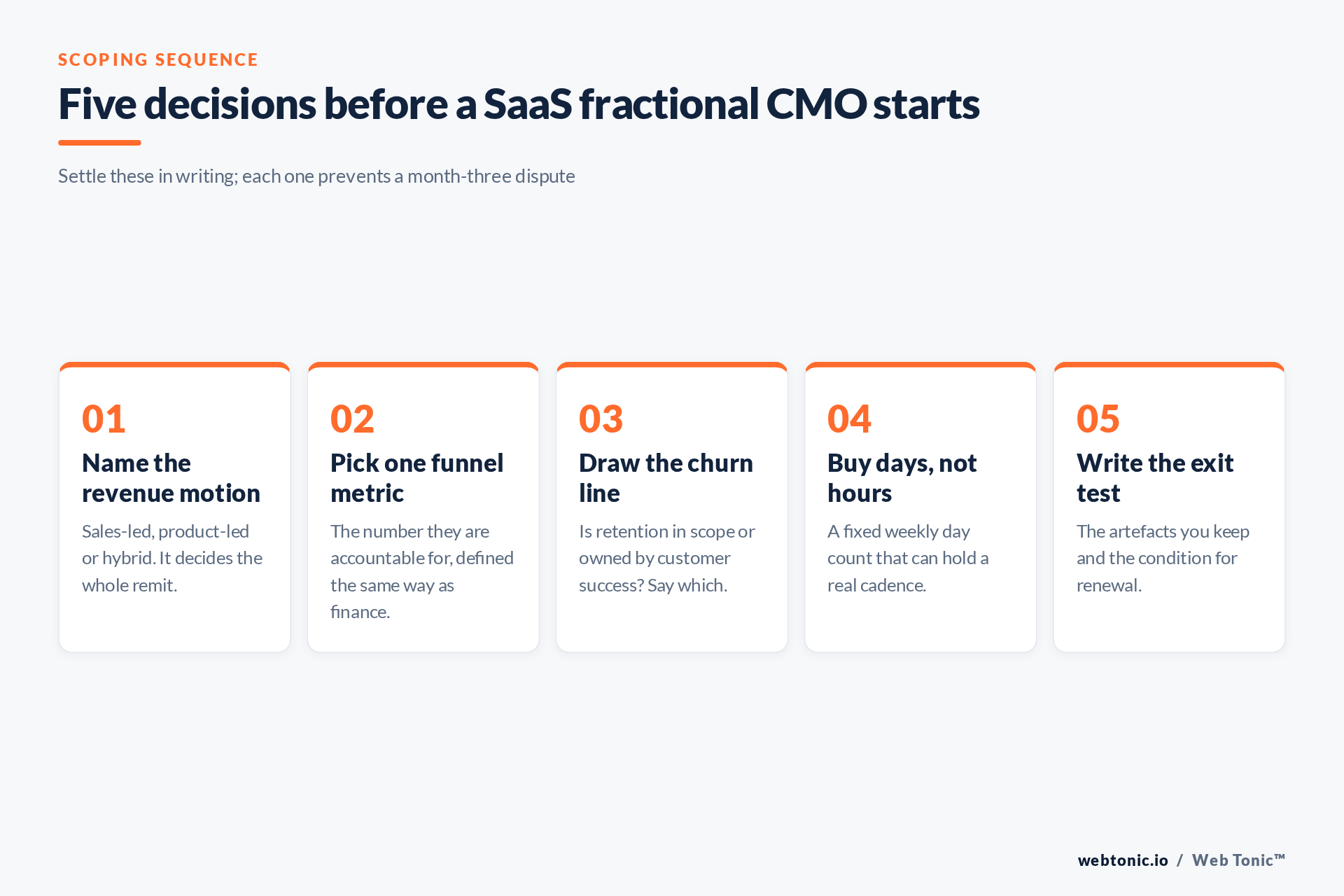
Step 5 — Write the exit test
State what must be true for the engagement to end well, renew, or convert to a full-time hire. Name the artefacts you keep: the positioning document, the funnel metric definitions, the marketing plan, hiring scorecards and any agency briefs. In SaaS, a common and healthy exit is a documented go-to-market plan plus a hired head of marketing to run it.
What goes wrong
The failure mode: the scope is copied from a generic CMO job description and never mentions the subscription economics. The fractional CMO then optimises the top of the funnel, signups rise, and nobody notices that activation or retention is flat until the next board meeting. Tie the scope to one metric that sits close to revenue, not to traffic.
The second failure mode is scoping senior marketing leadership before there is anything to lead. With no budget, no team and no agency, a fractional CMO becomes an expensive executor. At that stage execution support, such as our growth marketing work, is usually the better buy, with strategy layered on later. You can find related guides on the Web Tonic blog.
Frequently Asked Questions
Should a SaaS fractional CMO own the churn number?
Usually not alone. Customer success typically owns churn; the fractional CMO owns the lifecycle and expansion messaging that influences it. Shared ownership needs to be written into the scope.
Does a product-led company need a fractional CMO at all?
It can, but the remit shifts toward activation, onboarding and pricing-page messaging, and the key partner becomes the head of product rather than sales.
What should the first month deliver?
A diagnosis of the funnel against the agreed metric, a view on measurement gaps, and ranked priorities. A full plan normally follows, not precedes, that diagnosis.
How do we compare fractional CMO proposals?
Compare the outcome, metric, day count and decision rights side by side. Proposals that describe activities without a metric are hard to hold to account.
Sources: Software as a service, Annual recurring revenue, Churn rate, Customer acquisition cost, Customer lifetime value (Wikipedia); Google Analytics recommended events; GDPR.eu. Verified 2026-09-30.