Table of contents

Structure advice and a structure hire solve the same problem in different currencies. Advisory buys a decision in weeks for a project fee; hiring buys ownership over years for a loaded salary. Six dimensions decide which one you actually need.
Key Takeaways
- Advisory is a bounded cost for a bounded question. A structure and hiring plan runs $5,000–$20,000 as a project or $1,500–$8,000 a month; a senior hire is a multi-year commitment.
- Speed is the clearest split. Hiring takes 60–120 days to fill, then 4.7 months median ramp; an advisory answers inside a quarter.
- Fully loaded cost per marketer is benchmarked at $180K–$420K, median $294K — the money the structure decision commits.
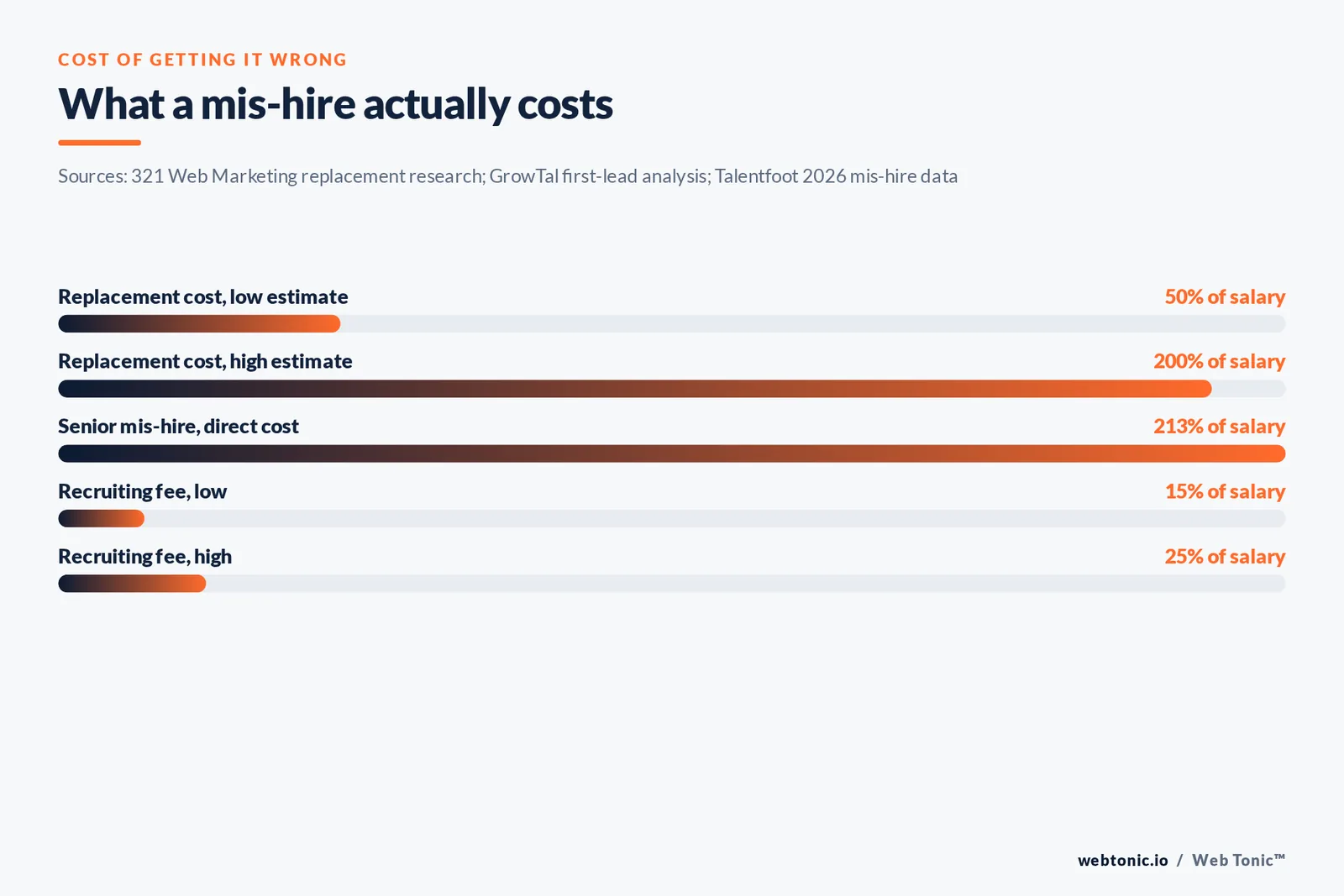
- Getting it wrong is expensive: replacement costs of 50–200% of salary are commonly cited, and senior mis-hire benchmarks reach 213%.
- One analysis of failed first marketing leads put the true first-year cost above $200,000 on a $150,000 hire once fees, equity and lost market time were counted.
- Hire when the work is continuous and the questions are settled. Buy advice when the question is which seats, in what order, and whether they should exist at all.
- The two are sequential more often than exclusive: advisory writes the mandate, the hire executes it.
The comparison, six dimensions at a time
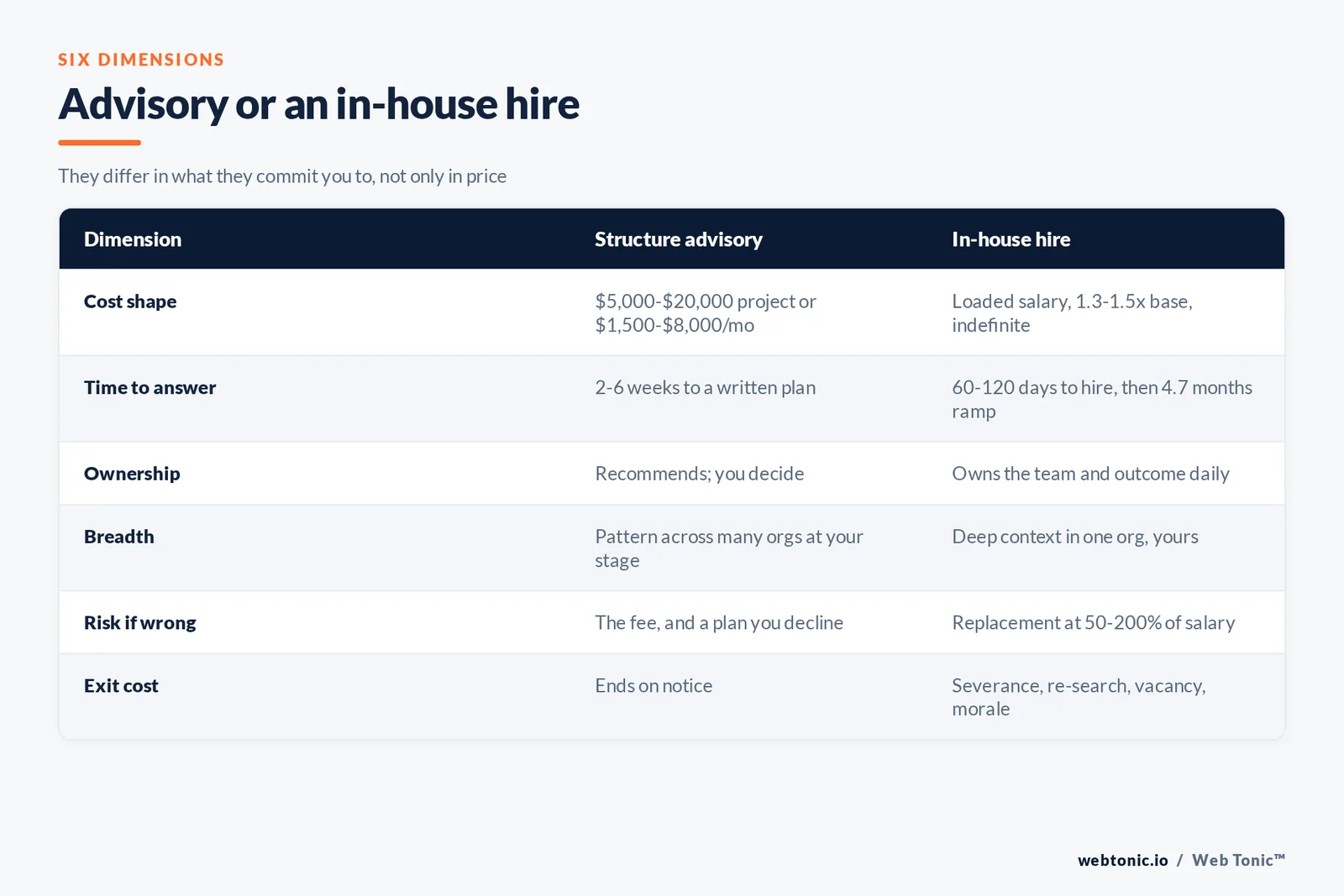
Framing this as cheap versus expensive misses the point. They differ in what they commit you to.
| Dimension | Structure and hiring advisory | In-house leadership hire |
|---|---|---|
| Cost shape | $5,000–$20,000 project, or $1,500–$8,000 a month | Loaded salary, roughly 1.3–1.5x base, indefinitely |
| Time to answer | 2–6 weeks to a written plan | 60–120 days to hire, then 4.7 months ramp |
| Ownership | Recommends; you decide and own | Owns the team and the outcome daily |
| Breadth | Pattern across many orgs at your stage | Deep context in one org — yours |
| Risk if wrong | The fee, and a plan you decline to use | Replacement at 50–200% of salary |
| Exit cost | Engagement ends on notice | Severance, re-search, vacancy and morale |
The friction numbers are documented rather than estimated. 2026 hiring cost analysis puts recruiting fees at 15–25% of salary, time to hire at 60–120 days and ramp at 3–6 months. B2B org benchmarks put median time to full productivity at 4.7 months for a marketing specialist and 6.8 months for senior demand generation and product marketing roles. A structure decision made through hiring, then, is a decision you learn the quality of about three quarters later.
What the hire commits, in money
2026 headcount benchmarks put fully loaded cost per marketer — salary, benefits, tools, agency augmentation and programme budget — at $180K to $420K, with a $294K median, and they show median team size stepping from 3 marketers in the $1–10M revenue band to 11 at $10–50M and 26 above $50M. Role-level data is blunter still: 2026 hiring research puts a marketing manager at $157,000–$221,000 a year fully loaded, with a contingency search fee of $16,200–$27,000 on a $108,000 base.
Set that against a bounded advisory fee and the asymmetry is obvious. The advisory's job is not to be cheaper than the hire — it is to make sure the six-figure annual commitment is the right seat, at the right seniority, in the right order.
Why first leadership hires fail so often
The failure mode is rarely competence. It is a mismatch between the stage of the business and the shape of the role. Seed-stage hiring guidance makes the point structurally: if only one of the readiness conditions is met, the hire fails — and with startup hiring down sharply from the 2021 wave, each seat has to clear a higher bar than it used to. Practitioner analysis puts it as builder versus strategist: at Series A you need shipping volume and rapid learning, not a 40-page plan that requires a team of eight to execute, at a budget of $90K–$140K.
The cost of the mismatch is quantified. One economic analysis of failed first marketing leads found the true cost of a mismatched $150,000 hire can exceed $200,000 in the first year once recruiter fees, equity and lost market time are counted. Research on companies under $5M ARR cites replacement costs of 50% to 200% of annual salary — $35,000 to $140,000 on a $70,000 marketing manager. At executive level, leadership mis-hire research puts the direct cost as high as 213% of salary.
None of that argues against hiring. It argues for hiring against a written mandate, which is precisely the artefact an advisory produces.
When advisory is the right purchase
The question is which seats, not who. If the debate in the room is "do we need a demand gen manager or a product marketer first", that is a design question and hiring will not answer it.
You are about to make an irreversible sequence decision. Hiring a senior leader who then hires their own team sets a structure for years.
Budget is capped and the mix is unsettled. Build-buy-borrow needs comparing before you commit a salary line.
You have been burned once. After a failed leadership hire, a mandate written independently is cheap insurance.
The strategy just changed. New segment, new motion, and the current org was designed for the old one.
A board wants the headcount case. Benchmarked, defensible numbers beat conviction in that meeting.
| Your situation | Buy advisory | Hire in-house |
|---|---|---|
| Seat order is unsettled | Yes — that is the deliverable | No — you would be delegating the design |
| Plan agreed, nobody executing | No | Yes, or borrow capacity now |
| Under $5M ARR, first marketing lead | Write the mandate first | Hire a builder, not a strategist |
| Team of 8+ needing restructure | Yes, then hire against the design | Leadership hire follows the design |
| Leadership seat empty right now | Advisory plus fractional cover | Hire, but do not rush the mandate |
| Continuous 30+ hours of leadership work | Advice alone will not cover it | Yes — permanent wins on continuity |
The third option most comparisons ignore
Between advice and a permanent hire sits borrowed leadership. First-hire guidance spells out the ladder for early-stage companies: a demand generation specialist at $90–130K plus equity, a content lead at $60–90K, or a fractional CMO at $5–15K a month with no equity when budget is constrained. 2026 fractional pricing research puts fractional CMO retainers at $8K–$25K a month and head of growth at $8K–$20K for one to two days a week, on 12–18 month engagements.
Analysis of early-stage hiring makes the structural argument plainly: most companies at seed or early Series A cannot carry a full-time senior marketing leader, which is why borrowed seniority paired with in-house execution has become a standard shape rather than a compromise. In practice the sequence that works is: advisory to write the design, fractional cover to run it while the plan proves out, then a permanent hire against a mandate that has already been tested.
How to decide this week
Answer four questions on one page. One: how many hours a week of genuine leadership work exists — under 8 is advisory territory, 10–20 suits fractional, past 30 and you are hiring. Two: is the plan the team will execute already written and agreed. Three: can you name the outcome the next seat owns in one sentence — if not, the seat is not ready. Four: what does being wrong cost, priced against the 50–200% replacement benchmark rather than the salary line.
Then buy in the order the answers imply. Advisory before hiring is nearly always cheaper than hiring before designing, because the fee is bounded and the salary is not. Our own bias is toward the artefact: a design nobody can act on is as useless as a hire nobody briefed.

The sequence that avoids both mistakes
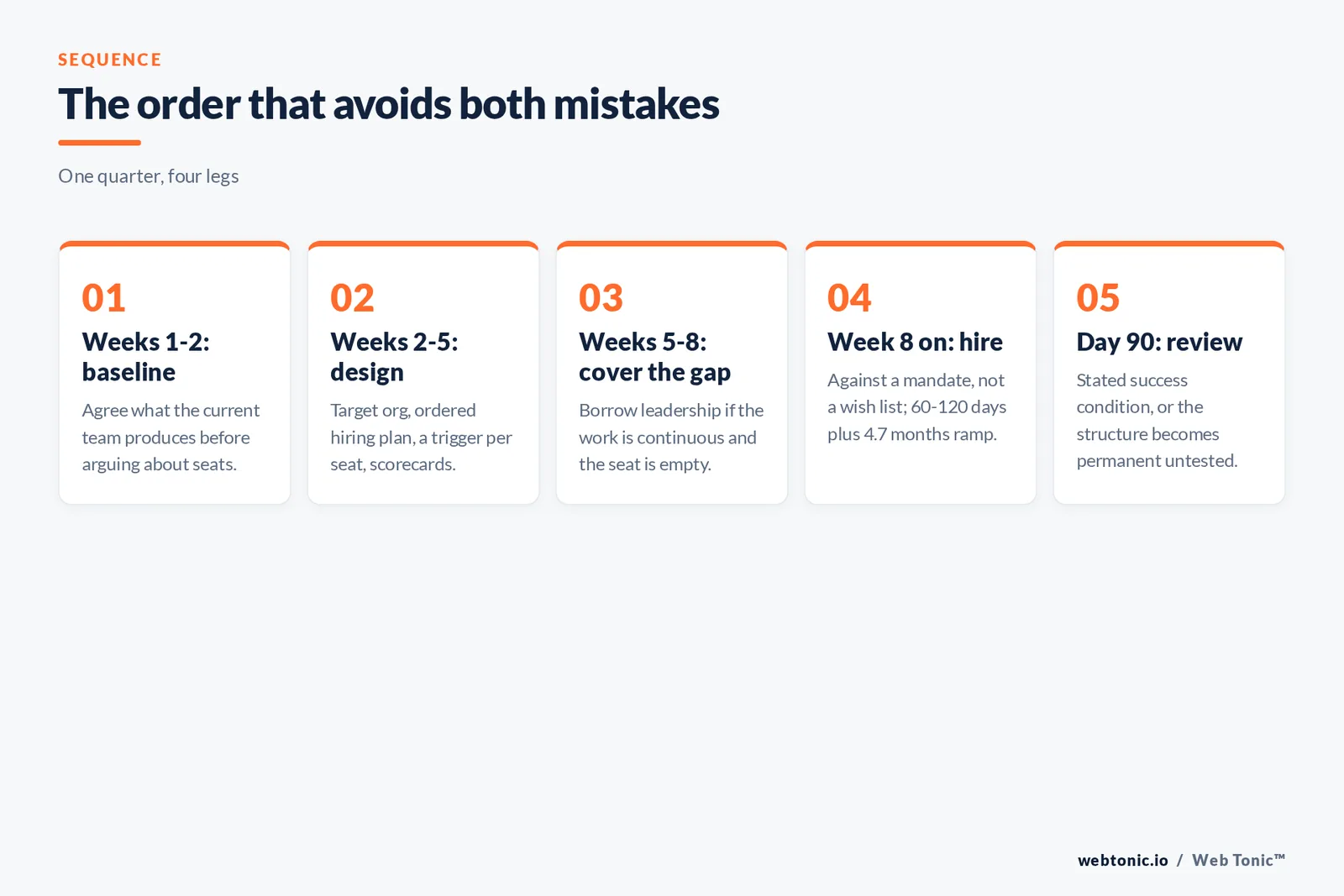
Framed as a binary, this decision produces two familiar errors: hiring a senior leader to answer a design question, or buying advice when the business needed a pair of hands. A sequence avoids both, and it fits inside a single quarter.
Weeks one and two — establish the baseline. Before anyone argues about seats, agree what the current team actually produces and what the reporting says. Structure debates are usually proxy arguments about performance nobody can measure, and they resolve quickly once the numbers are shared.
Weeks two to five — design and sequence. Produce the target structure, the ordered hiring plan with a trigger per seat, role scorecards stating owned outcomes, and a build-buy-borrow call per function. This is where an outside view earns its fee: seeing the same stage across many companies makes the sequencing mistakes obvious.
Weeks five to eight — cover the gap. If a leadership seat is empty and the work is continuous, borrow rather than wait. Fractional cover keeps the cadence while the search runs, and it produces evidence about what the permanent role really needs to be.
Weeks eight onward — hire against the mandate. Now the job description is a scorecard rather than a wish list, the interview panel assesses against the same standard, and the new leader inherits a written plan instead of an inheritance dispute. Given 60–120 days to fill and 4.7 months of median ramp, starting this leg with a settled mandate is worth more than starting it two weeks earlier.
Two conditions make the sequence work. The design must have an internal owner who defends the order when a loud function lobbies for its own seat. And the day-90 review must be scheduled at the start, with a stated success condition — otherwise a structure decision quietly becomes permanent without ever being tested.
Frequently Asked Questions
Is a structure advisory cheaper than hiring a marketing leader?
As a cash outlay, yes — $5,000–$20,000 for a project or $1,500–$8,000 a month, against a fully loaded senior salary that commits six figures a year indefinitely. They buy different things: a decision versus daily ownership.
Can an advisory replace a head of marketing?
No. It designs the role and sequence; it does not run the team. Where the seat must be covered while you build, fractional leadership at $5K–$25K a month is the bridge, not advisory.
How long before an in-house hire pays off?
Plan on 60–120 days to fill plus 4.7 months median ramp — 6.8 for senior demand generation and product marketing roles. A hire made in January contributes at target around midyear.
What is the most common first-hire mistake?
Hiring a strategist when the stage needs a builder, or hiring before the segment and offer are settled. Both produce a capable person answering questions the business has not decided.
Can we do both?
That is the usual answer. Buy the design, hire against the mandate it produces, and use borrowed capacity or fractional cover for the gap between the two.
Where to take this next
Put the four questions above on one page this week and see which column your answers sit in. Our marketing strategy consulting settles the plan a structure has to serve, fractional CMO and fractional head of growth engagements cover the leadership seat while you build, the marketing audit gives the baseline any org decision should rest on, growth marketing supplies capacity where a hire is premature, the wider services lineup covers delivery, and the blog carries more method detail. To pressure-test your next three hires, talk it through with us.
Sources
Digital Hive Labs — Cost of Hiring a Marketing Team in 2026
The Starr Conspiracy — B2B Marketing Org Benchmarks
Digital Applied — Marketing Team Structure 2026 Headcount Benchmarks
Stealth Agents — Cost of Hiring a Marketing Manager 2026
Causo Hub — First Marketing Hire at Seed, 2026
Field Vision — Why Your Startup's First Marketing Hire Is Probably Wrong
GrowTal — Why Hiring Your First Marketing Lead Often Fails
321 Web Marketing — First Marketing Hire Under $5M ARR
Talentfoot — Cost of a Leadership Mis-hire, 2026
MarketerHire — Your Startup's First Marketing Hire
CROWN — Why Your First Marketing Hire Is Probably a Mistake
Treetop — Fractional Executive Pricing Guide 2026