Table of contents

In 2026 a fractional head of growth or fractional CGO costs roughly $8,000–$20,000 a month for one to two days a week, with lighter advisory arrangements starting nearer $3,000–$5,000. The band you land in is set by stage, scope and how much of the number you hand over.
Key Takeaways
- Published 2026 pricing research puts fractional head of growth and CGO retainers at $8,000–$20,000 a month for one to two days a week, on engagements typically lasting 12–18 months.
- Stage moves the quote more than anything else: about $8,000–$12,000 a month at $1M–$5M ARR, and $14,000–$20,000 at $10M–$20M.
- Cross-functional CGO mandates sit at the top of the range — one benchmark set puts them at $10,000–$20,000 a month because the remit spans marketing, sales and product-led motions.
- The comparison is not salary. A senior in-house growth leader is a fixed commitment: verified SaaS data shows a $140,000 median base for a head of growth, and US CGO benchmarks show a $290,000 median.
- Recruiting, benefits, employer taxes and tooling turn base pay into a materially larger number before the role produces anything.
- Hourly framing is a sanity check, not a pricing model. One published benchmark scopes the role at about 18 hours a week; day-rate structures assume 1–3 days.
- Judge the price against payback, not the invoice: CAC payback benchmarks from 342 companies put the median at 16 months.
The 2026 price bands, and what sets them
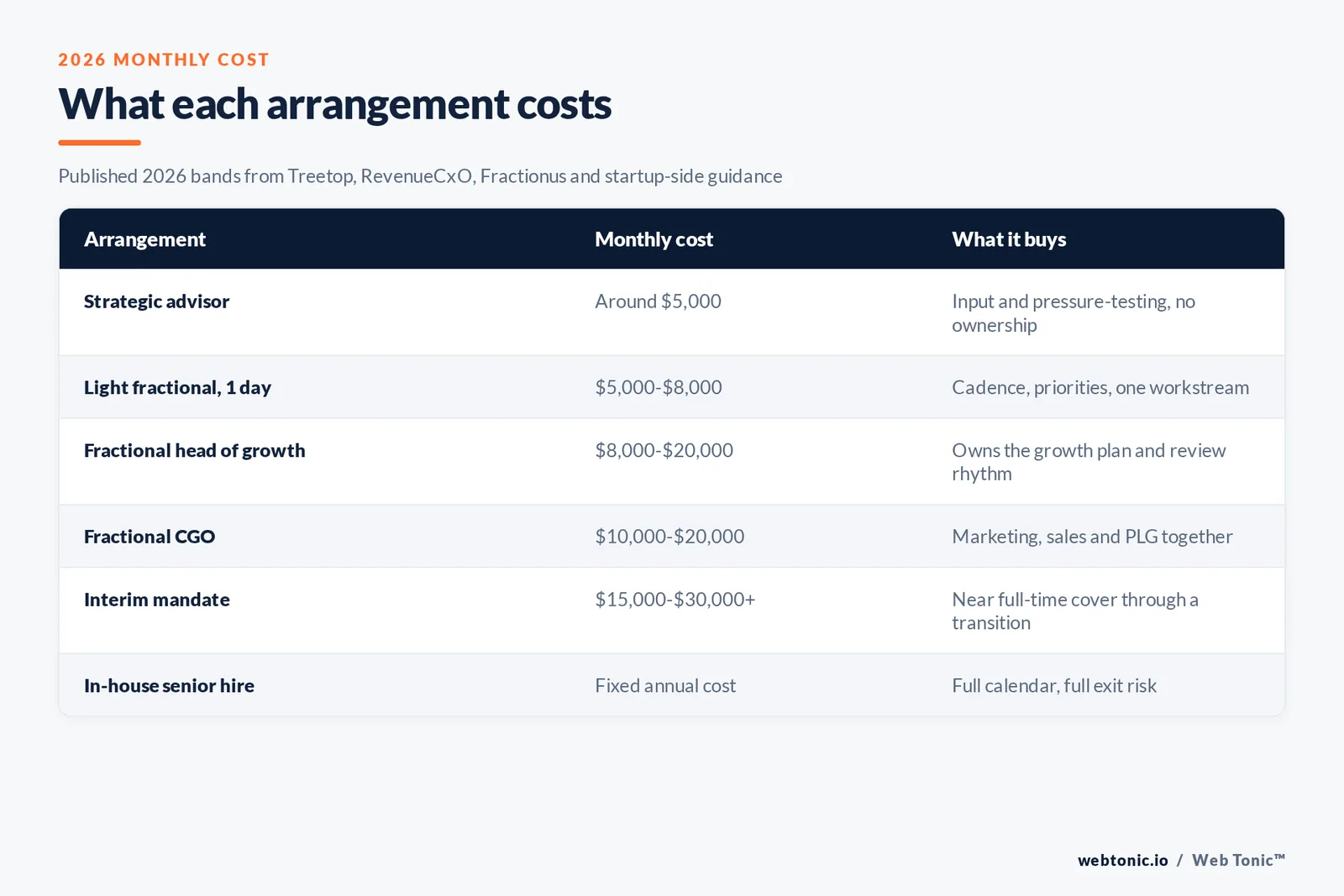
Fractional growth leadership has been priced long enough to have published ranges rather than folklore. 2026 fractional executive pricing research puts head of growth work at $8,000–$20,000 a month for one to two days a week, on engagements that typically run 12–18 months, and prices it just below a fractional CMO because the remit is narrower. The same work bands it by stage: $8,000–$12,000 at $1M–$5M ARR, rising toward $14,000–$20,000 at $10M–$20M.
Where the title becomes chief growth officer, the number moves up. Fractional executive rate benchmarks put a fractional CGO at $10,000–$20,000 a month and explain why: the mandate deliberately spans marketing, sales and often product-led growth, so it sits near the top of the fractional range. Cross-market data agrees on the shape — US benchmarks describe $7,000–$22,000 a month as typical for C-level fractional roles, against £4,000–£16,000 in the UK.
| Arrangement | 2026 monthly cost | What it buys |
|---|---|---|
| Strategic advisor or coaching | Around $5,000 | Input and pressure-testing, no ownership |
| Light fractional, 1 day a week | $5,000–$8,000 | Cadence, priorities, one workstream |
| Fractional head of growth, 1–2 days | $8,000–$20,000 | Owns the growth plan and the review rhythm |
| Fractional CGO, cross-functional | $10,000–$20,000 | Marketing, sales and PLG motions together |
| Interim or high-growth mandate | $15,000–$30,000+ | Near full-time cover through a transition |
| In-house senior hire | Fixed annual commitment | Full calendar, full cost, full exit risk |
Startup-side guidance lays the same ladder out for early-stage brands: roughly $5,000 a month for advisory or coaching, $5,000–$15,000-plus for ongoing fractional leadership at one to two days a week, and $15,000–$30,000-plus for interim or high-growth engagements. A practitioner cost breakdown puts the wider fractional CGO market at $3,000 to $15,000-plus a month and names days per week as the main driver, against a full-time hire it prices above $250,000.
Six variables that move your quote
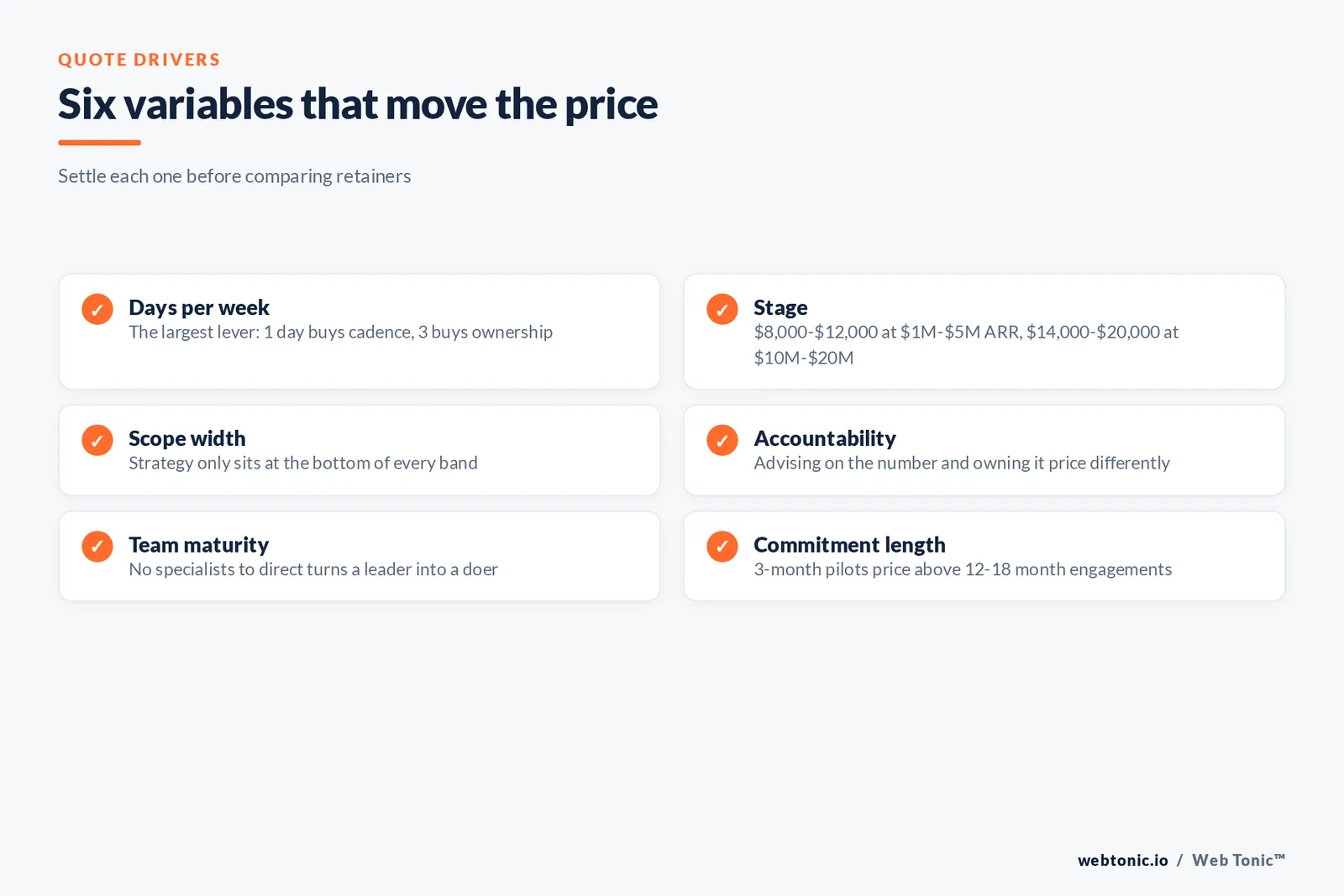
Days per week. The single largest lever. One day buys cadence and judgement; three days buys something close to operational ownership, and prices accordingly.
Stage. A $2M ARR company needs a channel decision and a repeatable motion. A $15M company needs a team managed, a forecast defended and several motions balanced — different work at the same job title.
Scope width. Strategy with light execution sits at the bottom of every published band. Strategy plus paid, lifecycle, analytics and team management sits at the top.
Accountability. Advising on the number and owning the number are separately priced, and they should be.
Team maturity. A fractional leader with three competent specialists to direct is efficient. The same person with nobody to direct becomes an expensive doer, and the retainer buys far less.
Commitment length. Three-month pilots price higher per month than 12-month engagements, because ramp is amortised over fewer invoices.
The number you are actually comparing it to
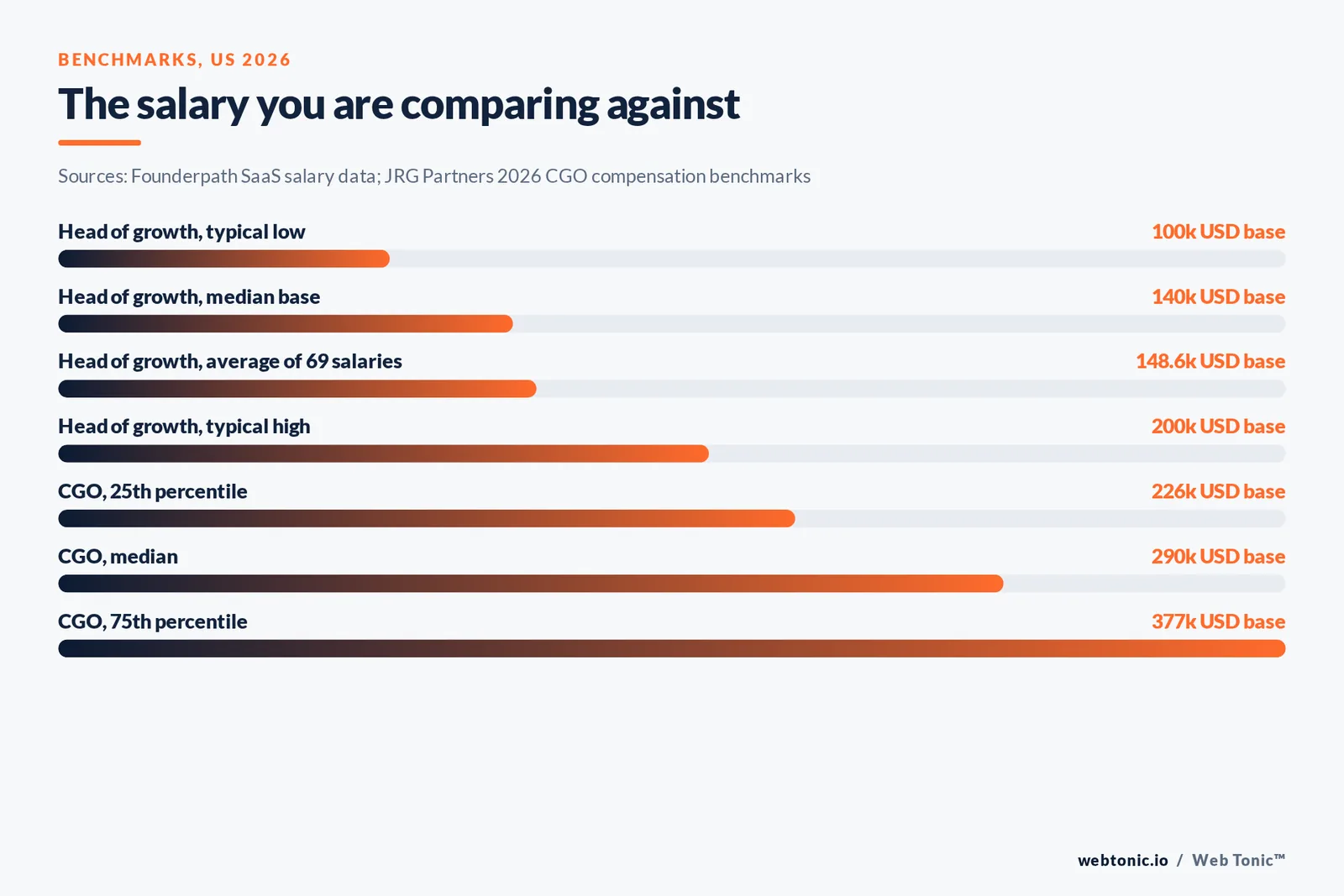
Comparing a monthly retainer to an annual salary is the error that makes fractional look expensive or free depending on which way you squint. Do the loaded arithmetic once. Verified SaaS salary data reports a $140,000 median base for a head of growth, a $100,000–$200,000 typical range and a $148,619 average across 69 reported salaries. At chief growth officer level, 2026 compensation benchmarks show a $290,000 median with the 25th percentile at $226,000 and the 75th at $377,000, and base pay of $300,000–$400,000 at businesses between $100M and $500M in revenue.
Then add what payroll actually costs: employer taxes and benefits, equipment and tooling, and recruiting. Search fees for senior marketing and growth roles are commonly quoted at 15–25% of first-year base, and 2026 hiring cost research puts growth marketing roles at about 48 days to fill. A $180,000 base is realistically a quarter-of-a-million-dollar year-one commitment before the role has made a single decision.
| Cost line | Fractional, 1–2 days a week | In-house senior hire |
|---|---|---|
| Cash per month | $8,000–$20,000, variable | Fixed salary, benefits and taxes |
| Recruiting cost | None | 15–25% of first-year base |
| Time to start | Days to two weeks | About 48 days to fill, then ramp |
| Tooling and equipment | Usually theirs | Yours, ongoing |
| Exit cost if wrong | Notice period, typically 30 days | Mis-hire benchmarks reach 213% of salary |
| Coverage | Judgement, not availability | Full calendar, single point of failure |
The downside case matters because growth leadership hires fail often enough to price. Leadership mis-hire research puts the direct cost of a senior mis-hire as high as 213% of salary, and 2026 executive hiring analysis benchmarks the total cost of a failed executive hire at 5–10x annual salary once vacancy, ramp, opportunity cost and re-search are counted. Against that, a retainer with a 30-day notice period is a cheap option on being wrong.
What the price does not include
Six things routinely surprise buyers, and all six should be settled in the scope document rather than discovered in month two. Execution capacity — a fractional leader directs work, and someone still has to do it. Media budget, which is a separate line and usually the larger one. Tooling, particularly analytics and attribution. Creative production. Data engineering, where the measurement layer needs rebuilding before any growth plan is trustworthy. And availability outside the agreed days: this is the trade being made, and pretending otherwise is how retainers sour.
Is the market rate rising or settling?
Supply has grown quickly, which has compressed the wild ends of the range rather than the middle. Marketplace data shows monthly fractional job postings up roughly five-fold from early 2024 to Q1 2026 — a 149% year-on-year rise in that quarter — while market analysis for 2026 puts global fractional executive services above $5.7bn, growing around 14% a year.
The practical consequence for a buyer is pleasant: published ranges now cluster tightly enough that you can put fractional and in-house in the same model and argue about assumptions instead of numbers. It also means a quote far outside $5,000–$20,000 a month needs an explanation — either the scope is unusually narrow, or the days per week are higher than the label suggests.
Making the price defensible
Price is a function of what you are asking someone to be accountable for, so write that down before the first call: the number that must move, the motions in scope, the team available to direct, and the review cadence. Then judge the retainer on the clock the work actually runs on. CAC payback benchmarks from 342 companies put the median at 16 months, the top quartile at 6 and the bottom at 24 or more — a role judged on payback needs quarters, not weeks, and a retainer cancelled at week six was never priced against an outcome.
Two guardrails keep the spend honest. Put a written 90-day scope review in the agreement, with a named success condition. And count the leadership hours the business genuinely needs: under 8 a week, an advisor is enough; 10–20 is the fractional sweet spot; consistently past 30 and a permanent hire wins on both cost and continuity.

Three ways the same retainer produces different value
Two companies can pay $12,000 a month for the same person and get results that are not comparable, because the retainer buys direction and direction needs something to direct.
The efficient case. A $6M ARR business has a paid media specialist, a content producer and an agency running lifecycle. Nobody sets priorities across the three, so effort collides and nothing compounds. A fractional leader at two days a week sets the sequence, kills two of the eight active initiatives, defines the weekly review and holds the forecast. The retainer is leveraged across four other people's output, which is where the arithmetic works.
The expensive case. A company with no execution capacity hires the same person, who spends the first month building dashboards and the second writing ad copy. Senior judgement is being spent on tasks a specialist would do faster and cheaper. The retainer is not wrong; the shape of the team around it is.
The premature case. Pre-product-market-fit, with the segment and offer still moving, growth leadership is being asked to optimise a machine that has not been built. The result is a plan that gets rewritten monthly and a retainer everyone quietly resents. Advisory hours or founder-led selling beat a growth mandate here.
The test before signing is simple. Write down who will execute the plan, name them, and count their hours. If the answer is "we will figure that out", the first quarter of the retainer will be spent figuring it out at senior rates. If the answer names three competent people and a budget, the same money buys a multiple of its own cost in redirected effort.
One more variable worth pricing explicitly: continuity. Ask what happens during a two-week absence and who holds the cadence. Engagements that survive their first holiday period are the ones with the review rhythm documented rather than carried in one person's head.
Frequently Asked Questions
How much does a fractional head of growth cost per month in 2026?
Published research puts it at $8,000–$20,000 a month for one to two days a week, with lighter advisory arrangements around $5,000 and interim or near-full-time cover at $15,000–$30,000-plus.
Is a fractional CGO more expensive than a fractional head of growth?
Usually, yes. Benchmarks put fractional CGO retainers at $10,000–$20,000 a month because the mandate spans marketing, sales and often product-led growth rather than a single function.
Is fractional actually cheaper than hiring?
Per month, generally yes — a variable $8,000–$20,000 against a fixed commitment built on a $140,000 median base at head-of-growth level, or a $290,000 median at CGO level, plus taxes, benefits, tooling and a search fee of 15–25% of base.
What contract length should we expect?
Engagements commonly run 12–18 months with a rolling 30-day notice period. Three-month pilots exist and price higher per month because ramp is spread across fewer invoices.
When does the maths favour a full-time hire?
When the role consistently needs 30-plus hours a week, when you are building a growth team of several people, or when the strategic questions are settled and the job becomes day-to-day execution management.
Where to take this next
Write the mandate before you compare quotes: the number that must move, the days you are buying, the team available, and the day-90 success condition. Our fractional head of growth engagement is scoped that way, fractional CMO cover suits a wider marketing remit, growth marketing supplies the execution capacity a fractional leader directs, data intelligence fixes the measurement layer the plan depends on, the wider services lineup covers delivery, and the blog has more method detail. To price it against your own stage, talk it through with us.
Sources
Treetop — Fractional Executive Pricing Guide 2026
RevenueCxO — Fractional Executive Rate Benchmarks
Fractionus — Fractional Executive Rates by Role, 2026
Yaniv Goldenberg — Fractional CGO Cost
Lindsay Angelo — Fractional CGO Costs for Startups
Founderpath — Head of Growth Salary Benchmarks
JRG Partners — CGO Salary Guide 2026
JRG Partners — Cost of a Bad Executive Hire, 2026
Talentfoot — Cost of a Leadership Mis-hire, 2026
Stealth Agents — Cost of Hiring a Growth Marketer 2026
Fractional Jobs — The Fractional Work Report
Vendux — 10 Numbers on Fractional Executives in 2026
Aleph — SaaS CAC Payback Benchmarks 2026