Table of contents

Marketing team structure and hiring advisory has two prices: the advice, and the org it designs. In 2026 the advice runs roughly $5,000–$20,000 as a project or $2,000–$8,000 a month on retainer. The team it prevents you mis-hiring is the far larger number.
Key Takeaways
- Advisory pricing follows the wider consulting market: independent senior advisors bill roughly $150–$400 an hour, with a $190 global median and $290 in North America.
- Retainer tiers are the honest way to compare: about $1,500–$3,000 a month for light input, $3,000–$8,000 for an active engagement.
- The org being designed dwarfs the fee. Fully loaded cost per marketer is benchmarked at $180K–$420K, with a $294K median.
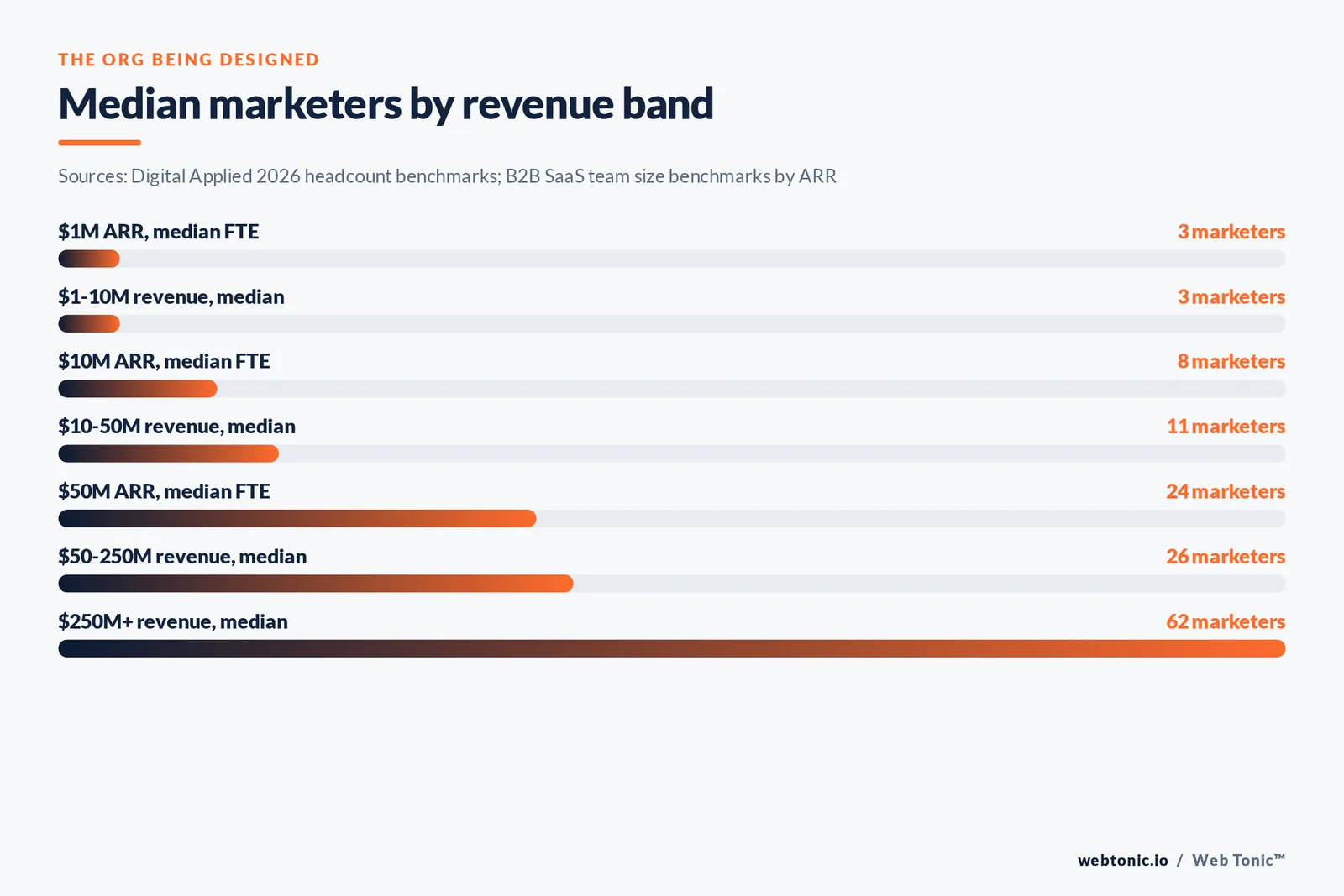
- Headcount scales non-linearly: a median of 3 marketers at $1–10M revenue, 11 at $10–50M and 26 above $50M.
- Hiring friction is a real cost line — recruiting fees of 15–25% of first-year base, 60–120 days to hire, and 3–6 months of ramp.
- Marketing budget benchmarks give the outer bound: 7.7% of revenue on average, with marketing at about 9.5% of total headcount in B2B SaaS.
- The advisory is worth its fee when it changes the sequence of your next three hires, not when it produces an org chart.
What you are buying, precisely
Structure and hiring advisory is a scoped piece of work with four typical outputs: a target org design tied to the next 12–18 months of plan, a sequenced hiring roadmap with the rationale for each role's timing, role scorecards that state the outcome each seat owns, and a build-buy-borrow decision per function — in-house, agency, freelance or fractional. Some engagements add compensation banding and an interview scorecard so hiring managers assess against the same standard.
What it is not: recruitment. An advisory does not source candidates, and paying advisory rates for sourcing is how budgets get resented. It also does not decide your strategy — org design follows the plan, and if the plan is unsettled the sequence should be strategy first, structure second.
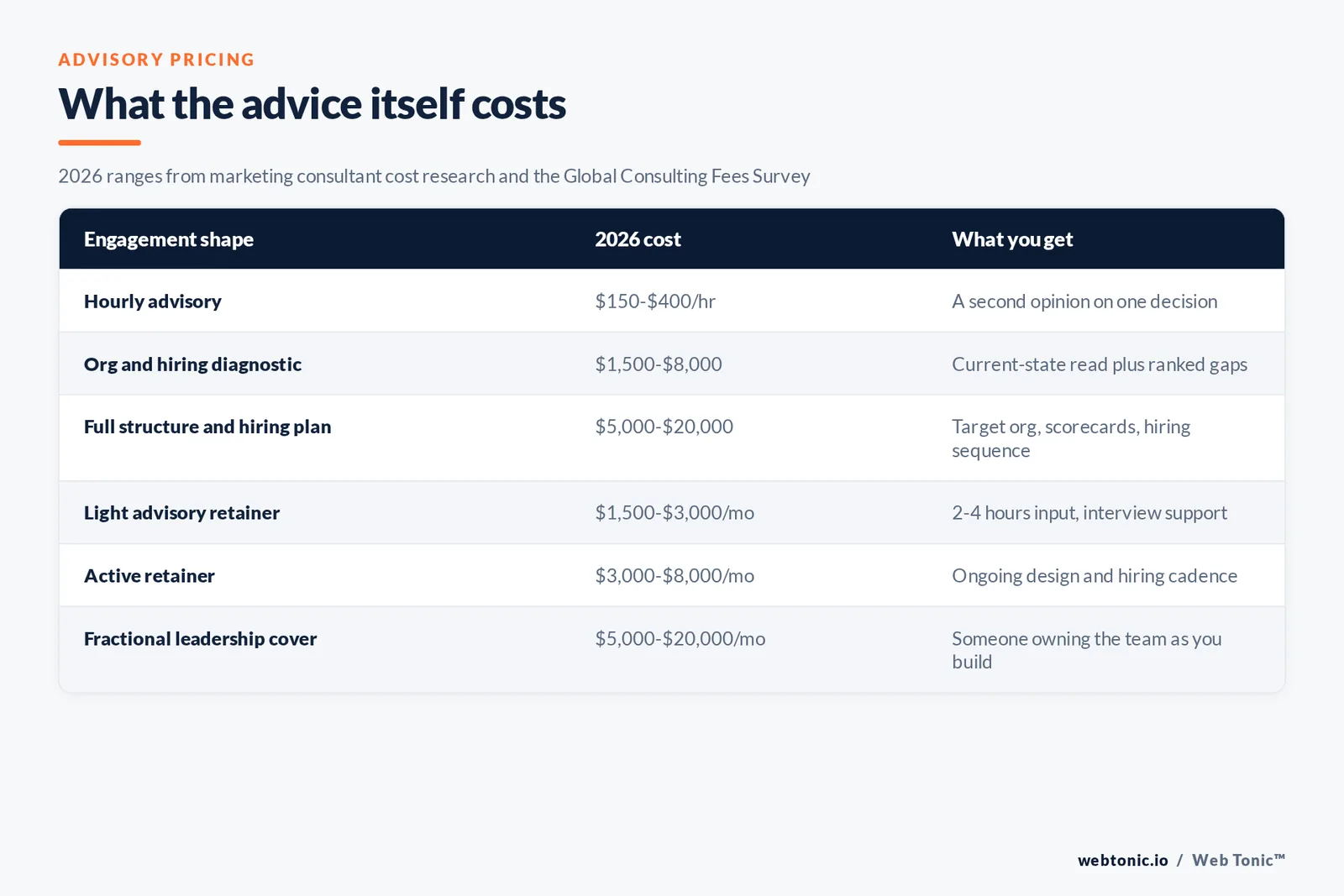
| Engagement shape | 2026 cost | What you get |
|---|---|---|
| Hourly advisory | $150–$400 an hour | A second opinion on a specific decision |
| Org and hiring diagnostic | $1,500–$8,000 | Current-state read plus a ranked gap list |
| Full structure and hiring plan | $5,000–$20,000 | Target org, role scorecards, hiring sequence |
| Light advisory retainer | $1,500–$3,000 a month | 2–4 hours of input, interview support |
| Active retainer | $3,000–$8,000 a month | Ongoing design, scorecards, hiring cadence |
| Fractional leadership cover | $5,000–$20,000 a month | Someone owning the team while you build it |
Those bands are not specific to org work; they are the market rates for senior marketing advice. 2026 marketing consultant cost research tiers retainers exactly that way — basic advisory at $1,500–$3,000 a month for two to four hours, active engagement at $3,000–$8,000, and intensive engagement at $8,000–$15,000-plus. The 2026 Global Consulting Fees Survey puts the median hourly fee at $190 globally and $290 in North America, which is the sanity check to apply when a quote arrives as a flat project number.
The number that dominates the decision
Nobody buys structure advice for its own sake. They buy it because the next three hires commit a large amount of money for a long time, and the sequence is hard to reverse. 2026 headcount benchmarks put fully loaded cost per marketer — salary, benefits, tools, agency augmentation and programme budget — at $180K for small B2B firms up to $420K at enterprise B2C, with a $294K median. Tools and platforms now account for 14–18% of that figure, up from 9% in 2022.
The same research shows median headcount scaling non-linearly: 3 marketers in the $1–10M revenue band, 11 at $10–50M, 26 between $50M and $250M, and 62 above that. SaaS-specific benchmarks put it in ARR terms: B2B SaaS team size data reports a median of 3 FTE at $1M ARR, 5 at $5M, 8 at $10M, 14 at $25M and 24 at $50M. An advisory that moves you one seat earlier or later against those medians is transacting in six-figure decisions.
Hiring friction, priced
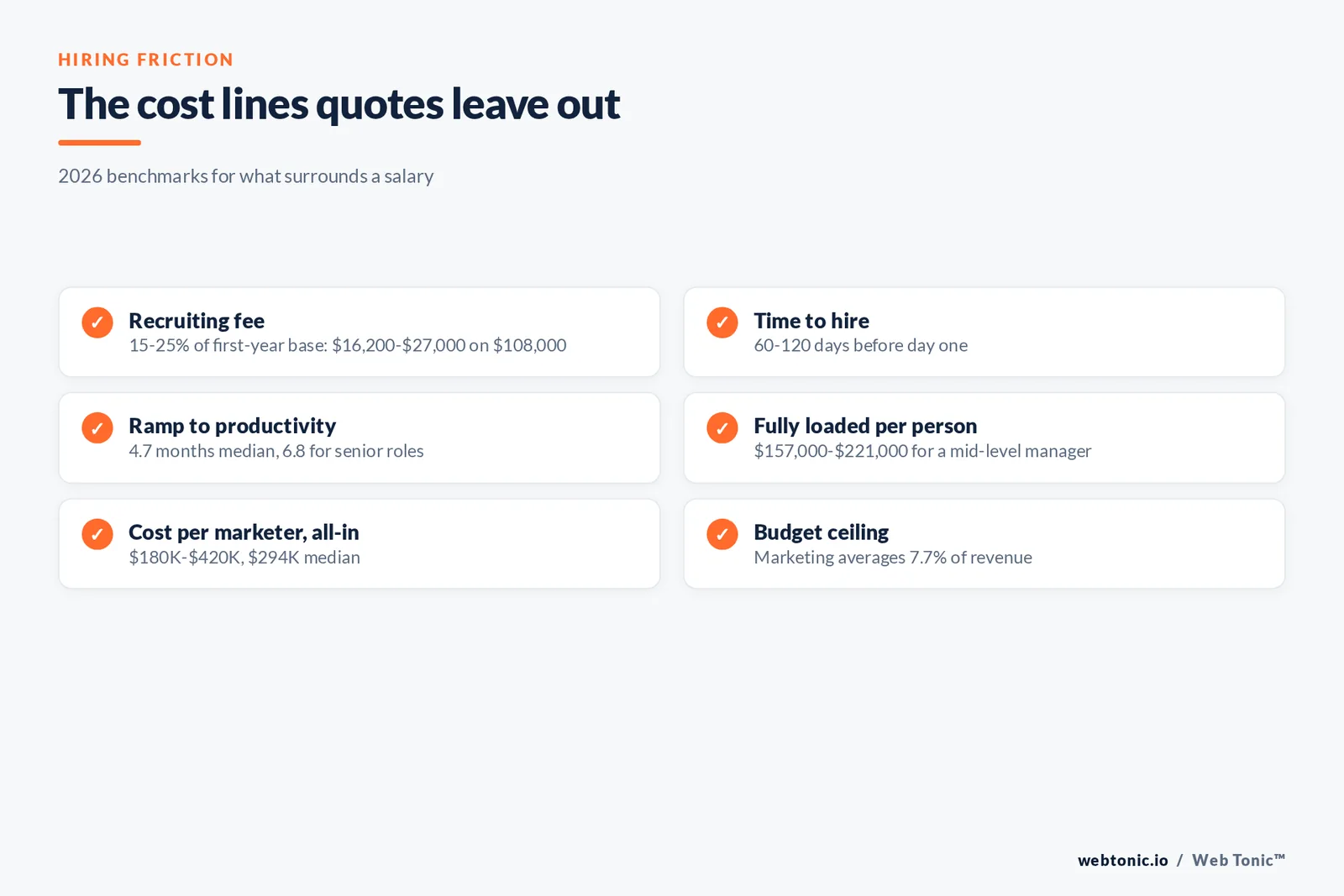
The salary is the visible cost. The friction around it is the one that gets left out of the model. 2026 hiring cost analysis puts recruiting fees at 15–25% of salary, time to hire at 60–120 days, and ramp at 3–6 months, with a typical mid-sized marketing team costing $500K to $1M-plus a year. Role-level research is more concrete: contingency search at 15–25% of first-year base means a fee of $16,200–$27,000 on a $108,000 marketing manager, whose fully loaded 2026 cost lands at $157,000–$221,000 a year.
Ramp deserves its own line. Benchmark data collected across B2B onboardings puts median time to full productivity for a marketing specialist at 4.7 months, and 6.8 months for senior demand generation and product marketing roles, according to B2B marketing org benchmarks. A hire made in January is contributing at target around midyear — which is the real argument for getting the sequence right rather than filling seats fast.
| Line item | 2026 benchmark | Why it changes the plan |
|---|---|---|
| Recruiting fee | 15–25% of first-year base | $16,200–$27,000 on a $108,000 role |
| Time to hire | 60–120 days | A quarter passes before day one |
| Ramp to productivity | 4.7 months median, 6.8 senior | Sequence hires against the plan's deadlines |
| Fully loaded per person | $157,000–$221,000 mid-level | Roughly 1.3–1.5x base once loaded |
| Cost per marketer, all-in | $180K–$420K, $294K median | Includes tools and programme budget |
| Marketing budget share | 7.7% of revenue average | Caps how many seats are defensible |
Build, buy or borrow — the comparison the advisory should run
Every seat in a proposed org chart is a build-buy-borrow choice, and published cost comparisons make the arithmetic straightforward. 2026 cost-math analysis puts a genuine in-house team of two to three people at $300,000–$500,000-plus a year fully loaded, against an agency covering comparable output at $36,000–$180,000. A four-person comparison lands at $500K–$800K a year fully loaded versus $5K–$15K a month — $60K–$180K annually — for the same scope of SEO, content, paid media and analytics.
Single-seat maths runs the same way. Managed-marketing cost comparisons put one full-time marketer at $152,000–$200,000-plus a year once benefits and a $500–$1,500 monthly tool stack are counted, and DTC-side analysis puts a fully loaded five-person in-house team above $520,000 a year before tools or training. None of this says in-house is wrong — it says each seat must be justified against the alternative that delivers the same output, which is exactly the comparison a structure advisory exists to force.
What moves the advisory fee itself
Scope of the org. Designing three seats is a different exercise from restructuring a 26-person department across five functions.
Depth of evidence. Interviewing the current team, reading the reporting and mapping actual work takes days that a template-driven org chart does not.
Compensation work. Banding roles against market data is separately priced by most advisors, and worth it if you are about to make offers.
Hiring support. Scorecards, interview guides and sitting in on final panels are add-ons, priced by time.
Duration. A one-off plan is cheaper per hour than a retainer, but a retainer is what survives the first hire falling through.
Seniority. A senior operator who has run the structure you want costs near the top of the $150–$400 hourly band, and generally pays for itself in one avoided mis-sequenced hire.
Judging value against the fee
Set the test before you buy. A structure and hiring advisory is worth its cost if it does at least two of four things: reorders the next three hires with a reason attached; converts a job title into a scorecard with a measurable outcome; replaces at least one planned seat with a borrow option that delivers the same output sooner; or produces a defensible headcount case for the board against published benchmarks — 7.7% of revenue on budget and marketing at roughly 9.5% of total headcount in B2B SaaS.
Against a $294K median cost per marketer, a $5,000–$20,000 engagement clears its own bar by improving one decision. What it cannot do is make the hires succeed — that depends on onboarding, mandate clarity and the plan holding steady long enough for a 4.7-month ramp to finish.

Three ways the fee gets wasted
The advisory market is not short of competent operators, so most disappointment traces to how the engagement was set up rather than who ran it.
Buying a chart instead of a sequence. A target org design is easy to produce and easy to ignore, because it describes a destination without a route. The valuable artefact is the ordered hiring plan: which seat first, why that one, what has to be true before the next one, and what gets borrowed in the meantime. Insist the deliverable names the trigger for each hire — a revenue level, a workload threshold, a plan milestone.
Designing against a plan nobody agreed. Org design is downstream of strategy. If the segment, offer and primary motion are still being debated, the structure will be redrawn within two quarters and the fee spent twice. Settle the plan first, even roughly, then design the team that delivers it.
Skipping the compensation reality check. A design that assumes market-rate senior hires the budget cannot support is a wish list. Band the roles against real numbers during the engagement, not after the first offer is declined. With fully loaded cost per marketer benchmarked at $180K–$420K, a two-seat error in the design is a larger sum than the entire advisory fee.
A fourth, quieter failure: no internal owner. Someone inside the business has to hold the hiring plan, defend the sequence when a loud function lobbies for its own seat, and update it when the plan changes. Advisories that end without a named owner tend to end with the old structure intact and a document in a shared drive.
Set the acceptance test at the start. Ours is deliberately narrow: at the end of the engagement, a person who was not in the room should be able to read the plan and know which role to open next, what it owns, what it costs fully loaded, and what evidence would delay it. If the deliverable cannot do that, it has not earned a $5,000-plus fee, however handsome the chart.
How advisors set a price, and what to ask
Advisory pricing looks arbitrary until you see the inputs. Most firms and independent consultants charge on a blend of scope, evidence depth and time in the room, and the same three questions reveal which model is in front of you.
What is in scope, in writing? Structure work for a three-person team is a different investment from an org spanning content, paid media, SEO, email, social and marketing operations. Ask which channels and functions the design covers and which are assumed away.
How much evidence is included? Template-driven org charts are cheap because nobody read your reporting. Engagements that interview the team, review the pricing of current agencies and specialist services, and map real workload cost more days and are worth the difference.
How is the model justified? Businesses buying advice should expect a stated reason for the pricing model — project fee for a bounded design, monthly retainer for continuing decisions. Consultants who charge a retainer for a one-off deliverable are pricing for their cash flow, not your problem.
Two comparisons help sanity-check any quote. First, agencies and specialist firms publish their own service pricing, so you can benchmark the borrowed-capacity options in the design against real market rates for content, paid media, video and optimization work rather than guesses. Second, express the fee as a share of the annual investment it governs: advisory that shapes a $500,000 team budget at a fee of $10,000 is 2% of the money it directs, which is the ratio to argue about rather than the invoice in isolation.
Finally, ask what the engagement produces about ROI. A credible structure plan states what each seat is expected to return and how that will be measured — pipeline, retention, cost per opportunity — so the org chart can be judged later against business results rather than tidiness.
Frequently Asked Questions
How much does marketing team structure and hiring advisory cost in 2026?
A full structure and hiring plan typically runs $5,000–$20,000 as a project, or $1,500–$8,000 a month on retainer. Hourly work sits at $150–$400, with a $190 global median consulting rate.
Is it cheaper than using a recruiter?
They solve different problems. A recruiter charges 15–25% of first-year base to fill a seat you have already defined; the advisory decides whether that seat is the right one and in what order. Many companies buy both, in that sequence.
How many marketers should we have at our revenue?
Benchmarks put the median at 3 marketers between $1M and $10M revenue, 11 from $10M to $50M, and 26 above $50M. Treat them as reference points, not targets — role mix matters more than count.
What does the advisory not include?
Candidate sourcing, employment contracts, payroll setup and the execution work itself. Media budget, tooling and creative production remain separate lines.
When is it too early to buy?
When the strategy is unsettled. Org design follows the plan; buying structure advice before the segment and offer are decided produces a chart that has to be redrawn.
Where to take this next
Before comparing quotes, write two things down: the plan the team must deliver over the next four quarters, and the seats you believe it needs. The gap between those is the engagement. Our marketing strategy consulting settles the plan first, fractional CMO cover holds the leadership seat while you build, the marketing audit establishes the baseline any structure decision should rest on, growth marketing supplies borrowed capacity where a hire is premature, the wider services lineup covers delivery, and the blog has more method detail. To price it against your own org, talk it through with us.
Sources
GTM 80/20 — Marketing Consultant Cost 2026
Reinvention Academy — 2026 Global Consulting Fees Survey
Digital Applied — Marketing Team Structure 2026 Headcount Benchmarks
Growth Spree — B2B SaaS Marketing Team Size Benchmarks 2026
The Starr Conspiracy — B2B Marketing Org Benchmarks
Digital Hive Labs — Cost of Hiring a Marketing Team in 2026
Stealth Agents — Cost of Hiring a Marketing Manager 2026
Tested Media — Agency vs In-House 2026 Cost Math
AgencyReview — Agency vs In-House Marketing 2026
Gameplan — Managed Marketing vs Agency vs In-House
Jetfuel — In-House vs Agency Marketing 2026