Table of contents
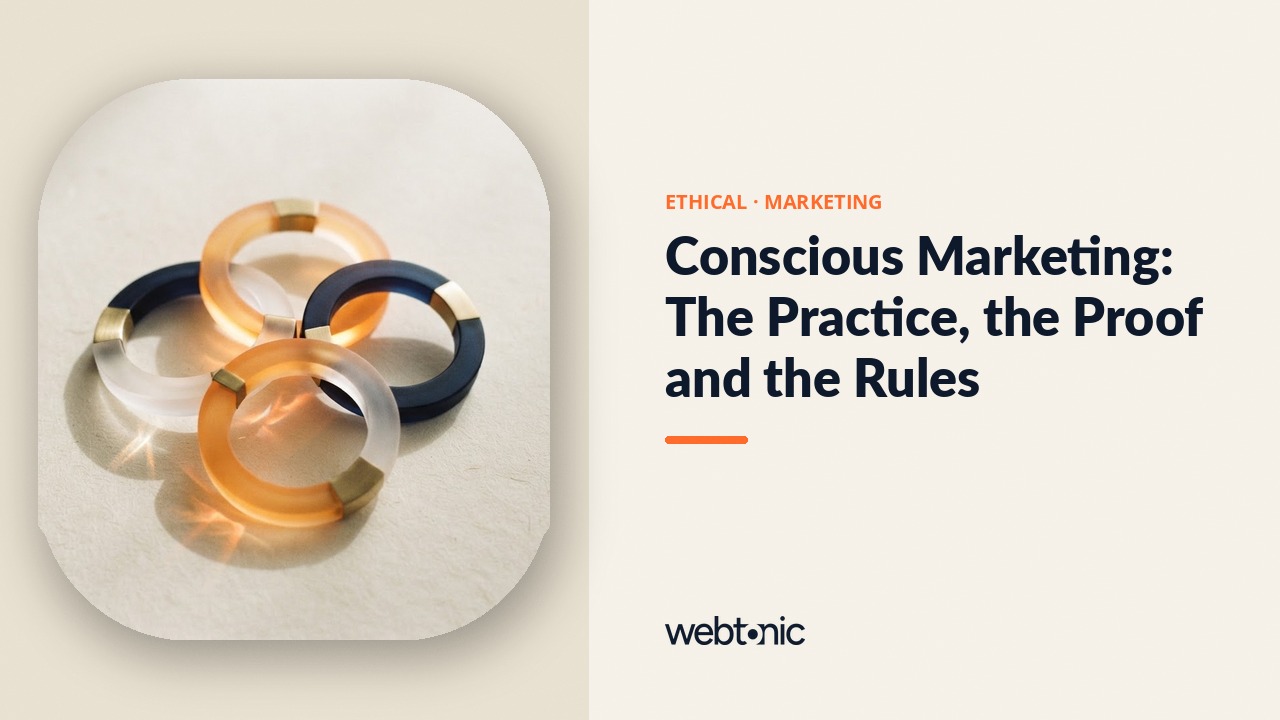
Conscious marketing is the practice of promoting a business in a way that is accountable to the people and systems it affects, not only to its revenue targets. It is a governance discipline before it is a campaign style, which is why so many attempts at it collapse under a single substantiation request.
Key Takeaways
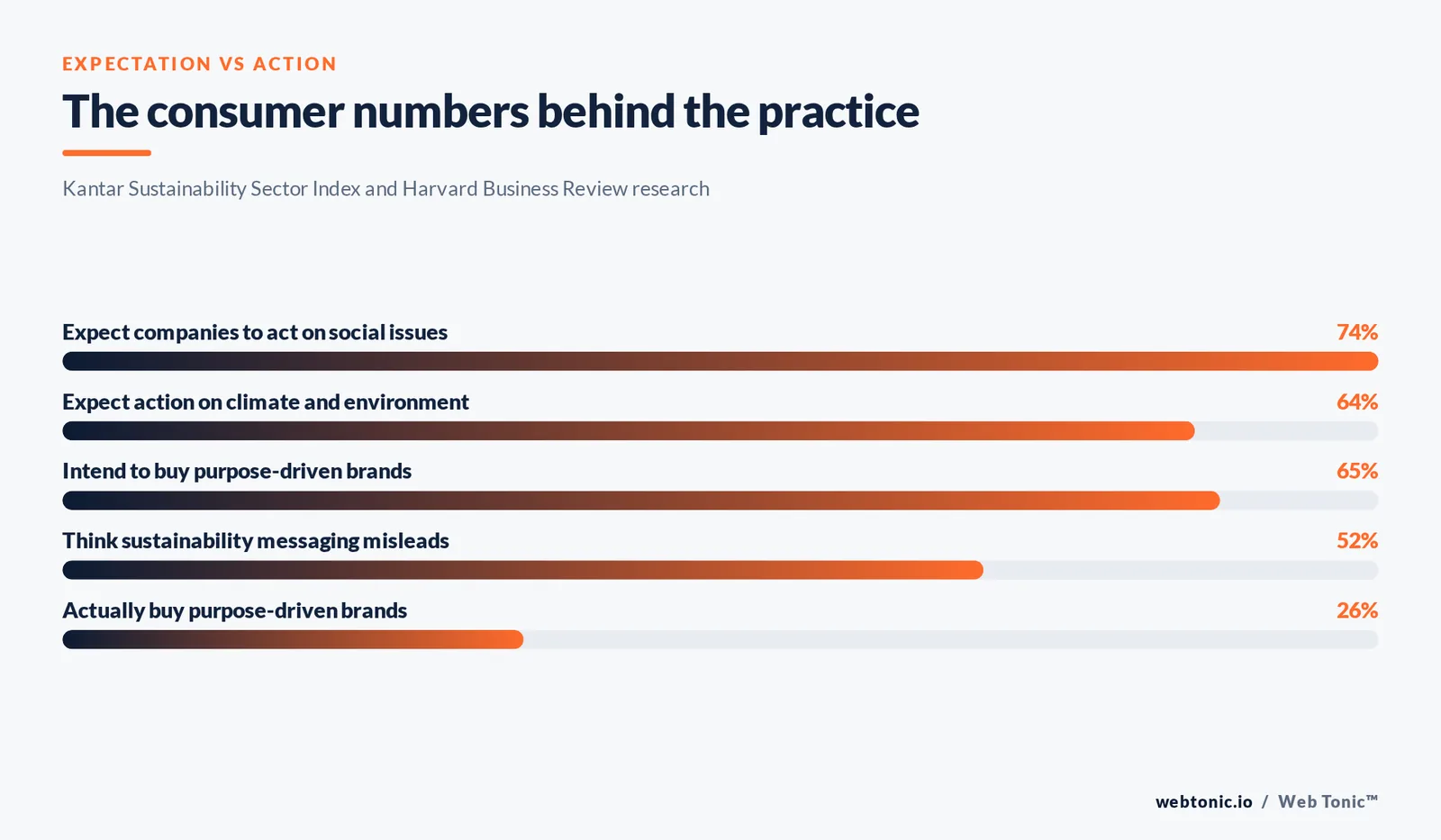
- 74% of consumers say companies have a responsibility to address social issues, and 64% say the same about climate and environmental problems.
- 52% also believe companies distribute misleading information about their sustainability efforts — scepticism is now the default audience posture.
- The value-action gap is measurable: 65% of people say they want to buy purpose-driven brands, while only about 26% actually do.
- Certification is a real bar, not a badge: over 10,000 certified companies exist worldwide, yet only about 1 in 4 consumers has heard of the label.
- US environmental advertising rules were first issued in 1992 and revised in 1996, 1998 and 2012, and enforcement actions have hit household names.
The definition, in one paragraph
Conscious marketing is an approach in which a company's promotional decisions are tested against its stated values, its social and environmental footprint, and the interests of every group it touches — customers, staff, suppliers and the wider public. In practice it means claims are substantiated before they are published, trade-offs are disclosed rather than hidden, and the promise made in an advert matches the operating reality behind it.
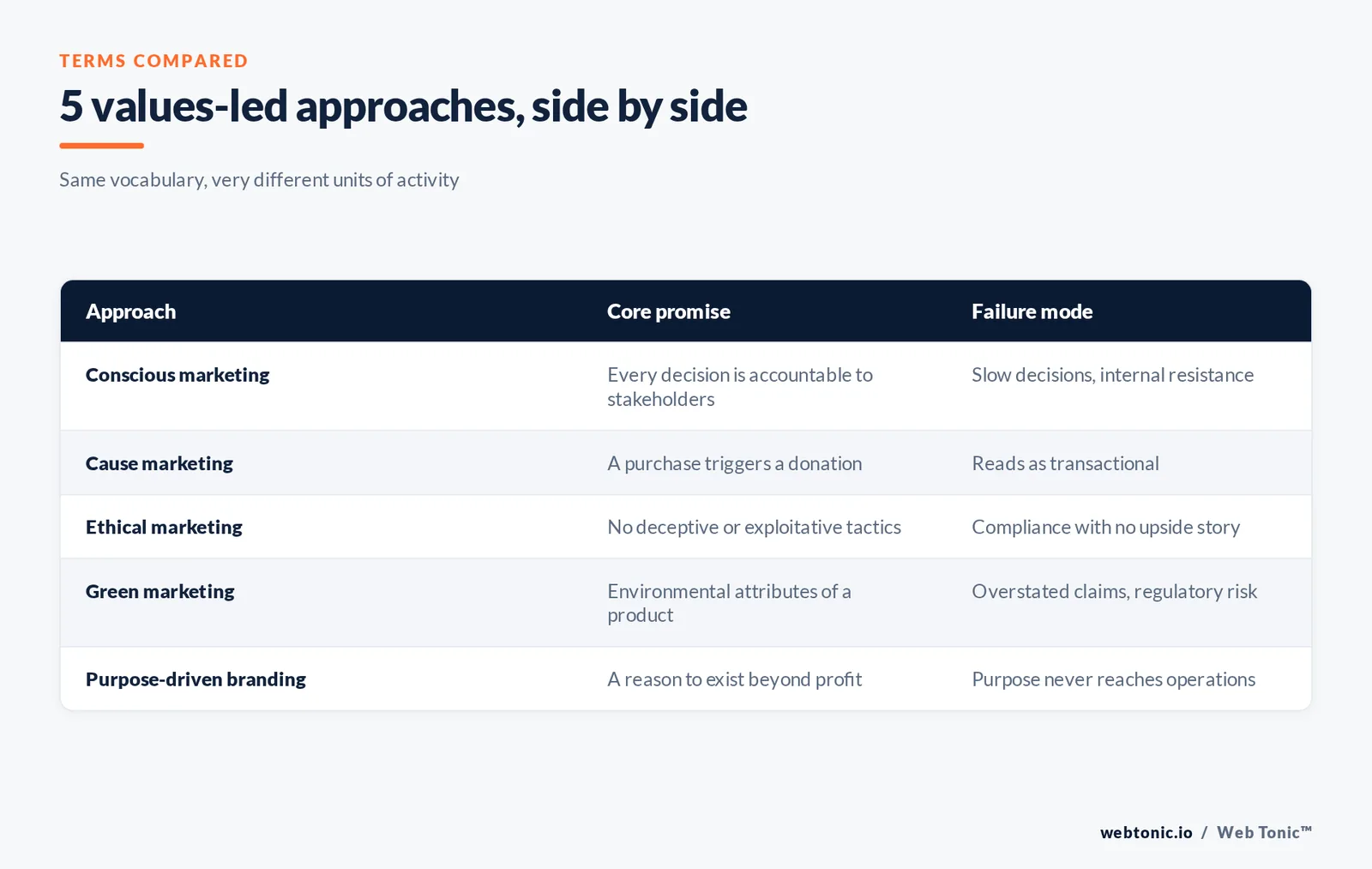
Five neighbouring ideas get used interchangeably. They are not the same thing:
| Approach | Core promise | Unit of activity | Failure mode |
|---|---|---|---|
| Conscious marketing | Every promotional decision is accountable to stakeholders | The whole marketing operation | Slow decisions, internal resistance |
| Cause marketing | A purchase triggers a donation | One campaign | Looks transactional if the cause is unrelated |
| Ethical marketing | No deceptive or exploitative tactics | Rules and review gates | Compliance mindset with no upside story |
| Green marketing | Environmental attributes of a product | Product and packaging claims | Overstated claims and regulatory risk |
| Purpose-driven branding | A reason to exist beyond profit | Brand positioning | Purpose that never reaches operations |
Rule 1 — if 1 department can quietly overrule the promise, it is positioning, not practice. Our guide to writing company core values covers the internal half of that problem.
The 5 principles that separate practice from posture
5 tests decide whether an initiative survives contact with a sceptical audience.
| Principle | Working test | Evidence a buyer can check |
|---|---|---|
| Substantiation | Can every claim be backed before publication? | Published methodology or third-party audit |
| Materiality | Does the commitment touch the biggest footprint? | Impact data on the core product line |
| Proportionality | Is the spend on the deed larger than on the advert? | Programme budget versus media budget |
| Transparency | Are trade-offs and misses disclosed? | A report that admits targets missed |
| Continuity | Does it survive a bad quarter? | Multi-year reporting history |
The UN Global Compact's ten principles and the 17 Sustainable Development Goals are the two frameworks most often used to give these tests external structure.
Why it pays: the numbers behind the practice
4 datasets are worth quoting when someone asks for a business case.
| Source | Finding | Scale of the study | How to use it |
|---|---|---|---|
| Kantar Sustainability Sector Index | 74% expect companies to act on social issues, 64% on climate | Multi-market consumer study | Sizing the expectation gap |
| Kantar, same index | 52% think sustainability messaging is misleading | Multi-market consumer study | Justifying proof-led creative |
| Harvard Business Review | 65% intend to buy purpose-driven brands, about 26% do | Consumer behaviour research | Designing for intent-to-action loss |
| NielsenIQ with McKinsey | 5 years of US sales data analysed for growth by claim | 600,000 SKUs, $400 billion revenue, 44,000 brands | Category-level demand evidence |
| PwC Voice of the Consumer | Behaviour tracking across a very large sample | 21,808 consumers in 27 countries | Trend context for planning |
The retail dataset is described by NielsenIQ as covering 32 food, beverage, personal-care and household categories from 2017 to mid-2022, and the intention gap is quantified in the HBR article The Elusive Green Consumer. Expectation data comes from the Kantar Sustainability Sector Index and behavioural context from PwC's Voice of the Consumer.
5 brands people actually cite, and the mechanism behind each
Each of these 5 programmes is verifiable, which is exactly why they get cited.
| Company | Mechanism | Verifiable detail | Why it holds up |
|---|---|---|---|
| Patagonia | Product footprint disclosure and repair programmes | Public footprint reporting on its own site | The deed predates the advertising |
| TOMS | Grant and product giving model | More than $200 million given since 2006 | Reported annually with an impact report |
| Ben & Jerry's | Issue advocacy tied to sourcing standards | Published values and sourcing commitments | Positions taken repeatedly, not opportunistically |
| Warby Parker | Distribute-a-pair programme | Programme described publicly with partner detail | Simple mechanic, easy for buyers to verify |
| Tom's of Maine | Ingredient and formulation transparency | Ingredient disclosure across the range | Transparency applied to the core product |
The giving figures come from the TOMS impact page, which also reports more than 106 million lives affected since 2006, and the distribution model is documented on Warby Parker's programme page. Building that kind of story into demand generation is growth marketing work, not a press release.
The claim rules you cannot design around
3 regulatory documents govern most of what a values-led campaign wants to say.
| Rule set | What it governs | Practical constraint |
|---|---|---|
| Green Guides | Environmental benefit claims in advertising | General claims such as eco-friendly need qualification |
| Endorsement guides | Reviews, testimonials and creator content | Material connections must be disclosed clearly |
| Health claim guidance | Health and wellness benefit statements | Competent and reliable evidence required up front |
| Certification claims | Use of seals and third-party marks | The mark must be earned and current |
| Category-specific rules | Energy labelling, organic claims and similar | Sector wording rules override creative preference |
The environmental rules were first issued in 1992 and revised in 1996, 1998 and 2012, and the enforcement record includes actions against large manufacturers and retailers. Both documents are published by the regulator: the Green Guides and the endorsement guides, with separate compliance guidance for health and wellness categories.
Designing for the intention gap
The 65 to 26 drop-off is a design problem, and 5 interventions address it directly.
| Barrier | What the buyer experiences | Intervention |
|---|---|---|
| Price friction | The responsible option costs visibly more | Show cost per use, not sticker price |
| Proof friction | No way to check the claim quickly | One-click access to the underlying data |
| Choice friction | The better option is harder to find | Default the responsible variant in the funnel |
| Habit friction | The switch requires a new routine | Trial packs and subscription nudges |
| Social friction | No visible signal to peers | Shareable proof of the choice made |
Trap 2 — running awareness campaigns against a 39-point intention gap wastes budget. Fix the purchase path first, then invest in brand awareness.
Certification and reporting routes, compared
4 external routes exist, and they cost very different amounts of effort.
| Route | What it verifies | Effort | Best fit |
|---|---|---|---|
| Third-party certification | Social, environmental and governance performance | High, audited | Consumer brands needing a trust shortcut |
| Voluntary principles | Commitment to human rights, labour and anti-corruption norms | Low to medium | Companies starting the journey |
| Goal alignment | Contribution mapped to global development targets | Medium | B2B firms reporting to enterprise buyers |
| Standards-based reporting | Disclosure of impacts on a defined framework | High, ongoing | Businesses with enterprise or public clients |
The certification route is audited against ISO 17021-1 requirements, the standards were updated in April 2025, and applicants from 2026 certify against version 2.1; the movement now spans over 10,000 companies on 6 continents while brand awareness sits near 1 in 4 consumers, per B Lab's certification overview.
An operating model by company size
3 stages, and the mistake at each one is different.
| Stage | Where to start | Owner | Common mistake |
|---|---|---|---|
| Under 20 staff | One material commitment, documented publicly | Founder | Claiming more than can be evidenced |
| 20 to 200 staff | A claims review gate before publication | Marketing lead with legal review | Leaving suppliers out of scope |
| 200 plus staff | Framework reporting with external assurance | Cross-functional council | Reporting volume without materiality |
Fact 3 — 1 documented commitment with evidence outperforms 10 aspirational statements. A short list beats a manifesto, and it survives a journalist's follow-up call. If you want that translated into positioning and campaigns, that is what our service teams build.

Measuring it without fooling yourself
6 measures give a defensible picture; the first 2 are the ones executives ask for.
| Measure | Method | Cadence |
|---|---|---|
| Claim substantiation rate | Share of live claims with evidence on file | Quarterly |
| Trust and scepticism score | Tracked survey question on believability | Twice a year |
| Preference lift | Brand preference among aware versus unaware groups | Twice a year |
| Programme reach | Beneficiaries, units or emissions affected | Quarterly |
| Commercial contribution | Revenue share of the committed product line | Monthly |
| Complaint and correction log | Challenges received and how they were resolved | Continuous |
Limit 4: no single metric proves sincerity, so publish 3 or more together. Consumer behaviour context for these measures is tracked in Deloitte's ConsumerSignals research.
5 traps that turn a values programme into a liability
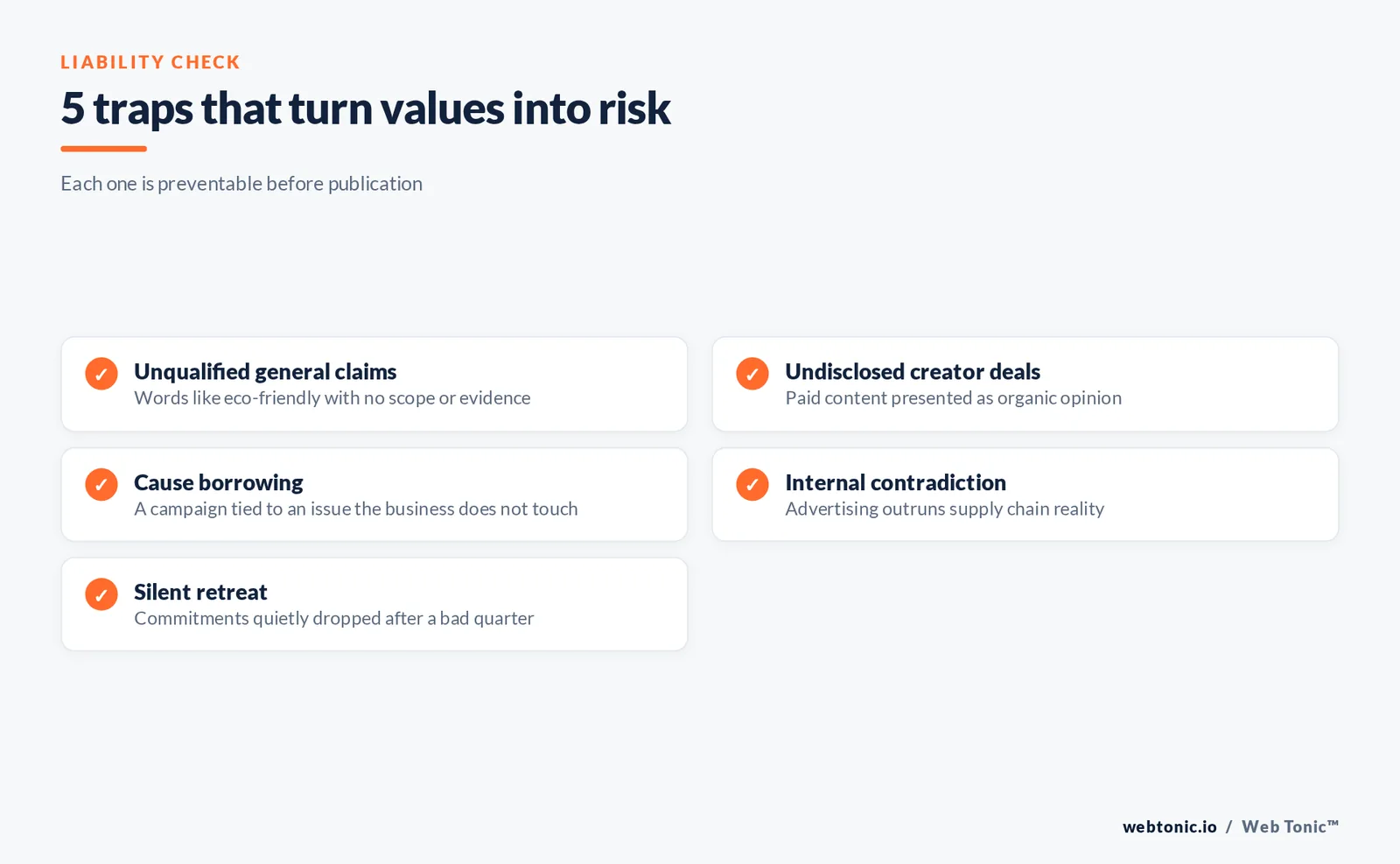
| Trap | How it shows up | Prevention |
|---|---|---|
| Unqualified general claims | Words like eco-friendly with no scope | Qualify to a specific attribute |
| Undisclosed creator relationships | Paid content presented as organic | Disclosure in the creative, not the bio |
| Cause borrowing | A campaign tied to an unrelated issue | Choose a cause with an operational link |
| Internal contradiction | Advertising outruns supply chain reality | Audit suppliers before publishing |
| Silent retreat | Commitments quietly dropped after a bad quarter | Publish misses alongside progress |
Rule 5 — when 1 claim fails publicly, every other claim gets re-examined. Campaign-level mechanics, including donation structures and disclosure duties, are covered in our guide to cause-based marketing, and you can talk to our team about a claims review before launch.
How CSR and conscious marketing connect
Corporate social responsibility supplies the practices; marketing supplies the proof. 5 CSR pillars map onto customer-facing work.
| CSR pillar | Business practices behind it | What customers can verify | Marketing responsibility |
|---|---|---|---|
| Environmental impact | Sourcing, packaging and energy initiatives | Footprint data on the products they buy | Publish the method, not just the headline |
| Labour and human rights | Supplier standards and audit programmes | Named supplier commitments | Say what is in scope and what is not |
| Community investment | Local partnerships and staff volunteering | Partner organisations and hours given | Report outcomes, not intentions |
| Governance and ethics | Ethical business practices and anti-corruption policy | Published code and reporting channel | Keep claims inside what governance can support |
| Product responsibility | Formulation, safety and durability work | Ingredient and repair information | Make the responsible option easy to find |
Fact 6 — CSR without communication changes nothing for 0 customers, and communication without CSR is the definition of greenwashing. The two halves have to ship together, which is why conscious marketing strategies belong in the same plan as the operational programme rather than in a separate brand document.
Conscious marketing strategies by industry
The same principles produce very different initiatives across 6 industries, and copying another sector's examples is the fastest route to a hollow campaign.
| Industry | Highest-impact initiative | Conscious marketing strategy | Proof customers respond to |
|---|---|---|---|
| Ecommerce and retail | Packaging and returns reduction | Show the durability case beside the price | Repair, resale and lifespan data |
| Food and beverage | Ingredient sourcing standards | Trace one hero product end to end | Named farms, cooperatives and audits |
| Professional services | Fair pricing and honest scoping | Publish process and typical outcomes | Case studies with real numbers |
| Software and SaaS | Data ethics and energy use | Explain data practices in plain language | Independent security and privacy audits |
| Local and home services | Fair labour and waste handling | Community commitments customers can see | Local partnerships and staff tenure |
| Health and wellness | Evidence-backed product claims | Lead with the evidence, not the promise | Study references and qualified experts |
Limit 7: 1 industry-relevant commitment beats 5 borrowed ones. Buyers judge relevance before sincerity, so an initiative that has nothing to do with how a business operates reads as marketing spend rather than social responsibility.
The long-term payoff: authenticity, loyalty and trust
Values-led work is a long term compounding asset, and 6 effects show up on different timelines.
| Effect | When it appears | How to see it | Risk if the practice slips |
|---|---|---|---|
| Believability of claims | 1 to 2 quarters | Scepticism questions in brand tracking | Every future claim is discounted |
| Customer loyalty | 2 to 4 quarters | Repeat rate among values-aware buyers | Loyalty reverts to price sensitivity |
| Brand authenticity | 1 to 2 years | Unprompted brand associations | Perceived as opportunistic |
| Talent attraction | 1 to 2 years | Applications per open role | Recruitment cost rises |
| Pricing power | 2 years plus | Willingness to pay in research | Discounting returns |
| Partnership access | 2 years plus | Enterprise and retailer requirements met | Removed from supplier lists |
Trap 8 — a 90-day campaign cannot buy a 2-year trust effect. Businesses that treat this as a positive impact programme with a multi-year reporting rhythm get the compounding benefits; businesses that treat it as a launch get one news cycle and a searchable claim they may not be able to defend. The future of the practice looks less like campaigns and more like published evidence that customers, staff and enterprise buyers can all audit.
FAQ
What is conscious marketing in simple terms?
It is promoting a business in a way that stays accountable to the people and systems the business affects. Claims are evidenced before publication, trade-offs are disclosed, and the advertising matches how the company actually operates.
How is it different from cause marketing?
Cause marketing is a campaign mechanic, usually a donation triggered by a purchase. The broader practice is an operating discipline that governs every claim and channel, whether or not a donation is involved.
Does it actually increase sales?
Demand exists, but intention converts poorly: about 65% of people say they want to buy purpose-driven brands and roughly 26% do. Removing price, proof and choice friction is what turns that stated preference into revenue.
What are the legal risks?
Unqualified environmental claims and undisclosed paid endorsements are the two biggest. US rules for both are published by the Federal Trade Commission, and enforcement has reached large, well-resourced advertisers.
Do we need a certification to start?
No. One material, documented and evidenced commitment is a stronger start than a certification pursued for its logo, and certification awareness among consumers is still only around one in four.
Sources
Kantar Sustainability Sector Index · Harvard Business Review, The Elusive Green Consumer (2019) · NielsenIQ with McKinsey, US retail sustainability sales analysis · PwC Voice of the Consumer · Deloitte ConsumerSignals · B Lab, B Corp Certification overview and 2024 brand awareness report · Federal Trade Commission, Green Guides, endorsement guides and health products compliance guidance · UN Global Compact ten principles · UN Sustainable Development Goals · TOMS impact reporting · Warby Parker programme page. All sources verified live 2026-08-06.