Table of contents

Company core values are the three to six behaviours an organisation agrees to reward, promote and fire on. They only matter when they change a decision.
Key Takeaways
- Gallup links high engagement to a 23% increase in profitability, 78% less absenteeism and 18% higher sales productivity — culture is a P&L line, not a poster.
- Global employee engagement fell to 20% in 2025, the lowest level since 2020, at an estimated $10 trillion in lost productivity (about 9% of global GDP).
- MIT Sloan Management Review put the cost of toxic culture at nearly $50 billion a year for US employers, measured across 1.3 million Glassdoor reviews.
- Values written as behaviours beat values written as nouns. 3 to 6 is the workable range; past 7, nobody recalls them.
- Below: 30 real published examples, a values-by-business-type table, a 6-step writing process and the 5 failure modes to avoid.
What company core values actually are (and what they are not)
A core value is a stated behavioural commitment that constrains choices when the easy option and the right option diverge. "Integrity" written on a wall is not a value; "we tell customers about a defect before they find it" is. Mind Tools frames values as decision filters rather than aspirations, and that is the test we use with clients: if a value cannot be used to reject a profitable option, it is marketing copy.
Three things values are not. They are not a mission (what you do), not a vision (where you are going), and not perks. MIT SMR's Culture 500 analysis measured 128 culture topics across large employers in 40 industries and found that benefits and perks are what company-level surveys capture most easily — and also what predicts culture ratings least. The negative drivers were disrespect, non-inclusion, unethical behaviour and cutthroat competition.
The distinction matters commercially. IBM's working definition of organisational culture ties values to observable norms and rituals, and HBR's organisational-culture library has spent two decades on the same point: the values that count are the ones enforced in promotion and exit decisions.
Why core values pay: the numbers
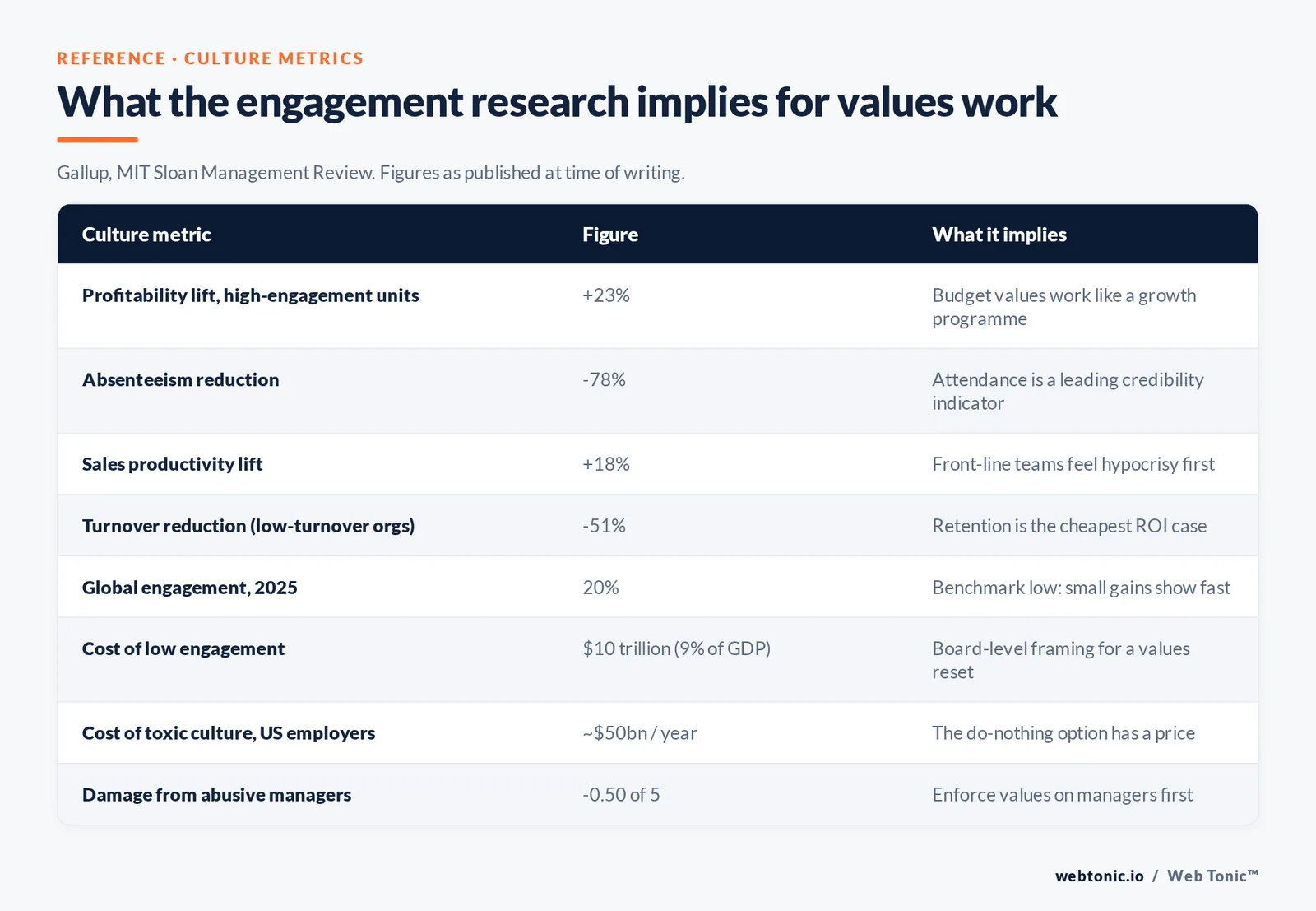
The strongest available evidence links values-driven cultures to engagement, and engagement to output. Gallup's meta-analysis of highly engaged business units reports 78% less absenteeism, 14% higher productivity, 10% higher customer loyalty, 18% higher sales productivity and a 23% increase in profitability. Turnover moves too: 21% less in high-turnover organisations and 51% less in low-turnover ones.
The gap is wide. Gallup's award-winning workplaces average 70% engaged employees against a US baseline of roughly 31% engaged and 17% actively disengaged. Globally the picture worsened: Gallup's 2026 State of the Global Workplace put engagement at 20% in 2025, with manager engagement dropping five points from 27% to 22% and employee thriving at just 34%.
Downside risk is quantified as well. MIT SMR's toxic-culture research found abusive management mentioned by only 0.8% of reviewers yet depressing culture ratings by an extra 0.50 points on a 5-point scale, and cited research where workplace injustice raises the odds of major disease by 35% to 55%. Public trust context helps calibrate claims too: Gallup's honesty and ethics ratings by profession show how little benefit of the doubt most industries start with.
| Culture metric | Figure | What it implies for values work |
|---|---|---|
| Profitability lift, high-engagement units | +23% | Values programmes should be budgeted like growth programmes |
| Absenteeism reduction | -78% | Attendance is a leading indicator of value credibility |
| Sales productivity lift | +18% | Front-line teams feel value hypocrisy first |
| Turnover reduction (low-turnover orgs) | -51% | Retention is the cheapest ROI case to build |
| Global engagement, 2025 | 20% | Benchmark low: small gains are visible fast |
| Cost of low engagement | $10 trillion / 9% of GDP | Board-level framing for a values reset |
| Cost of toxic culture, US employers | ~$50 billion per year | The do-nothing option has a price |
| Extra culture-rating damage from abusive managers | -0.50 of 5 | Enforce values on managers first |
30 company core values examples, and why each one works
Every example below is drawn from a publicly published values, culture or principles page. Read the "why it works" column as the mechanism: what decision does this phrasing actually settle? Sources include Google's ten things, Amazon's leadership principles, the Netflix culture memo and Nike's published mission and purpose pages.
| # | Value (as published or paraphrased) | Type | Why it works |
|---|---|---|---|
| 1 | Focus on the user and all else will follow | Customer | Settles roadmap arguments by naming who wins ties |
| 2 | Fast is better than slow | Operating | Gives permission to ship before consensus |
| 3 | You can make money without doing evil | Ethical | Pre-commits to rejecting profitable-but-harmful revenue |
| 4 | Customer obsession over competitor obsession | Customer | Redirects strategy meetings away from rival-watching |
| 5 | Ownership: leaders never say "not my job" | Accountability | Kills hand-off gaps between functions |
| 6 | Disagree and commit | Decision | Ends silent non-compliance after a decision |
| 7 | Bias for action; speed matters | Operating | Makes reversible decisions cheap to take |
| 8 | Frugality: constraints breed invention | Operating | Justifies saying no to headcount and tooling sprawl |
| 9 | Have backbone; disagree respectfully | Candour | Protects dissent without licensing rudeness |
| 10 | Deliver results, not activity | Accountability | Shifts reviews from effort to outcome |
| 11 | Judgement over process | Autonomy | Explains why the rulebook stays thin |
| 12 | Selflessness: seek what is best for the company | Teamwork | Disarms departmental empire-building |
| 13 | Candour: say what you think, even if uncomfortable | Candour | Normalises early bad news |
| 14 | People over process | Autonomy | Sets a bar for hiring instead of supervising |
| 15 | Inclusion: build teams that reflect the market | Inclusion | Turns a principle into a measurable hiring target |
| 16 | Do the right thing for the planet | Environmental | Constrains sourcing and packaging decisions |
| 17 | Build the best product, cause no unnecessary harm | Environmental | Trades short-term margin for durability on purpose |
| 18 | If you have a body, you are an athlete | Brand | Defines the audience so product scope stays wide |
| 19 | Win as a team | Teamwork | Makes shared metrics defensible |
| 20 | Create a culture of warmth and belonging | Service | Gives front-line staff a service standard, not a script |
| 21 | Act with courage, challenge the status quo | Candour | Licenses juniors to escalate |
| 22 | Be present, connect with transparency | Service | Sets a norm for how meetings and shifts run |
| 23 | Learn and be curious | Growth | Justifies training budget in a downturn |
| 24 | Insist on the highest standards | Quality | Makes "good enough" an arguable position |
| 25 | Invent and simplify | Innovation | Pairs novelty with a subtraction requirement |
| 26 | Think big, but start small | Innovation | Reconciles ambition with test-and-learn |
| 27 | Earn trust through evidence | Integrity | Requires data in claims, internal and external |
| 28 | Respect the craft | Quality | Protects specialists from generalist dilution |
| 29 | Leave the customer better off, deal or no deal | Integrity | Governs sales behaviour when a fit is poor |
| 30 | Keep the promise you actually made | Integrity | Turns marketing claims into an operational constraint |
Note the pattern: 26 of the 30 are phrased as an action or a trade-off, not as a noun. That is the single biggest difference between values that get quoted in meetings and values nobody remembers. If you need help translating them into external messaging, that is the bridge between culture work and growth marketing.
Core values by business type
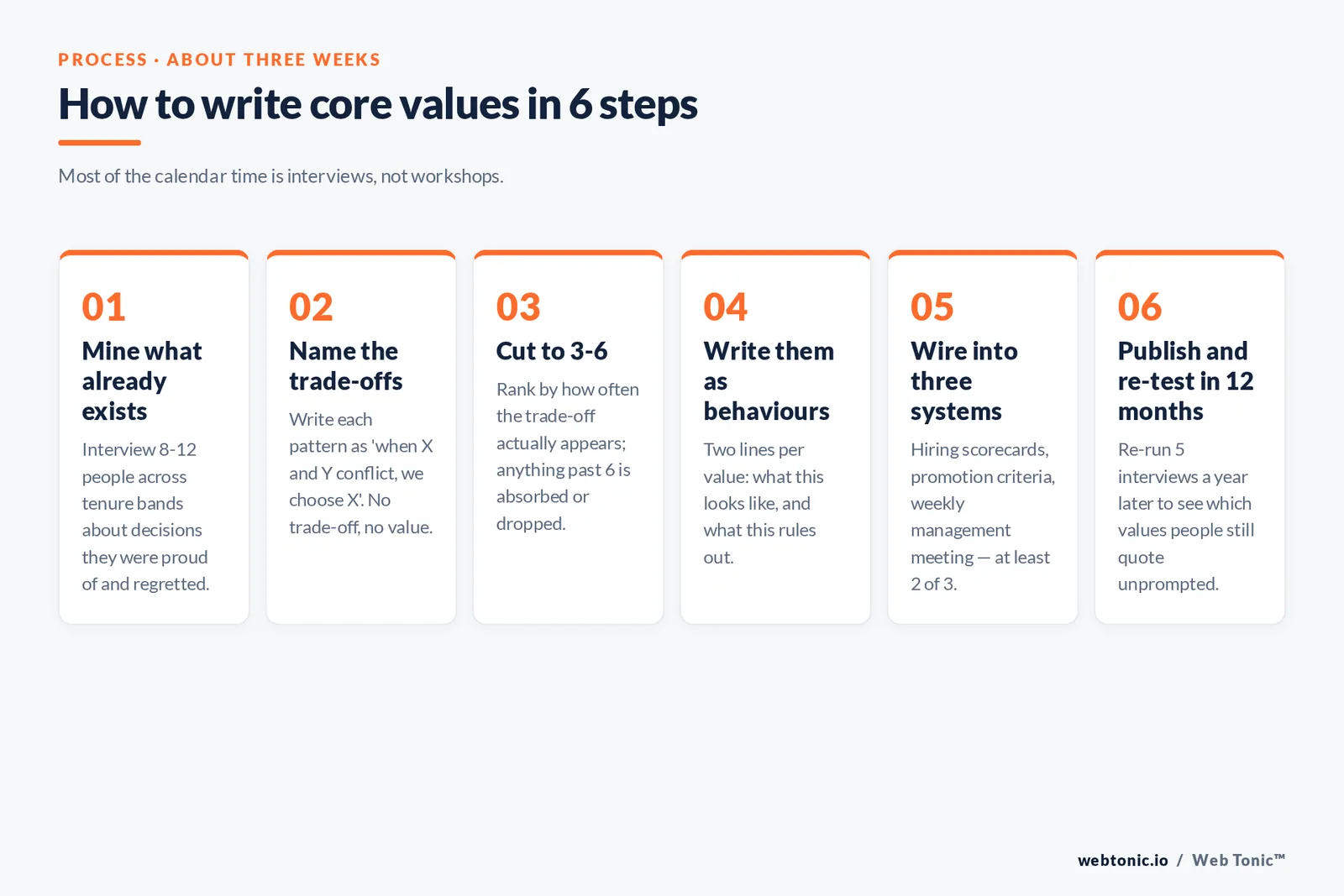
The right values depend on where your risk sits. A 12-person agency and a 400-person manufacturer fail for different reasons, so their value sets should be different. SHRM's employee-relations coverage is a useful reality check on what HR can actually enforce.
| Business type | Primary risk | Values that earn their place | How to test compliance |
|---|---|---|---|
| Local service business (1–20 staff) | Inconsistent job quality | Show up on time; fix it before the customer asks | Review 20 jobs a month against a 5-point checklist |
| Agency / consultancy | Overpromising in the pitch | Only sell what we can staff; report the bad number first | Audit every proposal against delivered scope quarterly |
| Ecommerce brand | Margin pressure eroding quality | Product truth in every claim; no dark-pattern checkout | Return-rate and complaint-reason review monthly |
| SaaS (Series A+) | Speed vs reliability | Ship weekly; own the incident end to end | Incident post-mortems with named owners, 100% coverage |
| Manufacturer / field ops | Safety and rework | Stop the line; no shortcut is worth an injury | Near-miss reporting rate as a positive KPI |
| Professional services (legal, finance) | Conflicts and confidentiality | Disclose early; decline the work if we cannot be neutral | Conflict-check log reviewed by a partner every 30 days |
| Healthcare / clinical | Patient trust | Explain in plain language; no upsell in the treatment room | Blinded patient-communication review, 10 cases a quarter |
| Nonprofit | Mission drift for funding | Refuse restricted money that bends the mission | Board sign-off on any grant above 10% of revenue |
How to write core values in 6 steps
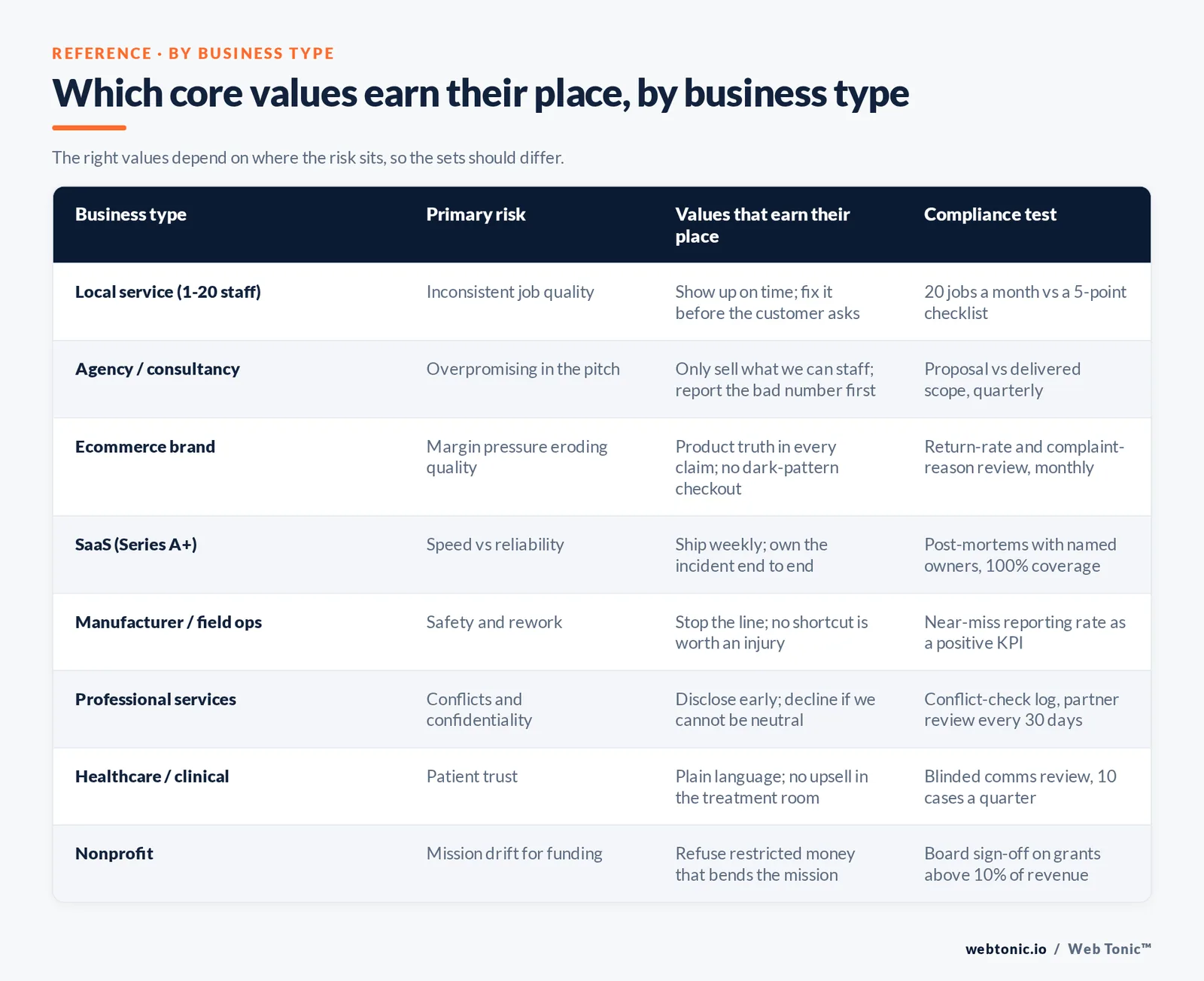
This is the sequence we run with clients. It takes about three weeks of calendar time, most of it interviews rather than workshops.
- Step 1 — Mine what already exists. Interview 8 to 12 people across tenure bands and ask for the last three decisions they were proud of and the last one they regretted. You are looking for values already in force, not inventing new ones.
- Step 2 — Name the trade-offs. Turn each pattern into a sentence of the form "when X and Y conflict, we choose X." A value that survives no trade-off is decoration.
- Step 3 — Cut to 3–6. Rank by how often the trade-off actually appears. Anything past 6 gets absorbed into a broader value or dropped.
- Step 4 — Write them as behaviours. Every value gets two lines: "what this looks like" and "what this rules out". The American Marketing Association makes the same argument for external positioning — specificity is the only defensible asset.
- Step 5 — Wire them into three systems. Hiring scorecards, promotion criteria, and the weekly management meeting. If a value does not appear in at least 2 of 3, it will not survive the year.
- Step 6 — Publish and re-test in 12 months. Put them on the site, in the handbook and in onboarding, then re-run 5 interviews a year later to see which ones people can still quote unprompted.
5 ways values programmes fail
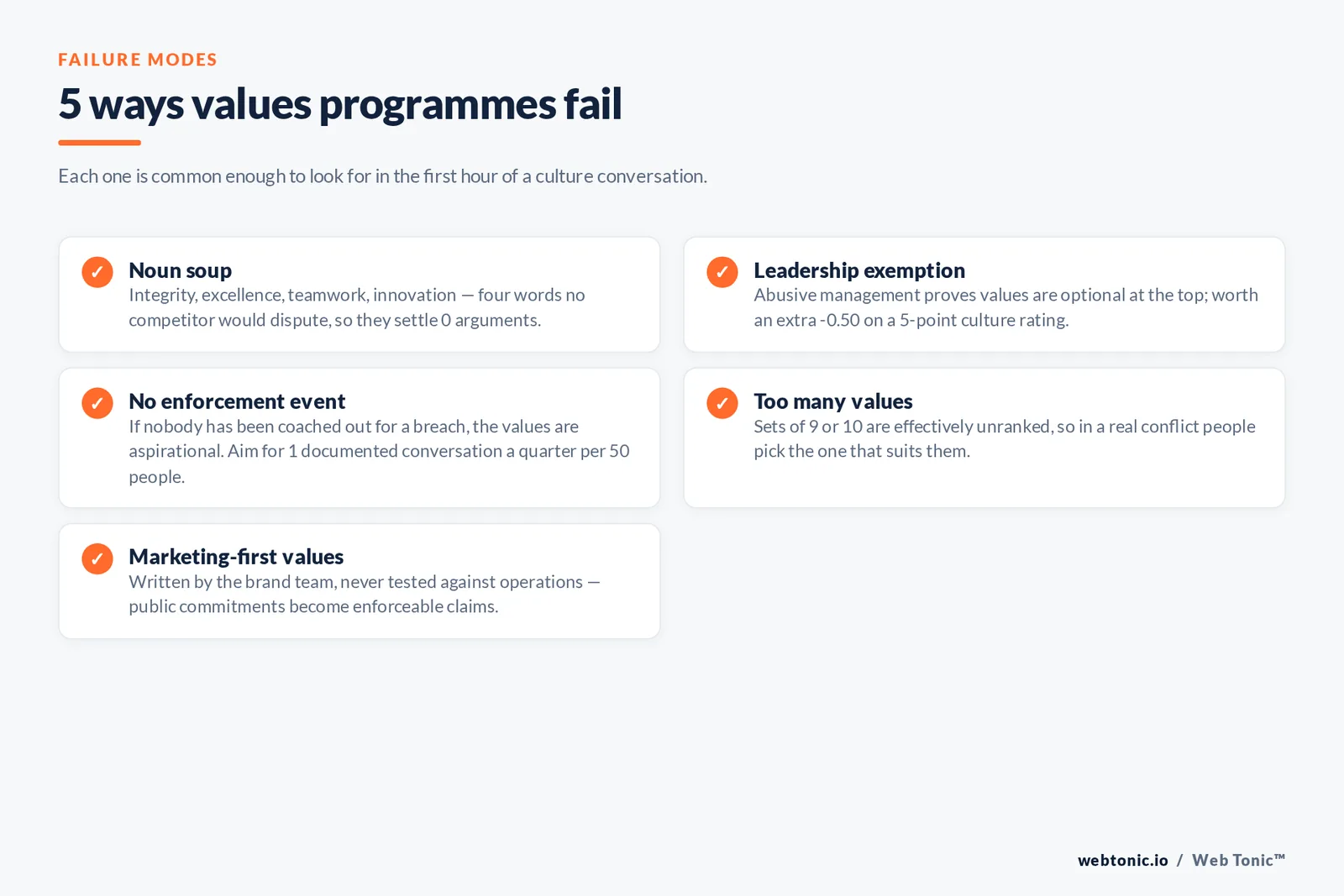
Each of these is common enough that we look for it in the first hour of any culture conversation.
- Failure 1 — Noun soup. Integrity, excellence, teamwork, innovation. Four words that no competitor would disagree with, so they settle 0 arguments.
- Failure 2 — Leadership exemption. The fastest way to void a value set. MIT SMR's data shows abusive management does outsized damage precisely because it proves values are optional at the top, worth an extra -0.50 on a 5-point culture rating.
- Failure 3 — No enforcement event. If nobody has ever been coached out for a values breach, the values are aspirational. Aim for at least 1 documented enforcement conversation per quarter in a 50-person company.
- Failure 4 — Too many. Sets of 9 or 10 values are effectively unranked, so in a real conflict people pick the one that suits them.
- Failure 5 — Marketing-first values. Values written by the brand team and never tested against operations produce claim risk. The FTC's endorsement guidance is a reminder that public commitments become enforceable claims.
Values also shape practical marketing choices — tone, which channels you will not use, and what you refuse to claim. That is why we treat them as an input to every engagement rather than an HR artefact, and why the calibration questions show up in our strategy writing. Practitioner debates on the same theme run in the Forbes Agency Council column.
Communicating company core values to employees and customers
Writing the values is the small half of the work. Communicating company core values so that employees, customers and candidates all hear the same thing is where most value programmes quietly die. The rule we apply: every value must appear in at least three places where a decision gets made, and in one place a customer can see.
Internally, that means the hiring scorecard, the onboarding week, and the weekly management meeting. Company values only become company culture when team members watch a leader apply them at a cost. Externally, it means the careers page, the sales conversation and the service recovery script — the three moments where a customer tests whether your values reflect reality. SHRM's employee-relations reporting is a practical reference for what an HR team can actually enforce here.
| Channel | Audience | What good looks like | Failure signal |
|---|---|---|---|
| Careers page | Candidates | Each core value paired with an example of work it ruled out | Values listed as single words with stock photography |
| Hiring scorecard | Interviewers | One behavioural question per value, scored 1–5 | Culture fit assessed on gut feel alone |
| Onboarding week | New employees | A real decision story told by the leader who made it | A slide deck read once and never revisited |
| Weekly management meeting | Managers | Contested decisions logged against the value that settled them | Values never mentioned in any meeting note |
| Performance and promotion reviews | All employees | Values weighted alongside results, not as a tiebreak | High performers exempt from the behaviour bar |
| Customer-facing service standards | Customers | A written promise the customer can hold you to | Service recovery decided ad hoc, case by case |
| Products and pricing decisions | Product and finance teams | Value cited when a profitable option is declined | Values silent whenever revenue is on the line |
| Supplier and partner selection | Operations | A short list of things we will not source or accept | Procurement treated as purely a cost exercise |
The pattern that builds trust is repetition with evidence. Employees believe company values at roughly the rate they see them cost the company something, and customers believe them at roughly the rate they experience them in a bad week rather than a good one.
Core values in action: hiring, innovation and long-term strategy
The best way to judge a core values list is to watch it work in three specific systems. Each one converts a stated value into an operating constraint, which is the only durable definition of company culture.
- Hiring. Values-based hiring means 1 behavioural question per value, asked of every candidate for every role, and a written score before the debrief. Teams that skip the written step converge on whoever interviewed most confidently. Ask what the candidate did the last time a customer request conflicted with an internal rule.
- Innovation. Innovation only survives a values test if the value explicitly protects failed work. A value such as "we fund 3 experiments a quarter and expect two to fail" changes budget behaviour; the word "innovation" on its own changes nothing.
- Business strategy. Long-term success comes from the options a company refuses. Write down the last 3 opportunities you declined and check whether a core value explains them. If none does, the values are not yet part of your business strategy.
- Employee experience and work-life balance. Claims about work-life balance are the easiest to falsify. Pair them with a measurable rule — response-time expectations, meeting-free blocks, or a cap on out-of-hours contact — or drop the claim.
- Customer experience. A customer-facing value should tell a frontline employee what to do without asking a manager, up to a stated limit such as a $200 service recovery allowance.
Two anchors for the effort. Engagement research shows the payoff is real: high-engagement business units deliver 23% more profit and 14% higher productivity, while global engagement sitting at 20% means most competitors are not doing this work at all. Values are one of the few strategy assets that compound quietly, because they change hundreds of small decisions a week rather than one big one a year.
Core values vs company culture: the daily difference
Core values are the written commitments. Company culture is what actually happens on an average Tuesday. The gap between the two is the only number that matters, and you close it by deciding what each value means for employees, for products and for customers before anyone has to guess.
| Value theme | What employees hear | What customers feel | Everyday decision it guides |
|---|---|---|---|
| Integrity | Report the bad number the day you see it | No surprises late in a project | Whether to flag a slipping deadline early |
| Customer focus | The customer's outcome outranks our convenience | Someone owns their problem end to end | Whether to escalate or close a ticket |
| Innovation | We fund experiments and expect most to fail | Products that improve visibly each year | Whether to ship a rough test to 5% of users |
| Craft and quality | We do not ship work we would not sign | Fewer defects and less rework | Whether "good enough" clears the bar today |
| Candour | Disagreement in the room, alignment outside it | Honest advice, including "do not buy this" | Whether to challenge a senior person's plan |
| Ownership | No task is beneath or outside your job | Nothing falls between departments | Whether to pick up an unassigned problem |
| Teamwork | Team members' results count as your results | One coherent voice, not five handovers | Whether to share a lead or hoard it |
| Inclusion | Different backgrounds are a hiring requirement | Products and copy that recognise them | Whether a shortlist is broad enough to review |
| Long-term thinking | We trade this quarter for the next three years | Pricing and policy that do not whiplash | Whether to accept revenue that creates churn |
| Work-life balance | Out-of-hours contact needs a real reason | Staff who are still here next year | Whether to send that 10pm message |
| Frugality | Constraints are a design input, not a complaint | Money spent on the product, not the office | Whether a new tool replaces one or adds one |
| Stewardship | We leave the customer and the market better off | Advice that survives the sale | Whether to decline work we cannot do well |
Two habits keep the list honest. First, each quarter pick 1 value and audit 10 real decisions against it — a value nobody can find evidence for gets rewritten or removed. Second, ask new employees at day 30 which value they have already seen broken. New people notice the gap between the values page and the workplace faster than anyone, and they will tell you once, early, if you ask directly. That single question has surfaced more useful culture information for our clients than any annual survey.
A 12-month core values action plan
Most companies do not need a bigger values statement; they need a calendar. This is the plan we hand to founders and people leaders who want their core values to guide real decisions inside a year rather than sit on a wall.
- Month 1 — Listen. Interview 10 employees across teams and tenure, and ask customers what they think the company stands for. The gap between the two answers is your brief.
- Month 2 — Draft 4 values as behaviours. One page each: what this looks like on a normal day, what it rules out, and one example from the company's own history.
- Month 3 — Pressure-test with managers. Bring 6 genuinely hard past decisions and check whether the draft values would have changed any of them. If not, the draft is still too abstract.
- Month 4 — Wire values into hiring. Rewrite the scorecard, add one behavioural question per value, and require a written score from every interviewer before the debrief.
- Months 5–6 — Rebuild onboarding. New employees should hear the values from the leader who applied them at a cost, not from a slide. Include the products, customers and workplace context for each value.
- Months 7–8 — Publish externally. Careers page, service standards and sales materials. Keep the mission, the vision and the values visibly distinct so nobody has to guess which is which.
- Months 9–10 — Enforce once, visibly. The first time a value costs the business money or a high performer, the culture becomes real. Aim for at least 1 documented values conversation at management level.
- Months 11–12 — Re-measure. Unprompted recall from 10 employees, decision-citation count over 90 days, and engagement against the roughly 20% global baseline. Rewrite at most 1 value per cycle.
Two notes from doing this work with clients. The teams that succeed treat values as a business strategy input — they can point to revenue they declined. The teams that fail treat values as an internal branding project, and their employees can tell the difference within a week. A short, enforced values list beats a long, admired one every time, because people can only hold three or four rules in their head while a customer is waiting for an answer.
How to measure whether your values are real
Four measurements, run annually, are enough to tell you whether the values exist outside the handbook.
| Measure | Method | Healthy signal |
|---|---|---|
| Unprompted recall | Ask 10 employees to list the values from memory | At least 7 of 10 name 3 or more correctly |
| Decision citation | Count value references in decision documents over 90 days | Values named in 20%+ of contested decisions |
| Enforcement rate | Log coaching or exits attributed to a values breach | Greater than 0, and applied at management level too |
| Engagement delta | Track engagement against the ~20% global baseline | Sustained movement over two consecutive cycles |
If you want the marketing side of this — turning a genuine internal standard into external positioning that holds up — talk to our team.
FAQ
How many core values should a company have?
Three to six. Fewer than three usually means the set is too abstract to guide decisions; more than six means they are unranked, and in a real conflict people simply choose the value that supports what they already wanted. Sets of 9 or 10 tend to function as a wish list rather than a filter.
What is the difference between core values and a mission statement?
A mission says what the organisation does and for whom. Core values say how it behaves when two good options conflict. A mission can be achieved or replaced; values are meant to persist across strategies. Vision, a third artefact, describes a future state rather than either behaviour or purpose.
Do core values actually affect financial performance?
Indirectly but measurably, through engagement. Gallup's research on highly engaged business units reports 23% higher profitability, 18% higher sales productivity and 78% less absenteeism, while MIT Sloan Management Review estimated toxic culture cost US employers nearly $50 billion a year. The mechanism is retention, discretionary effort and lower rework, not the values statement itself.
Who should write a company's core values?
Leadership owns the final set, but the raw material should come from interviews across the organisation, ideally 8 to 12 people spanning tenure and function. Values invented in a leadership offsite without that input tend to describe the company leaders wish they ran. HR and brand teams then translate, they do not originate.
How often should core values be revisited?
Review annually, rewrite rarely. An annual check tests whether people can still recall and cite them; a rewrite is warranted only after a genuine discontinuity such as a merger, a pivot or a serious cultural failure. Frequent rewrites signal that the values were never load-bearing.
Sources
Gallup — Right Culture: Not Just Employee Satisfaction; Gallup — State of the Global Workplace 2026; Gallup — Honesty and Ethics of Professions; MIT Sloan Management Review — Why Every Leader Needs to Worry About Toxic Culture (Culture 500); Harvard Business Review — Organizational Culture topic library; SHRM — Employee Relations; Mind Tools — Core Values; IBM Think — Organizational Culture; Google — Ten things we know to be true; About Amazon — Leadership Principles; Netflix — Culture; Nike — About; American Marketing Association — Brand Strategy; US Federal Trade Commission — Endorsement Guides. Figures cited as published at time of writing.