Table of contents
56% of marketers report improved direct mail performance over the past 12 months, and only 2% report a decline. Franklin Madison Direct's 2026 Direct Mail Marketing Benchmark Report, built from a national survey of 500 US marketing professionals and 600 US consumers, is the freshest published dataset on whether direct marketing still earns its line in a 2026 budget - and the numbers say it does.
Key Takeaways
- 56% of marketers report improved direct mail performance over the last 12 months.
- Only 2% report declining performance in the same period.
- 63% of marketers who increased direct mail spend saw performance gains.
- That compares to 48% for flat budgets and 42% for reduced budgets.
- More than half of marketers increased their direct mail budget in the past year.
- 41% rate mail more effective than digital for winback/reactivation.
- 41% also rate it more effective for upsell/cross-sell.
- 40% rate it more effective for new customer acquisition.
- 39% rate it more effective for lead remarketing.
- 79% of consumers engage with the mail they receive.
- Direct mail is the second most influential advertising channel for purchase decisions.
- 21% of consumers made a purchase from relevant mail in the past year.
- 95% of channel-integrators use a dedicated landing page for their mail piece.
- 98% say mirroring mail creative in digital improves results.
- 31% of consumers engage more when mail is paired with a digital ad, up 4 points.
- 52% of consumers value being able to keep a mail piece for later reference.
The performance number that should reframe the budget conversation
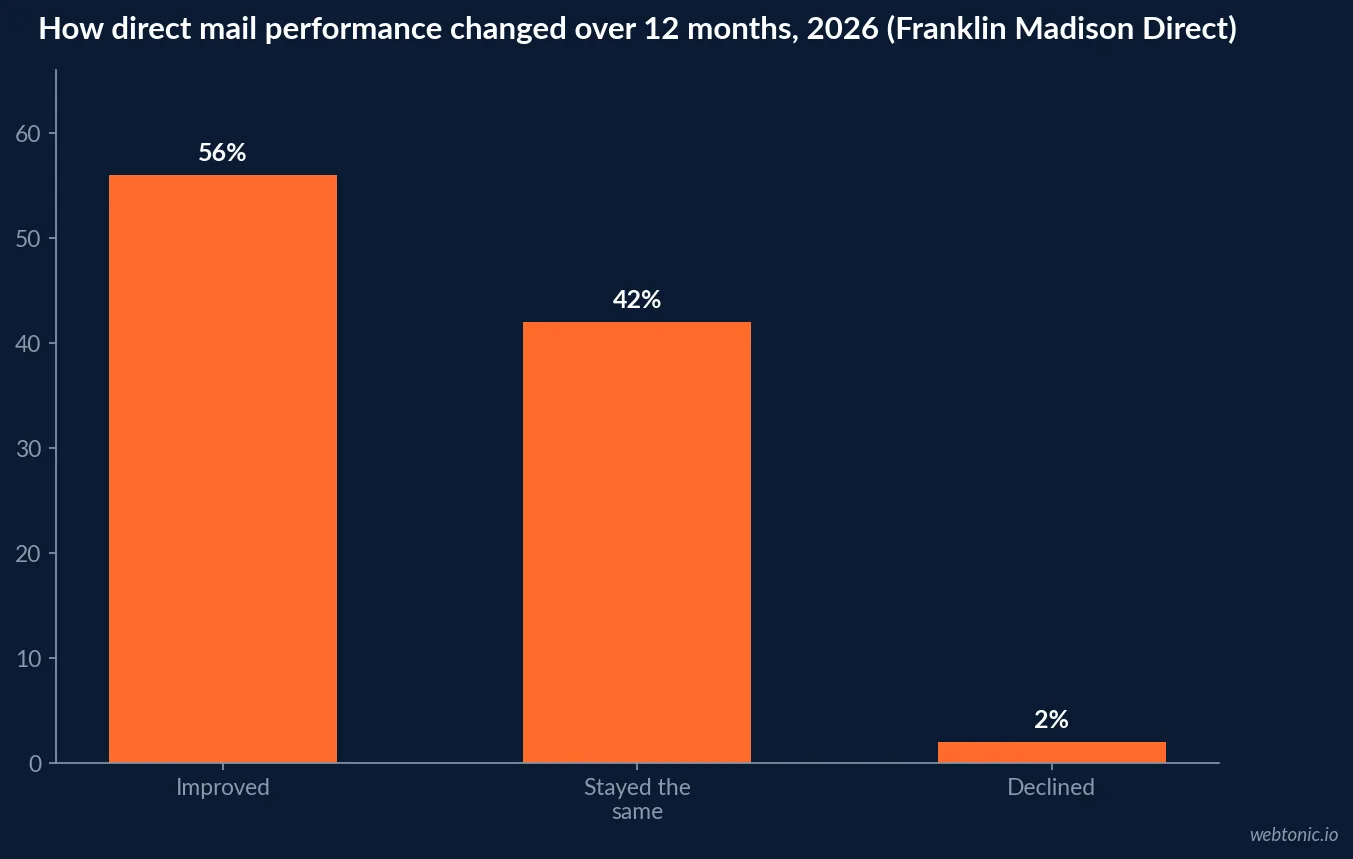
Franklin Madison Direct's 2026 Direct Mail Marketing Benchmark Report, fielded with research firm Circlebox among 500 US B2B, B2C and mixed-model marketing professionals, found 56% reporting improved direct mail performance over the prior 12 months, 42% reporting it held steady, and just 2% reporting a decline. That distribution - more than half improving, almost none declining - describes a channel performing well across a wide range of programs and business models, not a legacy line surviving on inertia.
| Direct mail performance, last 12 months (2026) | Share of marketers |
|---|---|
| Improved | 56% |
| Stayed the same | 42% |
| Declined | 2% |
Spend more, and the odds of improvement rise with it
The report ties spend directly to outcome: marketers who increased direct mail budget over the past 12 months were more likely to report improved performance (63%) than those who kept budgets flat (48%) or reduced them (42%). More than half of respondents increased their direct mail budget in the same period - a direct signal of confidence in the channel, not a hedge against a shrinking one.
| Budget change (2026) | Share reporting improved performance |
|---|---|
| Increased direct mail spend | 63% |
| Kept spend flat | 48% |
| Reduced spend | 42% |
Where direct mail beats digital, task by task
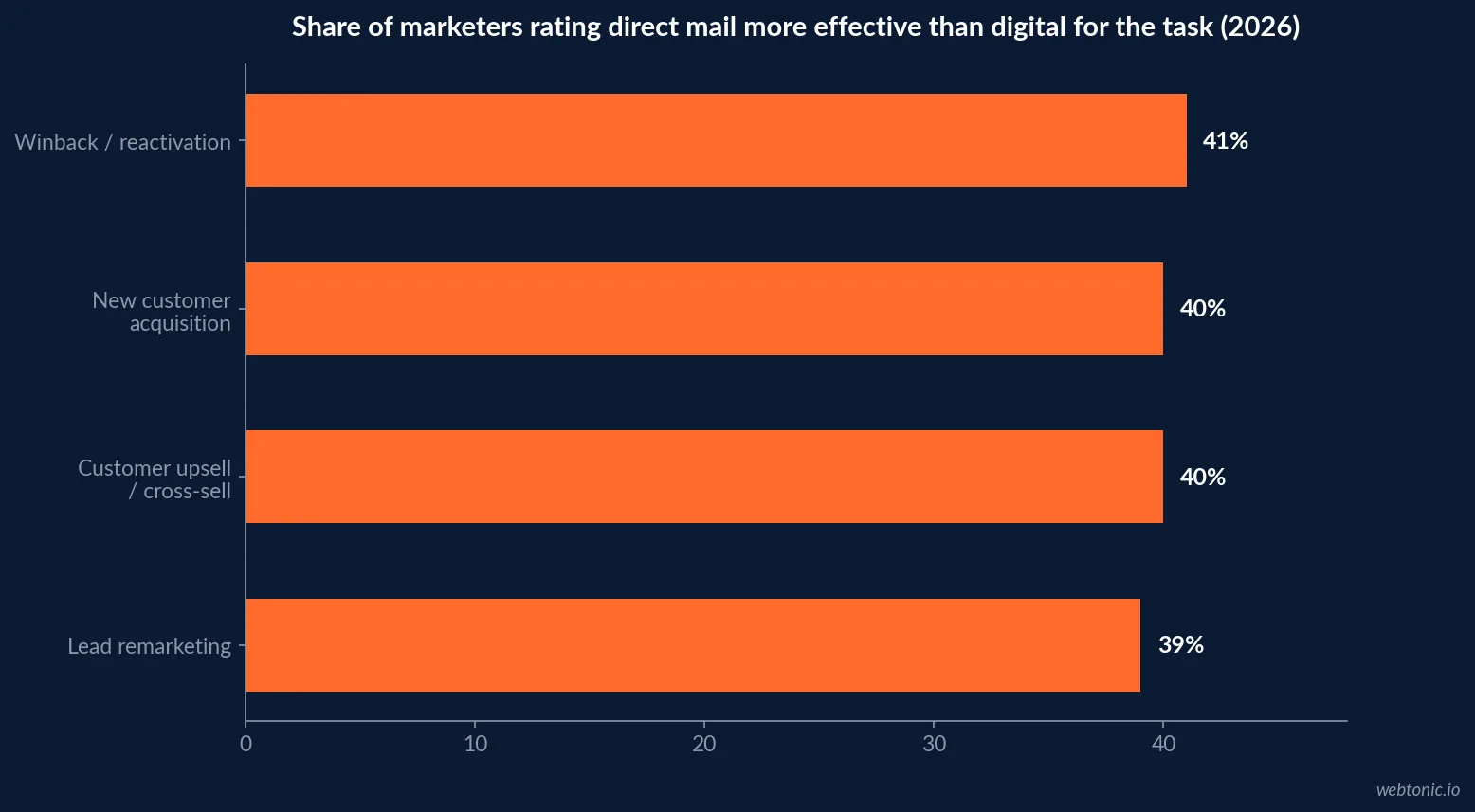
Asked to compare direct mail's effectiveness against digital channels on specific objectives, marketers rated mail more effective (not just equal) on all four tasks measured: 41% for winback/reactivation, 41% for customer upsell/cross-sell, 40% for new customer acquisition and 39% for lead remarketing. In each case, a similar or larger share rated the two channels equally effective, and only a small minority rated digital clearly better.
| Marketing objective (2026) | Mail rated more effective | Rated equally effective | Digital rated more effective |
|---|---|---|---|
| Winback / reactivation | 41% | 46% | 13% |
| Customer upsell / cross-sell | 41% | 45% | 13% |
| New customer acquisition | 40% | 43% | 17% |
| Lead remarketing | 39% | 46% | 14% |
What consumers themselves say about it
The consumer side of the same study, a separate national sample of 600 US consumers, backs the marketer-side numbers up. 79% of consumers engage with the mail they receive, direct mail ranks as the second most influential advertising channel for purchase decisions in the survey (behind only television/streaming ads), and 21% of consumers report making a purchase in the past year specifically because of a relevant mail piece they received. 52% say they value being able to keep an interesting piece and refer back to it later - a behavior no digital ad format replicates.
| Consumer signal (2026, n=600 US consumers) | Figure |
|---|---|
| Engage with mail they receive | 79% |
| Made a purchase from relevant mail in the past year | 21% |
| Rank mail among top-3 most influential ad types | 37% |
| Value keeping mail for later reference | 52% |
| Say mail feels less intrusive than other ads | 44% |
What it actually costs per acquisition
The report's cost-per-acquisition data shows a real spread rather than one number, and it clusters in the middle: the largest single band is USD 150-249 at 23% of respondents, followed by USD 250-499 at 28% combined across that range and USD 100-149 at 19%. Very few programs report a CPA under USD 50 or over USD 1,000, which puts direct mail's typical acquisition cost in a comparable range to several paid digital channels once creative, list and postage are all counted.
| Direct mail cost-per-acquisition band (2026) | Share of marketers reporting it |
|---|---|
| Less than USD 50 | 2% |
| USD 50-74 | 3% |
| USD 75-99 | 9% |
| USD 100-149 | 19% |
| USD 150-249 | 23% |
| USD 250-499 | 25% |
| USD 500-999 | 15% |
| USD 1,000 or more | 1% |
The real 2026 story: mail plus digital, not mail versus digital
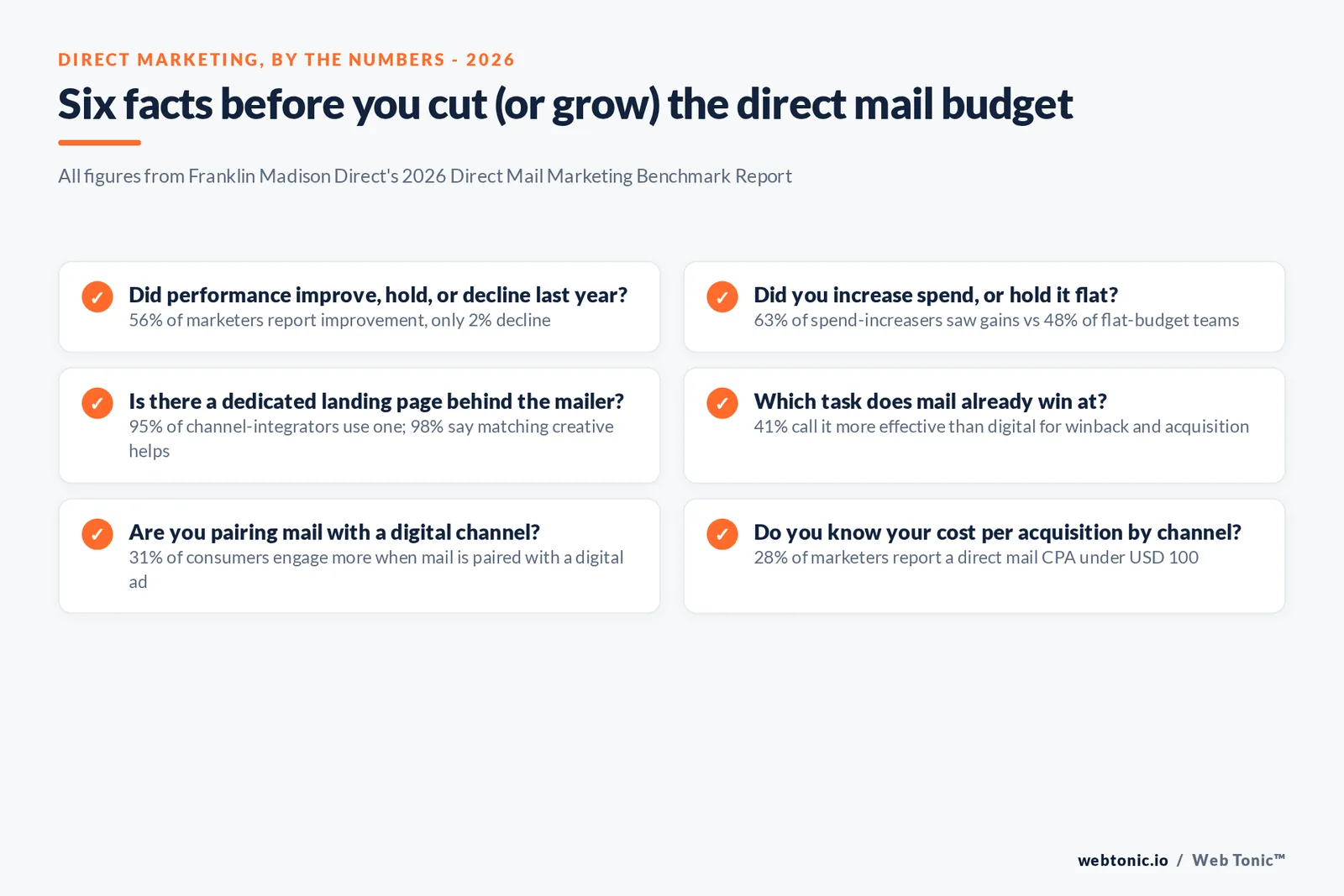
The strongest signal in the report is integration, not channel rivalry. 95% of marketers who integrate direct mail with digital channels use a dedicated landing page for the mail piece, and 98% say mirroring the mailpiece's creative in the digital experience leads to better results. Growing adoption of paid social (52%), SMS/MMS (46%), display (44%) and connected audio (40%) as digital partners for mail shows the channel is being built into omnichannel journeys, not run in isolation. On the consumer side, 31% say they are more likely to engage with brand content when they receive both a mail piece and a digital ad, up 4 points from 2025. Our performance creative team builds exactly this kind of matched mail-to-landing-page creative when a client runs a mail program.
| Digital pairing element (2026) | Adoption / impact |
|---|---|
| Use a dedicated landing page for the mail piece | 95% of channel-integrators |
| Say matching mail creative to digital improves results | 98% |
| Pair mail with paid social | 52% |
| Pair mail with SMS/MMS | 46% |
| Pair mail with display advertising | 44% |
| Consumers who engage more when mail + digital ad both arrive | 31%, up 4 pts YoY |
How this lines up with the government's own mail-use data
The USPS runs its own long-running consumer research on this exact question through the Household Mail Survey (formerly the Household Diary Study), which tracks mail use and attitudes across US households annually. Its FY2025 edition, covering the same period as Franklin Madison Direct's marketer-side survey, independently confirms that advertising mail remains a channel households actively open and act on rather than discard - consistent with the 79% consumer engagement rate above, from a completely separate data collection method.
Where direct marketing sits in the broader B2B tactic mix
Direct and print advertising is not a niche line item industry-wide either. Sagefrog Marketing Group's 2026 B2B Marketing Mix Report, surveying B2B marketers directly, puts direct & print advertising usage at 18% - ahead of paid social, market research and marketing technology in the same tactic list, and roughly tied with search engine optimization. That places direct marketing solidly inside the working tactic mix most B2B teams run, not at its margins.
| B2B tactic usage (2026, Sagefrog Marketing Mix) | Share of B2B marketers using it |
|---|---|
| Direct & print advertising | 18% |
| Search engine optimization (SEO) | 16% |
| Paid social media campaigns | 16% |
| Marketing technology | 15% |
The personalization gap Salesforce's Tenth Edition State of Marketing report documents elsewhere in the industry - 78% of marketers saying they need more personalization than they can currently produce - is exactly the gap direct mail's landing-page and creative-matching practices are built to close on a per-mailer basis. A mail program with a matched digital landing page is, in effect, a personalization program that does not depend on the same real-time data pipeline a fully digital campaign requires.
What to actually do with this data
If your direct mail program has been flat or shrinking on the assumption the channel is fading, the 2026 data does not support that assumption - performance is improving for the majority of teams running it, and it is improving fastest for the ones spending more, not less. The bigger risk this data points to is running mail as a standalone channel: the integration numbers show almost every marketer getting extra lift from pairing it with a landing page and a matched digital ad, and skipping that pairing is the more common way to leave the channel's return on the table.
If you want your own direct mail and digital pairing reviewed against these benchmarks, talk to us, or see how our growth marketing practice sequences offline and digital channels inside one campaign calendar.
The one number worth revisiting every quarter, not just at budget-planning time, is the spend-to-performance link from the top of this page: 63% of teams that increased mail spend saw improvement, against 42% of teams that cut it. That is not a guarantee any single program will follow the same curve, but it is the strongest single piece of evidence in the 2026 data that direct mail rewards continued investment rather than a slow wind-down, provided the mail is still paired with the landing-page and creative-matching practices the same survey ties to results.
Frequently Asked Questions
Is direct mail actually still working in 2026, or is this nostalgia?
The 2026 data says it is working. Franklin Madison Direct's Benchmark Report, based on a national survey of 500 US marketing professionals, found 56% reporting improved direct mail performance over the past 12 months and only 2% reporting a decline. That is not a channel in decline; it is a channel most teams say is getting better.
Does increasing the direct mail budget actually pay off?
The same study ties spend to outcome directly: marketers who increased direct mail spend were more likely to see improvement (63%) than those who kept budgets flat (48%) or cut them (42%). More than half of marketers surveyed increased their direct mail budget over the past 12 months, which the report calls a signal of confidence in the channel.
How does direct mail compare to digital for specific marketing tasks?
Marketers rate it favorably on retention and reactivation tasks specifically: 41% say mail outperforms digital for winback/reactivation, 41% for upsell/cross-sell, 40% for new customer acquisition and 39% for lead remarketing, against roughly similar shares who rate the two channels equal. Very few call digital clearly better on any of the four tasks measured.
What does direct mail actually cost per acquisition?
Cost varies widely by program, but Franklin Madison Direct's survey shows a concentration in the middle of the range: the largest single bands were USD 150-249 (23% of respondents) and USD 100-149 (19%), with 28% at USD 250-499. Very few programs run under USD 50 or over USD 1,000 per acquisition.
Should direct mail be paired with digital channels, or run alone?
Paired, based on the 2026 data. 95% of marketers who integrate channels use a dedicated landing page for their mail piece, 98% say mirroring the mail's creative in the digital experience improves results, and 31% of consumers say they engage more with brand content when they receive both a mail piece and a digital ad - up 4 points from 2025.
Sources
Franklin Madison Direct - 2026 Direct Mail Marketing Benchmark Report
Chief Marketer - 2026 Direct Mail Marketing Benchmark Report landing page
MarTech - 2026 Direct Mail Marketing Benchmark Report
New York Netwire - 2026 Direct Mail Marketing Benchmark Report release
USPS - Household Mail Survey (formerly Household Diary Study)
Sagefrog Marketing Group - 2026 B2B Marketing Mix Report
Salesforce - Tenth Edition State of Marketing (2026)