Table of contents
Brand awareness is the extent to which people in a product category can recognise or recall your brand — and how easily it comes to mind when a buying situation appears.
Below: the four levels, how brand awareness actually influences choice, five ways to measure it, the channels that build it, and the mistakes that waste the budget.
Key Takeaways
- Brand awareness has 4 levels: unaware, brand recognition, brand recall, and top-of-mind awareness. Each needs a different measurement method and a different marketing job.
- Recognition is aided memory; brand recall is unaided. Only recall gets you into the shortlist a consumer builds before they ever open a search engine.
- The audience is enormous and always on: DataReportal counts 5.66 billion social media users spending an average of 2 hours 40 minutes a day across 6.75 networks each month.
- Sprout Social reports that more than 60% of product discovery now starts on social platforms, with global social ad spend heading toward $317.33 billion in 2026.
- The evidence-based split for budget is roughly 60% brand building and 40% activation — the long-and-short rule popularised by the IPA's effectiveness research.
- In B2B, roughly 95% of buyers are not in market at any moment, so awareness spend is an investment in future demand, not this month's pipeline.
- Measure with a mix: aided and unaided surveys, branded search volume, share of search, direct traffic, and share of voice. Never a single number.
- The most expensive mistake is not low spend but dull, forgettable creative — System1's research argues brands pay a media premium to compensate for advertising nobody remembers.
What brand awareness actually means
Brand awareness is a memory metric. It measures whether your brand is stored in a consumer's mind in a way that is retrievable at the moment of choice — linked to the product category, to a need, or to a situation. Marketing academics call the strength and breadth of those links brand salience, and it is the part of brand management that most directly predicts market share.
That distinction matters because awareness is often confused with two neighbours. Brand image is what people associate with you (premium, cheap, sustainable, fast). Brand equity is the commercial value those associations create — the price premium and the loyalty. Awareness is the precondition for both: a consumer cannot hold an image of a brand they cannot retrieve, and no brand builds equity from a blank slate. The American Marketing Association treats it as the entry gate of the whole brand hierarchy.
The classic mental model is the hierarchy of effects model: attention, then interest, then desire, then action. Modern buying is far less tidy — people loop, compare and abandon — but the first rung has not changed. Nothing else in the funnel can happen until the brand exists in memory.
The 4 levels of brand awareness
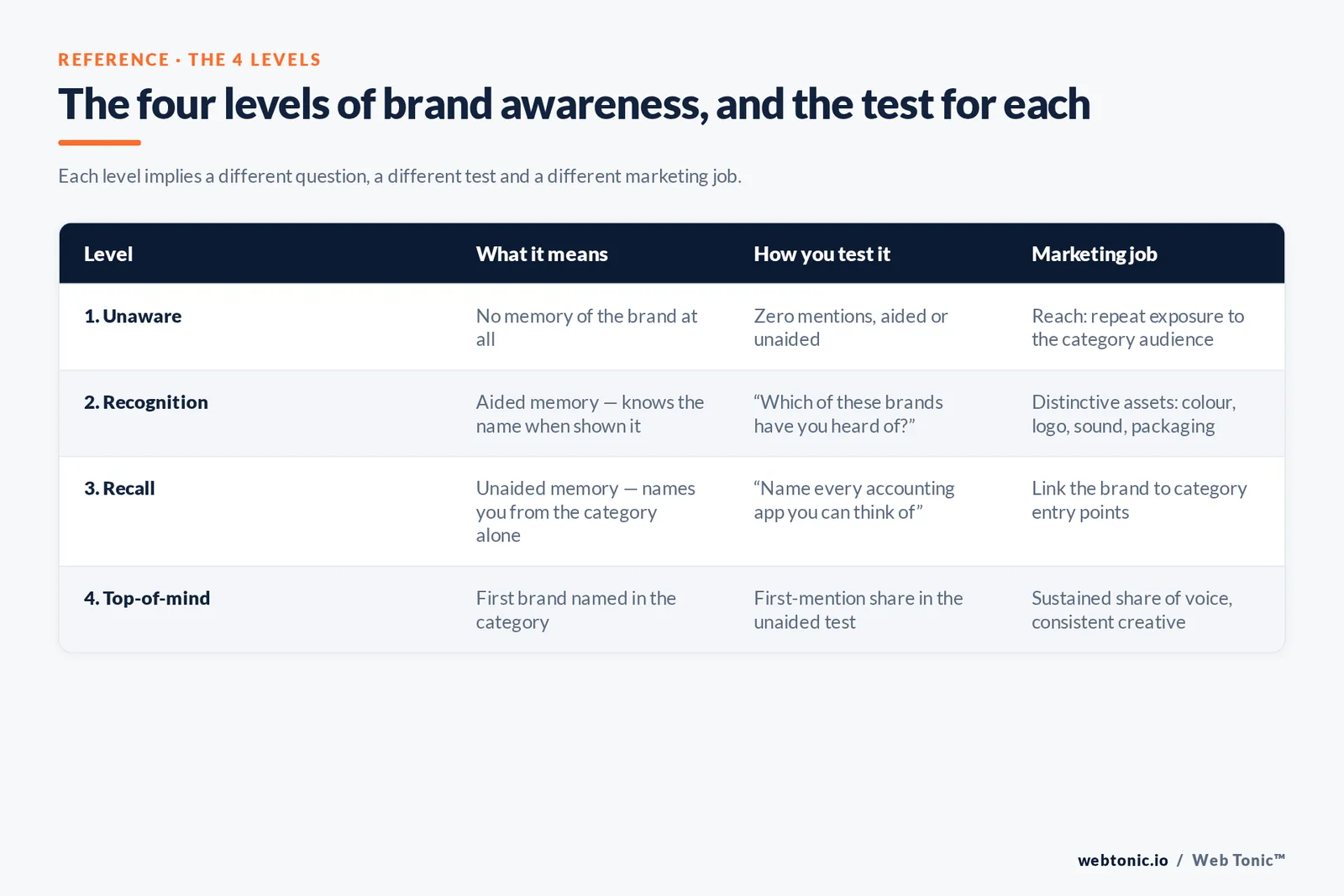
Treat these as stages, not labels. Each level implies a different question, a different test and a different tactic.
| Level | What it means | How you test it | Marketing job |
|---|---|---|---|
| 1. Unaware | The consumer has no memory of the brand at all | Zero mentions in aided or unaided tests | Reach: put the brand in front of the category audience repeatedly |
| 2. Brand recognition | Aided memory — they know the name or logo when shown it | Aided survey: "Which of these brands have you heard of?" | Distinctive assets: consistent colour, logo, sound, packaging |
| 3. Brand recall | Unaided memory — they name you when given only the product category | Unaided survey: "Name every accounting app you can think of" | Link the brand to category entry points and needs |
| 4. Top-of-mind awareness | You are the first brand named in the category | First-mention share in the unaided test | Sustained share of voice plus consistent creative |
The jump that changes commercial outcomes is level 2 to level 3. Brand recognition wins you a click when a consumer already sees you on a shelf or a results page. Brand recall gets you into the two-to-four-brand shortlist people assemble in their heads before any research starts — and most purchases are made from that shortlist. Reaching top-of-mind awareness in a category is rare, and it is usually the product of a decade of consistency rather than one campaign.
Why brand awareness moves revenue
Three mechanisms do the work, and they are worth separating because they need different proof.
Mental availability. Buying decisions happen fast and under low attention. Brands that are easy to retrieve get considered; brands that are not are invisible even when they are cheaper or better. That is why an awareness campaign can lift conversion rates on channels it never touched — the ad you ran in June is what makes the search click in September convert.
Cheaper acquisition. A known brand earns higher click-through, better landing-page engagement and stronger branded search demand. Branded queries convert at a far higher rate than generic ones, and as Ahrefs' work on branded search shows, that demand is a direct readout of how many people already have you in memory. Awareness quietly lowers the cost of every performance channel you run.
Future demand. In most categories, only a small slice of the audience is buying today. In B2B the widely cited figure is that around 95% of buyers are not in market at any given time. Advertising to those 95% cannot show up in this quarter's attribution report, which is exactly why awareness budgets get cut — and why the brands that hold them compound an advantage.
How to measure brand awareness
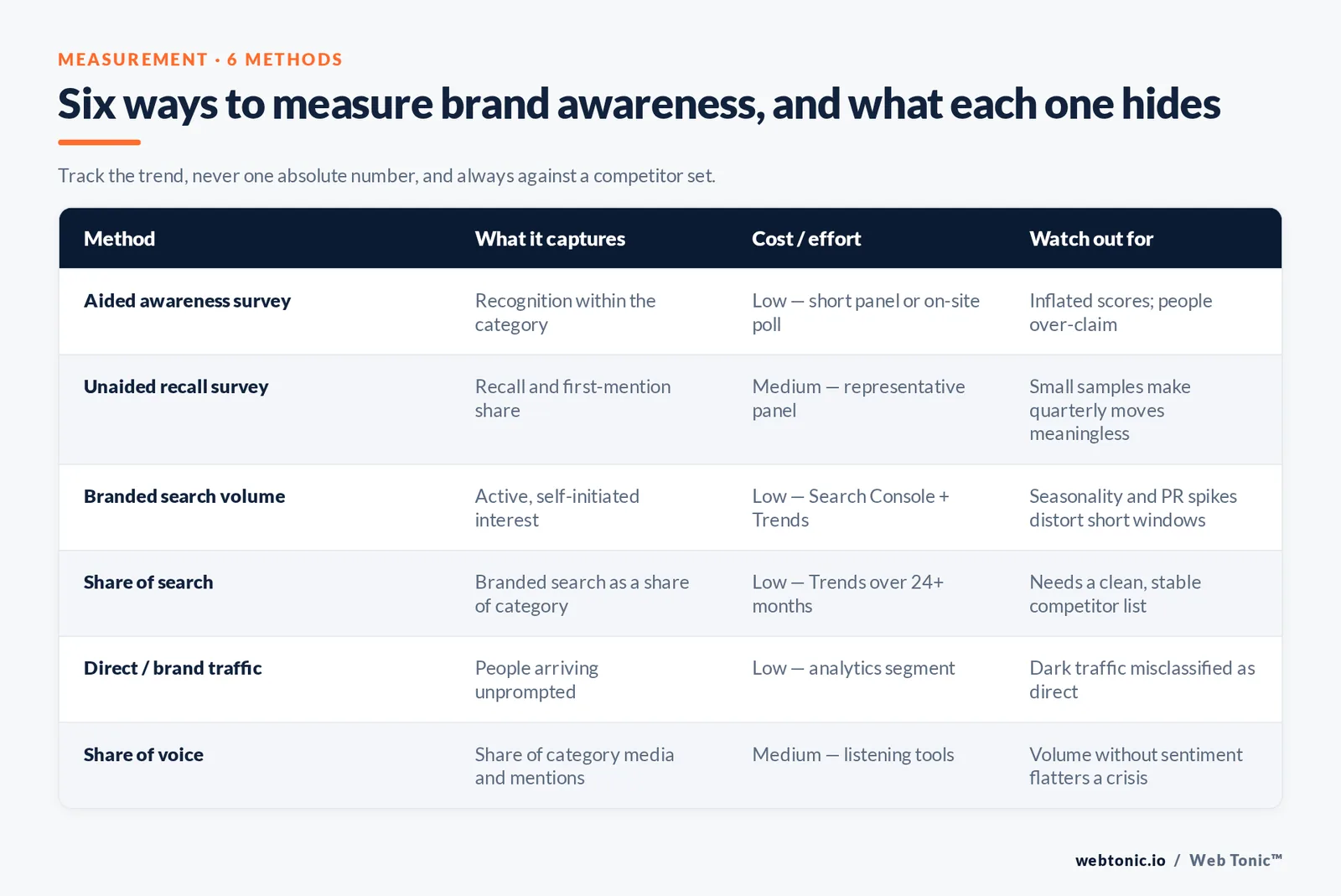
There is no single brand awareness metric. Use several, track the trend rather than the absolute number, and always read them against a competitor set.
| Method | What it captures | Cost / effort | Watch out for |
|---|---|---|---|
| Aided awareness survey | Brand recognition within the category | Low — a short panel or on-site poll | Inflated scores; people over-claim familiarity |
| Unaided recall survey | Brand recall and first-mention (top of mind) | Medium — needs a representative panel | Small samples make quarterly moves meaningless |
| Branded search volume | Active, self-initiated interest in the name | Low — Search Console plus Google Trends | Seasonality and PR spikes distort short windows |
| Share of search | Your branded search as a share of the category | Low — Trends comparison over 24+ months | Needs a clean, stable competitor list |
| Direct and organic-brand traffic | People who arrive without prompting | Low — analytics segment | Dark traffic misclassified as direct |
| Share of voice | Your share of category media and social mentions | Medium — listening tools | Volume without sentiment can flatter a crisis |
| Reach and frequency | Input, not outcome: who saw it, how often | Low — platform reporting | Never report reach as if it were awareness |
Two practical rules. First, run the same survey wording every time — changing the prompt breaks the trend line and the trend is the whole point. Second, pair a claimed measure (survey) with a behavioural one (branded search, direct traffic); if they diverge for two consecutive quarters, trust the behaviour. Google Trends gives you a free, long-horizon share-of-search view, and Kantar and Nielsen publish the panel methodology most brand trackers are modelled on. Our data intelligence team builds these dashboards so the survey wave, the search trend and the media plan sit in one view.
Building brand awareness: the channels that work
Awareness is bought with reach and kept with consistency. The mix below reflects where attention actually is rather than where reporting is easiest.
| Channel | Why it builds awareness | Best for | Awareness KPI |
|---|---|---|---|
| Short-form social video | Highest reach per dollar; sound, motion and faces aid memory | Broad consumer categories | 3-second and 15-second view rates, reach |
| YouTube and CTV | Long-form storytelling with controlled frequency | Considered purchases | Completed views, brand lift study |
| Search (generic terms) | Captures category demand before a brand is chosen | Categories with research behaviour | Impression share on non-brand terms |
| SEO and content | Compounding presence at every category entry point | B2B and high-consideration | Non-brand impressions, ranking breadth |
| Out-of-home and audio | Broad, low-targeting reach that signals scale | Local and regional brands | Covered population, share of search lift |
| Creators and influencers | Borrows an existing, trusted audience | Younger consumer segments | Reach, saves and shares |
| PR and earned media | Third-party credibility and durable citations | New categories and launches | Share of voice, referring domains |
| Partnerships and events | Physical memory cues and real conversations | B2B and premium brands | Assisted pipeline, aided recall in-region |
Social is doing more of this work every year. DataReportal puts social users at 5.66 billion, each averaging 6.75 platforms a month and 2h40m of daily use, while Sprout Social finds over 60% of product discovery beginning there and global social ad spend climbing toward $317.33 billion. For video specifically, Think with Google is the most useful public source on creative and frequency effects, and HubSpot's statistics library is a reasonable benchmark shelf for channel-level engagement.
A 6-step brand awareness strategy
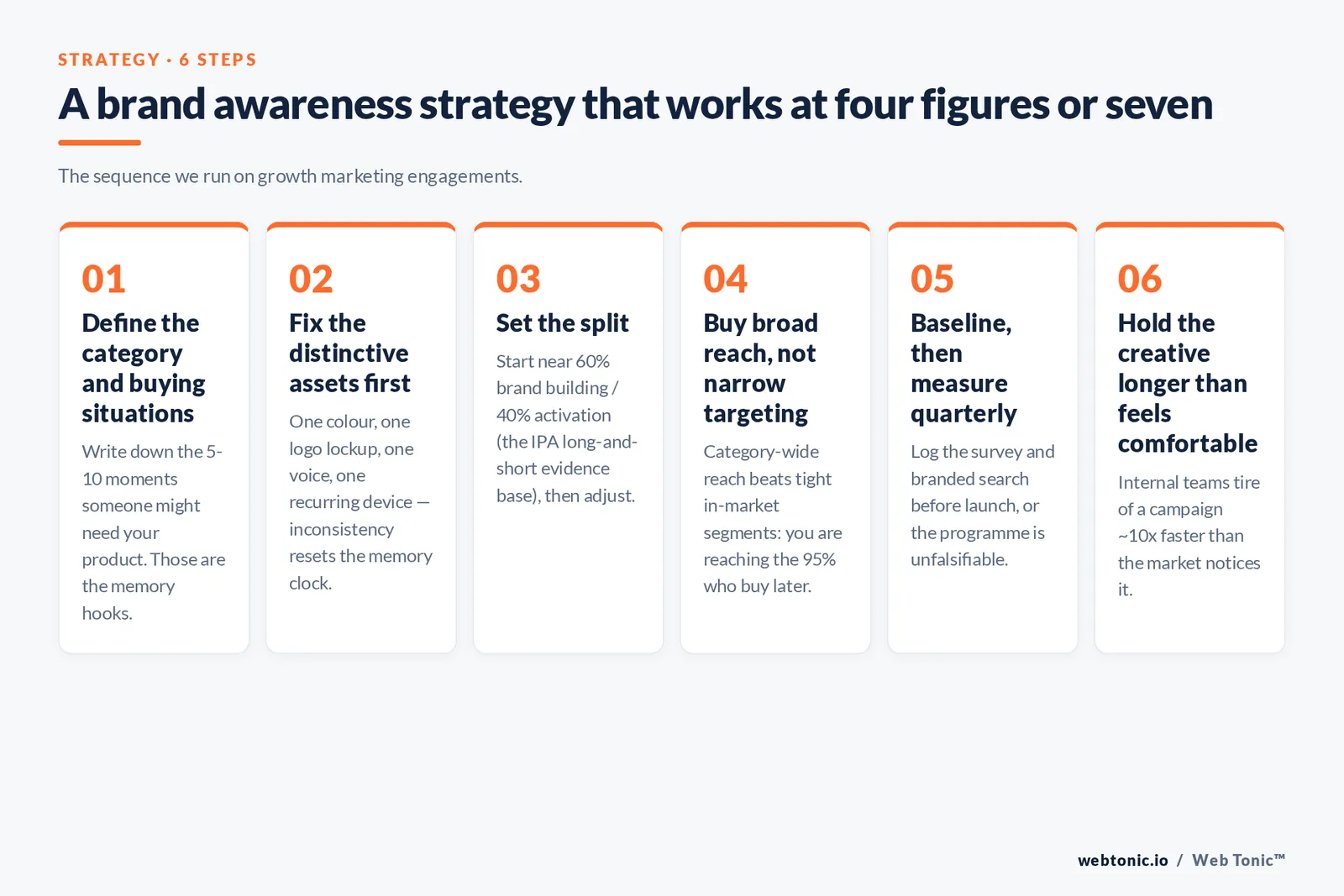
This is the sequence we use with clients on growth marketing engagements, and it works whether the budget is four figures or seven.
- Define the category and the buying situations. Awareness is always awareness of something, for something. Write down the 5–10 moments in which a person might need your product. Those are the memory hooks your creative has to attach to.
- Fix the distinctive assets before you buy media. One colour, one logo lockup, one voice, one recurring device. Assets only work when they repeat — inconsistency resets the memory clock, so lock the system first with your creative team.
- Set the split. Start near 60% brand building and 40% activation — the IPA's long-and-short evidence base — then adjust for category maturity and margin.
- Buy broad reach, not narrow targeting. For awareness, category-wide reach beats tight in-market segments. You are trying to reach the 95% who will buy later.
- Baseline, then measure quarterly. Run the survey and log branded search before the campaign starts. Without a baseline the whole programme is unfalsifiable.
- Hold the creative for longer than feels comfortable. Internal teams tire of a campaign roughly 10x faster than the market notices it. Refresh the execution; keep the assets.
7 mistakes that waste awareness budget
- Reporting reach as awareness. Impressions are an input. If nobody remembers the brand, 100% of that reach bought nothing.
- Rebranding every 18 months. Every reset throws away accumulated recognition. Consistency is the cheapest awareness tactic there is.
- Dull creative. System1's research on dull advertising makes the commercial case bluntly: unremarkable work forces brands to pay a media premium to be noticed at all. Boring is the expensive option.
- Judging awareness on last-click. Awareness activity rarely earns the last click. Judge it on the metrics in the table above, on a 2–4 quarter horizon.
- Targeting too tightly. Retargeting warm audiences is activation wearing an awareness costume.
- Going quiet in downturns. Share of voice falling below share of market predicts share loss, which is why effectiveness award case libraries are full of brands that kept spending while rivals paused.
- No brand in the performance ad. If the logo and the name appear only at the end, the awareness value of the impression is close to zero.
Brand awareness, brand equity and brand loyalty
Marketing researchers treat awareness as the base of a ladder that ends in profit, and the classic sequence — set out in the branding literature and refined across decades of Journal of Marketing studies — runs awareness, then brand image, then brand equity, then brand loyalty. Each rung depends on the one below it, which is why skipping straight to loyalty programmes rarely works for a brand most consumers cannot name.
Brand awareness puts the brand in the consumer's consideration set for a product category. Brand image fills that memory with meaning: quality cues, price expectations, personality. Brand equity is the measurable commercial premium — consumers choosing your product over an identical competitor, paying more, or forgiving a stockout. Brand loyalty is repeat purchase behaviour that survives a rival's discount. Managing brand equity, in other words, starts with managing awareness: no brand builds pricing power from an audience that has to be reminded who it is.
The hierarchy of effects model is the advertising version of the same idea — awareness, knowledge, liking, preference, conviction, purchase. Real consumer journeys loop and skip stages, and online research collapses several of them into one session, but the model still earns its place in a media plan for a practical reason: it forces you to name which stage a piece of content or advertising is actually for. Most underperforming campaigns are awareness budgets carrying conversion expectations, or conversion budgets asked to build a brand.
| Stage | Consumer state | Marketing lever | Metric |
|---|---|---|---|
| Awareness | Recognises or recalls the brand in the category | Broad-reach advertising, social content, PR | Aided and unaided awareness, share of search |
| Knowledge | Knows what the product does and who it is for | Content marketing, product education, SEO | Engaged sessions, non-brand impressions |
| Preference | Prefers the brand to relevant alternatives | Social proof, reviews, comparison content | Brand preference surveys, win rate |
| Purchase | Buys, in store or online | Search, retail media, promotions, CRM | Conversion rate, cost per acquisition |
| Loyalty | Repeats, and recommends to other people | Product experience, community, lifecycle | Repeat rate, retention, referral share |
What changes by business type
The tactics that raise awareness differ sharply by how consumers buy in your product category, and copying a big consumer brand's playbook is one of the most common ways to waste a modest budget.
Consumer brands with retail distribution compete for mental availability at the shelf and in the app. Distinctive packaging, broad-reach video advertising and consistent social media presence do most of the work, because the purchase decision takes seconds and rewards whichever brand is easiest to retrieve. Awareness here is close to a proxy for market share.
Ecommerce and DTC brands live between social discovery and branded search. Creator content and short-form video build the initial recognition; the branded query afterwards is where you see whether it landed. These brands should watch the ratio of branded to non-brand traffic monthly, because paid-only growth with flat branded demand is the classic sign of activation spend masquerading as brand building.
B2B businesses face long buying cycles, committees and a target audience that is mostly out of market. Awareness comes from category-level thought leadership, media presence, events and search visibility on the problems buyers research before they shortlist vendors. The commercial payoff is that a known brand gets into the request-for-proposal at all.
Local service businesses only need to win a radius. Consistent local search presence, reviews, vehicle livery, sponsorships and out-of-home inside the service area beat any national media buy on cost per remembered impression.
Brand awareness benchmarks: what "good" looks like
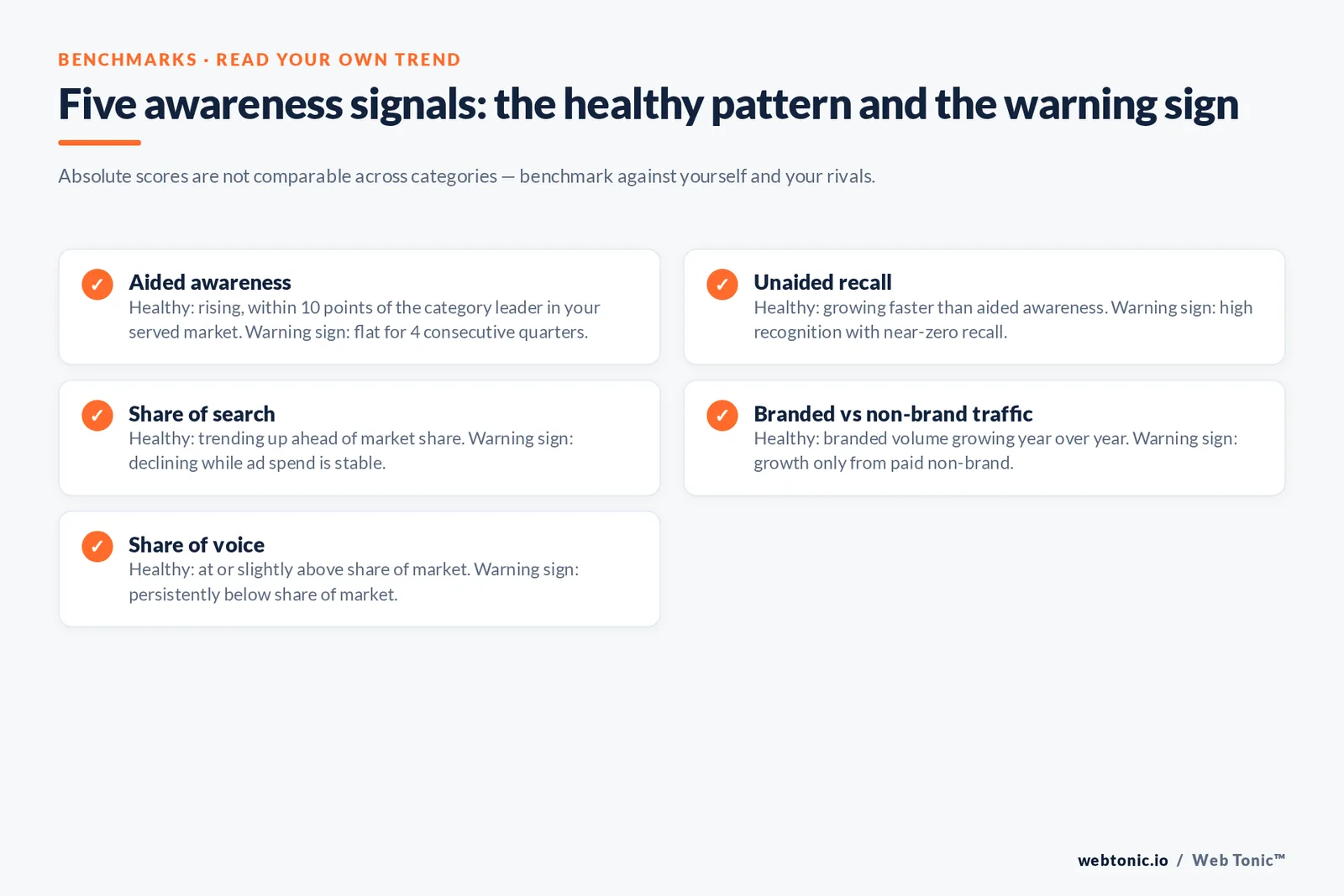
Absolute awareness scores are not comparable across categories, so benchmark against yourself and your competitor set instead.
| Signal | Healthy pattern | Warning sign |
|---|---|---|
| Aided awareness | Rising, and within 10 points of the category leader in your served market | Flat for 4 consecutive quarters |
| Unaided recall | Growing faster than aided awareness | High recognition, near-zero recall |
| Share of search | Trending up ahead of market share | Declining while ad spend is stable |
| Branded vs non-brand traffic | Branded volume growing year over year | Growth only from paid non-brand |
| Share of voice | At or slightly above share of market | Persistently below share of market |
One diagnostic is worth memorising: high recognition with low recall means people know your name but never think of you unprompted. The fix is not more reach — it is creative that ties the brand to specific category entry points, run consistently for long enough to stick.
FAQ
What is the difference between brand awareness and brand recognition?
Brand recognition is one level of brand awareness. Recognition is aided memory: shown your logo or name, a consumer confirms they have seen it. Brand awareness is the wider concept, spanning unaware, recognition, unaided brand recall and top-of-mind awareness. Recognition alone is weak, because it only pays off when the consumer is already looking at you.
How do you measure brand awareness without a big research budget?
Combine three free or cheap signals: branded search volume from Search Console, a share-of-search comparison against 3–5 competitors in Google Trends over 24 months, and a short aided-awareness poll to your own audience or a small paid panel. Baseline them before a campaign, then re-read the same measures quarterly using identical wording.
How long does it take to build brand awareness?
Reach effects appear within weeks, but memory effects compound over quarters. Expect movement in branded search within 1–2 quarters of sustained spend, and meaningful change in unaided recall over 4–8 quarters. Anything faster is usually a PR spike that decays quickly rather than a durable shift in brand salience.
Does brand awareness matter for small businesses?
Yes, but the category should be defined narrowly. A local service business does not need national awareness; it needs to be the first brand recalled inside its service area. That makes local out-of-home, community partnerships, reviews and consistent local search presence far more efficient than broad national media.
Which social platform is best for brand awareness?
The one where your category audience already spends attention, which is usually short-form video for consumer brands and LinkedIn plus search for B2B. Because the average user is active on 6.75 platforms a month, a two-platform mix with consistent creative usually beats spreading thin across six.
Brand awareness is the compounding asset behind every efficient acquisition channel you own. If you want the measurement, the media plan and the creative system built as one programme, see our services, browse more frameworks on the Web Tonic blog, or talk to us.
Sources: DataReportal Digital 2026 Global Overview · Sprout Social social media statistics · HubSpot marketing statistics · Harvard Business Review (brand management) · American Marketing Association · IPA effectiveness research · System1 (the extraordinary cost of dull) · Ahrefs (branded search) · Google Trends · Kantar · Nielsen Insights · Effie Awards. Figures verified against the cited pages in 2026.