Table of contents
Cause-based marketing ties a commercial offer to a social cause so both sides gain: the nonprofit gets funding or reach, the brand gets loyalty it cannot buy with a discount.
It is not philanthropy and not a donation page. It is a campaign with a mechanic, a disclosure duty and a measurable result.
Key Takeaways
- Americans gave $617.20 billion to charity in 2025, up 5.7% and past the $600 billion mark for the first time — the pool a cause campaign plugs into is growing, not shrinking.
- 65% of Fortune 500 companies run a matching gift programme, and over 26 million people work for an employer that will match their donations.
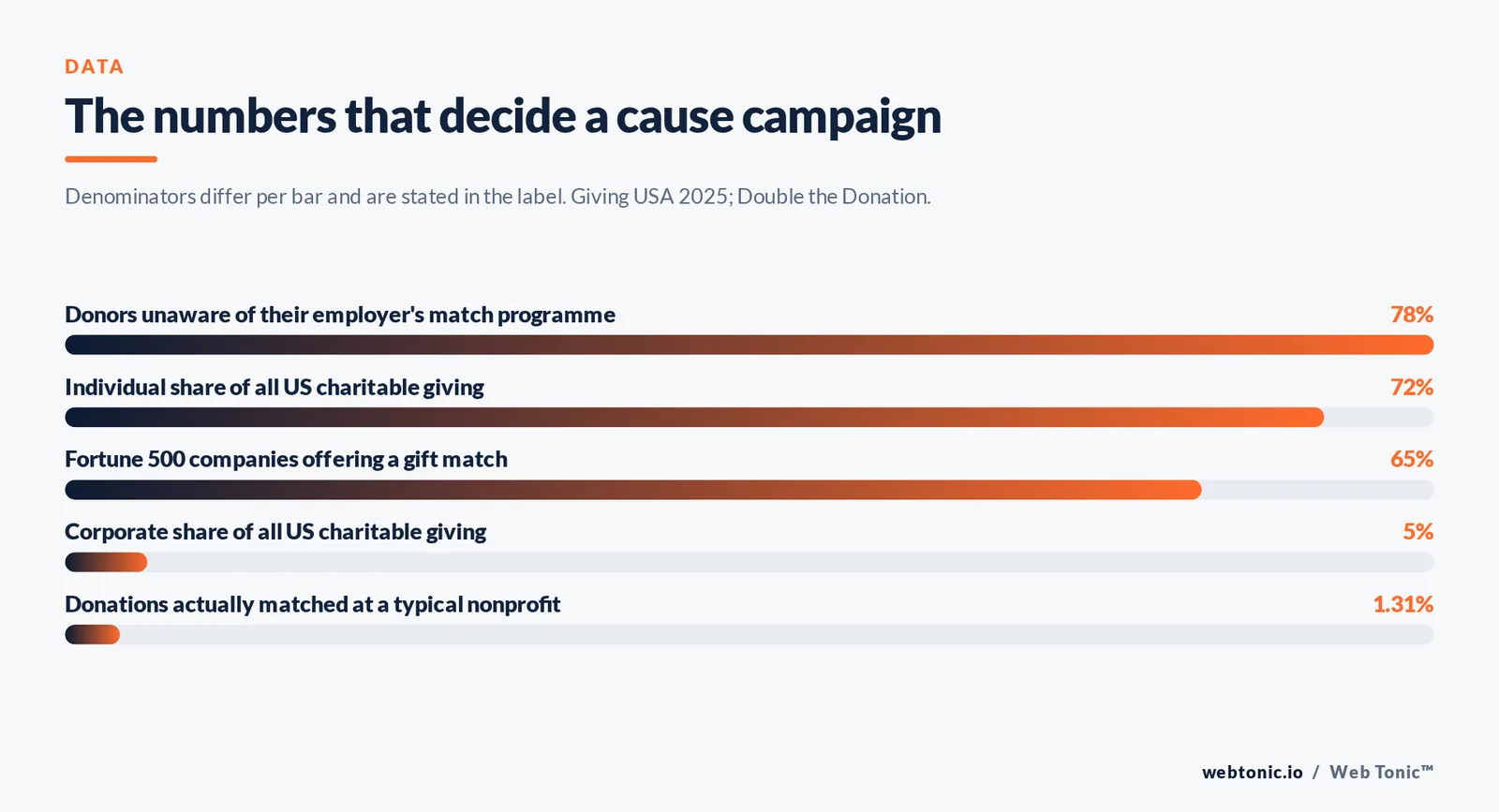
- Matching gifts move roughly $2.86 billion a year, yet an estimated $4 billion to $7 billion in match funds goes unclaimed annually because 78% of donors do not know whether their employer offers one.
- Simply mentioning a match lifts appeal response rates by about 71% and average gift size by about 51%; 84% of surveyed donors say a match makes them more likely to give.
- Only about 1.31% of donations are matched at the average nonprofit even though roughly 10% of individual contributions are eligible — the execution gap, not donor intent, is the constraint.
- Corporate giving is the smallest of the four giving sources (individuals sit near 72% of the total), which is exactly why cause campaigns that mobilise customers outperform ones funded only from a marketing budget.
- Every campaign that says "a portion of proceeds" is a commercial co-venture: US charity accountability standards expect you to disclose the actual or anticipated amount per purchase, the campaign duration, and any cap or guaranteed minimum.
- Five mechanics cover almost every campaign ever run: purchase-triggered donation, buy-one-give-one, round-up at checkout, matching or challenge gift, and non-cash contribution of product, media or expertise.
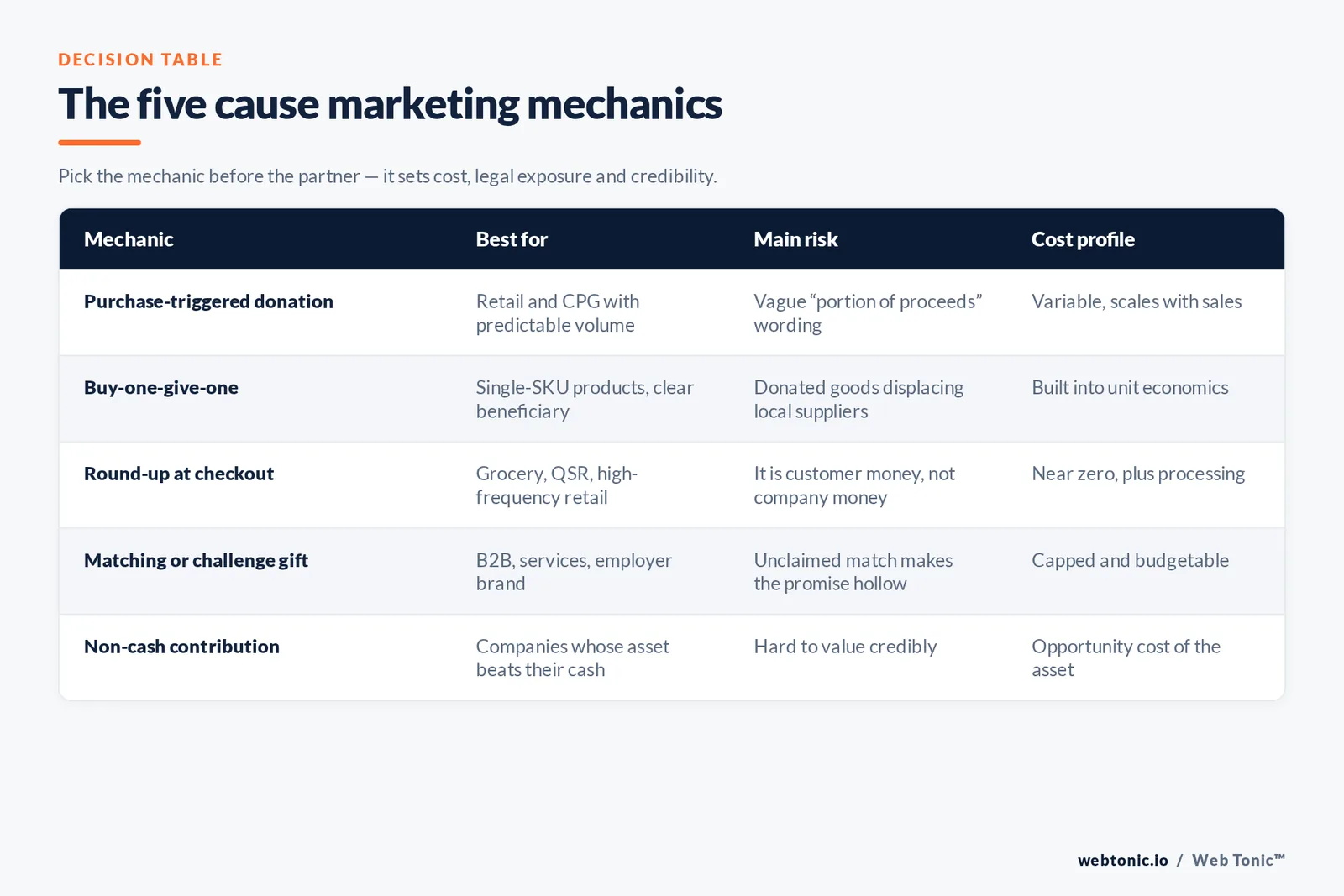
The five cause marketing mechanics, and what each one is good at
Before you pick a partner or a hashtag, pick the mechanic. It determines your cost, your legal exposure and how the campaign reads to a sceptical customer.
| Mechanic | How it works | Best for | Main risk | Cost profile |
|---|---|---|---|---|
| Purchase-triggered donation | A fixed amount or percentage per unit sold goes to the nonprofit partner | Retail and CPG with predictable volume | Vague "portion of proceeds" wording invites regulator and press scrutiny | Variable, scales with sales |
| Buy-one-give-one | Each purchase funds an equivalent product or service for a beneficiary | Single-SKU products with a clear beneficiary need | Criticism that donated goods displace local suppliers | Built into unit economics |
| Round-up at checkout | Customer rounds their total up; the brand collects and remits | High-frequency retail, grocery, QSR, ecommerce | Customer money, not company money — say so plainly | Near zero, plus processing |
| Matching or challenge gift | The company matches customer or employee gifts up to a cap | B2B, services, employer brand campaigns | Unclaimed match budget makes the promise look hollow | Capped and budgetable |
| Non-cash contribution | Donated product, media inventory, logistics, engineering or creative hours | Companies whose asset is more useful than their cash | Hard to value credibly; easy to overstate | Opportunity cost of the asset |
Rule 1 — the mechanic must be legible in one sentence on a shelf tag or an ad. "We give $5 from every pair" survives compression. "We support communities through our giving pillars" does not.
Cause marketing examples worth copying (and what actually made them work)
The examples below are all long-running programmes with public documentation, which is the point: a cause marketing campaign that runs for one quarter is a promotion, not a position.
| Programme | Mechanic | Why it works | Transferable lesson |
|---|---|---|---|
| Warby Parker — Buy a Pair, Give a Pair | Buy-one-give-one via distribution partners | The cause matches the product category exactly — vision for vision | Category fit beats cause popularity every time |
| Red Nose Day (Comic Relief US) | Retail merchandise plus broadcast fundraiser | A dated, repeatable moment with a physical token customers wear | Give the campaign a date and an object, not just a message |
| Toms — one-for-one, later restructured | Buy-one-give-one, then a percentage-of-profit model | The company publicly revised the model after criticism of donated goods | Publishing a model change builds more trust than defending version one |
| Corporate matching gift programmes | Employee gift matching, often 1:1 up to a cap | Employees choose the cause, so internal enthusiasm is automatic | Ownership of the choice is the engagement mechanism |
| Airline sustainability reporting | Operational commitments with published progress | Claims are attached to disclosed metrics rather than campaign copy | If you cannot report progress annually, do not make the claim |
| Checkout round-up at grocery and QSR | Round-up at point of sale | Tiny ask, enormous frequency, zero friction | Frequency of the ask matters more than the size of the ask |
Rule 2 — the strongest cause marketing examples share one trait: the brand's own operations are implicated. An eyewear company funding eye exams is credible. An eyewear company funding an unrelated cause is a press release.
Choosing a cause: the fit test
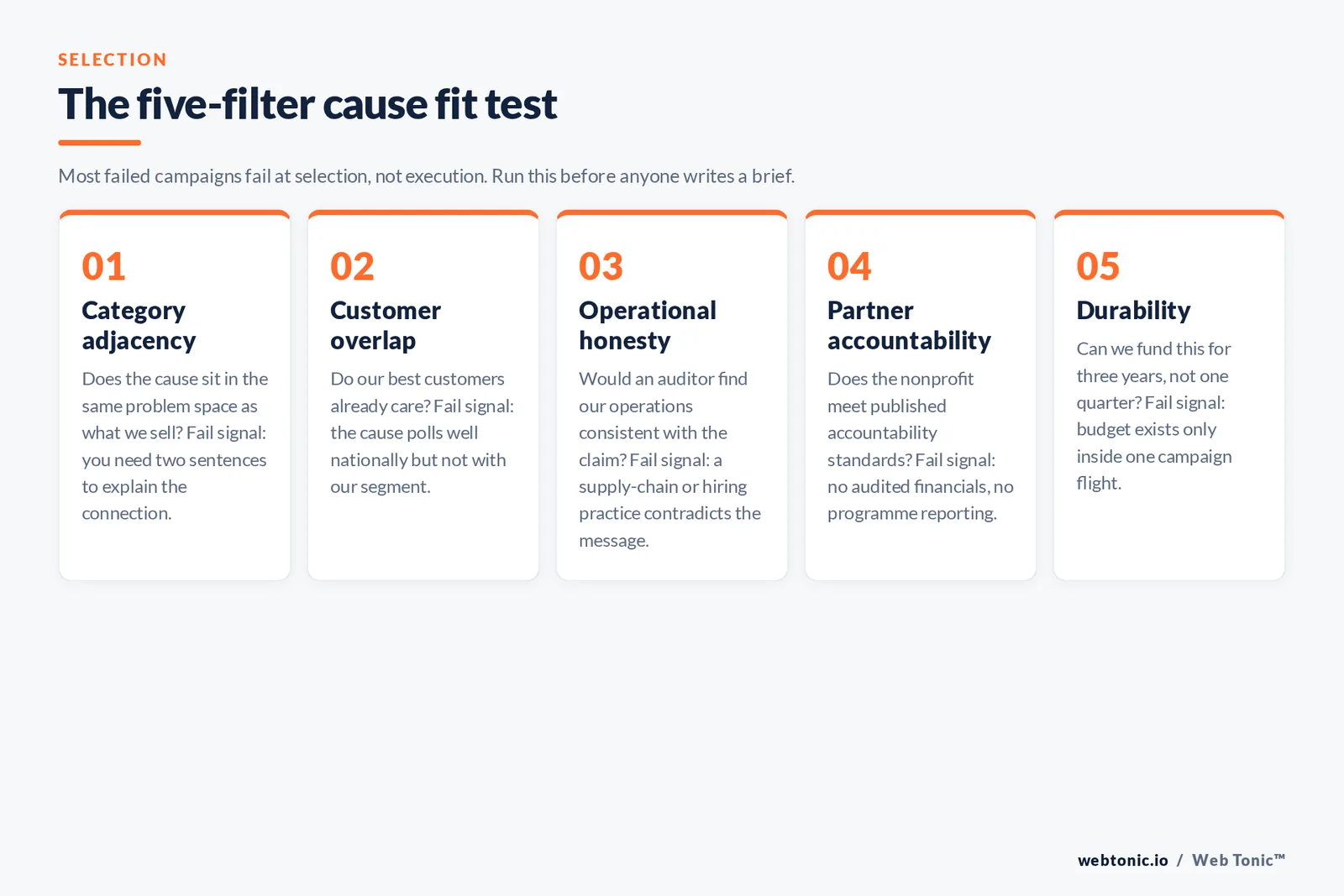
Most failed campaigns fail at selection, not execution. Run a candidate cause through five filters before anyone writes a brief.
| Filter | Question to answer | Fail signal |
|---|---|---|
| 1. Category adjacency | Does the cause sit in the same problem space as what we sell? | You need two sentences to explain the connection |
| 2. Customer overlap | Do our best customers already care about this cause? | The cause polls well nationally but not with our segment |
| 3. Operational honesty | Would an auditor find our operations consistent with the claim? | A supply-chain or hiring practice contradicts the message |
| 4. Partner accountability | Does the nonprofit meet published accountability standards? | No audited financials, no programme reporting |
| 5. Durability | Can we fund this for three years, not one quarter? | Budget exists only inside one campaign flight |
Filter 4 is the one companies skip. Vet the partner the way a donor would: Charity Navigator ratings and the BBB Wise Giving Alliance reports both publish accountability assessments, and the BBB's Standards for Charity Accountability set explicit expectations for how cause-related marketing offers must be described.
The disclosure and tax rules you cannot design around
A cause campaign is advertising, so it inherits advertising law. Three rule sets apply in the United States.
Limit 1: truth-in-advertising. Claims about how much a purchase gives must be substantiated and not misleading — the FTC's guidance on truth in advertising applies to a donation promise exactly as it applies to a performance claim.
Limit 2: creator and influencer disclosure. If you pay, gift or otherwise incentivise anyone to promote the campaign, the connection must be disclosed clearly and conspicuously, per the FTC's Disclosures 101 for social media influencers. Cause content does not get a pass because the motive is good.
Limit 3: who gets the deduction. When a customer rounds up at checkout, the customer made the gift, not you; when the company writes the cheque, the company may claim it under the rules for charitable contribution deductions, and gifts above the thresholds need documentation under the IRS rules on substantiating charitable contributions. Getting this backwards in campaign copy is the most common legal error in the category.
Limit 4: state registration. Many states regulate commercial co-ventures and may require registration, bonding or a written contract with the charity before the promotion runs. Budget legal review time before creative time.
Matching gifts: the cheapest cause marketing most companies already own
If you want a cause programme with a known cost and a proven lift, start here rather than with a campaign.
| Data point | Figure | What it implies |
|---|---|---|
| Fortune 500 companies offering a match | 65% | Your competitors likely already have the benefit |
| Employees covered by a match programme | 26 million+ | Enormous latent budget sitting in HR, not marketing |
| Annual match dollars flowing to nonprofits | ~$2.86 billion | About 11% of corporate cash contributions |
| Estimated unclaimed match funds per year | $4–7 billion | Promotion, not budget, is the bottleneck |
| Donors unaware of their employer's programme | 78% | Awareness campaigns beat new programme design |
| Response-rate lift when a match is mentioned | +71% | A copy change, not a spend change |
| Average gift lift when a match is mentioned | +51% | Match framing raises both frequency and value |
| Donations actually matched at a typical nonprofit | 1.31% | Vast headroom for partners who fix the ask |
Those figures come from Double the Donation's matching gift research. Read them as a marketing brief: the winning move is not a new pledge, it is telling people the pledge exists at the moment they are already giving.
Where cause campaigns fit in the wider giving picture
Context stops you overclaiming. Giving USA put total US charitable giving at $617.20 billion for 2025, a 5.7% increase, with individuals historically responsible for around 72% of the total against roughly 5% from corporations. Sector-level breakdowns compiled in online giving statistics show religion, education and human services absorbing the largest shares.
| Business type | Highest-leverage mechanic | Realistic first campaign | Primary metric |
|---|---|---|---|
| Ecommerce, single SKU | Purchase-triggered donation | Fixed $ per unit for one product line, one quarter | Conversion rate on the participating SKU |
| Multi-location retail or QSR | Round-up at checkout | Two-week round-up with in-store signage | Participation rate per transaction |
| B2B services | Matching or challenge gift | Client-nominated cause with a capped match | Account engagement and renewal conversations |
| Local trades and home services | Non-cash contribution | Donated labour on one community project, documented | Review volume and referral share |
| SaaS | Product donation or discounted tier | Free nonprofit tier with published eligibility | Qualified nonprofit signups and case studies |
| Franchise or dealer network | Matching gift with local choice | National match, locally selected charities | Franchisee participation rate |
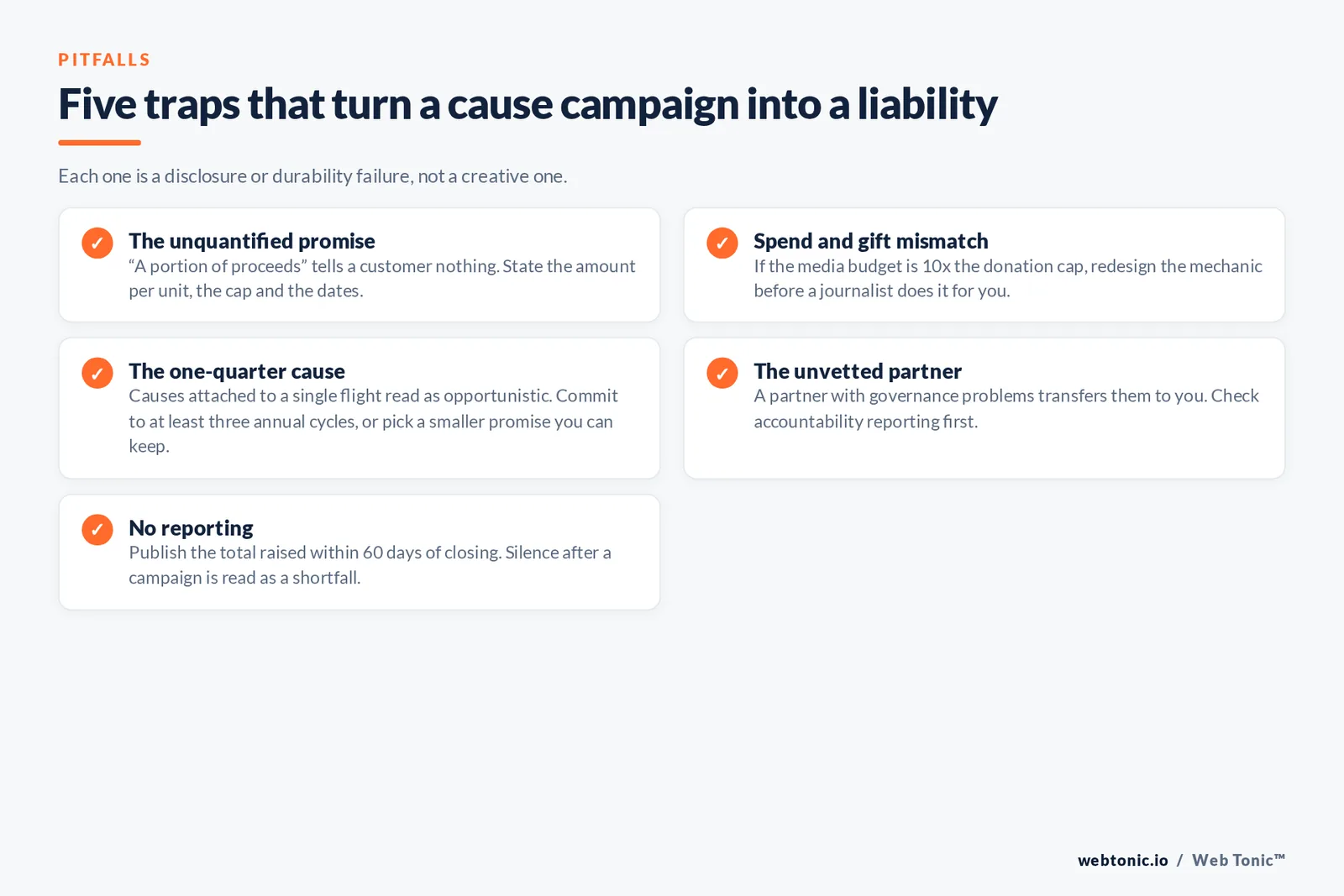
Five traps that turn a cause campaign into a liability
Trap 1 — the unquantified promise. "A portion of proceeds" tells a customer nothing and signals that the amount is embarrassing. State the amount per unit, the cap and the dates.
Trap 2 — the mismatch between spend and gift. Spending far more on the campaign's media than the campaign donates is the fastest way to earn a hostile article. If the media budget is 10x the donation cap, redesign the mechanic.
Trap 3 — the one-quarter cause. Causes attached to a single flight read as opportunistic. Commit to at least 3 annual cycles or pick a smaller commitment you can keep.
Trap 4 — the unvetted partner. A partner with governance problems transfers those problems to you. Check accountability reporting first.
Trap 5 — no reporting. Publish the total raised within 60 days of the campaign closing. Silence after a campaign is read as a shortfall, whether or not there was one.
Analysis in Stanford Social Innovation Review makes the same point from the nonprofit side: partnerships fail when the corporate partner's objectives and the programme's outcomes are never written down together.
Promoting the campaign: the channel mix that raises awareness and donations
A cause marketing campaign that no customer notices raises nothing. Plan the promotion with the same rigour as the mechanic, and give the nonprofit partner assets it can push to its own supporters — its audience is often more responsive than yours.
| Channel | Job in the campaign | Asset the brand owes the nonprofit partner | Signal of success |
|---|---|---|---|
| Social media posts | Raise awareness of the cause and the donation mechanic | A post kit: 6 social media posts, captions, the exact donation wording | Shares and saves by the nonprofit's own supporters |
| Email to customers | Convert existing customers into campaign participants | Co-signed email both organizations can send | Click-to-purchase rate versus a normal promotion |
| In-store and packaging | Deliver the ask at the moment of purchase | Shelf and counter signage naming the nonprofit | Participation rate per transaction |
| Employee channels | Turn staff into credible advocates for the program | Volunteer days plus a matching gift program page | Employee participation and volunteer hours |
| Earned media and PR | Extend reach beyond the brand's own customers | A results release with the impact numbers, not the launch hype | Coverage that names the outcome, not just the brand |
| Paid social and search | Reach new customers who already support the cause | Creative approvals and trademark clearance | Cost per participating purchase |
Rule 3 — the nonprofit partner should never learn about the campaign's social media posts after they publish. Approve the whole kit jointly, including the wording of the donation claim, before anything goes live.
Cause marketing by campaign type: what corporate philanthropy looks like in practice
Corporate social responsibility budgets fund several very different programs, and customers read them differently. The table below maps the main types of cause marketing to what each one does for brand loyalty, sales and social impact.
| Campaign type | What the company gives | Effect on brand loyalty | Effect on sales | How the nonprofit benefits |
|---|---|---|---|---|
| Percentage-of-sales campaign | Cash tied to units sold | Moderate; strongest with repeat customers | Direct and measurable | Unrestricted donations plus awareness |
| Matching gift program | Match of employee or customer donations | High among employees and donors | Indirect | Larger average gifts from existing supporters |
| Product or in-kind donation | Goods, software or media inventory | Moderate; depends on visibility | Low | Reduced program costs |
| Employee volunteering | Paid volunteer hours and skills | Highest internally; strong locally | Low, but strong in referral-driven businesses | Capacity the nonprofit cannot hire |
| Awareness partnership | Media reach with no cash transfer | Low unless the brand is already trusted on the issue | Low | Reach it could not buy |
| Multi-year corporate philanthropy | Committed funding across 3+ years | Highest; the commitment becomes part of the brand | Compounding rather than immediate | Predictable funding it can plan programs around |
Rule 4 — the further down that table you go, the slower the sales effect and the more durable the brand effect. Companies that only run the top row keep buying attention; companies that fund the bottom row eventually own a position, and their campaigns cost less to promote because customers already believe them.
How to measure cause-based marketing without fooling yourself
Cause campaigns generate soft evidence easily and hard evidence rarely. Force the hard evidence.
| Objective | Metric that proves it | Measurement method | Reporting cadence |
|---|---|---|---|
| Incremental sales | Conversion rate on participating vs control SKUs | Holdout by region or by product line | Weekly during the flight |
| Brand preference | Aided consideration among target segment | Pre/post survey with the same panel | Before and 30 days after |
| Loyalty | Repeat purchase rate of participants | Cohort comparison in your CRM | 90 days post-campaign |
| Employee engagement | Match programme participation rate | HR programme data | Quarterly |
| Cause outcome | Units delivered or services funded | Partner programme reporting | Annually, published |
| Earned attention | Branded search volume and referral traffic | Search and analytics baseline vs flight | Monthly |
The measurement design is the same discipline we apply to any performance programme: define the holdout before launch, not after. If you want that structure built around your campaign, our growth marketing and data intelligence teams do exactly this, and our performance creative work handles the asset side. More marketing breakdowns sit on the Web Tonic blog, and you can talk to us if you would rather review a campaign plan with someone.
A four-phase build for your first campaign
Phase 1 — select and vet (2–4 weeks): run the five-filter fit test, shortlist 3 partners, review accountability reporting and audited financials.
Phase 2 — contract and disclose (2–3 weeks): written agreement covering the donation formula, cap, duration, use of trademarks and reporting duties; legal check on state co-venture requirements.
Phase 3 — launch (flight length, minimum 4 weeks): one-sentence mechanic on every surface, disclosure in the same visual field as the claim, holdout in place.
Phase 4 — report (within 60 days): publish the total, the outcome delivered and what changes next cycle. This is the phase that converts a campaign into a position.
FAQ
What is the difference between cause marketing and corporate social responsibility?
Corporate social responsibility is the whole set of commitments a company makes about how it operates — labour, environment, governance, community. Cause-based marketing is a campaign layer that ties a specific commercial offer to a specific cause, usually with a nonprofit partner and a defined donation formula. CSR is a policy; cause marketing is a promotion built on top of it. A cause campaign that contradicts the company's actual operations tends to attract the criticism CSR reporting is meant to prevent.
Does cause marketing actually increase sales?
It can, but only measurably if you design a holdout. The clearest documented lift in the category is on the giving side rather than the retail side: mentioning a matching gift raises fundraising response rates by roughly 71% and average gift size by about 51%. For sales, compare conversion on participating products against a control set of products or regions during the same window, then check repeat purchase rate 90 days later. Campaigns with no control group produce testimonials, not evidence.
How much should a company donate in a cause campaign?
Pick an amount you can state plainly and sustain for at least three cycles — a fixed dollar figure per unit is easier to communicate than a percentage of undefined "proceeds". The practical test is proportionality: if your campaign media budget dwarfs the donation cap, the mechanic is wrong. Many companies get better returns by mobilising customer or employee giving through round-ups and matching, where a modest capped commitment unlocks far more total money for the cause.
What has to be disclosed in a cause marketing campaign?
At minimum: the actual or anticipated amount the charity receives per purchase, the campaign start and end dates, and any cap or guaranteed minimum. US charity accountability standards expect that level of specificity, advertising claims must be truthful and substantiated under FTC guidance, and paid or incentivised creator promotion needs a clear disclosure of the connection. Several states also regulate commercial co-ventures and may require registration or a written contract before the promotion runs.
Which causes work best for small local businesses?
Local, verifiable and adjacent ones. A trades business donating labour to a documented community project generates more trust than a small cheque to a national charity, because customers can see the work. Keep the mechanic simple — a fixed donation per job, a round-up jar, or donated hours — publish the total afterwards, and repeat it annually so it reads as a commitment rather than a promotion.
Sources
Giving USA (2026 report, giving year 2025) · Double the Donation matching gift statistics · NonprofitsSource online giving statistics · BBB Wise Giving Alliance Standards for Charity Accountability and give.org charity reports · Charity Navigator · FTC truth-in-advertising guidance and Disclosures 101 for social media influencers · IRS charitable contribution deduction and substantiation guidance · Stanford Social Innovation Review · Warby Parker Buy a Pair Give a Pair · Red Nose Day (Comic Relief US) · JetBlue sustainability reporting. Figures current as of publication; verify programme terms before citing.