Table of contents
A vision statement is a short, future-facing declaration of the world your organization is trying to create. The best ones are under 20 words, and they change hiring, roadmaps and marketing decisions.
Below are 25 real vision and purpose statements, a template you can fill in today, and the difference between vision and mission — with the parts that actually matter to your growth marketing work.
Key Takeaways
- Under 20 words is the practical ceiling for a vision statement — most of the 25 examples below land between 5 and 16 words.
- Vision is the destination; mission is the vehicle. Vision describes a future state, mission describes what you do daily to get there.
- Gallup's long-running workplace research puts US employee engagement in the low 30% range, and connection to purpose is one of the strongest levers managers control.
- Nonprofits write the cleanest visions because the future state is unambiguous — 3 of the 5 shortest examples here are charities.
- A usable vision passes 4 tests: time-bound or timeless, specific to you, memorable without a slide, and falsifiable enough to guide a "no".
- Rewrite cadence in practice: revisit every 3 to 5 years, or whenever your core market shifts.
What a vision statement is (and what it is not)
A vision statement is a written description of the future your organization exists to bring about. It is aspirational, directional and deliberately bigger than the current product line. Corporate Finance Institute frames it as the "where are we going" companion to the mission's "what do we do", and MindTools makes the same split: vision inspires, mission organizes.
It is not a slogan, a positioning line, or a list of values. A tagline sells to customers; a vision statement aligns the people building the thing. It is also not a strategy — strategy is the sequence of bets that closes the gap between today and the vision. IBM's strategy primer is a useful reminder that vision without a resourcing plan is decoration.
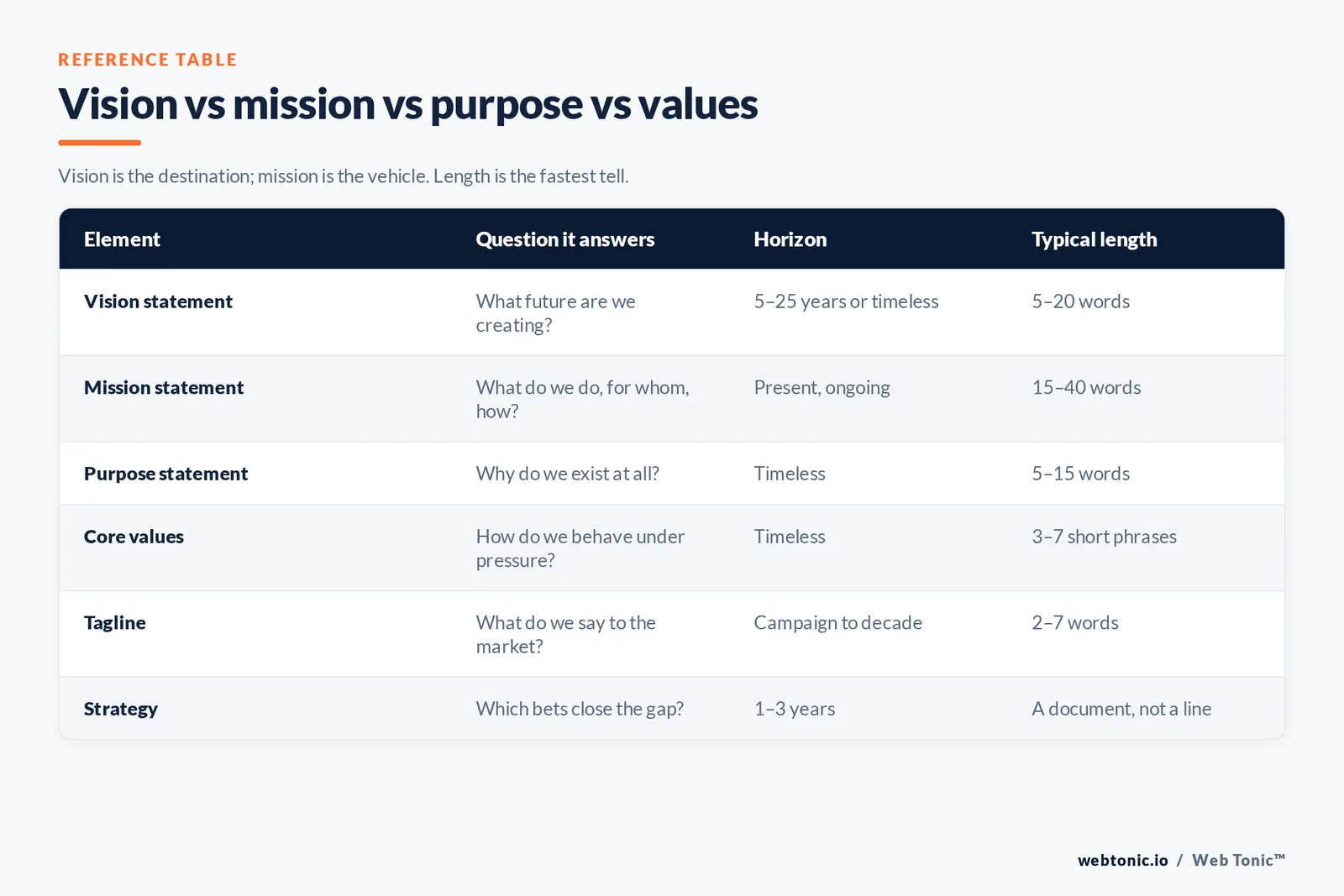
| Element | Question it answers | Time horizon | Typical length |
|---|---|---|---|
| Vision statement | What future are we creating? | 5-25 years or timeless | 5-20 words |
| Mission statement | What do we do, for whom, how? | Present tense, ongoing | 15-40 words |
| Purpose statement | Why do we exist at all? | Timeless | 5-15 words |
| Core values | How do we behave under pressure? | Timeless | 3-7 short phrases |
| Tagline | What do we say to the market? | Campaign to decade | 2-7 words |
| Strategy | Which bets close the gap? | 1-3 years | A document, not a line |
25 vision statement examples that hold up
Wording gets revised, so treat these as published-at-time-of-writing summaries rather than trademarks. What matters is the shape of each sentence: a future state, a beneficiary, and no hedging. Several are officially labelled purpose or mission by the company itself — that inconsistency is normal, and it is why we grouped by sector instead of by label.
Consumer brands and retail
| Organization | Vision / purpose (summarized) | Words | Why it works |
|---|---|---|---|
| Nike | Bring inspiration and innovation to every athlete in the world — "if you have a body, you are an athlete" | 16 | Redefines the market to include everyone, which licenses category expansion |
| Walmart | Help people save money so they can live better | 9 | Ties a mechanism (price) directly to a human outcome |
| IKEA | Create a better everyday life for the many people | 9 | "The many" is a pricing and design constraint in five words |
| Patagonia | Be in business to save our home planet | 8 | Impossible to satisfy, so it never stops driving decisions |
| Warby Parker | Inspire and impact the world with vision, purpose and style | 10 | Puns on the category while staying about impact |
| Starbucks | Nurture the limitless possibility of human connection | 7 | Sells the room, not the coffee — explains store design spend |
Technology and platforms
| Organization | Vision / purpose (summarized) | Words | Why it works |
|---|---|---|---|
| Microsoft | Empower every person and every organization on the planet to achieve more | 12 | Covers consumer and enterprise in one sentence |
| Organize the world's information and make it universally accessible and useful | 11 | Two verbs, one standard: "useful" is a testable bar | |
| Create economic opportunity for every member of the global workforce | 10 | Names the unit of value (opportunity), not the feature set | |
| Tesla | Accelerate the world's transition to sustainable energy | 8 | "Accelerate" concedes the trend and claims the pace |
| Airbnb | A world where anyone can belong anywhere | 7 | One emotional word carries the entire product promise |
| Spotify | Unlock the potential of human creativity for a million creative artists | 11 | Adds a countable target, which makes progress reportable |
| Shopify | Make commerce better for everyone | 5 | Shortest useful form: verb, domain, audience |
Nonprofits, health and education
Charity visions are the cleanest teaching examples because the finish line is obvious: the problem no longer exists. Note how many of these are 6 words or fewer.
| Organization | Vision (summarized) | Words | Why it works |
|---|---|---|---|
| Oxfam | A just world without poverty | 5 | States the end condition and the moral test in one line |
| Habitat for Humanity | A world where everyone has a decent place to live | 10 | "Decent" is deliberately measurable in housing policy terms |
| Alzheimer's Association | A world without Alzheimer's and all other dementia | 8 | Binary outcome, so every program can be judged against it |
| Feeding America | An America where no one is hungry | 7 | Geographic scope keeps the ambition credible |
| Teach for America | One day, all children will have the opportunity to attain an excellent education | 13 | "One day" gives urgency without a fake deadline |
| charity: water | Bring clean and safe water to every person on the planet | 11 | Single service, total coverage — easy to fundraise against |
| WWF | Build a future in which people live in harmony with nature | 11 | Names both parties in the relationship being fixed |
| TED | Spread ideas and foster a global community of curious minds | 10 | Explains why the content is free — distribution is the point |
| Save the Children | A world in which every child attains the right to survival, protection and participation | 14 | Borrows rights language, which sets policy priorities |
Services, hospitality and B2B
| Organization | Vision / purpose (summarized) | Words | Why it works |
|---|---|---|---|
| Disney | Entertain, inform and inspire people around the globe through storytelling | 11 | Three verbs cover parks, news and studios without listing them |
| Southwest Airlines | Connect people to what's important in their lives through friendly, affordable air travel | 14 | Puts the constraint (affordable) inside the aspiration |
| Zappos | Deliver happiness to customers, employees and vendors | 7 | Names three stakeholders, which is why support is a cost centre they protect |
| Nordstrom | Help customers feel good and look their best | 8 | Order of the verbs signals service before merchandise |
| Salesforce | Help companies connect with their customers in a whole new way | 11 | Vague on the "how", which survived four product eras |
| Web Tonic | A world where every ambitious brand can compete on execution, not budget | 12 | Frames the enemy (budget asymmetry) our service model exists to remove |
Vision vs mission statement, settled
The confusion is understandable: plenty of Fortune 500 companies publish a "mission" that reads like a vision, and Harvard Business Review's coverage of mission statements shows the categories blur in practice. Use this rule: if you can complete the sentence with a verb you do every day, it is a mission. If it describes a state of the world you may never fully reach, it is a vision.
Practical example. Mission: "We build affordable solar hardware for homeowners in the Gulf." Vision: "A region where every rooftop pays for itself." The mission is auditable this quarter; the vision outlives the product. Asana's guide uses the same test, and Simon Sinek's "start with why" talk is still the clearest explanation of why the vision has to come first in the story you tell.
Why vision statements pay off — and when they don't
The business case is about alignment, not poetry. Gallup's engagement research has tracked US engagement in the low 30% band for years, with the mission-and-purpose item among the questions most tied to retention and performance. Statista's engagement topic hub aggregates the same pattern across markets, and SHRM's HR reporting repeatedly lands on the same finding: people stay where the work adds up to something.
Vision statements fail in three predictable ways. First, they are written for the website instead of for decisions — nobody can cite one under pressure. Second, they are so generic that swapping in a competitor's name changes nothing; if that test passes, delete it. Third, leadership contradicts it in public, and every contradiction costs more credibility than the statement ever bought. Walmart's purpose reporting and Nike's newsroom are useful models of the opposite behaviour: repeated, evidenced, boring consistency.
A 6-step template for writing yours
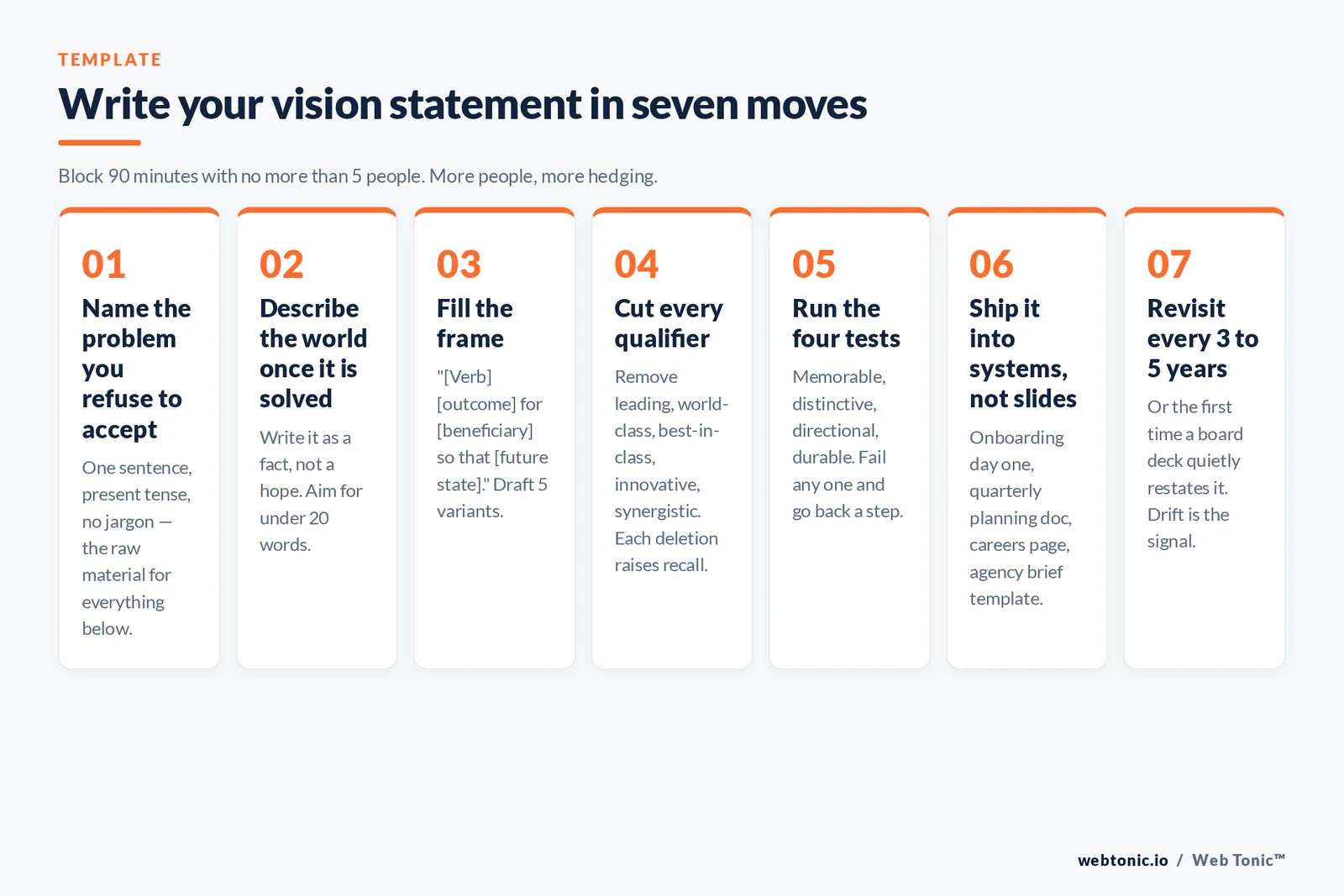
Block 90 minutes with no more than 5 people. More people, more hedging.
- Name the problem you refuse to accept. One sentence, present tense, no jargon. This is the raw material for everything below.
- Describe the world once it is solved. Write it as a fact, not a hope: "A region where…", "A world in which…". Aim for under 20 words.
- Fill the frame. Use: "[Verb] [outcome] for [beneficiary] so that [future state]." Draft 5 variants; you will keep parts of three.
- Cut every qualifier. Remove "leading", "world-class", "best-in-class", "innovative", "synergistic". Each deletion raises recall.
- Run the 4 tests in the table below. Fail any one and go back to step 3.
- Ship it into systems, not slides. Add it to onboarding day one, the top of your quarterly planning doc, your careers page, and the brief template your agency receives.
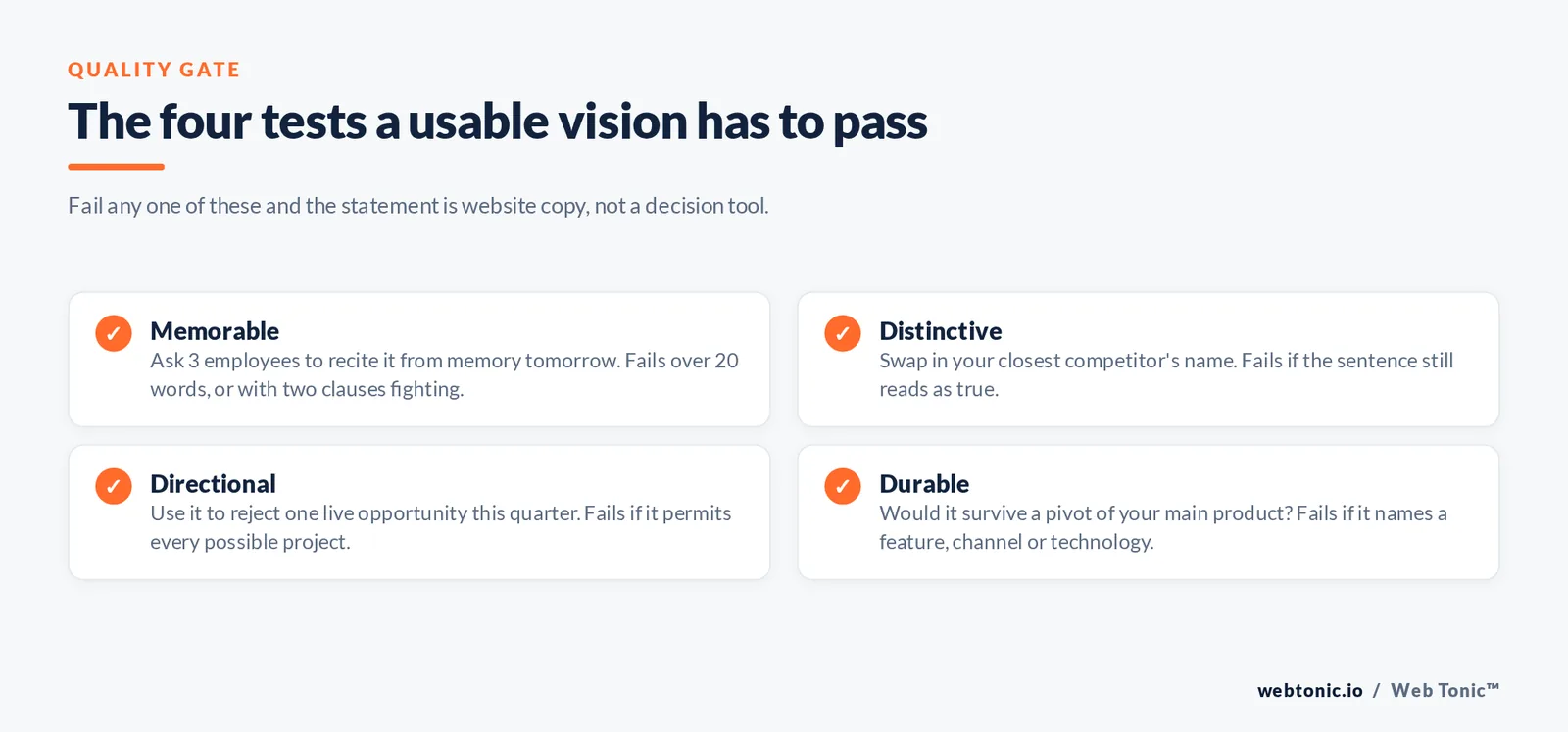
| Test | How to check | Fails when |
|---|---|---|
| Memorable | Ask 3 employees to recite it from memory tomorrow | Over 20 words, or two clauses fighting each other |
| Distinctive | Swap in your closest competitor's name | The sentence still reads as true |
| Directional | Use it to reject one live opportunity this quarter | It permits every possible project |
| Durable | Would it survive a pivot of your main product? | It names a specific feature, channel or technology |
Vision statements for small businesses and startups
Small teams get more out of a vision than enterprises do, because it substitutes for process. With fewer than 20 people, the vision is how you delegate: a hire who understands the destination makes calls you never have to review. The US Small Business Administration's business-plan guide places the vision and mission in the company-description section for exactly this reason — lenders and partners read it as a coherence check.
Three adjustments for early-stage companies. Keep it market-sized, not company-sized: "a world where X" survives your pivots, "the number one Y in Z" does not. Write it after 10 customer conversations, not before — the language you want is already in their complaints. And put a number on the near-term version: pairing a timeless vision with a 3-year concrete goal gives the team both altitude and a finish line. If you want that translated into channels and creative, our data intelligence and performance creative teams start every engagement from the vision, not the ad account.
One more discipline: revisit the wording every 3 to 5 years, or the first time a board deck quietly restates it. Drift is the signal, not the crime.
From vision to strategic plan: goals, values and the operating layer
A vision only earns its place when it changes what the team does on a Monday. The operating layer beneath it has four parts: core values, strategic goals, annual financial targets, and the process that keeps them connected. Companies that skip this layer end up with an inspiring line on the careers page and a strategy nobody can trace back to it.
Values come first, because they decide behaviour when the goals are under threat. Keep them to 3 to 5 short phrases, each with an example of what it looks like in practice. Strategic goals translate the vision into a 3-year horizon: which customer segments you will serve, which products or services you will build, and which quality bar you refuse to drop below. Annual targets then make the strategic layer financial — revenue, margin, retention, and the one leading indicator your team can move weekly.
The best long-term plans we see share a structure. A single vision at the top. Two or three strategic priorities beneath it, each owned by one leader. Under each priority, a small set of measurable goals with a named metric and a date. Then a quarterly review where the team asks one question: did the last 90 days move us toward the future the vision describes, or did we simply stay busy? That review is where innovation gets funded and where legacy products get retired.
Two practical notes for service businesses and technology companies. First, tie the vision to the customer outcome rather than the delivery model, because the delivery model will change: a consultancy that becomes a software company can keep its vision if the vision was about the customer's life, not about consulting. Second, make sure marketing carries the same language. When the careers page, the sales deck, the brand guidelines and the campaign brief all use different words for the same future, the team learns that none of them matter. Community and employer-brand programmes are the cheapest place to reinforce it — internal newsletters, onboarding, and the way leaders talk about wins in public.
For teams that want help turning a vision into a measurable growth plan, the useful sequence is: agree the vision, define 3 strategic priorities, pick 5 metrics, and only then choose channels and creative. Doing it in the other order is how brands end up with excellent ads for a business they have not decided how to build.
Where to see vision statements in the wild
The fastest research loop is to read 10 statements in your category, then write yours to be unmistakably different. Public sources worth mining: annual reports and proxy filings, careers pages, ESG or impact reports, investor day decks, and press newsrooms such as Apple's newsroom. For sector context beyond individual brands, Pew Research's economy and work hub is a reliable read on what employees and consumers currently care about, and Oracle's HCM resources cover how purpose statements get operationalized in performance systems.
Once you have a final line, the work is distribution: onboarding, careers page, sales deck slide two, and every creative brief. A vision nobody repeats is a vision nobody uses. Our blog covers the messaging systems that sit underneath it, and if you want help turning a vision into a positioning and channel plan, talk to us.
FAQ
What is a good vision statement example?
Oxfam's "a just world without poverty" is the cleanest model: 5 words, a clear future state, and no mention of programs or products. For a company, Tesla's "accelerate the world's transition to sustainable energy" does the same job in 8 words while implying a pace of change the whole business is judged against.
How long should a vision statement be?
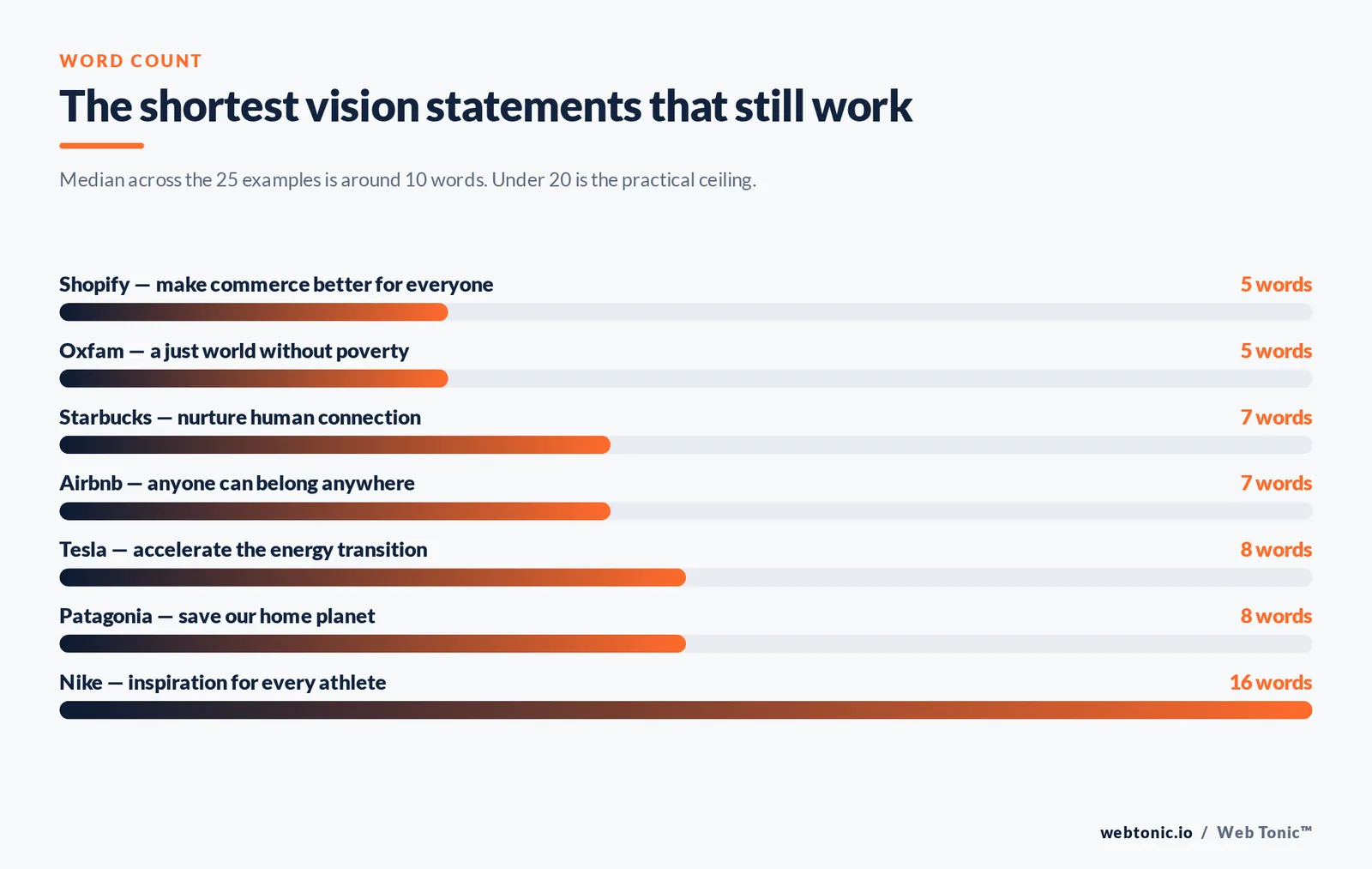
Between 5 and 20 words. Of the 25 examples above, the median is around 10 words, and the shortest useful form is a verb plus a domain plus an audience, as in Shopify's "make commerce better for everyone".
What is the difference between a vision statement and a mission statement?
A vision describes the future state you are working toward; a mission describes what you do every day to get there. If the sentence is auditable this quarter, it is a mission. If it may never be fully achieved, it is a vision.
Should a small business bother writing one?
Yes, and earlier than most founders think. Under 20 employees the vision is your delegation tool: it lets new hires make decisions without escalating. Pair it with a 3-year numeric goal so the team has both direction and a deadline.
How often should we update our vision statement?
Review the wording every 3 to 5 years or whenever your core market changes. Rewriting more often than that usually signals a strategy problem rather than a copy problem, since a well-built vision should survive at least one product pivot.
Sources: Corporate Finance Institute · MindTools · Harvard Business Review · Asana · Gallup · Statista · SHRM · Oracle · US Small Business Administration · Walmart corporate · Nike newsroom · Apple newsroom · Pew Research Center · Oracle HCM · TED. Statement wording is summarized from each organization's published materials at the time of writing and may be revised by the organization.