Table of contents
A positioning statement is one internal sentence that names your target customer, your market category, the unique value you deliver and the proof behind it. It is written for your own team, not for your homepage.
Below is the standard template, fourteen worked examples, and the mistakes that turn a positioning statement into a slogan nobody can act on.
Key Takeaways
- A working positioning statement has 4 required components: target audience, market category, unique benefit and reason to believe.
- Keep it to 1 sentence, usually 25 to 50 words, in plain language your sales team would repeat out loud.
- It is internal; a tagline is external. Roughly 3 lines separate the two: audience, category and proof all disappear in a tagline.
- Write 3 candidate versions per segment and test them against real customer language before locking one.
- Differentiation must be verifiable — every claim in the statement should map to something a competitor cannot copy this quarter.
- Positioning is measurable: brand tracking studies score awareness, associations and consideration, giving you a before-and-after read on the claim.
What a positioning statement is (and is not)
A positioning statement defines the space your product occupies in the mind of a specific customer relative to specific alternatives. It answers four questions in one breath: who is this for, what category does it compete in, what does it uniquely do for them, and why should anyone believe that. Marketers use it as the source document from which taglines, ad copy, sales decks and product roadmaps are all derived.
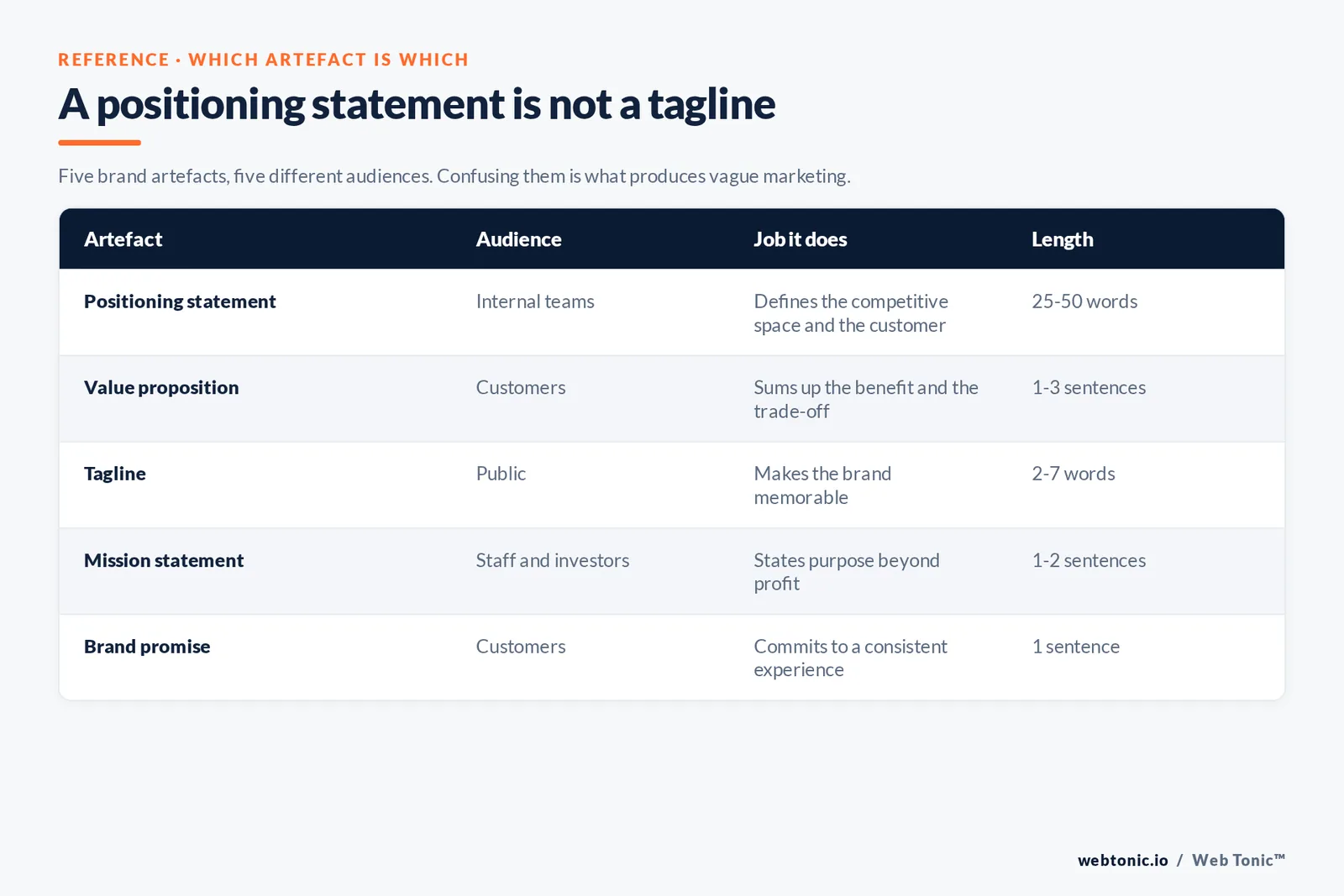
What it is not: a mission statement (why the company exists), a value proposition (a customer-facing benefit summary), or a tagline (a memorable public phrase). Confusing these produces vague marketing, because a tagline written without a positioning statement has no argument underneath it.
| Artefact | Audience | Job it does | Length |
|---|---|---|---|
| Positioning statement | Internal teams | Defines the competitive space and the customer | 25-50 words |
| Value proposition | Customers | Sums up the benefit and the trade-off | 1-3 sentences |
| Tagline | Public | Makes the brand memorable | 2-7 words |
| Mission statement | Staff and investors | States purpose beyond profit | 1-2 sentences |
| Brand promise | Customers | Commits to a consistent experience | 1 sentence |
Strategy literature is blunt about why this matters: strategy is about deliberate trade-offs, not about being better at everything, an argument Michael Porter made in "What Is Strategy?" and one that still governs positioning work. IBM's brand positioning primer and Qualtrics' brand positioning guide both frame the statement as the artefact that makes those trade-offs explicit.
The template, component by component
The classic structure has survived four decades of marketing fashion because it forces a choice at every clause:
For [target customer] who [need or problem], [product name] is a [market category] that [key unique benefit]. Unlike [primary alternative], we [primary differentiator and proof].
| Component | Question it answers | Common failure | Fix |
|---|---|---|---|
| Target customer | Who exactly is this for? | "Small businesses" — far too broad | Name a role, size and situation |
| Need or problem | What are they trying to solve? | Describing the feature, not the pain | Use the customer's own words from interviews |
| Market category | What are we compared against? | Inventing a category nobody searches for | Pick the category buyers already shop in |
| Unique benefit | What is the single payoff? | Listing three benefits at once | Choose one and rank the others below it |
| Primary alternative | What do they use today? | Naming only direct competitors | Include spreadsheets, agencies or doing nothing |
| Reason to believe | Why is this credible? | Adjectives instead of evidence | Cite data, patents, guarantees or scale |
The differentiator clause is where most statements collapse. If you can swap in a competitor's name and the sentence still reads true, you have described the category rather than your place in it. Frameworks for choosing which axis to differentiate on are covered by the American Marketing Association and in Strategy&'s capabilities-led strategy work.
Fourteen positioning statement examples
These are reconstructions written in the standard template to show the structure at work across business types — not official corporate copy.
| Business type | Positioning statement | Why it works |
|---|---|---|
| B2B SaaS (project tools) | For distributed product teams who lose context across tools, our platform is a work management system that keeps every decision attached to the task. Unlike chat-first tools, we make the audit trail the default. | Names a specific failure mode, not a persona |
| Premium electric vehicle | For drivers who refuse to trade performance for efficiency, this vehicle is a luxury EV that outperforms comparable combustion cars. Unlike legacy brands, our software and charging network ship as one product. | Category conflict resolved in one clause |
| Local dental practice | For anxious adults in the city centre who have avoided a dentist for years, we are a general practice built around sedation and pacing. Unlike high-volume clinics, we book double-length first appointments. | Differentiator is operational and checkable |
| D2C skincare | For people with reactive skin who cannot risk trial and error, our range is a minimal-ingredient skincare line with full formula disclosure. Unlike trend-driven brands, every product lists every concentration. | Proof is transparency, hard to copy quickly |
| Fintech app | For freelancers with irregular income, this app is a business banking service that forecasts tax before it is due. Unlike traditional banks, we reconcile invoices and set aside liabilities automatically. | Solves a scheduling pain, not a feature gap |
| Marketing agency | For scaling ecommerce brands spending six figures a month, we are a growth partner that owns paid media and creative in one team. Unlike siloed vendors, our creative testing is briefed from media data weekly. | Names spend level, so unfit leads self-select out |
| Enterprise cybersecurity | For regulated financial institutions, this platform is a threat detection suite that produces audit-ready evidence by default. Unlike generalist tools, our reporting maps to named regulatory frameworks. | Compliance framing beats speed claims |
| Meal delivery | For dual-income households cooking at 7pm, our service is a meal kit designed around 20-minute recipes and one pan. Unlike recipe boxes, we optimise for cleanup time as well as cook time. | Differentiator is a metric competitors ignore |
| Nonprofit | For donors who want to see outcomes, we are a literacy charity that publishes per-cohort reading gains every term. Unlike programmes reporting activity, we report measured progress per child. | Accountability as the differentiator |
| Boutique hotel | For remote professionals staying a week or more, we are a design hotel built for working days, with desks, wired internet and a quiet floor. Unlike business hotels, we price weekly and include laundry. | Reframes the category around length of stay |
| Online course platform | For career changers with 45 minutes a day, this platform is a technical school with cohort deadlines. Unlike self-paced libraries, every course ends in a reviewed portfolio project. | Time budget makes the audience concrete |
| Manufacturing supplier | For mid-sized assemblers running lean inventory, we are a components supplier guaranteeing 48-hour dispatch on stocked lines. Unlike importers, we hold regional stock and quote lead times per SKU. | A number the buyer can hold you to |
| Consumer app (fitness) | For people who have quit three gyms, this app is a strength programme that adapts when you miss sessions. Unlike rigid plans, we rebuild the week automatically after every gap. | Addresses the real churn trigger |
| Professional services (legal) | For founders raising a first institutional round, we are a corporate law firm working on fixed-fee packages. Unlike hourly firms, we publish our fee schedule before the engagement letter. | Pricing model is the positioning |
Notice the pattern: in twelve of the fourteen, the differentiator is a policy, a number or a process, not an adjective. Brand valuation work such as Interbrand's Best Global Brands and Kantar BrandZ consistently shows that clarity of meaning, not volume of messaging, is what compounds brand value over time.

How to write yours in seven steps
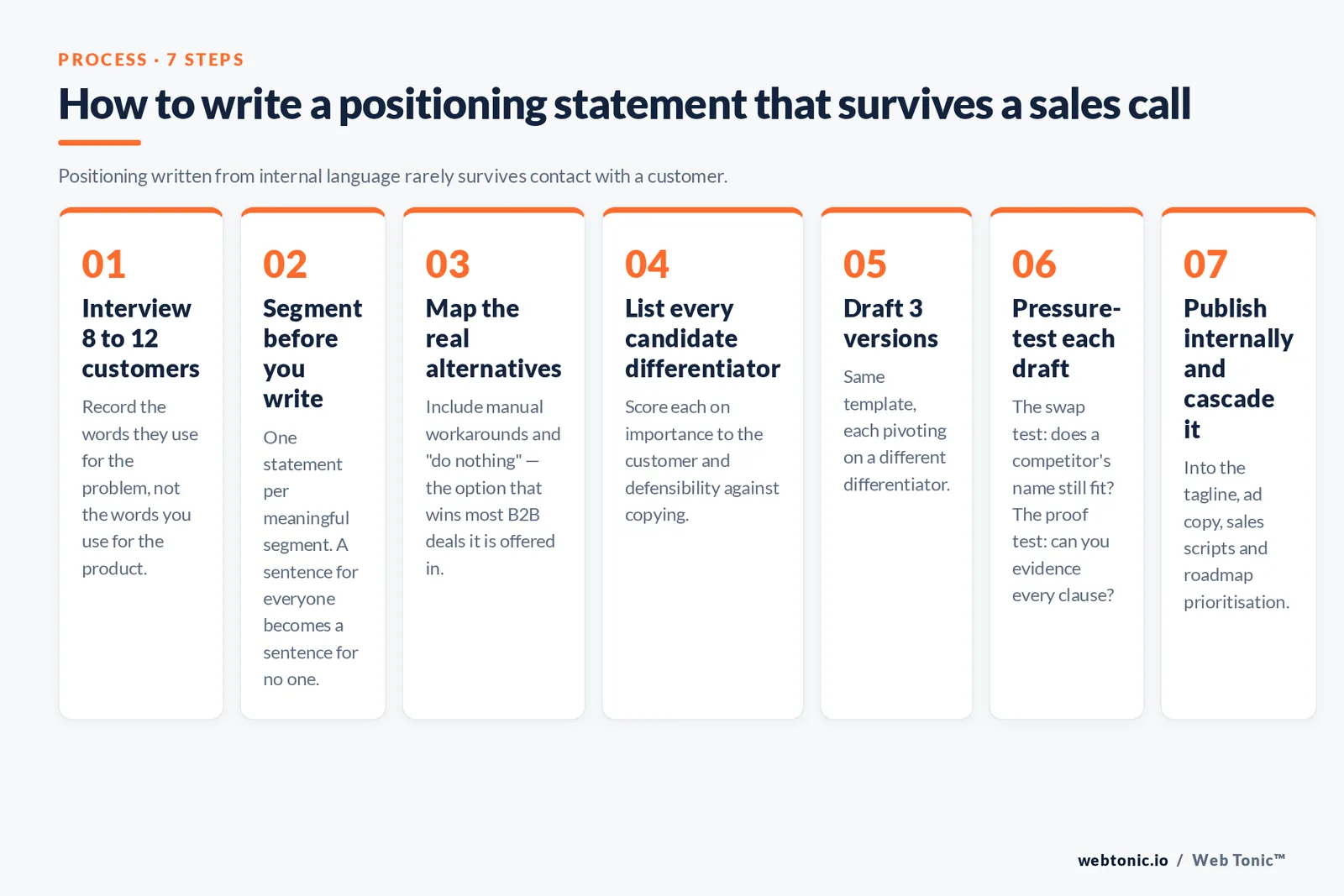
- Interview 8 to 12 customers and record the words they use for the problem. Positioning written from internal language rarely survives a sales call.
- Segment before you write. One statement per meaningful segment; a single sentence for everyone becomes a sentence for no one.
- Map the real alternatives including manual workarounds and "do nothing", the option that wins most B2B deals it is offered in.
- List every candidate differentiator and score each on importance to the customer and defensibility against copying.
- Draft 3 versions using the template, each pivoting on a different differentiator.
- Pressure-test each draft with the swap test (does a competitor's name fit?) and the proof test (can you evidence every clause?).
- Publish internally and cascade it into the tagline, ad copy, sales scripts and roadmap prioritisation.
Treat step 7 as the real work. A statement that lives in a slide deck changes nothing; one that decides which features get built and which campaigns get funded changes everything. Strategy-cascade mechanics are covered well in Atlassian's strategic planning guide, and category-level positioning examples appear throughout Shopify's brand positioning breakdown. If you want the statement translated into live campaigns, that handover is exactly what our growth marketing team and performance creative team do for clients.
Six mistakes that make a positioning statement useless
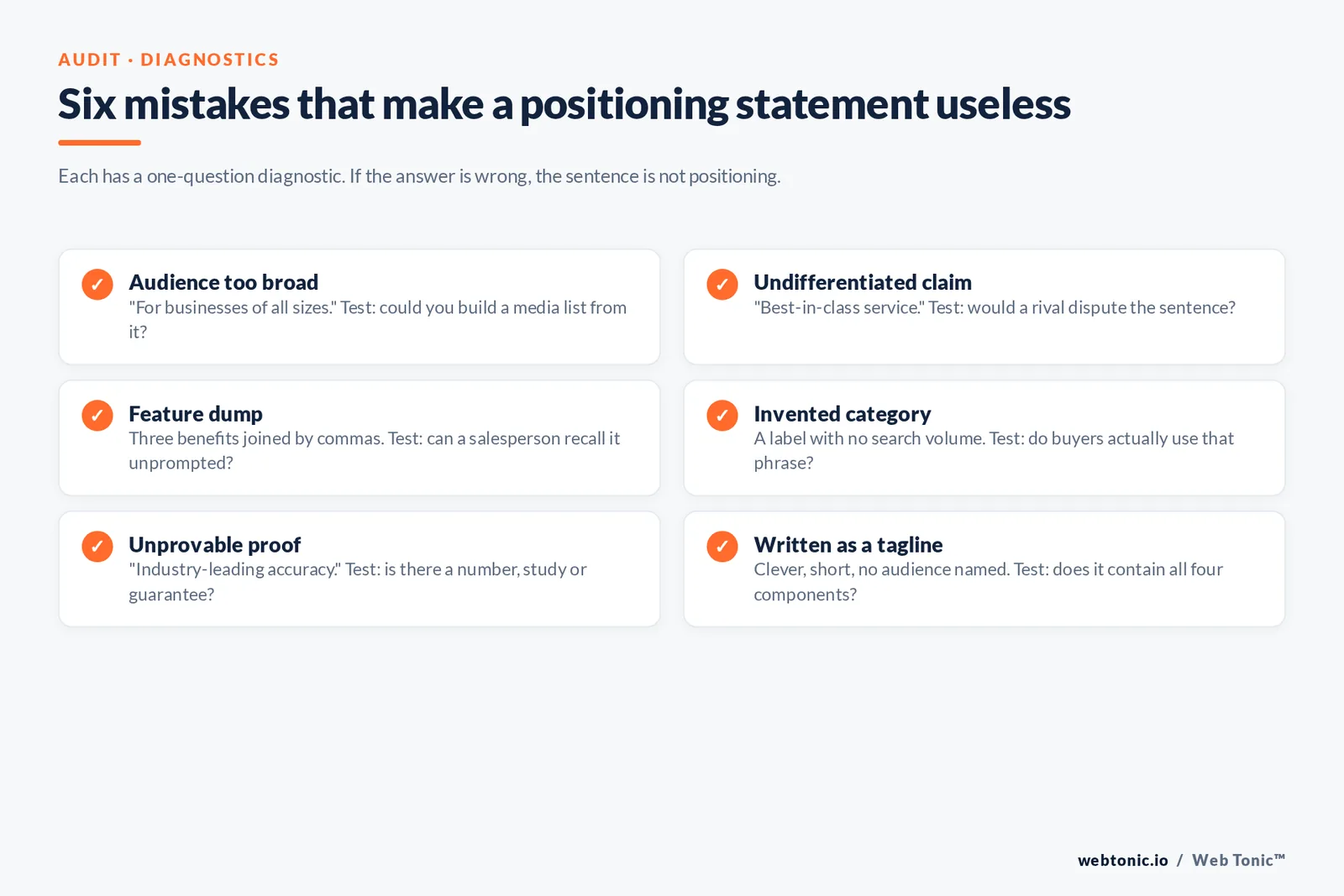
Most weak statements fail in predictable ways, and each has a quick diagnostic.
| Mistake | How it shows up | Diagnostic test |
|---|---|---|
| Audience too broad | "For businesses of all sizes" | Could you build a media list from it? |
| Undifferentiated claim | "Best-in-class service" | Would a rival dispute the sentence? |
| Feature dump | Three benefits joined by commas | Can a salesperson recall it unprompted? |
| Invented category | A label with no search volume | Do buyers use that phrase? |
| Unprovable proof | "Industry-leading accuracy" | Is there a number, study or guarantee? |
| Written as a tagline | Clever, short, no audience named | Does it contain all four components? |
Positioning also decays. Competitors copy the differentiator, the category shifts, and the customer's alternatives change. Review the statement annually against a brand tracker or customer survey, and rewrite it whenever a differentiator has become table stakes. Tracking methodology and market research design are documented by Ipsos, and practical prioritisation frameworks for the review itself sit in MindTools' strategy library. More marketing-strategy walkthroughs are collected on the Web Tonic blog, and if you would rather work through it with a team, get in touch.
Positioning statements for startups
Startups have the hardest version of this job: the products are young, the customers are few, and the market category may not exist yet. The fix is not a cleverer sentence but a narrower one. Early-stage teams that pick a single beachhead audience, describe the problem in that audience's own words, and name exactly what sets the offer apart tend to reach a clear message far faster than teams trying to speak to the whole industry at once.
A practical rule for founders: your first positioning statement should be almost embarrassingly specific. "For seed-stage fintech startups with no in-house designer" is a good target; "for technology companies" is not. Specificity is what makes the statement useful to sales, to product and to the ad platforms where you will spend money.
Look at how a mature technology company does it. Apple's product messaging has always described a clear customer, a familiar category and one benefit — the iPhone was positioned as a phone, an iPod and an internet device in a single sentence, and every Apple launch since has kept that habit of naming the category before the feature list. Whether or not you like the brand, the discipline is worth copying: name the category buyers already understand, then claim one thing inside it. Brand-value research from Interbrand repeatedly ranks Apple at the top precisely because that meaning is consistent across every product, every store and every ad.
Three startup-specific traps are worth naming:
- Competing on "free" or price. A free tier is a distribution tactic, not a differentiator — any funded competitor can match it in 1 sprint. Position on the outcome customers get, then let pricing support it.
- Claiming the whole platform. Early products are features, not platforms. Position the feature that already wins deals, and keep the platform vision for the fundraising deck.
- Skipping the competition question. If the honest answer is "consumers do this in a spreadsheet", say so internally. That is the alternative your copy must beat.
Vision, values and message: what sits above the statement
A positioning statement does not float alone. Above it sits the company vision and the core values; below it sit the message architecture, the campaign offers and the support experience customers actually meet. When those layers disagree, buyers feel it as inconsistency long before they can articulate it.
| Layer | Question it settles | Owner | Review cadence |
|---|---|---|---|
| Vision | Where the company is going | Founders and board | Every 2-3 years |
| Core values | How the team behaves | Leadership and people team | Rarely |
| Positioning statement | Who we are for and what sets us apart | Marketing lead | Annually |
| Message architecture | The 3-5 proof points we repeat | Marketing and sales | Every 2 quarters |
| Campaign offers | What we ask people to do now | Growth team | Monthly |
| Customer experience | Whether the promise is kept | Product and support | Continuous |
The test of a good positioning statement is whether it can generate the layer below it. If your message architecture — the 3 to 5 things you say in every deck, ad and onboarding email — cannot be derived from the statement in ten minutes, the statement is still too vague. Write the statement, then immediately draft the proof points it implies. Anything you want to claim that the statement does not support is either a new segment or a distraction.
Values deserve one specific warning. "We help customers" and "we are a good partner" are not values that clarify anything, because no competitor claims the opposite. Values are useful when they describe a trade-off you will actually accept: publishing prices, refusing certain clients, answering support in under an hour. Those are the raw material a credible differentiator is built from, and they are also what makes the statement defensible when a better-funded rival tries to copy it. The the AMA's strategy library and Qualtrics' positioning research guidance both frame this as the difference between stated and demonstrated brand meaning.
Testing and measuring the statement with real customers
A positioning statement is a hypothesis about what a specific group of consumers values most, so it should be tested like one. The fastest test is language-based: read the statement aloud on five sales calls and count how many prospects repeat the differentiator back to you. If nobody echoes it, the claim is not clear enough or not important enough, and no amount of design polish will fix that.
Beyond the qualitative read, four measurements tell you whether the positioning is doing commercial work:
| Signal | What it measures | Where to get it | Read it every |
|---|---|---|---|
| Unaided association | Whether customers link your brand to the benefit | Brand tracker survey | 2 quarters |
| Message-market fit on ads | Which claim earns the best click and conversion rate | Paid search and social tests | 4 weeks |
| Win reasons | Whether deals close on your differentiator | CRM win-loss fields | Monthly |
| Support themes | Whether the promise survives the experience | Support ticket tags | Monthly |
Paid media is the cheapest laboratory available. Run the same offer with three different headline claims drawn from your candidate statements, hold budget and audience constant, and let the click-through and conversion data rank them. A single 2-week test across 3 variants usually produces a clearer verdict than a month of internal debate, because it measures what buyers do rather than what they say. Keep the winning claim, then push it through the whole funnel: ad, landing page headline, product page, onboarding email and the first line of your support macros.
Watch the gap between promise and delivery. If the statement says you are the fastest solution in your category and support tickets show a queue, the positioning is not wrong so much as unearned — and the honest fix is operational, not editorial. The best companies treat a positioning statement as a commitment the whole business has to fund: product roadmap, service levels, pricing and staffing all shift to make one claim defensibly true. That is what genuinely sets a brand apart from competitors who simply describe themselves well.
Two closing habits keep the work alive. First, put the statement at the top of every campaign brief so nobody writes copy without it. Second, calendar one annual review where you check each clause against the current competitive set and delete anything that has become table stakes. A statement that survives that review unchanged for three years is either exceptional or unexamined, and it is usually worth finding out which.
Frameworks that feed the statement
The sentence is the output. Getting to it usually takes two or three of these inputs, and each one contributes a specific clause.
| Framework | What it produces | Clause it feeds | Effort |
|---|---|---|---|
| Customer interviews | Verbatim problem language | Target customer and need | 8-12 calls |
| Jobs to be done | The progress the buyer wants | Unique benefit | 1-2 workshops |
| Competitive matrix | Axes where rivals cluster | Category and alternative | 6-10 competitors |
| Perceptual map | Open space in buyer perception | Differentiator | 2 axes, one chart |
| Win-loss analysis | Why deals were actually won | Reason to believe | 20+ closed deals |
| Brand tracker | Awareness and association shifts | Validation over time | Quarterly waves |
A pragmatic sequence for a small team: run 10 customer interviews in week one, build the competitive matrix across 8 rivals in week two, draft 3 candidate statements in week three, then test them on 5 live sales calls in week four. That is a 4-week cycle costing almost nothing but attention, and it beats a day-long offsite because the language comes from buyers rather than from the room.
One caution on the perceptual map. Empty space on a chart is not automatically valuable space — it is often empty because nobody wants to buy there. Before committing, confirm that at least 2 of your last 10 won deals were decided by the axis you are claiming. If none were, the differentiator is interesting rather than commercial, and the statement will not survive contact with a pipeline.
Finally, budget for repetition. Internal alignment is a volume game: teams typically need to hear a new positioning statement 5 to 7 times, in different contexts, before it shows up unprompted in their own writing. Put it at the top of every campaign brief, every product spec and every new-hire onboarding doc until it becomes the default vocabulary of the company.
FAQ
What is a positioning statement in simple terms?
It is one sentence that says who your product is for, what category it belongs to, the single most valuable thing it does for that customer, and why that claim is credible. It is written for internal alignment, so clarity matters far more than cleverness.
How long should a positioning statement be?
One sentence, typically 25 to 50 words. If it needs a second sentence you are probably describing two segments and should write two separate statements.
What is the difference between a positioning statement and a value proposition?
A positioning statement is internal and comparative: it names the audience, the category and the competitor. A value proposition is customer-facing and benefit-first, written to be read on a landing page or in a sales email.
Can a company have more than one positioning statement?
Yes. Most multi-product companies hold one brand-level statement plus one per product line or major segment. They must ladder up consistently, otherwise sales and marketing end up making incompatible promises.
How do you know if your positioning statement is working?
Three signals: prospects repeat your differentiator back to you unprompted, sales cycles shorten because unfit leads self-select out, and brand tracking shows the association you targeted rising over successive waves.
Sources
Harvard Business Review, "What Is Strategy?" (Michael Porter) · IBM Think: brand positioning · Qualtrics brand positioning guide · American Marketing Association marketing strategy topics · Strategy& capabilities-led strategy · Interbrand Best Global Brands · Kantar BrandZ · Atlassian strategic planning guide · Shopify brand positioning breakdown · Ipsos market research and brand tracking · MindTools strategy library.