Table of contents
An elevator pitch is a 30-to-60-second spoken introduction that states who you are, what you do, and why the listener should care. The 18 examples below are written out word for word, grouped by situation, with the mechanism that makes each one land.
Key Takeaways
- 30-60 seconds is the working range for a spoken pitch, which is roughly 75-150 words at a natural speaking pace of about 130 words per minute.
- A pitch that tries to cover a whole CV fails; the 4 parts that matter are hook, value, proof, and ask.
- All 18 examples here follow one of 5 reusable formulas, so you can swap in your own details in under 10 minutes.
- Interviews, investor meetings, and trade-show booths need 3 different versions of the same pitch — the ask changes, the story does not.
- The single most common failure is no ask: about 1 sentence of specific next step turns a nice introduction into a meeting.
What an elevator pitch actually is
The name comes from the idea of having only the length of an elevator ride to explain your idea to someone who could act on it. Mind Tools frames it as a persuasive summary you can deliver on demand, and Corporate Finance Institute treats it as a career asset rather than a one-off script. In practice it is a compression exercise: you are choosing which 3 facts survive.
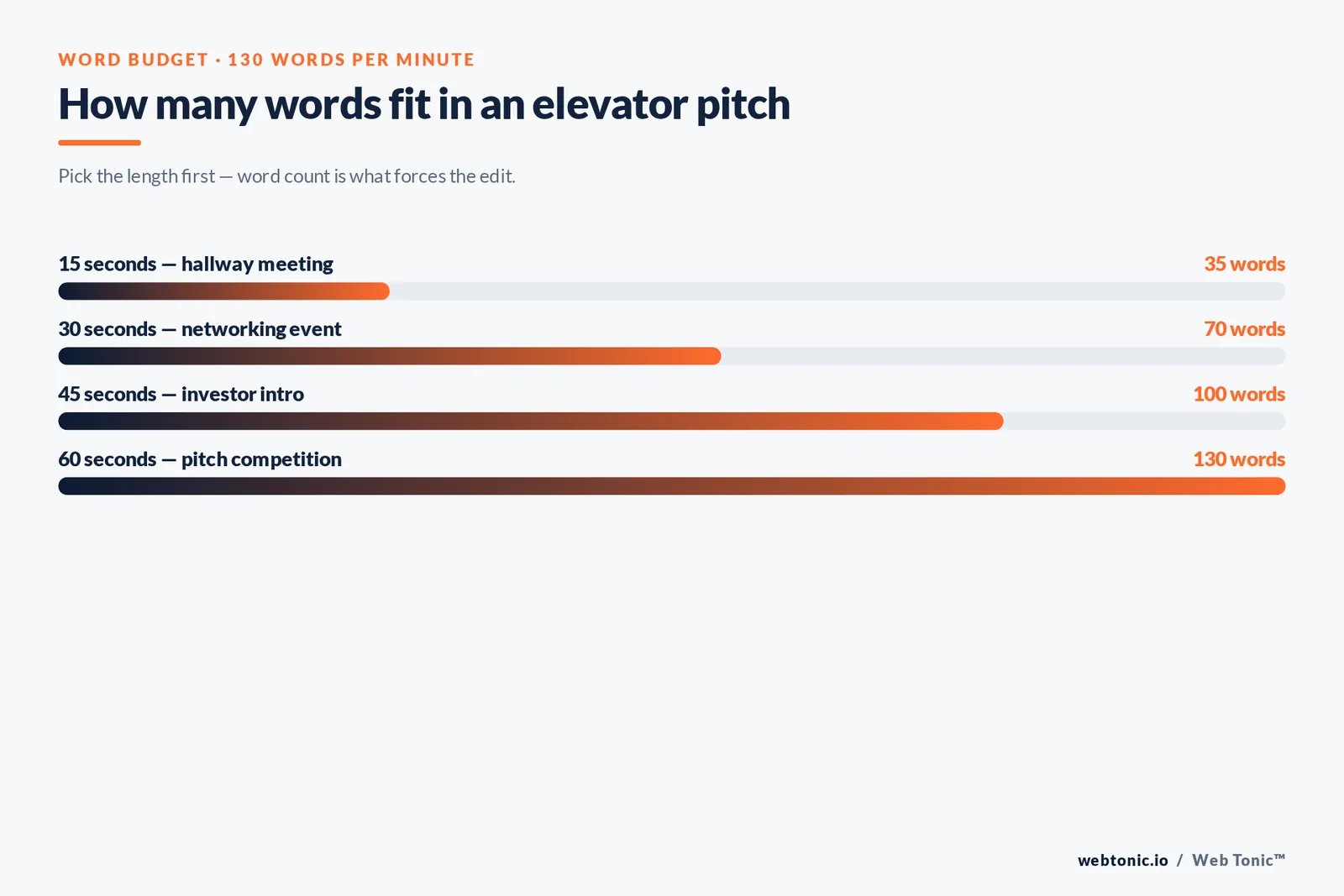
Length is the first decision. Pick a target before you write, because word count is what forces the edit.
| Length | Words | Where it fits | What you must cut |
|---|---|---|---|
| 15 seconds | ~35 | Chance hallway meeting, conference badge scan | Proof and background — keep role plus one benefit |
| 30 seconds | ~70 | Networking event, career fair, "tell me about yourself" | Job history, tool lists, second example |
| 45 seconds | ~100 | Investor intro, panel introduction, podcast opener | Team bios, roadmap detail |
| 60 seconds | ~130 | Pitch competition, structured first-round interview | Anything the listener cannot repeat afterwards |
The four-part structure behind every good pitch
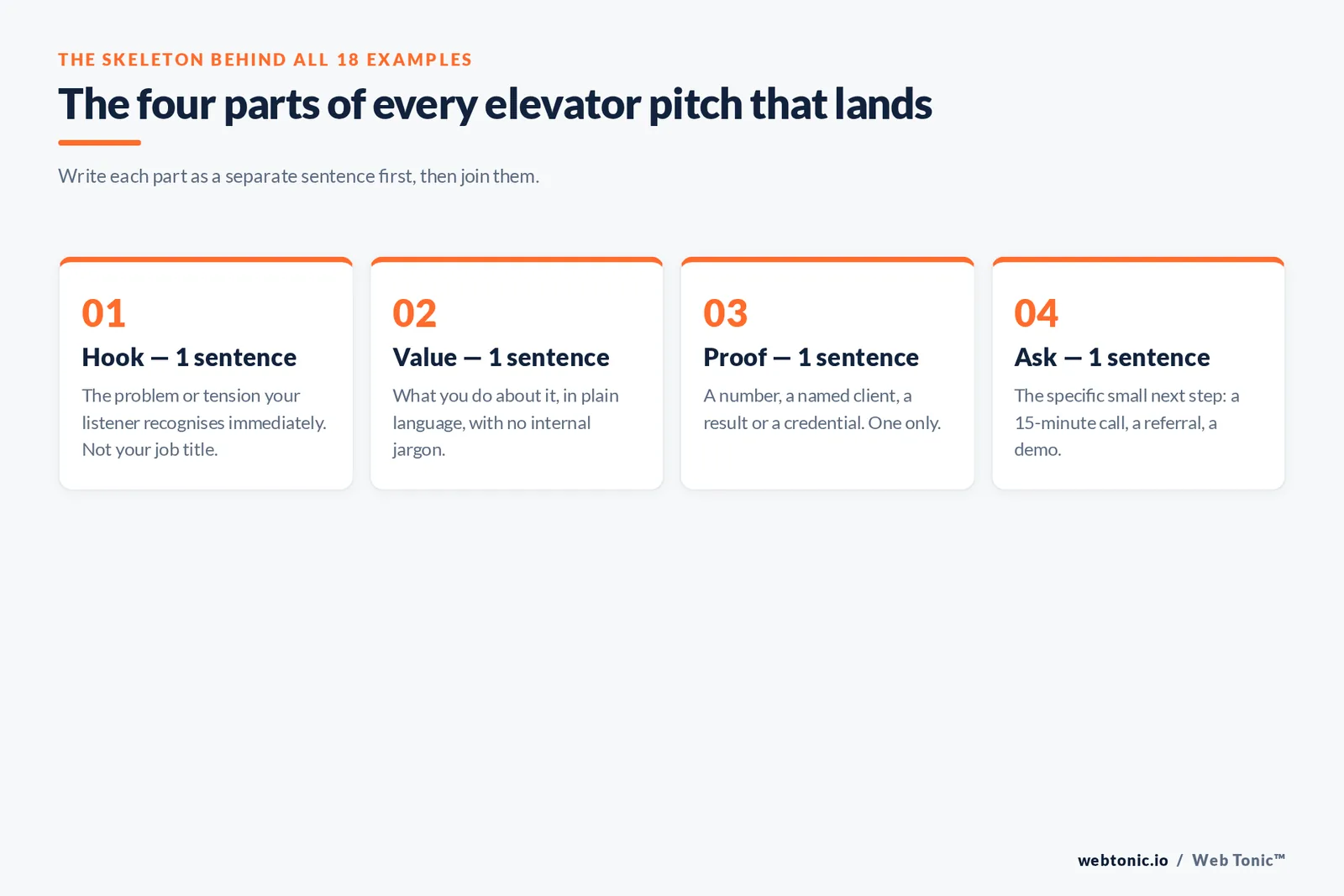
Every example in this article maps onto the same skeleton. Write your four parts as separate sentences first, then join them.
- Hook (1 sentence) — the problem or tension your listener recognises immediately.
- Value (1 sentence) — what you do about it, in plain language, with no internal jargon.
- Proof (1 sentence) — a number, a named client, a result, or a credential. One only.
- Ask (1 sentence) — the specific, small next step: a 15-minute call, a referral, a demo.
Simon Sinek's "start with why" talk is the reason the hook comes first: purpose is more memorable than process. If your opening line is your job title, you have started in the wrong place.
18 elevator pitch examples, by situation
Read the pitch, then the "why it works" column — that is the part you copy, not the wording.
Job seekers and interviews
| # | Pitch | Why it works |
|---|---|---|
| 1. Experienced hire | "I'm a supply-chain analyst who spends most of my time on the boring part nobody wants: forecast accuracy. At my last company I cut stockouts by a third across 40 SKUs by rebuilding how we handled seasonal demand. I saw you're scaling into three new markets — I'd love 15 minutes to hear how you're forecasting that." | Names an unglamorous specialism, then one hard result, then an ask tied to the employer's actual situation. |
| 2. Recent graduate | "I just finished a statistics degree, and the part that stuck was a capstone where I modelled bus delays for the city transit office — they still use the dashboard. I'm looking for a first analyst role where the output gets used, not filed. Are you hiring juniors this cycle?" | Replaces missing experience with a real artefact still in use; the ask is a yes/no question, which is easy to answer. |
| 3. Career changer | "I taught secondary maths for six years, which is really six years of explaining hard things to sceptical audiences. I've since built two internal training programmes and I'm moving into learning and development. Who on your people team should I talk to?" | Reframes the old career as the qualification instead of apologising for it, then asks for a referral rather than a job. |
| 4. Returning after a break | "I stepped away from finance for two years to care for a parent. I kept my licence current and did contract bookkeeping for four small businesses in that time. I'm ready for a full-time controller role and I'd like to be considered for yours." | Handles the gap in one clean sentence, proves continuity, and states the ask directly. No hedging. |
| 5. Internal promotion | "Over the last two quarters I've been running our onboarding queue unofficially, and time-to-first-value dropped from 21 days to 9. I'd like to make that my formal remit. Can we put it on the agenda for our next one-to-one?" | Evidence first, title second — the promotion is framed as ratifying work already happening. |
Founders and investor conversations
| # | Pitch | Why it works |
|---|---|---|
| 6. Seed-stage SaaS | "Dental practices lose a fortune to no-shows and still chase them by phone. We handle the whole reminder and rebooking loop automatically; 60 practices use us and no-shows are down by a quarter on average. We're raising a seed round — can I send you the deck?" | Names a specific vertical, quantifies traction, and asks for permission to send rather than for money. |
| 7. Marketplace | "Restaurant equipment goes to landfill while new operators can't afford a fryer. We're the resale layer between them — 1,200 listings and 40% month-on-month growth in the two cities we've launched. I'd like your read on our expansion model." | Two-sided problem stated in one line; the ask is for advice, which is the lowest-friction investor opener. |
| 8. Deep tech | "Battery testing labs wait six weeks for cycle data. Our sensor array gets the same confidence in nine days. Two of the top five cell manufacturers are running pilots. Are you looking at hardware this fund?" | Compresses the technology into a before/after number and qualifies the investor before pitching further. |
| 9. Pre-revenue idea | "I've interviewed 43 independent physiotherapists in the last two months and every single one hates their insurance-claim paperwork. I'm building the tool they described. I'm looking for one design partner before I write more code — is that you?" | With no traction to cite, evidence of customer research becomes the proof, and the ask is a design partner, not capital. |
Sales, agency, and service pitches
| # | Pitch | Why it works |
|---|---|---|
| 10. B2B software rep | "Most finance teams I meet close their month in 11 days and hate every one of them. We take that to under 5 by killing the spreadsheet reconciliation step. If close is a sore point for you, I'll show you the 10-minute version." | Leads with the prospect's pain expressed as a number, and the ask is a tiny time commitment. |
| 11. Marketing consultant | "I work with ecommerce brands doing $2m to $20m that are stuck because paid social is carrying everything. I rebalance the mix so acquisition isn't hostage to one channel — usually a 20-30% drop in blended cost per order within two quarters. Worth a look at your numbers?" | Qualifies by revenue band so unqualified listeners self-select out, then gives a realistic outcome range with a timeframe. |
| 12. Freelancer | "I'm a technical writer for developer tools. I turn the docs nobody has time to fix into something a new user can follow in under 20 minutes. I have two weeks open in March if your docs are on someone's someday list." | Availability creates urgency without discounting; the outcome is written from the end user's point of view. |
| 13. Local service business | "We're the crew people call when the last roofer disappeared mid-job. Fixed quote, photos every day, and we've finished 300-plus roofs in this county. Can I put you on the list for a free inspection before winter?" | Positions against a shared bad experience, then removes risk with a free, seasonal, time-boxed ask. |
Networking, students, and non-profits
| # | Pitch | Why it works |
|---|---|---|
| 14. Conference introduction | "I run data engineering for a hospital group — basically I make sure clinicians see the right number at the right time. I came here specifically to find out how other people handle consent tracking. How are you handling it?" | Explains a technical role in one plain sentence and ends by handing the conversation back. Pitches that end in a question keep going. |
| 15. Student at a career fair | "I'm a third-year mechanical engineering student and I spent last summer on a factory floor doing time studies, which taught me more than any lecture. I'm after a 2027 internship in process engineering. What does your application timeline look like?" | One credible experience beats a list of coursework; asking about timeline gets a concrete, useful answer. |
| 16. Non-profit programme lead | "We keep 400 kids in after-school tutoring in three neighbourhoods where the schools have no budget for it. Attendance is up 12 points at our partner schools. We're looking for one corporate sponsor for next year — who handles giving at your company?" | Scale, outcome, and a referral ask that a stranger can answer without committing money. |
| 17. Internal cross-team pitch | "Support answers the same billing question 200 times a month. I've drafted a self-serve fix that would take one sprint. I need 30 minutes with someone from your team to sanity-check it." | Quantified waste plus a costed fix plus a request for time, not budget. This is the pitch most likely to actually get approved. |
| 18. Personal brand / creator | "I make short videos explaining employment law to people who just got fired — about 90,000 follow along. Brands come to me when they need HR content that doesn't sound like HR. Do you have anything in that area this quarter?" | Audience size is the proof, positioning is the differentiator, and the ask matches how brand deals actually start. |
Five templates you can fill in
Pick the formula that matches your situation and write your version in the blanks. Asana's guide and HubSpot's sales examples both use variations of the first two.
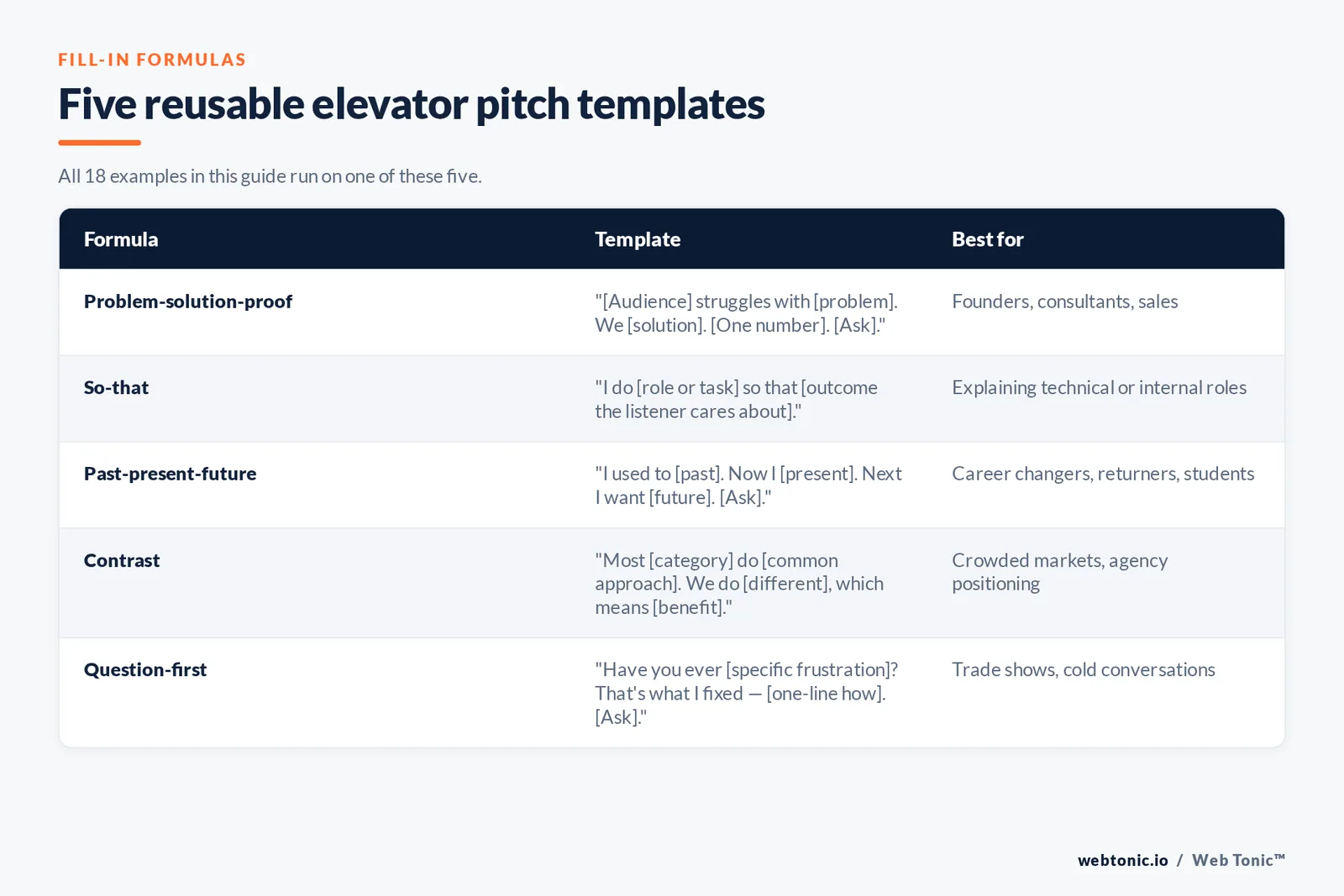
| Formula | Template | Best for |
|---|---|---|
| Problem-solution-proof | "[Audience] struggles with [problem]. I/we [solution]. [One number or named result]. [Ask]." | Founders, consultants, sales |
| So-that | "I do [role/task] so that [outcome the listener cares about]." | Explaining technical or internal roles |
| Past-present-future | "I used to [past]. Now I [present]. Next I want [future]. [Ask]." | Career changers, returners, students |
| Contrast | "Most [category] do [common approach]. We do [different approach], which means [benefit]." | Crowded markets, agency positioning |
| Question-first | "Have you ever [specific frustration]? That's what I fixed — [one-line how]. [Ask]." | Trade shows, cold conversations |
Delivery: timing, tone, and the pause
A pitch is a spoken artefact, so rehearse it out loud with a timer. At roughly 130 words per minute you get about 65 words into 30 seconds — write to that budget rather than trimming afterwards. Toastmasters makes the same point about pace and pausing: the silence after your ask is what invites the reply.
Three delivery habits separate the ones that work from the ones that don't. Speak 10-15% slower than feels natural. Stop cleanly instead of trailing off into "so, yeah". And say the ask as a full sentence, not as a mumbled afterthought. If you are pitching at a networking event, Mind Tools' networking guidance and university career-services resources such as Yale's and Penn's are worth reading alongside this.
How to write your elevator pitch: a step-by-step practice guide
Writing a strong elevator pitch is a drafting exercise, not a moment of inspiration. Work through these 6 steps and you will have a clear, professional pitch plus a shorter version for chance encounters.
- Write the value proposition first. One clear sentence naming the problem you solve and who you solve it for. If your value proposition needs a second sentence, it is not finished.
- List your proof, then cut to one. Pick the example with a number in it — a result, a client, a project, a percentage. Numbers create attention; adjectives do not.
- Name the audience. A pitch for a recruiter and a pitch for a prospect need different interests foregrounded. Write the audience at the top of the page before you draft.
- Choose the ask. A 15-minute call, a referral, a demo, a follow-up email. The ask is what turns a good introduction into a next step, and it is the single most skipped part of the whole structure.
- Read it out loud with a timer. Speech behaves differently from text: clauses that read cleanly become unspeakable. Anything you stumble over twice gets rewritten.
- Practice it on someone outside your field. If they can repeat your pitch back accurately, the language is clear. If they cannot, the jargon is still in there.
Do not try to memorise the wording. Memorise the structure — hook, value, proof, ask — and rebuild the sentences live each time. That is the practice that separates a natural professional introduction from a recital, and it is also what lets you shorten the same pitch to 15 seconds when the situation demands it.
Elevator pitch tips for interviews, presentations and networking
The same pitch does different jobs in different rooms. These tips will help you adapt one clear structure without rewriting it from scratch each time.
| Situation | What the listener wants | Best template | Tips that matter |
|---|---|---|---|
| Job interview | Evidence you can do the work | Problem-solution-proof | Open with the skills the role needs, not your job history. One example, one number, then stop. |
| Career fair | A reason to keep talking | Past-present-future | Ask about timelines. A question keeps the conversation alive after your 30 seconds are up. |
| Networking event | Common ground | So-that | Explain your work in one plain sentence, then hand the conversation back. Curiosity beats polish. |
| Sales call | A clear solution to a real cost | Contrast | Quantify the problem before naming your product. Then make the ask small: a 10-minute walkthrough. |
| Conference presentation | A reason to stay in the room | Question-first | Your first 20 words are your pitch. Everything else in the presentation is proof. |
| Internal project pitch | Cost, effort, and who owns it | Problem-solution-proof | State the waste as a number, the fix in one sprint, and ask for time rather than budget. |
Two habits improve every version. First, make the strong sentence the first sentence — first impressions form in seconds, and a weak opener spends attention you cannot get back. Second, keep a written personal pitch document with your best examples, your proof points, and your 3 asks, and review it before any event. A pitch you last practised 6 months ago is not a pitch you can deliver well today.
Seven mistakes that kill an otherwise good pitch
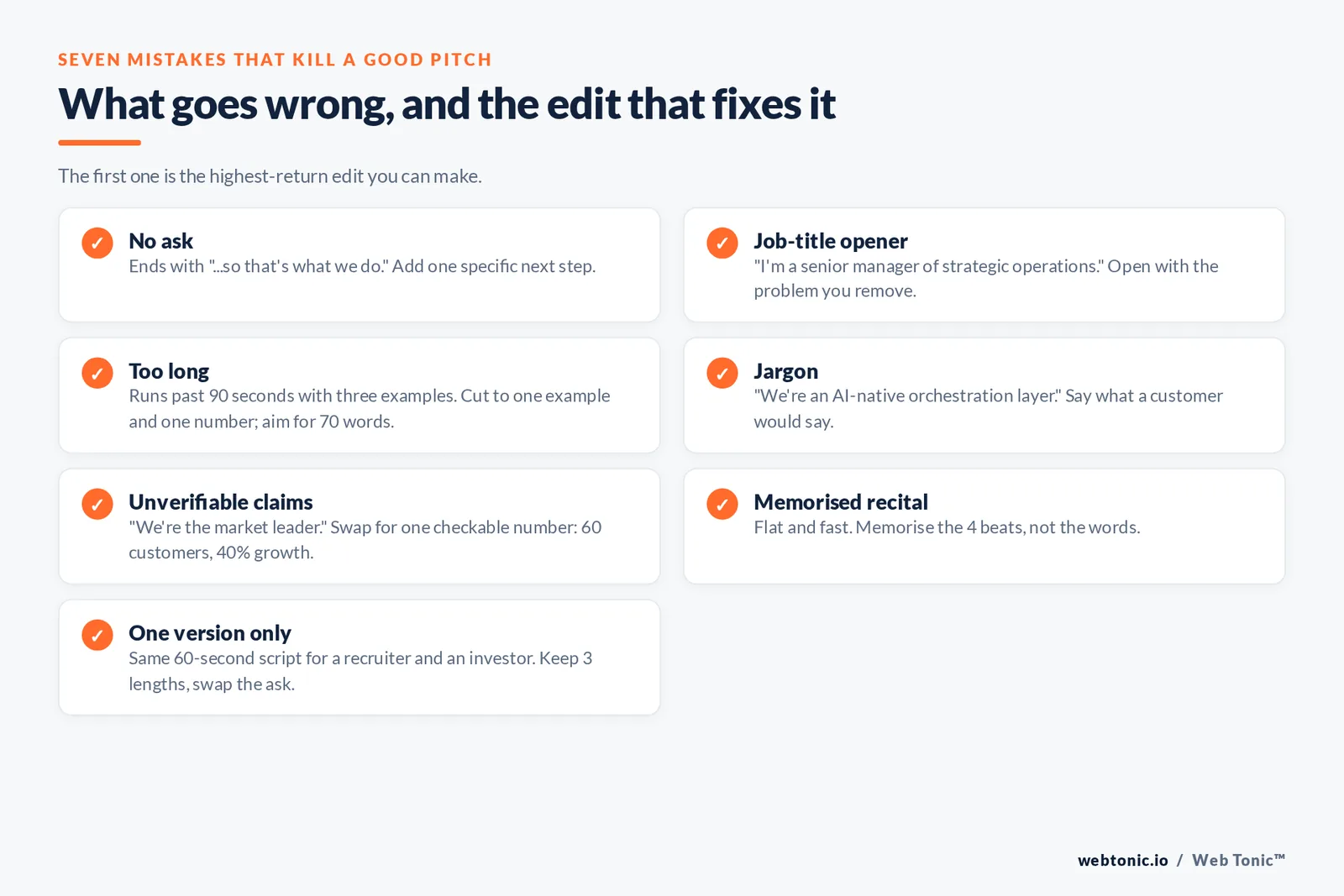
| Mistake | What it sounds like | Fix |
|---|---|---|
| No ask | Ends with "...so that's what we do." | Add one specific next step. This is the highest-return edit you can make. |
| Job-title opener | "I'm a senior manager of strategic operations." | Open with the problem you remove, not your title. |
| Too long | Runs past 90 seconds with three examples. | Cut to one example and one number. Aim for 70 words. |
| Jargon | "We're an AI-native orchestration layer." | Say what a customer would say. Test it on someone outside your field. |
| Unverifiable claims | "We're the market leader." | Swap for one checkable number: 60 customers, 40% growth. |
| Memorised recital | Flat, fast, eyes up-left. | Memorise the 4 beats, not the words. Rebuild the sentences live. |
| One version only | Same 60-second script for a recruiter and an investor. | Keep 3 lengths and swap the ask per audience. |
Adapting one pitch to different audiences
You do not need 18 pitches, you need 1 story with interchangeable asks. Keep the hook and value identical, then change the proof and the ask to match what the listener can actually do for you. A recruiter can advance an application; a peer can make a referral; an investor can take a meeting; a prospect can book a demo.
For business audiences, tie the pitch to a number the listener owns. The U.S. Small Business Administration recommends grounding positioning in market research rather than adjectives, and Harvard Business Review's business-communication library is a useful corrective if your pitch has drifted into abstraction. If you want the same discipline applied to a whole funnel rather than a conversation, our growth marketing and data intelligence teams do exactly that; more short guides like this sit on the Web Tonic blog, and you can always start a conversation if you'd rather pressure-test your positioning with someone.
FAQ: elevator pitch questions
How long should an elevator pitch be?
Between 30 and 60 seconds for most situations, which is roughly 70 to 130 words at a normal speaking pace. Prepare a 15-second version for chance encounters and a 60-second version for structured settings such as interviews or pitch competitions. If your pitch runs past 90 seconds it has become a presentation and the listener has stopped tracking it.
What should an elevator pitch include?
Four parts: a hook that names a problem the listener recognises, a plain-language statement of what you do about it, one piece of proof such as a number or named result, and a specific ask. Anything that does not serve one of those four parts is cut. The ask is the part people most often leave out and the part that determines whether the conversation continues.
How do I start an elevator pitch without sounding scripted?
Memorise the four beats rather than the exact wording, and rebuild the sentences live each time. Open with the problem or a question instead of your job title, speak slightly slower than feels natural, and pause after your ask. Rehearsing out loud with a timer, rather than reading silently, is what removes the recited quality.
Can I use the same elevator pitch for every situation?
Keep one story and swap the ask. The hook and value should stay stable so you sound consistent, but the proof point and the next step you request should match what the listener can actually do — advance an application, make a referral, take a meeting, or book a demo. Most people need three lengths of one pitch, not several different pitches.
What is a good elevator pitch example for a job interview?
"I'm a supply-chain analyst who spends most of my time on forecast accuracy. At my last company I cut stockouts by a third across 40 SKUs by rebuilding how we handled seasonal demand. I saw you're scaling into three new markets — I'd love 15 minutes to hear how you're forecasting that." It works because it names a specialism, gives one hard result, and ends with a question about the employer's situation.
Sources
Mind Tools, Elevator Pitches and Crafting an Elevator Pitch · Corporate Finance Institute, Elevator Pitch and Elevator Pitch (management) · Asana, Elevator pitch examples · HubSpot, Elevator pitch examples · Toastmasters International, Public speaking tips · TED, Simon Sinek: How great leaders inspire action · U.S. Small Business Administration, Market research and competitive analysis · Harvard Business Review, Business communication · Yale Office of Career Strategy, Networking · University of Pennsylvania, Career Services. Accessed July 2026.