Table of contents
A value proposition is the concise statement of what a customer gets, who it is for, and why it beats the alternative. Below are 22 real examples, taken from live pages in August 2026, plus the patterns and formulas behind them.
Key Takeaways
- 3 parts make a value proposition work: the target customer, the specific outcome, and the differentiator. Drop any one and it becomes a slogan.
- Under 15 words is the practical ceiling for a headline value proposition, with a supporting sentence of 20 to 30 words underneath it.
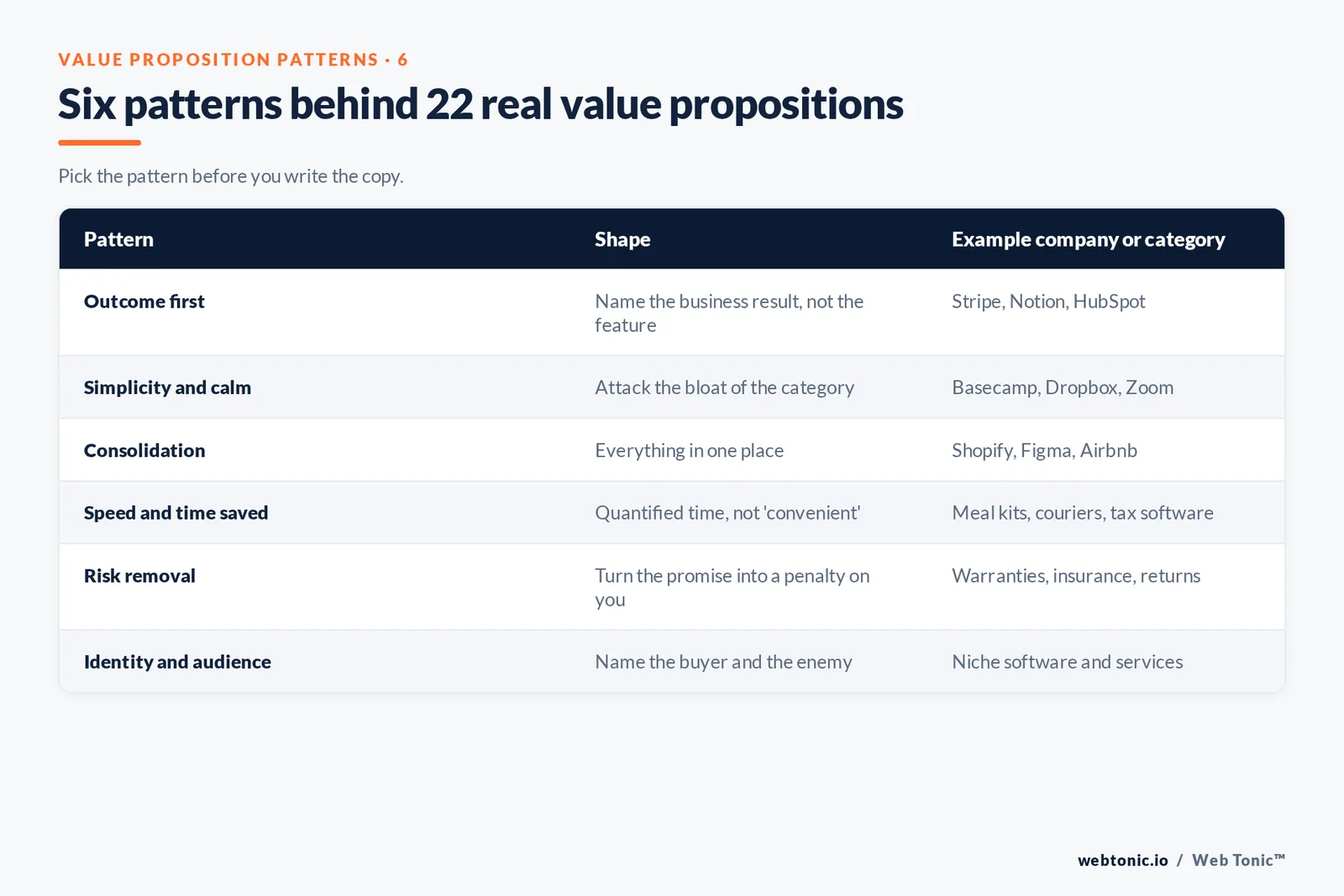
- 22 examples below are grouped into 6 patterns — outcome, speed, simplicity, consolidation, identity and risk removal — so you can pick the pattern that fits your product before you write copy.
- Rule 1: a value proposition is not a tagline, a mission statement or a positioning statement. It is written for the buyer, not for the company.
- 5 minutes is all the test needs: show the headline to someone outside your company and ask what you sell and who for. If they hesitate, rewrite.
What a value proposition actually is
A value proposition is a concise statement of the value a product or service delivers to a specific customer, and why that value is better or different from the next option on their list. It sits at the top of the homepage, at the top of a landing page, and at the start of a sales conversation. Optimizely's definition frames it as the promise of value to be delivered; the classic business-school treatment in Harvard Business Review's "Customer Value Propositions in Business Markets" pushes further and insists on points of difference that the customer can verify.
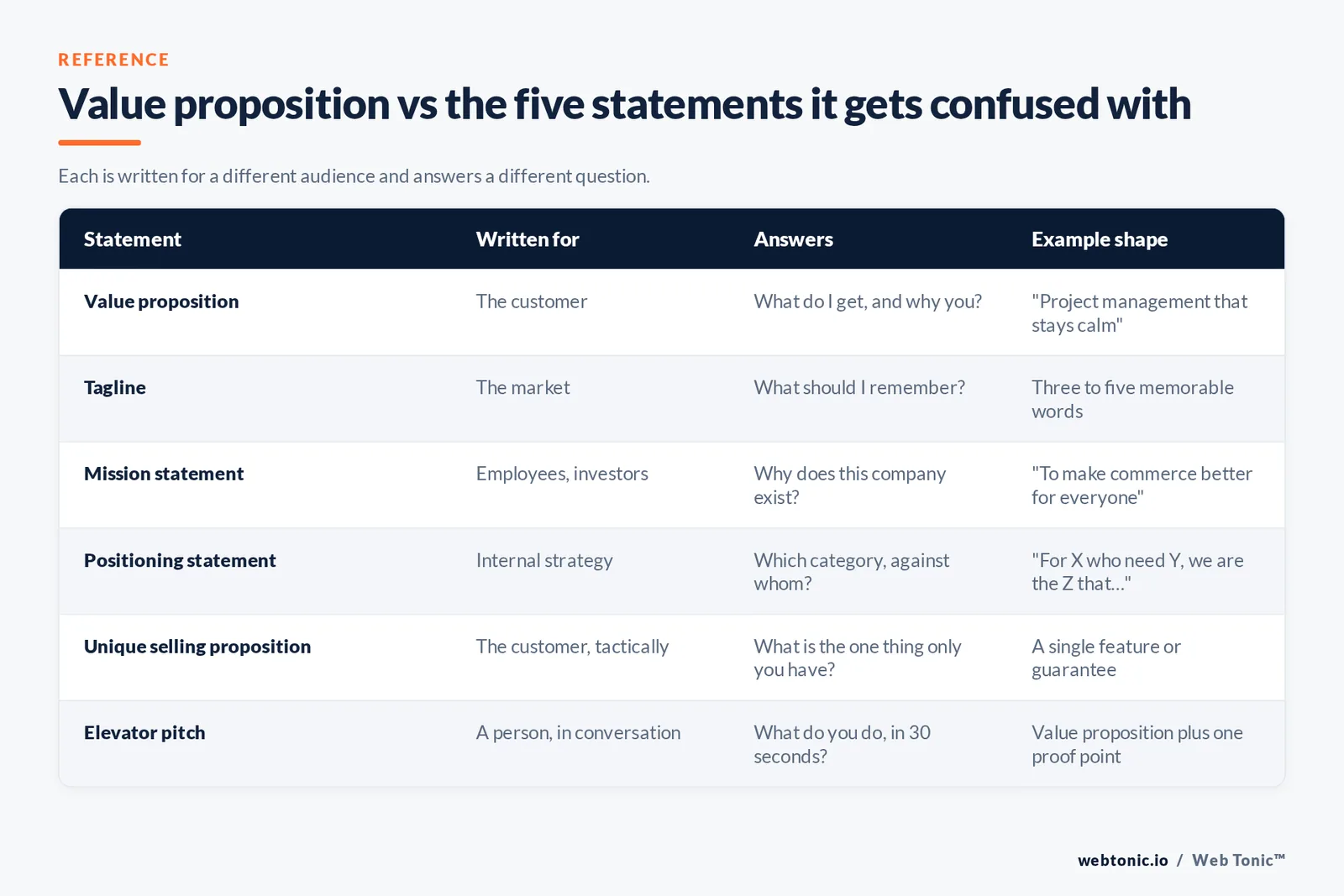
The confusion that costs the most is mixing the value proposition up with adjacent statements. 5 statements get confused with each other constantly — tagline, mission, positioning, USP and elevator pitch — and each has a different audience and a different job.
| Statement | Written for | Answers | Example shape |
|---|---|---|---|
| Value proposition | The customer | What do I get and why you? | "Project management that stays calm and organised" |
| Tagline | The market | What should I remember? | Three to five memorable words |
| Mission statement | Employees and investors | Why does this company exist? | "To make commerce better for everyone" |
| Positioning statement | Internal strategy and marketing | Which category do we own, against whom? | "For X who need Y, we are the Z that…" |
| Unique selling proposition | The customer, tactically | What is the one thing only you have? | A single differentiating feature or guarantee |
| Elevator pitch | A person in conversation | What do you do, in 30 seconds? | Value proposition plus one proof point |
22 value proposition examples, grouped by pattern
The wording below is drawn from each company's live homepage headline or meta description, checked in August 2026. Read them as pattern illustrations rather than permanent copy: strong companies rewrite these statements as their market shifts, and several of the 22 have changed twice in 3 years.
Pattern 1 — Outcome first
| Company | Value proposition as expressed | Why it works |
|---|---|---|
| Stripe | "Financial infrastructure to grow your revenue" | Names the business outcome, not the payment feature |
| Notion | "The AI workspace where teams get more done, faster" | Outcome plus a speed qualifier in nine words |
| HubSpot | "All the marketing, sales, customer service and CRM software you need to grow" | Scope plus the outcome the buyer is measured on |
| Mailchimp | "Convert more customers with real-time behaviour data and AI" | Mechanism attached directly to the result |
Pattern 2 — Simplicity and calm
| Company | Value proposition as expressed | Why it works |
|---|---|---|
| Basecamp | "The refreshingly straightforward project management system that's rock-solid and easy to use" | Attacks the pain point of bloated competitors head-on |
| Dropbox | "Find, organise and share your work, all in one place" | Three verbs the customer already uses for the job |
| Slack | "All your people and AI agents working together" | One picture of the end state, no feature list |
| Zoom | "One platform to connect" | Four words; consolidation and outcome at once |
Pattern 3 — Consolidation ("everything in one place")
| Company | Value proposition as expressed | Why it works |
|---|---|---|
| Shopify | "The all-in-one commerce platform for businesses" | Removes the cost of stitching tools together |
| Figma | "The canvas where design, code and AI come together" | Names the three audiences it unifies |
| Airbnb | "An Airbnb for every kind of trip — 8 million vacation rentals, 220+ countries" | Breadth proven with verifiable numbers |
| Zapier-style integrators | "Automate the busywork between your apps" | Frames the product as the removal of a chore |
Pattern 4 — Speed and time saved
| Category | Value proposition shape | Why it works |
|---|---|---|
| Meal kit service | "Dinner on the table in 20 minutes, no planning" | Quantified time saving beats "convenient" |
| Same-day courier | "Booked in 60 seconds, delivered by 6pm" | Two numbers, both checkable |
| Tax software | "File in under an hour, guaranteed accurate" | Time plus risk removal in one line |
| Emergency plumber | "On site within 90 minutes, 7 days a week" | The only thing the buyer cares about at 2am |
Pattern 5 — Risk removal and peace of mind
| Category | Value proposition shape | Why it works |
|---|---|---|
| B2B services | "Fixed monthly fee, cancel any month, you own the accounts" | Removes the three fears buyers actually have |
| Home warranty | "If it breaks, we replace it. No excess." | Peace of mind stated as a rule, not an adjective |
| Insurance | "Claims paid in 3 days or we pay you extra" | Converts a promise into a penalty on the seller |
| Ecommerce returns | "365-day free returns, no questions" | Reduces the perceived cost of being wrong |
Pattern 6 — Identity and audience naming
| Category | Value proposition shape | Why it works |
|---|---|---|
| Bookkeeping for trades | "Bookkeeping built for electricians, not for accountants" | Names the buyer and the enemy in one line |
| Fitness app | "Strength training for people who hate gyms" | Self-selection filter doubles as a promise |
| Agency positioning | "Performance marketing for ecommerce brands past $1M" | A revenue qualifier repels bad-fit leads |
| Recruiting platform | "Hiring for teams without a recruiter" | Describes the situation, not the software |
| Legal service | "Contracts for founders, reviewed in 48 hours" | Audience plus a service-level promise |
| Local clinic | "Evening dentistry for people who work 9 to 5" | Solves a scheduling pain the category ignores |
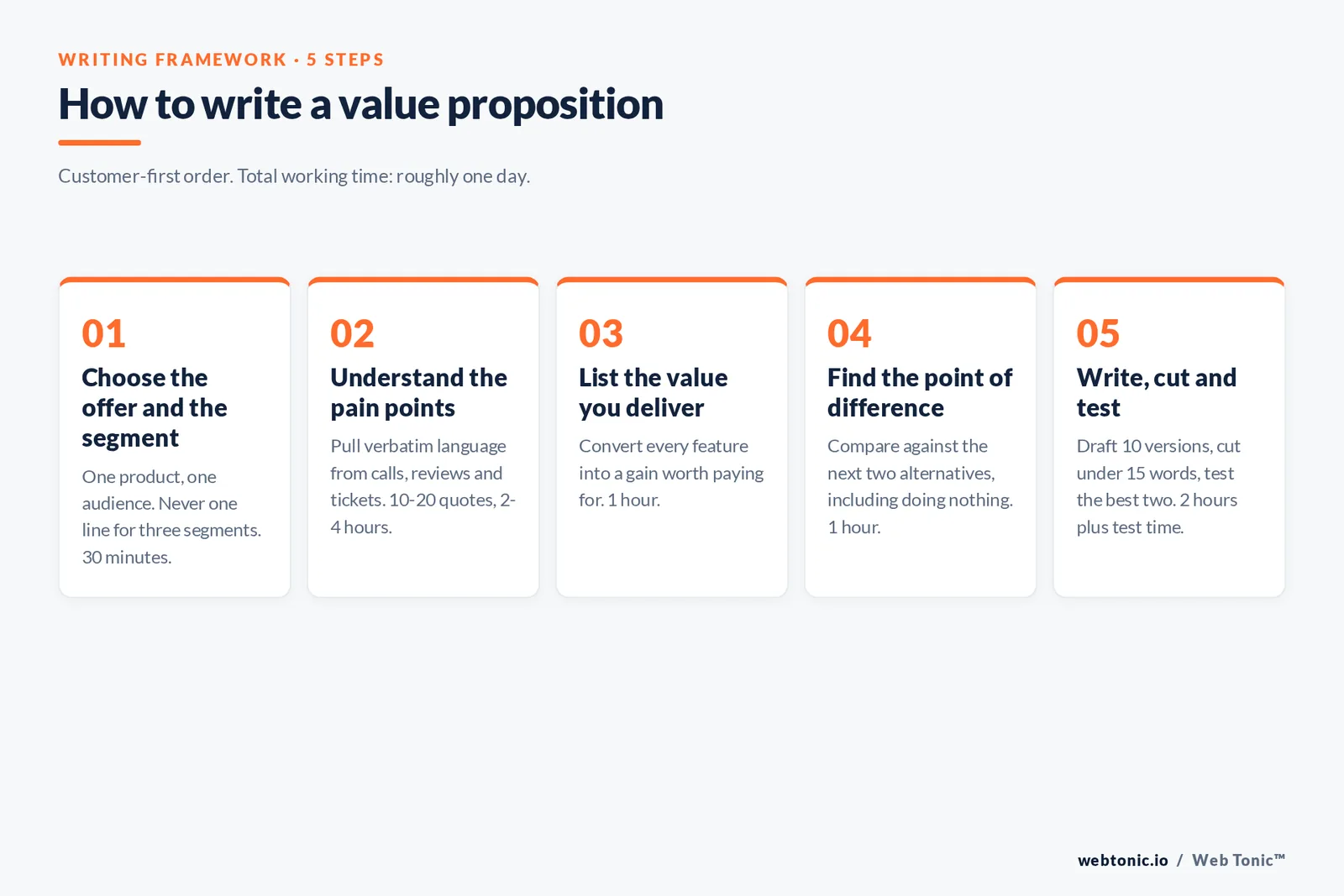
How to write a value proposition in 5 steps
The process below is deliberately customer-first. Nearly every weak value proposition comes from starting with the product sheet instead of the pain points, and Step 2 of 5 below is where most teams cut corners, and that inversion is what the Value Proposition Canvas was designed to prevent. The strategy side of the same question — where value is created and captured — traces back to the value chain work published by Harvard Business School's Institute for Strategy and Competitiveness.
| Step | What you do | Output | Time |
|---|---|---|---|
| Step 1 — Choose the product or service and the segment | One offer, one audience. Never write one line for three segments. | A named target customer | 30 minutes |
| Step 2 — Understand the pain points | Pull the exact language from sales calls, reviews and support tickets | 10 to 20 verbatim pain quotes | 2 to 4 hours |
| Step 3 — List the value you deliver | Convert each feature into a gain the customer would pay for | A feature-to-benefit table | 1 hour |
| Step 4 — Find the point of difference | Compare against the next two alternatives, including "do nothing" | One claim only you can make | 1 hour |
| Step 5 — Write, cut and test | Draft 10 versions, cut to under 15 words, test the two best | Headline plus support line and CTA | 2 hours plus test time |
Formulas that reliably produce a first draft
Formulas are scaffolding, not final copy — but they get you past the blank page, and they force the 3 required parts to appear. Write 4 drafts using four different formulas, then throw away three.
| Formula | Structure | Worked example |
|---|---|---|
| Steve Blank's XYZ | We help X do Y by doing Z | "We help clinics fill empty slots by texting waitlisted patients automatically" |
| The positioning template | For [segment] who [need], we are the [category] that [difference] | "For ecommerce brands past $1M, we are the growth team that owns profit, not clicks" |
| Outcome plus timeframe | [Result] in [time], without [pain] | "A live store in 14 days, without hiring a developer" |
| Job-to-be-done | The [category] for [situation] | "The CRM for teams that sell over the phone" |
| Contrast | [Benefit], not [category cliche] | "Reporting people actually read, not a 40-tab spreadsheet" |
| Proof-led | [Number] [customers] [result] | "1,200 clinics booked 38% more appointments last year" |
Where the value proposition goes, and what changes by placement
The same core statement gets compressed or expanded depending on the surface. A homepage hero has room for a headline plus a support line; a paid search ad headline has 30 characters; a cold email subject has fewer than 50. Consistency across all 7 surfaces below is what makes a brand feel coherent, and inconsistency is one of the most common causes of a high-bounce landing page.
| Placement | Length budget | What to include | Common mistake |
|---|---|---|---|
| Homepage hero | 8 to 15 words plus a 25-word support line | Outcome, audience, one proof point, CTA | Clever wordplay nobody decodes |
| Landing page | Same headline, matched to the ad | The exact promise the ad made | Message mismatch with the ad |
| Paid search ad | 30 characters per headline | The single strongest benefit | Brand name in every headline slot |
| Social bio | Under 150 characters | Audience plus outcome | Internal jargon and emoji filler |
| Sales deck slide 2 | One sentence | The customer's words, not yours | Company history first |
| Cold email subject | Under 50 characters | A specific, checkable claim | Vague curiosity hooks |
| Pricing page header | One line | What every plan guarantees | Repeating the homepage verbatim |
How to test whether it works
A value proposition is a hypothesis and should be treated like one. 6 tests cover it, and only 2 of them need traffic. Test it on real traffic rather than in a meeting: run two headlines against each other on the same landing page, and judge on qualified conversions rather than clicks. Conversion-focused write-ups from CXL and Crazy Egg both land on the same conclusion: clarity beats cleverness in almost every documented test, and Shopify's guide makes the same point for ecommerce stores.
Layer in qualitative checks too. A 5-second test across 10 to 20 people tells you whether the statement is legible; a survey question ("what do you think we sell?") tells you whether it is understood; measures like customer satisfaction tracking tell you whether the promise survives delivery. Shifting consumer expectations across 2 major annual studies, tracked in Think with Google's consumer trends and Salesforce's connected customer research, are the reason the statement needs revisiting yearly rather than once.
| Test | Method | Sample needed | What it tells you |
|---|---|---|---|
| 5-second test | Show the hero for 5 seconds, ask what we sell | 10 to 20 people | Legibility and clarity |
| Headline A/B test | Two headlines, one page, equal traffic split | 200+ conversions per variant | Which promise sells |
| Sales call listen-back | Count how often prospects repeat your line | 10 calls | Whether it is memorable |
| Survey on exit | "What were you hoping to find?" | 50 responses | Mismatch between promise and intent |
| Paid search test | Run the line as an ad headline | 1,000 impressions | Click-through as a proxy for appeal |
| Churn interview | Ask leavers what they expected | 10 interviews | Whether the promise was overstated |
Eight traps that weaken a value proposition
| Trap | Symptom | Fix |
|---|---|---|
| Trap 1: writing for everyone | "Solutions for businesses of all sizes" | Pick one segment per page |
| Trap 2: unverifiable superlatives | "World's best", "leading provider" | Replace with a number you can prove |
| Trap 3: feature dumping | Six features in the headline | One outcome above, features below |
| Trap 4: internal jargon | "Synergistic omnichannel enablement" | Use the customer's own words |
| Trap 5: no differentiator | A competitor could paste it on their site | Add the claim only you can make |
| Trap 6: mission masquerading as value | "Empowering people everywhere" | Move it to the About page |
| Trap 7: ad-to-page mismatch | Ad promises price, page talks quality | Mirror the ad headline exactly |
| Trap 8: set and forget | Copy untouched for 4 years | Review annually against competitors |
If you want the statement pressure-tested against live data rather than opinion, that is the work our growth marketing and performance creative teams do before any campaign spend, and the web development team implements the winning version across the site. Related reading sits in the Web Tonic blog.
FAQ
What is a good example of a value proposition?
Basecamp's "the refreshingly straightforward project management system that's rock-solid and easy to use" is a strong example because it names the category, the differentiator (straightforward, easy) and the implicit enemy (bloated competitors) in one sentence. A good value proposition can be understood by someone outside your industry in under five seconds.
How long should a value proposition be?
Aim for a headline of 8 to 15 words with a supporting sentence of 20 to 30 words beneath it. Anything longer stops being a value proposition and becomes a paragraph of positioning. Compressed versions for ads and bios should keep the same promise in fewer words rather than switching to a different claim.
What is the difference between a value proposition and a USP?
A value proposition covers the whole bundle of value a customer receives, including outcomes, experience and risk reduction. A unique selling proposition isolates the single feature or guarantee that only you offer. The USP is usually a component you can use inside the broader value proposition, not a replacement for it.
How do I write a value proposition for a service business?
Start with the pain points you hear on sales calls, then state the outcome plus a service-level promise, since service buyers are mostly buying reliability. "Contracts for founders, reviewed in 48 hours" works because it names the audience, the deliverable and the speed. Avoid describing your process; buyers care about the result.
How often should a value proposition be updated?
Review it annually, and immediately after any change to your pricing, target segment or competitive set. Live examples from major companies change every 18 to 36 months as their category shifts. If your homepage headline has been untouched for four years while your customers have changed, it is almost certainly under-selling you.
Sources: Optimizely optimisation glossary, value proposition · Harvard Business Review, "Customer Value Propositions in Business Markets" (2006) · Harvard Business School Institute for Strategy and Competitiveness, the value chain · Strategyzer, the Value Proposition Canvas · CXL and Crazy Egg value proposition analyses · Shopify value proposition guide · Qualtrics customer satisfaction methodology · Think with Google consumer trends · Salesforce State of the Connected Customer · Live homepage headlines and meta descriptions for Slack, Basecamp, Stripe, Notion, Mailchimp, Shopify, Dropbox, Figma, Zoom, HubSpot and Airbnb, all checked August 2026.