Table of contents
A headline has one job: make the next line worth reading. Below are 60 headline examples across articles, landing pages, email, ads, news and LinkedIn profiles, each paired with the formula it came from so you can rebuild it for your own topic.
Key Takeaways
- Nielsen Norman Group research found 79% of users scan a new page and only 16% read word by word.
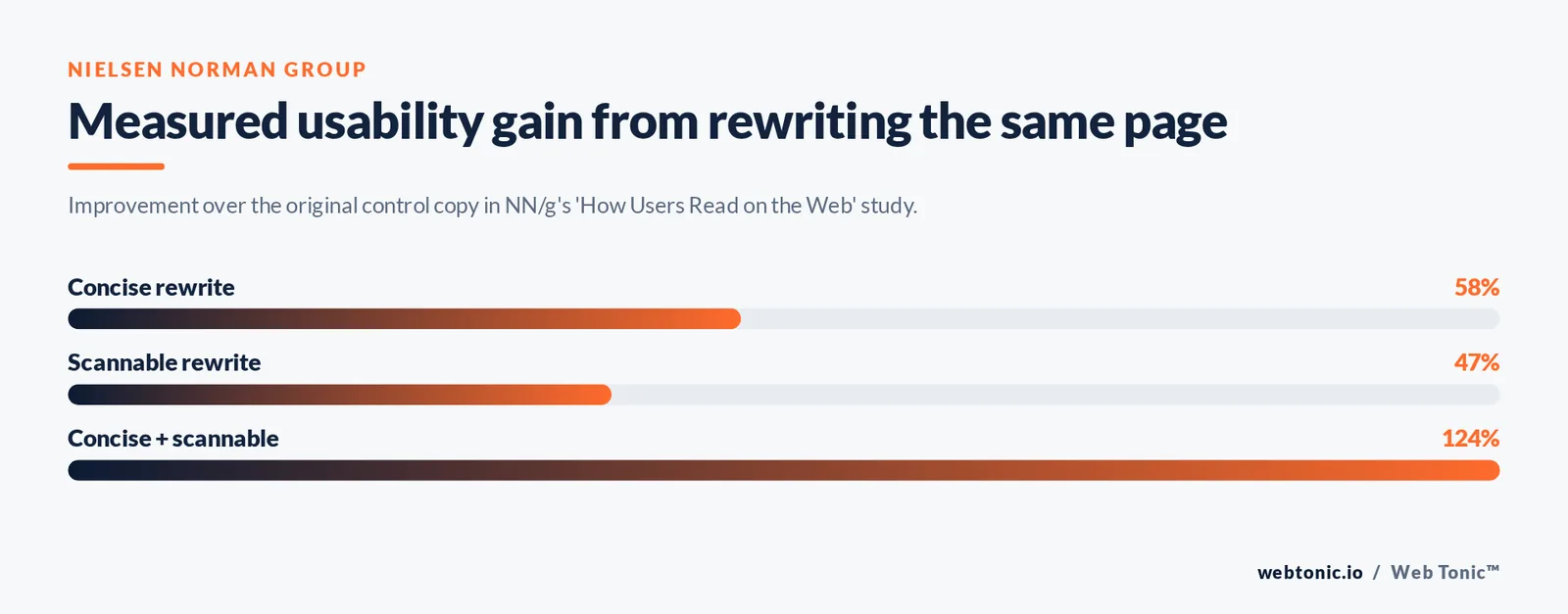
- Rewriting the same page to be concise and scannable improved measured usability by 124%.
- 12 reusable headline formulas cover almost every article, ad and social post you will write.
- Google places no character limit on a title element but truncates the display, so front-load the first 60 characters.
- Responsive search ads allow 15 headlines of 30 characters each — a live headline testing lab most marketers ignore.
- The average blog post now runs 1,333 words and takes about 3.5 hours to produce, so the headline is the cheapest lever you have.
What separates a working headline from a wasted one
Every effective headline does four things at once: it names the reader, promises a specific outcome, signals the format, and sets an honest expectation of effort. Drop the specificity and you get a vague headline nobody clicks. Drop the honesty and you get a click followed by an immediate bounce, which is worse than no click.
The scanning research is the practical reason. Jakob Nielsen's team found that 79% of test users always scanned a new page while just 16% read word by word, and that a concise rewrite improved usability 58%, a scannable rewrite 47%, and both combined 124%. Readers meet your headline in scan mode, so the first three words carry most of the weight.
12 headline formulas with worked examples
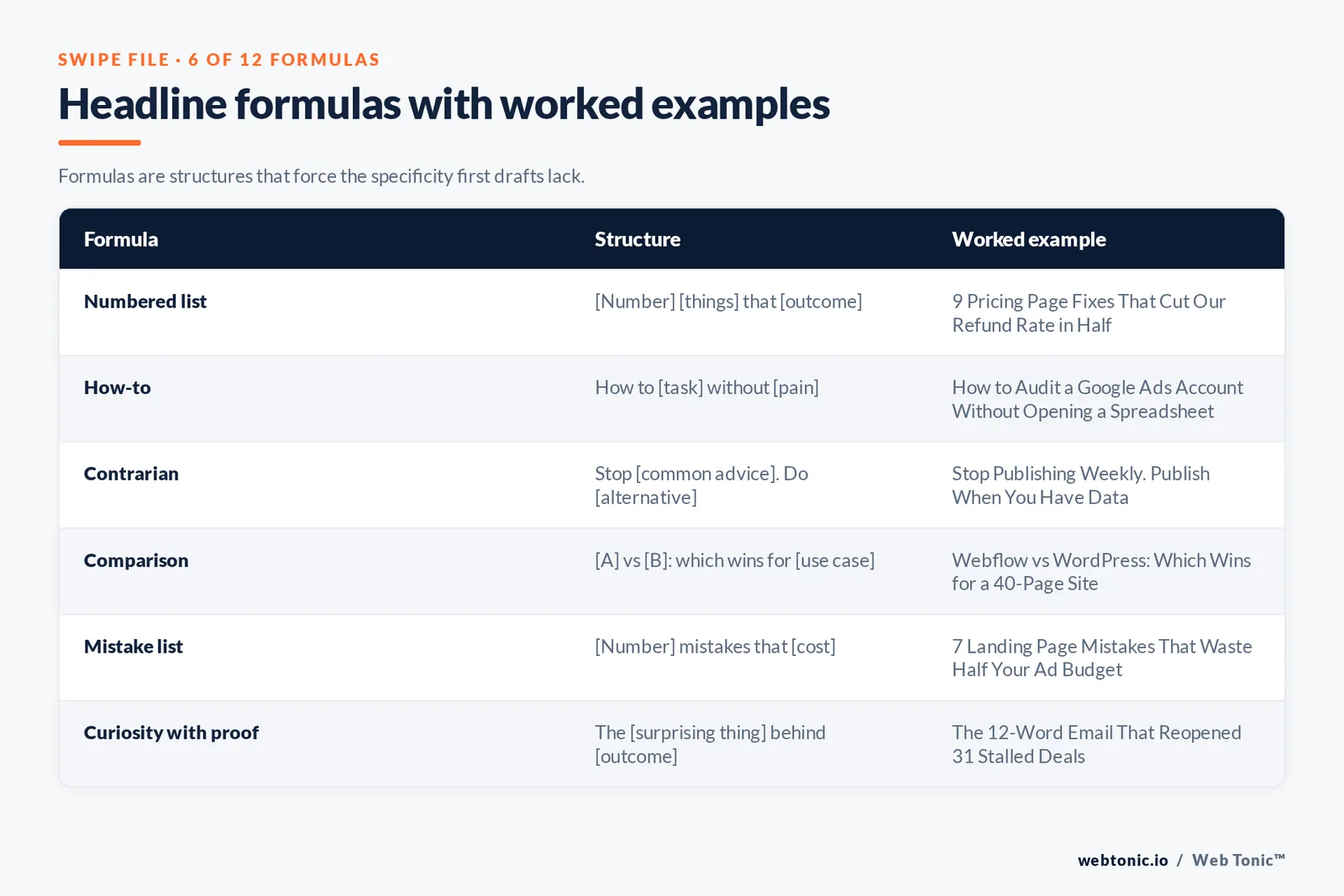
Formulas are not templates to publish verbatim — they are structures that force the specificity most first drafts lack. Fill each one with your own number, audience and outcome.
| Formula | Structure | Worked headline example | Best used for |
|---|---|---|---|
| 1. Numbered list | [Number] [things] that [outcome] | 9 Pricing Page Fixes That Cut Our Refund Rate in Half | Blog posts, roundups, quick-win content |
| 2. How-to | How to [task] without [pain] | How to Audit a Google Ads Account Without Opening a Spreadsheet | Tutorials, documentation, video titles |
| 3. Question | Why does [problem] happen? | Why Do Good Ads Stop Working After Three Weeks? | Search-intent articles, newsletters |
| 4. Direct promise | Get [outcome] in [timeframe] | Get a Full Content Calendar Built in One Afternoon | Landing pages, lead magnets |
| 5. Contrarian | Stop [common advice]. Do [alternative] | Stop Publishing Weekly. Publish When You Have Data | Opinion posts, LinkedIn, PR pitches |
| 6. Comparison | [A] vs [B]: which wins for [use case] | Webflow vs WordPress: Which Wins for a 40-Page Site | Consideration-stage articles |
| 7. Case study | How [subject] achieved [result] | How a 6-Person Team Doubled Demo Requests in 90 Days | Proof content, sales collateral |
| 8. Mistake list | [Number] mistakes that [cost] | 7 Landing Page Mistakes That Waste Half Your Ad Budget | Diagnostic articles, audits |
| 9. Definition | What is [term]? [Clarifier] | What Is Incrementality Testing? A Plain-English Walkthrough | Glossary and top-of-funnel search |
| 10. Curiosity with proof | The [surprising thing] behind [known outcome] | The 12-Word Email That Reopened 31 Stalled Deals | Newsletters, social posts |
| 11. Audience call-out | For [audience] who [situation] | For Founders Who Just Fired Their Agency | Ads, landing pages, cold outreach |
| 12. Deadline or news | [Change] takes effect [date] — what to do | Consent Mode Rules Change in October — What to Fix First | News headlines, alerts, email subject lines |
Copyblogger's long-running argument for writing the headline first still holds: if you cannot make a promise specific enough to survive one line of text, the article underneath is not focused enough either. Write 10 headlines before you write the piece, then keep the one that survives a read-aloud test.
Headline examples by content type
The same idea needs different phrasing on a search results page, in an inbox and in a feed. This table gives one example per surface, plus the constraint that shapes it.
| Where it appears | Practical length | Headline example | What changes on this surface |
|---|---|---|---|
| Blog article H1 | 45–70 characters | Headline Examples: 60 Openers and the Formulas Behind Them | Can be longer than the search title; must match the promise exactly |
| SEO title tag | Front-load 60 characters | 60 Headline Examples (With Formulas You Can Reuse) | Display is truncated, and search engines may rewrite a weak title |
| Landing page hero | 6–12 words | Ad Copy That Survives Contact With Real Buyers | Must state the offer, not the category |
| Email subject line | 30–50 characters | Your Q3 headline test results (2 winners) | Mobile inboxes cut long lines; the preview text is part of the headline |
| Search ad headline | 30 characters, up to 15 assets | Free Google Ads Audit in 48h | Assets are recombined, so every headline must stand alone |
| Social post hook | First 2 lines before "more" | We killed our best-performing ad on purpose. Here is why. | Truncation point is the headline boundary |
| LinkedIn profile headline | Front-load 60–90 characters | Performance Marketer · I fix $50k/month ad accounts for DTC brands | Follows your name everywhere on the platform, so it must work out of context |
| News headline | 6–10 words, present tense | Regulator Fines Retailer Over Automated Pricing Claims | Accuracy outranks cleverness; house style rules apply |
| Press release | One line plus a subhead | Web Tonic Opens Its Dubai Studio to Regional Clients | Must be quotable verbatim by a journalist |
| Video title | 40–60 characters | Rebuilding a Broken Google Ads Account (Live) | Competes with a thumbnail, so avoid duplicating its text |
| Webinar or event | 8–14 words | Creative Testing for Small Budgets: A 45-Minute Working Session | Must signal the time commitment |
| Case study title | Result plus constraint | 3x Qualified Leads on the Same Media Budget | Numbers must be defensible in a sales call |
On the search side, Google's documentation is explicit that there is no hard limit on the length of a title element but that the displayed title link is truncated, and that vague titles like "Home" invite a rewrite. Moz's title tag guide and Backlinko's on-page reference both land on the same practical rule: put the distinguishing words first and keep the important part inside roughly 60 characters.
LinkedIn profile headline examples
A LinkedIn profile headline is the only headline you write that travels with your name into every search result, comment and invitation. "Marketing Manager at Company" wastes it. Pair the role with the outcome you deliver and the audience you serve.
| Role | Weak version | Stronger LinkedIn headline example |
|---|---|---|
| Performance marketer | Digital Marketing Specialist | Paid Search & Social · I rebuild ad accounts that plateaued past $30k/month |
| SEO lead | SEO Expert | Google Certified | Technical SEO for ecommerce · 400-page migrations without traffic loss |
| Founder | CEO & Founder | Founder, Web Tonic · Growth marketing for brands with 1 in-house marketer |
| Job seeker | Looking for opportunities | Content strategist (open to work) · 3 years scaling B2B blogs to 100k sessions |
| Freelancer | Freelance Copywriter | Conversion copywriter for SaaS pricing and onboarding pages |
| Analyst | Data Analyst at Company | Marketing analytics · I turn 6 disconnected dashboards into 1 decision |
| Student | Student at University | Marketing student · 2 live client projects, 1 published research piece |
Two mechanics matter. First, only the opening stretch is visible in search listings and mobile previews, so the differentiator belongs at the front. Second, the words people actually type to find someone in your field need to appear literally — recruiters search the way LinkedIn's own talent resources describe, using role language rather than clever labels.
Headline examples by industry
Specificity is industry-dependent: the number that makes a headline credible in ecommerce is meaningless in professional services. Use this as a starting bank and swap in your own figures.
| Industry | Article headline example | Landing page headline example |
|---|---|---|
| Ecommerce | 11 Product Page Details That Reduce Returns | Ship Faster Than Your Category Average |
| SaaS | Why Free Trials Convert Better on Day 4 Than Day 1 | Onboarding That Gets Teams Live in 20 Minutes |
| Professional services | What a Fair Retainer Looks Like in 2026 | Senior Strategists, No Account Managers |
| Healthcare | 6 Questions to Ask Before Any Elective Procedure | Same-Week Appointments, No Referral Needed |
| Legal | What Happens in the First 30 Days of a Claim | No Fee Until Your Case Settles |
| Real estate | The 5 Costs Buyers Forget in Their First Offer | See Every Listing 48 Hours Before Portals Do |
| Home services | How to Tell a Roof Repair From a Roof Replacement | Fixed-Price Quotes, Given On Site |
| Education | 8 Study Habits That Beat Rereading Notes | Finish the Certificate in 12 Weeks |
| Finance | The 3 Fees That Quietly Eat a Small Portfolio | One Statement for All 9 Accounts |
| Hospitality | Where Locals Actually Eat in Old Dubai | Late Checkout Included, Every Booking |
| Manufacturing | How to Cut 4 Days From a Quoting Process | Sample Parts in 10 Working Days |
| Nonprofit | What $25 Covers, Line by Line | 92 Cents of Every Dollar Reaches the Field |
Headline ideas by goal: traffic, trust or reply
Compelling headlines are not interchangeable. A headline written to win website traffic from search reads differently from one written to earn a reply, and treating them as the same asset is the most common reason a strong post underperforms. Match the headline idea to the single job the page has.
| Goal | Headline idea that fits | Example | Signal to include |
|---|---|---|---|
| Search traffic | Match the phrase readers type, then add the format | Headline Writing Tips: 12 Formulas With Examples | The exact query plus a count |
| Repeat readers | Serial framing that promises continuity | Teardown 14: A Landing Page That Converts at 9% | A number that grows each issue |
| Trust with buyers | Name the constraint you worked inside | 3x Qualified Leads on a Flat $8k Budget | A verifiable result |
| Replies and DMs | Ask the question your reader argues about | Is Weekly Publishing Actually Hurting Your Blog? | A real disagreement, not a fake one |
| Press pickup | Lead with the news, keep it quotable | Retail Ad Spend Falls 6% for the First Time Since 2020 | A dated, sourced figure |
| Internal buy-in | State the decision, not the analysis | Cut 4 Channels, Fund 2: Q3 Media Plan | The recommendation up front |
News headlines sit at one extreme of this range. Desks working to house style strip every eye-catching flourish because accuracy is the product, and journalism institutes such as Poynter publish exactly why hedged, precise wording survives scrutiny while clever wording does not. Marketing headlines can carry more personality, but they inherit the same rule: the words people read first must be true.
Three writing tips carry across every surface. Put the reader's noun in the first 3 words, because scanners never reach word 12. Keep one idea per line, since compound headlines split attention. And write the headline before the article, so the promise shapes the content rather than the reverse — a habit worth roughly 15 minutes against the 3.5 hours the average post already consumes.
How to write and test headlines: seven steps
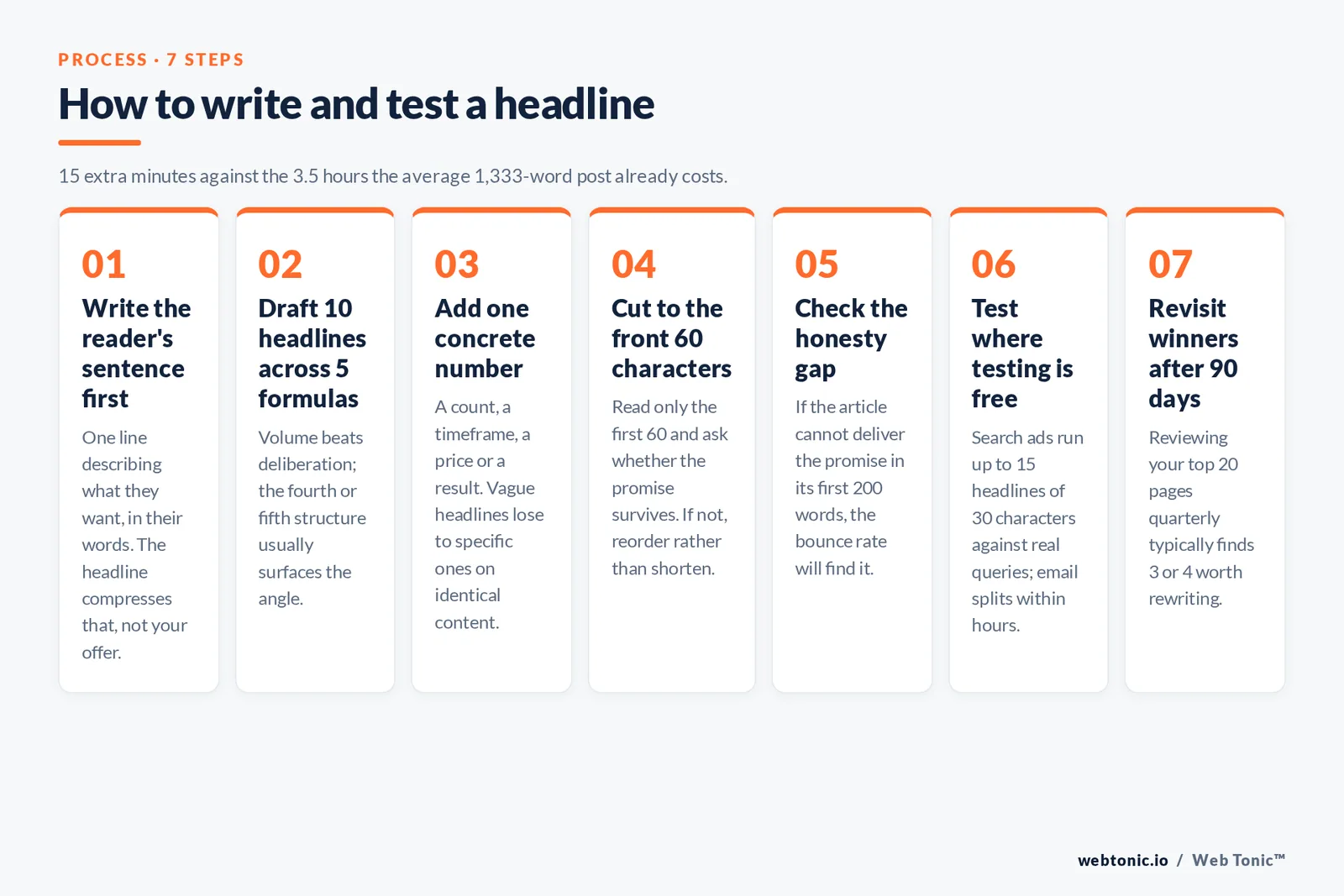
Step 1 — write the reader's sentence first. One line describing what they want, in their words. The headline is a compression of that sentence, not of your offer.
Step 2 — draft 10 headlines using 5 different formulas. Volume beats deliberation here; the fourth or fifth structure usually surfaces the angle.
Step 3 — add one concrete number. A count, a timeframe, a price or a result. Vague headlines lose to specific ones on identical content.
Step 4 — cut to the front 60 characters. Read only the first 60 and ask whether the promise survives. If not, reorder rather than shorten.
Step 5 — check the honesty gap. If the article cannot deliver the headline's promise in its first 200 words, you have a clickbait problem the bounce rate will find.
Step 6 — test where testing is free. Search ads let you run up to 15 headlines of 30 characters against real queries, and email gives you a subject-line split within hours. Litmus's testing guidance is a useful sanity check on inbox rendering before you send.
Step 7 — revisit winners after 90 days. Headlines decay as the market's vocabulary shifts. Reviewing your top 20 pages quarterly typically finds 3 or 4 worth rewriting.
Given that the average post now runs 1,333 words and takes roughly 3.5 hours to write according to Orbit Media's survey of 808 bloggers, spending 15 extra minutes on the headline is the highest-leverage step in the whole workflow. Our growth marketing and performance creative teams treat headline sets as a deliverable in their own right for exactly that reason.
Five headline mistakes to stop repeating
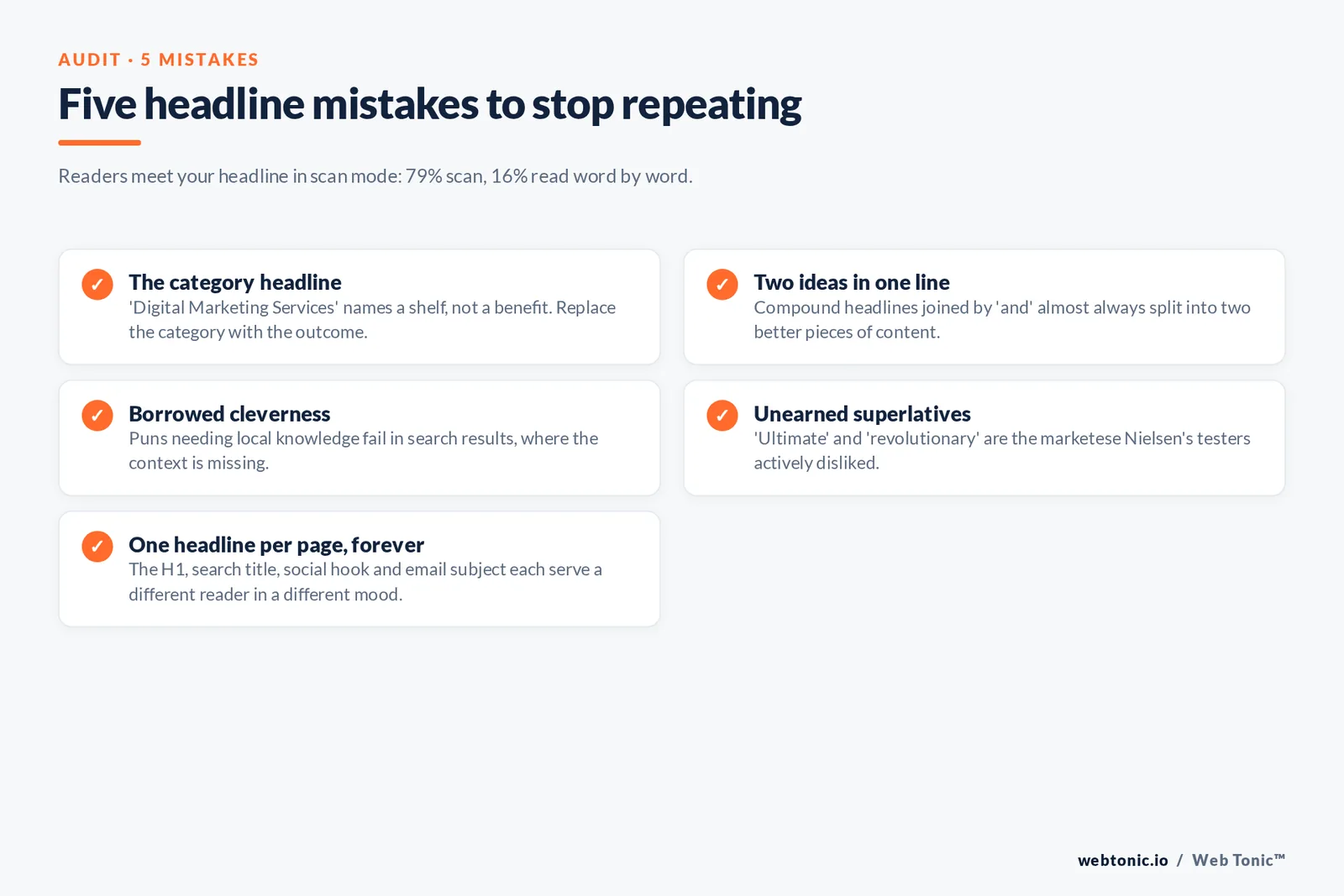
Mistake 1 — the category headline. "Digital Marketing Services" names a shelf, not a benefit. Replace the category with the outcome.
Mistake 2 — 2 ideas in 1 line. Compound headlines joined by "and" almost always split into two better pieces of content.
Mistake 3 — borrowed cleverness. Puns that require local knowledge fail in search results, where context is missing. News desks working to AP style default to clarity for the same reason.
Mistake 4 — unearned superlatives. "Ultimate", "best ever" and "revolutionary" are the marketese Nielsen's testers actively disliked, and they push credibility down rather than up.
Mistake 5 — one headline per page, forever. Write a variant set: the H1, the search title, the social hook and the email subject line each serve a different reader in a different mood. Sprout Social's copywriting guidance and the Content Marketing Institute library both treat this as standard practice.
If you want a second opinion on a set of headlines before they ship, send them over — and browse the Web Tonic blog for the formats these formulas were tested on.
FAQ
What are some good headline examples for articles?
Strong article headlines pair a number with a specific outcome: "9 Pricing Page Fixes That Cut Our Refund Rate in Half", "How to Audit a Google Ads Account Without Opening a Spreadsheet", "Why Do Good Ads Stop Working After Three Weeks?" and "7 Landing Page Mistakes That Waste Half Your Ad Budget". Each names the reader's situation, promises a defined result, and signals the format so nobody clicks expecting something else.
How long should a headline be?
For on-page headlines, 45 to 70 characters reads comfortably. For search titles, Google states there is no character limit on the title element itself but the displayed link is truncated, so keep the distinguishing words within roughly the first 60 characters. Email subject lines work best at 30 to 50 characters because mobile inboxes cut long lines, and search ad headlines are capped at 30 characters per asset.
What should my LinkedIn profile headline say?
Use the pattern "specialism · outcome you deliver for a named audience" instead of "Job Title at Company". For example: "Technical SEO for ecommerce · 400-page migrations without traffic loss". Put the differentiator first because only the opening stretch shows in search results and mobile previews, and use the literal role words recruiters search for rather than invented titles like "growth ninja".
How many headlines should I write before choosing one?
Ten, spread across at least five different formulas — list, how-to, question, contrarian and case study. The first three drafts tend to restate the topic; the useful angle usually appears in draft four or later. Read the finalists aloud, then confirm the article can deliver the promise inside its first 200 words.
Are eye-catching headlines the same as clickbait?
No. An eye-catching headline makes a specific promise the content keeps; clickbait withholds the payoff to force the click. The difference shows up in behaviour rather than wording: clickbait earns the click and loses the session. Nielsen Norman Group's work found readers scan and distrust exaggeration, so overselling in the headline reduces credibility even when it briefly raises click-through.
Sources
Nielsen Norman Group, "How Users Read on the Web" (79% scanning, 58% concise, 47% scannable, 124% combined usability gains) · Google Search Central documentation on title links · Moz, title tag guide · Backlinko, on-page SEO guide · Google Ads Help, responsive search ads (15 headlines, 30 characters, 90-character descriptions) · Orbit Media Studios, 12th Annual Blogger Survey, 808 respondents, 2025 · Copyblogger, magnetic headlines resource · Litmus blog on email testing · Sprout Social, social media copywriting · LinkedIn Talent Blog · AP Stylebook · Content Marketing Institute article library. All sources accessed August 2026.