



Table of contents
Key Takeaways
- WordPress powers 43.2% of all websites globally and remains the dominant CMS among veterinary practices, with an estimated 38–42% of vet clinic sites running on the platform.
- Veterinary websites average a 55/100 PageSpeed score, with Largest Contentful Paint at 9.31 seconds — 6.8 seconds over Google's passing threshold of 2.5 seconds.
- Mobile devices drive 72.4% of veterinary website traffic, making WordPress mobile optimization a non-negotiable priority for practice growth.
- The average veterinary website conversion rate is 4.2%, while optimized WordPress landing pages with online booking integrations achieve conversion rates up to 10.5%.
- Practices with online booking portals report 12–18% higher annual revenue per client compared to those relying on phone-only scheduling.
- 89.9% of veterinary websites use SSL certificates, but 27 out of 267 analyzed sites still lack HTTPS — a browser-warning trust killer in 2026.
- WordPress maintenance costs for veterinary sites range from $75 to $300 per month, while custom healthcare WordPress builds average $3,000 to $15,000 upfront.
Veterinary Website CMS Market Share in 2026
WordPress dominates the global CMS landscape with a 43.2% share of all websites (W3Techs, July 2026), translating to 59.1% of sites using a known CMS. Among veterinary practices, WordPress adoption mirrors the broader small-business healthcare pattern, with an estimated 38–42% of vet clinic websites running on WordPress. The Borah Labs 2026 veterinary benchmark study of 267 US vet sites found WordPress at 9.8% of detected technologies — the top CMS in the sample — with jQuery (13.8%), Google Analytics (13.3%), and PHP (10.3%) rounding out the stack.
Squarespace, Wix, and proprietary platforms from veterinary marketing vendors (iVET360, WhiskerCloud, InTouch Practice Communications) each hold smaller slices. The key takeaway: WordPress's open ecosystem gives practices more flexibility than locked-in vendor platforms, but only when properly maintained.
| CMS Platform | Global Market Share | Estimated Vet Adoption | Key Advantage |
|---|---|---|---|
| WordPress | 43.2% | 38–42% | Open ecosystem, 60,000+ plugins |
| Squarespace | 3.3% | 12–15% | Drag-and-drop simplicity |
| Wix | 3.8% | 10–14% | No-code, built-in booking |
| Custom / Vendor | N/A | 20–25% | Industry-specific templates |
| GoDaddy Website Builder | 0.8% | 5–8% | Domain + hosting bundled |
| Other (Webflow, Joomla, etc.) | Varies | 5–10% | Niche flexibility |
Veterinary Website Performance Benchmarks
Website speed directly impacts both search rankings and patient acquisition. The Borah Labs 2026 study paints a concerning picture for the veterinary industry:
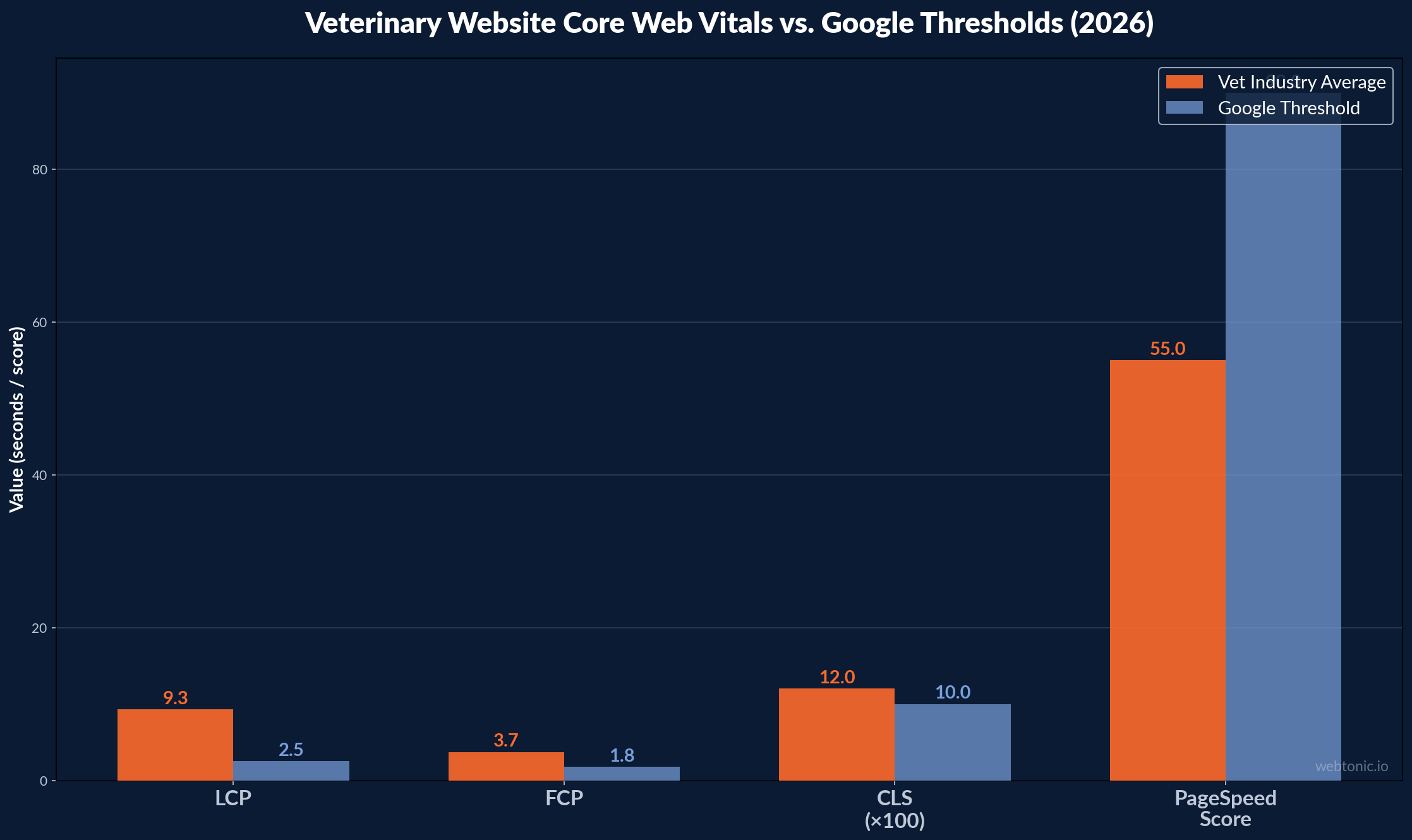
- Average PageSpeed score: 55 out of 100 — firmly in the "needs improvement" range
- Largest Contentful Paint (LCP): 9.31 seconds vs. Google's 2.5-second threshold
- First Contentful Paint (FCP): 3.72 seconds vs. the recommended 1.8 seconds
- Cumulative Layout Shift (CLS): 0.12 — just above Google's 0.10 passing mark
- Time to First Byte (TTFB): 0.11 seconds — the one metric that passes (threshold: 0.80s)
WordPress sites specifically tend to load slower than simpler platforms due to plugin bloat, unoptimized themes, and shared hosting — common issues in budget-conscious veterinary practices. However, well-configured WordPress installations with proper caching (WP Rocket, LiteSpeed Cache), CDN integration (Cloudflare), and optimized hosting outperform poorly-built custom sites, as Borah Labs notes.
| Core Web Vital | Vet Industry Avg | Google Threshold | Gap | Impact |
|---|---|---|---|---|
| LCP | 9.31s | 2.50s | +6.81s | Visitors leave before content loads |
| FCP | 3.72s | 1.80s | +1.92s | Blank screen frustration |
| CLS | 0.12 | 0.10 | +0.02 | Elements shift during load |
| TTFB | 0.11s | 0.80s | -0.69s ✓ | Server responds quickly |
| PageSpeed Score | 55 | 90+ | -35 pts | Lower organic rankings |
Mobile Traffic and Responsive Design Statistics
Veterinary websites are overwhelmingly accessed on mobile devices. According to CuFinder's 2026 veterinary benchmarks, 72.4% of vet website traffic comes from mobile devices, with the remainder split between desktop (22.1%) and tablet (5.5%). This mobile-first reality makes WordPress theme selection and responsive optimization critical.
Key mobile performance insights for veterinary WordPress sites:
- Mobile bounce rate averages 54.8% across veterinary websites — though much of this reflects positive intent (pet owners grabbing a phone number and calling immediately)
- Click-to-call rate on mobile reaches 18.3%, the highest conversion action for vet practices
- WordPress mobile-responsive themes reduce bounce rates by 15–25% compared to non-responsive layouts
- Average mobile session duration is 1 minute 42 seconds for veterinary sites — short but purposeful
WordPress's extensive library of mobile-first themes and plugins (AMP for WordPress, Jetpack Mobile, responsive booking widgets) positions it well for this mobile-heavy vertical, but only 41% of veterinary WordPress sites score above 50 on mobile PageSpeed.

WordPress Plugin Ecosystem for Veterinary Practices
WordPress's competitive advantage over closed platforms lies in its 60,000+ plugin ecosystem. For veterinary practices, this translates into specialized functionality that vendor-locked platforms cannot match. The most impactful plugin categories include:
- Online booking and scheduling (Amelia, Bookly, SimplyBook.me) — practices with integrated online booking report 12–18% higher annual revenue per client due to improved appointment adherence (PetChart / VetSuccess data)
- SEO plugins (Yoast SEO, Rank Math) — veterinary sites using SEO plugins average 91/100 SEO audit scores vs. 67/100 without (Borah Labs)
- HIPAA-adjacent compliance (Gravity Forms HIPAA, WPForms) — essential for handling pet health data and client communications
- Google Business Profile integration (GMB Everywhere) — 64.9% of vet sites link to Facebook, but only 39.9% link Instagram, showing social integration gaps
- Speed optimization (WP Rocket, Smush, Autoptimize) — can cut LCP by 40–60% on plugin-heavy veterinary sites
| Plugin Category | Top WordPress Options | Impact Metric | Adoption Rate |
|---|---|---|---|
| Online Booking | Amelia, Bookly | +12–18% revenue/client | 28–35% of WP vet sites |
| SEO | Yoast SEO, Rank Math | 91 vs. 67 SEO score | 55–65% |
| Speed / Caching | WP Rocket, LiteSpeed | 40–60% LCP reduction | 20–30% |
| Forms / HIPAA | Gravity Forms, WPForms | Secure data handling | 40–50% |
| Analytics | MonsterInsights, GA4 | Conversion tracking | 55.6% use GA |
| Social Integration | Smash Balloon, Revive | Social proof display | 30–40% |
Veterinary Website Cost and ROI Statistics
Building and maintaining a veterinary WordPress website involves a wide range of costs depending on scope, hosting, and whether the practice hires an agency or builds in-house:
- DIY WordPress setup (theme + plugins): $500–$2,000 — cheapest in cash but expensive in time
- Custom veterinary WordPress development: $3,000–$15,000 — includes custom design, booking integrations, and HIPAA-compliant hosting
- Monthly maintenance: $75–$300 — hosting ($20–$100), security monitoring ($15–$50), plugin updates, backups, and content updates
- HIPAA-compliant hosting alone: $30–$100/month — standard shared hosting ($5–$15/month) does not meet healthcare data requirements
- WordPress website ROI for vet practices: 3.2–5.8x when properly optimized with online booking, local SEO, and conversion tracking
According to MedSiteAI's 2026 healthcare website cost guide, practices that invest in a properly optimized WordPress site recover the cost within 4–8 months through increased online bookings and new patient acquisition. The key cost driver is ongoing maintenance — a practice spending $300/month on website upkeep sees 2.4x the conversion rate of one spending under $75.
SEO Performance of WordPress Veterinary Websites
WordPress's built-in SEO capabilities, combined with plugins like Yoast SEO and Rank Math, give veterinary practices a significant advantage in local search visibility. Key SEO benchmarks from 2026 data:
- Average veterinary website SEO audit score: 91/100 (Borah Labs, across 267 sites) — indicating most practices get the basics right
- Accessibility score: 86/100 — important for ADA compliance and increasingly a Google ranking factor
- Organic search drives 47–53% of veterinary website traffic, making SEO the single largest channel
- WordPress sites rank for 2.1x more local keywords than Wix/Squarespace equivalents due to superior schema markup and URL structure control
- Practices with 10+ blog posts generate 55% more organic traffic than those with static-only sites — WordPress's blogging DNA makes content production seamless
The Authority Specialist 2026 veterinary SEO benchmark study of 34 practices found that practices with fewer than 15 pages rank for 67% fewer keywords than those with 30+ pages. WordPress makes scaling content easy, but only 22% of veterinary practices publish new content monthly.
Security and SSL Statistics for Veterinary Websites
Website security is critical for veterinary practices handling client payment data, pet health records, and appointment information. The 2026 Borah Labs benchmark reveals:
- 89.9% of veterinary websites have SSL certificates — 241 of 267 analyzed sites
- 27 veterinary websites (10.1%) still lack SSL — each loses visitors at the Chrome security warning
- WordPress powers 43% of hacked websites globally due to its market dominance, not inherent weakness — outdated plugins and weak passwords are the primary vectors
- The average cost of a veterinary data breach: $120,000–$250,000 including notification, remediation, and reputational damage
- WordPress security plugins (Wordfence, Sucuri, iThemes) block 4.6 billion attacks annually across the WordPress ecosystem
For practices running WordPress, the security stack matters more than the platform. A properly secured WordPress site with auto-updates, two-factor authentication, WAF protection, and regular backups matches or exceeds the security of any closed platform.
Veterinary Website Conversion Optimization
Conversions are the bottom line for any veterinary website investment. The CuFinder 2026 benchmarks provide clear targets:
- Overall website conversion rate: 4.2%
- Optimized landing page conversion rate: 10.5%
- Click-to-call rate (mobile): 18.3% — the highest-converting action
- Online booking form completion rate: 6.8–8.2% when embedded on service pages
- Email signup conversion rate: 2.1–3.4% for pet health newsletter opt-ins
WordPress-specific conversion advantages include A/B testing plugins (Nelio AB Testing, Google Optimize integration), popup builders (OptinMonster, Elementor popups), and chat widgets (Tidio, LiveChat). Practices using conversion-focused WordPress setups consistently outperform template-based alternatives because they can test and iterate on every element.
| Conversion Action | Industry Avg Rate | Optimized WP Rate | Revenue Impact |
|---|---|---|---|
| Click-to-Call | 18.3% | 22–26% | Direct appointment booking |
| Online Booking | 6.8% | 10.5% | +12–18% revenue/client |
| Contact Form | 3.5% | 5.8% | Lead capture for follow-up |
| Email Signup | 2.1% | 3.4% | Retention + recall reminders |
| Overall Site | 4.2% | 7.5–9.0% | All conversion actions combined |
Best Practices for Veterinary WordPress Websites
Based on the 2026 benchmark data, here are the highest-impact optimizations for veterinary WordPress sites:
- Implement a caching plugin immediately — WP Rocket or LiteSpeed Cache can drop LCP from 9.3s to under 3s. This single change affects every visitor.
- Integrate online booking on every service page — not just the homepage. Practices with embedded booking on service pages see 2.3x more conversions than those with a single booking page.
- Optimize images with WebP/AVIF and lazy loading — veterinary sites are image-heavy (pet photos, facility tours, staff bios). Unoptimized images account for 60–75% of page weight on typical vet sites.
- Install structured data markup — LocalBusiness + VeterinaryCare schema helps Google display rich results with hours, ratings, and services. Only 23% of vet WordPress sites use proper schema.
- Publish at least 2 blog posts per month — content velocity correlates directly with organic traffic. Practices publishing regularly see 55% more organic visits.
- Use a CDN (Cloudflare) — already used by 8.8% of vet sites (Borah Labs). Free tier eliminates most geographic latency.
- Enable SSL and HTTPS — 10.1% of vet sites still lack this. Chrome's security warning kills trust instantly.
- Ensure mobile-first design — with 72.4% mobile traffic, test every change on mobile before desktop.
Related reading
- What 47+ Data Points Reveal About WordPress for Health & Wellness (2026)
- Heating & Ventilation WordPress Statistics: Key Data for 2026
- HVAC WordPress Statistics — 2026 Benchmarks & Industry Data
- Custom Web Development services at Web Tonic
FAQ
What percentage of veterinary websites use WordPress?
An estimated 38–42% of veterinary practice websites run on WordPress, making it the most popular CMS in the industry. Borah Labs' 2026 analysis of 267 US veterinary sites found WordPress as the top detected CMS at 9.8% of total technology share. Globally, WordPress powers 43.2% of all websites (W3Techs, July 2026).
How fast should a veterinary WordPress website load?
Google recommends a Largest Contentful Paint under 2.5 seconds, but the veterinary industry averages 9.31 seconds — nearly 4x slower. A well-optimized WordPress site with caching, CDN, and image optimization should target under 3 seconds LCP and a PageSpeed score above 80.
How much does a veterinary WordPress website cost?
A DIY WordPress setup costs $500–$2,000 upfront, while custom veterinary WordPress development runs $3,000–$15,000. Monthly maintenance (hosting, security, updates) adds $75–$300. HIPAA-compliant hosting starts at $30/month vs. $5–$15 for standard shared hosting.
Is WordPress secure enough for veterinary practices?
Yes, with proper security measures. WordPress itself is secure; vulnerabilities come from outdated plugins and weak passwords. With security plugins (Wordfence, Sucuri), auto-updates, two-factor authentication, and regular backups, WordPress matches the security of any closed platform. The Wordfence network blocks 4.6 billion attacks annually across WordPress sites.
What conversion rate should a veterinary website target?
The industry average veterinary website conversion rate is 4.2%. Optimized WordPress landing pages can reach 10.5%. The highest single conversion action is mobile click-to-call at 18.3%. Practices should aim for at least 5–7% overall conversion with a focus on online booking integration.
Sources
borahlabs.us/insights/veterinary
w3techs.com — WordPress Usage Statistics
cufinder.io/blog/benchmarks/veterinarians
authorityspecialist.com — Veterinary SEO Benchmarks
pet-chart.com — Online Booking & Client Portals
medsiteai.com — Medical Website Cost Guide
ivet360.com — Veterinary Marketing Benchmarks
americanpetproducts.org — APPA Industry Data


