



Table of contents

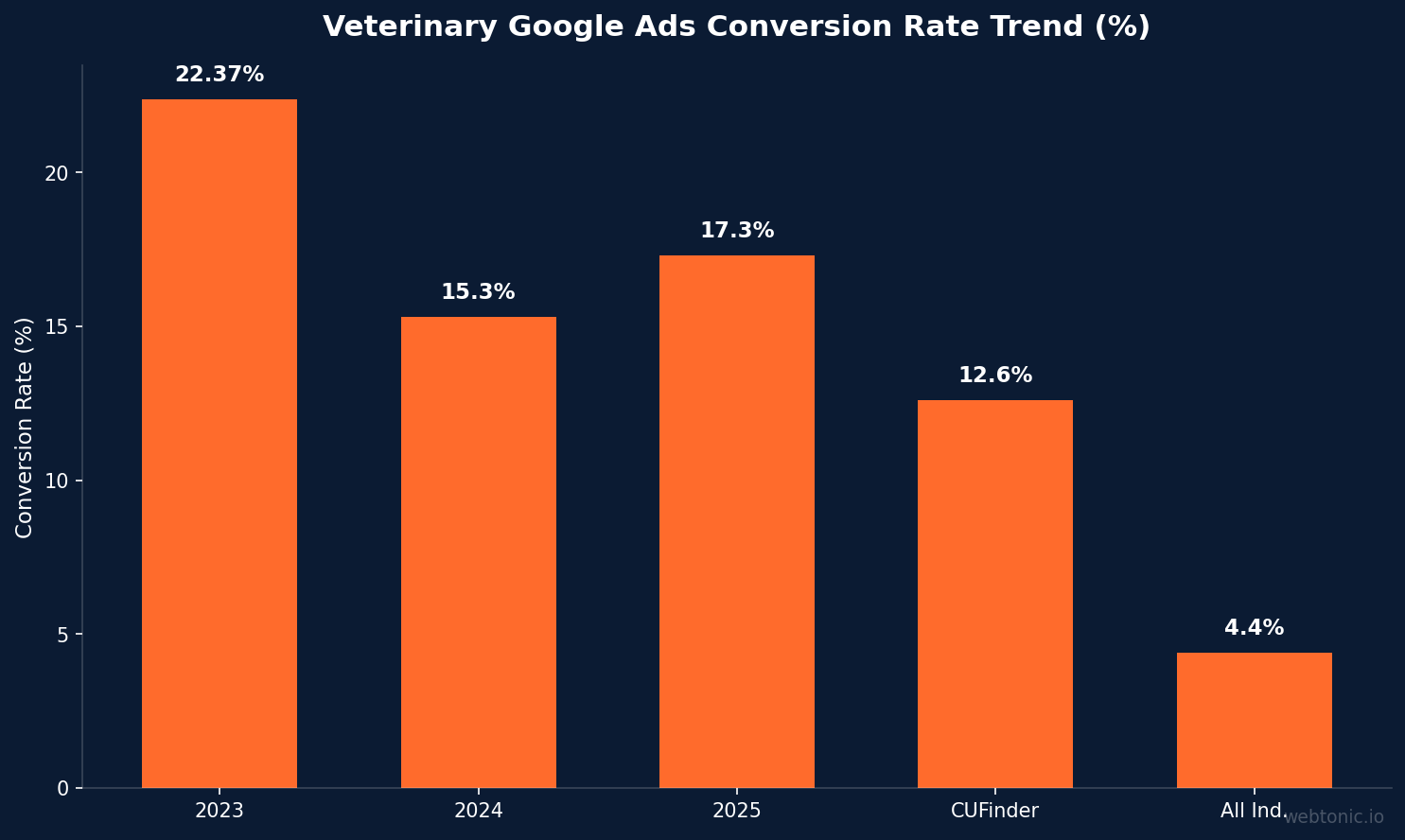
Google Ads remains the highest-intent digital channel for veterinary practices, capturing pet owners at the exact moment they search for care. With veterinary Google Ads converting at 12.6%–17.3% — among the highest conversion rates in local services — understanding how to benchmark and optimize your clinic's PPC campaigns against real industry data is essential for maximizing your marketing ROI in 2026.
Key Takeaways
- Average CPC for veterinary Google Ads ranges from $1.35 to $7, depending on keyword intent and competition level.
- Veterinary Google Ads conversion rates average 12.6%–17.3%, far above the all-industry average of 4.4%.
- Cost per acquisition (CPA) ranges from $4.43 to $56.11, with well-optimized accounts achieving under $10.
- Emergency veterinary keywords carry CPCs 3× higher than routine care search terms.
- One mobile vet clinic saw a 122% increase in phone calls within 3 months of Google Ads optimization.
- Click-to-call rate on mobile veterinary ads is 18.3%, nearly double the service-industry average.
- Search ads CTR for veterinary averages 2.7%–4.85%, with top performers exceeding 8%.
- The U.S. veterinary services market reached $38.3 billion in 2026, growing at 5.2% annually.
Veterinary Google Ads Performance Benchmarks
| Metric | 2023 | 2024 | 2025 | Direction |
|---|---|---|---|---|
| CPC | $0.99 | $1.35 | $1.63 | ↑ Rising |
| CTR | 8.21% | 1.70% | 2.70% | ↑ Rebounding |
| CVR | 22.37% | 15.30% | 17.30% | ↑ Stabilizing |
| CPA | $4.43 | $8.82 | $9.40 | ↑ Rising |
| Spend | $14,538 | $38,734 | $47,971 | ↑ Growing |
| Conv Value / Cost | 0% | 34.94% | 125% | ↑ Strong |
Source: MDMPPC — Veterinary & Pet Google Ads Benchmarks 2023–2025, based on real account data
The 2025 data from MDMPPC shows conversion value exceeding cost by 125% — a significant improvement from 2024's 35% return. This indicates that veterinary PPC campaigns are maturing as practices improve their tracking, landing pages, and bid strategies. For clinics looking to benchmark their own Google Ads performance, these year-over-year trends provide essential context.
Cost Per Click by Keyword Category and Service Type
Veterinary Google Ads CPC varies dramatically by keyword intent. Emergency keywords like "emergency vet near me" command CPCs of $5–$7, while routine care terms like "pet vaccinations" stay in the $1.50–$3.00 range. Understanding this cost structure is critical for budget allocation.
| Keyword Category | Avg. CPC Range | Avg. CVR | Cost Per Booking |
|---|---|---|---|
| Emergency Vet | $5.00–$7.00 | 15%–18% | $28–$47 |
| New Patient / General | $2.00–$4.50 | 10%–15% | $13–$45 |
| Dental / Specialty | $2.50–$5.00 | 8%–12% | $21–$63 |
| Vaccines / Wellness | $1.50–$3.00 | 12%–17% | $9–$25 |
| Brand / Name Search | $0.50–$1.50 | 25%–40% | $1–$6 |
| Top Performers (Blended) | $1.50–$3.00 | 14%+ | $10–$22 |
Sources: RYN Digital (60+ vet accounts), CUFinder

Real Campaign Results: Veterinary Google Ads Case Studies
Benchmarks tell one side of the story — real campaign results tell the rest. Here are documented outcomes from veterinary Google Ads campaigns:
Furry Friends Mobile Vet (NJ) partnered with Wingman Planning and saw a 122% increase in appointment calls within 3 months. The campaign delivered 2,351 clicks with an 8.1% increase in click volume, focusing on service-intent keywords for in-home veterinary care across Ocean and Monmouth Counties.
Ethos Veterinary Health ran an AI-optimized campaign that produced a 267% increase in phone leads, 289% more appointments, and a 26% reduction in CPA. The system processed 8,600 automated optimizations to refine audience targeting and bid adjustments across their multi-location practice network.
These results align with broader benchmarks from Google Ads strategy best practices, where service-intent keyword clustering and dedicated landing pages consistently outperform generic campaign structures.
Performance by Google Ads Network
Veterinary campaigns perform differently across Google's ad networks. Search campaigns deliver the highest conversion rates due to intent-driven queries, while Display and Performance Max campaigns extend reach at lower CPCs but require stronger creative assets.
| Network | Avg. CPC | Avg. CTR | Avg. CVR | Best For |
|---|---|---|---|---|
| Search | $1.63–$3.45 | 2.7%–4.85% | 12.6%–17.3% | High-intent appointment booking |
| Display | $0.30–$0.78 | 0.46%–0.78% | 1.2%–3.0% | Awareness, retargeting |
| Performance Max | $0.80–$2.00 | 1.5%–3.0% | 8%–14% | Multi-channel reach |
| Local Services Ads | Pay-per-lead | N/A | 15%–25% | Verified local clinics |
Sources: MDMPPC, CUFinder, Stethon
Budget Allocation and Optimization Best Practices
- Start with $1,500–$3,000/month for search-only — veterinary Google Ads benchmarks show top-performing accounts spend $48K+ annually; a $1,500 floor ensures sufficient data for Smart Bidding to optimize.
- Allocate 35%–40% of digital budget to Google Ads — this mirrors the industry-standard split where PPC captures high-intent searches that social cannot.
- Build service-intent keyword clusters — separate ad groups for new patient, dental, vaccines, urgent care, and specialty services prevent budget cannibalization.
- Use click-to-call extensions on every mobile ad — with 18.3% click-to-call rates on mobile veterinary ads, phone leads often convert at higher rates than form fills.
- Monitor Quality Score landing page experience — poor landing pages increase CPC and reduce ad rank; dedicated service-specific pages reduce cost per click by 15%–30%.
- Track offline conversions — connect your practice management software to Google Ads for accurate appointment-to-revenue attribution.
- Review search terms weekly — veterinary campaigns attract irrelevant traffic from pet store, pet food, and veterinary school searches without proper negative keywords.
The U.S. Veterinary Market: Scale and Digital Opportunity
The U.S. veterinary services market reached $38.3 billion in 2026, growing at 5.2% annually, according to IBISWorld. With approximately 34,000 veterinary practices and 121,000 licensed veterinarians serving 90.5 million pet-owning households, the competitive landscape for Google Ads is intensifying. Average annual revenue for a single-veterinarian practice is $1.4 million, meaning even modest Google Ads investments can deliver meaningful patient acquisition returns.
Total U.S. pet industry spending hit $158 billion in 2025, with veterinary care representing $35.9 billion of that total. Pet owners spend an average of $410 per dog and $283 per cat annually on veterinary services. This lifetime patient value — often spanning 10–15 years per pet — makes the $9.40 average CPA on Google Ads extremely attractive relative to the revenue each new patient generates over their pet's lifespan.
The shift toward digital discovery is accelerating: 72.4% of veterinary website traffic now comes from mobile devices, and searches for "vet near me" have grown consistently year over year. For practices not yet running Google Ads, this represents both a competitive threat and an acquisition opportunity — especially as corporate veterinary consolidators (Mars, NVA, VCA) invest heavily in paid search to capture local market share.
Quality Score and Landing Page Impact on Veterinary Google Ads
Google Ads performance for veterinary clinics depends heavily on Quality Score — the metric that determines ad rank and actual CPC. Landing page experience is the most underinvested Quality Score component for veterinary practices, with the average veterinary website scoring just 55/100 on PageSpeed and averaging a 9.31-second Largest Contentful Paint.
Veterinary clinics with dedicated landing pages for each service category see Quality Scores of 7–9, compared to 3–5 for practices sending all traffic to a generic homepage. This Quality Score gap translates directly to CPC savings: a Quality Score of 8 can reduce effective CPC by 30%–50% compared to a score of 4 on the same keyword.
Key landing page factors that impact veterinary Quality Score include:
- Page load speed — sites loading in under 2.5 seconds see measurably higher Quality Scores and lower bounce rates
- Service-keyword alignment — the landing page headline and H1 must match the ad group's primary keyword intent
- Mobile responsiveness — with 72.4% mobile traffic, non-responsive pages receive a direct Quality Score penalty
- Conversion action clarity — prominent click-to-call buttons, online booking widgets, and clear forms improve the "landing page experience" signal
- Above-fold trust signals — Google Reviews badges, AAHA accreditation logos, and veterinarian credentials reduce bounce rate
Practices that invest in professional landing page optimization alongside their Google Ads management consistently outperform those running ads to unoptimized websites. The compound effect of higher Quality Scores, lower CPCs, and better conversion rates can reduce overall cost per appointment by 40%–60%.
Negative Keyword Strategy for Veterinary Google Ads
Veterinary Google Ads campaigns are particularly vulnerable to irrelevant traffic without proper negative keyword management. Common waste triggers include "veterinary school," "vet tech salary," "pet store near me," and "animal shelter adoption" — all high-volume searches that can consume budget without generating patient bookings.
Well-managed veterinary accounts maintain negative keyword lists of 200–500 terms, reviewed and updated weekly. The most effective approach uses tiered negatives: account-level negatives for universal exclusions (schools, jobs, DIY), campaign-level negatives for service-specific filtering, and ad-group-level negatives for granular query sculpting.
Search term analysis from veterinary accounts reveals that 15%–25% of initial click spend goes to irrelevant queries before negative keywords are properly configured. For a practice spending $3,000 per month, that represents $450–$750 in wasted spend that could instead fund 50–80 additional qualified clicks. Weekly search term reviews during the first 90 days of a campaign — then bi-weekly thereafter — are essential to capture new irrelevant query patterns as they emerge.
Veterinary Google Ads vs. Other Local Service Industries
When compared to other local service industries competing for Google Ads traffic, veterinary clinics benefit from moderate CPCs with above-average conversion rates, creating one of the most favorable ROI profiles in local search advertising.
| Industry | Avg. CPC | Avg. CVR | Avg. CPA | Typical Monthly Spend |
|---|---|---|---|---|
| Veterinary / Pet | $1.63 | 17.3% | $9.40 | $1,500–$5,000 |
| Dental | $6.69 | 5.2% | $65.00 | $3,000–$10,000 |
| HVAC | $7.50 | 6.8% | $52.00 | $2,000–$8,000 |
| Plumbing | $8.20 | 7.5% | $48.00 | $2,000–$7,000 |
| Personal Injury Law | $75.00 | 3.5% | $350.00 | $10,000–$50,000 |
Sources: RYN Digital, MDMPPC
Veterinary CPA of $9.40 is 85% lower than dental ($65) and 82% lower than HVAC ($52), making it one of the most cost-efficient local service categories in Google Ads. Combined with the high lifetime value of veterinary patients (10+ years of recurring visits), the ROI case for veterinary Google Ads is compelling even at modest budget levels.
Frequently Asked Questions
How much do Google Ads cost for veterinary clinics?
Veterinary Google Ads CPC ranges from $1.35 to $7 per click, with a blended average of $1.63 in 2025. Top-performing accounts spend $2–$3 per click on average. Emergency vet keywords command premium CPCs of $5–$7, while wellness and vaccine keywords average $1.50–$3.00. Total monthly budgets for effective campaigns typically range from $1,500 to $5,000.
What is a good conversion rate for veterinary Google Ads?
The veterinary industry averages 12.6%–17.3% conversion rate on Google Ads search campaigns. This is 3–4× higher than the all-industry average of 4.4%. Top-performing accounts with optimized landing pages and service-specific ad groups achieve conversion rates above 20%.
Are Google Ads better than Facebook Ads for veterinary clinics?
Google Ads capture higher-intent traffic (pet owners actively searching for care), while Facebook Ads excel at awareness and retargeting. Google Ads conversion rates (12.6%–17.3%) significantly exceed Facebook (3.27%), but Facebook CPC ($0.61–$0.96) is far lower than Google ($1.35–$7). Most successful veterinary practices use both channels together, allocating 35%–40% of budget to Google and 25%–30% to Facebook.
How long does it take for veterinary Google Ads to show results?
Most veterinary clinics see meaningful data within 2–4 weeks and optimized performance within 60–90 days. The Furry Friends Mobile Vet case study demonstrated a 122% increase in calls within 3 months. Smart Bidding strategies require at least 30 conversions per month to optimize effectively.
What keywords should veterinary clinics target in Google Ads?
Priority keywords include "vet near me," "emergency vet [city]," "pet vaccinations [city]," and specific service terms like "dog dental cleaning." Brand keywords (your clinic name) should run in a separate campaign at low CPCs ($0.50–$1.50) with 25%–40% conversion rates. Negative keywords for "veterinary school," "vet tech jobs," and "pet store" are essential for waste prevention.
Sources
mdmppc.com
ryndigital.com
cufinder.io
stethondigitalmarketing.com
wingmanplanning.com
cool.co
schedulingkit.com
americanpetproducts.org


